Buyer Journey Touchpoints: The 2026 B2B Mapping Guide
Map every buyer journey touchpoint across awareness, consideration, and decision — and learn which ones actually move B2B deals forward in 2026.
TL;DR
- A buyer journey touchpoint is any moment a prospect interacts with your brand — an ad, a review, a sales email, a demo — across awareness, consideration, and decision stages.
- B2B buyers now hit 20–30+ touchpoints before a purchase, and most happen before they ever talk to sales.
- Map touchpoints by stage and channel first, then score each one for influence so you stop over-investing in noise.
- Accurate contact data is the connective tissue: if you can't reach the right person at the right account, your touchpoints never fire.
- Tools like a reliable email finder keep outbound touchpoints landing in real inboxes instead of bouncing.
What are buyer journey touchpoints?#
A buyer journey touchpoint is any single interaction between a potential customer and your company on the path to a purchase. Think of it like a relay race: no single runner wins the race, but every handoff either keeps momentum or drops the baton. A LinkedIn ad, a G2 review, a cold email, a pricing page visit, a sales demo, a customer reference call — each is a touchpoint, and the deal is won across the whole sequence, not at one finish line.
In B2B, this matters more than in consumer sales because the purchase is committee-driven, expensive, and slow. The average buying group now includes 6–10 stakeholders, and Gartner's research shows B2B buyers spend only about 17% of their total purchase time actually meeting with potential suppliers — and far less with any single vendor. The rest is independent research across touchpoints you don't control.
So the job is no longer "run a great demo." The job is to map, influence, and measure the full constellation of touchpoints — including the dozens that happen before a rep is ever invited into the conversation.
What are the stages of the B2B buyer journey?#
Most teams use a three-stage model, sometimes expanded to five. Each stage answers a different buyer question, and each demands different touchpoints.
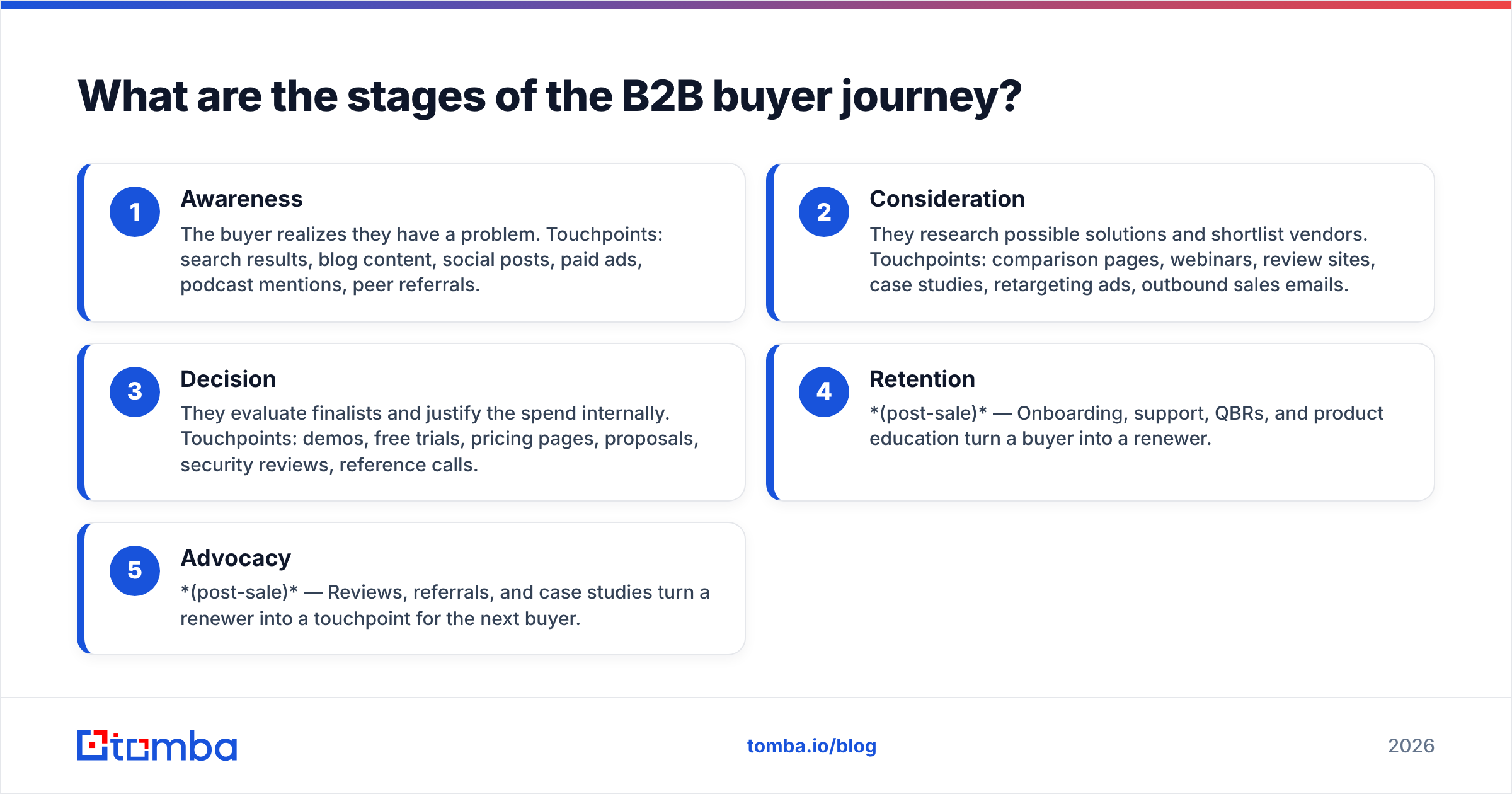
- Awareness — The buyer realizes they have a problem. Touchpoints: search results, blog content, social posts, paid ads, podcast mentions, peer referrals.
- Consideration — They research possible solutions and shortlist vendors. Touchpoints: comparison pages, webinars, review sites, case studies, retargeting ads, outbound sales emails.
- Decision — They evaluate finalists and justify the spend internally. Touchpoints: demos, free trials, pricing pages, proposals, security reviews, reference calls.
- Retention (post-sale) — Onboarding, support, QBRs, and product education turn a buyer into a renewer.
- Advocacy (post-sale) — Reviews, referrals, and case studies turn a renewer into a touchpoint for the next buyer.
The trap is treating these as a clean funnel. Real buyers loop backward, skip stages, and add new stakeholders who restart their own awareness phase. Your touchpoint map has to assume non-linear movement.
How many touchpoints does a B2B sale actually take?#
Short answer: a lot more than reps assume. Depending on deal size and industry, B2B purchases commonly require 20 to 30+ touchpoints before close, and complex enterprise deals can exceed 50 across the full buying committee.
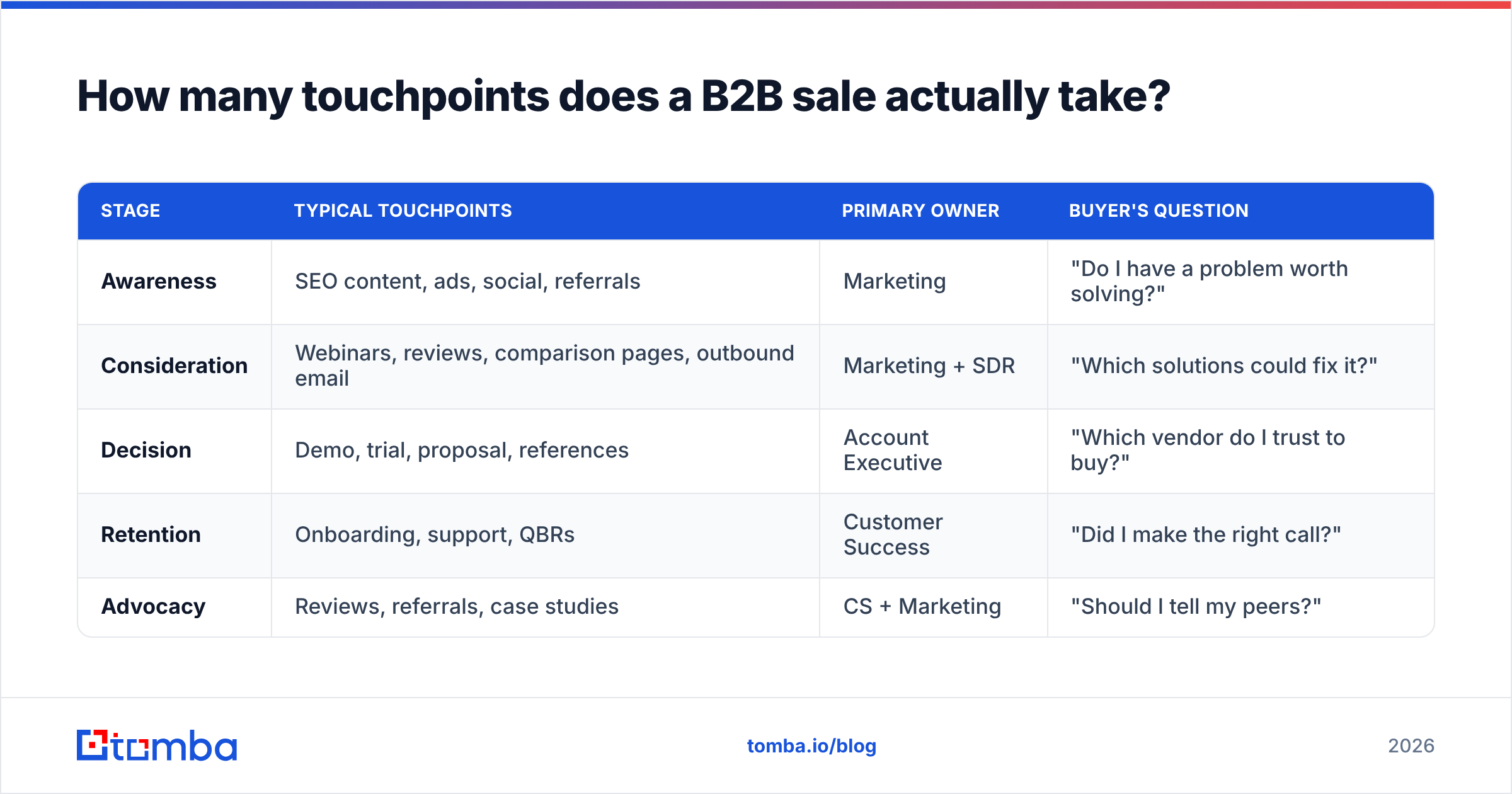
Here's how those touchpoints typically distribute by stage and who owns them:
| Stage | Typical touchpoints | Primary owner | Buyer's question |
|---|---|---|---|
| Awareness | SEO content, ads, social, referrals | Marketing | "Do I have a problem worth solving?" |
| Consideration | Webinars, reviews, comparison pages, outbound email | Marketing + SDR | "Which solutions could fix it?" |
| Decision | Demo, trial, proposal, references | Account Executive | "Which vendor do I trust to buy?" |
| Retention | Onboarding, support, QBRs | Customer Success | "Did I make the right call?" |
| Advocacy | Reviews, referrals, case studies | CS + Marketing | "Should I tell my peers?" |
Two things jump out. First, the early stages are dominated by self-serve, marketing-owned touchpoints — by the time a rep engages, the buyer is often 50–70% through their decision. Second, the highest-trust touchpoints (reviews, references, peer referrals) aren't fully controlled by you, which is exactly why they convert.
What's the difference between a touchpoint and a channel?#
A channel is the pipe; a touchpoint is the moment. Email is a channel — a specific cold email a VP opens on a Tuesday is a touchpoint. LinkedIn is a channel — a comment your AE leaves on a prospect's post is a touchpoint.
This distinction stops teams from confusing reach with influence. You can be present on six channels and still have weak touchpoints if none of them answer the buyer's question at that stage. Map touchpoints, then group them by channel — not the other way around. To go deeper on terminology, Tomba's B2B glossary breaks down related concepts like MQLs and response rate that feed touchpoint scoring.
How do you map buyer journey touchpoints?#
Mapping is a four-step exercise you can run in a spreadsheet before you ever buy software.
- Step 1 — List every known interaction. Pull from your CRM, marketing automation, web analytics, and rep notes. Don't filter yet; capture the unglamorous ones (a contract redline email is a touchpoint too).
- Step 2 — Tag each touchpoint by stage and owner. Assign awareness/consideration/decision and the team responsible. Gaps appear instantly — most B2B teams find their consideration stage is thin.
- Step 3 — Map the sequence and dependencies. Which touchpoints reliably precede a stage advance? A demo rarely happens without a prior pricing-page visit plus an SDR conversation.
- Step 4 — Note the data each touchpoint requires. Outbound email needs a verified address; an ABM ad needs firmographics; a reference call needs an enriched contact record. This is where data quality becomes a touchpoint enabler, not an afterthought.
Once mapped, overlay your actual conversion data. You'll usually discover a handful of "load-bearing" touchpoints doing most of the work and a long tail of activity that feels busy but moves nothing.
Which touchpoints actually influence the deal?#
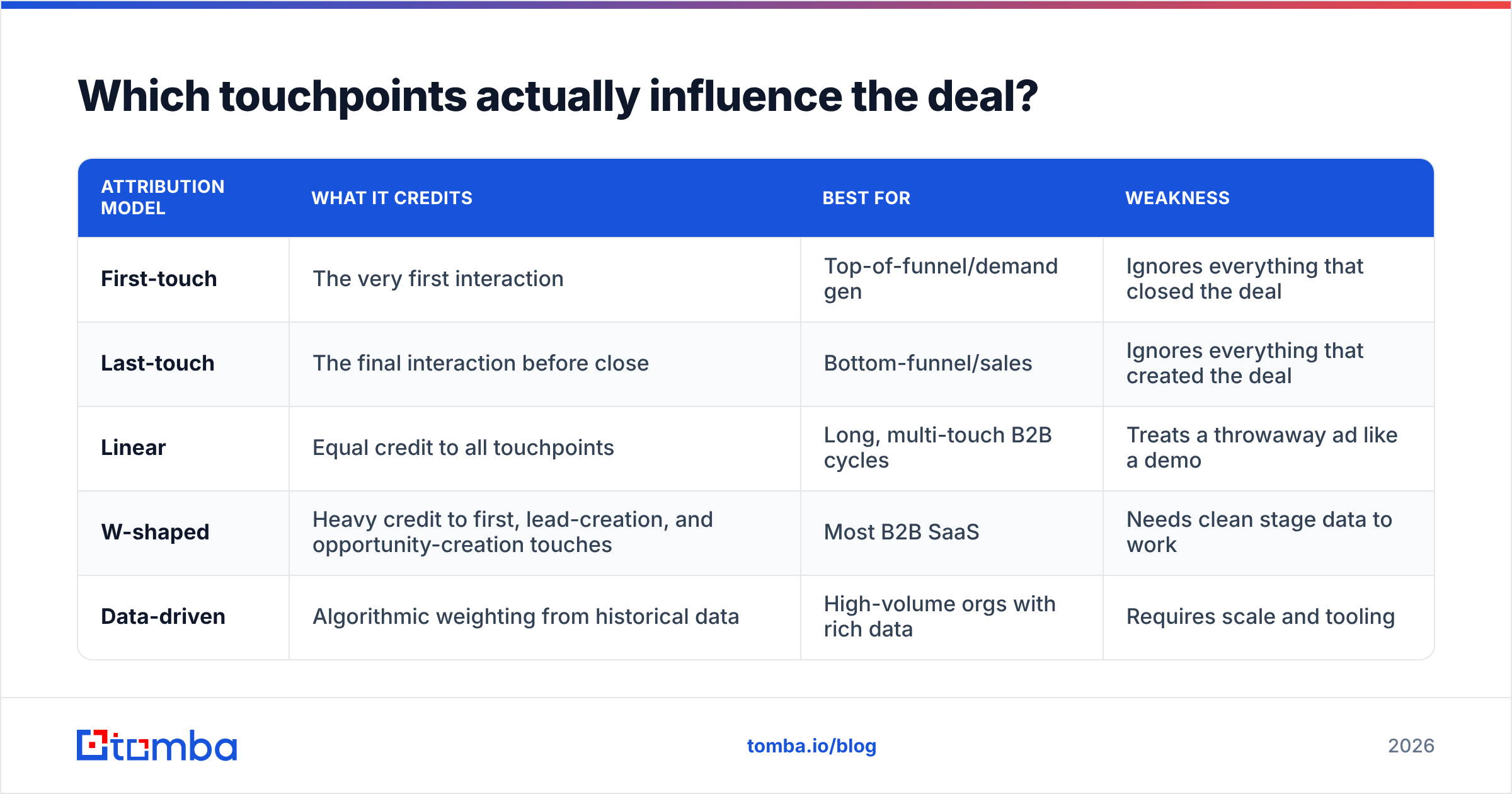
Not all touchpoints are equal, so attribution matters. Here's a practical comparison of common attribution lenses you can apply to your touchpoint map.
| Attribution model | What it credits | Best for | Weakness |
|---|---|---|---|
| First-touch | The very first interaction | Top-of-funnel/demand gen | Ignores everything that closed the deal |
| Last-touch | The final interaction before close | Bottom-funnel/sales | Ignores everything that created the deal |
| Linear | Equal credit to all touchpoints | Long, multi-touch B2B cycles | Treats a throwaway ad like a demo |
| W-shaped | Heavy credit to first, lead-creation, and opportunity-creation touches | Most B2B SaaS | Needs clean stage data to work |
| Data-driven | Algorithmic weighting from historical data | High-volume orgs with rich data | Requires scale and tooling |
For most B2B teams in 2026, a W-shaped model is the pragmatic default: it rewards the touchpoints that create awareness, convert a lead, and create an opportunity, without pretending every touch is equal. Whatever model you pick, the prerequisite is the same — clean, deduplicated, accurately attributed contact and account data. Garbage touchpoint data produces confident, wrong conclusions.
Why does contact data quality make or break touchpoints?#
Because a touchpoint that never reaches the buyer isn't a touchpoint — it's a bounce. You can design the perfect seven-touch sequence, but if 30% of your email addresses are stale or guessed, a third of your sequence silently fails and drags your sender reputation down with it.
This is the unglamorous backbone of touchpoint strategy. Every outbound, ABM, and nurture touchpoint depends on three data fundamentals:
- Reach — Do you have a current, deliverable email and phone number for the right stakeholder? Use an email verifier before any send to strip dead addresses.
- Relevance — Is the record enriched enough to personalize the touchpoint to their role and company? Data enrichment fills the firmographic gaps that make a message land.
- Coverage — Can you reach the full buying committee, not just your one champion? Buying groups of 6–10 mean single-threaded touchpoints lose.
When buyers protect their attention more every year, deliverability and accuracy aren't a back-office concern — they're the difference between a sequence that books meetings and one that quietly burns your domain. Independent review sites like G2 are full of teams who scaled outbound on bad data and watched reply rates collapse.
How do you reduce touchpoint friction without cutting touches?#
The goal isn't fewer touchpoints — it's fewer wasted ones. Three moves consistently help:
- Consolidate redundant touches. If marketing nurture and SDR outbound both hit the same contact in the same week with different messages, you're creating friction, not coverage. Align sequences on a shared timeline.
- Sequence for the stage, not the calendar. A decision-stage buyer doesn't need another awareness blog; they need a reference and a tight proposal. Trigger touchpoints off behavior, not arbitrary day-3/day-5 cadences.
- Fix the data layer once. Most "our outreach isn't working" problems trace back to bad inputs. Verifying and enriching at the point of entry means every downstream touchpoint inherits clean data.
For teams running outbound at scale, vendor documentation from CRM leaders like HubSpot and Salesforce covers how to wire stage triggers into sequences — but the data feeding those triggers still has to be right.
What does a healthy touchpoint mix look like in 2026?#
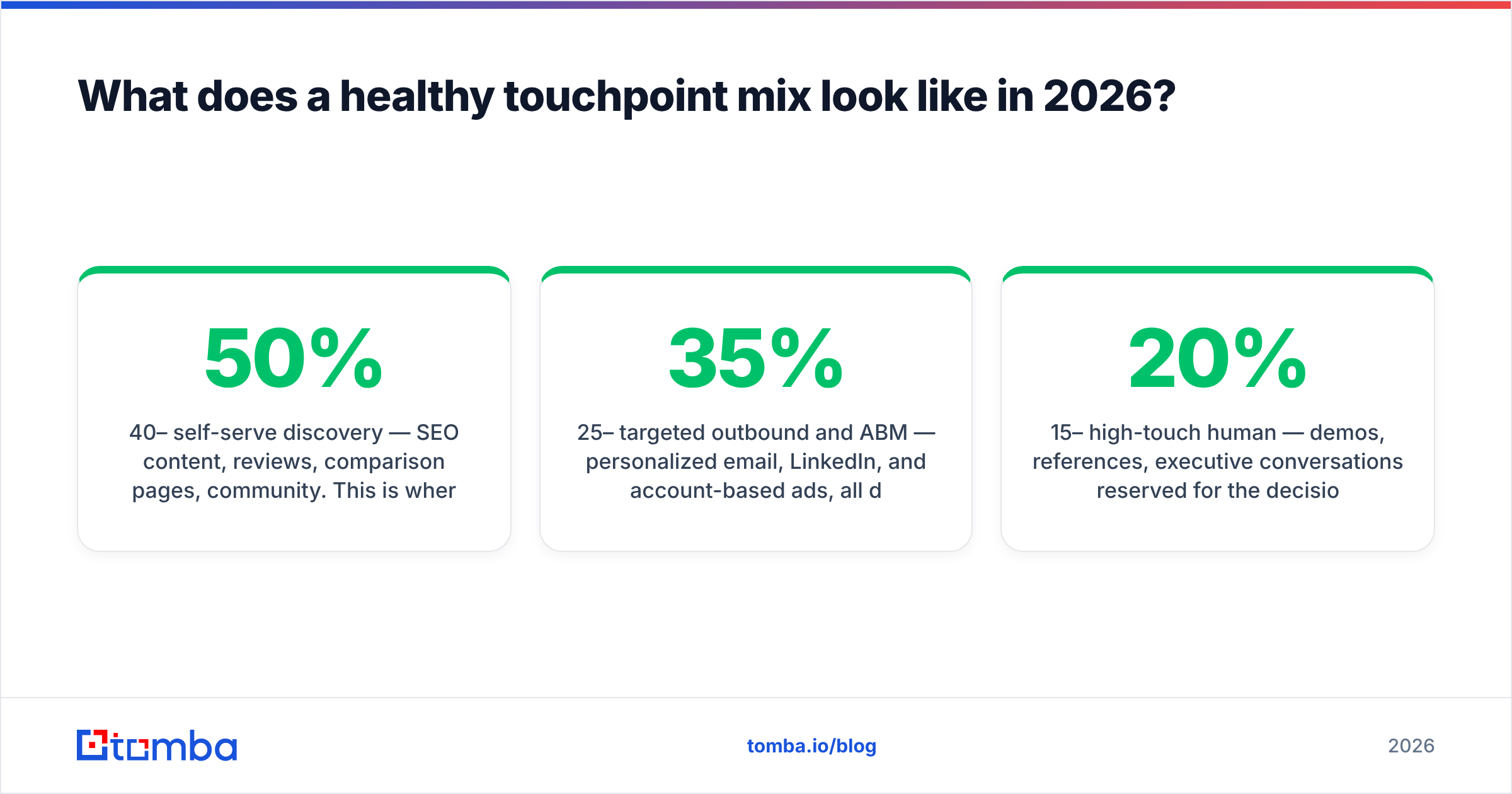
A balanced B2B program in 2026 leans on buyer-led, high-trust touchpoints early and high-context, human touchpoints late. Practically:
- 40–50% self-serve discovery — SEO content, reviews, comparison pages, community. This is where modern buyers want to live.
- 25–35% targeted outbound and ABM — personalized email, LinkedIn, and account-based ads, all dependent on accurate targeting data.
- 15–20% high-touch human — demos, references, executive conversations reserved for the decision stage.
- The rest, retention and advocacy — the post-sale touchpoints that compound into your next deal's awareness stage.
The exact ratios depend on deal size and segment, but the principle holds: respect that buyers self-educate, then make your human touchpoints count when invited. And underpin all of it with data accurate enough that no touchpoint is wasted on the wrong person.
Map your touchpoints, then make every outbound one land#
Touchpoint mapping is only as good as your ability to actually reach the people in the map. The fastest way to turn a clean touchpoint plan into booked meetings is to make sure every outbound email reaches a real, verified inbox — at the right person, at the right account, across the full buying committee.
That's exactly what the Tomba Email Finder is built for: find professional email addresses by domain, name, or company, verify them before you send, and enrich the record so each touchpoint is personalized and deliverable. Start free with 25 searches a month, and see the full Tomba pricing when you're ready to scale your outbound touchpoints from a handful of accounts to your entire target market. Build the map — then make every touch count.
// get started
Find, verify and enrich your first contacts today
Start on the free plan with 25 searches a month, then scale when your team is ready.
Free plan · No credit card required · GDPR & CCPA
// about the author