Buyer Leads in 2026: How to Find, Score, and Close Them
Buyer leads are prospects showing real purchase intent — not random contacts. Here's how to source, score, and convert them in 2026.
TL;DR
- Buyer leads are contacts showing measurable purchase intent — budget, authority, need, or active research — not just any name on a list.
- The difference between a buyer lead and a cold contact is intent signal plus accurate contact data. Miss either and your pipeline stalls.
- A repeatable buyer-lead engine has four parts: identify intent, find the right person, verify the contact, and score before outreach.
- Tools matter less than process, but accurate data is the non-negotiable foundation — bad emails sink even great targeting.
- You can build a buyer-lead workflow in 2026 with intent data, website visitor reveal, and a reliable email finder feeding your CRM.
What are buyer leads?#
A buyer lead is a prospect who has shown a concrete signal that they intend to purchase — think of it like the difference between everyone walking past a car dealership and the person who just asked for a test drive. Both are technically "traffic," but only one is worth a salesperson's hour.
Technically, a buyer lead combines two things: an intent signal (they downloaded a pricing sheet, requested a demo, visited your product page three times, or hired for a role your product supports) and deliverable contact data (a verified email or phone number for the actual decision-maker). Remove the intent and you have a cold contact. Remove the data and you have an unreachable opportunity.
Most teams confuse buyer leads with raw lead lists. A purchased list of 10,000 "CFOs in fintech" is not 10,000 buyer leads — it's 10,000 contacts, most of whom have no need, no timing, and no awareness of you. Buyer leads are a subset defined by behavior, not job title.
How do buyer leads differ from cold leads and MQLs?#
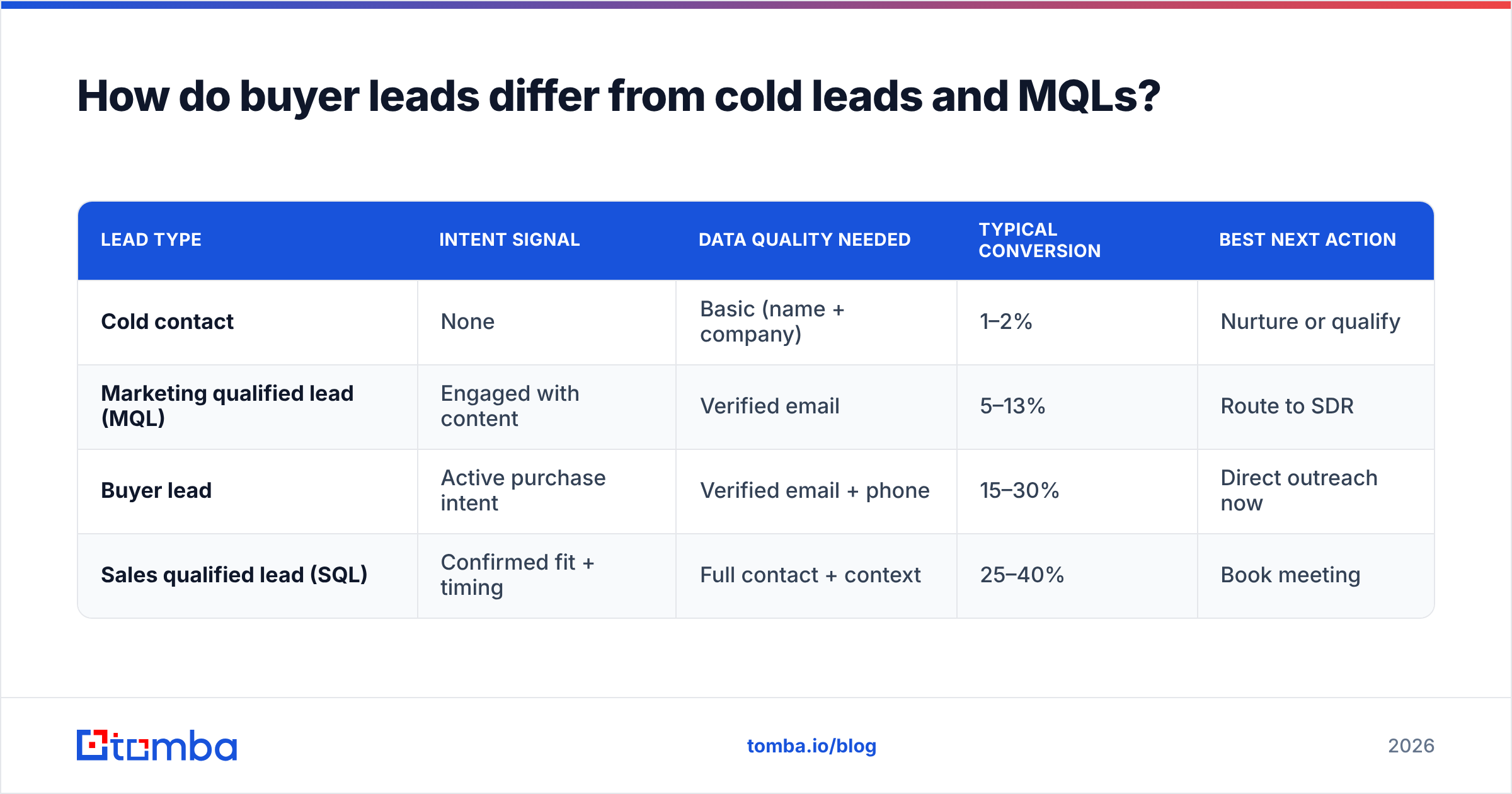
The terms get muddled, so here's a concrete breakdown of where buyer leads sit relative to the labels you already use.
| Lead type | Intent signal | Data quality needed | Typical conversion | Best next action |
|---|---|---|---|---|
| Cold contact | None | Basic (name + company) | 1–2% | Nurture or qualify |
| Marketing qualified lead (MQL) | Engaged with content | Verified email | 5–13% | Route to SDR |
| Buyer lead | Active purchase intent | Verified email + phone | 15–30% | Direct outreach now |
| Sales qualified lead (SQL) | Confirmed fit + timing | Full contact + context | 25–40% | Book meeting |
The jump from MQL to buyer lead is where revenue lives. A marketing qualified lead has raised a hand; a buyer lead has reached for a wallet. Treating them the same — same cadence, same templates, same priority — is the most common reason good leads go cold. Buyer leads decay fast. Intent that's three weeks old is barely intent at all.

What signals identify a buyer lead?#
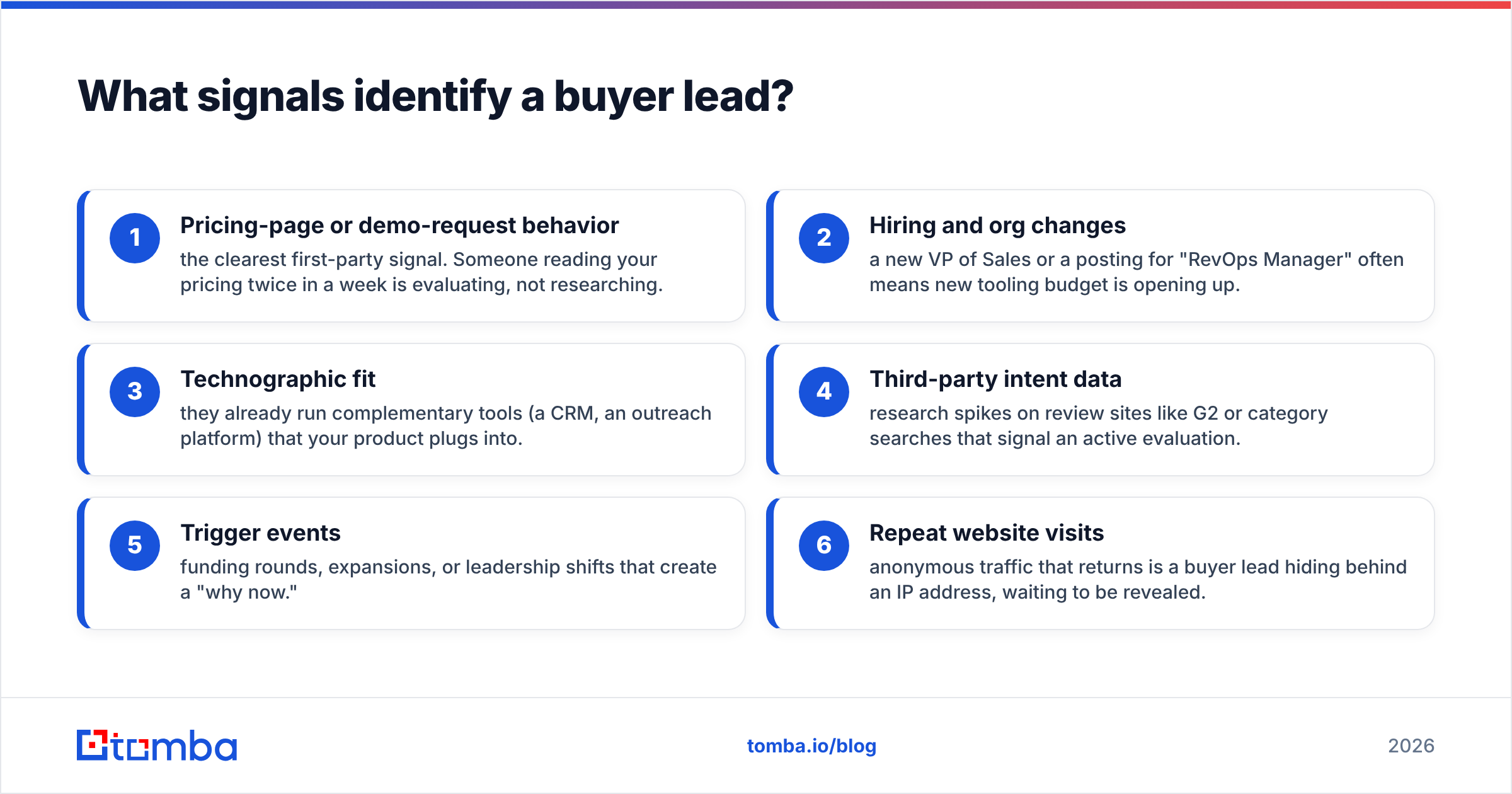
Use this checklist to separate buyers from browsers. You don't need every signal — two or three strong ones is usually enough to justify direct outreach.
- Pricing-page or demo-request behavior — the clearest first-party signal. Someone reading your pricing twice in a week is evaluating, not researching.
- Hiring and org changes — a new VP of Sales or a posting for "RevOps Manager" often means new tooling budget is opening up.
- Technographic fit — they already run complementary tools (a CRM, an outreach platform) that your product plugs into.
- Third-party intent data — research spikes on review sites like G2 or category searches that signal an active evaluation.
- Trigger events — funding rounds, expansions, or leadership shifts that create a "why now."
- Repeat website visits — anonymous traffic that returns is a buyer lead hiding behind an IP address, waiting to be revealed.
That last point is underused. Most of your highest-intent traffic never fills out a form. Pairing website visitor reveal with intent scoring turns anonymous sessions into named, reachable buyer leads — which is exactly the gap between knowing demand exists and being able to act on it.
How do you source buyer leads in 2026?#
The sourcing engine has four stages, and each one feeds the next. Skip a stage and the leads downstream get weaker.
Stage 1 — Capture intent. Combine first-party signals (forms, product usage, page visits) with third-party intent data. Your goal is a ranked list of accounts that are in-market right now, not a static ICP list.
Stage 2 — Find the right person. An in-market account is not a buyer lead until you have a name. Use domain search to map the buying committee at a target company, then narrow to the decision-maker and one or two influencers. Targeting the whole org wastes credits; targeting one wrong contact wastes the opportunity.
Stage 3 — Get verified contact data. This is where most pipelines quietly break. A name without a deliverable email is a dead end. Run every contact through an email verifier before it touches a sequence — bounces don't just waste sends, they damage your sender reputation and suppress deliverability for the leads that are good.
Stage 4 — Enrich and score. Layer firmographic and technographic context onto each lead so reps walk into outreach with a reason to call. Data enrichment fills the gaps — company size, tech stack, role seniority — that turn a name into a qualified buyer lead.

How should you score buyer leads before outreach?#
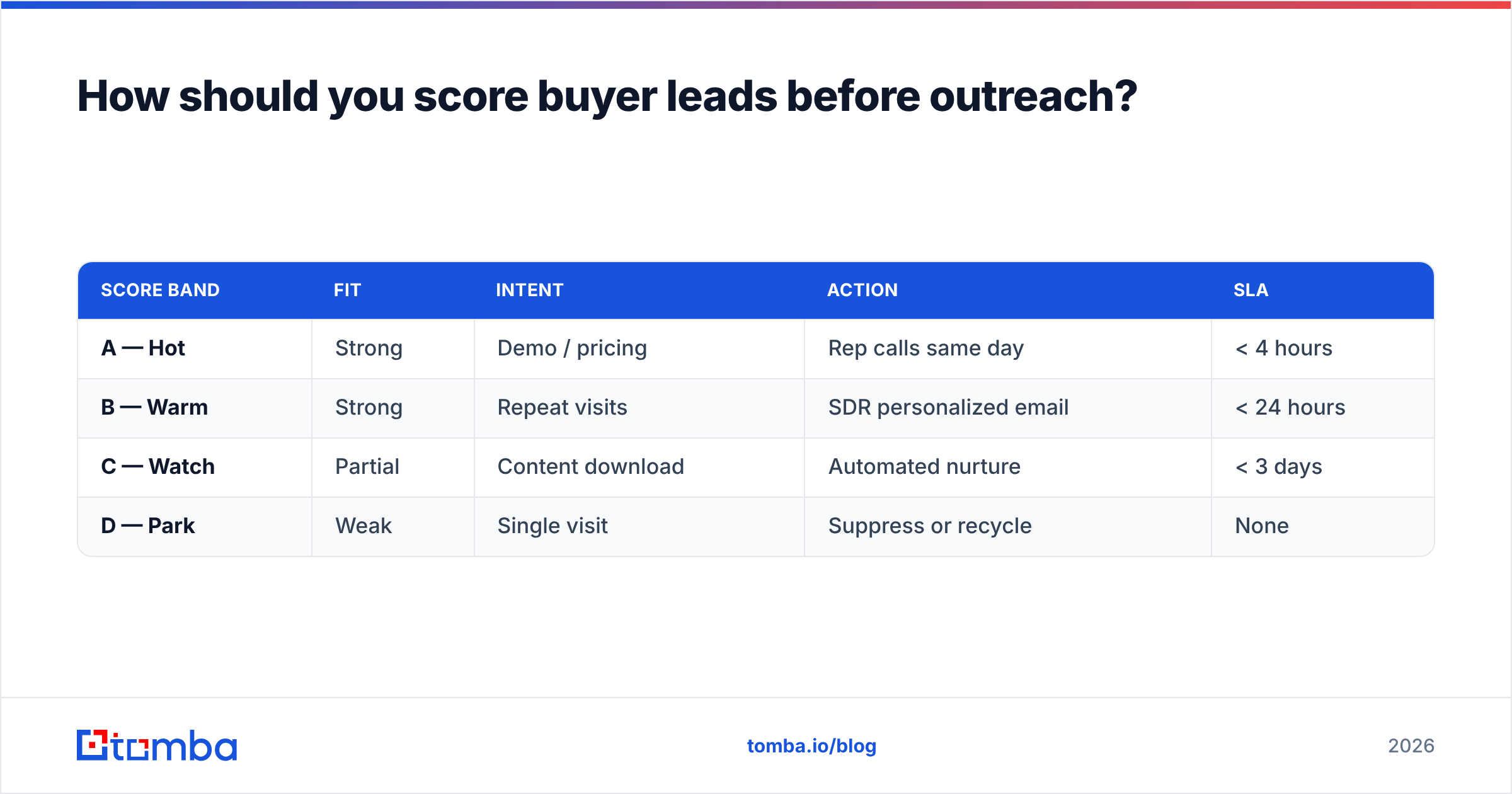
Score on two axes: fit (do they match your ICP?) and intent (how hot is the signal?). A simple model beats a complicated one nobody trusts.
| Score band | Fit | Intent | Action | SLA |
|---|---|---|---|---|
| A — Hot | Strong | Demo / pricing | Rep calls same day | < 4 hours |
| B — Warm | Strong | Repeat visits | SDR personalized email | < 24 hours |
| C — Watch | Partial | Content download | Automated nurture | < 3 days |
| D — Park | Weak | Single visit | Suppress or recycle | None |
The discipline that matters most is the SLA on A-band leads. Research from sales-acceleration studies — and echoed by vendors like HubSpot — consistently shows that response speed to high-intent leads is one of the largest controllable factors in win rate. A hot buyer lead contacted in four hours converts far better than the same lead contacted in four days, because intent windows close.
Keep the model boring and consistent. The value isn't precision to the decimal — it's that every rep treats an A-lead the same way, every time.
What's the real cost of bad data on buyer leads?#
Bad contact data doesn't just lose individual deals — it compounds. Think of it like a leaky bucket: every invalid email you send erodes your domain reputation, which lowers inbox placement for the good leads, which lowers reply rates across the board.
Here's the chain reaction most teams underestimate:
- A 20% bounce rate flags your domain to mailbox providers, throttling all future sends.
- Reps burn hours chasing contacts who left the company two roles ago.
- Your CRM fills with junk, making lead scoring unreliable because the inputs are wrong.
- Forecasts skew because "pipeline" includes leads that were never reachable.
This is why verification isn't a nice-to-have step at the end — it's a gate every buyer lead passes through before it's allowed into a sequence. Maintaining clean sender reputation is cheaper than rebuilding it after a deliverability collapse.
Which tools build a buyer-lead engine?#
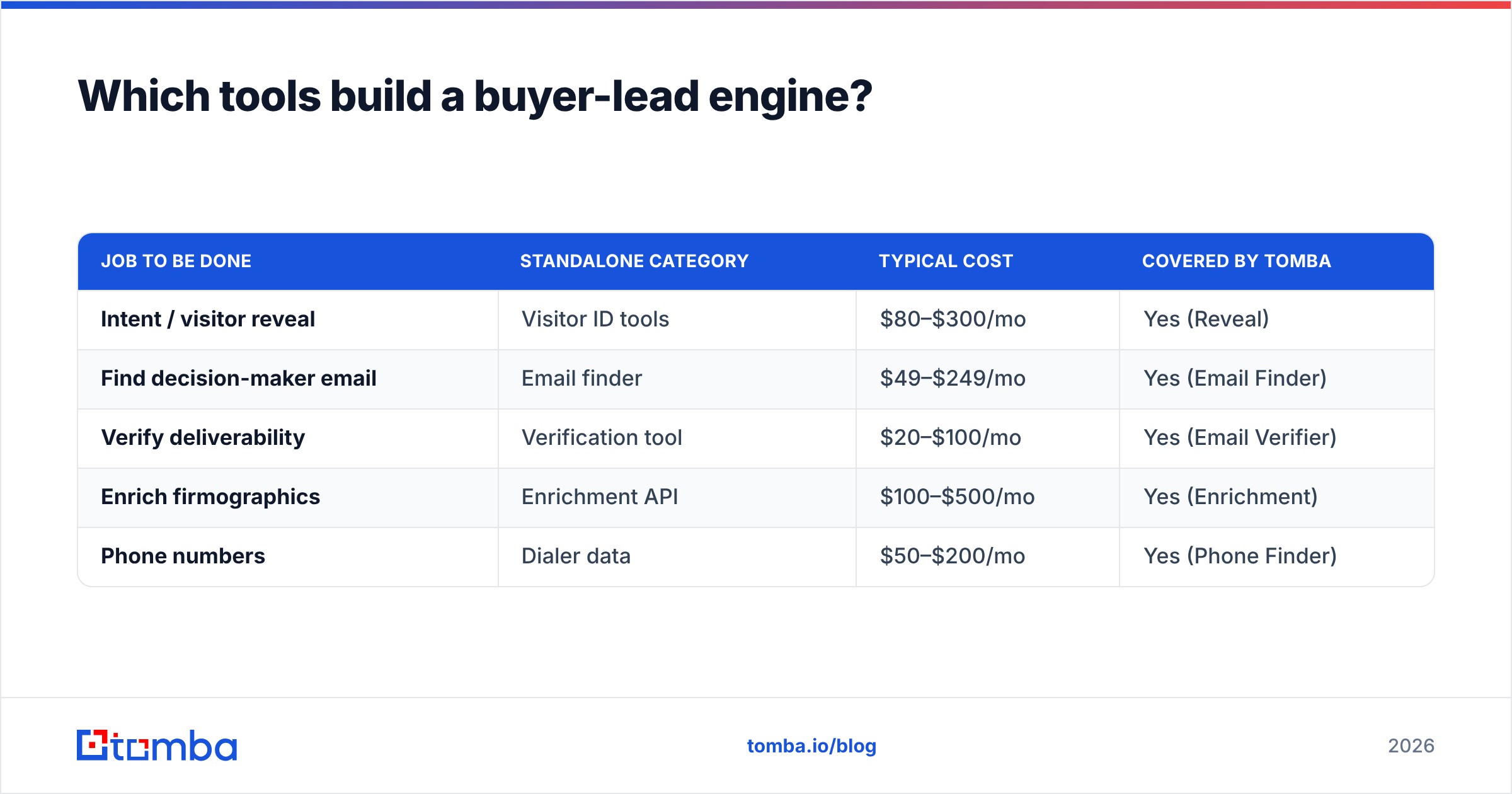
You don't need a 12-tool stack. You need coverage across four jobs: intent, contact discovery, verification, and CRM routing. Here's how the categories compare and where a single platform can collapse several line items.
| Job to be done | Standalone category | Typical cost | Covered by Tomba |
|---|---|---|---|
| Intent / visitor reveal | Visitor ID tools | $80–$300/mo | Yes (Reveal) |
| Find decision-maker email | Email finder | $49–$249/mo | Yes (Email Finder) |
| Verify deliverability | Verification tool | $20–$100/mo | Yes (Email Verifier) |
| Enrich firmographics | Enrichment API | $100–$500/mo | Yes (Enrichment) |
| Phone numbers | Dialer data | $50–$200/mo | Yes (Phone Finder) |
Consolidating these jobs matters for more than budget. When your finder, verifier, and enrichment share one data source, your buyer leads stay consistent as they move from intent to outreach. When they come from five disconnected vendors, you spend your week reconciling mismatches instead of selling. For full plan breakdowns, the Tomba pricing page lays out the free tier (25 searches/month), Starter at $49/mo, Growth at $99/mo, and Pro at $249/mo.
How do you turn buyer leads into booked meetings?#
Sourcing is half the job. The conversion half comes down to speed, relevance, and persistence.
Lead with the signal. If a buyer lead just read your pricing page, reference the problem that page solves — not a generic "I'd love to connect." The signal is your opener.
Multi-thread early. Map two or three people on the buying committee with domain search and reach the champion and the economic buyer in parallel. Single-threaded deals stall when your one contact goes quiet.
Sequence across channels. Email plus phone plus LinkedIn outperforms any single channel. A verified email gets you in the inbox; a B2B phone number gets you the conversation that actually moves the deal.
Respect the decay curve. Buyer-lead intent has a half-life measured in days. Build your SLAs around hours for A-band leads, and recycle anything that goes cold back into nurture rather than letting it rot in a rep's queue.
The teams that win in 2026 aren't the ones with the biggest lists — they're the ones who react fastest to the smallest signals with the most accurate data.
Frequently asked questions#
What is the difference between a buyer lead and a sales lead? A sales lead is any contact handed to sales. A buyer lead is a sales lead with a demonstrated intent signal — it's a narrower, higher-converting subset.
How many buyer leads does a rep need per month? Fewer than you'd think. Twenty true A-band buyer leads with verified data and fast SLAs typically outperform 500 cold contacts, because conversion rates are an order of magnitude higher.
Can you buy buyer leads? You can buy lists, but lists aren't buyer leads — they lack the intent signal. Better to generate intent in-house and use a B2B database and finder to attach accurate contacts to the accounts already showing demand.
How do you keep buyer leads from going stale? Verify on capture, score on fit and intent, and enforce response SLAs. Re-verify any lead that's been sitting longer than 30 days before re-engaging.
Start building your buyer-lead pipeline#
Every buyer lead worth chasing starts with one thing you can't fake: an accurate way to reach the right person at the right moment. The Tomba Email Finder gives you verified, decision-maker emails by domain, name, or company — so the in-market accounts you've identified become reachable buyer leads instead of dead ends. Pair it with verification and enrichment, start free with 25 searches a month, and scale into the $49/mo Starter plan when your pipeline proves itself. Stop renting cold lists and start building an engine that turns intent into revenue.
// get started
Find, verify and enrich your first contacts today
Start on the free plan with 25 searches a month, then scale when your team is ready.
Free plan · No credit card required · GDPR & CCPA
// about the author