How to Build a Buyer Persona That Actually Converts in 2026
A buyer persona is only useful if it changes who you target and what you say. Here's how to build data-backed personas in 2026 — and skip the fiction.
A buyer persona is supposed to tell you who to sell to and how to talk to them. Most of them do neither. They sit in a slide deck, full of invented names like "Marketing Mary," and never touch a single outbound campaign.
This guide fixes that. You'll build a buyer persona from real signals — firmographics, behavior, and verified contact data — instead of a workshop full of guesses. The goal is a persona that changes your targeting list, your messaging, and your conversion rate.
TL;DR#
- A buyer persona is a research-based profile of the specific person who buys your product — their role, goals, pains, objections, and buying triggers.
- Personas built from assumptions waste budget; personas built from interviews + data improve targeting, copy, and win rates.
- Separate the buyer persona (the human) from the ICP (the company) — you need both, and they answer different questions.
- The fastest path to a usable persona: interview 5–10 closed-won customers, mine your CRM, then validate at scale with enrichment data.
- Keep personas alive. A persona you wrote in 2023 is describing a market that no longer exists in 2026.
What is a buyer persona?#
A buyer persona is a semi-fictional profile of your ideal individual buyer, built from real data about the people who actually purchase from you. Think of it like a casting brief for a film: before you write a single line of dialogue (your outreach), you decide exactly who is in the scene — their job, what they want, and what would make them walk out.
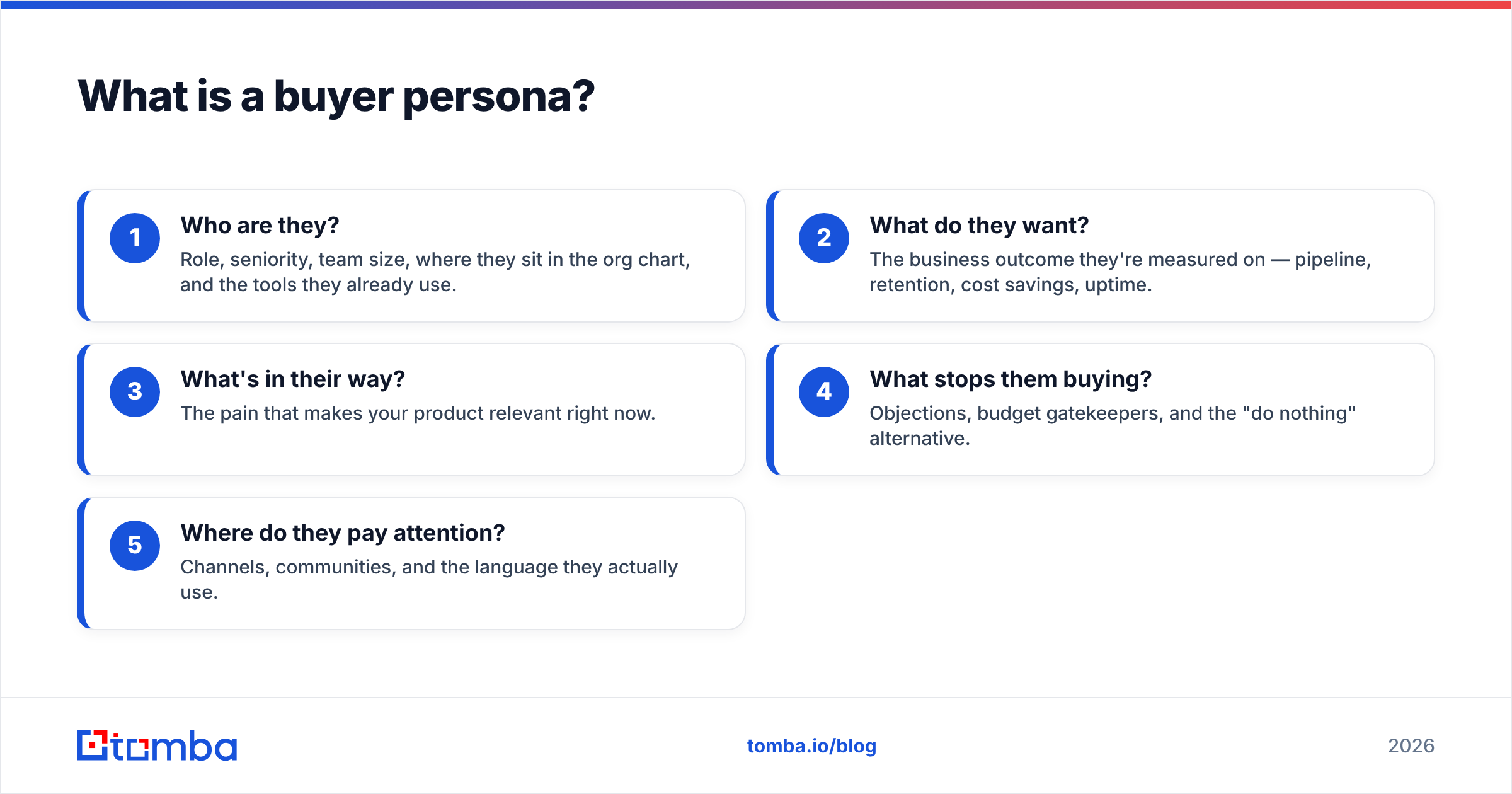
A complete buyer persona answers five questions:
- Who are they? Role, seniority, team size, where they sit in the org chart, and the tools they already use.
- What do they want? The business outcome they're measured on — pipeline, retention, cost savings, uptime.
- What's in their way? The pain that makes your product relevant right now.
- What stops them buying? Objections, budget gatekeepers, and the "do nothing" alternative.
- Where do they pay attention? Channels, communities, and the language they actually use.
Note what's missing: a stock photo, a cute alliterative name, and a fake commute story. Those decorate a persona; they don't make it useful.
Buyer persona vs ICP vs target market: what's the difference?#
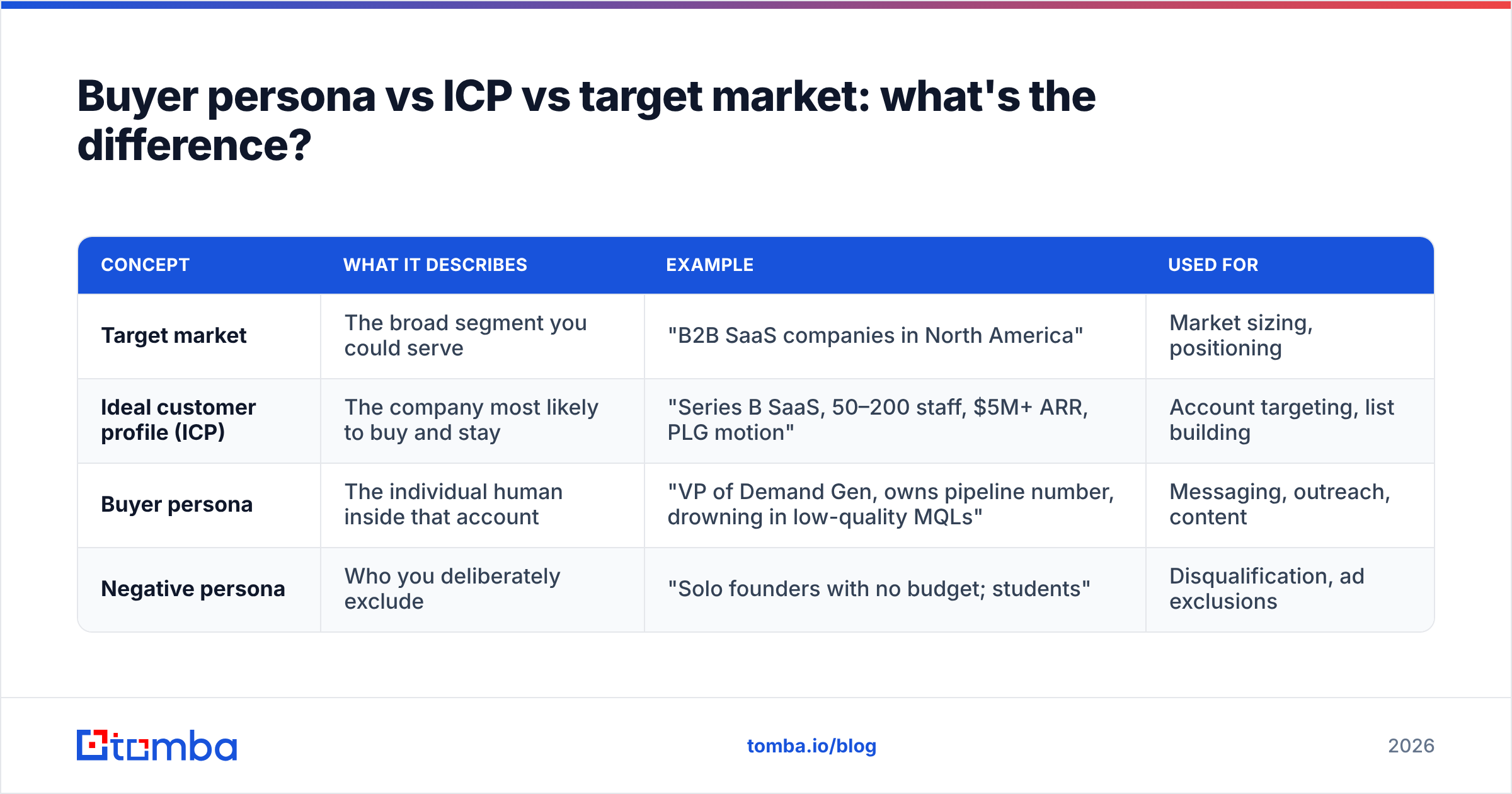
These three terms get used interchangeably, and that confusion is why so many campaigns miss. They operate at different altitudes.
| Concept | What it describes | Example | Used for |
|---|---|---|---|
| Target market | The broad segment you could serve | "B2B SaaS companies in North America" | Market sizing, positioning |
| Ideal customer profile (ICP) | The company most likely to buy and stay | "Series B SaaS, 50–200 staff, $5M+ ARR, PLG motion" | Account targeting, list building |
| Buyer persona | The individual human inside that account | "VP of Demand Gen, owns pipeline number, drowning in low-quality MQLs" | Messaging, outreach, content |
| Negative persona | Who you deliberately exclude | "Solo founders with no budget; students" | Disqualification, ad exclusions |
The short version: your ICP tells you which doors to knock on, and your buyer persona tells you what to say when someone opens it. If you only build one, build the persona that maps to a defined marketing qualified lead so sales and marketing are chasing the same human.
Why do most buyer personas fail?#
Most personas fail because they're written from imagination, not evidence. A team locks itself in a room, invents "IT Ian," assigns him a golden retriever and a fear of downtime, and ships it. Nobody ever checks whether real buyers behave that way.
Here are the failure patterns to avoid:
- Demographic theater. Age, hobbies, and a headshot feel like a persona but rarely change a sales decision. In B2B, role and trigger beat age every time.
- One-and-done. Markets shift. According to Gartner, B2B buying involves a growing group of stakeholders and increasingly digital, self-directed research — a static persona can't keep up.
- No disqualification. A persona that describes everyone describes no one. If it doesn't tell a rep when to walk away, it's a horoscope.
- Living in a doc, not a workflow. A persona that isn't wired into your list-building and copy is decoration.
Gartner research has long held that the typical B2B buying group includes six to ten decision-makers — which means a single persona almost never closes a deal on its own. You need a small set that maps the buying committee.
How do you build a data-backed buyer persona?#
Build it in four passes, moving from qualitative depth to quantitative scale. Conclusion first: interview real buyers, then validate the patterns against data so you know they generalize.
Step 1 — Mine your closed-won data#
Start with customers who already paid. Pull your last 20–50 closed-won deals from the CRM and look for what they share: industry, company size, the title of the economic buyer, the trigger that opened the deal, and time-to-close. This is the cheapest research you'll ever do because the data already exists.
Step 2 — Interview 5–10 real buyers#
Numbers tell you what; interviews tell you why. Talk to recent buyers and ask about the moment they decided to look for a solution, the alternatives they weighed, and what almost stopped the purchase. HubSpot's buyer persona research is a solid framework for the questions to ask. Record the exact phrases people use — that language becomes your subject lines.
Step 3 — Validate the pattern at scale#
A pattern from eight interviews is a hypothesis. Confirm it across your whole addressable market using firmographic and contact data. This is where data enrichment earns its keep: append company size, tech stack, role, and seniority to your existing list and check whether the "VP of Demand Gen at a 100-person SaaS" pattern actually repeats — or whether you've been selling to directors all along.
Step 4 — Document, then operationalize#
Write the persona on a single page (template below) and immediately wire it into a workflow: a saved search in your prospecting tool, an ad-exclusion list for negative personas, and a messaging brief for SDRs. A persona that doesn't generate a list isn't finished.

What goes in a buyer persona template?#
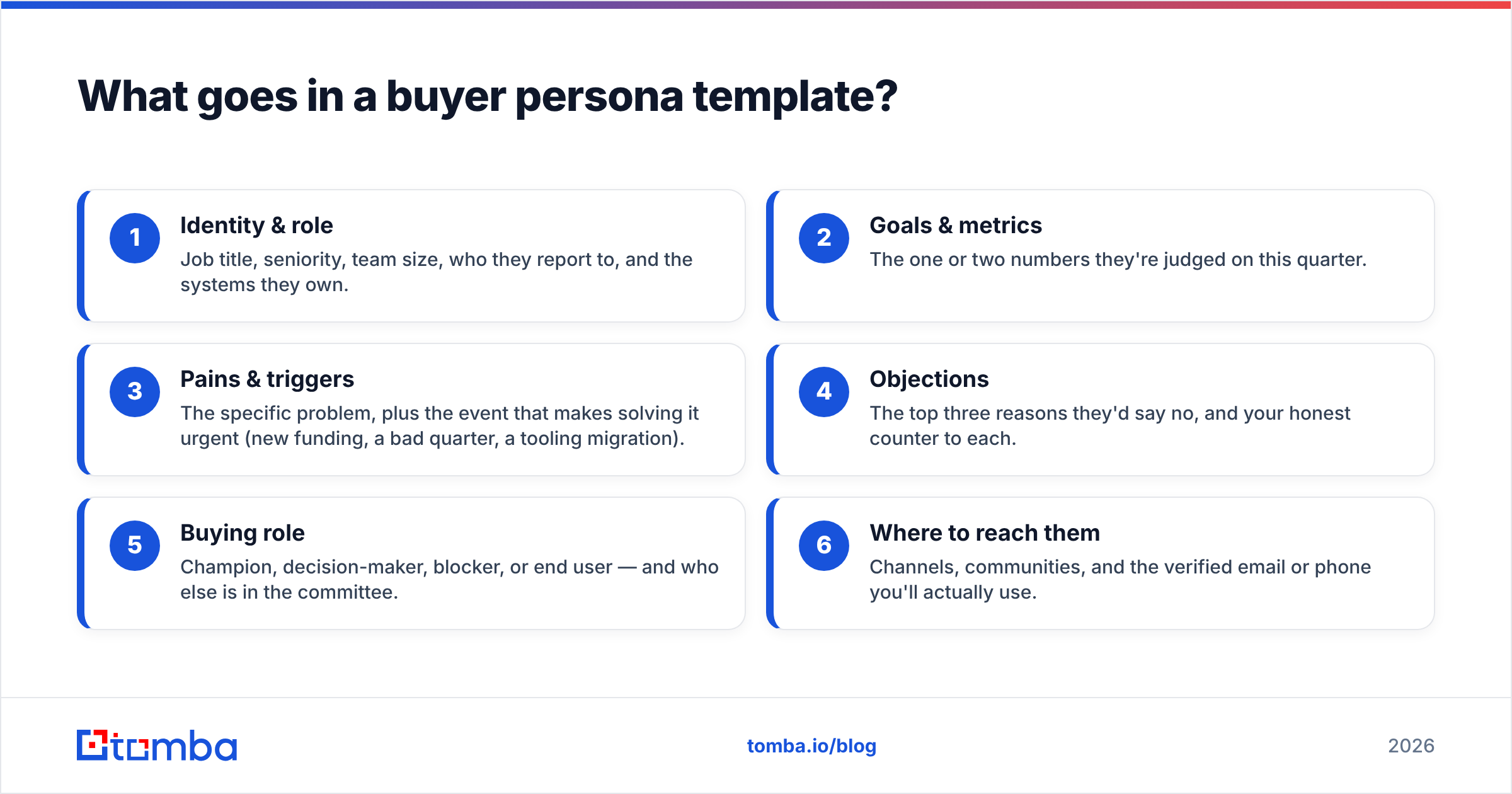
Keep it to one page. If it doesn't fit, you've added fiction. Use these six fields with bold leads so a rep can scan it in ten seconds:
- Identity & role — Job title, seniority, team size, who they report to, and the systems they own.
- Goals & metrics — The one or two numbers they're judged on this quarter.
- Pains & triggers — The specific problem, plus the event that makes solving it urgent (new funding, a bad quarter, a tooling migration).
- Objections — The top three reasons they'd say no, and your honest counter to each.
- Buying role — Champion, decision-maker, blocker, or end user — and who else is in the committee.
- Where to reach them — Channels, communities, and the verified email or phone you'll actually use.
That last field is where most personas quietly collapse. You can nail every psychographic detail, but if you can't reach the person, the persona is a creative-writing exercise. Pairing the profile with a reliable email finder and a clean B2B database turns "VP of Demand Gen at Acme" from a description into a deliverable contact.
How many buyer personas do you actually need?#
Fewer than you think. Most B2B companies need three to five personas, not fifteen. A useful rule: create a new persona only when the message has to change. If two roles respond to the same pitch, they're one persona. If the CFO needs a cost story and the practitioner needs a time-saving story, that's two.
Map your personas to the buying committee instead of to job titles. A typical mid-market deal has a champion who feels the pain, an economic buyer who controls budget, and a technical evaluator who can veto. Three personas, one deal — each needs its own angle, and all three need to be findable.
How do you keep buyer personas from going stale?#
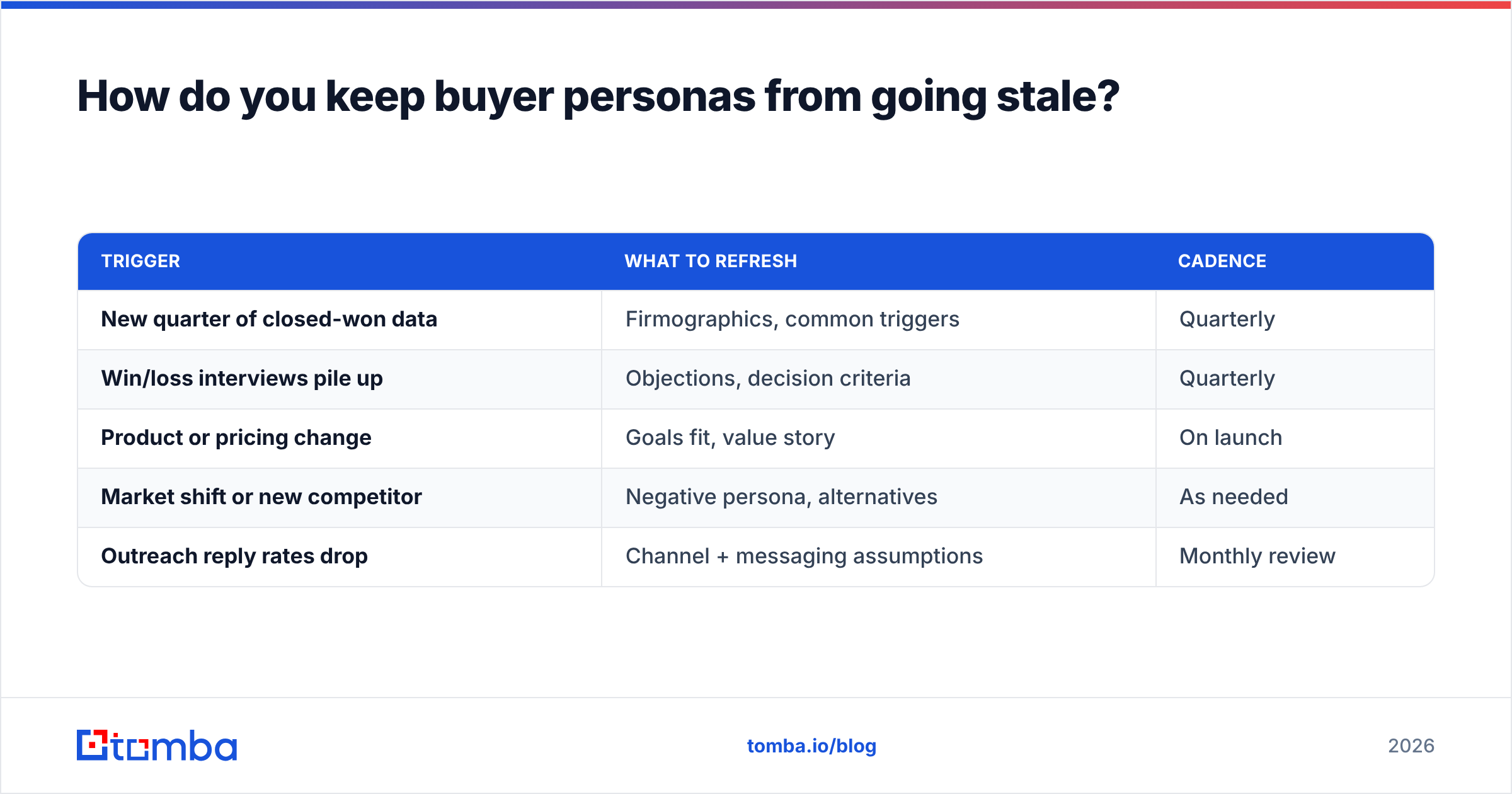
Treat personas like software, not stone tablets — they need a release cycle.
| Trigger | What to refresh | Cadence |
|---|---|---|
| New quarter of closed-won data | Firmographics, common triggers | Quarterly |
| Win/loss interviews pile up | Objections, decision criteria | Quarterly |
| Product or pricing change | Goals fit, value story | On launch |
| Market shift or new competitor | Negative persona, alternatives | As needed |
| Outreach reply rates drop | Channel + messaging assumptions | Monthly review |
A practical signal: when your response rate on a persona-targeted campaign drops two months running, the persona — not the copy — is usually the thing that aged out.
What tools do you need to operationalize a persona?#
You need three capabilities, and they map cleanly to the build-then-act workflow:
- Research & validation — your CRM plus enrichment to confirm patterns hold at scale.
- List building — a way to pull every company and contact that matches the persona, fast. A domain search turns a target-account list into named, role-filtered contacts.
- Reachability — verified emails and phones so your perfectly-targeted message actually lands. Garbage contact data quietly sabotages even a flawless persona.
The order matters. Build the persona first; let it define the filters. Then let the data tools execute against those filters. Reverse the order — buy a giant list and reverse-engineer a persona from it — and you'll just rationalize whatever you already bought.
For teams that want to see exactly where contact data originates, transparency about data sources is worth checking before you commit budget — accuracy claims mean little without a sourcing trail you can audit. You can review Tomba pricing to match a plan to your list volume, from the free tier up.
Common buyer persona mistakes (and quick fixes)#
- Writing fiction. Fix: every claim in the persona traces to an interview quote or a data point. No source, no line.
- Skipping the negative persona. Fix: write down exactly who to disqualify so reps stop wasting cycles.
- Confusing persona with ICP. Fix: keep two artifacts — company-level ICP, person-level persona.
- Not validating contact data. Fix: verify emails before a campaign so bounce rates don't torch your sender reputation. Cross-reference any third-party vendor's accuracy claims on a neutral review site like G2 before trusting them.
- Letting it rot. Fix: put a review date on the document and treat the date as a deadline.
Frequently asked questions#
Is a buyer persona the same as an ICP? No. An ICP describes the ideal company (size, industry, revenue), while a buyer persona describes the ideal person inside that company (role, goals, objections). You use the ICP to pick accounts and the persona to craft the message.
How much data do I need to build one? Start with 5–10 customer interviews and 20–50 closed-won records. That's enough to form a hypothesis. Then validate the pattern across your full list with enrichment data before you bet a campaign on it.
How often should I update a buyer persona? Review quarterly, and immediately after any product, pricing, or major market change. If outreach reply rates on a persona drop for two consecutive months, refresh it sooner.
Can I build a buyer persona without talking to customers? You can start from CRM and enrichment data, but you'll be missing the "why" behind the buying decision. Even three short interviews dramatically sharpen messaging.
Turn your persona into a pipeline#
A buyer persona is only as good as your ability to act on it. Once you know the exact role, company profile, and trigger you're targeting, the next step is finding those people — by name, with a verified email, at scale. That's exactly what the Tomba Email Finder is built for: feed it your persona's company domains and target roles, and get back deliverable, verified contacts you can put straight into outreach. Build the persona on data, then let the data go find your next customer. Start on the free tier and turn your sharpest persona into your next campaign.
// get started
Find, verify and enrich your first contacts today
Start on the free plan with 25 searches a month, then scale when your team is ready.
Free plan · No credit card required · GDPR & CCPA
// about the author