Buyer Persona Email Segmentation: The 2026 Playbook
Stop blasting one email to everyone. Learn how buyer persona email segmentation lifts replies, with a 2026 framework, comparison table, and the data you need to do it right.
You can write the most polished cold email in the world, but if the same copy lands in the inbox of a CFO, a junior developer, and a head of marketing, two of those three are deleting it. Buyer persona email segmentation is how you stop that from happening.
This guide breaks down how to group your contacts by who they actually are — their role, pain, and buying motivation — and then send email that speaks to each group directly. No fluff, just the framework, the data layer, and the trade-offs.
TL;DR#
- Buyer persona email segmentation means splitting your email list by who the recipient is (role, seniority, industry, pain point) so each group gets relevant copy instead of one generic blast.
- Persona-based campaigns consistently beat batch-and-blast on open rate, reply rate, and unsubscribe rate — segmentation is one of the highest-ROI changes you can make.
- You need three layers: clean contact data, defined personas, and mapped messaging. Skip any one and the whole thing falls apart.
- Start with 3–5 personas, not 15. Over-segmentation creates maintenance debt and thin lists you can't act on.
- Tools like Tomba supply the enrichment data (role, company, seniority) that makes segmentation possible in the first place.
What is buyer persona email segmentation?#
Buyer persona email segmentation is the practice of dividing your email audience into groups based on semi-fictional profiles of your ideal buyers, then tailoring email content, timing, and offers to each group.
Think of it like a tailor versus a discount rack. A discount rack sells one cut of suit to everyone who walks in — most leave empty-handed. A tailor measures each person and adjusts the fit. Same fabric, very different conversion rate. Persona segmentation is the tailoring step for your inbox.
A buyer persona is a research-based archetype: "Marketing Mary, VP of Demand Gen at a 200-person SaaS company, judged on pipeline, frustrated by attribution." A segment is the slice of your list that matches that persona. The two are not the same thing — a persona is the strategy, a segment is the executable list you actually send to.
The reason this matters in 2026 is simple: inbox providers and recipients both punish irrelevance. Generic sends drag down your sender reputation, and low engagement tells Gmail and Outlook to route you to spam. Relevant, segmented sends do the opposite.
Why does segmentation beat batch-and-blast?#
The short answer: relevance compounds. Every part of the funnel improves at once.
- Open rates rise because subject lines reference the reader's actual world.
- Reply rates rise because the body speaks to a pain the reader recognizes.
- Unsubscribes and spam complaints fall because fewer people feel spammed.
- Sales velocity improves because replies come from people who fit your ICP.
Marketing teams have reported segmented campaigns generating significantly more revenue than non-segmented ones, and major vendors like HubSpot have built entire product lines around list segmentation for exactly this reason. The mechanism isn't magic — it's that a message written for everyone is, functionally, a message written for no one.
There's also a deliverability dividend. When your engagement metrics improve, your email deliverability improves, which means even your future sends land better. Segmentation is one of the few tactics that pays you back twice.
What are the main ways to segment by persona?#
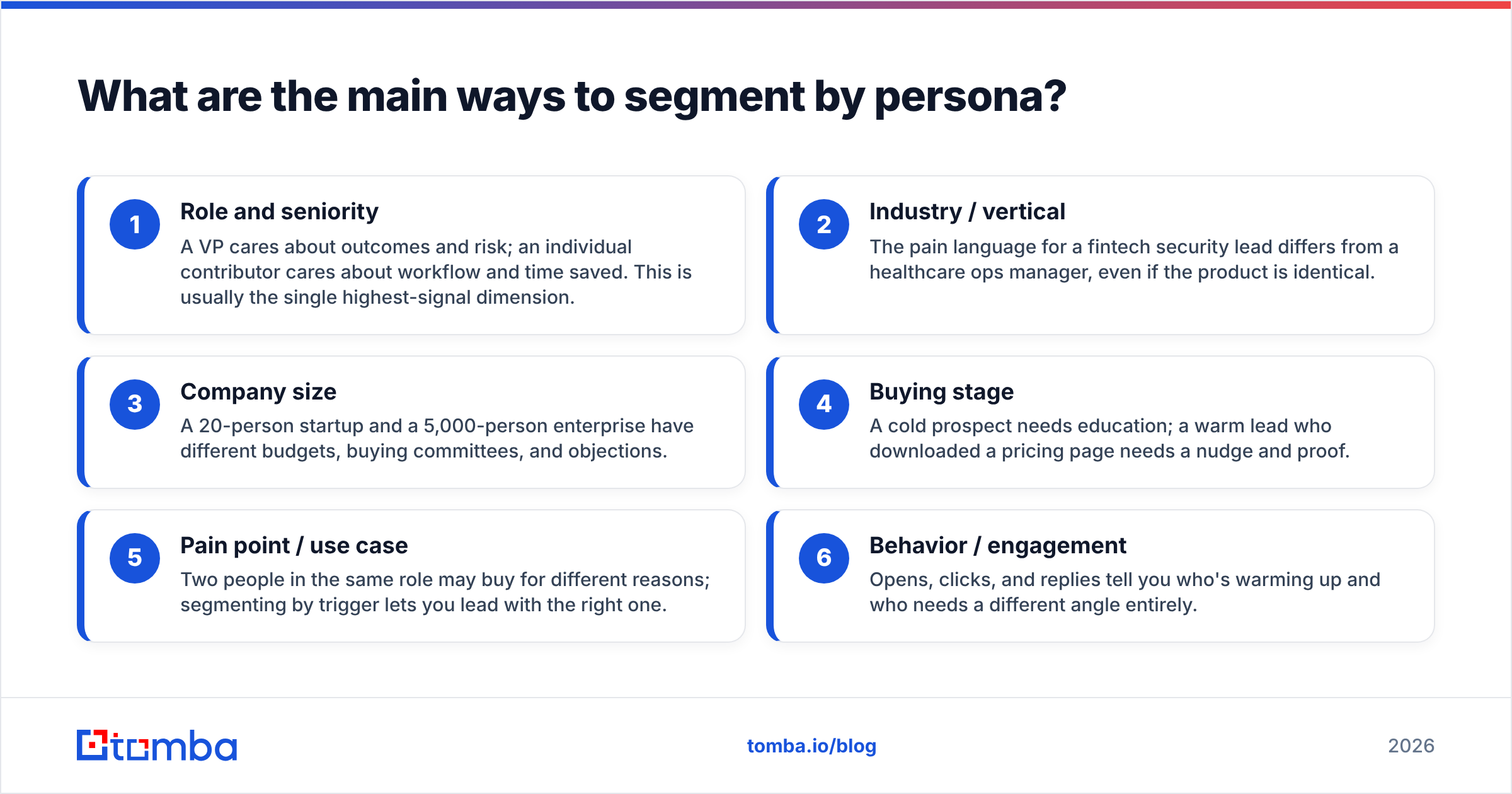
You can slice a list along many axes. The trick is picking the two or three that actually change what you'd write. Here are the segmentation dimensions that matter most for B2B persona work.
- Role and seniority — A VP cares about outcomes and risk; an individual contributor cares about workflow and time saved. This is usually the single highest-signal dimension.
- Industry / vertical — The pain language for a fintech security lead differs from a healthcare ops manager, even if the product is identical.
- Company size — A 20-person startup and a 5,000-person enterprise have different budgets, buying committees, and objections.
- Buying stage — A cold prospect needs education; a warm lead who downloaded a pricing page needs a nudge and proof.
- Pain point / use case — Two people in the same role may buy for different reasons; segmenting by trigger lets you lead with the right one.
- Behavior / engagement — Opens, clicks, and replies tell you who's warming up and who needs a different angle entirely.
You don't need all six. Most strong programs run on role + industry + buying stage and leave it there.
How do you build the data layer for segmentation?#
Conclusion first: segmentation is only as good as the data underneath it, so fix the data before you fix the copy.
You can't segment by seniority if you don't know anyone's title. You can't segment by company size if the firmographic field is empty. This is the part teams skip, and it's why so many "segmentation strategies" quietly collapse into a single fallback list.
A workable data layer needs three things:
- Verified contact addresses so your sends don't bounce and tank your reputation. Run new lists through an email verifier before the first send.
- Enrichment fields — title, department, seniority, company, headcount, industry — attached to every contact. This is where data enrichment earns its keep: it fills the columns your segmentation rules depend on.
- A single source of truth — usually your CRM — where these fields live and stay updated, so a contact who gets promoted moves to the right persona automatically.
When you're building lists from scratch, an email finder that returns role and company metadata alongside the address saves you a second enrichment pass. The goal is that every contact arrives already tagged with the attributes you'll segment on.

Persona segmentation vs. basic list segmentation: what's the difference?#
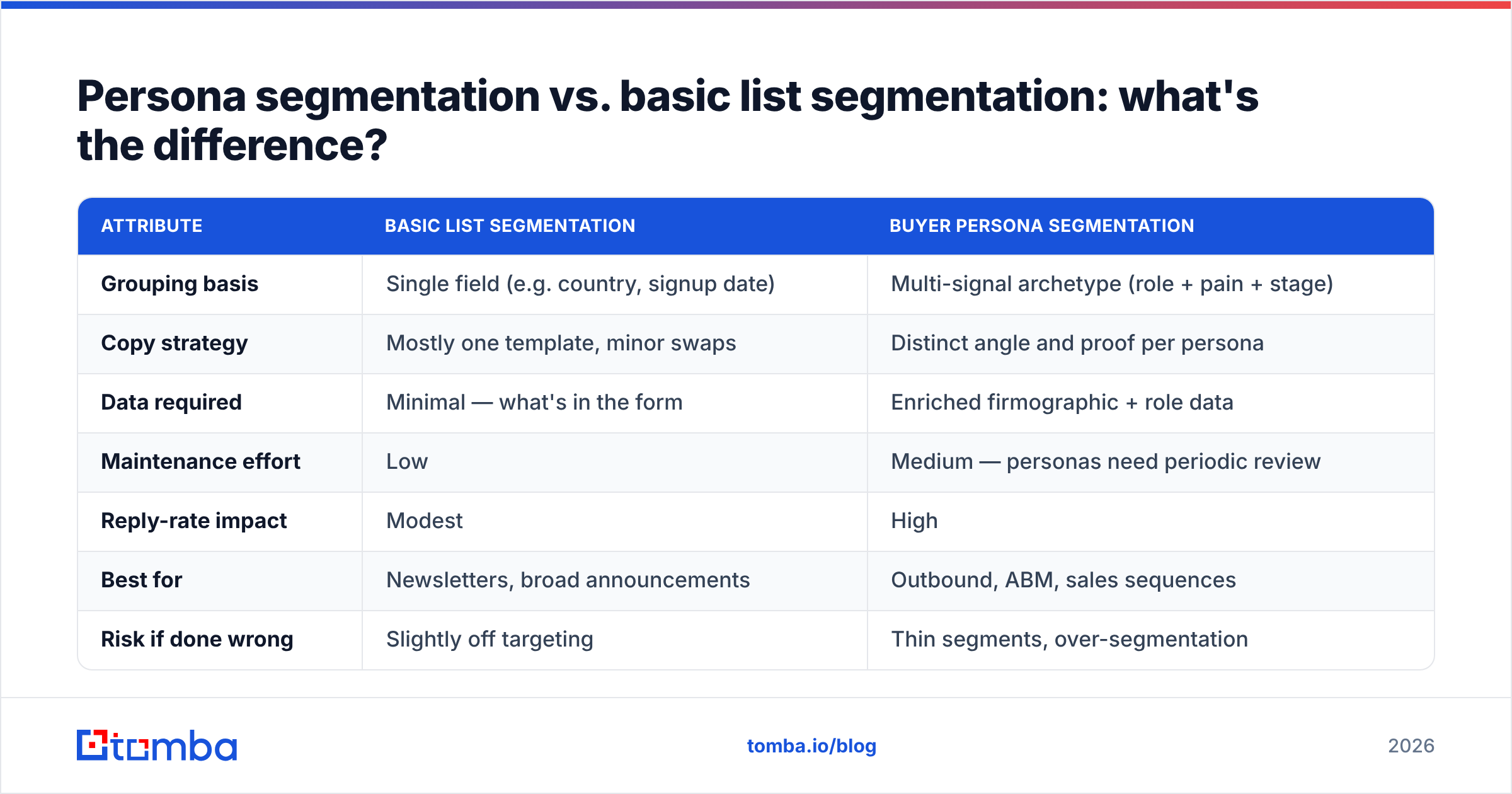
People use these terms interchangeably, but they're not the same. Basic list segmentation often stops at surface fields (location, signup date). Persona segmentation ties those fields back to a documented buyer archetype and a specific message strategy.
| Attribute | Basic List Segmentation | Buyer Persona Segmentation |
|---|---|---|
| Grouping basis | Single field (e.g. country, signup date) | Multi-signal archetype (role + pain + stage) |
| Copy strategy | Mostly one template, minor swaps | Distinct angle and proof per persona |
| Data required | Minimal — what's in the form | Enriched firmographic + role data |
| Maintenance effort | Low | Medium — personas need periodic review |
| Reply-rate impact | Modest | High |
| Best for | Newsletters, broad announcements | Outbound, ABM, sales sequences |
| Risk if done wrong | Slightly off targeting | Thin segments, over-segmentation |
The takeaway: basic segmentation is fine for a product update going to your whole base. Persona segmentation is what you reach for when the message needs to land a sale.
How many personas should you actually create?#
Start with three to five. That's the answer for almost every team.
It's tempting to build a persona for every job title in your TAM, but each persona you add multiplies the work: more copy variants, more list maintenance, more places for data gaps to break the flow. Gartner and other analysts have long noted that buying committees are growing, but that's an argument for segmenting by committee role (champion, economic buyer, technical evaluator), not for inventing dozens of micro-personas.
A practical rule: only create a new persona when it would change what you write. If "VP of Sales" and "VP of RevOps" get the same email, they're one persona for segmentation purposes — even if they're different people. Merge until merging would hurt relevance, then stop.
How do you map personas to email copy?#
Once your segments exist, each one needs its own messaging spine. Map every persona to four things before you write a single subject line:
- The pain you lead with — the one frustration this persona feels weekly.
- The proof that lands — a metric, customer name, or case study from their world.
- The objection to preempt — what makes this persona hesitate (budget, security, change management).
- The call to action — a demo for buyers, a resource for researchers, a quick reply ask for the time-poor.
For example, a "technical evaluator" persona gets copy heavy on integration detail and a link to docs. An "economic buyer" persona gets ROI framing and a short, outcome-focused ask. Same product, two different emails, two different response rates.
If you want a faster start, build one core template per persona and treat it as a living asset rather than rewriting from scratch each campaign. A library of cold email templates mapped to your personas keeps the team consistent and makes A/B testing meaningful — you're testing one variable, not ten.
What mistakes break persona segmentation?#
Most failures come from a handful of repeatable errors:
- Over-segmentation. Twelve personas, each with a 40-person list, none big enough to learn from. Consolidate.
- Stale data. People change jobs constantly. A persona segment built on year-old titles is mostly fiction. Re-enrich on a schedule.
- Personas without copy. Documenting personas in a slide deck and then sending everyone the same email. The segment has to change the message.
- Ignoring buying stage. Sending a cold prospect the same email as a warm, sales-ready lead wastes both.
- No measurement. If you can't compare reply rate by persona, you can't tell which segments are worth the effort.
The fix for most of these is operational discipline, not a new tool. Pick your personas, attach them to real list fields, write distinct copy, and review quarterly.
How do you measure whether segmentation is working?#
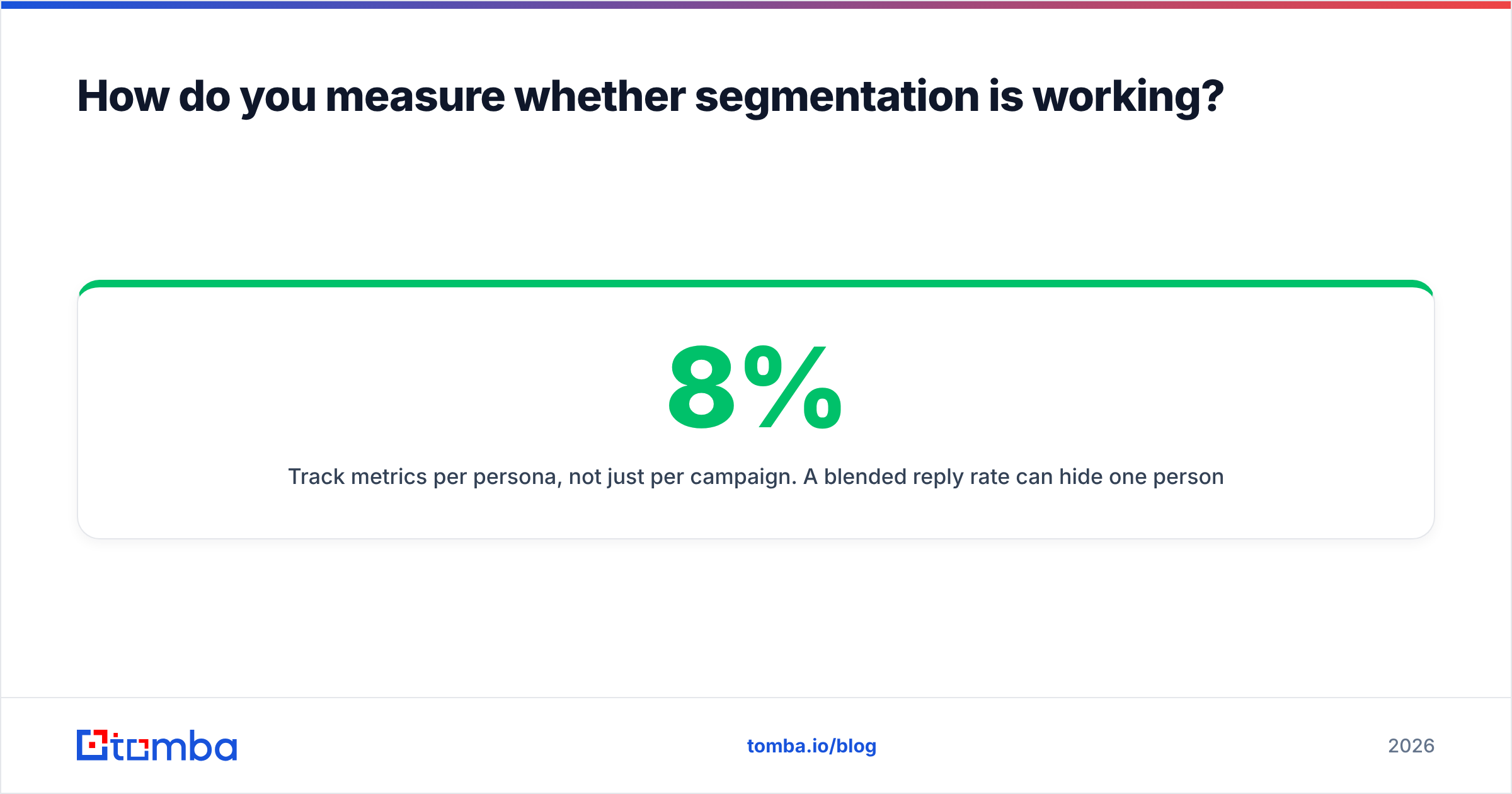
Track metrics per persona, not just per campaign. A blended 8% reply rate can hide one persona pulling 18% and another pulling 1% — and you'd never know to fix the laggard.
Watch these by segment:
- Open rate — tests your subject line and persona-relevance of the from-line.
- Reply rate — the real signal that the body resonated.
- Positive reply rate — replies that move toward a deal, not "unsubscribe me."
- Unsubscribe / spam rate — your early-warning system for irrelevance.
- Pipeline contribution — which personas actually become opportunities.
Review this monthly. When a persona underperforms, the fix is usually copy or data, not the segmentation itself. You can validate which buyer types convert best by cross-referencing with peer reviews and category data on sites like G2 to confirm your assumptions about who buys and why.
A simple 5-step rollout#
If you're starting from a single undifferentiated list, here's the order of operations that works:
- Audit your data. Verify addresses, fill missing role and firmographic fields, dedupe.
- Define 3–5 personas. Base them on your best closed-won deals, not guesses.
- Tag your list. Assign every contact to a persona using the enriched fields.
- Write one message spine per persona. Pain, proof, objection, CTA.
- Send, measure by persona, iterate. Kill what underperforms, double down on what converts.
Each step depends on the one before it. The most common point of failure is step one — which is exactly why the data layer deserves the most attention.
Final word: get the data right, the rest follows#
Buyer persona email segmentation isn't a copywriting trick; it's a data discipline that makes copywriting work. You can't tailor a message to a CFO if your list doesn't know who the CFO is. Get clean, enriched, verified contact data first, define a tight set of personas second, and write distinct copy third — in that order.
That's where Tomba fits. The Tomba Email Finder returns verified professional addresses along with the role and company context you need to slice your list by persona from day one — no separate enrichment scramble. Pair it with built-in verification to protect your sender reputation, and you've got the data foundation that makes every segment you send measurably better. Plans start free at 25 searches a month, with paid tiers at $49, $99, and $249 — see Tomba pricing to match a plan to your volume, and start segmenting on real data instead of guesses.
// get started
Find, verify and enrich your first contacts today
Start on the free plan with 25 searches a month, then scale when your team is ready.
Free plan · No credit card required · GDPR & CCPA
// about the author