Buyer Persona Generator: Build B2B Personas Fast in 2026
A buyer persona generator turns scattered firmographic data into sales-ready profiles. Here's how to build accurate B2B personas, which tools to use, and how to keep them current in 2026.
TL;DR
- A buyer persona generator is any tool or repeatable workflow that turns raw firmographic, behavioral, and contact data into a structured profile of the person you actually sell to.
- The fastest path is a three-layer stack: a template for structure, real B2B data for accuracy, and an LLM to draft the narrative — not a single magic button.
- Free template generators (HubSpot, Semrush) are great for structure but invent the data. Pair them with a real data source so your personas reflect actual accounts, not guesses.
- Personas decay. Job titles change, tools get swapped, buying committees grow. Refresh personas every quarter using live enrichment, not a one-time PDF.
- Below: a comparison of the main generator types, a build workflow you can run today, and where an email-and-enrichment layer like Tomba fits.
What is a buyer persona generator?#
A buyer persona generator is a tool that takes scattered inputs about your customers and assembles them into a single, usable profile — name, role, goals, pain points, objections, and the channels where they actually pay attention. Think of it like a sketch artist for sales: you feed in fragments ("VP of Ops at a 200-person SaaS firm, hates manual reporting, evaluates tools on G2"), and it returns a coherent face you can target.
The catch most teams miss: a generator only assembles. It does not know anything. If you feed it assumptions, you get a confident-looking persona built on vibes. The output quality is capped by the quality of the data you put in — which is why the best modern workflows bolt a real B2B data layer onto the generator step.
There are three things people mean when they say "buyer persona generator":
- Template generators — fill-in-the-blank frameworks (HubSpot's Make My Persona, Semrush's persona tool). They structure your thinking but supply zero real data.
- AI persona writers — LLM prompts that draft a narrative persona from a short brief. Fast, fluent, and prone to inventing specifics.
- Data-driven generators — workflows that pull actual account and contact data (firmographics, tech stack, titles, intent) and synthesize personas from patterns in your real pipeline.
The strongest setup uses all three: template for the skeleton, data for the muscle, AI for the voice.
Why do most B2B buyer personas fail?#
Most personas fail because they're written once, in a workshop, from memory — then filed in a slide deck nobody opens again. They describe a customer the company imagined in 2023, not the accounts closing today.
Three specific failure modes show up again and again:
- Invented specifics. Someone asks an AI tool to "create a persona for our product" and it returns "Marketing Mary, age 34, drinks oat-milk lattes." That detail came from nowhere. It feels concrete but predicts nothing about who converts.
- No buying committee. B2B deals are committee decisions. Gartner's research puts the typical B2B buying group at six to ten stakeholders. A single persona models one seat at a table of eight.
- Static decay. Titles get reorganized, tools get ripped out, the champion leaves. A persona built on a 2024 org chart is quietly wrong by 2026.
The fix is not a better template. It's grounding the persona in current, verifiable data and refreshing it on a schedule. That's the difference between a generator that produces a poster and one that produces a targeting spec your SDRs can act on.
How does a buyer persona generator actually work?#
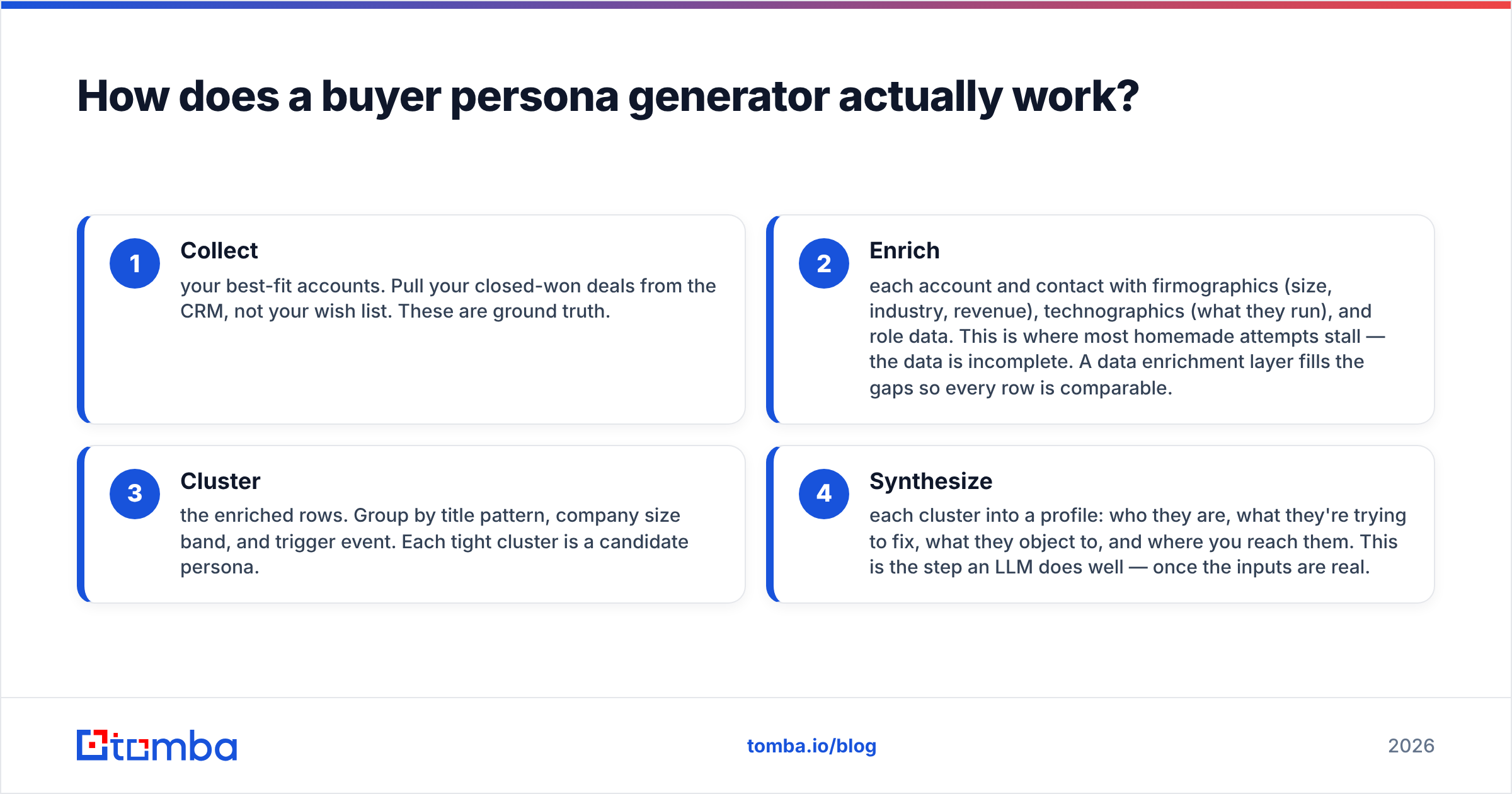
A real data-driven generator runs four steps. You can do this manually in a spreadsheet or wire it into an automation — the logic is the same.
- Collect your best-fit accounts. Pull your closed-won deals from the CRM, not your wish list. These are ground truth.
- Enrich each account and contact with firmographics (size, industry, revenue), technographics (what they run), and role data. This is where most homemade attempts stall — the data is incomplete. A data enrichment layer fills the gaps so every row is comparable.
- Cluster the enriched rows. Group by title pattern, company size band, and trigger event. Each tight cluster is a candidate persona.
- Synthesize each cluster into a profile: who they are, what they're trying to fix, what they object to, and where you reach them. This is the step an LLM does well — once the inputs are real.
The output is not "Marketing Mary." It's "Series-B RevOps leads at 100–300 employee SaaS companies running Salesforce + Outreach, triggered by a missed quarter, who object on data accuracy." That's something a campaign can target.
Which buyer persona generator should you use?#
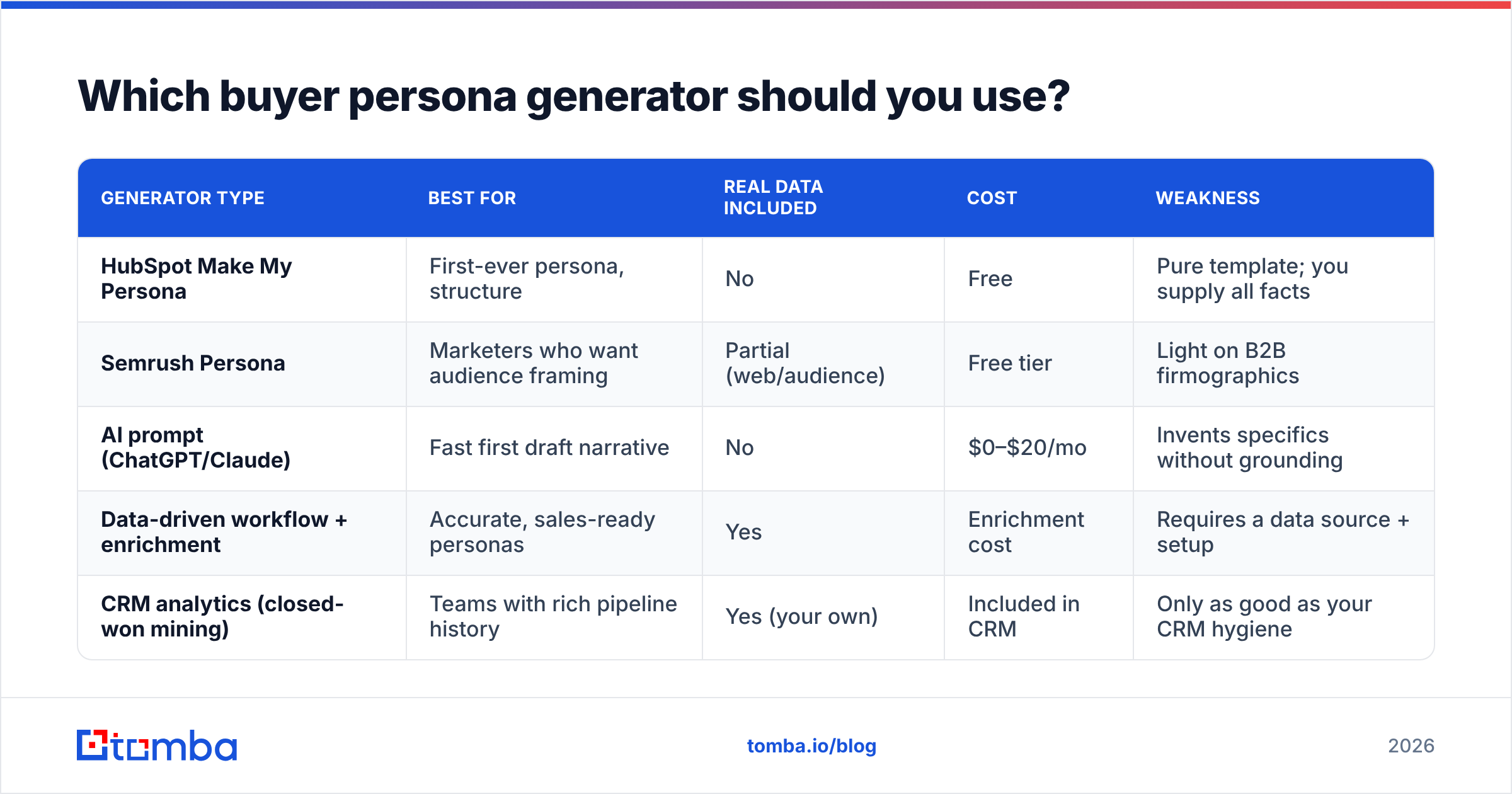
Pick based on what you're missing. If you lack structure, a template tool solves it in an afternoon. If you lack accurate data — the usual bottleneck — no template fixes that. Here's how the main options compare.
| Generator type | Best for | Real data included | Cost | Weakness |
|---|---|---|---|---|
| HubSpot Make My Persona | First-ever persona, structure | No | Free | Pure template; you supply all facts |
| Semrush Persona | Marketers who want audience framing | Partial (web/audience) | Free tier | Light on B2B firmographics |
| AI prompt (ChatGPT/Claude) | Fast first draft narrative | No | $0–$20/mo | Invents specifics without grounding |
| Data-driven workflow + enrichment | Accurate, sales-ready personas | Yes | Enrichment cost | Requires a data source + setup |
| CRM analytics (closed-won mining) | Teams with rich pipeline history | Yes (your own) | Included in CRM | Only as good as your CRM hygiene |
The honest takeaway: free template generators are a fine starting point, but they're scaffolding. The accuracy comes from the data layer you add underneath. That's the part a B2B database and enrichment step provide — verified company and contact attributes instead of guesses.
For a structured starting template, HubSpot's Make My Persona is the most-used free option, and you can pressure-test tool choices against real reviews on G2. Use those for the skeleton, then ground it.
How do you build a data-driven persona step by step?#
Here's a workflow you can run this week without buying a new platform. It assumes you already have a CRM with some closed deals.
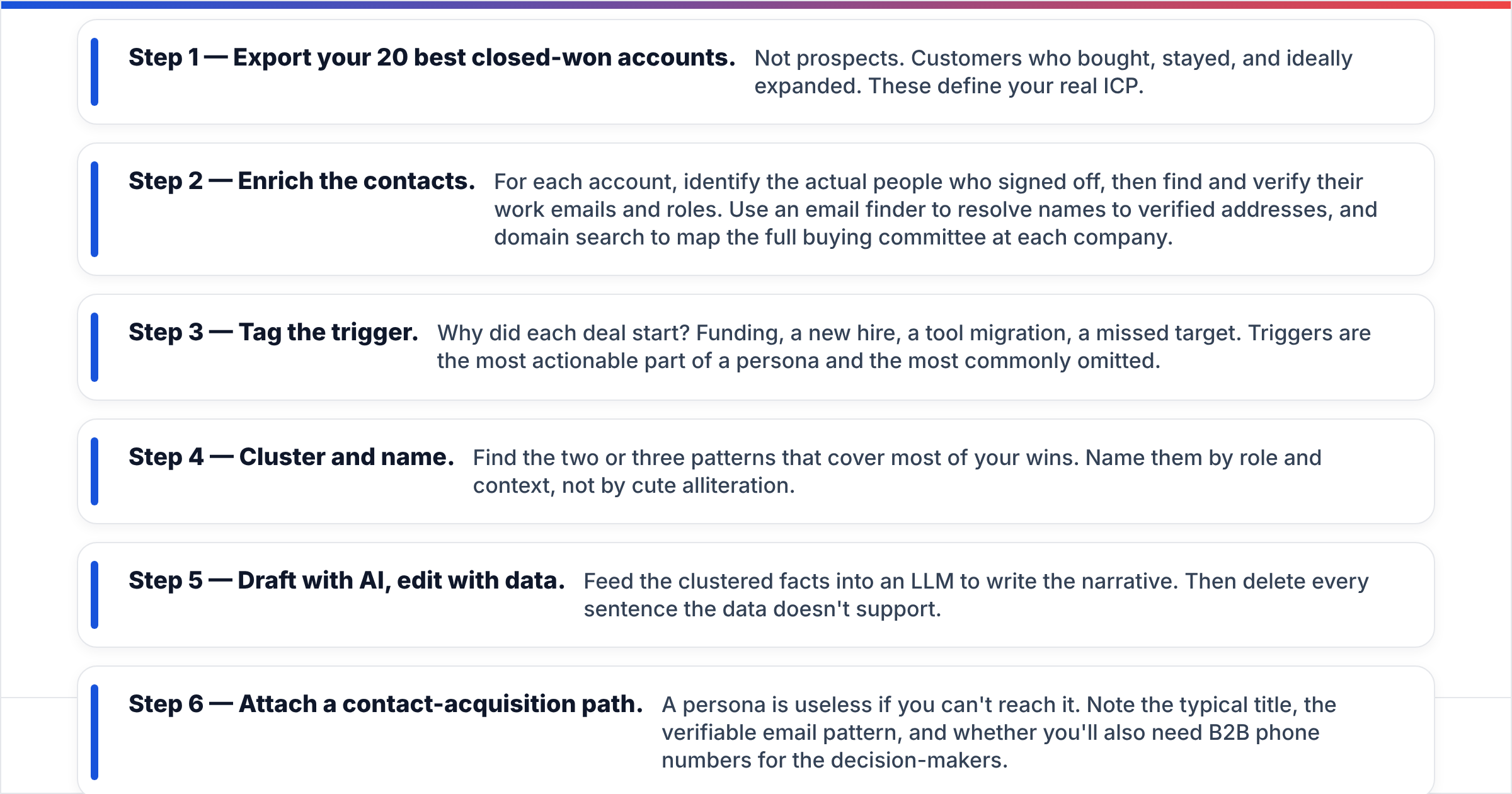
- Step 1 — Export your 20 best closed-won accounts. Not prospects. Customers who bought, stayed, and ideally expanded. These define your real ICP.
- Step 2 — Enrich the contacts. For each account, identify the actual people who signed off, then find and verify their work emails and roles. Use an email finder to resolve names to verified addresses, and domain search to map the full buying committee at each company.
- Step 3 — Tag the trigger. Why did each deal start? Funding, a new hire, a tool migration, a missed target. Triggers are the most actionable part of a persona and the most commonly omitted.
- Step 4 — Cluster and name. Find the two or three patterns that cover most of your wins. Name them by role and context, not by cute alliteration.
- Step 5 — Draft with AI, edit with data. Feed the clustered facts into an LLM to write the narrative. Then delete every sentence the data doesn't support.
- Step 6 — Attach a contact-acquisition path. A persona is useless if you can't reach it. Note the typical title, the verifiable email pattern, and whether you'll also need B2B phone numbers for the decision-makers.
This produces personas tied to real, reachable people — which is the whole point. A persona that doesn't connect to a marketing qualified lead you can actually contact is a creative-writing exercise.

Can AI generate accurate buyer personas on its own?#
No — not on its own. AI generates fluent personas instantly, but fluency is not accuracy. An LLM with no grounding will happily produce demographics, salaries, and software preferences that are statistically plausible and specifically wrong. That's fine for a brainstorming prompt and dangerous for a targeting decision.
Where AI genuinely helps:
- Drafting the narrative once you supply real clustered data.
- Summarizing call transcripts and support tickets into pain-point themes.
- Generating objection-handling language per persona.
- Rewriting one persona into messaging variants for email, LinkedIn, and ads.
Where it fails without help:
- Inventing firmographics it was never given.
- Guessing the buying committee structure.
- Knowing whether a contact's email is still valid.
The pattern that works: retrieval first, generation second. Pull verified data, then let the model write. If you're enriching at scale, a bulk email finder or the Tomba API can feed real contact and company attributes into your generation step so the model is describing actual accounts, not a hallucinated average.
How often should you refresh buyer personas?#
Refresh on a quarterly cadence, and re-validate the contact data every time you run a campaign. Personas are perishable. Forrester and most RevOps leaders treat ICP and persona definitions as living documents, not annual artifacts — because the underlying reality moves constantly:
- Titles drift. "Growth Marketer" becomes "Lifecycle Lead." Your filters silently miss people.
- Committees expand. A deal that took three stakeholders in 2024 takes six in 2026.
- Emails rot. Roughly 2–3% of B2B contacts change jobs every month, which compounds fast. By the time a persona's contact list is a year old, a quarter of it bounces.
A practical refresh loop: re-pull closed-won every quarter, re-cluster, and re-verify the contact emails before each outbound push. Running your list through an email verifier before a send protects your sender reputation and keeps your persona's "reachable" claim honest. The persona document and the deliverability of the people it describes are the same problem.
What does a complete buyer persona include?#
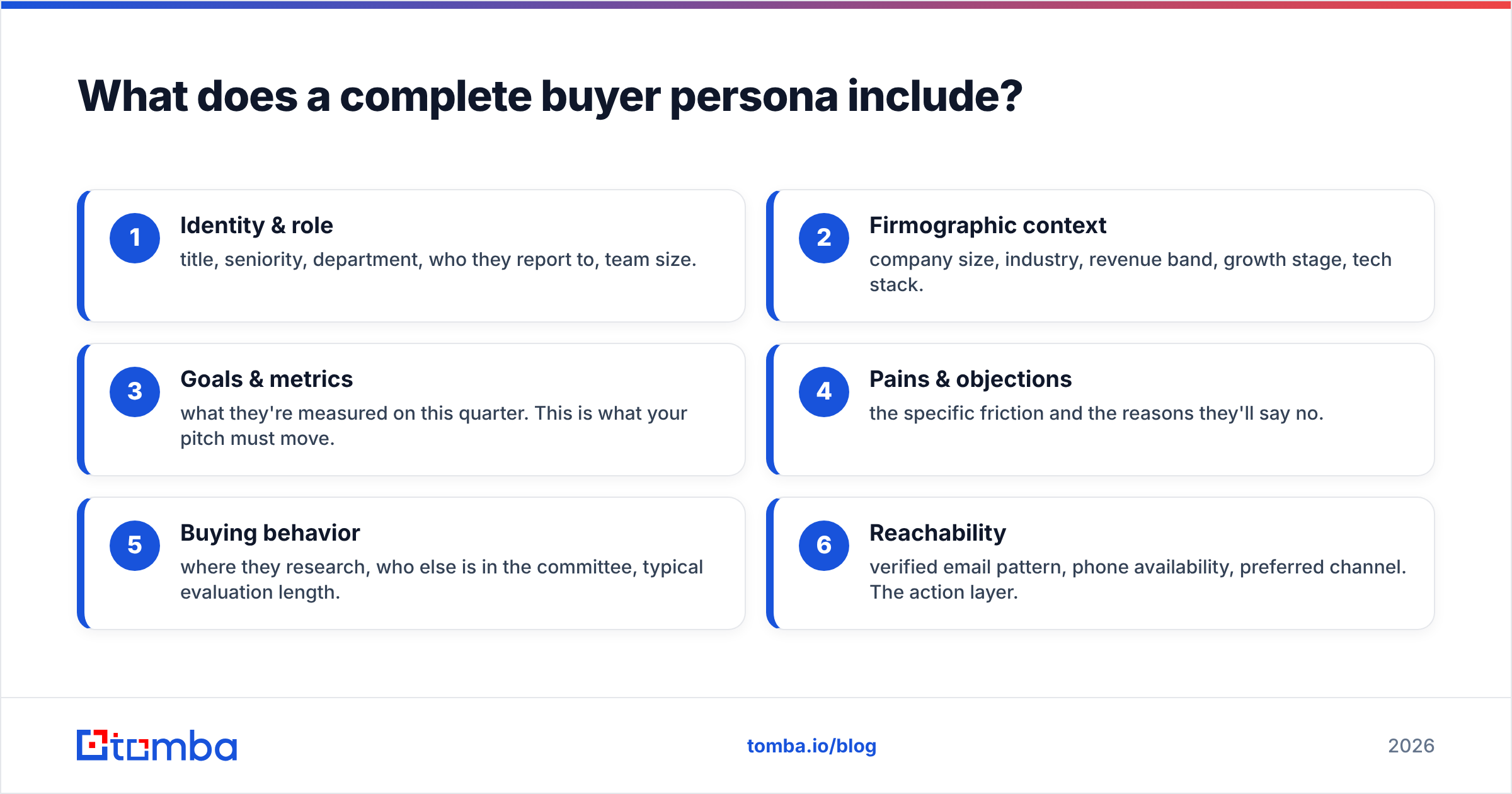
A persona that drives revenue covers six blocks. If your generator's output is missing any of these, it's incomplete regardless of how polished it looks.
- Identity & role — title, seniority, department, who they report to, team size.
- Firmographic context — company size, industry, revenue band, growth stage, tech stack.
- Goals & metrics — what they're measured on this quarter. This is what your pitch must move.
- Pains & objections — the specific friction and the reasons they'll say no.
- Buying behavior — where they research, who else is in the committee, typical evaluation length.
- Reachability — verified email pattern, phone availability, preferred channel. The action layer.
Notice that half of these are factual and only obtainable from data — firmographics, tech stack, reachability. That's the half template generators leave blank and the half that determines whether your campaigns land. Filling it reliably at scale is a data problem, which is why pairing any generator with verified contact data beats any generator used alone.
Build personas your pipeline can actually act on#
A buyer persona generator is only as good as the data feeding it. Templates give you structure, AI gives you a voice, but accuracy comes from grounding every profile in verified, current B2B data — the real titles, the real companies, the real reachable people inside the buying committee.
That's exactly the layer Tomba adds. Use the Tomba Email Finder to resolve your best-fit personas into verified contacts you can actually reach, run domain search to map full buying committees, and enrich every account so your personas describe reality instead of a workshop guess. Start free with 25 searches a month, or check Tomba pricing — Starter at $49/mo — when you're ready to build personas at pipeline scale. Stop generating posters. Start generating profiles your reps can close.
// get started
Find, verify and enrich your first contacts today
Start on the free plan with 25 searches a month, then scale when your team is ready.
Free plan · No credit card required · GDPR & CCPA
// about the author