Buying Groups in B2B Sales: The 2026 Playbook to Win Deals
B2B deals are no longer won by one champion. Learn how to map, engage, and close buying groups in 2026 — with a practical framework, roles, and outreach tactics.
Buying Groups in B2B Sales: The 2026 Playbook to Win Deals
If you are still selling to a single contact and praying they sell internally on your behalf, you are losing deals you should be winning. The modern B2B purchase is a committee decision, and the rep who maps that committee early almost always beats the rep who doesn't.
TL;DR#
- A buying group (or buying committee) is the set of people inside a company who collectively decide on a purchase — typically 6 to 11 people in 2026, not one "decision maker."
- Single-threaded deals (one contact) stall, slip, and die when your champion goes quiet, changes jobs, or gets overruled.
- Winning means multithreading: identifying every role, mapping their motivations, and engaging them with messaging tuned to what each one actually cares about.
- You need accurate contact data for the whole group — names, verified emails, phone numbers, and titles — not just the one person who replied to your first email.
- This guide gives you a role-by-role framework, an outreach sequence, and the tooling to find and verify the full committee fast.
What is a buying group in B2B sales?#
A buying group is the collection of individuals who influence and approve a B2B purchase. Think of it like a mortgage application: the person signing the papers is rarely acting alone — there is a spouse weighing the monthly cost, an accountant checking the numbers, and a lawyer reading the fine print. The signature is the last step, not the decision.
In B2B, that same dynamic plays out inside companies. Gartner's research has put the typical technology buying group at six to ten stakeholders, each arriving with their own priorities, biases, and four or five pieces of independently gathered information. For larger or riskier purchases, that number climbs higher. The result: more people to convince, more ways for a deal to stall, and far less tolerance for a one-contact sales motion.
The shift matters because the old playbook assumed a single "decision maker" you could charm into a yes. That person mostly no longer exists. Even a CFO with sign-off authority is reacting to input from finance analysts, the team that will actually use the product, IT security, and procurement. Sell to one node and ignore the rest, and you are betting your quota on a champion who has to do your selling for you — usually badly, and usually behind closed doors you can't see into.
Who is in a typical buying committee?#
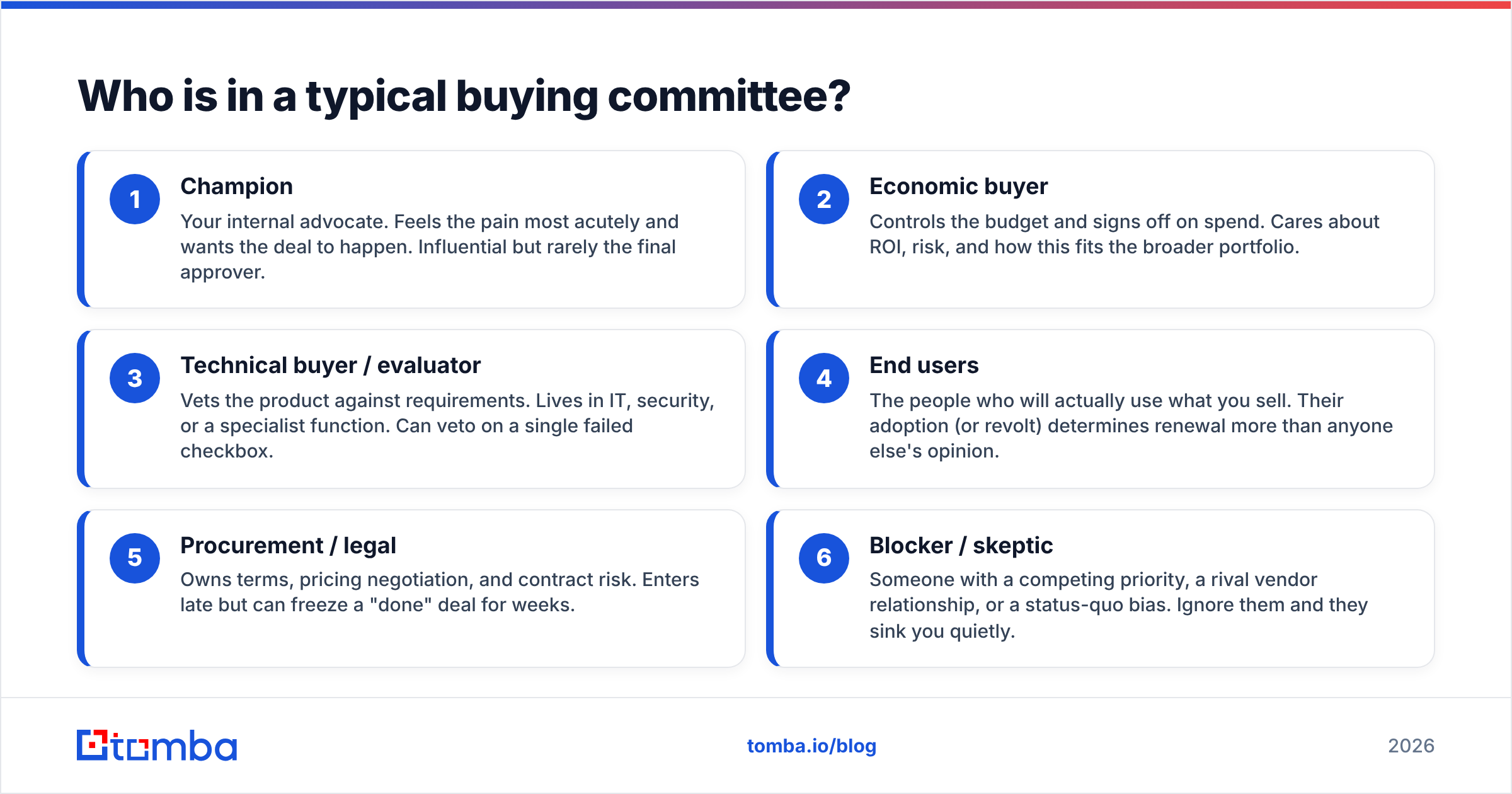
Every committee is different, but the roles repeat across deals. Mapping these roles is the single highest-leverage thing you can do early in a cycle. Here is the cast you should expect to find:
- Champion — Your internal advocate. Feels the pain most acutely and wants the deal to happen. Influential but rarely the final approver.
- Economic buyer — Controls the budget and signs off on spend. Cares about ROI, risk, and how this fits the broader portfolio.
- Technical buyer / evaluator — Vets the product against requirements. Lives in IT, security, or a specialist function. Can veto on a single failed checkbox.
- End users — The people who will actually use what you sell. Their adoption (or revolt) determines renewal more than anyone else's opinion.
- Procurement / legal — Owns terms, pricing negotiation, and contract risk. Enters late but can freeze a "done" deal for weeks.
- Blocker / skeptic — Someone with a competing priority, a rival vendor relationship, or a status-quo bias. Ignore them and they sink you quietly.
The mistake reps make is treating these as job titles. They are roles. One person can hold two of them; a single role can be split across three people. Your job is to figure out who plays what — and that requires talking to more than one human.
Why do single-threaded deals fail?#
The conclusion first: single-threaded deals fail because your forecast depends on a person you don't control. When that person changes — and people change jobs roughly every two to three years — your deal goes dark with no warning.
Here is what actually happens. Your champion gets excited, you build a great relationship, and the deal feels real. Then the economic buyer asks a question your champion can't answer, security raises a concern nobody flagged, or your champion accepts a role at another company. Suddenly your "90% likely" deal has no pulse, and you have no other relationship to revive it. You weren't selling to the company; you were selling to one inbox.
Multithreading fixes the structural problem, not just the symptom. Research from the HubSpot and broader sales-enablement community consistently shows that deals with more engaged stakeholders close at higher rates and slip less. More relationships mean more early-warning signals, more internal advocates carrying your message in rooms you'll never enter, and resilience when any single contact disappears.
It also changes how you handle objections. When procurement pushes back on price, a champion and an end user who already love the product will fight that battle internally — for free — long after your call ends.
How do you map and engage a buying group?#
Mapping a buying group is a four-step loop: identify, enrich, prioritize, and engage. Run it deliberately on every deal above a trivial size.
Step 1 — Identify the org around your entry point#
Start from the contact you have and work outward. Who do they report to? Who reports to them? Which adjacent functions touch this decision? A company email search across the target domain surfaces the people you didn't know existed — the security lead, the finance analyst, the VP two levels up. You can't engage a committee you can't see.
Step 2 — Enrich and verify contact data#
A name without a working email is a dead end. Before you build a sequence, run your list through a data enrichment pass to attach verified emails, titles, and phone numbers, then confirm deliverability with an email verifier so your outreach actually lands. Bouncing into a buying committee torches your sender reputation right when you need every message delivered.
Step 3 — Prioritize by role and influence#
Not everyone gets the same energy. Rank contacts by decision power and likely receptiveness. Your champion and economic buyer are non-negotiable. End users are higher leverage than reps assume. Procurement can wait until there is a deal to paper.
Step 4 — Engage with role-specific messaging#
This is where most multithreading attempts collapse: reps send the same email to eight people. Each role cares about a different thing. Tailor the message or don't bother sending it.
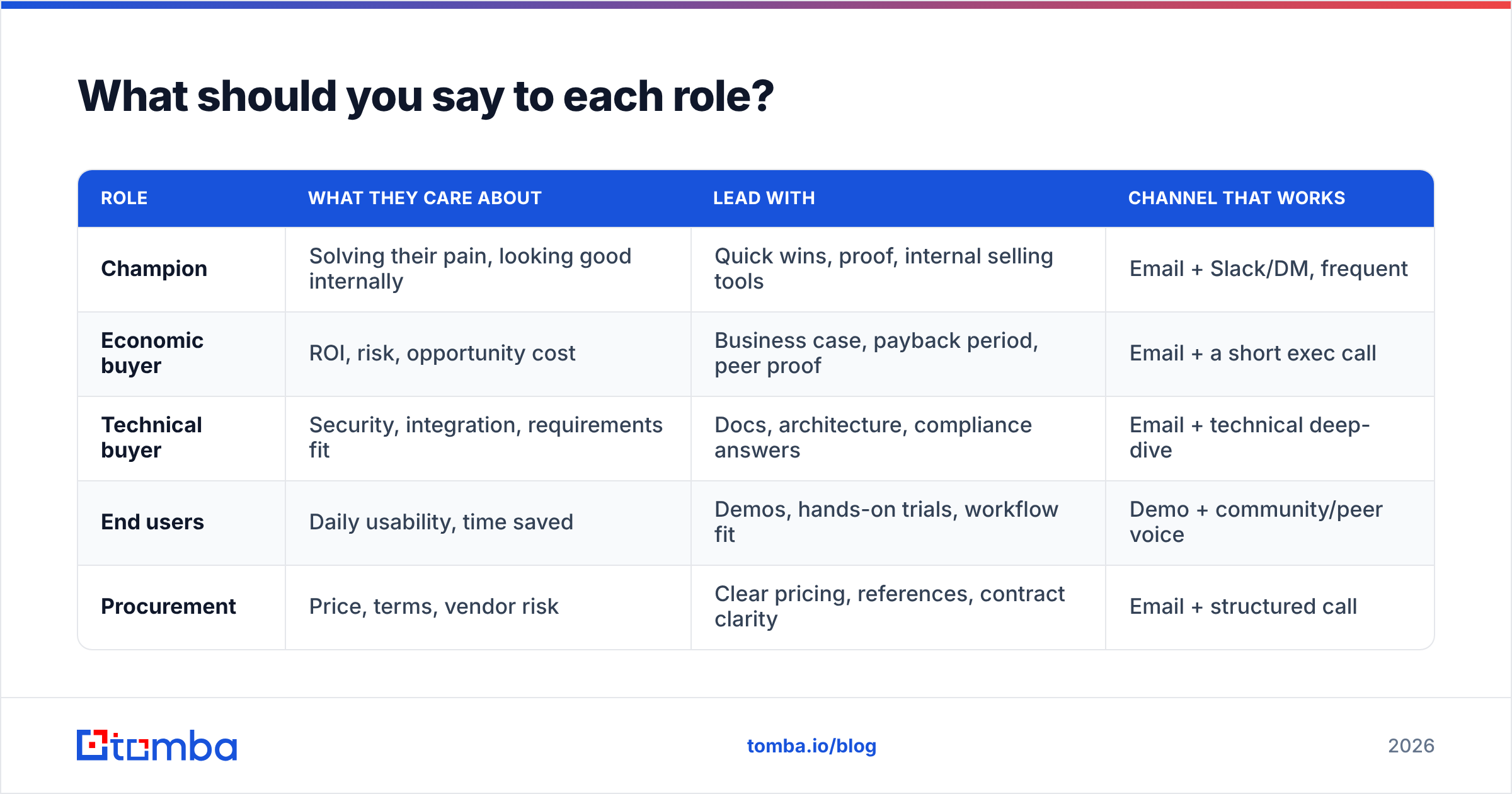
What should you say to each role?#
Message-market fit applies inside a single account. The economic buyer does not want the feature tour your end user craves, and your champion does not need the risk-and-compliance language procurement lives for. Here is a practical mapping:
| Role | What they care about | Lead with | Channel that works |
|---|---|---|---|
| Champion | Solving their pain, looking good internally | Quick wins, proof, internal selling tools | Email + Slack/DM, frequent |
| Economic buyer | ROI, risk, opportunity cost | Business case, payback period, peer proof | Email + a short exec call |
| Technical buyer | Security, integration, requirements fit | Docs, architecture, compliance answers | Email + technical deep-dive |
| End users | Daily usability, time saved | Demos, hands-on trials, workflow fit | Demo + community/peer voice |
| Procurement | Price, terms, vendor risk | Clear pricing, references, contract clarity | Email + structured call |
Notice the channel column. A committee is reached across email, phone, and social — not one of them. Pulling verified B2B phone numbers for the economic buyer and pairing email with a LinkedIn outreach touch dramatically raises the odds you actually get a reply from a busy executive who ignores cold email entirely.
Buying group selling vs. single-threaded selling#
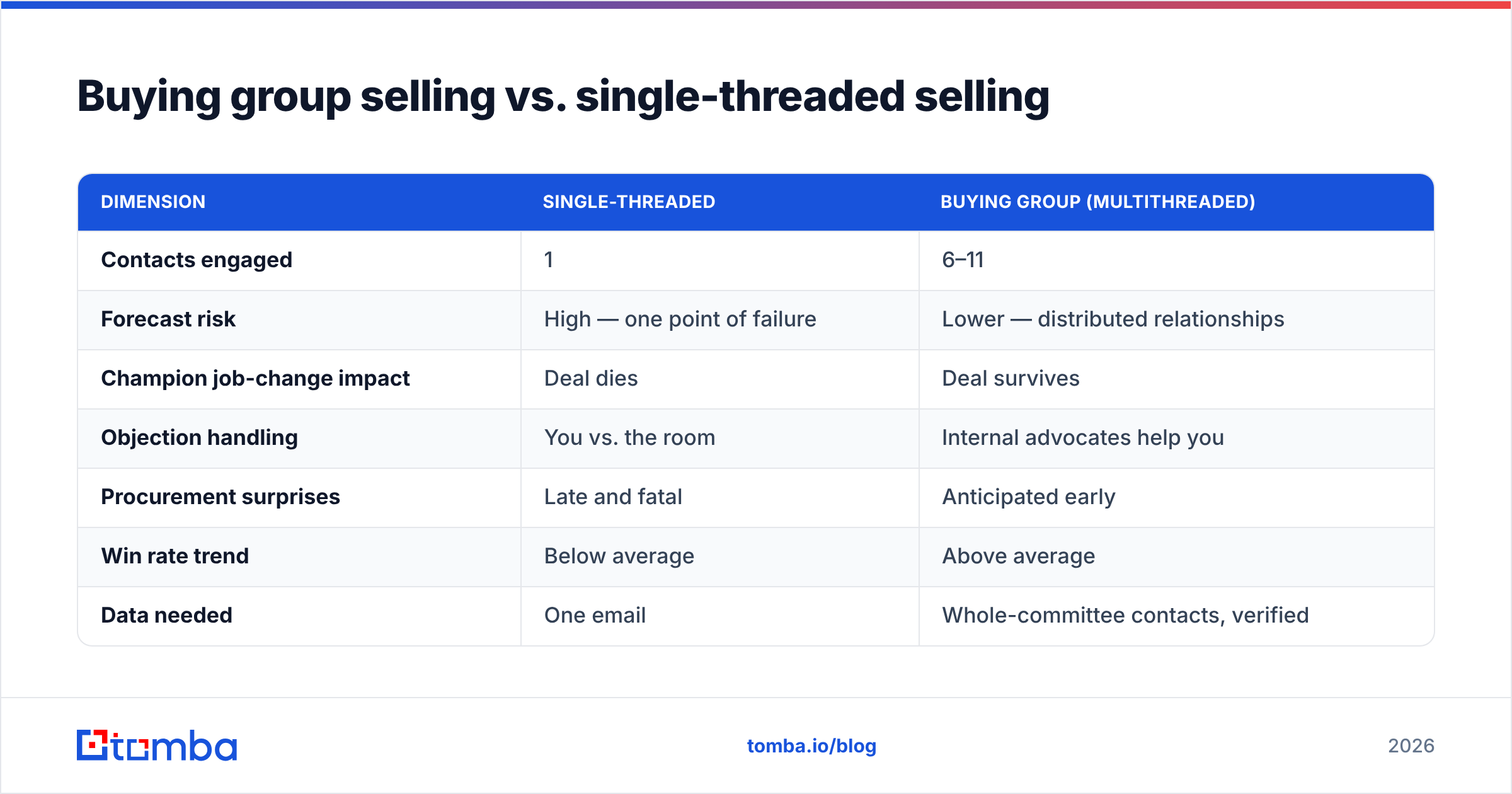
To make the contrast concrete, here is how the two motions compare across the metrics that decide whether you hit quota.
| Dimension | Single-threaded | Buying group (multithreaded) |
|---|---|---|
| Contacts engaged | 1 | 6–11 |
| Forecast risk | High — one point of failure | Lower — distributed relationships |
| Champion job-change impact | Deal dies | Deal survives |
| Objection handling | You vs. the room | Internal advocates help you |
| Procurement surprises | Late and fatal | Anticipated early |
| Win rate trend | Below average | Above average |
| Data needed | One email | Whole-committee contacts, verified |
The right column is more work. It is also the only column that scales past hero deals into a repeatable motion your whole team can run. The bottleneck is almost never strategy — reps understand they should multithread. The bottleneck is data: finding eight real people with verified contact details fast enough that the extra coverage doesn't blow your cycle time. That is a tooling problem, and it is solvable.
How do you find the whole committee without wasting a week?#
Speed comes from automation, not manual LinkedIn spelunking. The workflow that holds up at volume:
- Start from the domain. Run a domain search to pull the people and email patterns at the target company in one pass.
- Go from a profile to an email. When you spot a stakeholder on LinkedIn, a LinkedIn finder turns that profile into a verified work email without guesswork.
- Enrich a known list in bulk. Already have a few names from a call? Push them through a bulk email finder to fill in the rest of the committee at once.
- Verify before you send. A final email verification pass protects your deliverability across the whole multithreaded sequence.
Plug those steps into your CRM through a HubSpot integration or Salesforce integration and the committee map populates itself as the deal develops, instead of living in a spreadsheet that goes stale by Friday. For teams checking cost, the Tomba pricing tiers — Free (25 searches/mo), Starter at $49/mo, Growth at $99/mo, and Pro at $249/mo — scale with how many committees you are working at once.
For deeper benchmarking on how vendors source and validate this kind of contact data, G2's category reviews are a useful neutral reference before you commit to any platform.
What does this look like in practice?#
Picture a $60K platform deal. You enter through a manager who replied to a webinar follow-up — your champion. Single-threaded, you nurture that manager for six weeks until they mention "leadership wants to see numbers," go quiet, and resurface to say the budget got reallocated. Deal lost, no recovery path.
Buying-group motion, same starting point: in week one you map the org, identify the VP of Operations (economic buyer), an IT security lead (technical buyer), two team leads (end users), and a procurement contact. You enrich and verify all of them, then run role-specific outreach. When the VP asks for ROI, you already have a business case in their inbox. When security raises a concern, you have a direct line instead of a game of telephone through your champion. When the champion does go quiet — they take a new job in week five — the deal survives because four other people are invested. That is the entire difference, and it is mostly a function of whether you did the mapping early.
Frequently asked questions#
How big is a typical B2B buying group in 2026? Most fall in the 6–11 person range, with complex or high-risk purchases trending higher. Even "small" deals usually involve three or four real stakeholders once you count end users and finance.
Is multithreading just spamming everyone at the account? No. Sending identical messages to eight people is how multithreading fails. The point is role-specific relevance — each contact hears about what they actually care about, through a channel they actually use.
When should procurement and legal enter the conversation? Usually late, once there is a deal worth papering — but identify them early so their eventual involvement doesn't surprise you. A frozen contract at the finish line is almost always a stakeholder you mapped too late.
What is the fastest way to build an accurate committee map? Start from the company domain, enrich and verify every contact, and sync it into your CRM. Manual research doesn't scale past a handful of deals; automated finding and verification does.
Put the playbook to work#
Buying groups are not a trend you can wait out — they are how B2B buys now, and the reps who map the whole committee early are the ones hitting number. The strategy is straightforward; the constraint is getting accurate, verified contact data for every stakeholder before your cycle drags. That is exactly what the Tomba Email Finder is built for: find every member of the committee by domain, name, or company, verify their emails, and feed a multithreaded sequence that doesn't die when one contact goes dark. Start on the free tier, map your next open deal end to end, and stop betting your quota on a single inbox.
// get started
Find, verify and enrich your first contacts today
Start on the free plan with 25 searches a month, then scale when your team is ready.
Free plan · No credit card required · GDPR & CCPA
// about the author