Buzzeteer Pricing, Reviews, Pros and Cons (2026 Guide)
Is Buzzeteer worth it in 2026? We break down its pricing model, user reviews, and the real pros and cons — and where it falls short for serious outbound teams.

Buzzeteer markets itself as a fast way to pull B2B leads and contact data, but the question buyers actually ask is simpler: is it worth the money, and what's the catch? This guide gives you a neutral, hype-free read on Buzzeteer pricing, what reviewers report, and the honest trade-offs — so you can decide before you hand over a card.
TL;DR#
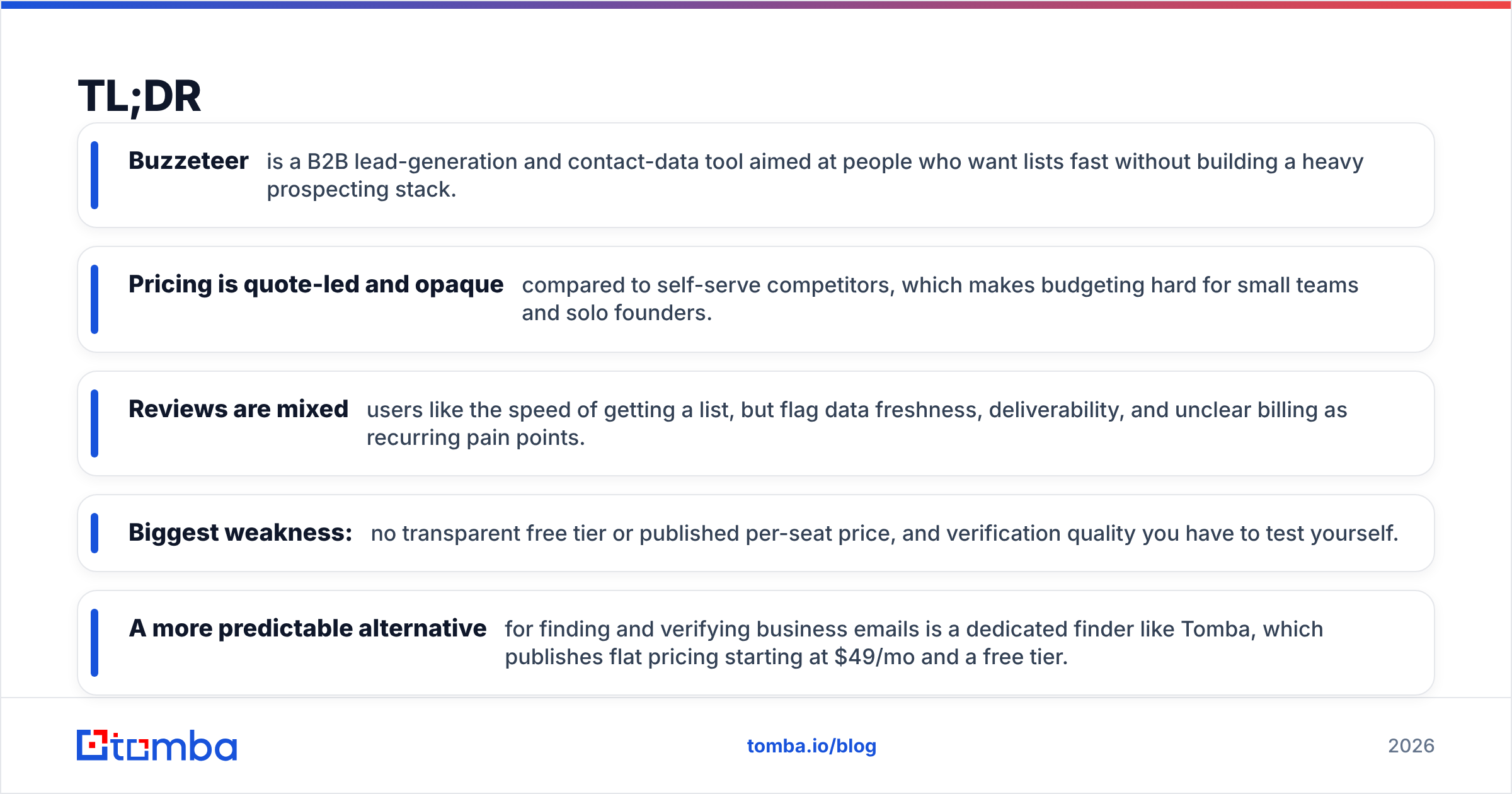
- Buzzeteer is a B2B lead-generation and contact-data tool aimed at people who want lists fast without building a heavy prospecting stack.
- Pricing is quote-led and opaque compared to self-serve competitors, which makes budgeting hard for small teams and solo founders.
- Reviews are mixed: users like the speed of getting a list, but flag data freshness, deliverability, and unclear billing as recurring pain points.
- Biggest weakness: no transparent free tier or published per-seat price, and verification quality you have to test yourself.
- A more predictable alternative for finding and verifying business emails is a dedicated finder like Tomba, which publishes flat pricing starting at $49/mo and a free tier.
What is Buzzeteer?#
Buzzeteer is a B2B lead-generation platform — think "give me a list of companies and contacts in this niche" rather than a full sales-engagement suite. Its pitch is speed: define a target, get exportable contact data, and move that into your outreach tool or CRM.
That category is crowded. It overlaps with email finders, data providers, and scraping tools, so the real question isn't "what is it" but "what does it do better than the tool you already pay for." Most teams evaluating Buzzeteer are really evaluating one of three jobs:
- Build a targeted prospect list — companies + decision-makers in a defined segment.
- Get contact details — work emails and sometimes phone numbers for those people.
- Push it downstream — export to a sequencer, CRM, or spreadsheet.
Each of those jobs has specialist tools that do it cheaper or more accurately, which is why pricing and data quality matter so much in this decision. If your core need is simply finding verified work emails by name or domain, a focused email finder will usually beat a generalist list tool on cost-per-good-record.
How much does Buzzeteer cost?#
Here's the honest answer: Buzzeteer's pricing is not consistently published as flat self-serve tiers, and that's the first thing prospective buyers should know. Pricing for tools in this category tends to be quote-based, credit-based, or bundled — meaning the number you pay depends on volume, seats, and a sales conversation rather than a clear menu.
Always confirm current numbers on the vendor's own site and verified marketplace listings before you commit. Treat any third-party figure (including ranges in this article) as directional, not contractual.
When pricing is quote-led, watch for these cost drivers:
- Credits vs. records — are you billed for every lookup, or only for valid results?
- Seat minimums — many list tools require a multi-seat annual commitment.
- Export caps — "unlimited search" often hides a monthly export limit.
- Verification add-ons — list accuracy may cost extra on top of the base plan.
- Annual lock-in — monthly options may be missing or heavily marked up.
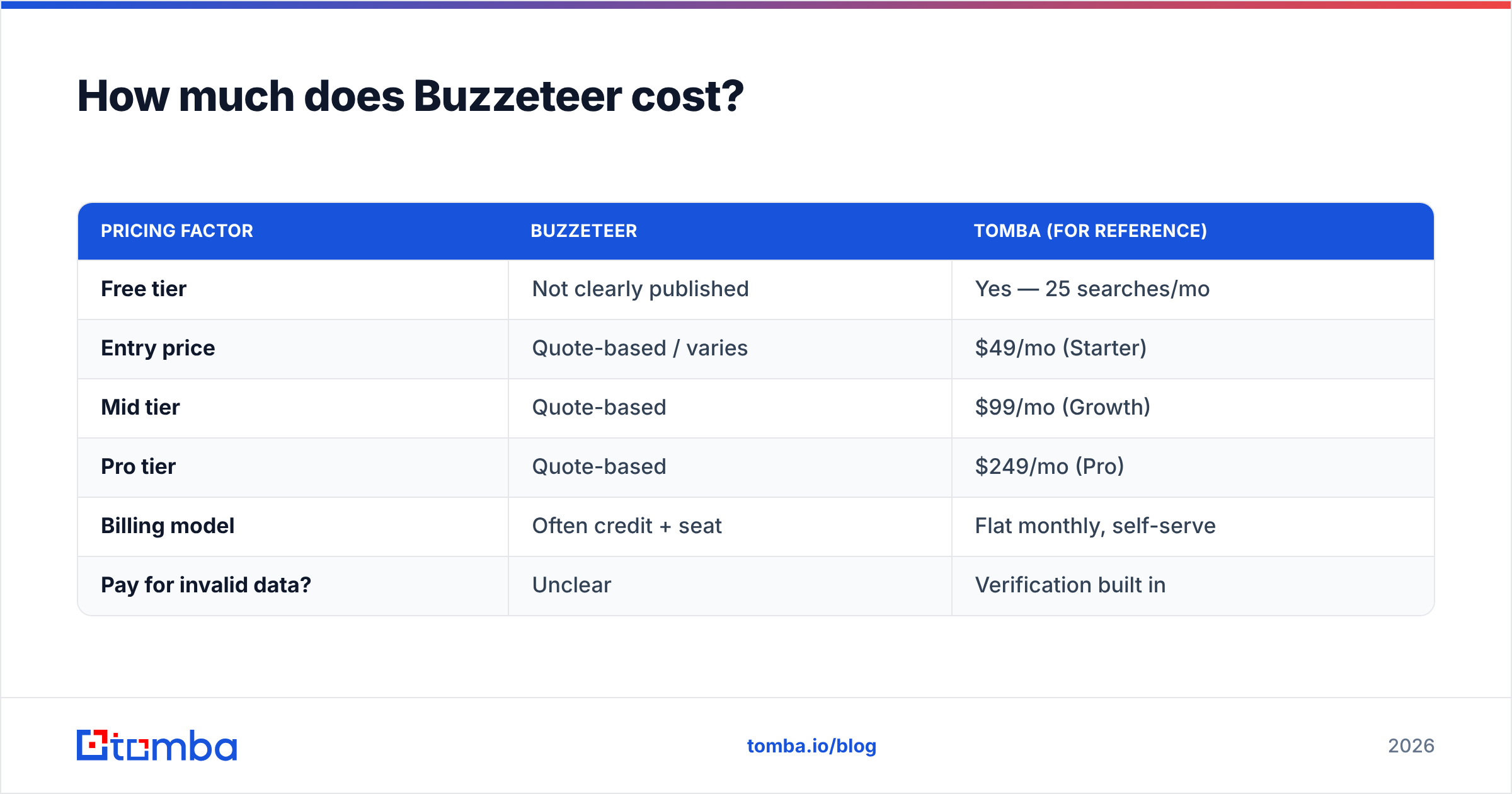
For comparison, here's how an opaque, quote-led model stacks against a transparent, self-serve one. Note how a published-price tool removes most of the budgeting guesswork:
| Pricing factor | Buzzeteer | Tomba (for reference) |
|---|---|---|
| Free tier | Not clearly published | Yes — 25 searches/mo |
| Entry price | Quote-based / varies | $49/mo (Starter) |
| Mid tier | Quote-based | $99/mo (Growth) |
| Pro tier | Quote-based | $249/mo (Pro) |
| Billing model | Often credit + seat | Flat monthly, self-serve |
| Pay for invalid data? | Unclear | Verification built in |
You can see full, current numbers on the Tomba pricing page if you want a concrete benchmark to negotiate against.

What do Buzzeteer reviews say?#
Reviews for niche lead-gen tools tend to cluster around the same themes, and Buzzeteer is no exception. Cross-referencing public review platforms like G2 and Capterra is the smart move before buying, because marketing copy never mentions the friction points.
The recurring positive signals:
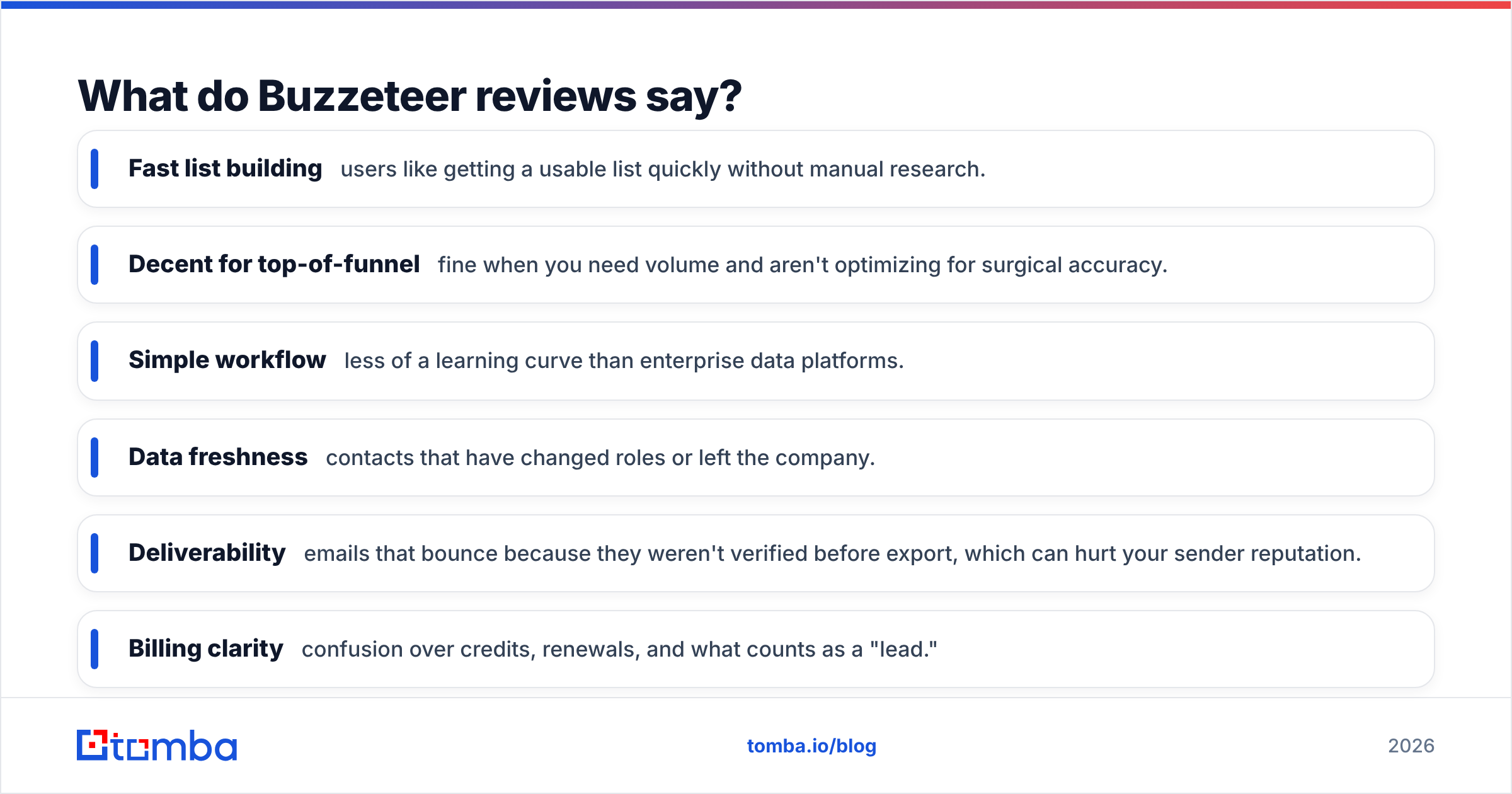
- Fast list building — users like getting a usable list quickly without manual research.
- Decent for top-of-funnel — fine when you need volume and aren't optimizing for surgical accuracy.
- Simple workflow — less of a learning curve than enterprise data platforms.
The recurring complaints:
- Data freshness — contacts that have changed roles or left the company.
- Deliverability — emails that bounce because they weren't verified before export, which can hurt your sender reputation.
- Billing clarity — confusion over credits, renewals, and what counts as a "lead."
- Support response times on lower commitments.
None of these is unique to Buzzeteer — they're the standard failure modes of any list-first tool. But they explain why teams that scale outbound eventually split the job into two cleaner steps: find and verify separately, using tools that are good at each. Running every address through an email verifier before send is the single highest-leverage fix for the bounce problem reviewers describe.
What are the pros and cons of Buzzeteer?#
Here's the balanced view. Use this as your gut-check, then validate against your own trial data.
Pros
- Speed to a list — good when the deadline matters more than precision.
- Generalist coverage — one tool attempts the full company-to-contact path.
- Beginner-friendly — fewer moving parts than stitching a custom stack.
- Export flexibility — gets data into CSV/CRM with minimal fuss.
Cons
- Opaque pricing — quote-led models make ROI hard to forecast and harder to compare.
- Verification gap — if accuracy isn't guaranteed pre-export, you inherit the bounce risk.
- Data decay — B2B contact data rots ~2-3% per month; freshness is everything.
- Lock-in risk — annual or seat commitments before you've proven value.
- Jack-of-all-trades — rarely the best tool for any single job versus a specialist.
The core tension is this: a generalist list tool optimizes for "give me data now," while a focused email finder plus verifier optimizes for "give me data that lands." Outbound results are decided at the inbox, not the export button — so the second priority usually wins on revenue.
Who is Buzzeteer best for?#
Buzzeteer makes the most sense if you're an early-stage team or agency that needs broad lists fast, you're not yet sending high enough volume for deliverability to bite you, and you're comfortable with a sales-led pricing conversation.
It makes less sense if any of these are true:
- You send enough cold email that bounce rate directly threatens your domain.
- You need predictable, self-serve pricing you can scale up or down monthly.
- You want verification baked in rather than as a separate paid step.
- You mostly need emails by name or domain, not a full company database.
If you recognize yourself in that second list, you're really shopping for a precision finder-and-verifier, not a generalist list tool — and that changes the math considerably.

Is there a better Buzzeteer alternative?#
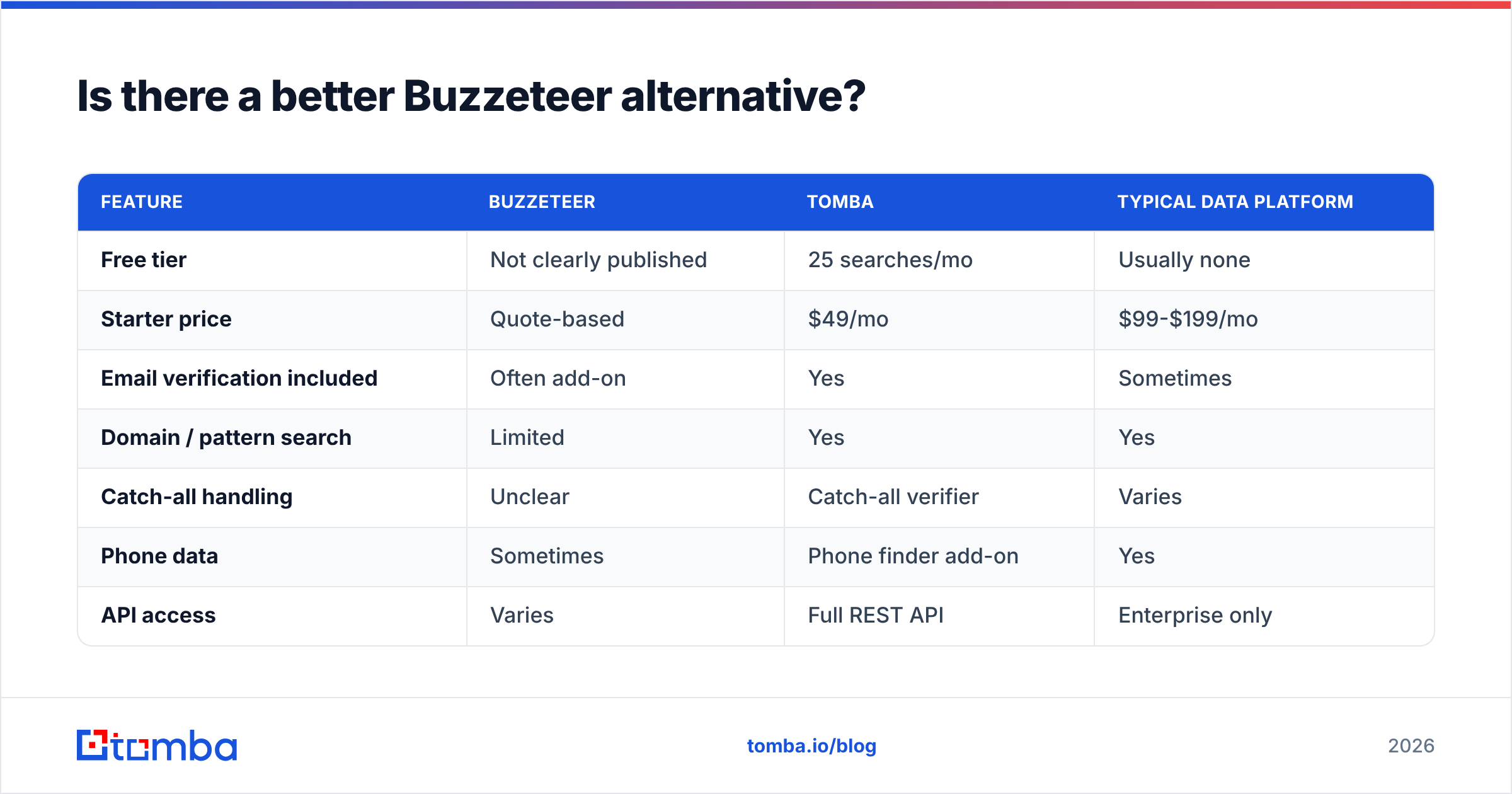
For most teams whose real job is finding and verifying business emails, a dedicated tool wins on price transparency and accuracy. Below is a like-for-like comparison so you can judge the trade-off without the sales pitch.
| Feature | Buzzeteer | Tomba | Typical data platform |
|---|---|---|---|
| Free tier | Not clearly published | 25 searches/mo | Usually none |
| Starter price | Quote-based | $49/mo | $99-$199/mo |
| Email verification included | Often add-on | Yes | Sometimes |
| Domain / pattern search | Limited | Yes | Yes |
| Catch-all handling | Unclear | Catch-all verifier | Varies |
| Phone data | Sometimes | Phone finder add-on | Yes |
| API access | Varies | Full REST API | Enterprise only |
| Pricing transparency | Low | High | Low-medium |
A few specialist capabilities are worth calling out, because they're where generalist list tools tend to be thin:
- Domain search — pull every public email pattern for a company at once via domain search, instead of guessing one contact at a time.
- Catch-all verification — distinguish truly valid mailboxes from accept-all domains, the silent killer of bounce-free claims.
- Built-in verification — every result is checked before it reaches your sequencer.
- Self-serve, flat pricing — scale from a free tier to a paid plan without a quote.
If you'd rather pull contacts in volume, data enrichment and bulk workflows cover the "I need a list" job too — just with verification attached so you're not paying to email dead addresses.
How do you choose between Buzzeteer and the alternatives?#
Decide on three axes, in this order: accuracy, price transparency, and fit.
- Accuracy first. Run a 100-contact test through any tool you're considering, send to a seed list, and measure the real bounce rate. A cheap list that bounces 15% is more expensive than a slightly pricier list that bounces 2%, because bounces damage the domain you send everything else from.
- Price transparency second. If you can't see the price without a call, assume it's higher than the published competitor and harder to exit. Quote-led pricing favors the vendor, not you.
- Fit last. Match the tool to the job. List-building generalist for broad top-of-funnel; finder-plus-verifier for precise, deliverable outreach.
A simple rule: if more than half your use case is "find a verified work email for this person or company," a focused finder is the better spend. If it's genuinely "build me a broad market map," a list tool earns its place — provided the pricing is something you can actually forecast.
Frequently asked questions#
Is Buzzeteer free? There's no clearly published, durable free tier in the way self-serve finders offer one. Confirm current trial terms directly with the vendor, and compare against tools that publish a free allowance up front.
Why does Buzzeteer pricing vary so much? Because it leans on credits, seats, and quotes rather than flat plans. Your cost depends on volume and negotiation, which is great for the vendor and frustrating for buyers who want to budget.
Will Buzzeteer leads bounce? Any list will bounce if it isn't verified before sending. If verification isn't included, run every address through a verifier first to protect your email deliverability.
What's the safest alternative for cold email? A finder with built-in verification, transparent pricing, and catch-all handling. That combination minimizes bounces and budget surprises — the two things that sink most outbound programs.
The bottom line#
Buzzeteer can get you a list quickly, and for some early-stage teams that's enough. But opaque, quote-led pricing plus an uncertain verification story makes it a hard tool to recommend for anyone whose revenue depends on emails actually landing. The two costs reviewers complain about most — bounced sends and confusing bills — are exactly the costs a transparent finder-and-verifier is built to remove.
If your real job is finding accurate, verified business emails at a price you can predict, start with the Tomba Email Finder. You get a free tier to test accuracy on your own list, flat pricing from $49/mo with no sales call, and verification built in — so you spend on contacts that convert, not on guesses that bounce. Run the same 100-contact test through both and let the bounce rate decide.
// get started
Find, verify and enrich your first contacts today
Start on the free plan with 25 searches a month, then scale when your team is ready.
Free plan · No credit card required · GDPR & CCPA
// about the author