By Way of Introduction Email: Templates That Get Replies in 2026
"By way of introduction" can open doors or kill your reply rate. Here's how to write the intro email people actually answer in 2026 — with templates, a phrasing table, and the data behind it.

By Way of Introduction Email: Templates That Get Replies in 2026
You typed "by way of introduction" into an email, paused, and wondered: does this still sound professional, or does it sound like a 2008 form letter? Fair question. The phrase is fine — but the email around it is usually the problem.
TL;DR#
- "By way of introduction" is a framing line, not a strategy. It signals "we haven't met, here's why I'm reaching out." It works only when the rest of the email earns the recipient's attention.
- Lead with relevance, not your résumé. The first two sentences should be about them — a trigger, a mutual connection, or a specific problem — not your title.
- Warm intros outperform cold ones 3–5x on reply rate. If someone can connect you, ask for that before sending cold.
- Deliverability is half the battle. A perfect intro email that lands in spam gets zero replies. Verify the address and warm your domain first.
- Templates below cover warm intros, cold intros, mutual-connection intros, and the self-introduction to a new team — plus a phrasing table so you stop guessing.
What does "by way of introduction" actually mean in an email?#
It means "let me introduce myself (or someone else) before I get to the point." Think of it like knocking before you walk into a room — you're acknowledging that the recipient doesn't know you yet, so you're giving context before making a request.
There are three common uses, and mixing them up is where people lose the reader:
- Self-introduction — you introduce yourself to someone new ("By way of introduction, I lead partnerships at Acme").
- Third-party introduction — you connect two people ("By way of introduction, meet Sara, who runs growth at Beta").
- Cold outreach framing — you use it to soften a first-touch sales or networking email.
Each one needs a slightly different structure. A self-intro to a new colleague can be warm and casual. A cold sales intro has about eight seconds to prove relevance before it's archived. According to HubSpot's sales benchmarks, personalized first lines consistently outperform generic openers — and "by way of introduction" alone is not personalization.

Is "by way of introduction" too formal for 2026?#
No — but it's easy to make it sound stiff. The phrase itself is neutral. What dates an email is everything around it: "Dear Sir or Madam," "I hope this email finds you well," and three paragraphs about your company before you mention the reader once.
Used well, it's efficient. Used badly, it's a tell that you copy-pasted a template and changed the name field. The fix is simple: keep the phrase, but make the sentence after it specific to the person you're writing to.
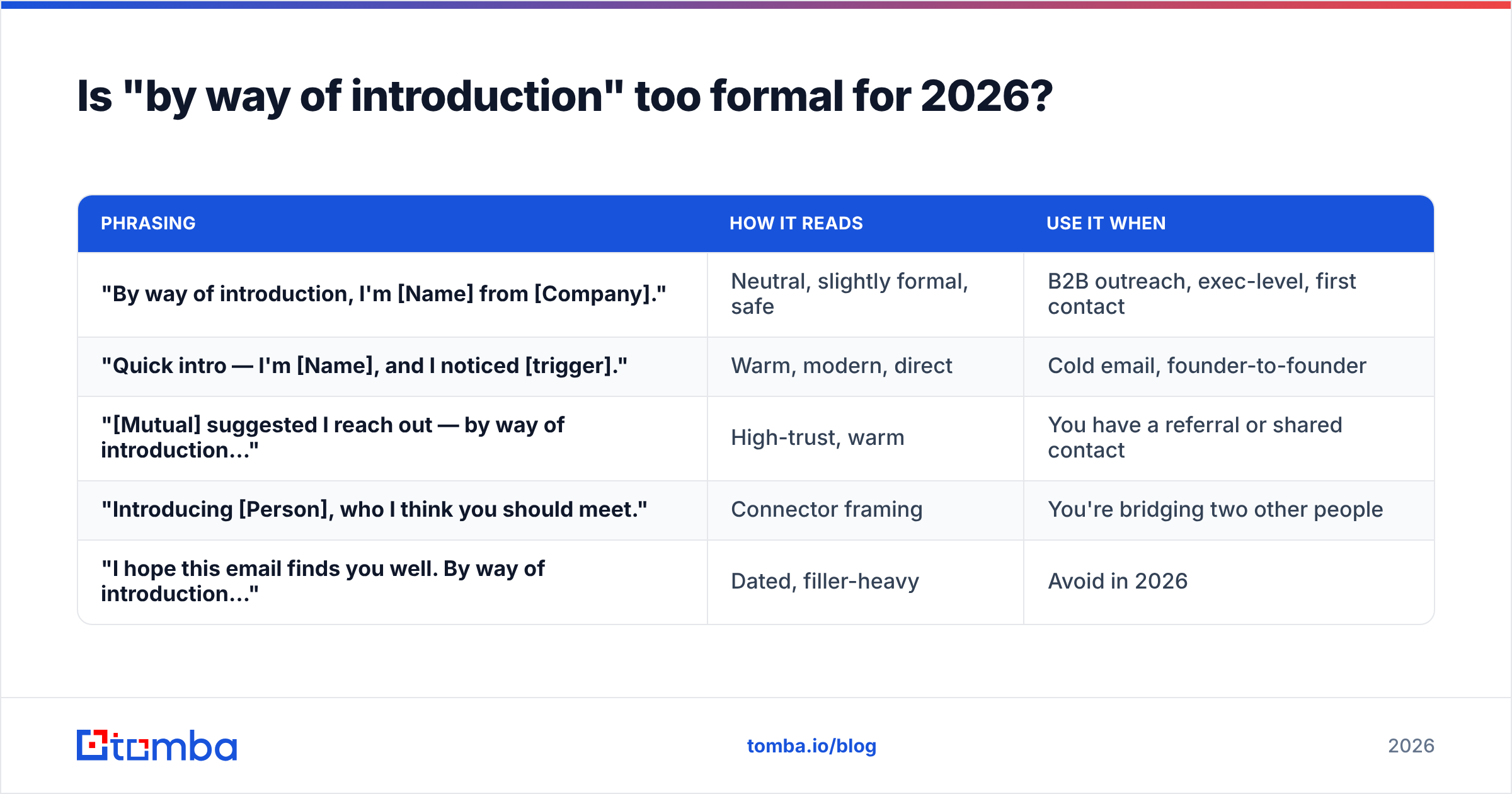
Here's the difference in practice:
| Phrasing | How it reads | Use it when |
|---|---|---|
| "By way of introduction, I'm [Name] from [Company]." | Neutral, slightly formal, safe | B2B outreach, exec-level, first contact |
| "Quick intro — I'm [Name], and I noticed [trigger]." | Warm, modern, direct | Cold email, founder-to-founder |
| "[Mutual] suggested I reach out — by way of introduction…" | High-trust, warm | You have a referral or shared contact |
| "Introducing [Person], who I think you should meet." | Connector framing | You're bridging two other people |
| "I hope this email finds you well. By way of introduction…" | Dated, filler-heavy | Avoid in 2026 |
The pattern: the more specific and human the words around the phrase, the better it lands. Formality isn't the enemy — vagueness is.
How do you structure a "by way of introduction" email that gets replies?#
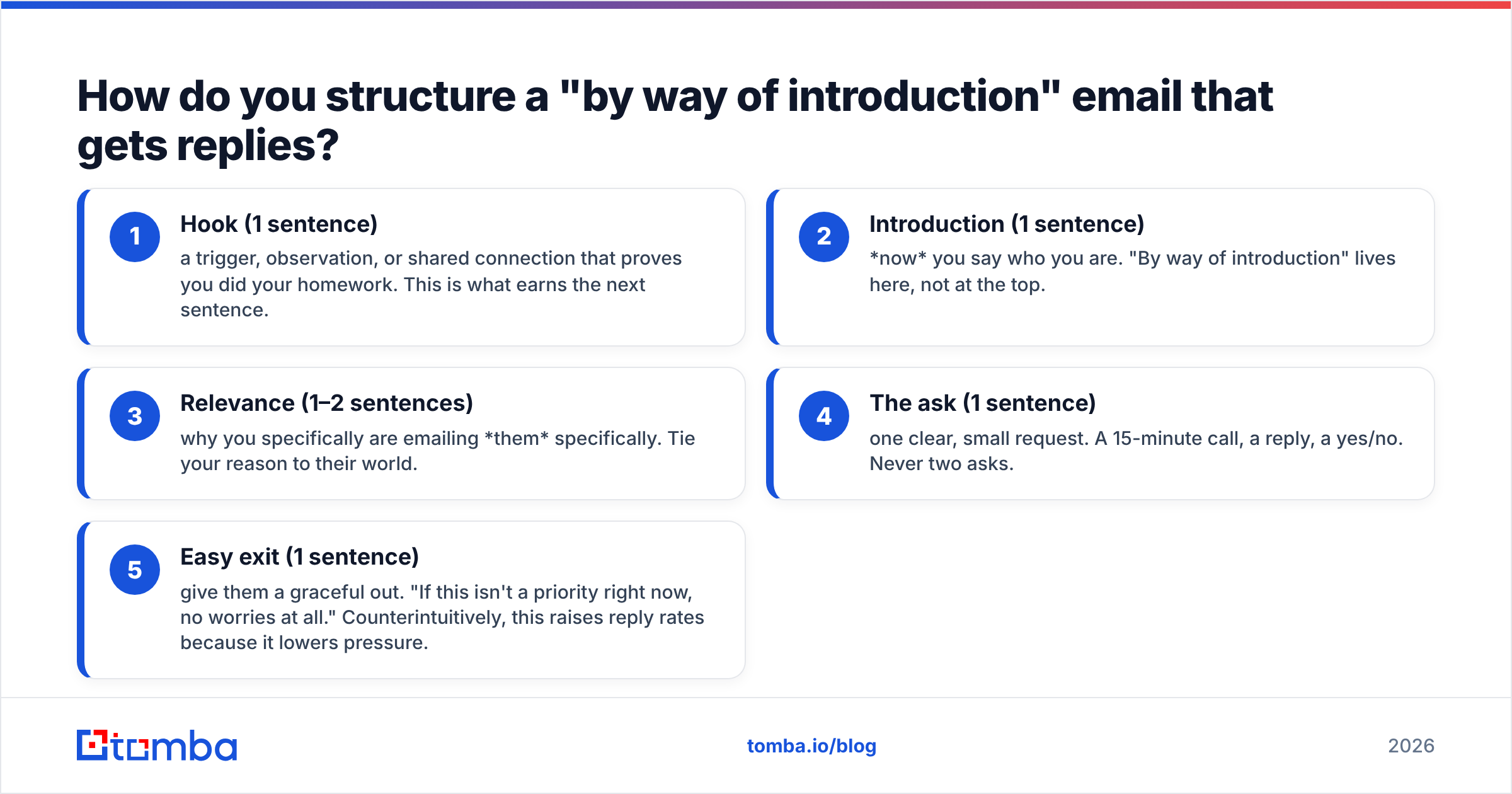
Follow a five-part skeleton: hook, intro, relevance, ask, easy exit. Most intro emails fail because they invert this — they open with the writer's credentials and bury the reader's reason to care at the bottom.
Use this order every time:
- Hook (1 sentence) — a trigger, observation, or shared connection that proves you did your homework. This is what earns the next sentence.
- Introduction (1 sentence) — now you say who you are. "By way of introduction" lives here, not at the top.
- Relevance (1–2 sentences) — why you specifically are emailing them specifically. Tie your reason to their world.
- The ask (1 sentence) — one clear, small request. A 15-minute call, a reply, a yes/no. Never two asks.
- Easy exit (1 sentence) — give them a graceful out. "If this isn't a priority right now, no worries at all." Counterintuitively, this raises reply rates because it lowers pressure.
Keep the whole thing under 120 words. The longer the intro email, the lower the odds anyone finishes it. If you want to test your draft before sending, run the subject line through a subject line tester and the body through a spam checker so you know it'll actually reach the inbox.
What are the best "by way of introduction" email templates?#
Below are four templates you can copy, each matched to a different scenario. Swap the brackets, keep the structure, and resist the urge to add a second paragraph about your product.
1. Cold intro (B2B outreach)#
Subject: Quick question about [their initiative]
Hi [First Name],
Saw that [Company] just [trigger — launched X, hired for Y, expanded to Z]. By way of introduction, I'm [Name] at [Company] — we help [similar companies] with [specific outcome].
Worth a quick chat to see if it's relevant to what you're building? If the timing's off, no problem at all.
[Name]
2. Warm intro (referral)#
Subject: [Mutual] thought we should connect
Hi [First Name],
[Mutual Name] mentioned you're tackling [problem] and suggested I reach out. By way of introduction, I'm [Name] — I've spent the last few years working on exactly this with teams like [example].
Happy to share what's worked. Open to 15 minutes next week?
[Name]
3. Self-intro to a new team#
Subject: Hello from your new [role]
Hi team,
By way of introduction, I'm [Name], joining as [role] starting [date]. I'll be focused on [area], and I'm looking forward to working with each of you.
A bit about me: [one human detail]. I'll be setting up short intro chats over the next two weeks — grab any open slot here: [link].
[Name]
4. Connector intro (introducing two people)#
Subject: Intro: [Person A] <> [Person B]
[Person A], meet [Person B], who runs [role] at [Company] — sharp on [topic]. [Person B], [Person A] is [context], and I think you two should compare notes on [shared interest].
I'll step out of the thread and let you take it from here.
[Name]
Want more reusable structures? Tomba's free cold email templates library covers follow-ups and sequences too, so an intro doesn't dead-end after one send.

Does your intro email even reach the inbox?#
The best-written introduction is worthless if it lands in spam — and most senders never check. Two things sink first-touch emails before anyone reads them: a bad address and a cold sending domain.
Start with the address. Sending to a guessed or stale email triggers a bounce, and bounces wreck your sender reputation fast. A single high-bounce campaign can knock a healthy domain into the spam folder for weeks. Before you send a batch of intros, run them through an email verifier so you're only contacting real, deliverable inboxes.
Then there's the domain itself. A brand-new or rarely-used domain sending a sudden burst of intro emails looks like spam to mailbox providers, regardless of how polite your copy is. Mailbox providers like Google publish sender guidelines, and warming up gradually keeps you on the right side of them. If you're scaling outreach, check your email deliverability basics — SPF, DKIM, and a steady sending ramp — before volume goes up.
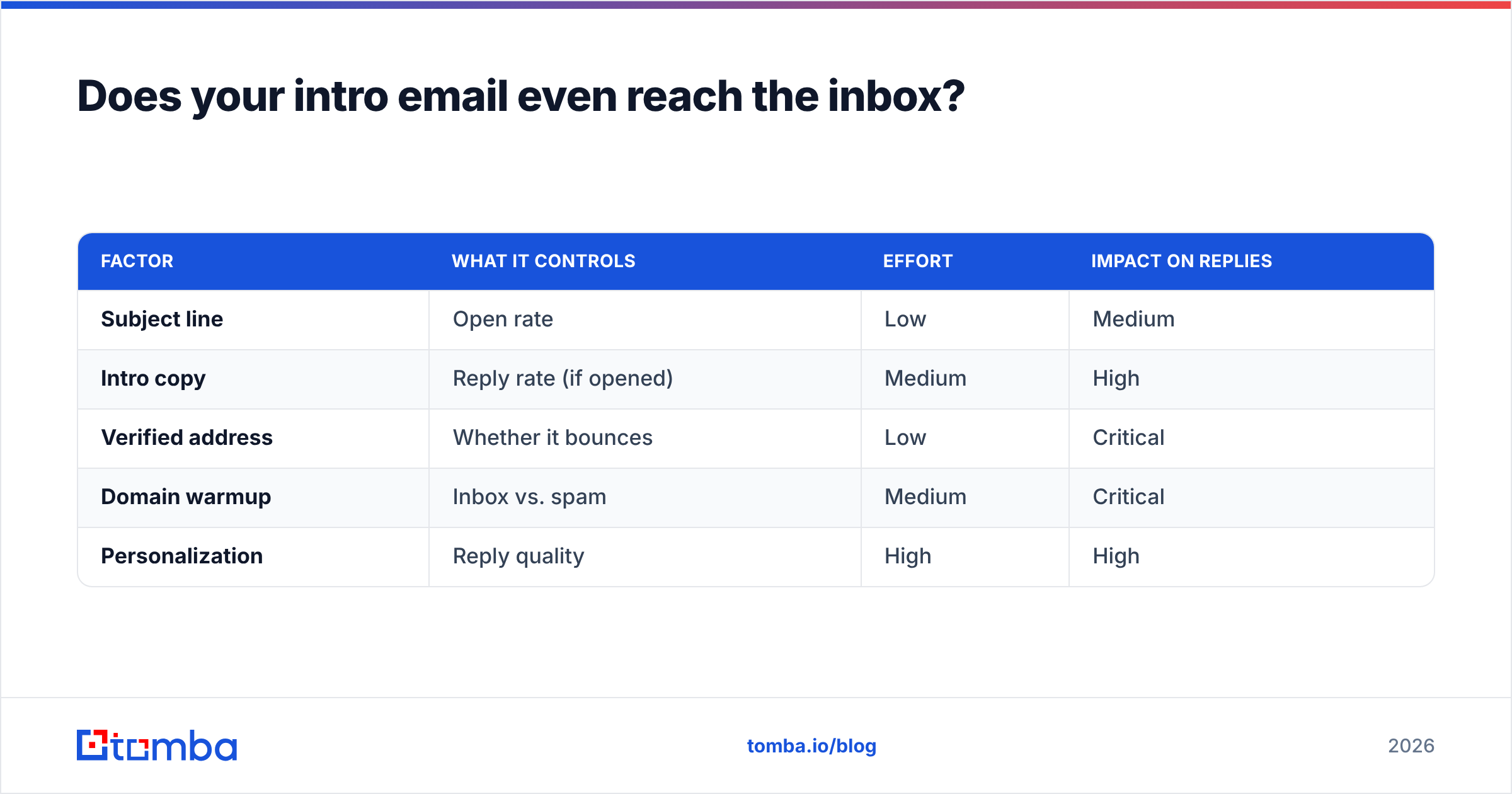
Here's how the deliverability layer compares to the copywriting layer most people obsess over:
| Factor | What it controls | Effort | Impact on replies |
|---|---|---|---|
| Subject line | Open rate | Low | Medium |
| Intro copy | Reply rate (if opened) | Medium | High |
| Verified address | Whether it bounces | Low | Critical |
| Domain warmup | Inbox vs. spam | Medium | Critical |
| Personalization | Reply quality | High | High |
Notice that the two "critical" rows are both technical, not creative. You can write the best "by way of introduction" line in the world, but if the email never reaches a real inbox, it doesn't matter.
How do you find the right person to introduce yourself to?#
Send to the decision-maker, not the info@ inbox. A flawless intro email to the wrong person is a wasted send. The highest-converting intros go to a named human with the authority to act — which means you need their actual work address, not a generic catch-all.
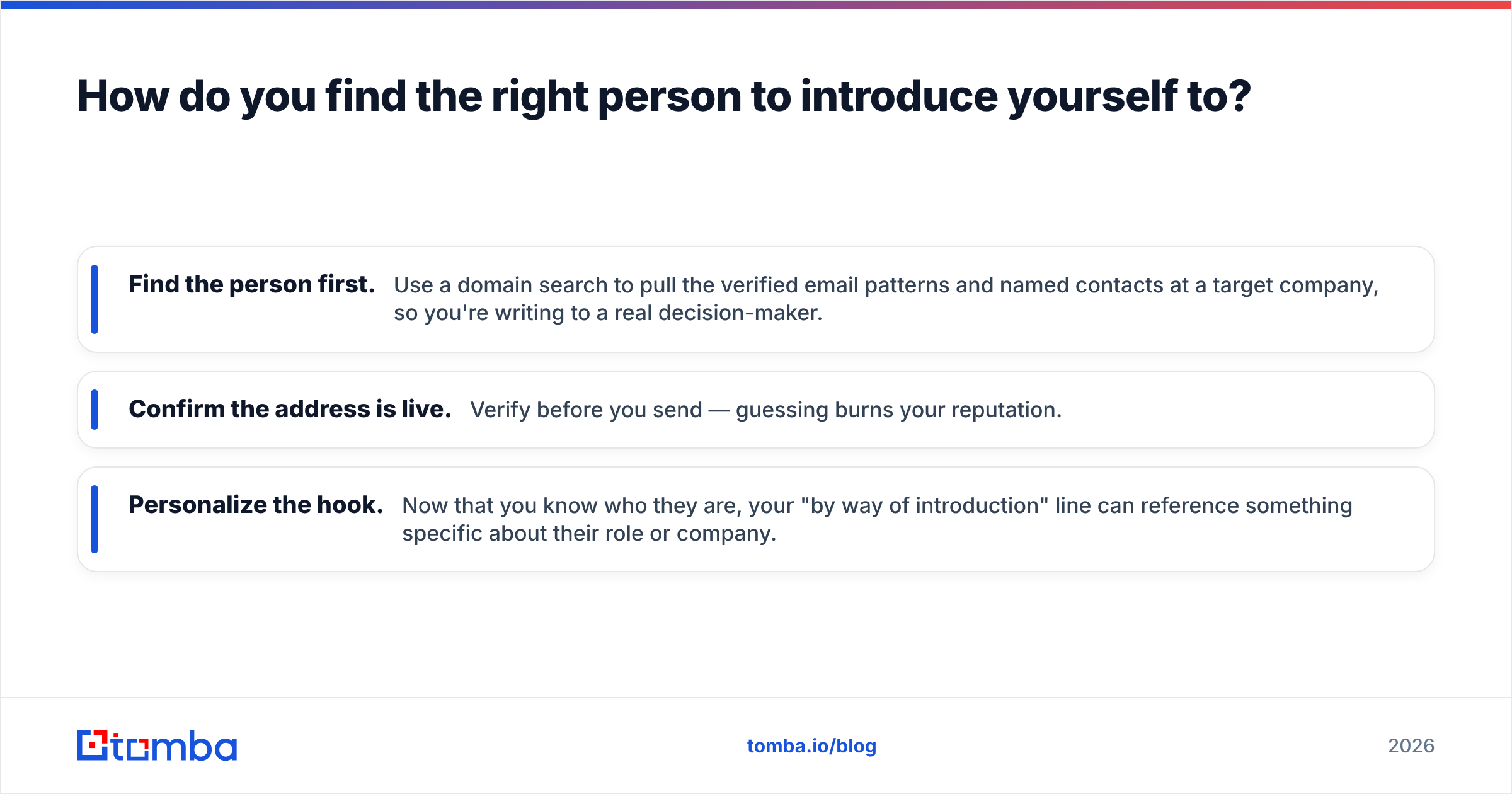
This is where most intro campaigns quietly fail: people either email contact@company.com and hope, or they guess firstname@company.com and get a bounce. Both tank your numbers. A better workflow:
- Find the person first. Use a domain search to pull the verified email patterns and named contacts at a target company, so you're writing to a real decision-maker.
- Confirm the address is live. Verify before you send — guessing burns your reputation.
- Personalize the hook. Now that you know who they are, your "by way of introduction" line can reference something specific about their role or company.
Tools like Tomba, alongside alternatives reviewed on G2, exist precisely because manual guessing doesn't scale past a handful of contacts. The point isn't to spray more intros — it's to send fewer, better-targeted ones to people who actually exist.
What mistakes kill a "by way of introduction" email?#
The big four: too long, too much about you, no clear ask, and no relevance. If your draft has any of these, the recipient archives it before the second paragraph.
- It opens with you. "By way of introduction, I'm the VP of…" — the reader doesn't care yet. Earn it with a hook first.
- It has two asks. "Can we hop on a call, and also could you forward me to procurement?" Pick one.
- It's a wall of text. Three paragraphs is two too many for a first touch.
- It's generic. If you could send the exact same email to 500 people, so could anyone. Mailbox filters notice, and so do humans.
- It skips verification. You spent 20 minutes on copy and zero seconds confirming the address is real.
Fix relevance and verification first — they move the needle more than any clever turn of phrase. A short, specific, deliverable email beats a long, polished, undeliverable one every single time.
Frequently asked questions#
Is "by way of introduction" grammatically correct? Yes. It's a standard idiomatic phrase meaning "as a way of introducing myself or someone else." It's correct in both formal and semi-formal writing.
Should I use it in a cold sales email? You can, but pair it with a strong, personalized hook. On its own it reads like a template. Put the relevance before the phrase, not after.
What's a less formal alternative? "Quick intro —", "A bit about me —", or simply "I'm [Name], and I'm reaching out because…". Match the tone to your audience.
How long should the email be? Under 120 words for a first touch. The shorter it is, the more likely it gets read and answered.
Write the intro, then make sure it lands#
A great "by way of introduction" email is half copy, half delivery. You've got the templates and the phrasing table — now make sure each message reaches a real person who can actually reply. Use the Tomba Email Finder to pull verified, deliverable addresses for the decision-makers you want to reach, so every carefully written intro lands in a real inbox instead of bouncing into the void. Start free with 25 searches a month, and check Tomba pricing when you're ready to scale your outreach — Starter is $49/mo. Find the right person, verify the address, then send the intro. In that order, your reply rate takes care of itself.
// get started
Find, verify and enrich your first contacts today
Start on the free plan with 25 searches a month, then scale when your team is ready.
Free plan · No credit card required · GDPR & CCPA
// about the author