Bytemine vs Clearalist: Email Finder Showdown (2026)
Bytemine vs Clearalist, compared on accuracy, pricing, data coverage, and verification in 2026 — plus where a third option quietly beats both.
You found two tools on a shortlist, both promising "verified B2B emails at scale," and now you have to pick one. Bytemine and Clearalist sit in the same crowded category, charge in the same range, and use almost identical marketing language. The differences that actually matter — match rate on real lists, how they handle catch-all domains, what a bounce costs you downstream — are the ones neither homepage tells you about.
This is a practical, side-by-side breakdown of Bytemine vs Clearalist for 2026: where each one is genuinely strong, where the data thins out, and how to run a test that exposes the truth in an afternoon.
TL;DR#
- Bytemine leans toward breadth — large raw database, aggressive credit packaging, good for high-volume list building where some waste is acceptable.
- Clearalist leans toward precision — tighter verification, a cleaner UI, and better single-lookup workflows, but you pay more per usable email.
- Neither publishes an independently audited match rate, so treat their headline accuracy numbers as marketing until you run your own bounce test.
- For most teams the real decision is price-per-verified-email, not price-per-credit — and that's where a third option, Tomba, tends to undercut both.
- Run the 100-contact test in the last section before you commit to an annual plan with either vendor.
What do Bytemine and Clearalist actually do?#
Both are B2B email-finding and lead-enrichment platforms. You give them a name and a company (or a domain, or a LinkedIn URL) and they return a business email address, usually with a confidence score and some firmographic data attached. Under the hood, the job has three parts, and every tool in this category is really just a different balance of the three:
- Sourcing — collecting candidate emails from public pages, partner data, opt-in contributions, and pattern inference (e.g.
first.last@company.com). - Verification — pinging the mail server to confirm the inbox exists without sending an actual message, then scoring the result.
- Enrichment — bolting on title, company size, location, and sometimes phone or social data.
Bytemine markets itself on the first pillar (volume of records). Clearalist markets itself on the second (verification quality). That framing alone tells you who each tool is built for — but it doesn't tell you whether the claims hold up.

How accurate are Bytemine vs Clearalist?#
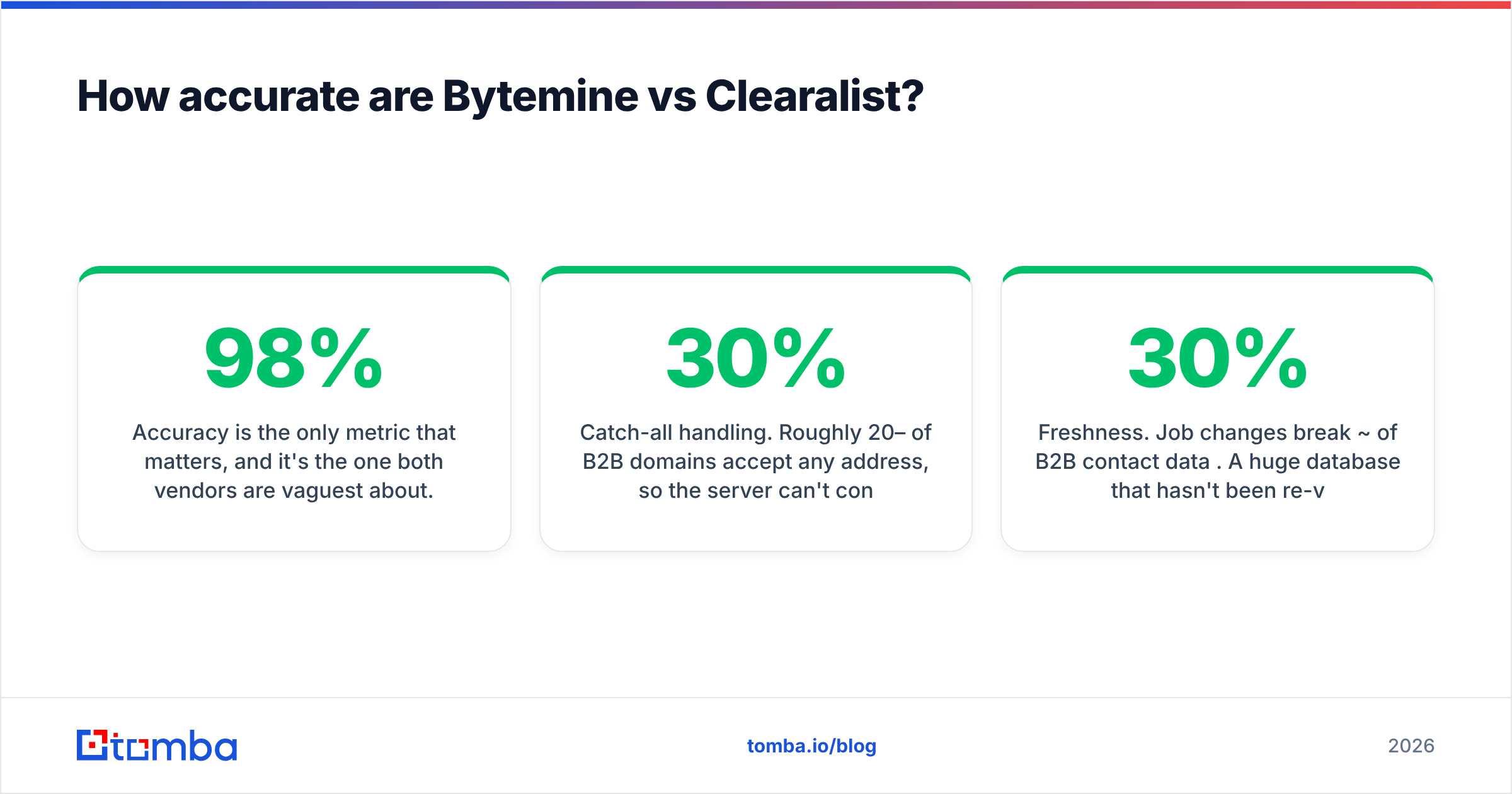
Accuracy is the only metric that matters, and it's the one both vendors are vaguest about. "Up to 98% accuracy" is a ceiling, not an average — it describes the easiest subset of lookups (large companies, common name patterns, non-catch-all domains) and quietly excludes the hard cases where you actually need help.
Here's what separates a real accuracy claim from a marketing one:
- Tested against bounces, not self-scored. A tool grading its own confidence will always look good. The number that counts is how many emails bounce when you send.
- Catch-all handling. Roughly 20–30% of B2B domains accept any address, so the server can't confirm a specific inbox. Honest tools flag these as "risky" or "catch-all"; weaker ones return them as "valid" and let you eat the bounce. If you deal with these often, a dedicated catch-all verifier matters more than raw match rate.
- Freshness. Job changes break ~30% of B2B contact data per year. A huge database that hasn't been re-verified recently is a liability, not an asset.
Bytemine's larger raw database means it will return an address more often — higher match rate on paper. But "returned an address" and "the address works" are different things, and Bytemine's broader sourcing is where stale and inferred records creep in. Clearalist returns fewer addresses but applies a stricter verification gate, so a higher share of what it gives you is deliverable. Neither approach is wrong; they're optimizing different ends of the same trade-off.

The honest takeaway: don't trust either headline number. Both will look great in a demo on cherry-picked accounts and merely okay on your messy real-world list. The test in the final section is the only thing that settles it.
Bytemine vs Clearalist: feature and pricing comparison#
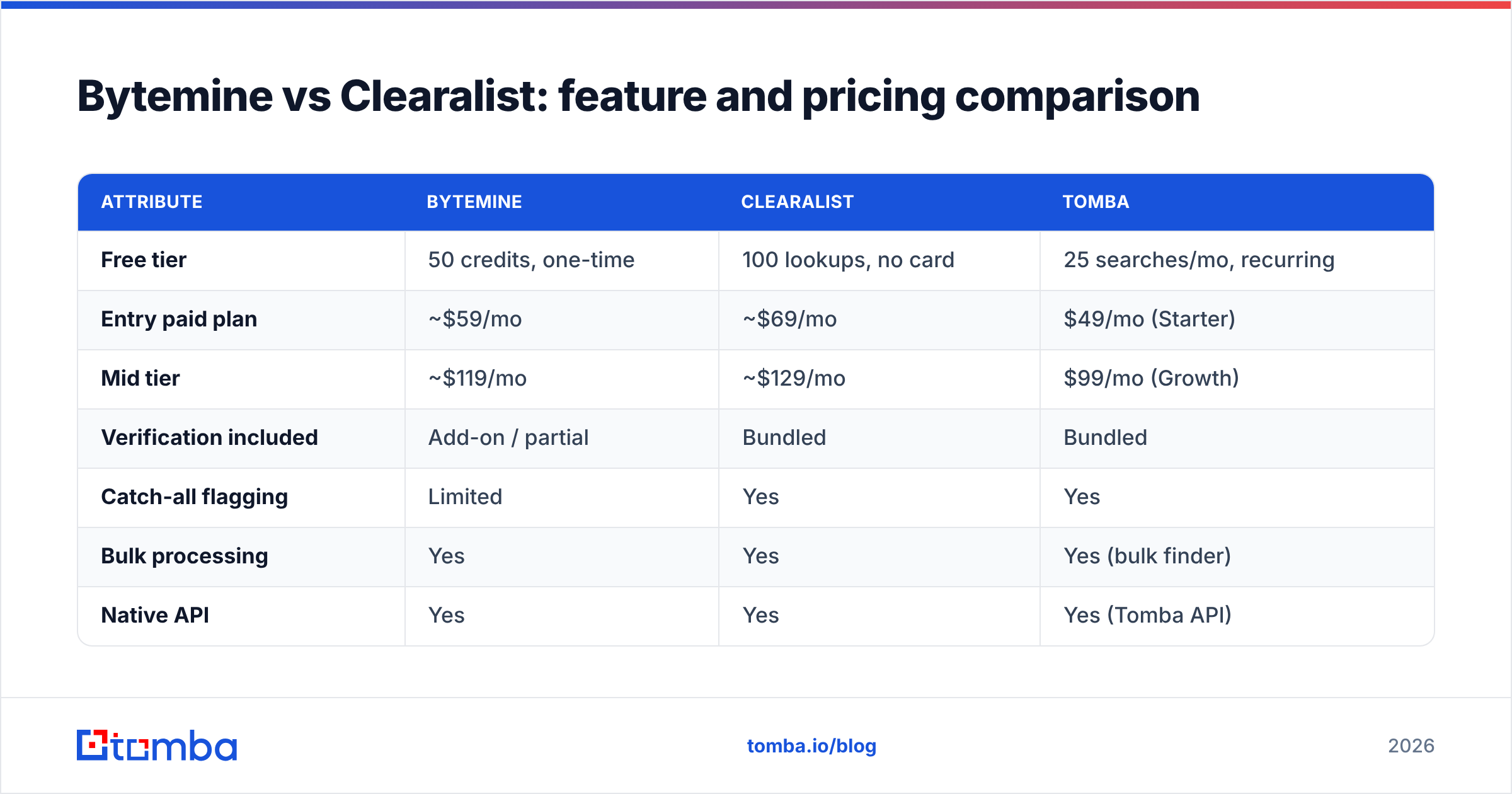
Pricing in this category is deliberately hard to compare because each vendor counts "credits" differently — a search, a verification, and an enrichment may each burn a credit, or may be bundled. Normalize everything to cost per verified email before you decide.
| Attribute | Bytemine | Clearalist | Tomba |
|---|---|---|---|
| Free tier | 50 credits, one-time | 100 lookups, no card | 25 searches/mo, recurring |
| Entry paid plan | ~$59/mo | ~$69/mo | $49/mo (Starter) |
| Mid tier | ~$119/mo | ~$129/mo | $99/mo (Growth) |
| Verification included | Add-on / partial | Bundled | Bundled |
| Catch-all flagging | Limited | Yes | Yes |
| Bulk processing | Yes | Yes | Yes (bulk finder) |
| Native API | Yes | Yes | Yes (Tomba API) |
| Chrome extension | Yes | Yes | Yes |
| Phone data | Add-on | No | Yes (phone finder) |
A few things to read out of that table:
- Free tiers favor evaluation differently. Bytemine and Clearalist give a bigger one-time trial; Tomba's free tier renews monthly, which is better if you have a small, ongoing need rather than a single burst.
- Verification bundling is the hidden cost. If verification is an add-on (Bytemine's pattern in lower tiers), your effective cost per usable email is higher than the sticker price suggests.
- Phone and multi-channel data only matter if you run calling or multichannel sequences — but if you do, paying separately for it adds up fast.
The pricing pages move, so confirm current numbers directly, and cross-check independent reviews on G2 before signing anything annual.
Which tool is better for your use case?#
The "winner" depends entirely on what you're doing. Map your workflow to the right column:
High-volume list building (SDR teams, agencies) — You're enriching thousands of rows and can tolerate some waste because you verify and clean afterward. Bytemine's breadth and credit packaging fit here, provided you run a separate verification pass before sending.
Precision outbound (founders, AE-led, ABM) — You're targeting a defined account list where every bounce hurts your domain reputation. Clearalist's stricter gate suits low-volume, high-value sending where deliverability beats coverage.
Single-contact, on-the-fly lookups — Researching one prospect at a time inside LinkedIn or a CRM. Both have extensions; Clearalist's UI is generally cleaner for this, but a LinkedIn finder workflow is worth comparing before you decide.
Developer / programmatic enrichment — You're calling an API from your own product or data pipeline. Compare rate limits, response schemas, and per-call pricing directly; this is where a transparent email finder API and clear docs matter more than UI polish.
Domain-level prospecting — You want every contact at a target company, not one named person. This is a domain search job, and the quality difference between tools widens here because pattern inference does more of the work.

If your honest answer is "a bit of all five," that's the signal to look past the Bytemine-vs-Clearalist binary entirely — because forcing a breadth tool into a precision job (or vice versa) is how you end up paying for two subscriptions.
What about deliverability and bounce risk?#
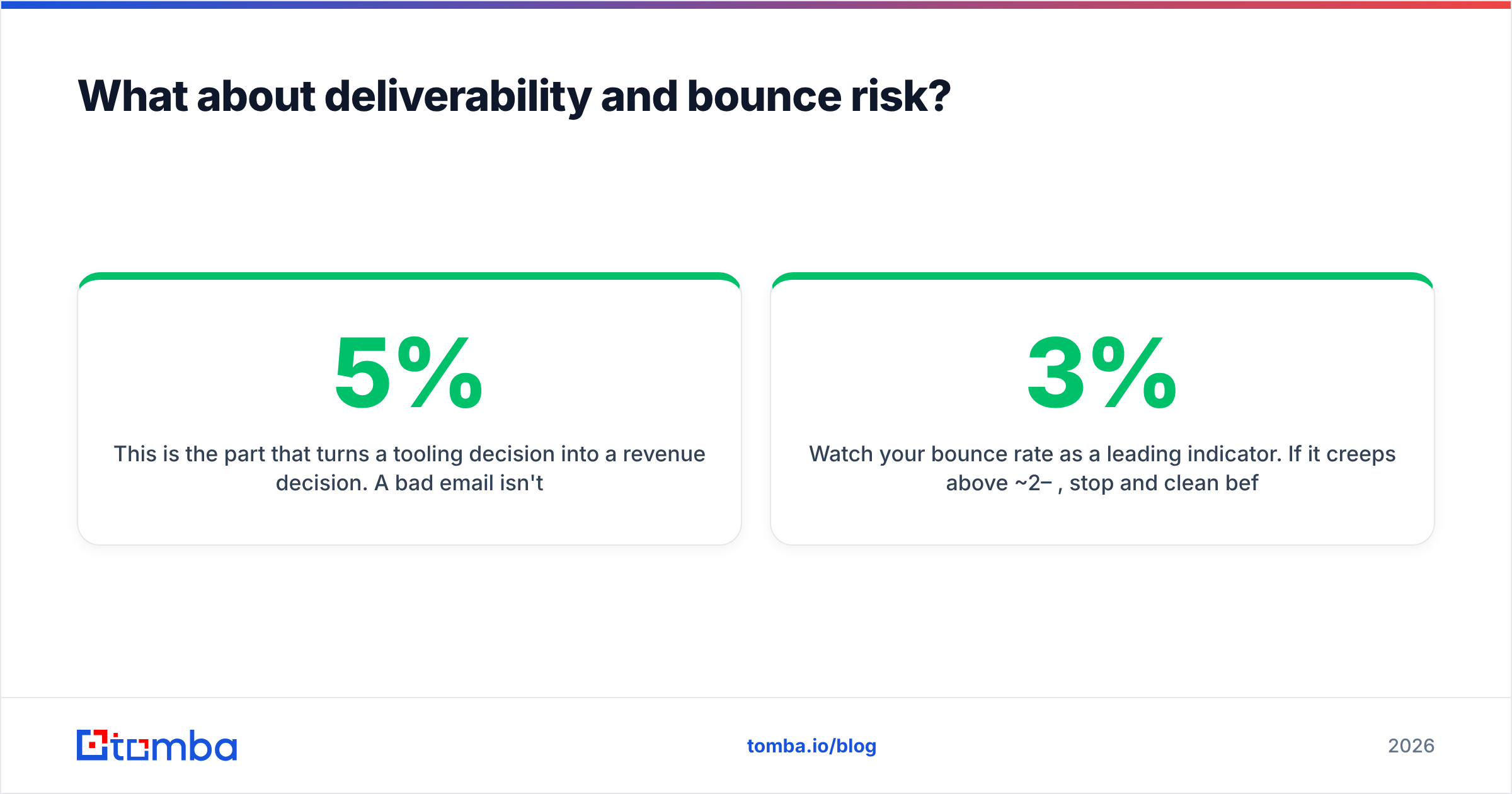
This is the part that turns a tooling decision into a revenue decision. A bad email isn't free — it's negative. Every hard bounce chips at your sender reputation, and once mailbox providers start throttling you, even your good emails land in spam. A tool that's 5% cheaper but bounces 8% more is the more expensive tool, full stop.
Three habits protect you regardless of which vendor you pick:
- Re-verify before every send, not just at import. Data decays between when you build the list and when you mail it. Run the list through an email verifier as a final gate.
- Quarantine catch-all and "risky" results into a separate, low-volume sending stream rather than blasting them with your main domain.
- Watch your bounce rate as a leading indicator. If it creeps above ~2–3%, stop and clean before you keep sending — your provider is already noticing.
Bytemine's volume-first model puts more weight on this step; you must verify its output. Clearalist front-loads verification, so you can be slightly more relaxed — but "slightly," not "skip it." For the underlying mechanics, HubSpot's deliverability guidance is a solid neutral primer.
Is there a better alternative to both?#
Often, yes — and not because Bytemine or Clearalist are bad, but because the breadth-vs-precision trade-off they each force is a false choice for many teams. Tomba is worth putting in the same test because it bundles verification into the core flow rather than charging for it separately, which usually lowers the metric that actually matters: cost per verified email.
Where Tomba tends to differ in a head-to-head:
- Verification is in the loop, not an upsell — every find can be checked against the email verifier without a second tool or a second invoice.
- Recurring free tier — 25 searches every month, so light and occasional users aren't forced onto a paid plan to keep working.
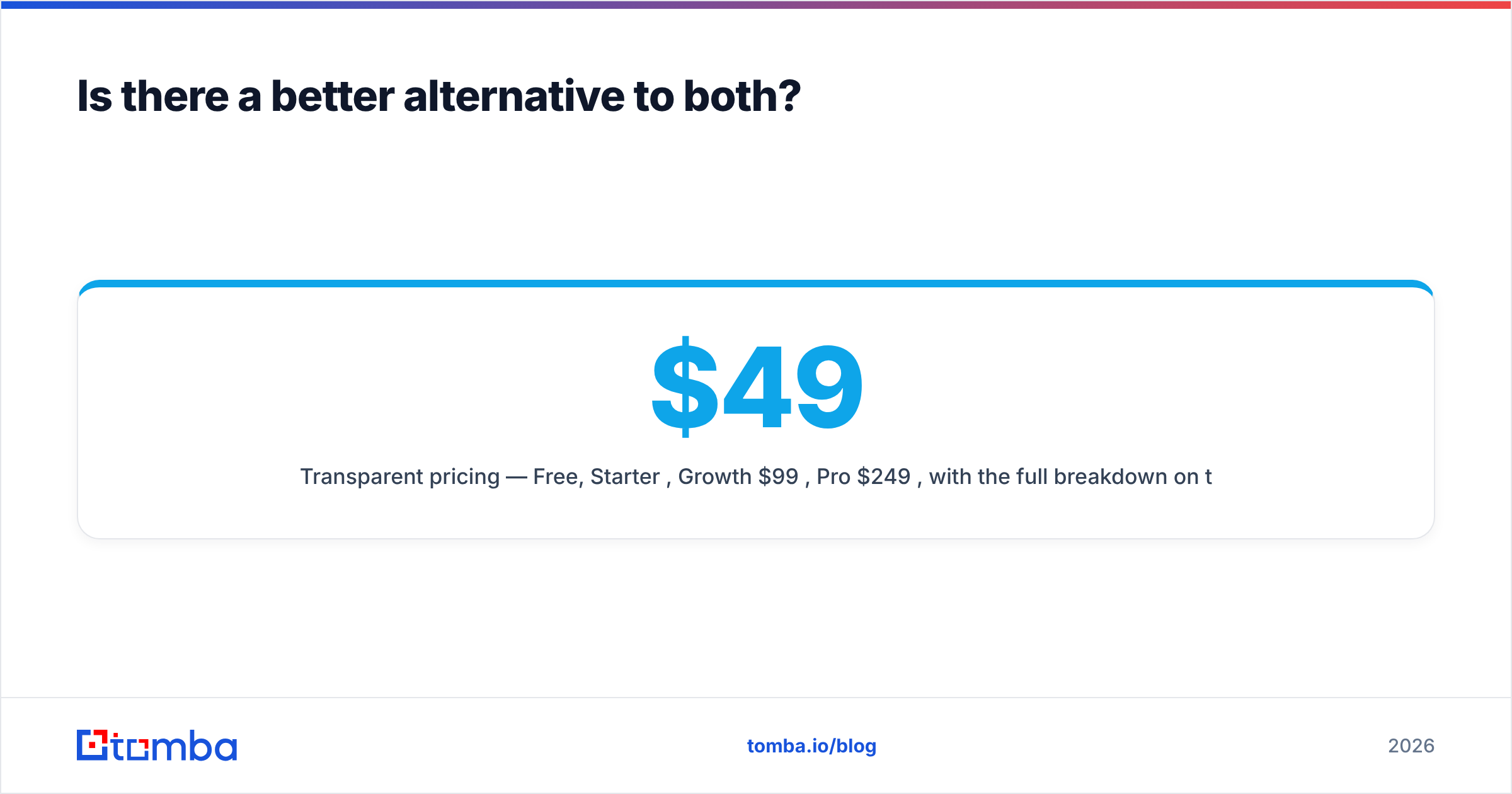
- Transparent pricing — Free, Starter $49/mo, Growth $99/mo, Pro $249/mo, with the full breakdown on the Tomba pricing page rather than buried behind a sales call.
- Multi-tool stack — domain search, catch-all verification, phone data, and data enrichment under one account, which removes the "two subscriptions" problem from the use-case section above.
None of that means Tomba auto-wins for you. It means the shortlist should be three, not two — and the comparison should be run on your data, not theirs.
How to test Bytemine vs Clearalist yourself (the 100-contact method)#
Skip the demos. Here's a controlled test that gives you a real answer in an afternoon, using each tool's free tier:
Build a known-truth sample. Pull 100 contacts where you already know the correct email (past customers, your own teammates across companies, replied-to threads). Mix easy and hard cases — big companies and small ones, common and unusual name patterns, at least 20% catch-all domains.
Run the identical list through each tool. Bytemine, Clearalist, and a third option like Tomba. Record what each returns: address, confidence score, and whether it flagged catch-all/risky.
Score on three columns, not one:
- Match rate — did it return any address?
- Accuracy — does the returned address match the known-truth value?
- Honesty — did it correctly flag the cases it couldn't confirm, instead of guessing?
Send a small, warmed test campaign to a safe subset and measure actual bounce rate. This is the only number marketing can't fake.
Divide cost by verified emails. Not by credits, not by searches — by emails that were correct and deliverable. That single figure usually reorders your shortlist completely.
A tool that returns 95 addresses but bounces 12 is worse than one that returns 80 and bounces 1. The 100-contact test surfaces that gap immediately, and it costs you nothing but an afternoon.
The bottom line#
Bytemine vs Clearalist comes down to breadth versus precision: Bytemine if you build big lists and verify aggressively afterward, Clearalist if you run tight, high-value account lists where every bounce stings. But the framing both vendors push — pick one of us — quietly assumes you must trade coverage for accuracy. You don't have to.
Run the 100-contact test, judge on cost-per-verified-email, and add at least one bundled-verification option to the bracket so you're comparing real outcomes instead of homepage claims.
If you want a starting point that folds finding and verification into one transparent, recurring-free-tier workflow, start with the Tomba Email Finder — load the same test list, check the match rate against your known-truth sample, and let the numbers, not the marketing, make the call.
// get started
Find, verify and enrich your first contacts today
Start on the free plan with 25 searches a month, then scale when your team is ready.
Free plan · No credit card required · GDPR & CCPA
// about the author