Bytemine vs EasyLeadz 2026: Which B2B Data Tool Wins?
Bytemine and EasyLeadz both promise accurate B2B contacts, but they win on different fronts. Here's an honest 2026 breakdown of accuracy, pricing, and coverage.
Choosing between Bytemine and EasyLeadz comes down to one question: do you need direct dials or do you need verified work emails at scale? That single trade-off decides which tool fits your motion better than any feature checklist will.
TL;DR#
- EasyLeadz is built around mobile/direct-dial phone numbers (its "Mr. E" engine), making it strong for cold-calling teams in India, APAC, and EMEA.
- Bytemine leans toward email discovery and lightweight lead lists, with a simpler interface aimed at small teams and solo founders.
- Accuracy is the real battleground: both claim high match rates, but neither publishes independent verification benchmarks the way dedicated email tools do.
- Pricing favors EasyLeadz for pay-as-you-go credits; Bytemine is cheaper at entry but thinner on data depth.
- If your core need is verified email coverage with transparent accuracy, a specialist like Tomba Email Finder often beats both — and you can layer it on top of either.
What are Bytemine and EasyLeadz?#
Both tools sit in the B2B data intelligence category: software that turns a name, company, or domain into a usable contact record. But they were built for different buyers.
EasyLeadz is a contact-discovery platform best known for its "Mr. E" browser extension that pulls direct mobile numbers from LinkedIn profiles. Its pitch is phone-first prospecting — get the decision-maker's cell, skip the gatekeeper. It has strong coverage in India and growing reach across global markets.
Bytemine positions itself as a simpler lead-generation and email-finding tool. It targets founders, freelancers, and small sales teams who want company and contact lists without the complexity (or price) of an enterprise data platform. Email discovery is its center of gravity, with company filtering on top.
Here's the fast orientation before we go deeper:
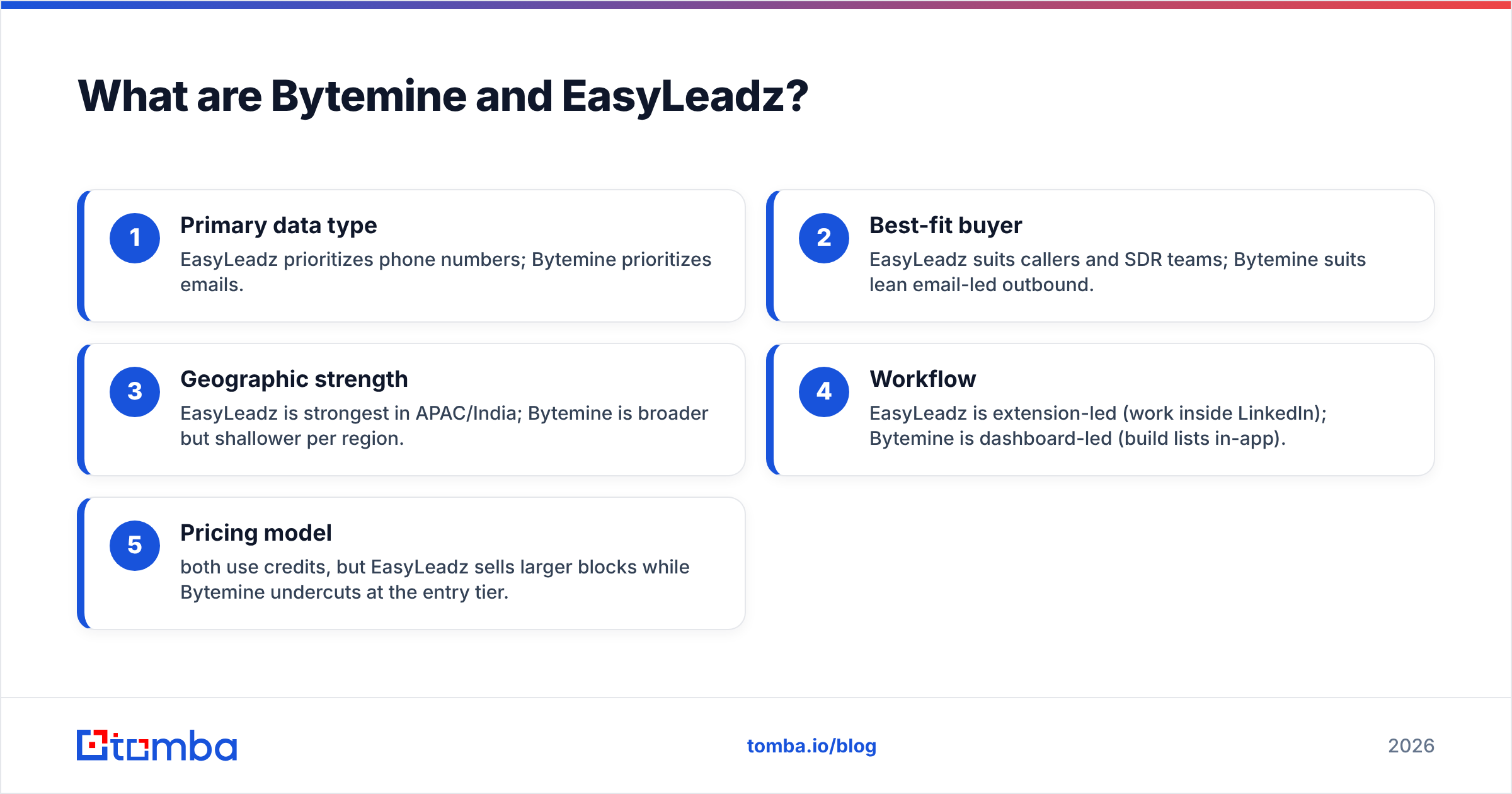
- Primary data type — EasyLeadz prioritizes phone numbers; Bytemine prioritizes emails.
- Best-fit buyer — EasyLeadz suits callers and SDR teams; Bytemine suits lean email-led outbound.
- Geographic strength — EasyLeadz is strongest in APAC/India; Bytemine is broader but shallower per region.
- Workflow — EasyLeadz is extension-led (work inside LinkedIn); Bytemine is dashboard-led (build lists in-app).
- Pricing model — both use credits, but EasyLeadz sells larger blocks while Bytemine undercuts at the entry tier.

How accurate is the data in Bytemine vs EasyLeadz?#
Accuracy is where every data tool lives or dies, and it's also where marketing claims get loudest. EasyLeadz advertises high phone-match rates; Bytemine advertises broad email coverage. The honest answer: neither publishes the kind of independent, repeatable accuracy benchmark you should demand before committing budget.
That matters because the cost of bad data is asymmetric. A wrong phone number wastes one dial. A wrong email can damage your sender reputation, trigger spam traps, and quietly tank your whole domain's email deliverability. Phone data is cheaper to get wrong; email data is expensive to get wrong.

This is the gap dedicated email tools fill. Where Bytemine and EasyLeadz treat verification as a side feature, a specialist runs SMTP checks, catch-all detection, and syntax validation as the core product. If you're going to email the contacts you pull, run them through a real email verifier before the first send — regardless of which platform sourced them. Treat any tool's "valid" flag as a starting hypothesis, not a guarantee.
A practical test before you buy either tool: pull 50 contacts you can independently confirm (your own customers, partners, people you already email) and measure the real hit rate. Vendor-reported accuracy and your-segment accuracy are rarely the same number.
Bytemine vs EasyLeadz: full feature comparison#
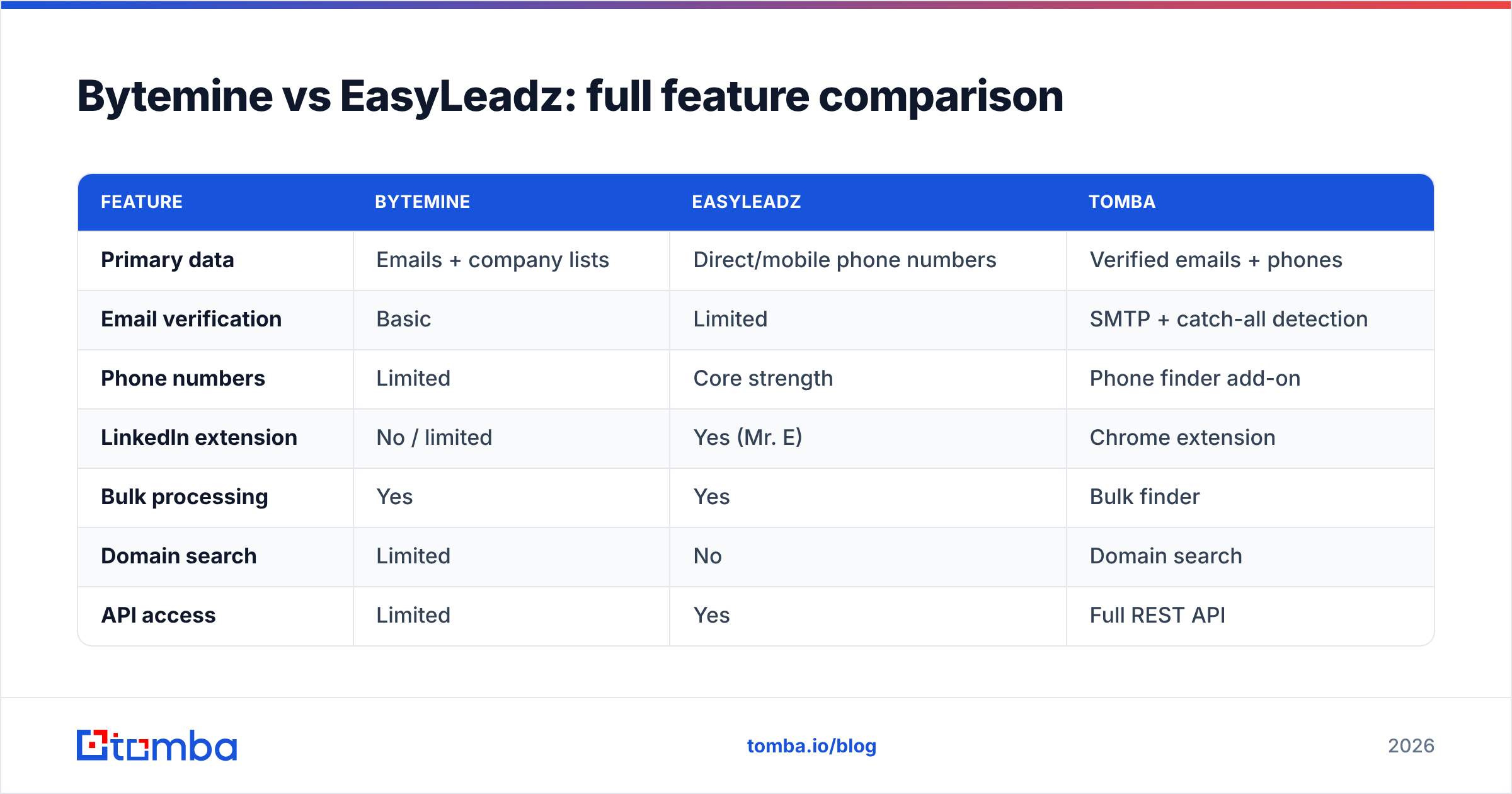
| Feature | Bytemine | EasyLeadz | Tomba |
|---|---|---|---|
| Primary data | Emails + company lists | Direct/mobile phone numbers | Verified emails + phones |
| Email verification | Basic | Limited | SMTP + catch-all detection |
| Phone numbers | Limited | Core strength | Phone finder add-on |
| LinkedIn extension | No / limited | Yes (Mr. E) | Chrome extension |
| Bulk processing | Yes | Yes | Bulk finder |
| Domain search | Limited | No | Domain search |
| API access | Limited | Yes | Full REST API |
| Free tier | Trial credits | Limited free credits | 25 searches/mo |
| Entry price | Low entry | Mid (credit packs) | $49/mo Starter |
| Best for | Lean email outbound | Phone-first SDR teams | Email accuracy at scale |
The pattern is clear. EasyLeadz wins on phone breadth and the in-LinkedIn workflow. Bytemine wins on entry-level simplicity and price. Neither leads on email verification depth, domain-level search, or published accuracy — which is exactly the lane email specialists occupy.
Which is better for phone numbers?#
EasyLeadz, decisively. This is its purpose. If your team's day is built around dials — recruiting, real estate, APAC SaaS, high-velocity SDR motions — EasyLeadz's mobile coverage is the reason to choose it. Bytemine offers some phone data, but it's a secondary feature, not the engine.
That said, "has a phone number" and "has a correct, dialable phone number" are different claims. Whatever tool you use, validate before you call: invalid and disconnected numbers burn rep time and skew your connect-rate metrics. A phone validator step catches dead numbers before they hit a dialer queue. For teams that blend email and calling, sourcing B2B phone numbers alongside verified emails from one provider keeps your enrichment consistent instead of stitching two vendors together.
Which is better for email finding?#
This is closer, and it's where the comparison gets interesting. Bytemine treats email as its main job, so for pure email list-building it edges out EasyLeadz. But "better than EasyLeadz at email" is a low bar when EasyLeadz is a phone-first tool.
The deeper issue is coverage method. Strong email tools support multiple discovery paths:
- Domain search — give a company domain, get every discoverable email and the company's email pattern.
- Name + company lookup — the classic single-contact find.
- Catch-all handling — many B2B domains accept all mail, so a naive tool reports everything as "valid." A real catch-all verifier distinguishes deliverable from undeliverable on these domains.
- Bulk enrichment — upload a list of names/companies, get verified emails back.
Bytemine covers the basics; it's thinner on catch-all logic and domain-level pattern detection. If email is your primary channel, that thinness shows up later as bounces. This is the case for pairing your sourcing tool with a dedicated finder. You can run discovery in Bytemine and verification in a specialist, or skip the middle step and use one accurate email finder end to end.
How do Bytemine and EasyLeadz pricing compare?#
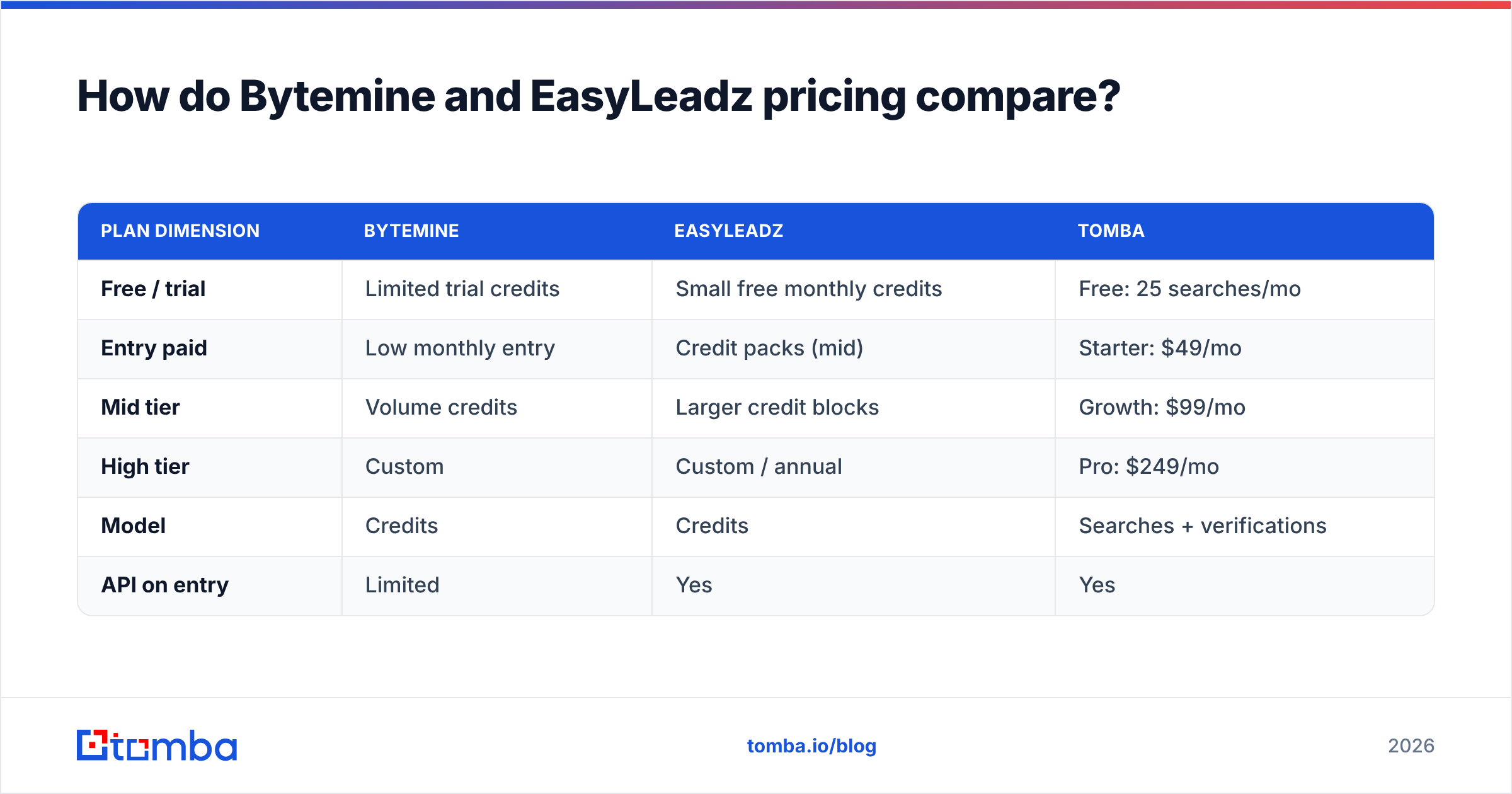
Both use credit-based pricing, which is good for variable usage and bad for predictability if your volume swings. Here's the honest shape of it:
| Plan dimension | Bytemine | EasyLeadz | Tomba |
|---|---|---|---|
| Free / trial | Limited trial credits | Small free monthly credits | Free: 25 searches/mo |
| Entry paid | Low monthly entry | Credit packs (mid) | Starter: $49/mo |
| Mid tier | Volume credits | Larger credit blocks | Growth: $99/mo |
| High tier | Custom | Custom / annual | Pro: $249/mo |
| Model | Credits | Credits | Searches + verifications |
| API on entry | Limited | Yes | Yes |
EasyLeadz tends to cost more per seat but delivers data Bytemine simply doesn't have (mobile numbers). Bytemine is the cheaper way to build email lists if you accept lower verification depth. For a transparent point of comparison, Tomba pricing starts at $49/mo and bundles both finding and verification, so you're not paying separately to confirm the data is real.
One pricing trap to watch in all credit systems: do you get charged for results that turn out to be invalid? With pure-finder tools, you can pay for an email that bounces. Tools that verify before charging — or that pair finding with built-in verification — protect that spend. Always read how a vendor counts a "credit" before you compare headline prices.
Bytemine vs EasyLeadz: pros and cons#
Bytemine — pros
- Low entry cost for email-led teams
- Simple, fast to learn
- Decent for building company and contact lists quickly
Bytemine — cons
- Thin email verification and catch-all handling
- Limited phone data
- No published accuracy benchmarks
EasyLeadz — pros
- Best-in-class direct/mobile phone coverage, especially APAC/India
- In-LinkedIn workflow via the Mr. E extension
- Solid API access even on lower tiers
EasyLeadz — cons
- Email is secondary, not a strength
- Higher cost per contact
- Coverage drops outside its strongest regions
When should you use a dedicated email tool instead?#
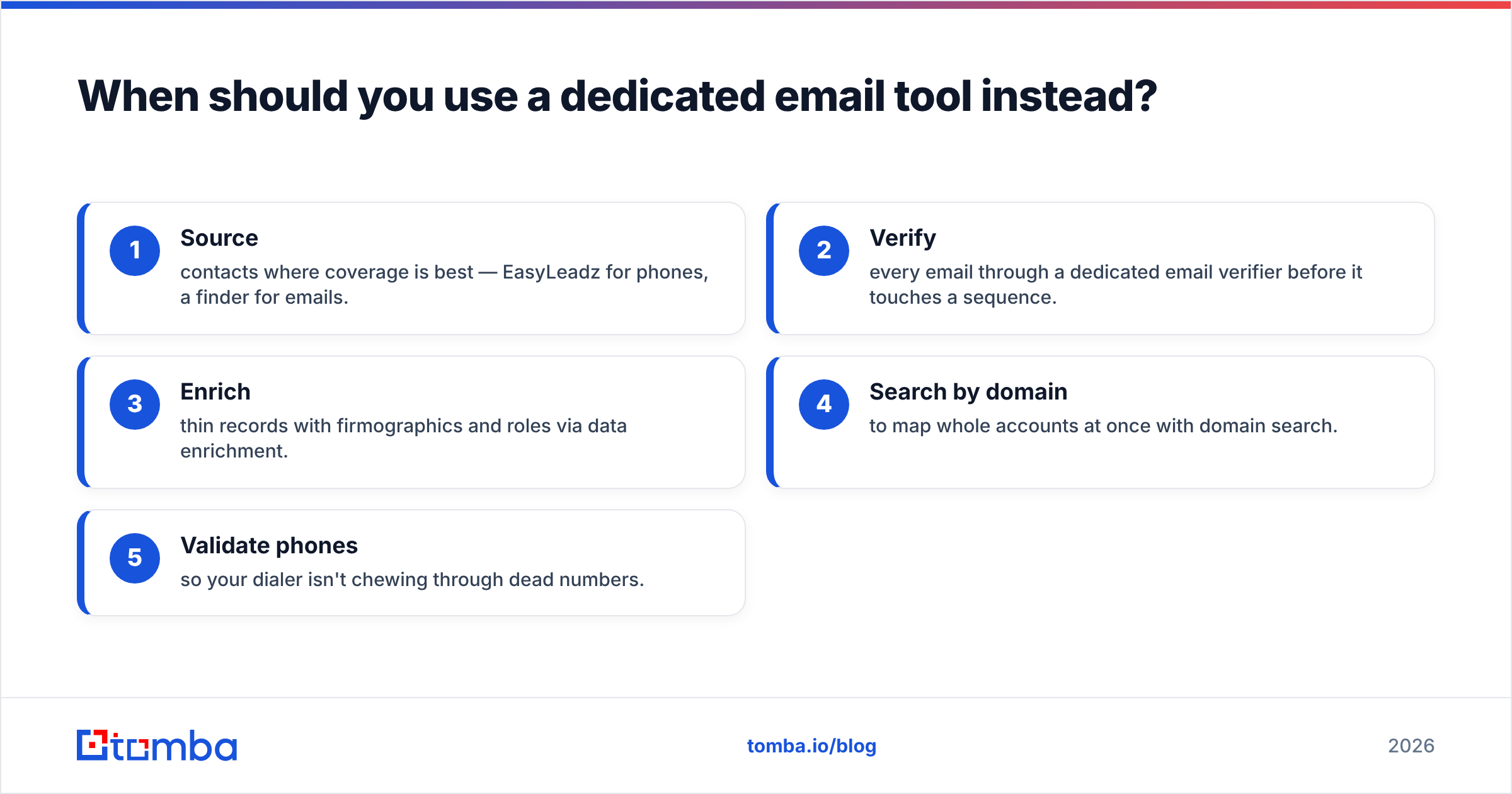
Reach for a specialist when email is your primary channel and accuracy is non-negotiable — which describes most cold-outbound and ABM teams. Bytemine and EasyLeadz are generalists optimizing for breadth (EasyLeadz) or price (Bytemine). A focused email platform optimizes for the one metric that protects your domain: deliverability.
Consider the layered stack most experienced teams actually run:
- Source contacts where coverage is best — EasyLeadz for phones, a finder for emails.
- Verify every email through a dedicated email verifier before it touches a sequence.
- Enrich thin records with firmographics and roles via data enrichment.
- Search by domain to map whole accounts at once with domain search.
- Validate phones so your dialer isn't chewing through dead numbers.
You don't have to pick one vendor for the whole chain. But you do want the email step handled by something built for it. If you're evaluating broader options, the Clearbit alternative and RocketReach alternative breakdowns cover adjacent tools in the same decision.
Which one should you choose?#
Conclusion first: pick EasyLeadz if you live on the phone, pick Bytemine if you want cheap email lists, and add a dedicated email tool if accuracy matters more than either.
- Choose EasyLeadz if direct dials drive your pipeline and you sell into India, APAC, or EMEA. The phone coverage justifies the price.
- Choose Bytemine if you're a solo founder or small team building email lists on a tight budget and can tolerate doing your own verification.
- Choose a specialist (or layer one in) if you send real volume over email, because a 5% bounce difference compounds into a deliverability problem fast.
For independent perspective on the wider category, G2's lead intelligence grid and Capterra's sales intelligence listings show how buyers rate these tools side by side. Cross-check vendor claims against real reviews before you commit annual spend.
The bottom line#
Bytemine and EasyLeadz solve adjacent but different problems — emails-on-a-budget versus phones-at-a-premium. Neither is built to be your email-accuracy backbone, and both ask you to trust accuracy claims you can't independently verify from their marketing pages.
If verified email coverage is what you actually need, start with a tool built for exactly that. Tomba Email Finder finds professional emails by name, domain, or company, runs SMTP and catch-all verification before you send, and starts free with 25 searches a month — so you can benchmark it against Bytemine or EasyLeadz on your own list before paying a cent. Run the 50-contact test, compare the real hit rates, and let the data decide.
// get started
Find, verify and enrich your first contacts today
Start on the free plan with 25 searches a month, then scale when your team is ready.
Free plan · No credit card required · GDPR & CCPA
// about the author