Bytemine vs Generect: Best B2B Lead Data Tool in 2026?
Bytemine vs Generect compared head-to-head on data accuracy, coverage, pricing, and workflow fit — plus where a dedicated email finder beats both in 2026.
Choosing between Bytemine and Generect comes down to one question most comparison pages dodge: when you push "find this person's email," how often is the address real, and how often does it bounce? Everything else — UI, integrations, credit math — is secondary to that. This breakdown puts both tools side by side on the metrics that actually move pipeline, then shows where a dedicated email-finding stack changes the math entirely.
TL;DR#
- Bytemine leans on AI-assisted prospecting and intent signals; strong for teams that want a research-to-outreach workflow in one place, weaker on transparent verification.
- Generect is LinkedIn-native, built to pull leads and emails straight from Sales Navigator searches; fast for SDRs living in LinkedIn, but coverage narrows outside that channel.
- Neither publishes independent bounce-rate benchmarks, which is the number that decides your sender reputation.
- For pure email accuracy and multi-source verification, a focused tool like Tomba often beats both bundled platforms on cost-per-valid-contact.
- Pick by your primary channel: LinkedIn-only → Generect; AI workflow → Bytemine; deliverability-first at scale → a dedicated email finder.
What are Bytemine and Generect?#
Both are B2B lead data platforms, but they solve the problem from opposite ends.
Bytemine positions itself as an AI-driven prospecting layer. You describe an ideal customer, and it surfaces matching companies and contacts, often pairing firmographic data with buying-intent signals. The pitch is "less manual list-building," and for outbound teams that hate spreadsheets, that resonates.
Generect is built around LinkedIn and Sales Navigator. You run a search, and Generect extracts the leads — names, titles, companies — and appends business emails so you can move them into a sequencer. Its center of gravity is the LinkedIn workflow, which is exactly where a lot of modern SDR work happens.
The shared weakness: both wrap email discovery inside a broader product, so the verification step is rarely the headline. When data quality is a feature buried under "AI" and "automation," it's hard to audit. That matters, because a 5% bounce difference is the line between a healthy domain and a blacklisted one.

How do Bytemine and Generect compare on the core attributes?#
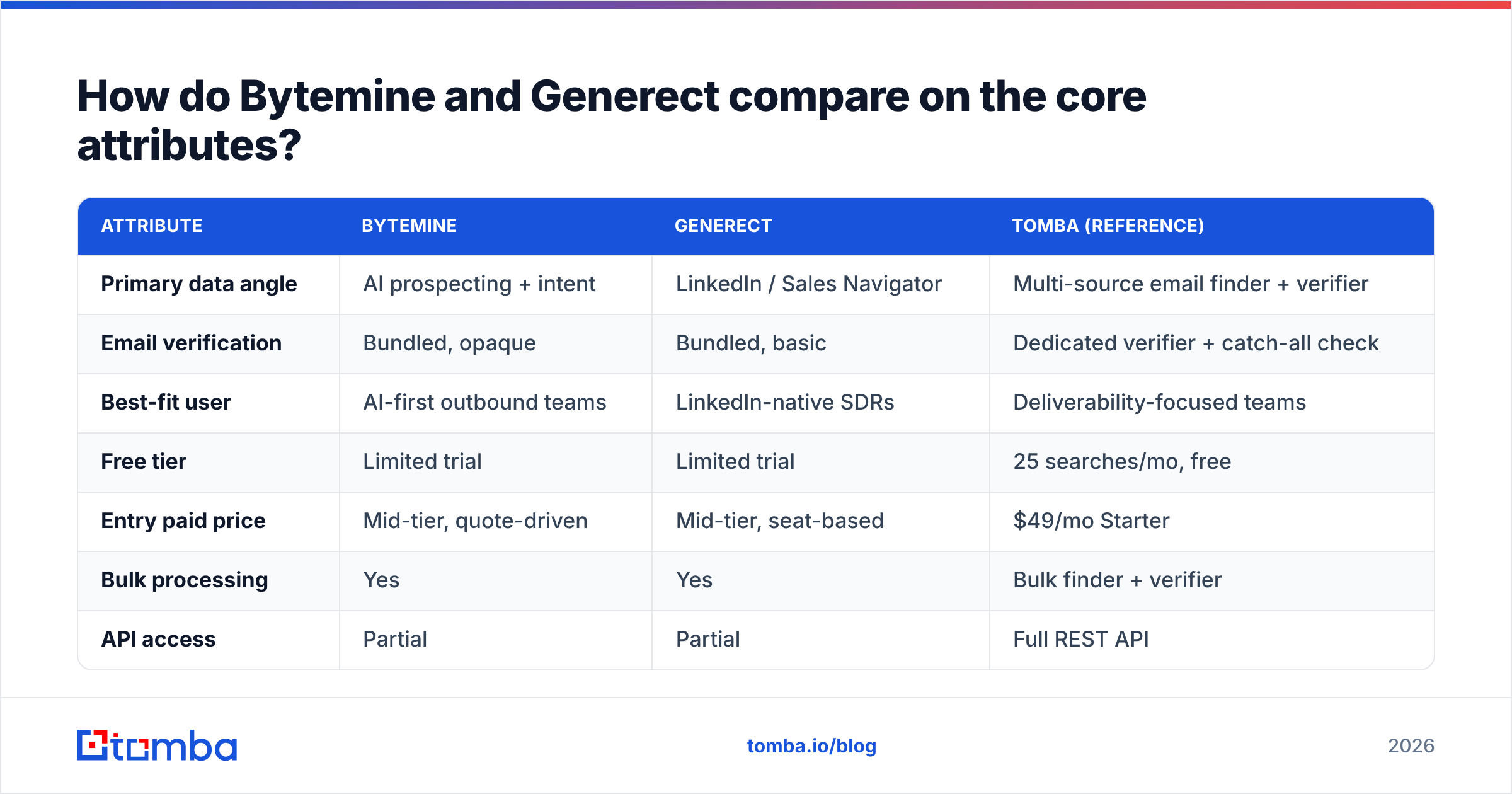
Here's the side-by-side on the dimensions that decide fit. Treat vendor-stated coverage claims with skepticism until you test on your own list.
| Attribute | Bytemine | Generect | Tomba (reference) |
|---|---|---|---|
| Primary data angle | AI prospecting + intent | LinkedIn / Sales Navigator | Multi-source email finder + verifier |
| Email verification | Bundled, opaque | Bundled, basic | Dedicated verifier + catch-all check |
| Best-fit user | AI-first outbound teams | LinkedIn-native SDRs | Deliverability-focused teams |
| Free tier | Limited trial | Limited trial | 25 searches/mo, free |
| Entry paid price | Mid-tier, quote-driven | Mid-tier, seat-based | $49/mo Starter |
| Bulk processing | Yes | Yes | Bulk finder + verifier |
| API access | Partial | Partial | Full REST API |
| Catch-all handling | Unclear | Unclear | Dedicated catch-all verifier |
The pattern is consistent: bundled platforms optimize for "leads in your CRM fast," while a specialist optimizes for "every email you send lands." Those are different goals, and your bounce rate notices the difference.
Which tool has better data accuracy?#
Accuracy is where this comparison gets uncomfortable, because neither Bytemine nor Generect publishes a third-party-audited bounce benchmark you can point to. You're trusting marketing copy.
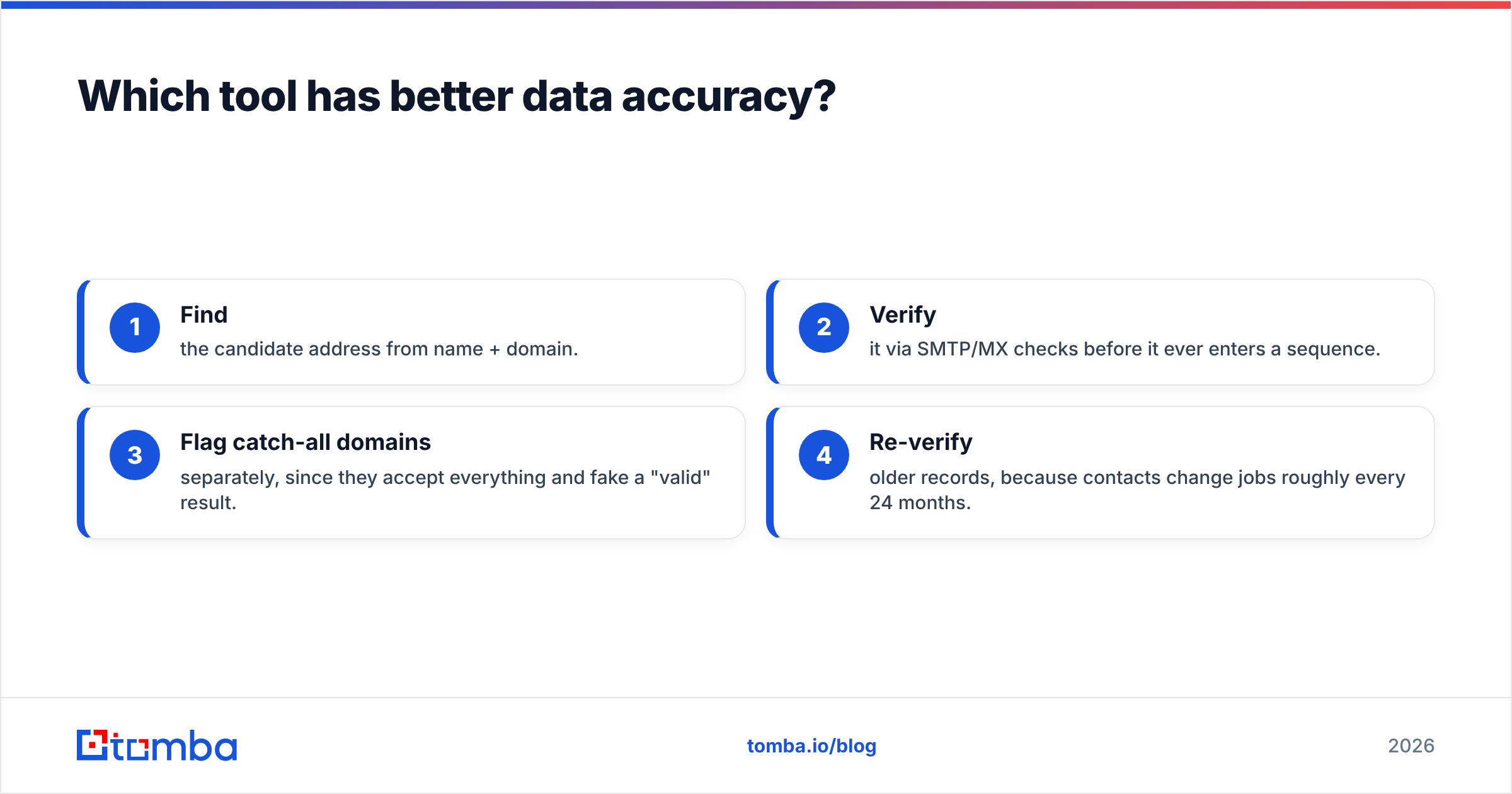
What you can control is the verification layer. A serious workflow treats finding and verifying as two steps:
- Find the candidate address from name + domain.
- Verify it via SMTP/MX checks before it ever enters a sequence.
- Flag catch-all domains separately, since they accept everything and fake a "valid" result.
- Re-verify older records, because contacts change jobs roughly every 24 months.
Generect's LinkedIn-sourced emails tend to be accurate for active profiles but go stale fast once someone moves roles. Bytemine's AI inference can broaden coverage but introduces guess-based addresses that need hard verification. In both cases, you'll want an independent email verifier in the loop — relying on a single bundled check is how good-looking lists still bounce at 8-12%.
If accuracy is your top priority, the honest recommendation is to test all three on the same 200-contact sample and measure real bounce rates through your sending platform. Don't trust the dashboard's "valid" label — trust your inbox provider's bounce report.
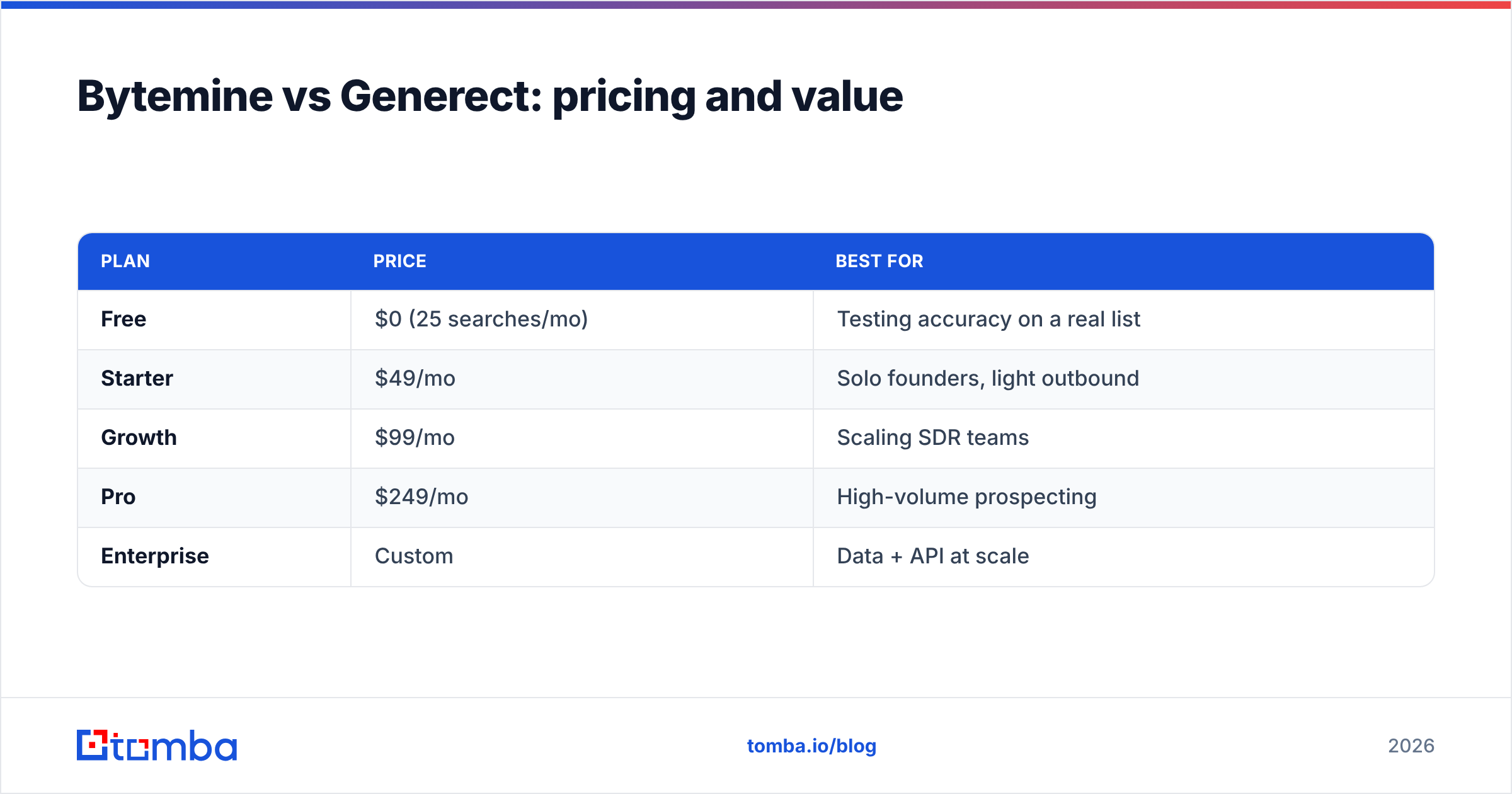
Bytemine vs Generect: pricing and value#
Both vendors run quote-driven or seat-based pricing that climbs quickly with team size, and neither makes per-credit cost obvious upfront. That opacity is itself a data point.
For a transparent baseline, here's how a dedicated stack prices against the "bundled platform" model:
| Plan | Price | Best for |
|---|---|---|
| Free | $0 (25 searches/mo) | Testing accuracy on a real list |
| Starter | $49/mo | Solo founders, light outbound |
| Growth | $99/mo | Scaling SDR teams |
| Pro | $249/mo | High-volume prospecting |
| Enterprise | Custom | Data + API at scale |
You can see full Tomba pricing without a sales call — which is the opposite of how most Bytemine and Generect deals get scoped. The strategic point isn't "cheaper is better." It's cost-per-valid-contact. A platform that's $30/month less but bounces twice as often is more expensive once you price in domain reputation damage. Independent reviews on G2 are a better sanity check on real-world reliability than any vendor landing page.
Which one fits your workflow?#
Match the tool to where your team already works.
- You live in LinkedIn Sales Navigator → Generect's extraction flow is the least friction. It pulls leads where you're already prospecting.
- You want AI to build target lists for you → Bytemine's intent-plus-firmographic angle saves manual research time.
- You send cold email at volume and fear blacklisting → a deliverability-first stack with a standalone verifier and catch-all verifier wins, regardless of which all-in-one you pair it with.
- You need programmatic enrichment → check API depth carefully; the Tomba API exposes find, verify, and enrich as separate endpoints, while bundled tools often gate the API behind higher tiers.
There's no shame in running two tools. Plenty of teams use Generect for LinkedIn sourcing and a dedicated finder/verifier to clean every address before it hits the sequencer. That hybrid usually beats forcing one platform to do everything.
Where does a dedicated email finder beat both?#
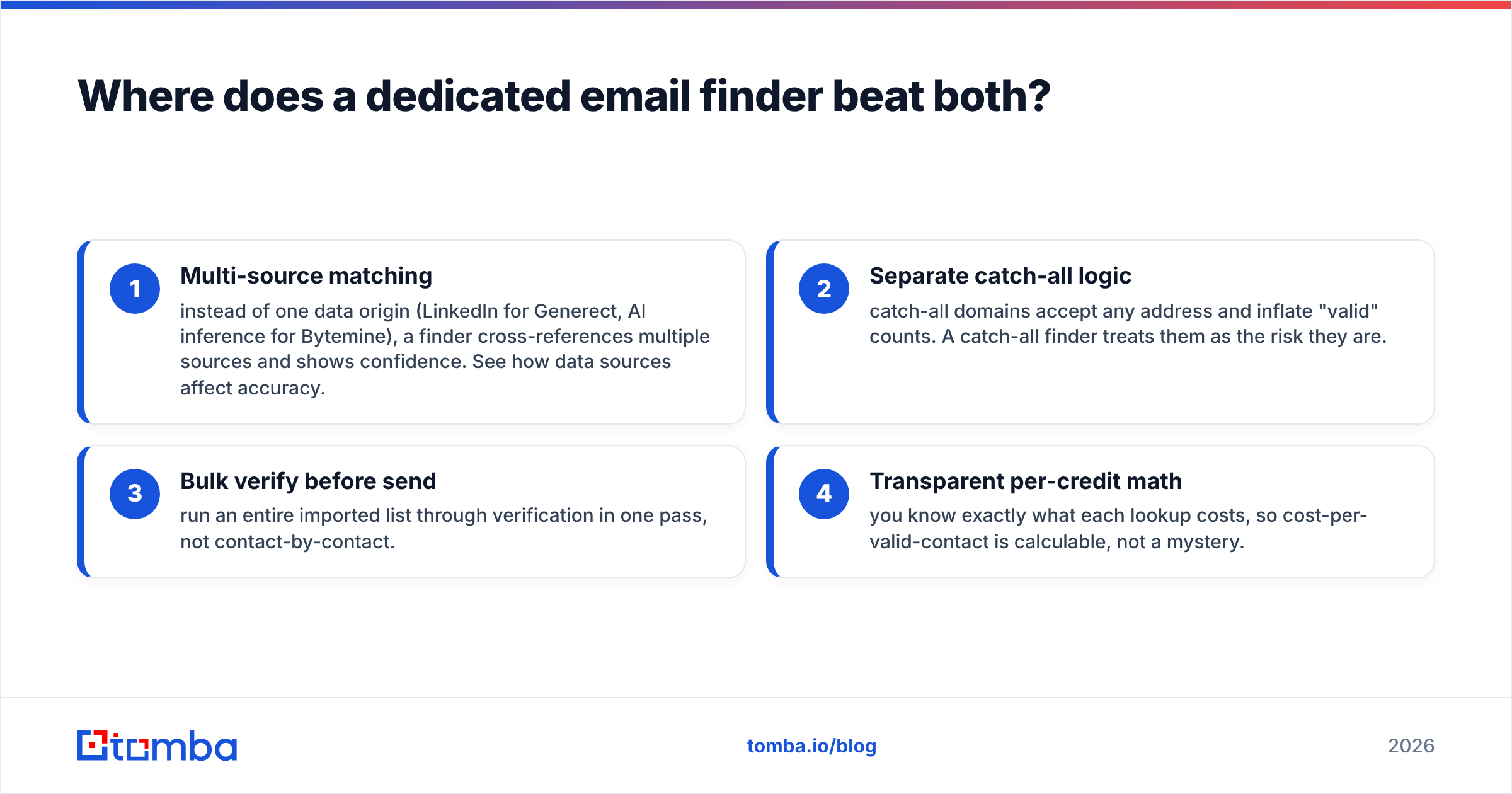
Bundled platforms are convenient, but convenience hides the verification gap. A specialist closes it in four ways:
- Multi-source matching — instead of one data origin (LinkedIn for Generect, AI inference for Bytemine), a finder cross-references multiple sources and shows confidence. See how data sources affect accuracy.
- Separate catch-all logic — catch-all domains accept any address and inflate "valid" counts. A catch-all finder treats them as the risk they are.
- Bulk verify before send — run an entire imported list through verification in one pass, not contact-by-contact.
- Transparent per-credit math — you know exactly what each lookup costs, so cost-per-valid-contact is calculable, not a mystery.
This isn't an argument to abandon Bytemine or Generect if they fit your motion. It's an argument that email verification deserves to be a first-class step, not a checkbox inside an AI feature. For a deeper view on what separates reliable email data from guesswork, the HubSpot blog and broader email deliverability fundamentals are worth reading before you commit budget.

Bytemine vs Generect: the verdict#
There's no universal winner — there's a winner for your channel.
- Choose Generect if your entire motion runs through LinkedIn and you want lead extraction that mirrors your Sales Navigator searches.
- Choose Bytemine if you want AI to assemble target accounts and layer intent signals, and you're comfortable adding your own verification step.
- Choose a dedicated finder + verifier if deliverability, transparent pricing, and cost-per-valid-contact are your north star — and pair it with whichever sourcing tool you prefer.
The teams that win in 2026 stop treating "find" and "verify" as one button. They source where their buyers are, then verify ruthlessly before a single email goes out. That two-step discipline protects your domain far more than any single platform's "AI accuracy" claim.
Ready to send emails that actually land?#
Whichever sourcing tool you pick, the address still has to be real. Run your Bytemine or Generect exports through the Tomba Email Finder and verifier to catch stale, guessed, and catch-all addresses before they bounce. Start free with 25 searches a month — test it on your own list, measure the real bounce rate, and let the numbers decide. Your sender reputation is the one asset you can't buy back, so protect it from the first send.
Ready to find emails that actually work?
Join 150,000+ professionals who stopped guessing and started sending. Free credits on signup — no credit card required.
Get the Tomba newsletter
Practical outbound tactics and product updates — once every two weeks.
About the author