Bytemine vs Jet Leads Pro: Which Lead Tool Wins in 2026?
A neutral, hands-on breakdown of Bytemine vs Jet Leads Pro — accuracy, pricing, data coverage, and which lead tool actually fits your outbound motion in 2026.
Choosing between Bytemine and Jet Leads Pro comes down to one question most buyers skip: do you need a broad prospecting suite, or do you need contact data that actually lands in the inbox? This guide compares both on the metrics that move pipeline, then shows where a focused email finder beats either.
TL;DR — Bytemine vs Jet Leads Pro#
- Bytemine leans toward all-in-one prospecting: list building, basic enrichment, and a built-in sequencer aimed at small teams that want one login.
- Jet Leads Pro positions itself around volume and speed — large export limits and bulk list pulls, with lighter verification on the back end.
- Accuracy is the deciding factor. Both bundle "millions of contacts," but bounce rates differ sharply once you actually send. Verify before you trust headline numbers.
- Pricing is close at entry level, but credit definitions and overage costs diverge fast at scale.
- If deliverability is your priority, a specialist email finder and verifier (like Tomba) often outperforms either suite on cost-per-valid-contact.
What are Bytemine and Jet Leads Pro?#
Both tools sit in the B2B prospecting category — software that helps you find business contacts, enrich them with firmographic data, and load them into outreach. The difference is emphasis.
Bytemine markets itself as a lightweight prospecting workspace. You search by company or role, build a list, and push contacts into an included email sequencer. The pitch is consolidation: fewer tools, one bill, less context-switching for a two- or three-person sales team.
Jet Leads Pro takes the volume angle. Its selling point is large monthly export ceilings and fast bulk pulls — useful when you're feeding a high-throughput cold email machine and care more about raw record count than hand-picked precision.
Neither is a household name like Apollo or ZoomInfo, which matters: smaller vendors often rent their underlying data from the same third-party brokers, so "different tool, same stale records" is a real risk. That's why the comparison below weighs verified output, not catalog size.

How do Bytemine and Jet Leads Pro compare on features?#
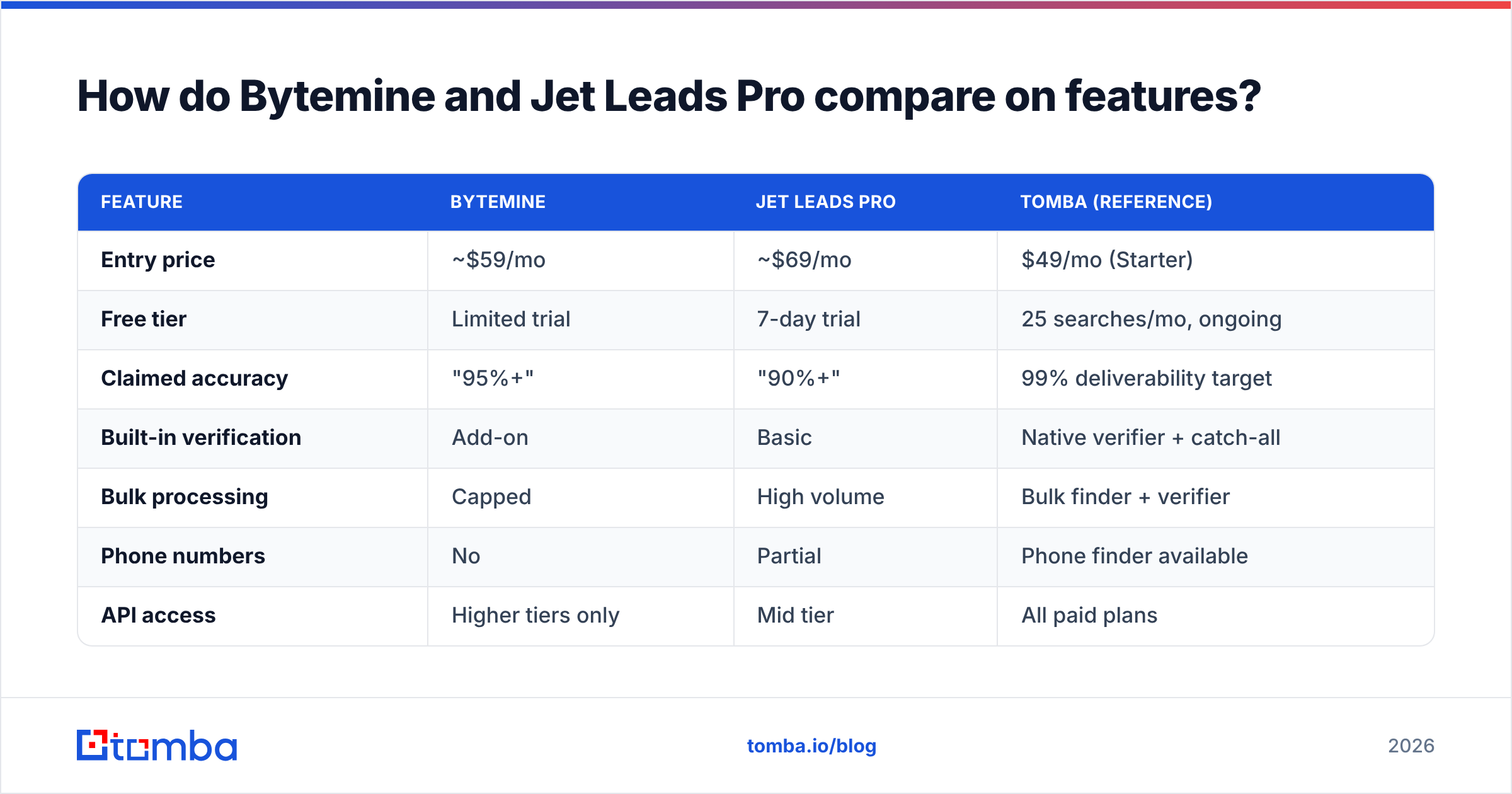
Here's the side-by-side on the attributes that actually affect your numbers. Treat vendor-claimed accuracy with skepticism until you run your own test batch.
| Feature | Bytemine | Jet Leads Pro | Tomba (reference) |
|---|---|---|---|
| Entry price | ~$59/mo | ~$69/mo | $49/mo (Starter) |
| Free tier | Limited trial | 7-day trial | 25 searches/mo, ongoing |
| Claimed accuracy | "95%+" | "90%+" | 99% deliverability target |
| Built-in verification | Add-on | Basic | Native verifier + catch-all |
| Bulk processing | Capped | High volume | Bulk finder + verifier |
| Phone numbers | No | Partial | Phone finder available |
| API access | Higher tiers only | Mid tier | All paid plans |
| Native integrations | Sequencer-first | CSV-heavy | HubSpot, Salesforce, Pipedrive, Sheets |
A few things stand out. Bytemine's bundled sequencer is convenient but locks you into its sending logic — if your warmup and deliverability stack already works, that's redundant. Jet Leads Pro's volume is attractive, but "90%+" claimed accuracy on unverified exports usually means real-world bounce rates well above the 3% threshold inbox providers tolerate.
For context on why that threshold matters, see Google's own Postmaster guidelines and our primer on email deliverability — sustained high bounces tank your sender reputation and quietly route good campaigns to spam.
Wait — let me restate that image properly so it renders:

Which has better data accuracy?#
Accuracy wins this category, and it's where most suite tools quietly lose money. The pattern with bundled prospecting platforms is consistent: a large catalog, a confident accuracy claim, and a verification step that's optional or shallow. You only discover the gap after a campaign bounces.
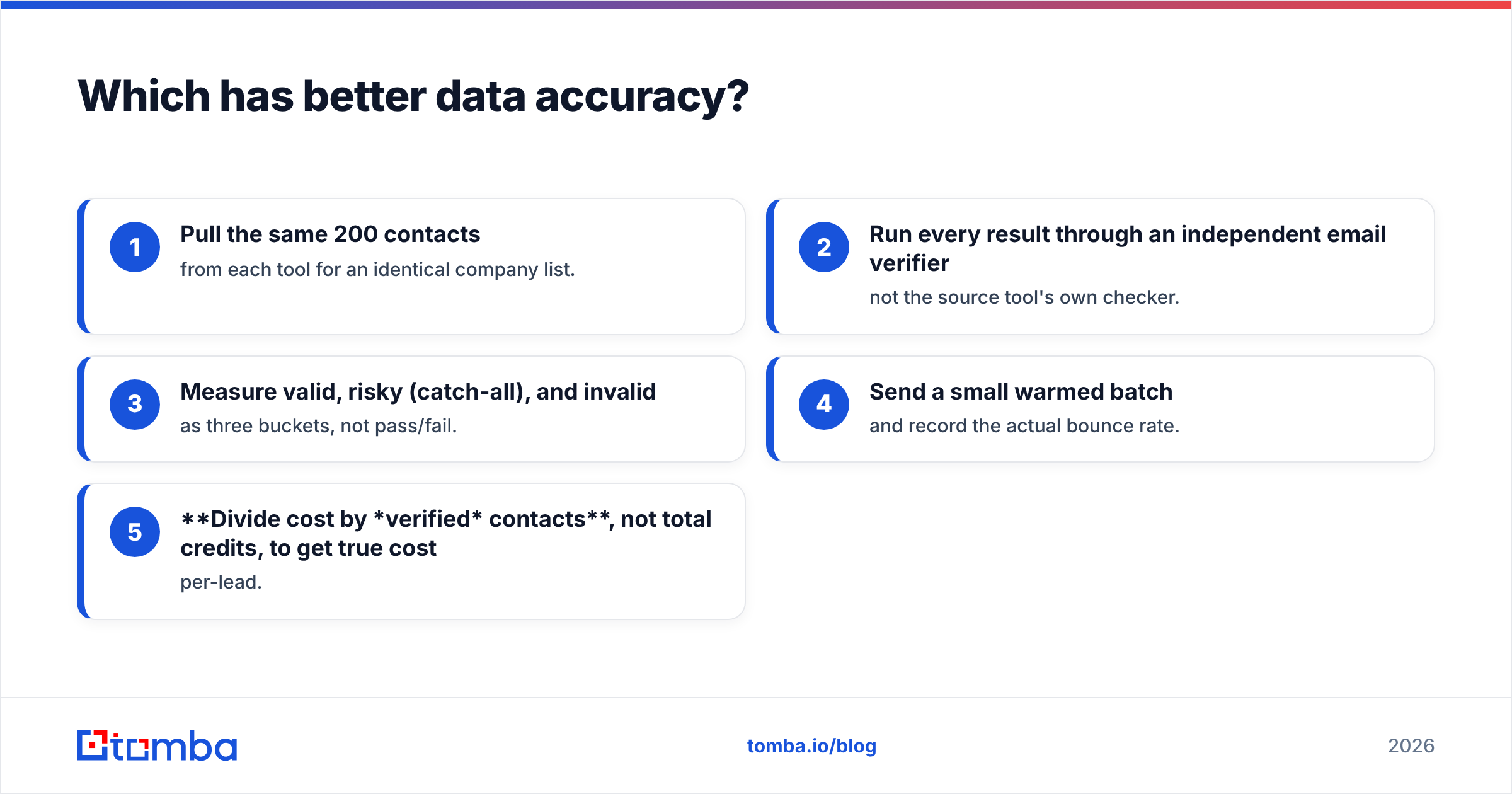
The honest way to compare Bytemine vs Jet Leads Pro is to ignore the marketing percentages and run a controlled test:
- Pull the same 200 contacts from each tool for an identical company list.
- Run every result through an independent email verifier — not the source tool's own checker.
- Measure valid, risky (catch-all), and invalid as three buckets, not pass/fail.
- Send a small warmed batch and record the actual bounce rate.
- Divide cost by verified contacts, not total credits, to get true cost-per-lead.
In practice, suites that treat verification as an add-on (Bytemine) or skip catch-all handling (Jet Leads Pro) produce a meaningful slice of "risky" addresses that look fine until they bounce. A dedicated catch-all verifier resolves a category both tools tend to wave through.
This is also why catalog size is a vanity metric. Ten million records at 80% deliverability is worse than two million at 97% — you pay to send to addresses that were never going to land.
How does pricing compare?#
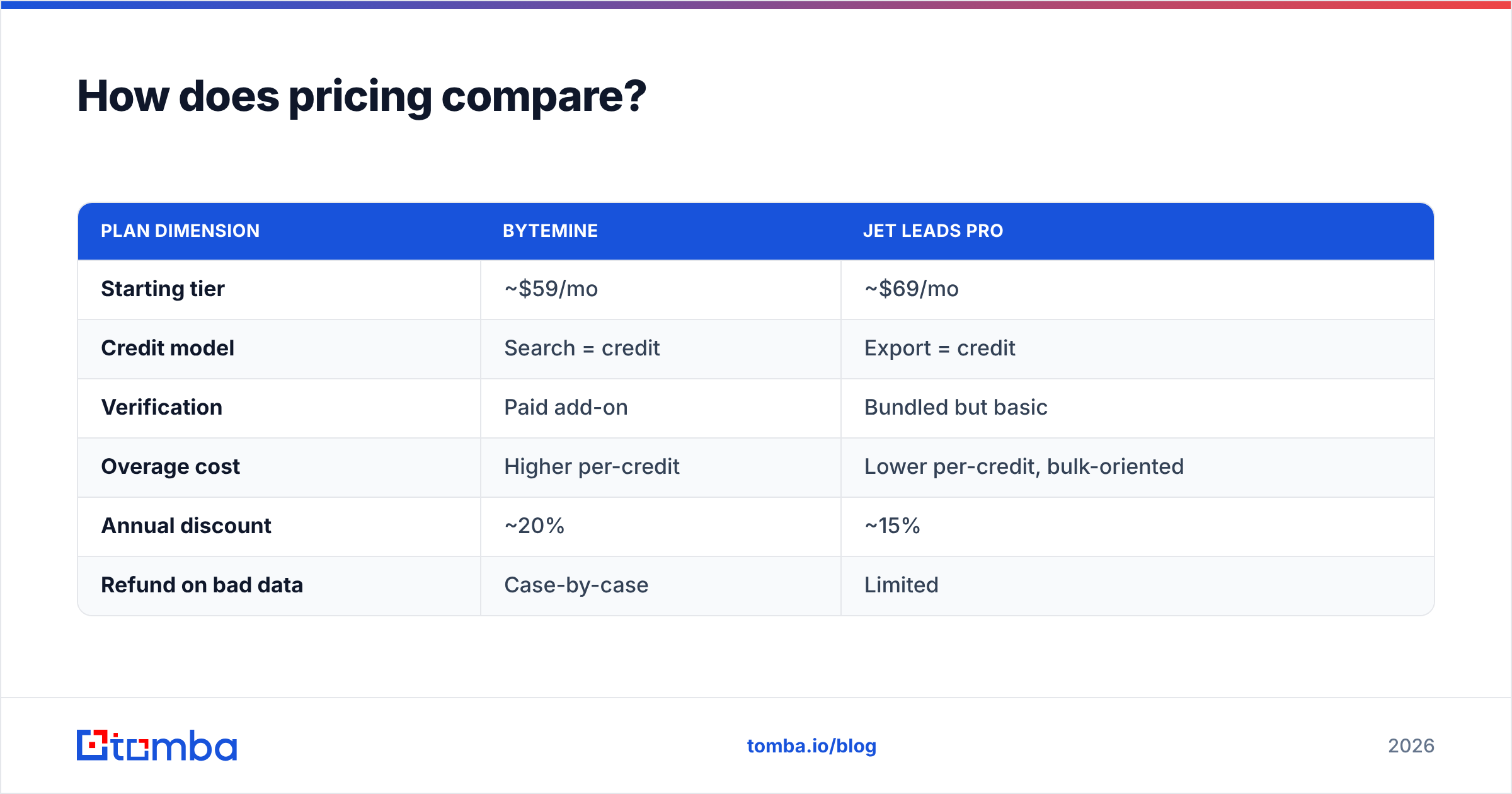
Entry pricing is deceptively similar; the real cost shows up in three places: credit definitions, verification fees, and overage rates.
| Plan dimension | Bytemine | Jet Leads Pro |
|---|---|---|
| Starting tier | ~$59/mo | ~$69/mo |
| Credit model | Search = credit | Export = credit |
| Verification | Paid add-on | Bundled but basic |
| Overage cost | Higher per-credit | Lower per-credit, bulk-oriented |
| Annual discount | ~20% | ~15% |
| Refund on bad data | Case-by-case | Limited |
Two traps to watch:
- Credit redefinition. When a "credit" is consumed on every search (Bytemine) rather than every valid contact returned, you pay for misses. Read the metering rules before the price.
- Verification as a separate line item. A low headline price plus a mandatory verification add-on can cost more than a single tool that verifies natively.
For comparison, Tomba pricing folds verification into the same workflow — Free (25 searches/mo), Starter $49/mo, Growth $99/mo, Pro $249/mo, and Enterprise custom — so cost-per-valid-contact is predictable rather than discovered after the fact. You can sanity-check any vendor's claims against third-party reviews on G2 before committing to an annual plan.
Which tool fits which use case?#
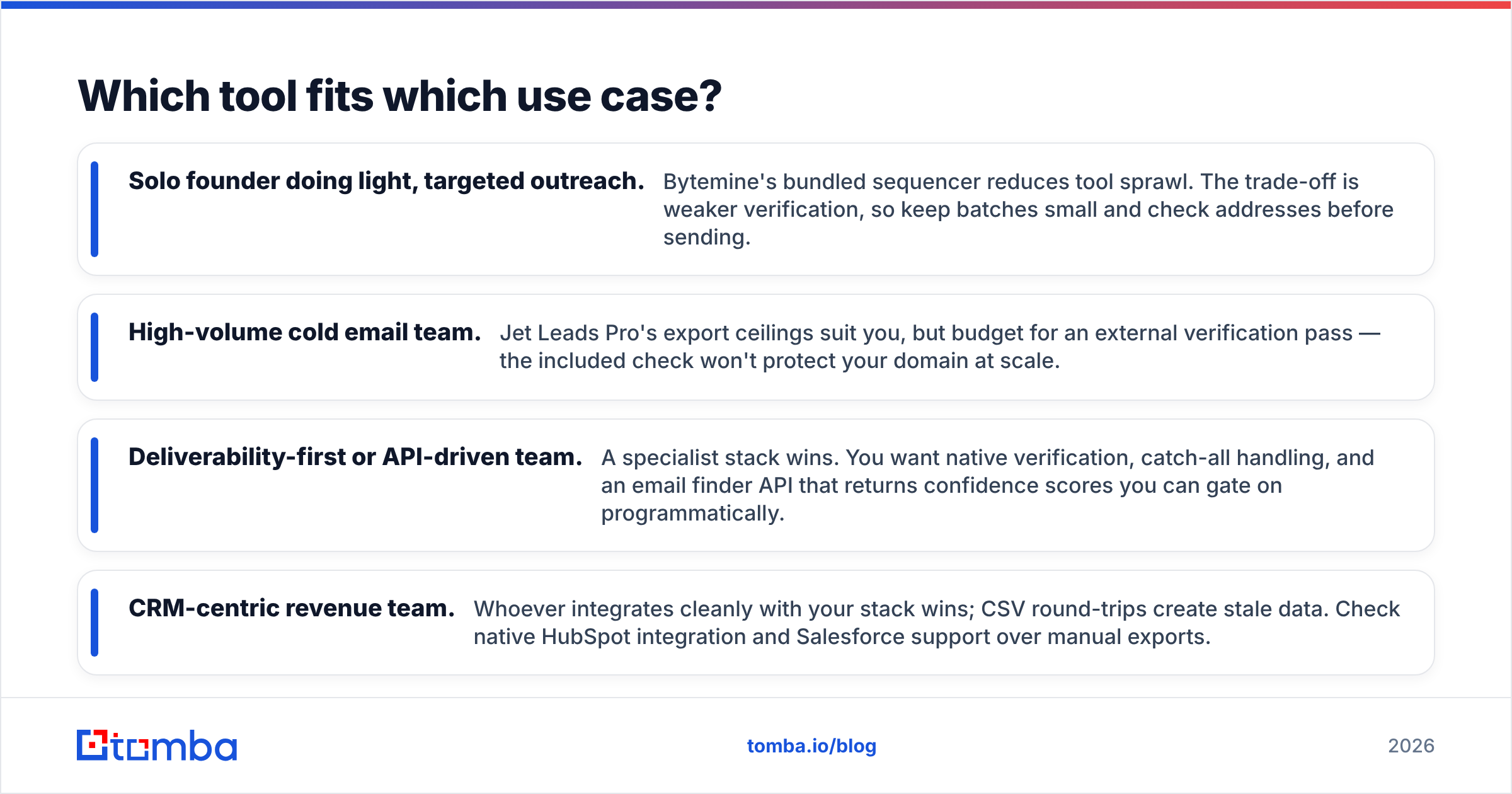
Neither tool is universally "better" — fit depends on your motion.
- Solo founder doing light, targeted outreach. Bytemine's bundled sequencer reduces tool sprawl. The trade-off is weaker verification, so keep batches small and check addresses before sending.
- High-volume cold email team. Jet Leads Pro's export ceilings suit you, but budget for an external verification pass — the included check won't protect your domain at scale.
- Deliverability-first or API-driven team. A specialist stack wins. You want native verification, catch-all handling, and an email finder API that returns confidence scores you can gate on programmatically.
- CRM-centric revenue team. Whoever integrates cleanly with your stack wins; CSV round-trips create stale data. Check native HubSpot integration and Salesforce support over manual exports.
Is there a better alternative to both?#
For most teams whose core need is reaching real people, a focused email finder plus verifier beats a thin all-in-one. The logic is simple: prospecting suites spread engineering across sequencing, dashboards, and CRM features, while a specialist concentrates it on the one thing that determines whether your email arrives — data quality.
That's the case for Tomba as a third option in the Bytemine vs Jet Leads Pro decision. Instead of a broad catalog with optional checks, you get an email finder backed by a native verifier, a domain search for company-wide mapping, bulk processing for scale, and a phone finder when email alone isn't enough — all under transparent, contact-based pricing.
If you already run a sequencer you like (Instantly, Smartlead, your own SMTP), you don't need a tool to replace it. You need clean, verified contacts feeding it. That's the gap both Bytemine and Jet Leads Pro leave open, and it's the one a specialist closes.
Quick decision guide#
- Want one login and minimal setup? → Bytemine, with a verification safeguard.
- Need raw export volume above all? → Jet Leads Pro, plus an external verifier.
- Want the lowest cost-per-valid-contact and a clean API? → A specialist finder + verifier like Tomba.
How do I test these tools before paying?#
Run the same five-step accuracy test described above on each tool's free or trial tier. Don't extend a trial into a paid plan on the strength of the dashboard — extend it on the strength of your bounce log. Concretely:
- Build one identical target list of ~50 companies.
- Pull contacts from each tool.
- Verify all results independently.
- Send a small warmed batch and read the deliverability data.
- Compare cost per verified, landed contact.
The tool with the best inbox-arrival-per-dollar wins — regardless of which has the prettier interface or the bigger catalog claim. For deeper context on what separates real coverage from inflated counts, see how Tomba documents its data sources.
The bottom line#
Bytemine and Jet Leads Pro solve adjacent problems: Bytemine for consolidation, Jet Leads Pro for volume. Both are reasonable for the buyer who matches their profile, and both share the same blind spot — verification depth — that quietly inflates your true cost per lead.
If your number-one goal is landing in the inbox at a predictable cost, start with a specialist. Try the Tomba Email Finder free — 25 searches a month, native verification built in, and no credit card to test it. Run your own accuracy batch against whatever you're using now, then let the bounce log decide. That's the only comparison that actually predicts pipeline.
// get started
Find, verify and enrich your first contacts today
Start on the free plan with 25 searches a month, then scale when your team is ready.
Free plan · No credit card required · GDPR & CCPA
// about the author