Bytemine vs Leadsrush: Which Lead Tool Wins in 2026?
A neutral, hands-on comparison of Bytemine vs Leadsrush for B2B lead generation in 2026 — data coverage, accuracy, pricing, and where each tool actually fits.
Choosing between Bytemine and Leadsrush comes down to one question most reviews skip: do you need raw volume, or do you need contacts that actually land in an inbox? Both tools promise B2B leads on tap, but they optimize for different things — and the wrong pick quietly burns your sending reputation for months before you notice.
This is a neutral breakdown. No tool is perfect, and the right answer depends on your motion. By the end you'll know which platform fits your team, where each one falls short, and how to plug the accuracy gap that affects nearly every list-based tool.
TL;DR#
- Bytemine leans toward broad data coverage and bulk list-building — good when you need a lot of records fast and can tolerate some decay.
- Leadsrush leans toward workflow and outreach features bundled with its data — handy if you want sourcing and sending under one roof.
- Neither replaces verification. List-based platforms ship stale and risky records; an email verifier step is non-negotiable before you send.
- For accuracy-first prospecting, a dedicated finder like Tomba's email finder with real-time verification often beats bundled data on deliverability.
- Pick by motion: high-volume top-of-funnel → Bytemine; all-in-one convenience → Leadsrush; precision cold outreach → a verify-first stack.
What are Bytemine and Leadsrush?#
Both are B2B lead-generation tools, but they sit in slightly different lanes.
Bytemine positions itself as a data-volume play: pull large lists of companies and contacts filtered by industry, size, geography, and role. The pitch is reach — get thousands of records into a CSV or your CRM quickly. Think of it like a wholesale warehouse: you walk out with a full cart, and it's on you to check the expiry dates.
Leadsrush bundles sourcing with outreach workflow. Instead of just handing you a list, it leans toward "find and contact" in fewer steps. The analogy here is a meal kit: ingredients and recipe arrive together, which is convenient, though you're locked into their kitchen.
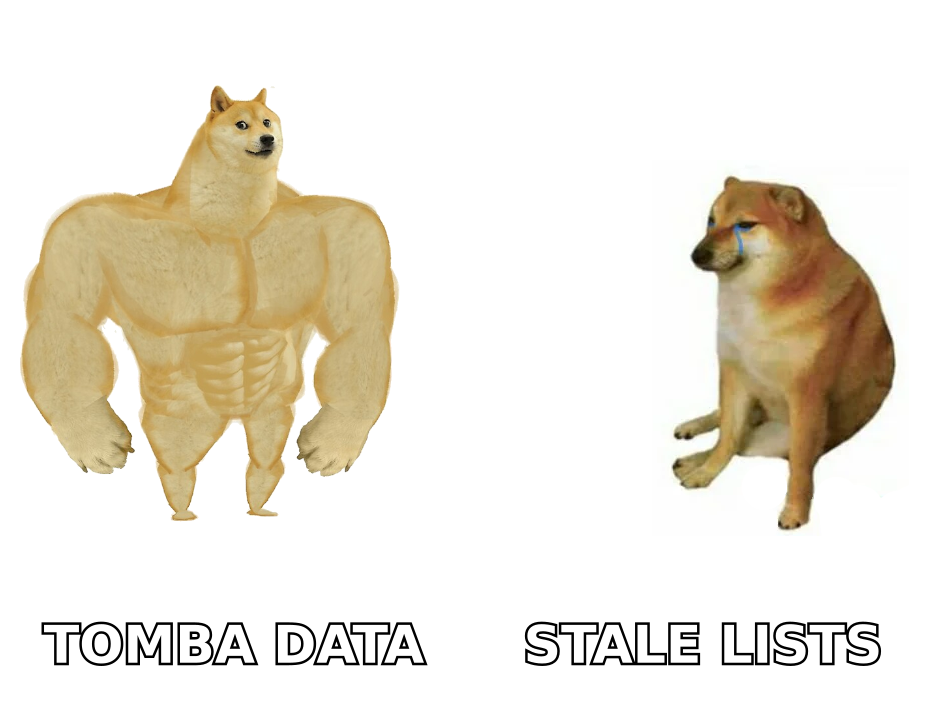
The core tension is the same one every list vendor faces: data ages fast. People change jobs, companies rebrand, and email formats shift. Roughly 2–3% of B2B contacts go stale every month, which is why coverage numbers on a sales page rarely match what hits your inbox.
How do Bytemine and Leadsrush compare head-to-head?#
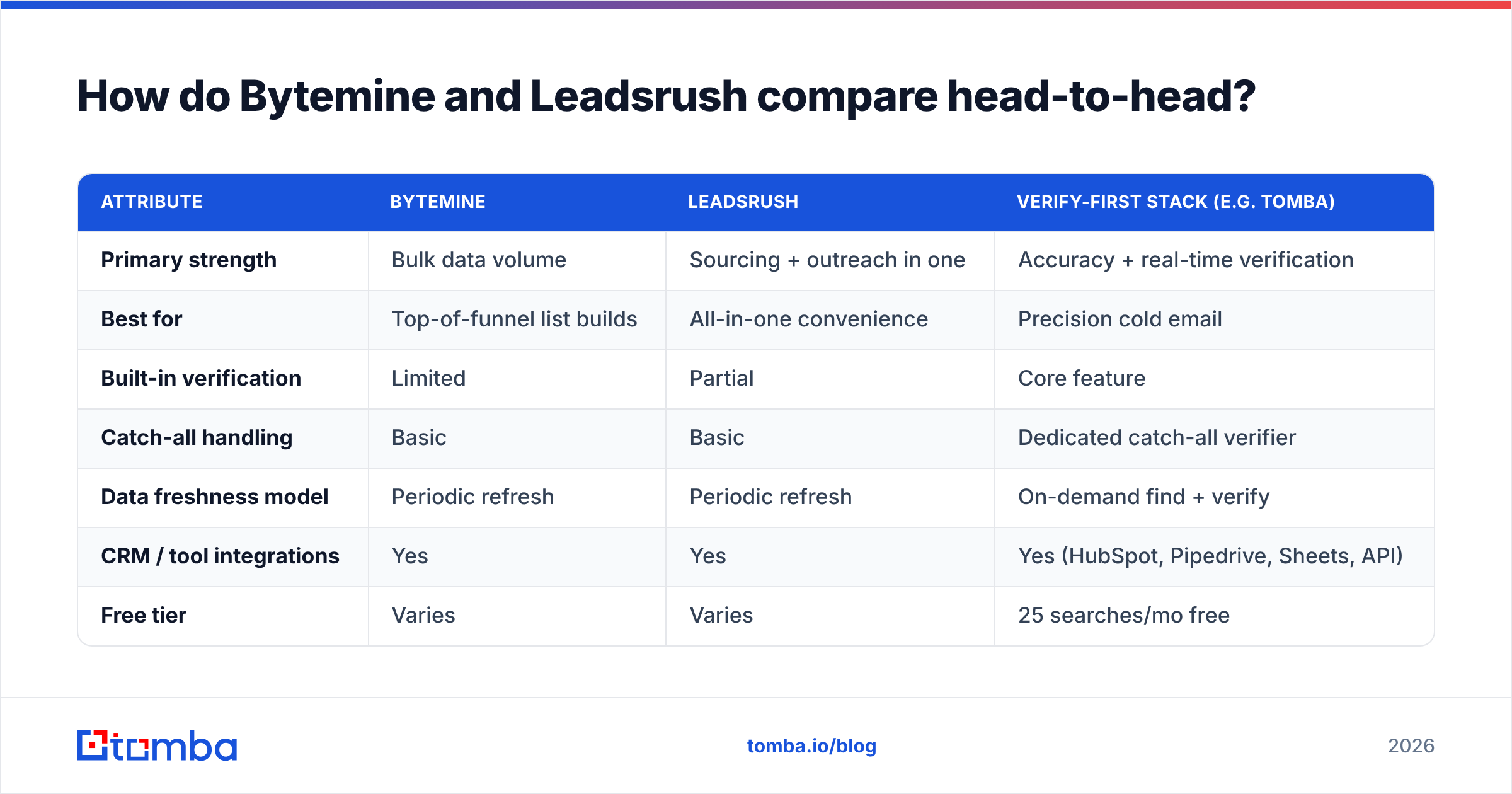
Here's the practical breakdown. Treat published coverage and accuracy claims as vendor-stated — always run your own sample test before committing budget.
| Attribute | Bytemine | Leadsrush | Verify-first stack (e.g. Tomba) |
|---|---|---|---|
| Primary strength | Bulk data volume | Sourcing + outreach in one | Accuracy + real-time verification |
| Best for | Top-of-funnel list builds | All-in-one convenience | Precision cold email |
| Built-in verification | Limited | Partial | Core feature |
| Catch-all handling | Basic | Basic | Dedicated catch-all verifier |
| Data freshness model | Periodic refresh | Periodic refresh | On-demand find + verify |
| CRM / tool integrations | Yes | Yes | Yes (HubSpot, Pipedrive, Sheets, API) |
| Free tier | Varies | Varies | 25 searches/mo free |
| Transparency on sources | Moderate | Moderate | Public data-sources page |
The pattern across list-based tools: coverage looks impressive, but the deliverable quality depends entirely on how recently each record was verified. That's the variable that decides whether your campaign hits a 2% bounce rate or a 25% one.
Which has better data accuracy?#
Accuracy is where this comparison actually matters, because bounce rate is the silent killer of cold outreach. Every hard bounce signals mailbox providers that you might be a spammer, and once your sender reputation drops, even your good emails land in spam.
Both Bytemine and Leadsrush refresh their databases periodically, but periodic refresh is fundamentally different from verification at the moment of use. A record verified three months ago and sold to you today is a gamble. The honest framing:
- Bulk list tools optimize for coverage, so they keep records even when confidence is borderline — more rows looks better on a demo.
- Bundled outreach tools may verify on send, but their verification depth varies and catch-all domains routinely slip through.
- Dedicated finders verify each address against live SMTP signals when you request it, which is why their accuracy holds up under real sending.
If your motion is volume-tolerant — say, retargeting or enrichment where a 15% miss rate is acceptable — Bytemine's reach can be worth it. If you're sending personalized cold email where every bounce costs reputation, you need a verification layer regardless of which database you start from. Independent reviews on G2 and Capterra are useful for sanity-checking vendor accuracy claims against real user reports.
How do they handle catch-all domains?#
This deserves its own section because catch-all domains break most accuracy promises. A catch-all server accepts every address at a domain, so a standard verifier returns "valid" even for addresses that don't exist. Many large companies run catch-all, so this isn't an edge case — it's a chunk of your B2B list.
Both Bytemine and Leadsrush flag catch-alls but typically can't tell you whether a specific catch-all address is real. That's a gap. A dedicated catch-all finder uses additional signals to make a confident call, which can be the difference between a 5% and a 20% bounce rate on enterprise-heavy lists.
Rule of thumb: if a meaningful share of your targets are mid-market or enterprise, catch-all handling should weigh heavily in your decision — more than total record count.
What about pricing and value?#
Pricing for both Bytemine and Leadsrush varies by plan tier and credit volume, and both run promotional rates, so confirm current numbers directly on their sites before budgeting. What matters more than headline price is cost per usable contact — a cheap list with 30% dead records is more expensive than a pricier one that's 95% deliverable, once you factor in wasted sends and reputation damage.
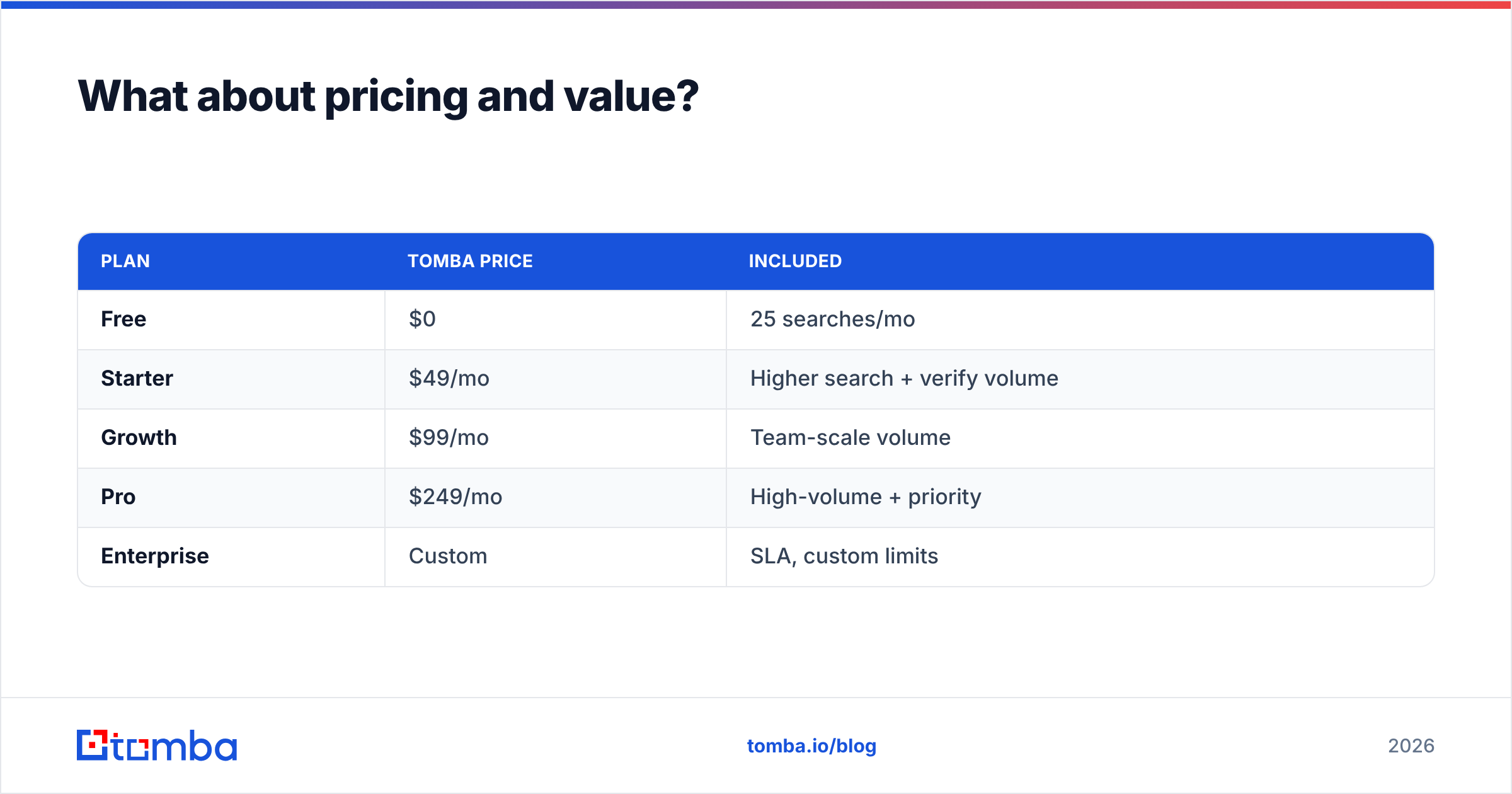
For reference, here's how a verify-first option is priced so you can model true cost-per-contact:
| Plan | Tomba price | Included |
|---|---|---|
| Free | $0 | 25 searches/mo |
| Starter | $49/mo | Higher search + verify volume |
| Growth | $99/mo | Team-scale volume |
| Pro | $249/mo | High-volume + priority |
| Enterprise | Custom | SLA, custom limits |
See full Tomba pricing for current limits. The takeaway isn't "Tomba is cheapest" — it's that you should compute cost per deliverable contact, not per raw record, when you compare any of these tools.
Bytemine vs Leadsrush: which should you choose?#
Here's the decision in plain terms, mapped to how you actually work.
- Choose Bytemine if your priority is raw volume for top-of-funnel — enrichment, market mapping, or campaigns where you'll verify downstream anyway. Its reach is the selling point.
- Choose Leadsrush if you want sourcing and outreach bundled and you value fewer tools over best-in-class accuracy. Convenience has real value for small teams.
- Choose a verify-first stack if cold email deliverability is mission-critical and bounce rate directly affects revenue. Start from accurate, verified contacts instead of cleaning a bulk list after the fact.
Many teams land on a hybrid: use a volume tool for discovery, then run everything through a verification and enrichment pass before it touches a sequence. You can route lists through bulk verify and layer data enrichment to fill gaps, so you keep the reach of a bulk source without inheriting its bounce risk.
What are the limitations to watch for?#
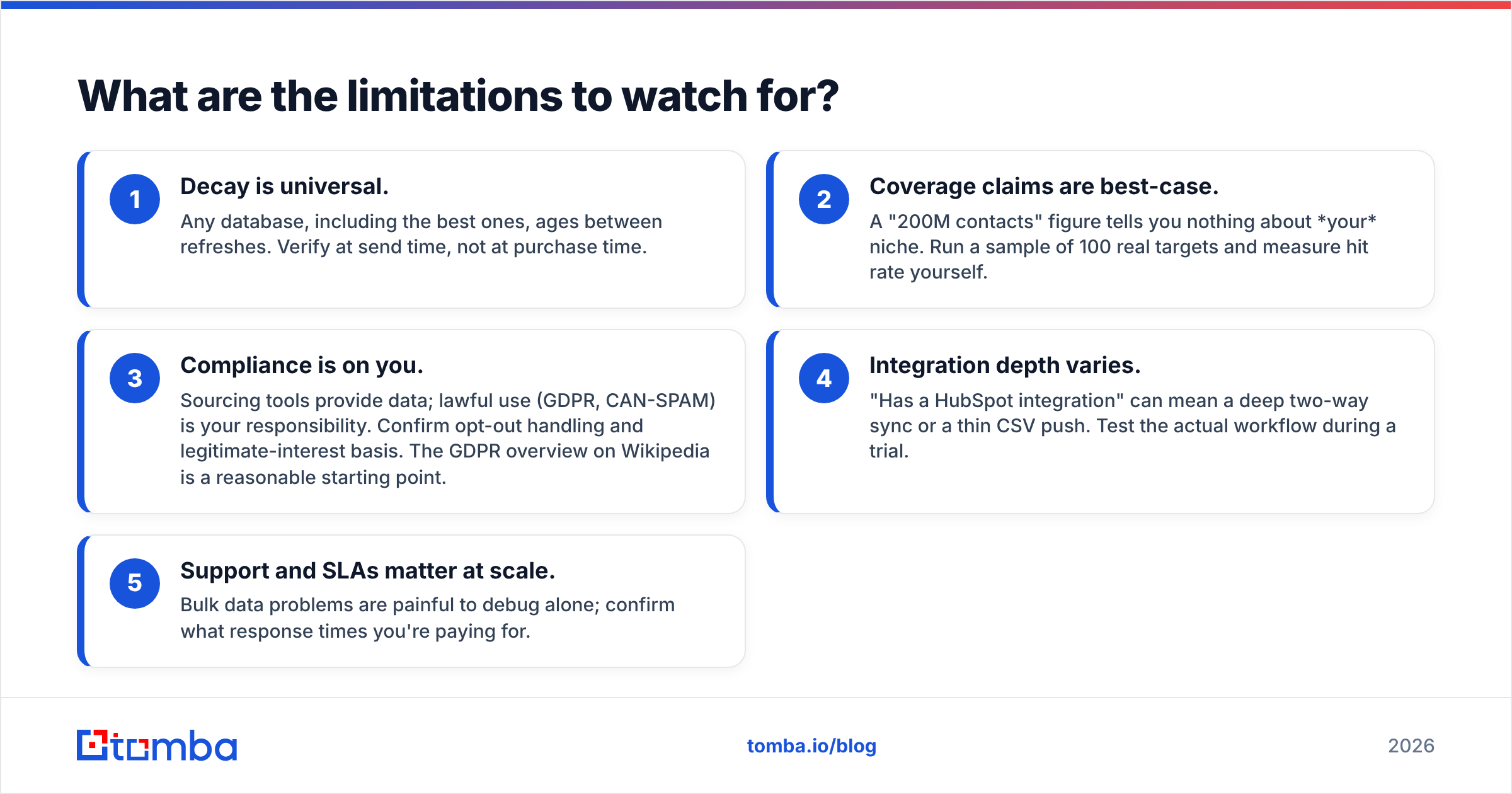
No tool in this category is magic. Set expectations before you buy:
- Decay is universal. Any database, including the best ones, ages between refreshes. Verify at send time, not at purchase time.
- Coverage claims are best-case. A "200M contacts" figure tells you nothing about your niche. Run a sample of 100 real targets and measure hit rate yourself.
- Compliance is on you. Sourcing tools provide data; lawful use (GDPR, CAN-SPAM) is your responsibility. Confirm opt-out handling and legitimate-interest basis. The GDPR overview on Wikipedia is a reasonable starting point.
- Integration depth varies. "Has a HubSpot integration" can mean a deep two-way sync or a thin CSV push. Test the actual workflow during a trial.
- Support and SLAs matter at scale. Bulk data problems are painful to debug alone; confirm what response times you're paying for.
How do I test either tool before committing?#
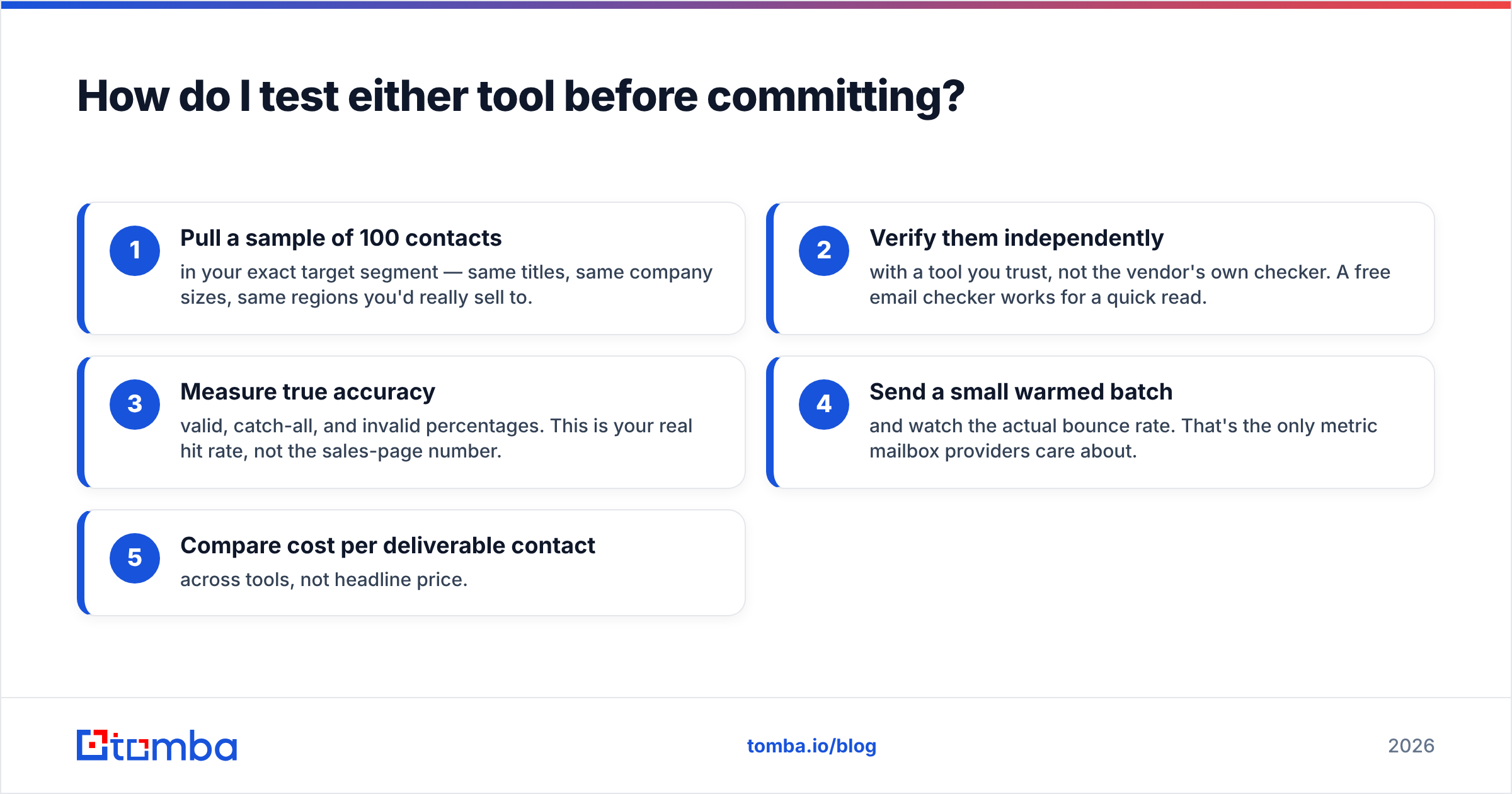
Run the same honest experiment on Bytemine, Leadsrush, or any alternative:
- Pull a sample of 100 contacts in your exact target segment — same titles, same company sizes, same regions you'd really sell to.
- Verify them independently with a tool you trust, not the vendor's own checker. A free email checker works for a quick read.
- Measure true accuracy — valid, catch-all, and invalid percentages. This is your real hit rate, not the sales-page number.
- Send a small warmed batch and watch the actual bounce rate. That's the only metric mailbox providers care about.
- Compare cost per deliverable contact across tools, not headline price.
This five-step test takes an afternoon and saves months of degraded deliverability. It also neutralizes marketing claims — you're deciding on your data, not their demo.
The bottom line#
Bytemine and Leadsrush are both legitimate choices, and the "winner" depends on whether you optimize for volume (Bytemine), bundled convenience (Leadsrush), or deliverability (a verify-first stack). What unites all three: verification is the step that decides whether your campaign works. Skip it and even the best database becomes a reputation liability.
If your campaigns live or die on whether emails actually reach the inbox, build your list around accuracy from the start. Tomba's Email Finder finds professional addresses by name, domain, or company and verifies each one in real time — so you start from contacts that land, not records you have to clean up after the bounces roll in. Try the free tier (25 searches a month, no card) and run the 100-contact test against whatever you're using now. Let your own bounce rate pick the winner.
// get started
Find, verify and enrich your first contacts today
Start on the free plan with 25 searches a month, then scale when your team is ready.
Free plan · No credit card required · GDPR & CCPA
// about the author