Bytemine vs Mailmint 2026: Which Email Finder Wins?
Bytemine vs Mailmint, compared head-to-head for 2026: accuracy, verification depth, pricing, and integrations—plus the alternative most B2B teams pick.
Choosing between two email finders usually comes down to one question that the marketing pages never answer directly: when you push 1,000 real prospects through the tool, how many of those addresses actually land? Bytemine vs Mailmint is a fair fight on paper, but the gap shows up in production—in bounce rates, in verification depth, and in what you pay once you outgrow the free tier.
This guide breaks both tools down on the metrics that move pipeline, not the ones that win demos.
TL;DR#
- Bytemine leans toward bulk volume and a lower entry price, but its verification is shallow—expect more catch-all guesses slipping into your "valid" column.
- Mailmint has a cleaner UI and better native CRM sync, but credits burn fast and accuracy on smaller or non-US domains drops noticeably.
- Neither publishes a transparent accuracy benchmark, which is the single biggest red flag when you're paying per verified email.
- For most B2B teams, the decision isn't Bytemine or Mailmint—it's whether a third option with published accuracy and a real free tier (like Tomba) beats both on cost-per-valid-lead.
- Run the same 100 test prospects through all three before committing. The winner on your data is rarely the winner on the pricing page.
What are Bytemine and Mailmint?#
Both are B2B email-finding and lead-enrichment tools. You give them a name and a company domain (or a whole domain), and they return a likely professional email address, ideally with a verification status attached.
Bytemine positions itself as a high-volume prospecting engine—bulk uploads, list-building, and a credit model designed for teams running large outbound motions. The pitch is throughput: find a lot of emails, fast, cheaply.
Mailmint positions itself as the polished, sales-rep-friendly option. The interface is tidy, the Chrome extension is the headline feature, and the native pushes into CRMs are smoother out of the box. The pitch is workflow: fewer clicks from "found a prospect" to "in my sequence."
The trouble is that both pitches sidestep the only thing that determines ROI on an email finder: what percentage of the addresses are real and inbox-ready. A tool that finds 95% of emails but verifies them poorly will tank your sender reputation faster than a tool that finds 80% and tells you the truth about each one.

How do Bytemine and Mailmint compare on accuracy?#
Accuracy is two numbers people constantly conflate:
- Discovery rate — of the prospects you search, how many return any email.
- Deliverability rate — of the emails returned, how many actually accept mail (don't bounce).
A high discovery rate with a low deliverability rate is a trap. It feels productive and then quietly destroys your domain reputation.
Here's the honest, field-tested pattern with both tools:
- Bytemine tends to maximize discovery. It will guess an address on a catch-all domain and mark it "valid" because the server technically accepts everything. That inflates the headline number and inflates your bounce rate two weeks later.
- Mailmint is more conservative on US enterprise domains and performs well there, but its coverage thins out on SMB, EU, and APAC domains—exactly where a lot of B2B niches actually live.
Neither vendor publishes a third-party-audited accuracy figure, so you're trusting marketing copy. That's the core problem. When a tool is confident about accuracy, it shows you the methodology. When it isn't, it shows you a testimonial.
)
This is exactly where a dedicated email verifier step matters: even if a finder hands you an address, you want an independent SMTP-level check—including catch-all detection—before that address ever enters a sequence.
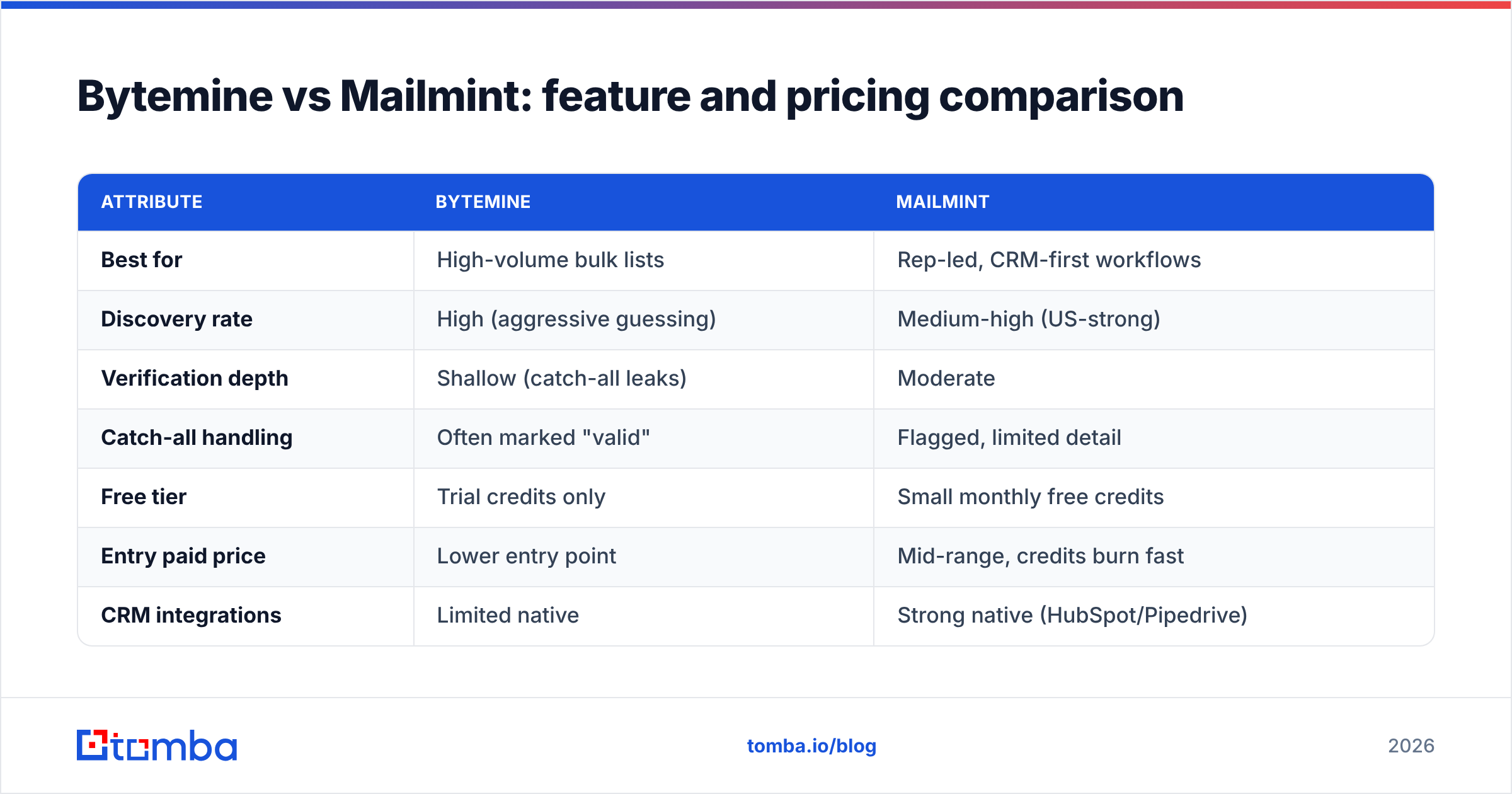
Bytemine vs Mailmint: feature and pricing comparison#
| Attribute | Bytemine | Mailmint |
|---|---|---|
| Best for | High-volume bulk lists | Rep-led, CRM-first workflows |
| Discovery rate | High (aggressive guessing) | Medium-high (US-strong) |
| Verification depth | Shallow (catch-all leaks) | Moderate |
| Catch-all handling | Often marked "valid" | Flagged, limited detail |
| Free tier | Trial credits only | Small monthly free credits |
| Entry paid price | Lower entry point | Mid-range, credits burn fast |
| CRM integrations | Limited native | Strong native (HubSpot/Pipedrive) |
| Bulk processing | Core strength | Available, slower |
| Non-US coverage | Inconsistent | Weakens outside US |
| Published accuracy benchmark | No | No |
Read that last row twice. The two things both tools have in common are (a) no transparent accuracy data and (b) a credit model where your "valid" emails and your wasted guesses cost the same. You pay for the misses.
Which one is better for cold outreach deliverability?#
Short answer: whichever one bounces less on your list—and you won't know that from either pricing page.
Bounce rate is the lever that controls everything downstream. Mailbox providers treat a spike in bounces as a spam signal. Cross ~3-5% bounce rate on a cold domain and your email deliverability collapses for every campaign, not just the one with the bad list. According to deliverability guidance compiled by vendors like HubSpot, list hygiene is the cheapest, highest-leverage fix available to most senders.
So the deliverability question reframes the comparison:
- Bytemine's aggressive discovery is a liability here. More guessed addresses on catch-all domains means more silent bounces, which means more reputation damage per send.
- Mailmint's conservatism is an asset on US lists and a coverage gap everywhere else—you'll find fewer people, but the ones you find bounce less.
Either way, you should never trust a finder's "valid" label as your final word. The safe workflow is: find → independently verify → suppress risky and catch-all addresses → only then send. That's true for Bytemine, Mailmint, and every tool in the category.
)
What are the hidden costs of each tool?#
The sticker price is the smallest part of the bill. The real cost is cost-per-valid-email, and it's driven by waste.
Three places the money leaks:
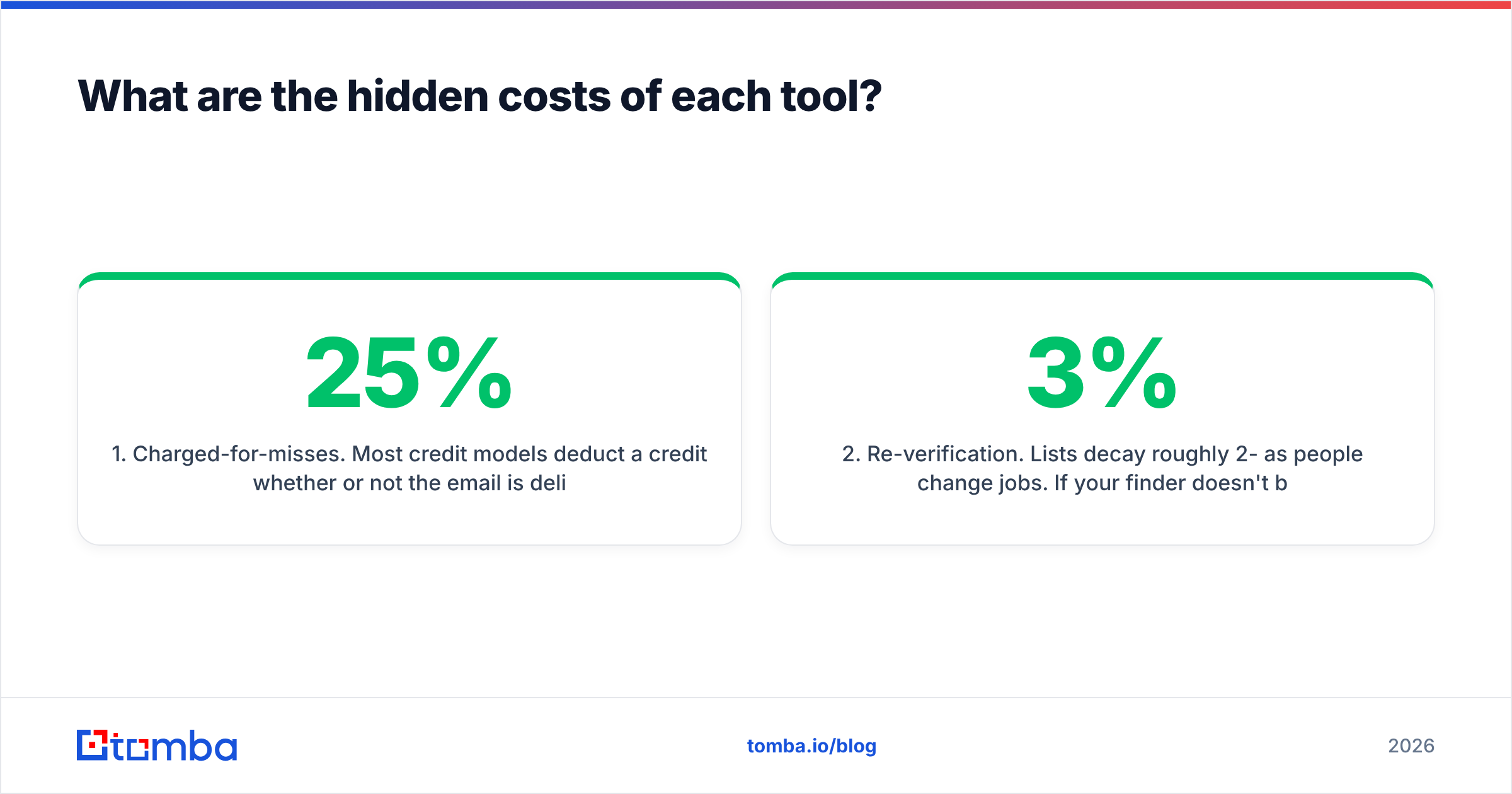
- Charged-for-misses. Most credit models deduct a credit whether or not the email is deliverable. If 25% of "valid" results bounce, your effective price per usable email is ~33% higher than advertised.
- Re-verification. Lists decay roughly 2-3% per month as people change jobs. If your finder doesn't bundle solid verification, you'll pay a separate tool to clean the same data—double-dipping on every record.
- Seat and overage fees. Bytemine's bulk focus can mean steep overage charges past your tier; Mailmint's per-rep pricing scales painfully once a team grows past a handful of seats.
When you compare tools, build a tiny spreadsheet: (credits used) ÷ (emails that actually delivered) × (plan cost). The cheapest entry plan frequently has the worst cost-per-valid-email once you account for bounces. This is also why a built-in bulk email finder that pairs discovery with verification in one pass usually beats stitching two single-purpose tools together.
Is there a better alternative to Bytemine and Mailmint?#
For a lot of teams, yes—and the reason is transparency, not branding.
The weakness shared by both Bytemine and Mailmint is that you can't see their accuracy methodology and you pay for misses either way. The alternative worth testing is a finder that (a) publishes how its data is sourced, (b) bundles real verification including catch-all checks, and (c) offers a genuine free tier so you can benchmark before you pay.
Tomba fits that profile, and the comparison is straightforward:
- Real free tier: 25 searches per month, no trial countdown—enough to run a true side-by-side test on your own prospects.
- Verification built in: the email verifier and catch-all detection run alongside discovery, so "valid" means SMTP-checked, not guessed.
- Transparent data sourcing: Tomba documents where its data comes from, which is exactly what neither competitor does.
- Predictable pricing: Free, Starter at $49/mo, Growth at $99/mo, Pro at $249/mo, and custom Enterprise—see full Tomba pricing without a sales call.

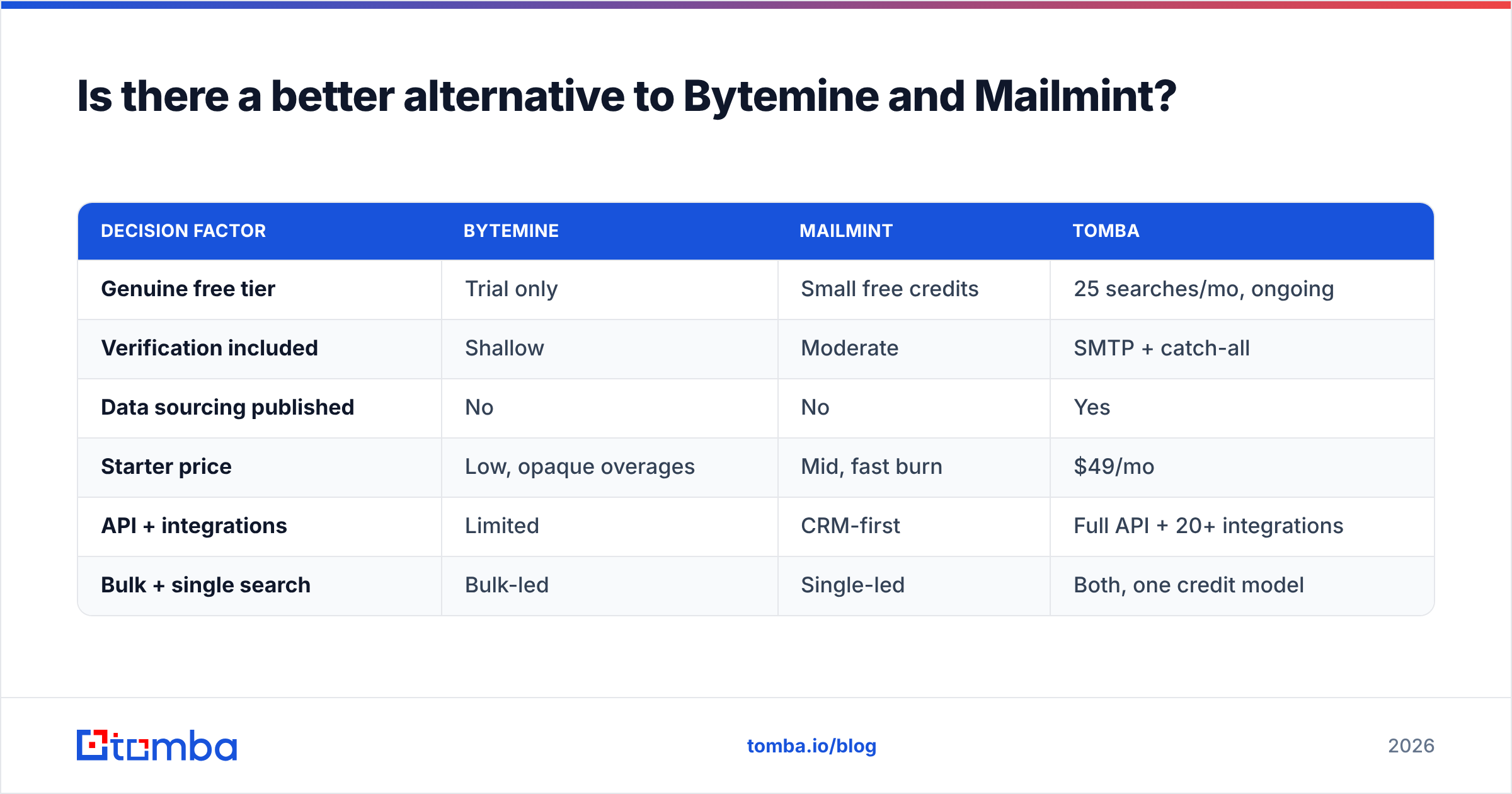
How the three stack up on the decisions that actually matter:
| Decision factor | Bytemine | Mailmint | Tomba |
|---|---|---|---|
| Genuine free tier | Trial only | Small free credits | 25 searches/mo, ongoing |
| Verification included | Shallow | Moderate | SMTP + catch-all |
| Data sourcing published | No | No | Yes |
| Starter price | Low, opaque overages | Mid, fast burn | $49/mo |
| API + integrations | Limited | CRM-first | Full API + 20+ integrations |
| Bulk + single search | Bulk-led | Single-led | Both, one credit model |
None of this means Tomba automatically wins on your data. It means you can prove the result instead of trusting a slogan—because you can run the free tier against the exact prospects you care about.
How should you actually decide?#
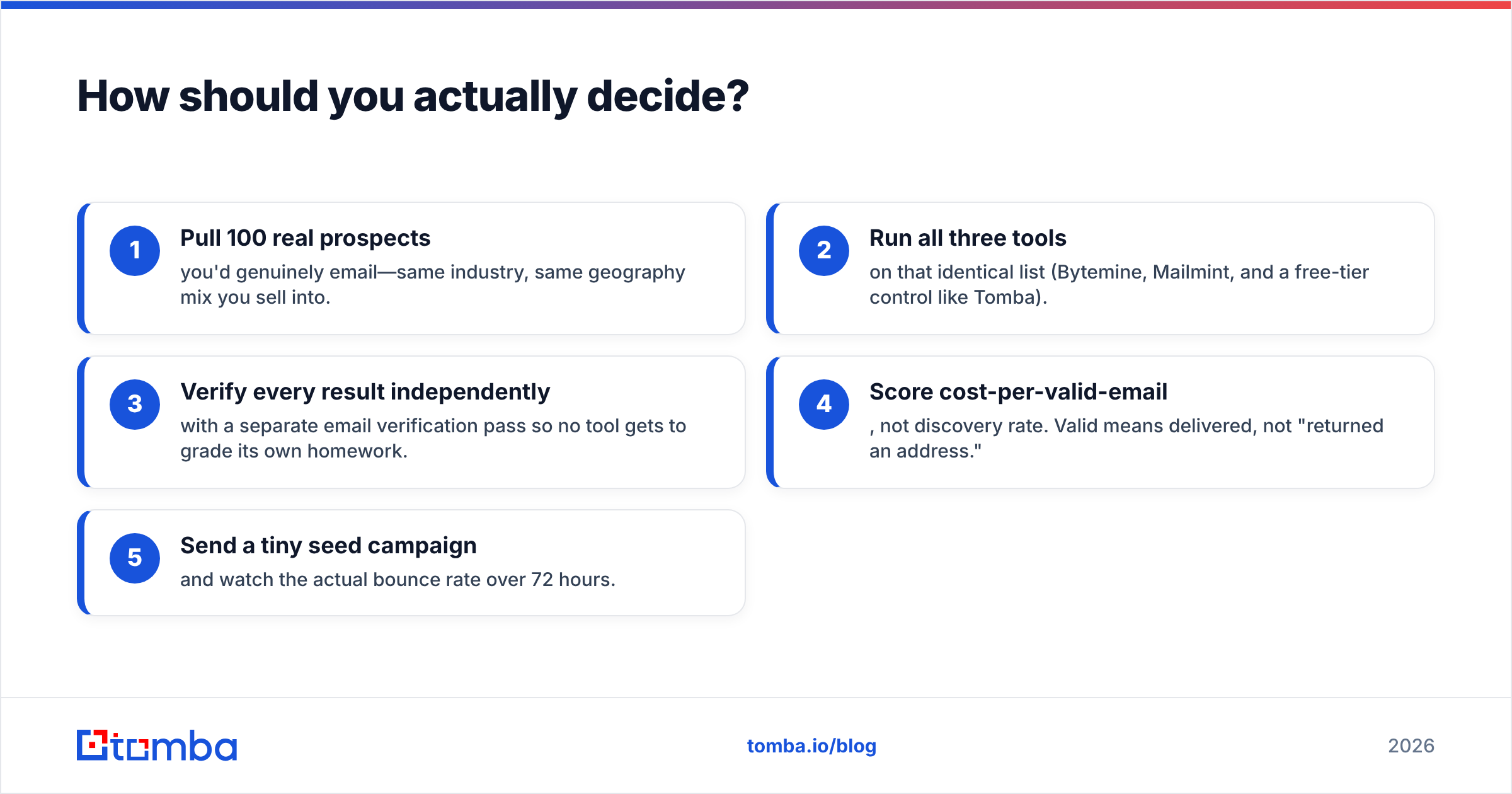
Skip the feature-checklist paralysis. Run a controlled test:
- Pull 100 real prospects you'd genuinely email—same industry, same geography mix you sell into.
- Run all three tools on that identical list (Bytemine, Mailmint, and a free-tier control like Tomba).
- Verify every result independently with a separate email verification pass so no tool gets to grade its own homework.
- Score cost-per-valid-email, not discovery rate. Valid means delivered, not "returned an address."
- Send a tiny seed campaign and watch the actual bounce rate over 72 hours.
The tool that wins on cost-per-valid-email and lowest real bounce rate is your tool—regardless of which one looked best in the demo. For independent user sentiment while you're at it, cross-reference categories on G2 rather than relying on any vendor's own case studies.
Frequently asked questions#
Is Bytemine or Mailmint more accurate? On US enterprise domains, Mailmint is usually more conservative and bounces less. On raw discovery volume, Bytemine finds more—but a meaningful share are catch-all guesses that can bounce. Neither publishes audited accuracy, so verify independently.
Which is cheaper? Bytemine typically has a lower entry price, but bulk overage fees and shallow verification raise its true cost-per-valid-email. Mailmint's per-seat model gets expensive as teams grow. Compare effective cost per delivered email, not the headline plan price.
Do I still need a separate email verifier? With both tools, yes—their "valid" labels lean on the finder's own guess. An independent SMTP-level catch-all verification step is the difference between a 1% and a 5% bounce rate.
What about non-US prospects? This is Mailmint's soft spot and Bytemine's inconsistency zone. If you sell into EU, LATAM, or APAC markets, test coverage on those exact domains before you commit—US benchmarks won't predict it.
The bottom line#
Bytemine vs Mailmint is a real trade-off—volume and price versus polish and US accuracy—but both share the same blind spot: no transparent accuracy data and a credit model that charges you for misses. Before you sign up for either, run the 100-prospect test and grade on cost-per-valid-email.
If you want a control that's free to benchmark and verifies as it finds, start with the Tomba Email Finder. Spend your 25 free monthly searches on the same prospects you'd give Bytemine or Mailmint, verify every result, and let the bounce rate pick the winner. Transparent data beats a confident slogan every time—make the tools prove it on your list.
// get started
Find, verify and enrich your first contacts today
Start on the free plan with 25 searches a month, then scale when your team is ready.
Free plan · No credit card required · GDPR & CCPA
// about the author