Bytemine vs Mattermark: B2B Data Tools Compared (2026)
Bytemine and Mattermark promised data-driven prospecting, but the market moved on. Here's how they compare in 2026 — and what to use now.
Bytemine vs Mattermark: Which B2B Data Tool Wins in 2026?
If you landed here, you are probably auditing an old prospecting stack, inheriting a list someone built years ago, or comparing legacy market-intelligence tools against what is available today. Both Bytemine and Mattermark belong to an earlier generation of B2B data platforms — and understanding what each did well tells you exactly what to look for in a modern replacement.
TL;DR#
- Bytemine positioned itself as a developer-leaning data and analytics layer for B2B prospecting; Mattermark was a market-intelligence platform built around company signals, funding data, and growth scores.
- Neither tool is a strong fit for teams whose core job in 2026 is finding and verifying contact emails — that is a different workload than company-level intelligence.
- Mattermark's most useful feature was deal/growth signal tracking; Bytemine leaned toward raw data access and segmentation.
- For accurate, current B2B email and contact data, a dedicated email finder plus an email verifier will outperform either legacy platform.
- Skip to the comparison table if you just want the side-by-side.

What is Bytemine?#
Bytemine was built for teams that wanted programmatic access to B2B company and contact data rather than a polished point-and-click dashboard. Think of it less like a CRM add-on and more like a data warehouse you query: you pull segments, enrich records, and feed them into your own pipeline.
That design appealed to technical growth and RevOps teams who already had engineers and wanted control over how data flowed into their systems. The trade-off is obvious — without an in-house data person, the value drops fast. You are responsible for the orchestration, the deduplication, and keeping records fresh.
The other catch with any raw-data platform is decay. Company headcounts, job titles, and email patterns change constantly. A static export is only as good as the day it was generated, which is why teams that relied on bulk dumps often discovered bounce rates climbing months later.
What is Mattermark?#
Mattermark was a market-intelligence product. Its reason for existing was to score and rank companies by growth signals — funding rounds, web traffic momentum, hiring velocity, mindshare — so that sales and investment teams could prioritize accounts likely to be "hot."
For venture and account-based teams in the mid-2010s, that was genuinely useful. Instead of guessing which startups were scaling, you could sort a list by a composite growth score and spend your time on the accounts with momentum. Mattermark's data and brand changed hands over the years (it was acquired and folded into other portfolios), so its standalone trajectory effectively ended well before 2026. Treat any "Mattermark" you encounter today as a legacy dataset rather than an actively expanding platform, and verify the current owner before you commit budget.
The strength was prioritization. The weakness — for anyone whose actual job is outreach — was that knowing a company is growing does not give you the named person and the working email address you need to start a conversation.
How do Bytemine and Mattermark compare feature by feature?#
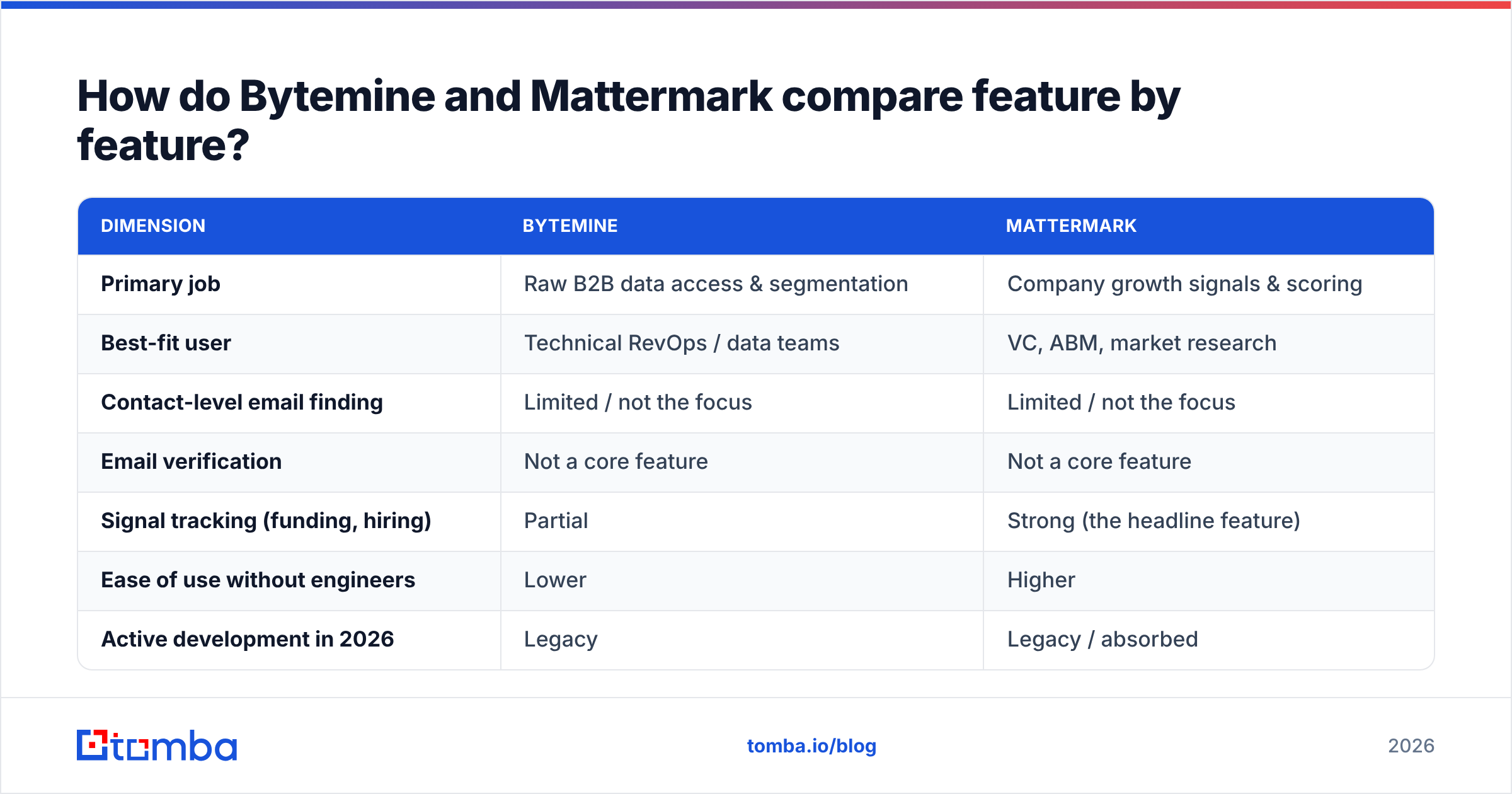
Here is the honest side-by-side. Both tools occupy the company intelligence lane more than the contact data lane, which matters a lot depending on your goal.
| Dimension | Bytemine | Mattermark |
|---|---|---|
| Primary job | Raw B2B data access & segmentation | Company growth signals & scoring |
| Best-fit user | Technical RevOps / data teams | VC, ABM, market research |
| Contact-level email finding | Limited / not the focus | Limited / not the focus |
| Email verification | Not a core feature | Not a core feature |
| Signal tracking (funding, hiring) | Partial | Strong (the headline feature) |
| Ease of use without engineers | Lower | Higher |
| Active development in 2026 | Legacy | Legacy / absorbed |
| Pay-as-you-go contact credits | No | No |
Read that table with one question in mind: what is the actual output you need this week? If it is a ranked list of accounts to research, these tools were designed for that. If it is 500 verified decision-maker emails ready for a sequence, neither was.
Which one is better for prospecting in 2026?#
Neither, if your bottleneck is contact data — and for most outbound teams, it is. That is the uncomfortable conclusion. Company intelligence is the easy half of prospecting now; dozens of sources will tell you a company raised a Series B. The hard, high-value half is getting a current, deliverable email for the specific person who owns the budget.
This is where the workflow splits into three jobs most legacy platforms never specialized in:
- Find the person — map the named decision-maker to a company, not just the company itself.
- Find the email — resolve that person to a working address using a dedicated find emails engine, or pull every address on a domain with a domain search.
- Verify before you send — run each address through an email verifier so your bounce rate stays low and your sender reputation survives.
A growth score cannot do step two or three. And in 2026, with mailbox providers tightening enforcement, skipping step three is how good domains end up in the spam folder.

What should you use instead of Bytemine or Mattermark?#
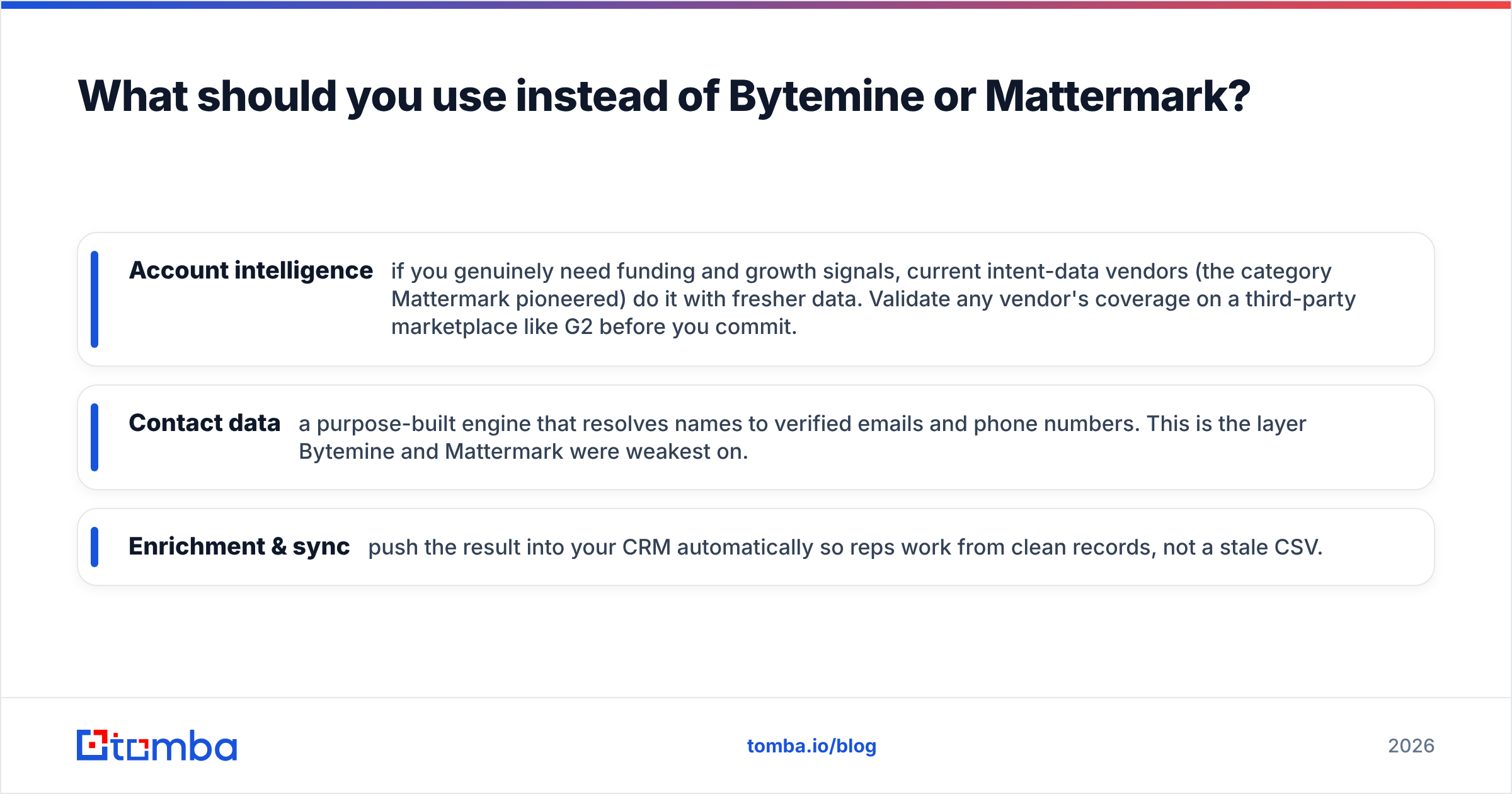
Match the tool to the job instead of buying one platform that half-does everything. Most modern stacks split cleanly into three layers:
- Account intelligence — if you genuinely need funding and growth signals, current intent-data vendors (the category Mattermark pioneered) do it with fresher data. Validate any vendor's coverage on a third-party marketplace like G2 before you commit.
- Contact data — a purpose-built engine that resolves names to verified emails and phone numbers. This is the layer Bytemine and Mattermark were weakest on.
- Enrichment & sync — push the result into your CRM automatically so reps work from clean records, not a stale CSV.
For the contact-data layer, Tomba is built specifically for the job those legacy tools punted on. Beyond the core email finder, you get a phone finder for B2B numbers, bulk email finder for list building at scale, and data enrichment to fill gaps in records you already own. Everything is callable through the Tomba API if you liked Bytemine's programmatic angle — you keep the developer control without inheriting the staleness problem.
How does pricing compare?#
Legacy enterprise data platforms like Bytemine and Mattermark historically ran on opaque, annual, sales-call-gated contracts — you rarely saw a price without a demo, and seats started in the four figures. That model made sense when data access itself was scarce. It makes far less sense now, when transparent, usage-based pricing is the norm.
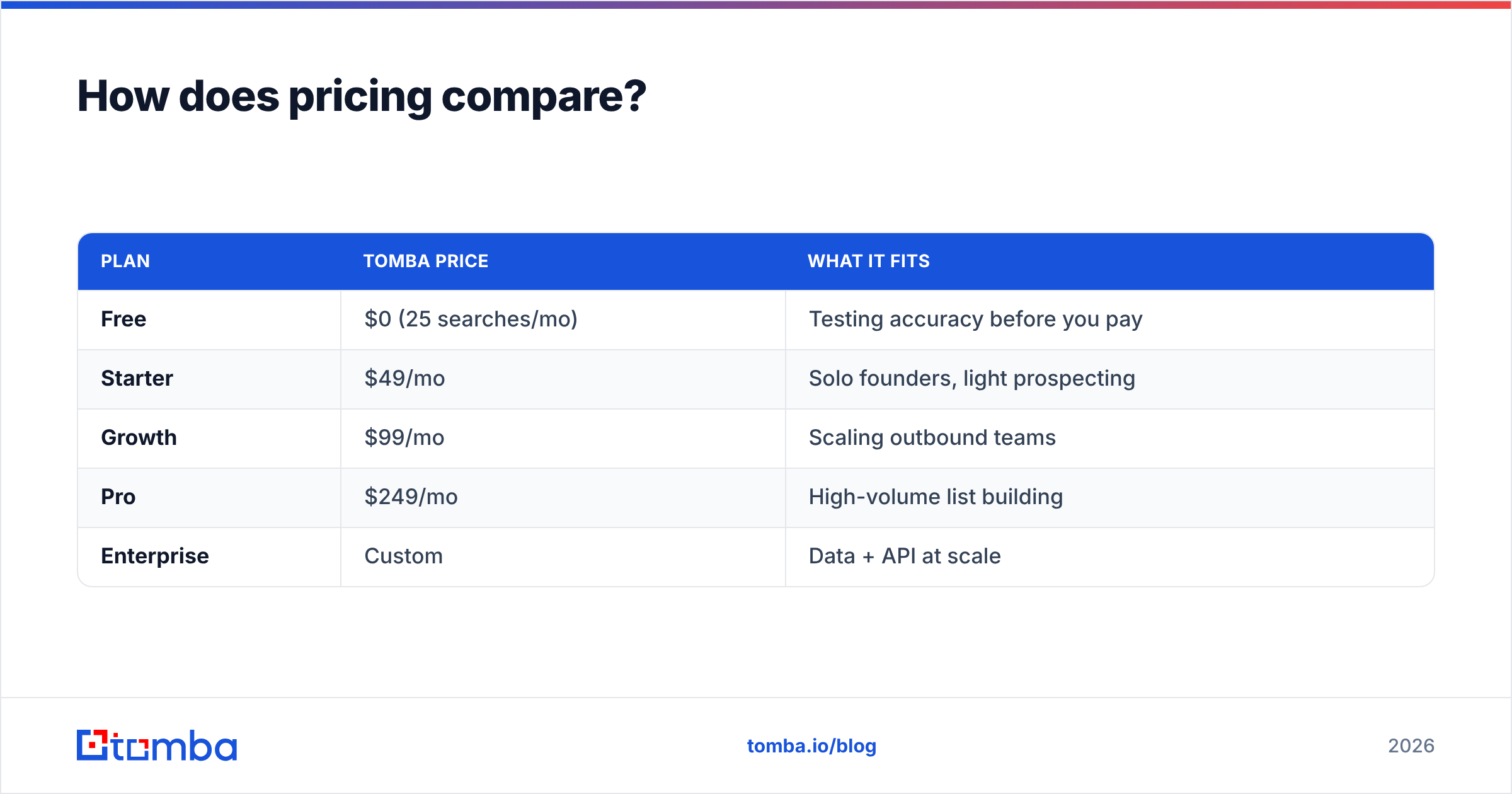
Here is how a transparent, contact-focused alternative is structured by comparison:
| Plan | Tomba price | What it fits |
|---|---|---|
| Free | $0 (25 searches/mo) | Testing accuracy before you pay |
| Starter | $49/mo | Solo founders, light prospecting |
| Growth | $99/mo | Scaling outbound teams |
| Pro | $249/mo | High-volume list building |
| Enterprise | Custom | Data + API at scale |
The point is not that one number beats another — it is that you can start on a free tier, test real accuracy on your own target accounts, and scale up without signing an annual contract first. Compare the full Tomba pricing against any legacy quote you are holding and weigh it on cost-per-verified-contact, not cost-per-seat.
Is the data accurate enough to trust?#
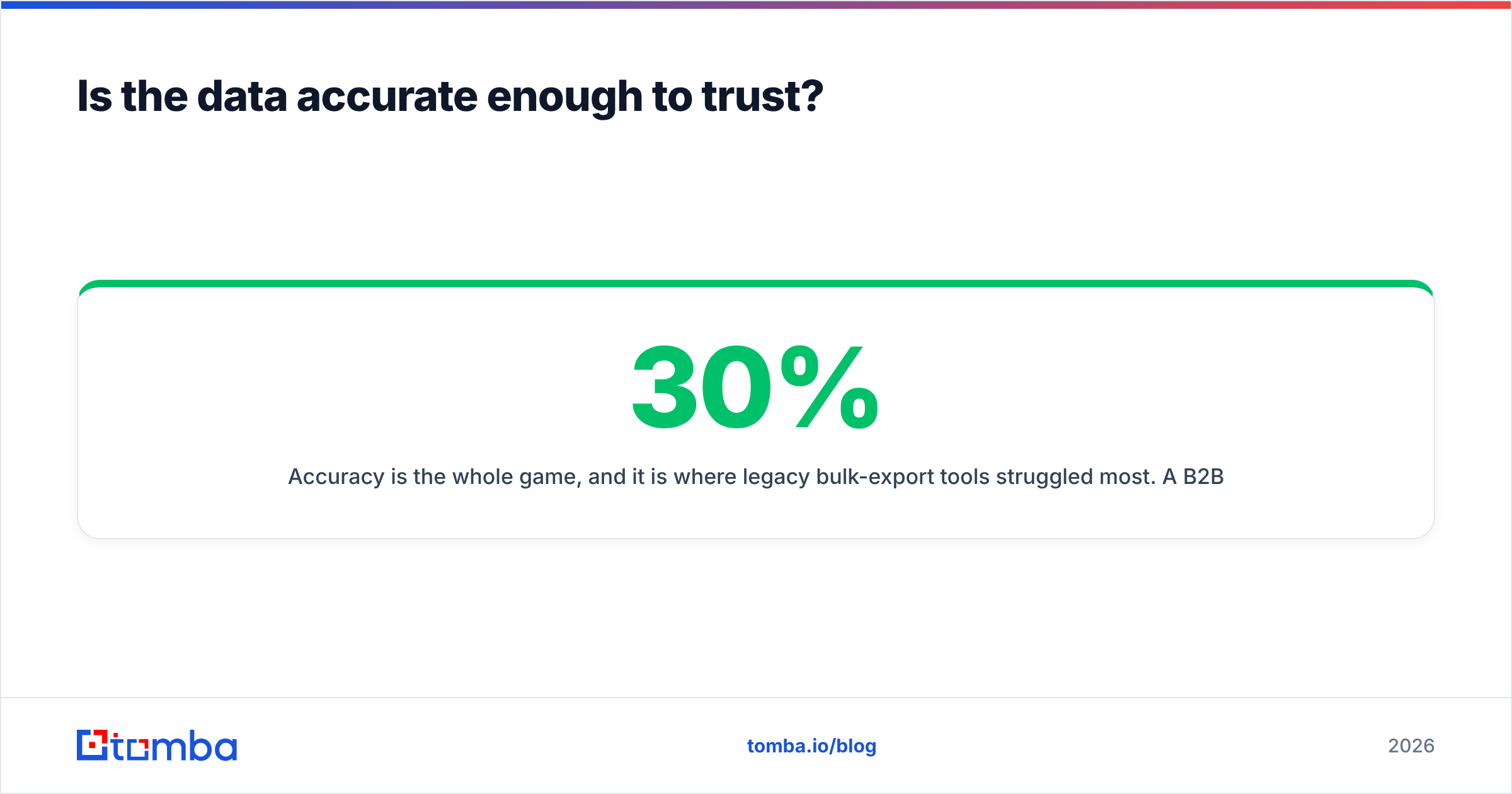
Accuracy is the whole game, and it is where legacy bulk-export tools struggled most. A B2B record degrades roughly 25–30% per year as people change jobs — so a dataset that was 95% accurate at export can drift well below 70% within twelve months. That decay is invisible until your bounce rate spikes.
Two habits protect you regardless of vendor:
- Verify at send time, not at export time. Run addresses through an email verification step right before a campaign, and handle risky domains with a dedicated catch-all verifier instead of guessing.
- Re-enrich on a schedule. Treat your database as a living thing; refresh stale records with contact enrichment rather than trusting a one-time pull.
If you want to understand where a vendor's data actually comes from before you rely on it, read the data sources documentation — transparency about sourcing is a strong signal of quality, and it is something the older platforms rarely published clearly.
Who still benefits from a Mattermark-style tool?#
To be fair, the market-intelligence model is not dead — it just narrowed. You still benefit from a Mattermark-style signal platform if:
- You are an investor screening hundreds of startups by growth momentum.
- You run account-based marketing and genuinely orchestrate around funding and hiring triggers.
- Your reps already have reliable contact data and only need help with prioritization, not reach.
If none of those describe you — if your daily pain is "I know the company, I just need the right person's verified email" — then a company-intelligence platform is solving a problem you do not have, and you are better served by a focused contact-data tool plus a lightweight CRM workflow. You can wire that into HubSpot or your existing system through Tomba's integrations so reps never touch a raw spreadsheet.
The bottom line on Bytemine vs Mattermark#
Both tools were good answers to a 2015 question: which companies should I care about? In 2026 that question is mostly commoditized, and the durable competitive edge has shifted to can I reliably reach the right person before my competitor does? That is a contact-data and deliverability problem, and it is not what either Bytemine or Mattermark was built to solve.
So use the legacy comparison to clarify your real need. If you want account signals, look at the current intent-data category. If — like most teams — you want verified emails and phone numbers that convert into pipeline, start with a tool built for exactly that.
Stop paying for company trivia and start reaching real people. Try the Tomba Email Finder free for 25 searches a month, verify every address before you send, and see your bounce rate drop on the next campaign — no annual contract, no demo gate, just accurate contact data when you need it.
// get started
Find, verify and enrich your first contacts today
Start on the free plan with 25 searches a month, then scale when your team is ready.
Free plan · No credit card required · GDPR & CCPA
// about the author