Bytemine vs Noparam: Best B2B Email Finder in 2026
Bytemine vs Noparam, head to head: accuracy, pricing, verification, and API depth. See which email finder fits your outbound stack in 2026 — and where Tomba beats both.
You have a list of target companies and zero verified emails. Two tools keep coming up in the search: Bytemine and Noparam. Both promise accurate B2B contact data, both lean on enrichment, and both want a slot in your prospecting stack. Only one should get it.
This is a practical, side-by-side breakdown of Bytemine vs Noparam — what each does well, where each falls short, what they cost, and how they handle the part that actually decides your bounce rate: verification. We'll also be honest about where a third option, Tomba, outperforms both.
TL;DR#
- Noparam is built around real-time, on-demand email finding with a verification step baked in — strong for one-off lookups and waterfall-style enrichment.
- Bytemine leans toward bulk enrichment and data workflows, appealing to teams that want to push lists through automation rather than search name-by-name.
- Accuracy and bounce protection are the deciding factors, not the homepage copy. Always test on your own list before committing.
- Pricing for both is credit-based; effective cost depends heavily on how many "found" emails are actually deliverable.
- If you want high match rates, built-in email verification, and a developer-grade Tomba API on one platform, Tomba is the stronger all-rounder — starting at $49/mo with a free tier.
What are Bytemine and Noparam?#
Both tools sit in the email finder / lead enrichment category. You give them a name and a company (or a domain, or a LinkedIn profile), and they return a professional email address. The difference is in philosophy.
Noparam positions itself as a precision finder. The pitch is real-time resolution: when you request a contact, it searches and validates on the spot, aiming to return only emails it believes are deliverable. That makes it a natural fit inside a "waterfall" — a chain of providers queried in sequence until one returns a verified hit.
Bytemine leans toward the data-pipeline side. The emphasis is on enriching lists at scale, feeding contacts into your CRM or sequencing tool, and treating email-finding as one step in a broader enrichment flow rather than a manual, search-bar activity.
Neither approach is wrong. The right one depends on whether you prospect in small, deliberate batches or push thousands of rows through automation each week.
The core attributes that actually matter#
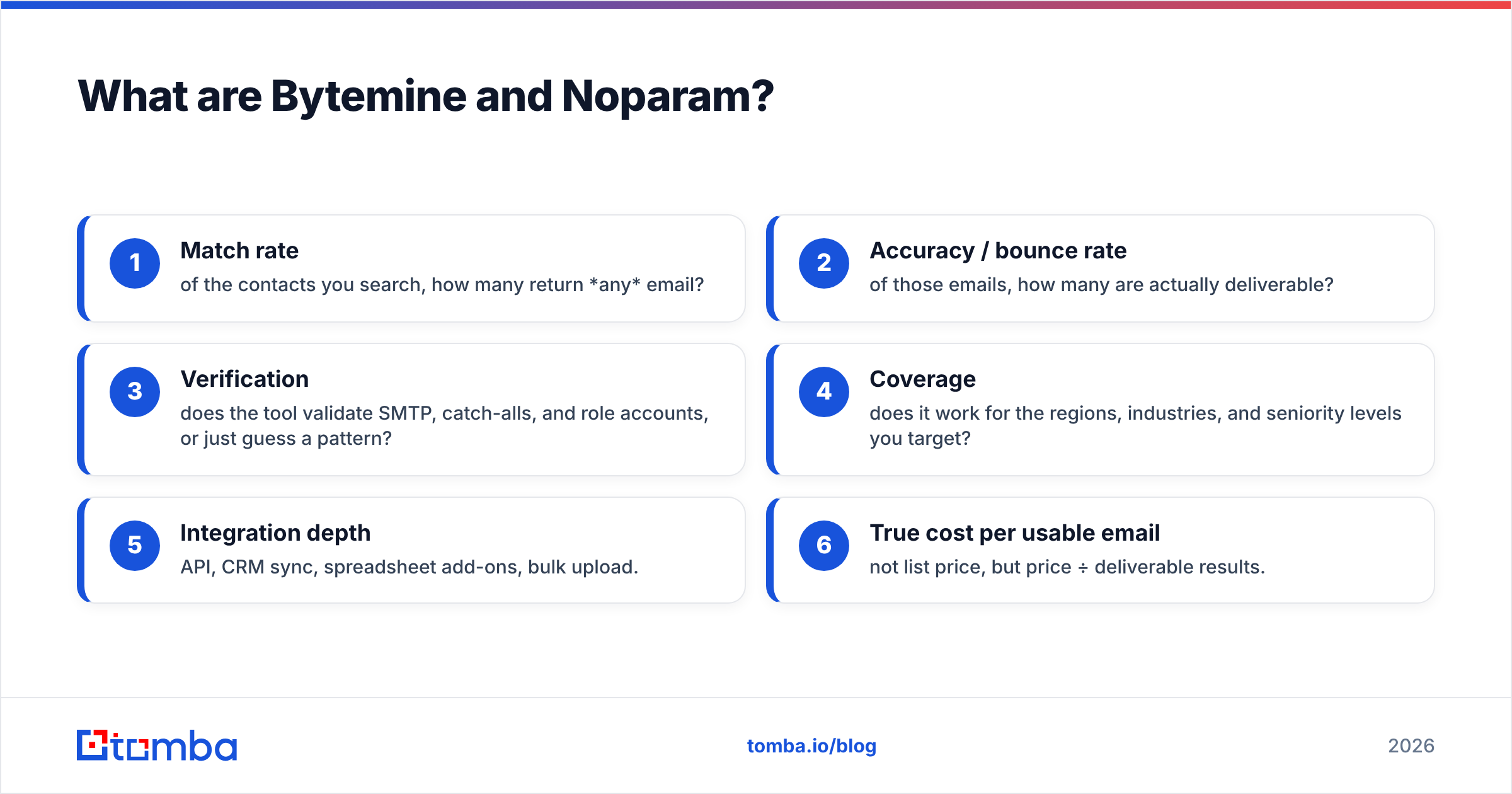
When you strip away branding, an email finder is judged on six things. Score any tool against these before you pay:
- Match rate — of the contacts you search, how many return any email?
- Accuracy / bounce rate — of those emails, how many are actually deliverable?
- Verification — does the tool validate SMTP, catch-alls, and role accounts, or just guess a pattern?
- Coverage — does it work for the regions, industries, and seniority levels you target?
- Integration depth — API, CRM sync, spreadsheet add-ons, bulk upload.
- True cost per usable email — not list price, but price ÷ deliverable results.

Notice that match rate and accuracy pull in opposite directions. A tool can inflate its "found" number by returning guessed, pattern-based addresses it never validated. Those count as wins on the dashboard and losses in your inbox when they bounce. This is exactly why the verification column below carries more weight than the raw match rate.

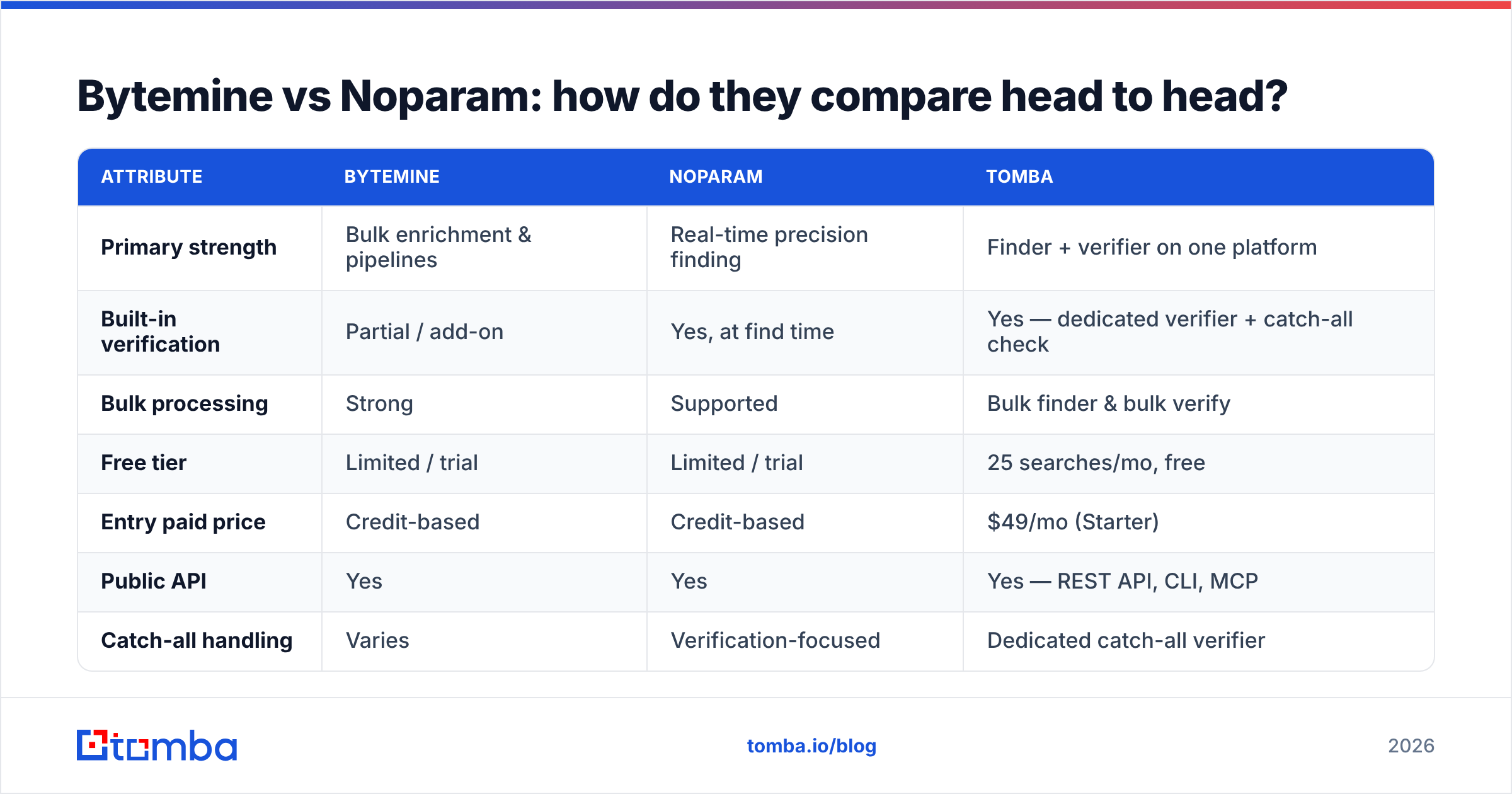
Bytemine vs Noparam: how do they compare head to head?#
Here's the practical comparison. Treat vendor-published accuracy figures as marketing until you test them — the only number that counts is the one you measure on your own list.
| Attribute | Bytemine | Noparam | Tomba |
|---|---|---|---|
| Primary strength | Bulk enrichment & pipelines | Real-time precision finding | Finder + verifier on one platform |
| Built-in verification | Partial / add-on | Yes, at find time | Yes — dedicated verifier + catch-all check |
| Bulk processing | Strong | Supported | Bulk finder & bulk verify |
| Free tier | Limited / trial | Limited / trial | 25 searches/mo, free |
| Entry paid price | Credit-based | Credit-based | $49/mo (Starter) |
| Public API | Yes | Yes | Yes — REST API, CLI, MCP |
| Catch-all handling | Varies | Verification-focused | Dedicated catch-all verifier |
| Spreadsheet add-ons | Limited | Limited | Google Sheets, Excel, Airtable |
| Best for | Data teams automating lists | SDRs doing targeted lookups | Teams wanting accuracy + scale |
A few honest caveats. Both Bytemine and Noparam are credible tools, and for some niches one may out-resolve everyone else — coverage is regional and category-specific. Noparam's find-time verification is genuinely useful for keeping bounce rates low on small, high-value lists. Bytemine's pipeline orientation suits RevOps teams who live in automation and want enrichment to run hands-off.
Where the two diverge most is workflow fit. If your day is "I have 30 named accounts and need the right person at each," Noparam's real-time model is comfortable. If it's "here are 5,000 rows from a list pull, enrich them overnight," Bytemine's batch mentality feels more natural.
Which has better accuracy and lower bounce rates?#
Accuracy is the whole game, because a bounced email doesn't just waste a credit — it damages your sender reputation and drags down deliverability for every other message on the domain.
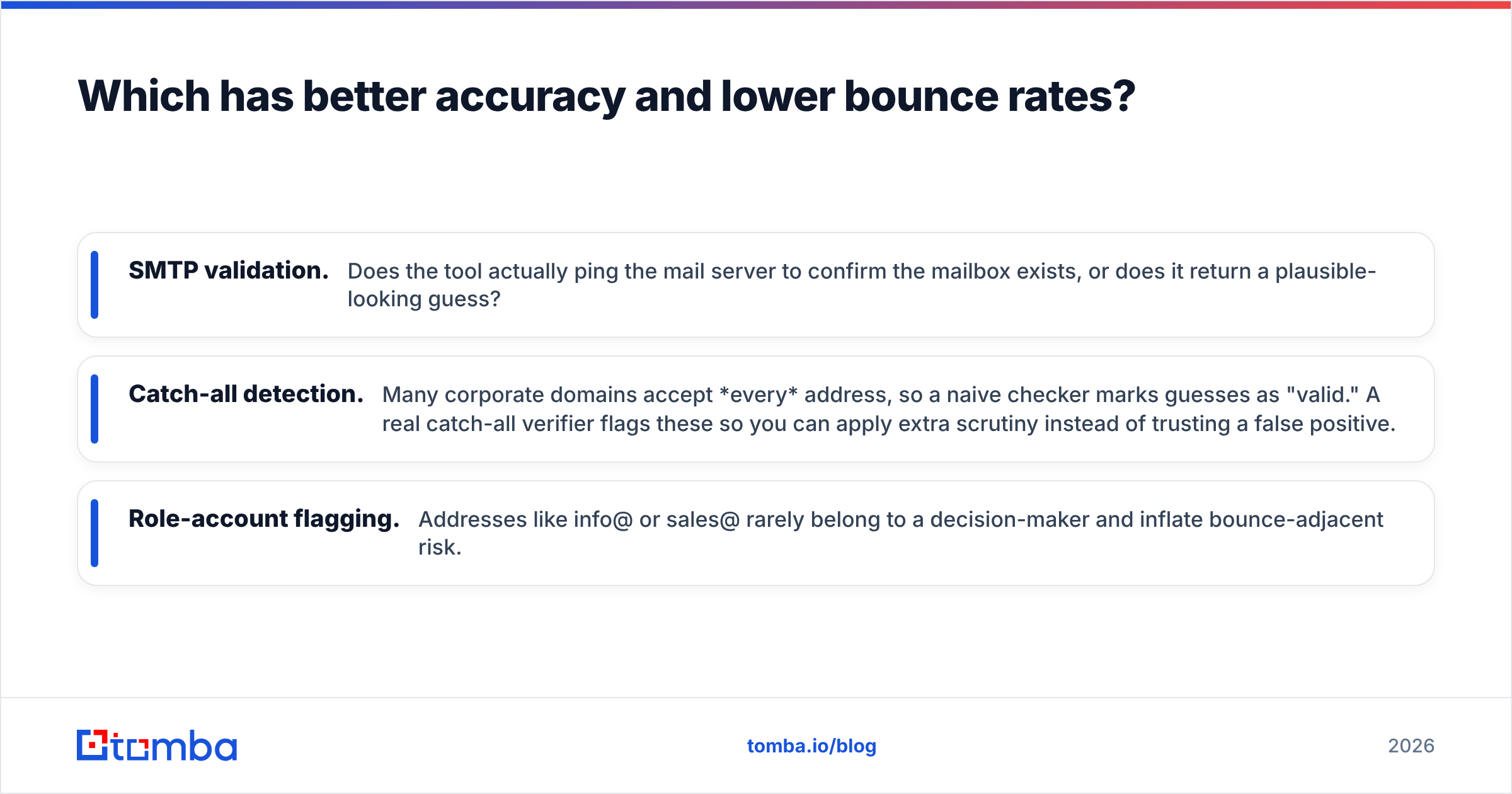
Three mechanics separate accurate finders from optimistic ones:
- SMTP validation. Does the tool actually ping the mail server to confirm the mailbox exists, or does it return a plausible-looking guess?
- Catch-all detection. Many corporate domains accept every address, so a naive checker marks guesses as "valid." A real catch-all verifier flags these so you can apply extra scrutiny instead of trusting a false positive.
- Role-account flagging. Addresses like info@ or sales@ rarely belong to a decision-maker and inflate bounce-adjacent risk.
Noparam's pitch leans hard on the first point — verify-at-find-time — which is a strong default. Bytemine's verification depth varies by plan and configuration, so confirm exactly what's included before you assume every enriched row was validated. With either tool, always run a separate verification pass on the export before you load it into a sequencer.
This is also where Tomba's design philosophy differs: finding and verifying are first-class, separate-but-connected steps. You can find emails and immediately push them through the verifier, and the catch-all verifier resolves the ambiguous cases that quietly wreck campaigns. If you want the deeper mechanics, the email deliverability glossary entry breaks down how verification protects sender reputation.
How do Bytemine vs Noparam pricing models compare?#
Both tools use credit-based pricing, which makes apples-to-apples comparison tricky. A "credit" might mean one search, one verified result, or one enrichment — and that definition changes your real cost dramatically.
The metric that matters is cost per usable (deliverable) email, not the sticker price per credit:
- A tool charging less per credit but returning more bounces can cost more per usable lead.
- A tool that only bills for verified hits looks pricier up front but may be cheaper in practice.
- Bulk discounts shift the math at volume, so price the plan at your monthly volume, not the headline tier.
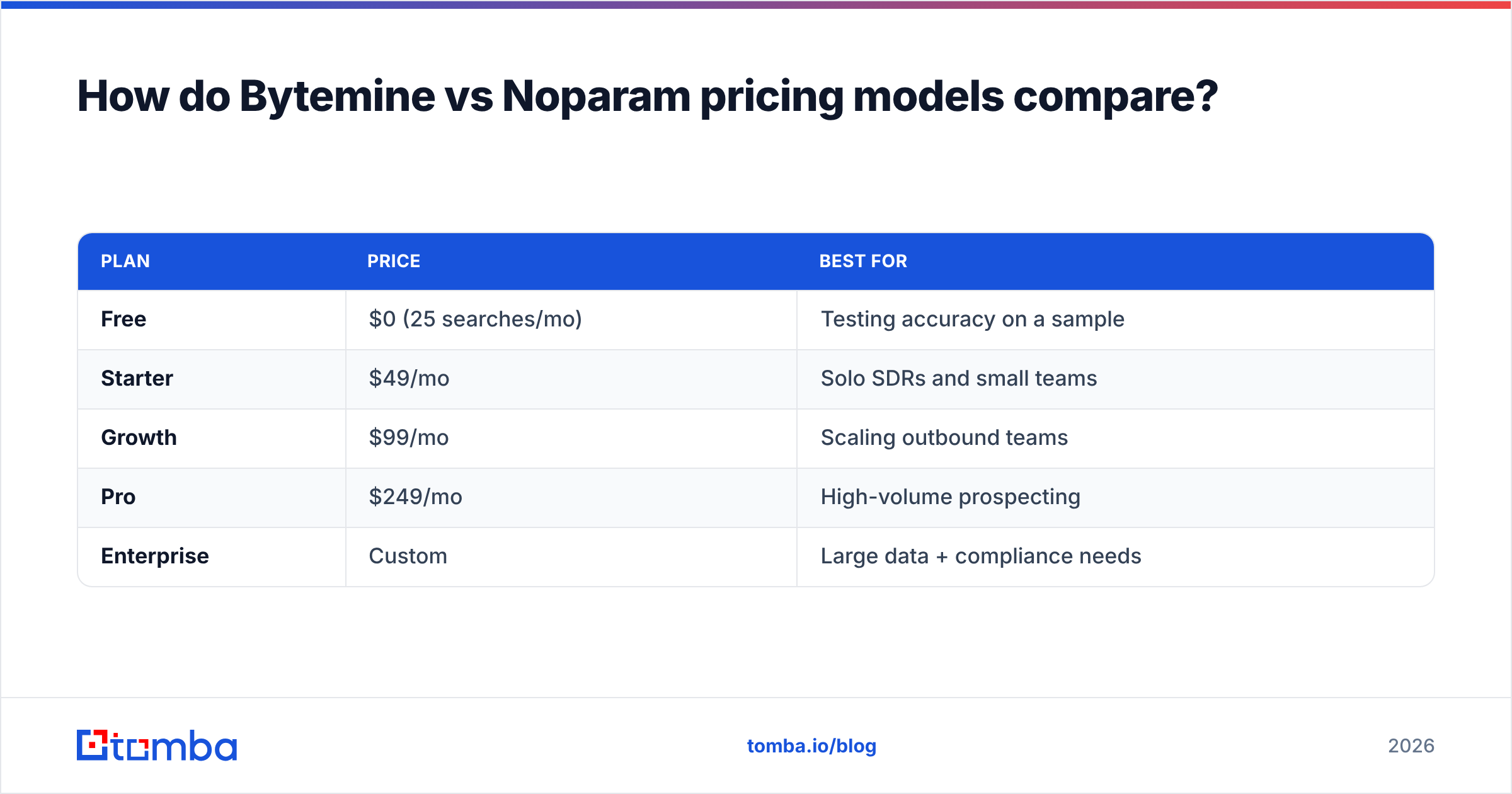
Because Bytemine and Noparam adjust pricing and packaging over time, check their current published rates directly rather than trusting any third-party number — including this one. For a transparent reference point, Tomba pricing is published in full:
| Plan | Price | Best for |
|---|---|---|
| Free | $0 (25 searches/mo) | Testing accuracy on a sample |
| Starter | $49/mo | Solo SDRs and small teams |
| Growth | $99/mo | Scaling outbound teams |
| Pro | $249/mo | High-volume prospecting |
| Enterprise | Custom | Large data + compliance needs |
The takeaway: run a free or trial test on each tool with the same 50-contact list, count the deliverable results, and divide. The winner on paper is rarely the winner on cost-per-usable-lead.
Which integrates better with your sales stack?#
A finder you can't wire into your workflow becomes copy-paste busywork. Evaluate three integration layers:
- API. All three tools expose an API. The differences are in rate limits, endpoint breadth (finder, verifier, enrichment, domain search), and documentation quality. If engineering is building the pipeline, read the docs before you buy.
- No-code automation. Zapier, Make, and native CRM connectors decide whether ops can self-serve. Tomba, for instance, connects to HubSpot, Salesforce, Pipedrive, and Zapier directly.
- Spreadsheet and browser tools. A Google Sheets add-on or Chrome extension is what most reps actually use day to day.
Bytemine's pipeline focus means its sweet spot is programmatic enrichment — strong if you have an ops team, less convenient for a rep who just wants a browser button. Noparam's real-time model plays well with waterfall enrichment platforms that orchestrate multiple providers. Tomba aims to cover both ends: a documented API plus consumer-friendly add-ons and a bulk uploader.
For broader context on the category, independent review sites like G2 and Capterra let you filter user reviews by company size and use case — useful for sanity-checking whether a tool's strengths match teams like yours.
What about coverage and data freshness?#
Coverage is the quiet differentiator. Two finders can post identical "match rate" claims while excelling in completely different regions or seniority bands.
Ask each vendor — or better, test for — these:
- Geographic coverage. EU-heavy databases may under-perform on North American mid-market, and vice versa.
- Seniority depth. Finding a VP at a 5,000-person company is harder than finding a founder at a 10-person startup; tools vary widely here.
- Freshness. People change jobs constantly. A stale record returns a real-looking email that bounces because the person left. Re-verification before send is non-negotiable.
If your motion depends on enriching inbound or identifying companies before you even have a name, that's a different job — closer to data enrichment and domain-level discovery than single-contact lookup. Make sure the tool you pick is strong at the specific job you're hiring it for.
Bytemine vs Noparam: which should you choose?#
Here's the honest decision tree:
- Choose Noparam if you do targeted, lower-volume prospecting where every contact matters and you want verification baked into the find step. Its real-time precision model minimizes bounces on small, high-value lists.
- Choose Bytemine if you're a data or RevOps team running list enrichment at scale through automation, and you're comfortable configuring verification as part of your pipeline.
- Choose Tomba if you want both — high match rates and dedicated verification (including catch-all), a transparent $49 entry price, a free tier to test first, and a single API that covers finding, verifying, domain search, and enrichment without stitching multiple vendors together.
No tool wins every category for every team. But for most outbound and growth teams that need accuracy without managing a fragile multi-vendor waterfall, consolidating on one accurate platform beats juggling two.
The bottom line#
Bytemine and Noparam are both legitimate choices, and the "right" answer depends on your volume, region, and how much of your workflow is automated. Test both on the same sample list, measure deliverable results, and compute cost per usable email. Don't trust the dashboard's "found" count — trust your bounce rate.
If you'd rather skip the waterfall entirely and get accurate emails and verification on one platform, start with the Tomba Email Finder. Run the free tier (25 searches/month) against the same test list you'd use for Bytemine or Noparam, push the results through the built-in verifier, and compare deliverable hits side by side. Then check the full Tomba plans — $49/mo Starter, scaling to Growth and Pro as your outbound grows. Let the bounce rate, not the marketing, pick your winner.
Ready to find emails that actually work?
Join 150,000+ professionals who stopped guessing and started sending. Free credits on signup — no credit card required.
Get the Tomba newsletter
Practical outbound tactics and product updates — once every two weeks.
About the author