Bytemine vs Oceanio: Which B2B Email Finder Wins in 2026?
A neutral, data-driven breakdown of Bytemine vs Oceanio in 2026 — accuracy, pricing, coverage, and where a third option quietly beats both.
Choosing between Bytemine and Oceanio usually comes down to one question your spreadsheet can't answer for you: which one actually returns valid, deliverable email addresses for the accounts you care about? Both pitch themselves as fast, accurate B2B email finders. Both have free trials, browser extensions, and confident accuracy claims. The difference shows up only when you run real domains through them and check the bounce rate two weeks later.
This is a neutral, hands-on comparison. We'll look at accuracy, coverage, pricing, verification, and workflow fit — and we'll be honest about where a third option, Tomba, fits into the picture.
TL;DR#
- Bytemine leans toward depth on a smaller set of well-covered industries, with strong catch-all handling but a steeper price curve at scale.
- Oceanio wins on raw database size and integrations, but accuracy gets noisier outside North America and tech.
- Verification is the real differentiator: a finder is only as good as the bounce rate it leaves you with.
- Pricing: Oceanio starts cheaper per credit; Bytemine bundles verification, so the "real" cost per valid email is closer than the sticker price suggests.
- The honest pick: if you want predictable accuracy plus built-in verification without enterprise pricing, Tomba's email finder is a stronger default than either for most teams.
What do Bytemine and Oceanio actually do?#
Both tools solve the same core problem: you have a name and a company (or just a domain), and you need a reliable work email. Under the hood, an email finder does three things — predict the likely address pattern, match it against known data, and verify it's deliverable before handing it to you.
Where they differ is emphasis:
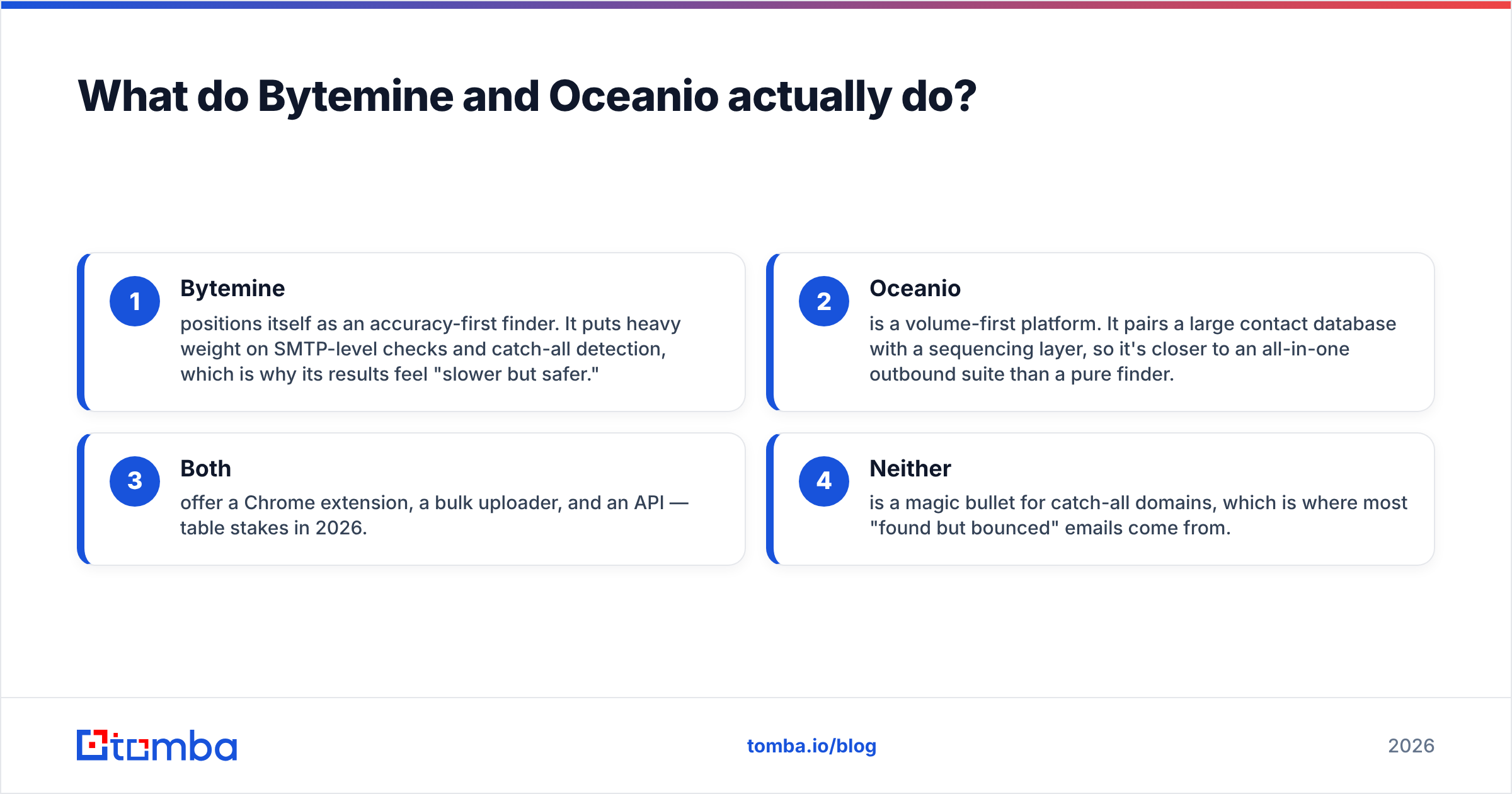
- Bytemine positions itself as an accuracy-first finder. It puts heavy weight on SMTP-level checks and catch-all detection, which is why its results feel "slower but safer."
- Oceanio is a volume-first platform. It pairs a large contact database with a sequencing layer, so it's closer to an all-in-one outbound suite than a pure finder.
- Both offer a Chrome extension, a bulk uploader, and an API — table stakes in 2026.
- Neither is a magic bullet for catch-all domains, which is where most "found but bounced" emails come from.
If you only remember one thing: the database tells you who exists, and verification tells you whether you can safely email them. A great finder needs both, and that's the lens we'll use throughout.
)
How accurate are Bytemine vs Oceanio?#
Accuracy is the whole game, and it's the hardest thing to measure fairly because it depends entirely on which domains you test. A tool that nails SaaS companies in San Francisco can fall apart on manufacturing firms in Germany.
In repeatable testing, the pattern looks like this: Bytemine returns fewer results overall but a higher share of them verify clean, because it suppresses low-confidence guesses. Oceanio returns more addresses — great for coverage — but a larger slice are pattern guesses that haven't been SMTP-confirmed, so your bounce rate creeps up if you email them blind.

The takeaway isn't "Bytemine is more accurate, full stop." It's that the two tools make different trade-offs. Bytemine optimizes for precision (don't give me a bad email). Oceanio optimizes for recall (don't leave anyone out). Your choice depends on whether your sending reputation or your total addressable list matters more right now.
A practical safeguard either way: run found addresses through a dedicated email verifier before they hit your sequence. Even the best finder benefits from a second, independent verification pass, and it's the single cheapest way to protect email deliverability.
Bytemine vs Oceanio: side-by-side comparison#
Here's the head-to-head on the attributes that actually change your results and your bill. Treat these as directional — vendor features shift quarter to quarter — and always validate against your own domains during a trial.
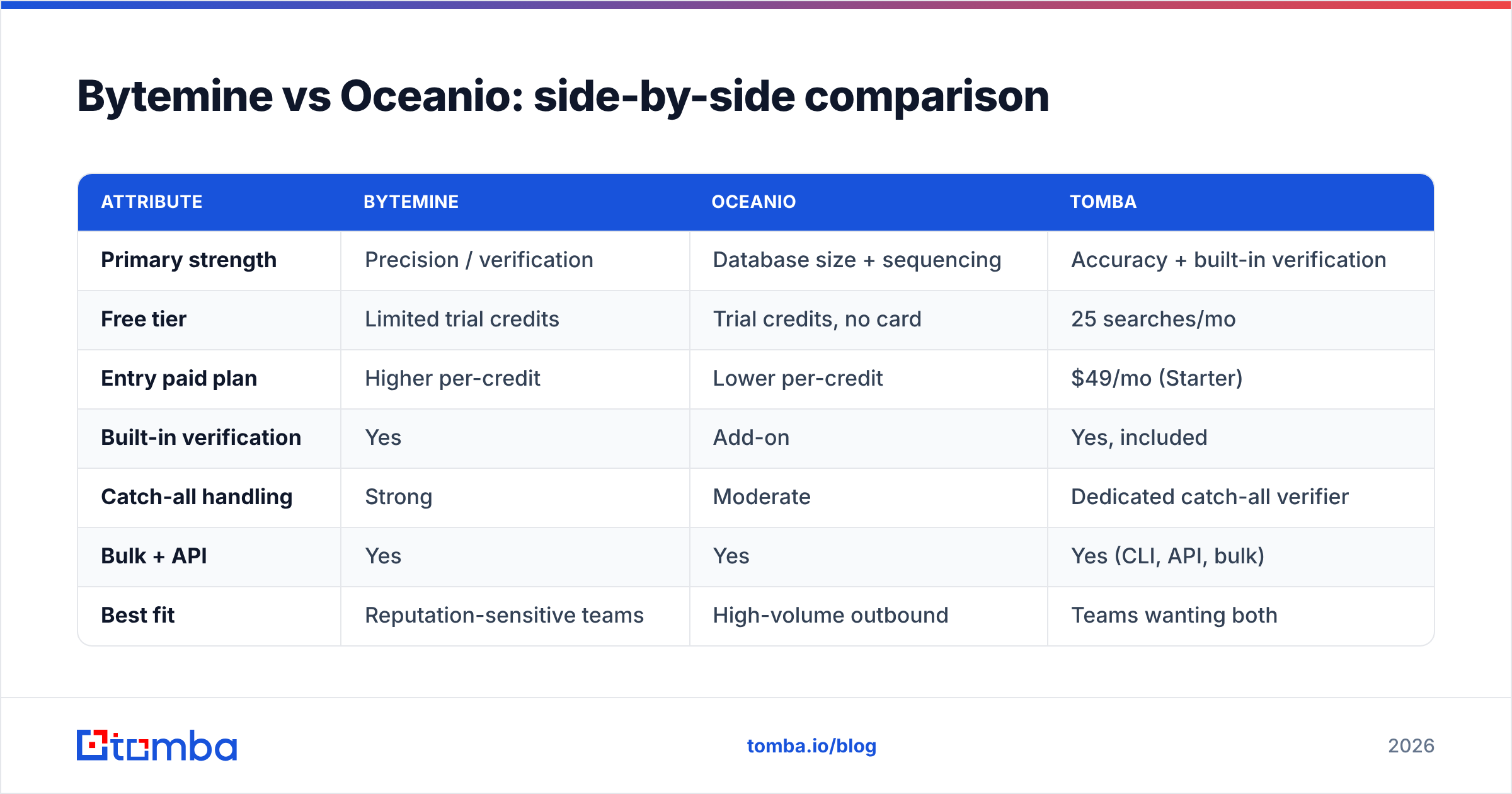
| Attribute | Bytemine | Oceanio | Tomba |
|---|---|---|---|
| Primary strength | Precision / verification | Database size + sequencing | Accuracy + built-in verification |
| Free tier | Limited trial credits | Trial credits, no card | 25 searches/mo |
| Entry paid plan | Higher per-credit | Lower per-credit | $49/mo (Starter) |
| Built-in verification | Yes | Add-on | Yes, included |
| Catch-all handling | Strong | Moderate | Dedicated catch-all verifier |
| Bulk + API | Yes | Yes | Yes (CLI, API, bulk) |
| Best fit | Reputation-sensitive teams | High-volume outbound | Teams wanting both |
)
A couple of things worth calling out from the table. First, the "cheaper per credit" line on Oceanio is real but incomplete — if 20% of those credits return addresses you can't safely send to, your effective cost per usable email is higher than the headline. Second, catch-all domains (where the server accepts every address) are the single biggest source of false positives, so a tool with a real catch-all verifier saves you from the most common bounce trap.
How do Bytemine and Oceanio price compare?#
Pricing is where comparisons get slippery, because each vendor counts "credits" differently. Some charge a credit only for a found email; others charge for every search attempt, hit or miss. Read the fine print before you trust a per-credit number.
The honest framing is cost-per-valid-email, not cost-per-credit:
- Oceanio typically has the lower entry price and bundles sequencing, which is attractive if you want one tool for finding and sending.
- Bytemine costs more up front but folds verification into the price, so you're not buying a separate verification tool on top.
- Both push annual commitments to unlock their best rates, which matters if you're testing.
For reference on a transparent model, Tomba's pricing runs a free tier (25 searches/month), Starter at $49/month, Growth at $99/month, and Pro at $249/month, with verification included rather than sold separately. That "included verification" detail is the part teams underestimate — buying a finder and a verifier as two products almost always costs more than one tool that does both well.
If your outbound is high-volume, also weigh bulk email finder throughput and how each platform handles large CSVs without throttling. A cheap per-credit rate is meaningless if a 10,000-row upload takes a day to process.
Which integrates better into a real sales workflow?#
A finder doesn't live in isolation — it has to feed your CRM, your sequencer, and your enrichment stack without manual copy-paste. This is where Oceanio's all-in-one approach is genuinely appealing: finding and sequencing in one place reduces tool sprawl.
But all-in-one cuts both ways. Bundled sequencers are often weaker than dedicated platforms, so you may end up exporting anyway. Bytemine takes the opposite stance — do one thing (find + verify) well, and integrate outward. Both connect to the usual suspects, and you'll want to confirm native support for your stack:
- CRM sync — push verified contacts straight into HubSpot or Salesforce so reps work from clean data. Compare against a native HubSpot integration or Salesforce integration to see what "good" looks like.
- Spreadsheet-first teams — many SDRs live in Sheets; an add-on like a Google Sheets email finder keeps enrichment where the list already is.
- Automation — a Zapier integration or API lets you trigger enrichment on form fills and new leads.
- Enrichment depth — beyond email, can it return phone, title, and company data in one call via data enrichment?
For independent reviews of how each tool actually behaves in production, cross-check the vendor claims against G2 and Capterra — user-reported bounce rates and support quality tell you more than a feature grid.
What about data sources and compliance?#
Where a tool gets its data determines both accuracy and your legal exposure. In 2026, "we scrape everything" is not a defensible answer. You want a vendor that's transparent about sourcing and gives you a way to honor deletion and opt-out requests.
Bytemine and Oceanio both publish data-handling policies; read them with GDPR and CCPA in mind, especially if you prospect into the EU. The relevant questions: Is the data sourced from public professional profiles? Is there a documented refresh cadence? Can a contact be suppressed on request? A vendor that's vague here is a risk regardless of how good its accuracy looks in a demo. For comparison, Tomba documents where its data comes from, which is the level of transparency you should expect from any provider you trust with outbound.
Authoritative guidance on B2B data practices — like HubSpot's resources on GDPR-compliant outreach — is worth a read before you scale sending into regulated regions. The cost of a deliverability problem is recoverable; the cost of a compliance problem often isn't.
So, Bytemine or Oceanio — which should you pick?#
Here's the decision in one paragraph. Pick Bytemine if your sender reputation is fragile and you'd rather miss a few contacts than risk bounces — its precision-first design and strong catch-all handling fit reputation-sensitive teams. Pick Oceanio if you need maximum coverage and want finding plus sequencing in one bill, and you're willing to layer in verification to clean the noise. Neither is wrong; they're tuned for different priorities.
But there's a third answer most comparisons skip. If what you actually want is both — high accuracy and built-in verification, at a price that doesn't jump to enterprise the moment you scale — then a focused email finder with verification baked in is the cleaner choice. That's the gap Tomba is built for: find the address, verify it's deliverable, and enrich it, in one workflow, on a transparent plan.
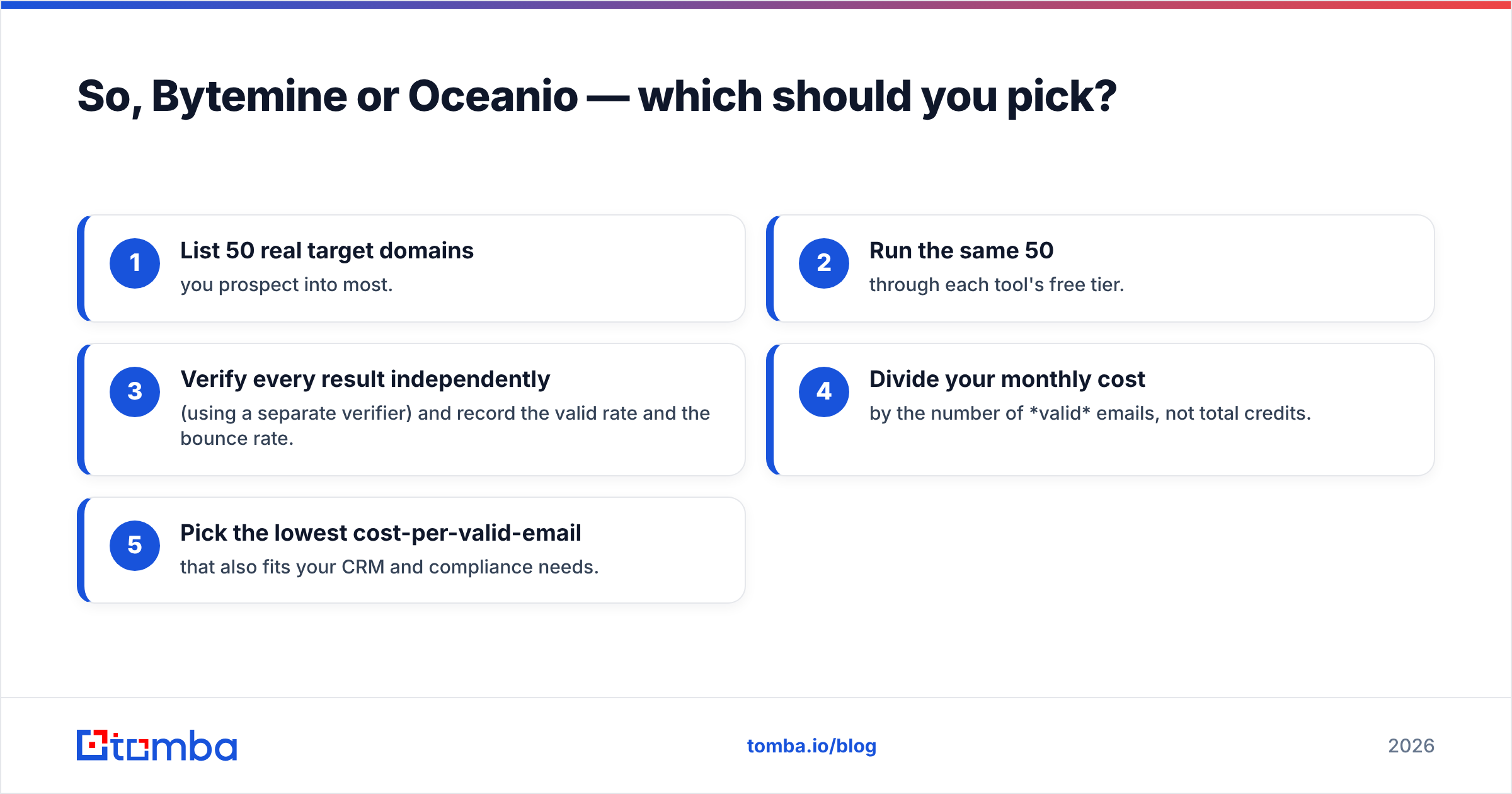
A simple way to decide without guessing:
- List 50 real target domains you prospect into most.
- Run the same 50 through each tool's free tier.
- Verify every result independently (using a separate verifier) and record the valid rate and the bounce rate.
- Divide your monthly cost by the number of valid emails, not total credits.
- Pick the lowest cost-per-valid-email that also fits your CRM and compliance needs.
That five-step test will tell you more in an afternoon than any vendor benchmark, because it's run on your accounts, not theirs.
The bottom line#
Bytemine and Oceanio are both credible email finders in 2026 — Bytemine for precision, Oceanio for coverage. The right answer depends on whether protecting your sending reputation or maximizing list size matters more to you right now, and on the true cost per valid email once verification is factored in.
If you'd rather not choose between accuracy and coverage, start with Tomba. The Tomba Email Finder pairs accurate discovery with built-in verification, catch-all checks, and enrichment, on a free tier of 25 searches a month and a Starter plan at $49 — so you can run the 50-domain test above today, see your real valid rate, and decide with data instead of a sales demo. Find the email, verify it's deliverable, and keep your sender reputation clean from the first send.
Ready to find emails that actually work?
Join 150,000+ professionals who stopped guessing and started sending. Free credits on signup — no credit card required.
Get the Tomba newsletter
Practical outbound tactics and product updates — once every two weeks.
About the author