Bytemine vs Prosperfleet Valgen: 2026 B2B Data Tool Showdown
A neutral, side-by-side breakdown of Bytemine vs Prosperfleet Valgen for B2B prospecting in 2026 — pricing models, data depth, accuracy, and where a leaner tool wins.
Choosing between Bytemine and Prosperfleet Valgen usually comes down to one uncomfortable question: are you paying for a platform, or for the data inside it? Both pitch themselves as end-to-end B2B prospecting and enrichment stacks. Both want an annual contract. And both make it surprisingly hard to compare what you actually get per dollar.
This is a neutral teardown. No vendor wrote it, and the goal is simple — help you pick the right tool for your motion, your team size, and your budget. Where a leaner option makes more sense than either, we'll say so.
TL;DR#
- Bytemine leans toward large, technographic-heavy databases and intent signals — strong for enterprise ABM teams who live inside a CRM all day.
- Prosperfleet Valgen positions around workflow automation and "guided selling," bundling sequencing with data, which is convenient but locks you into one ecosystem.
- Pricing is the real story: both default to seat-based annual contracts that get expensive fast once you add data credits and integrations.
- Accuracy varies by region and seniority — neither publishes an independently audited bounce rate, so verify before you trust.
- A focused finder + verifier (like the Tomba Email Finder) often delivers the same usable contacts at a fraction of the platform cost, especially for SMB and mid-market teams.
What are Bytemine and Prosperfleet Valgen?#
Think of these two as different answers to the same problem: "I have a list of target accounts, and I need verified contacts plus a way to reach them."
Bytemine is a data-first platform. Its center of gravity is the database — firmographics, technographics, and buyer-intent signals — surfaced through CRM integrations and a Chrome extension. The selling point is breadth: a lot of records, a lot of attributes per record.
Prosperfleet Valgen is a workflow-first platform. The data exists, but the product is built around doing something with it — sequences, task queues, "next best action" prompts. It's the kind of tool a sales manager buys when they want reps to follow a process, not just dump a CSV.
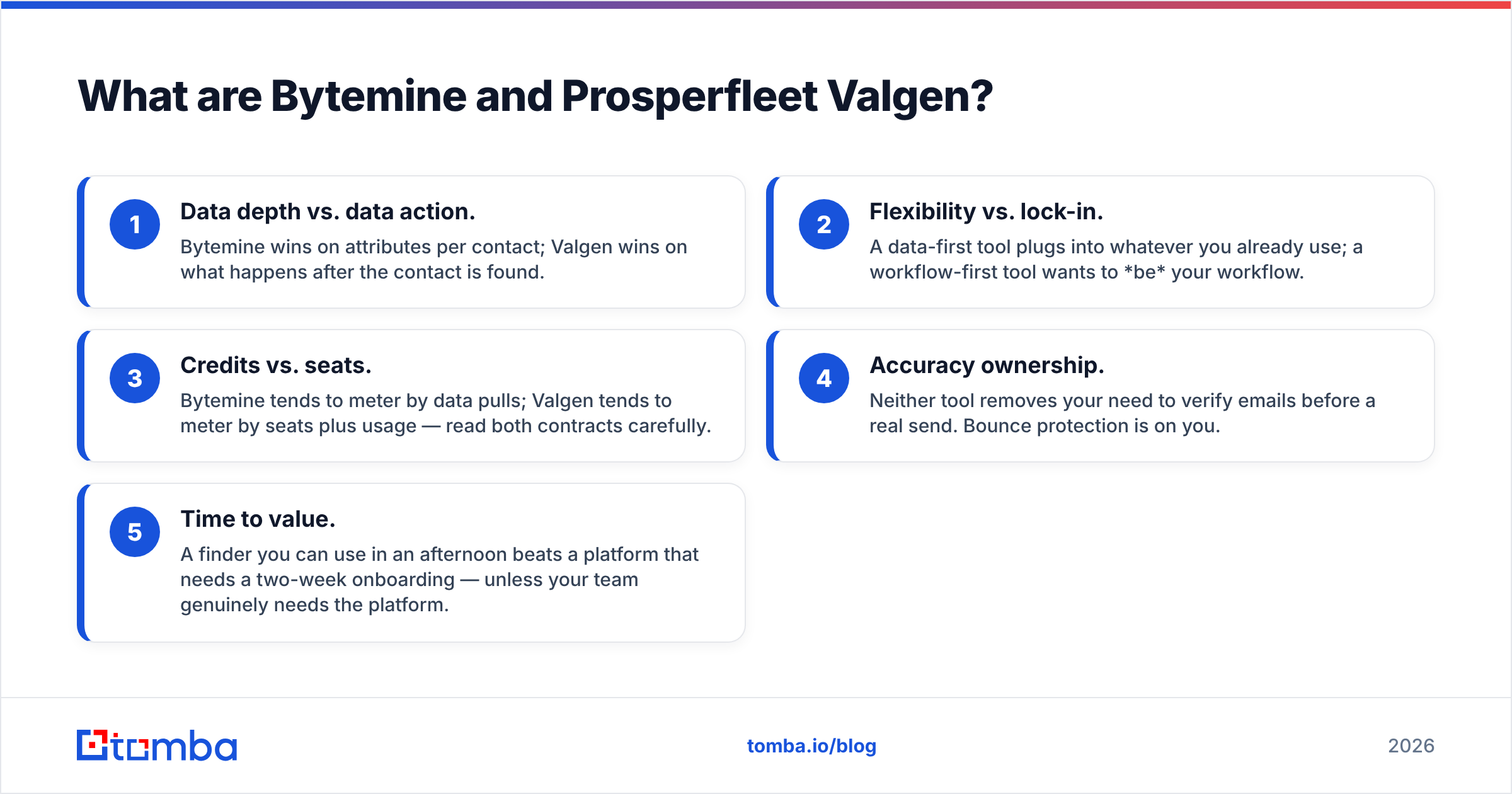
Here's the core trade-off in five points:
- Data depth vs. data action. Bytemine wins on attributes per contact; Valgen wins on what happens after the contact is found.
- Flexibility vs. lock-in. A data-first tool plugs into whatever you already use; a workflow-first tool wants to be your workflow.
- Credits vs. seats. Bytemine tends to meter by data pulls; Valgen tends to meter by seats plus usage — read both contracts carefully.
- Accuracy ownership. Neither tool removes your need to verify emails before a real send. Bounce protection is on you.
- Time to value. A finder you can use in an afternoon beats a platform that needs a two-week onboarding — unless your team genuinely needs the platform.
)
If you only remember one thing: the database is the asset, the platform is the rental. You're renting both here.
How do Bytemine and Prosperfleet Valgen compare on features?#
Below is a like-for-like comparison. Where a vendor doesn't publish a hard number, the cell says "Quote-based" or "Varies" rather than inventing one — because guessing a price helps no one.
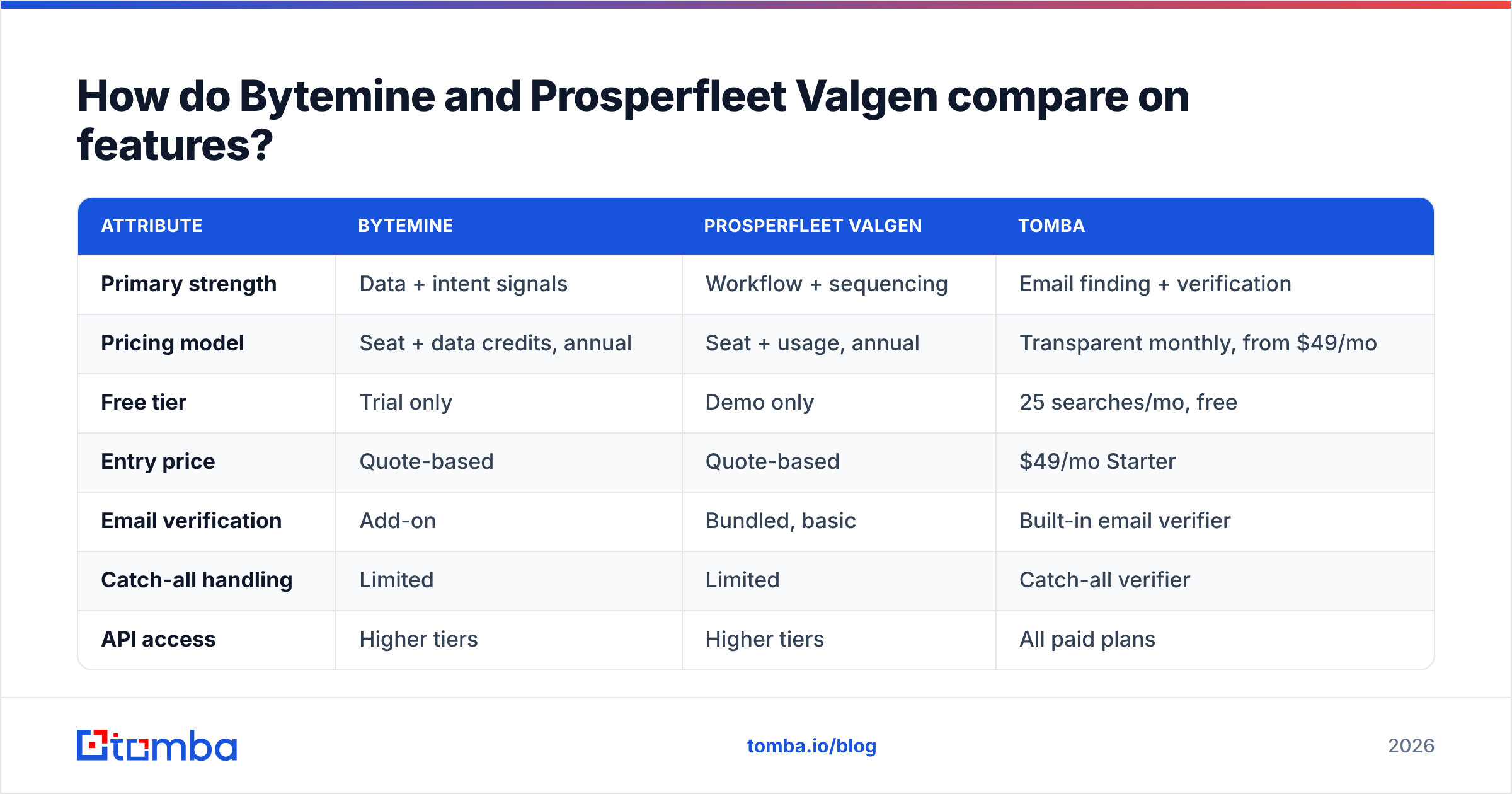
| Attribute | Bytemine | Prosperfleet Valgen | Tomba |
|---|---|---|---|
| Primary strength | Data + intent signals | Workflow + sequencing | Email finding + verification |
| Pricing model | Seat + data credits, annual | Seat + usage, annual | Transparent monthly, from $49/mo |
| Free tier | Trial only | Demo only | 25 searches/mo, free |
| Entry price | Quote-based | Quote-based | $49/mo Starter |
| Email verification | Add-on | Bundled, basic | Built-in email verifier |
| Catch-all handling | Limited | Limited | Catch-all verifier |
| API access | Higher tiers | Higher tiers | All paid plans |
| Bulk processing | Yes | Yes | Bulk finder |
| Best for | Enterprise ABM | Managed sales teams | SMB to mid-market outbound |
| Contract length | Annual typical | Annual typical | Cancel anytime |
The pattern is consistent: the two platforms ask for a bigger commitment up front, and the per-contact economics only make sense at scale. That's not a knock — at enterprise volume, a unified platform can pay for itself. It is a warning if you're a five-person team being sold an enterprise contract.
Where Bytemine pulls ahead#
Bytemine's intent data is its differentiator. If your ABM strategy depends on knowing which accounts are in-market this quarter, that signal layer is hard to replicate with a pure finder. Enterprise teams running coordinated plays across revenue operations and marketing will feel the value. Independent reviews on G2 tend to praise database breadth while flagging price and contract rigidity — read recent ones, not the vendor's curated quotes.
Where Prosperfleet Valgen pulls ahead#
Valgen's bet is that most reps don't fail for lack of data — they fail for lack of consistent execution. Bundling sequencing with enrichment means fewer tools to stitch together, and managers get visibility into the whole motion. The cost is flexibility: once your sequences, tasks, and reporting live inside Valgen, leaving is painful. That switching cost is the product strategy, not an accident.
Which tool has better data accuracy?#
Neither vendor publishes an independently audited bounce rate, so treat all accuracy claims as marketing until you test them. This is the single most expensive blind spot in the whole category.
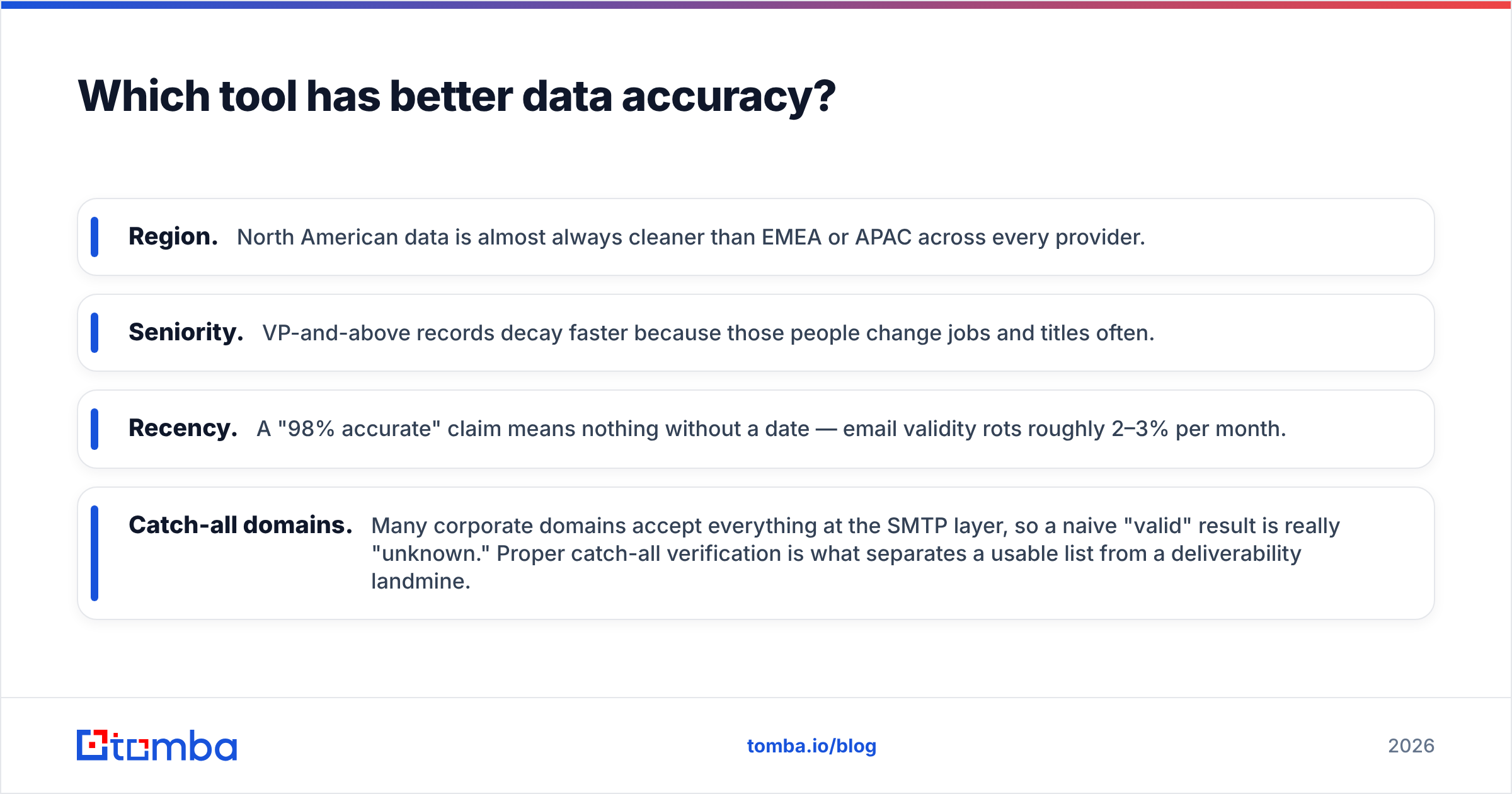
Accuracy isn't one number. It moves with:
- Region. North American data is almost always cleaner than EMEA or APAC across every provider.
- Seniority. VP-and-above records decay faster because those people change jobs and titles often.
- Recency. A "98% accurate" claim means nothing without a date — email validity rots roughly 2–3% per month.
- Catch-all domains. Many corporate domains accept everything at the SMTP layer, so a naive "valid" result is really "unknown." Proper catch-all verification is what separates a usable list from a deliverability landmine.
)
The practical move regardless of which platform you choose: never trust a single source's "valid" flag for cold sends. Run your final list through an independent email verifier before it touches your sending domain. Both Bytemine and Valgen will happily hand you addresses; protecting your sender reputation is still your job. One hard bounce spike can do more damage to deliverability than a month of bad copy.
How does pricing really compare?#
Conclusion first: both platforms are priced for teams that have a budget owner, not for individuals or scrappy SMBs. The sticker is rarely the real number.
What inflates the bill on enterprise-style B2B data tools:
- Seat minimums. You often can't buy three seats; the floor is higher.
- Credit overages. Data pulls beyond your allotment bill at a premium, and prospecting is bursty by nature.
- Integration tiers. API and CRM sync frequently sit behind the top plan.
- Annual lock-in. Month-to-month is rarely offered, so a bad fit costs you a year.
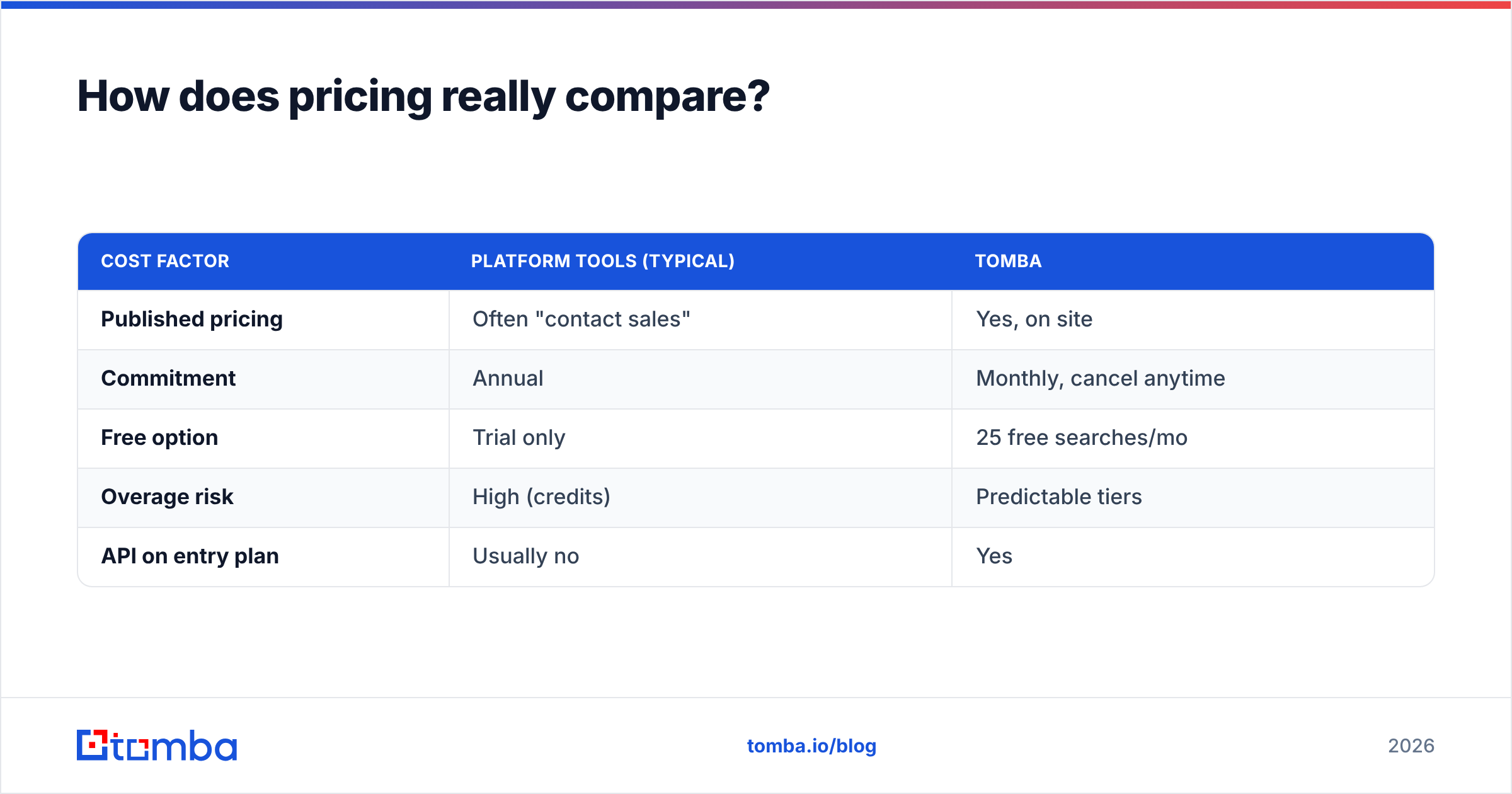
Compare that with transparent, published pricing. Tomba's plans are flat and monthly: a Free tier with 25 searches, Starter at $49/mo, Growth at $99/mo, Pro at $249/mo, and custom Enterprise — all visible on the pricing page without a sales call. For a team that mostly needs verified contacts and a clean API, that predictability often wins on total cost of ownership.
| Cost factor | Platform tools (typical) | Tomba |
|---|---|---|
| Published pricing | Often "contact sales" | Yes, on site |
| Commitment | Annual | Monthly, cancel anytime |
| Free option | Trial only | 25 free searches/mo |
| Overage risk | High (credits) | Predictable tiers |
| API on entry plan | Usually no | Yes |
This isn't an argument that platforms are overpriced — it's an argument that you should match the spend to the job. Paying enterprise rates for what is, functionally, contact discovery is the most common waste in outbound budgets.
Bytemine vs Prosperfleet Valgen: which should you choose?#
Pick based on your motion, not the demo dazzle:
- Choose Bytemine if you're an enterprise ABM team whose strategy genuinely hinges on intent signals and deep technographics, and you have the budget and ops maturity to use them.
- Choose Prosperfleet Valgen if you manage a sales floor and want data, sequencing, and reporting in one governed system — and you accept the lock-in that buys you.
- Choose a focused finder + verifier if your real need is "find verified business emails and phone numbers, then push them into the CRM and tools I already use." Most SMB and mid-market teams are in this bucket and overspending on the other two.
That third path is where Tomba fits. Instead of renting an entire ecosystem, you get the asset — verified contact data — through a domain search, bulk finder, and a clean email finder API, plus a HubSpot integration so the records land where your reps already work. You keep your sequencing tool, your CRM, your reporting. You just stop paying platform tax on the data layer.
What about implementation and switching cost?#
The hidden line item in any of these decisions is time. A platform that takes weeks to onboard and trains reps into proprietary workflows has a real exit cost — that's by design. Before signing anything, ask three questions:
- Can I export my data freely? If the answer is hedged, that's a lock-in flag.
- Does the entry plan include the API? If not, budget for the upgrade you'll inevitably need.
- What's the documented bounce rate, with a date? No date, no trust.
For teams that want to start finding contacts the same afternoon, a tool with a Chrome extension, Google Sheets add-on, and free email checker removes the multi-week ramp entirely. You can validate the data quality on real targets before you commit a cent — which is exactly the test you should run on Bytemine and Valgen too.
The honest verdict#
Bytemine and Prosperfleet Valgen are both legitimate platforms aimed squarely at well-funded teams. Bytemine wins on data and intent depth; Valgen wins on workflow and managed execution. Neither is a bad tool — but both ask you to buy a whole ecosystem to get at the data, and both meter that data in ways that surprise finance at renewal.
If you're enterprise with an ABM mandate, demo both, push hard on documented accuracy, and negotiate the seat floor. If you're SMB or mid-market and your honest need is verified contacts that flow into the stack you already run, you'll likely get there faster and cheaper without either platform.
Start with the data, not the dashboard. Run a real list — your actual target accounts — through the Tomba Email Finder free tier, verify the results, and see how many usable, deliverable contacts you get before you ever sign an annual contract. The 25 free searches are enough to settle the argument with evidence instead of a sales pitch.
// get started
Find, verify and enrich your first contacts today
Start on the free plan with 25 searches a month, then scale when your team is ready.
Free plan · No credit card required · GDPR & CCPA
// about the author