Bytemine vs Revli (2026): Which B2B Data Tool Wins?
Bytemine vs Revli compared on accuracy, pricing, data coverage, and workflow fit — plus where a focused email finder like Tomba beats both for cold outreach.
Choosing between Bytemine and Revli usually comes down to one question you can't answer from a pricing page: which one actually returns the right email when you paste in a real prospect list? Both pitch themselves as B2B data and prospecting tools, both promise "verified" contacts, and both will happily charge you for records you can't reach. This comparison cuts through the marketing to the parts that change your reply rate.
TL;DR#
- Bytemine leans toward enrichment and data-platform workflows — better when you already have a CRM full of records that need filling in.
- Revli positions closer to lightweight prospecting and list-building — easier to start, thinner on coverage depth.
- Neither is a deliverability tool. A clean-looking email still bounces if it isn't SMTP-verified at send time.
- For pure email-finding accuracy and verification, a focused tool like Tomba Email Finder is worth pricing against both — it's purpose-built for exactly that job.
- Pick on data accuracy, verification, and cost per usable contact, not on the size of the database number on the homepage.
What are Bytemine and Revli?#
Bytemine and Revli are both B2B contact-data tools — they help you turn a name, a company, or a domain into a reachable business email (and sometimes a phone number or enriched company profile). Think of them like two different grocery delivery services: both claim a huge catalog, but what matters is whether the specific items you ordered actually show up, fresh, at your door.
Bytemine tends to sit in the "data enrichment" lane: you bring records, it appends firmographic and contact fields. Revli plays more in the "find me leads" lane: you describe a target and it builds a list. The overlap is the email itself — and that's where most teams get burned, because a database can be enormous and still be stale.

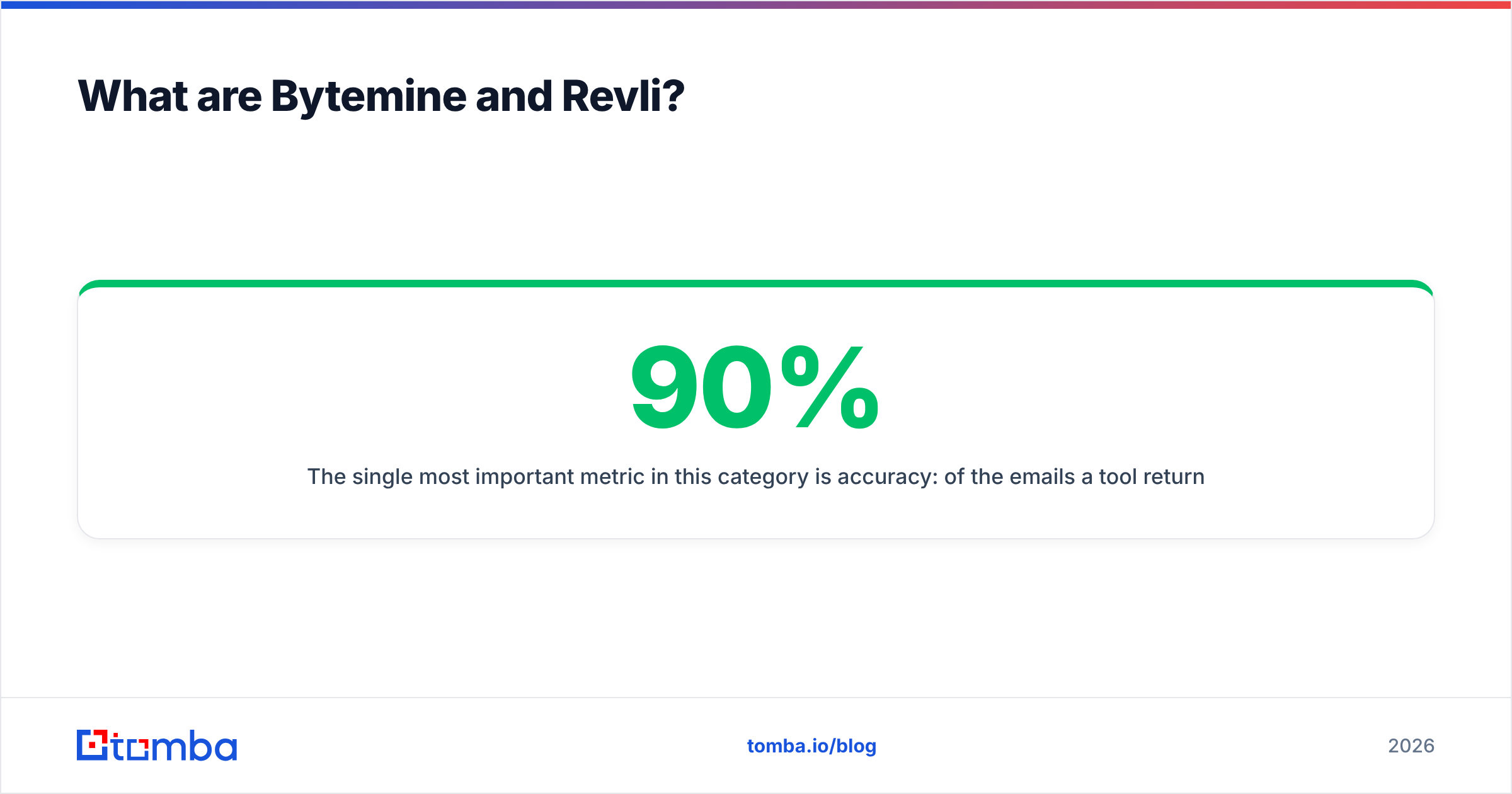
The single most important metric in this category is accuracy: of the emails a tool returns, what percentage are valid, deliverable, and not catch-all guesses. A tool that returns an email for 90% of your list but only verifies 50% of them is worse than a tool that returns 60% and verifies all of them — because the bounces cost you sender reputation. If you want the underlying concept, Tomba's note on email deliverability explains why bounce rate, not match rate, is the number that protects your domain.
Bytemine vs Revli: head-to-head comparison#
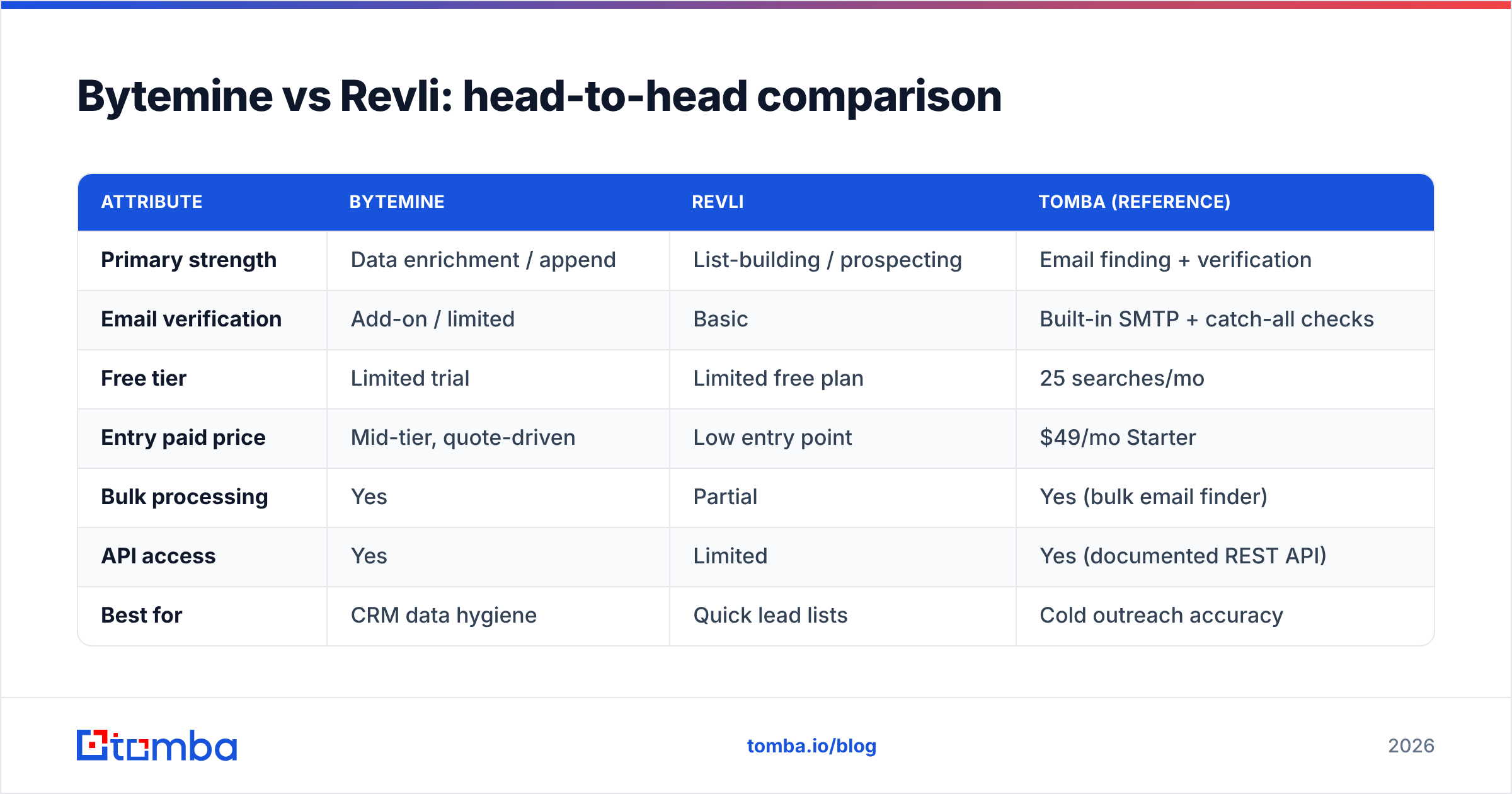
Here's the practical breakdown across the attributes that actually decide which tool earns a place in your stack.
| Attribute | Bytemine | Revli | Tomba (reference) |
|---|---|---|---|
| Primary strength | Data enrichment / append | List-building / prospecting | Email finding + verification |
| Email verification | Add-on / limited | Basic | Built-in SMTP + catch-all checks |
| Free tier | Limited trial | Limited free plan | 25 searches/mo |
| Entry paid price | Mid-tier, quote-driven | Low entry point | $49/mo Starter |
| Bulk processing | Yes | Partial | Yes (bulk email finder) |
| API access | Yes | Limited | Yes (documented REST API) |
| Best for | CRM data hygiene | Quick lead lists | Cold outreach accuracy |
A few honest takeaways from the table:
- Bytemine wins on enrichment depth — if your problem is "my Salesforce records are half-empty," that's its home turf.
- Revli wins on time-to-first-list — lower friction to get something exported and into a sequence.
- Both treat verification as secondary, which is the gap that bites cold-email teams. Verification isn't a nice-to-have; it's the difference between landing in the inbox and landing on a blocklist.
- Cost per usable contact matters more than sticker price. A cheap plan that returns unverified guesses can cost more in deliverability damage than a pricier plan that returns clean data.

Is Bytemine more accurate than Revli?#
It depends on the record type, and you should never trust a vendor's self-reported accuracy number without testing it on your own list. Here's the uncomfortable truth: every tool in this space quotes accuracy figures generated on their favorable sample. The only number that matters is the one you measure on a sample of your ideal-customer profile.
Run this test before you commit a dollar:
- Pull 100 known-good contacts you already have verified emails for.
- Strip the emails, keep names + companies, and run the list through each tool's free or trial tier.
- Compare what each tool returns against your known-good answers.
- Bounce-test the results through a real email verifier — not the tool's own optimistic "valid" flag.
Whichever tool returns the most verified matches on your data wins. For some segments Bytemine's enrichment graph will edge ahead; for others Revli's freshness on newer companies helps. There is no universal winner — only a winner for your ICP. This is also why data sources matter: a tool is only as good as where it gets and how often it refreshes its records.
One thing both tools share is the catch-all problem. Many corporate domains accept every address at the SMTP layer, so a contact can look "valid" and still be a dead drop. A dedicated catch-all verifier is the only reliable way to separate real mailboxes from catch-all noise — and it's exactly the kind of check that generic enrichment tools skip.
How do Bytemine and Revli price out?#
Bytemine generally runs quote-driven and enrichment-volume based, while Revli offers a lower, more transparent entry point — but both can get expensive once you factor in the records you pay for and can't use.
The trap in this category is paying per returned record rather than per usable one. If a tool charges you for a guessed email that later bounces, you've paid twice: once for the credit, and again in sender-reputation cost. When you compare plans, normalize everything to "cost per verified, deliverable contact."
| Pricing factor | What to check |
|---|---|
| Credit model | Charged on return, or only on verified result? |
| Rollover | Do unused credits expire monthly? |
| Verification cost | Bundled, or billed separately per check? |
| Overage rate | What happens past your plan limit? |
| Bulk discount | Does cost per contact drop at volume? |
For comparison, transparent published pricing helps you model this in advance. Tomba lists its pricing openly: a Free tier with 25 searches/mo, Starter at $49/mo, Growth at $99/mo, Pro at $249/mo, and custom Enterprise — with verification built into the workflow rather than bolted on as a surprise line item.
Which tool fits which workflow?#
Match the tool to the job you actually have, not the job the homepage describes.
- You run a CRM data-hygiene project. You have thousands of half-complete records and need firmographic + contact append at scale. Bytemine is the natural fit here — enrichment is its core competency.
- You need a fast, lightweight prospecting list. You're a small team that wants to describe a target and export a starter list this afternoon. Revli lowers the friction.
- You run cold outbound and live or die by reply rate. Your bottleneck is deliverable, verified emails that won't torch your domain. This is where a purpose-built finder earns its place — and where you should weigh a tool like Tomba against both.
- You're a developer wiring data into an app or workflow. Check the API depth and rate limits carefully. A documented email finder API with predictable verification responses beats a data dump you have to clean yourself.
The mistake teams make is buying a broad data platform when their real problem is narrow: "I need the right email, verified, before I hit send." If that's your problem, a focused tool usually beats a sprawling one — fewer features, but the one feature you need works.
What do Bytemine and Revli miss?#
Both tools under-invest in the verification and deliverability layer — the part that actually protects your outbound program. A B2B data tool can hand you a perfectly formatted email and still set you up to fail, because finding an address and confirming it's safe to mail are two different jobs.
Here's what tends to fall through the cracks with general-purpose data tools:
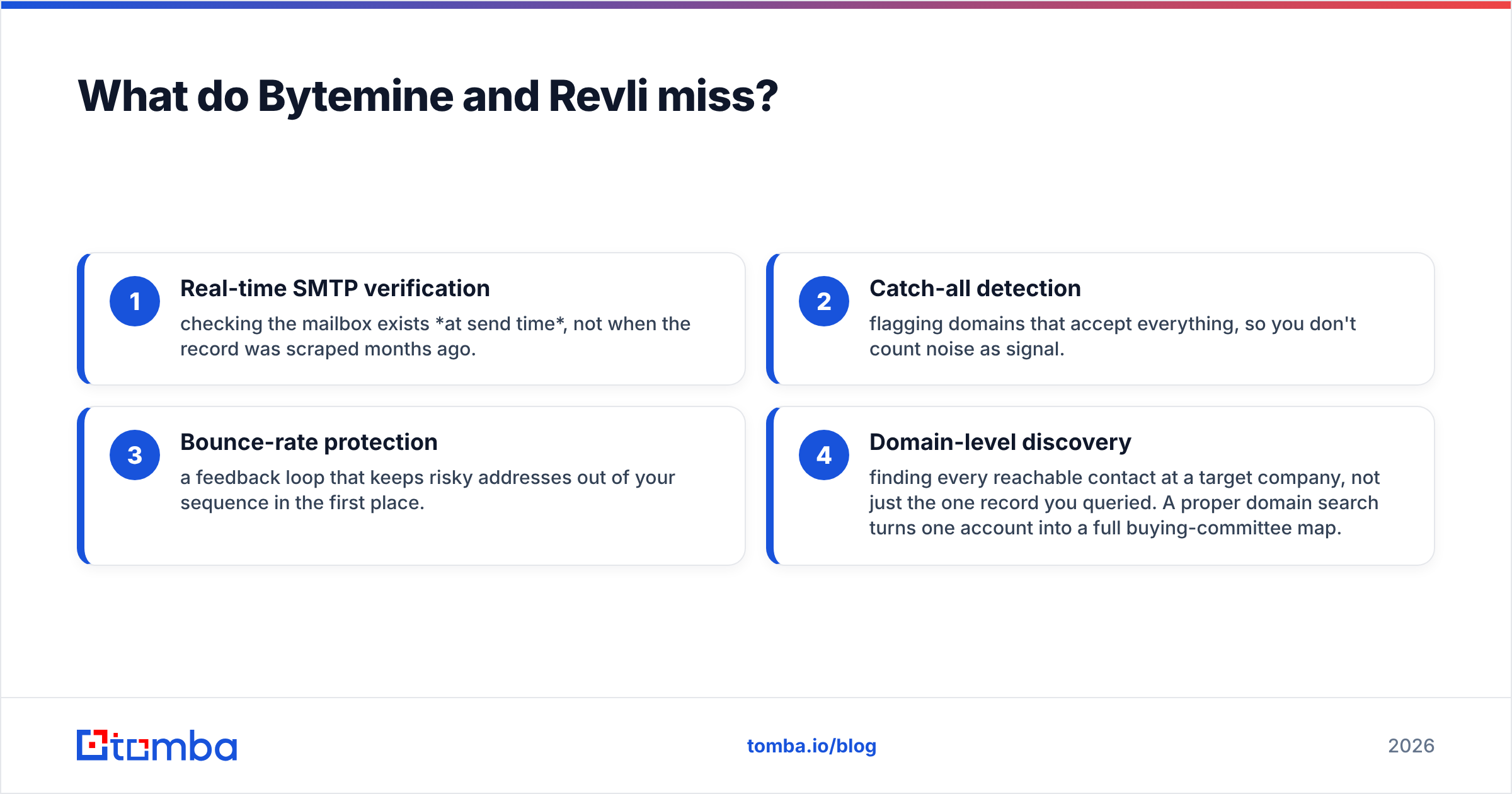
- Real-time SMTP verification — checking the mailbox exists at send time, not when the record was scraped months ago.
- Catch-all detection — flagging domains that accept everything, so you don't count noise as signal.
- Bounce-rate protection — a feedback loop that keeps risky addresses out of your sequence in the first place.
- Domain-level discovery — finding every reachable contact at a target company, not just the one record you queried. A proper domain search turns one account into a full buying-committee map.
If you're serious about outbound, you'll end up bolting a verification tool onto Bytemine or Revli anyway. At that point, it's worth asking whether a single tool that does finding and verification — with a free tier to test it — is the simpler stack. You can sanity-check any list for free with Tomba's email checker before you trust it.
How should you decide?#
Decide with a test, not a feature list. The honest verdict on Bytemine vs Revli is that they're built for slightly different jobs — Bytemine for enrichment, Revli for quick prospecting — and the "better" one is whichever scores higher on your sample data. Vendor accuracy claims and database-size numbers are marketing; your 100-contact bounce test is evidence.
Three rules to close on:
- Test on your own ICP before paying. Every tool looks great on its own demo data.
- Optimize for cost per verified contact, not headline price or match rate.
- Treat verification as non-negotiable. Whatever you choose to find emails, run results through real SMTP verification before sending — your sender reputation depends on it.
Independent reviews on G2 and Capterra are useful for spotting support and billing complaints that vendors won't volunteer — read the 2- and 3-star reviews, not the 5-star ones, because that's where the real limitations live. Pair that with your own test and you'll make a decision you won't regret three months into a contract.
The bottom line#
Bytemine and Revli both have a legitimate place — Bytemine when you're enriching an existing database, Revli when you want a fast, low-cost prospecting list. But if your real bottleneck is getting verified, deliverable business emails for cold outreach without wrecking your domain, a focused tool is the smarter buy. Tomba Email Finder is built for exactly that: find emails by name, company, or domain, with SMTP and catch-all verification baked in, a free tier to test it on your own list, and transparent pricing from $49/mo. Run all three against the same 100 contacts — then let the bounce rate pick the winner.
Ready to find emails that actually work?
Join 150,000+ professionals who stopped guessing and started sending. Free credits on signup — no credit card required.
Get the Tomba newsletter
Practical outbound tactics and product updates — once every two weeks.
About the author