Bytemine vs Salesbot: B2B Sales Tool Comparison (2026)
Choosing between Bytemine and Salesbot? We break down features, pricing, data accuracy, and which B2B sales workflow each one actually wins in 2026.
Picking between Bytemine and Salesbot usually comes down to one question most comparison posts dodge: which one actually puts qualified, reachable contacts in your pipeline — and which one just looks busy doing it? Both tools promise to accelerate B2B outbound, but they solve different halves of the problem, and the data layer underneath them matters more than either vendor's feature list.
This is a neutral breakdown. We'll compare what each tool does well, where each falls short, what they cost, and how to decide. We'll also be honest about one thing both categories share: a workflow tool is only as good as the contact data feeding it, which is where a dedicated email finder earns its place in the stack.
TL;DR — Bytemine vs Salesbot at a glance#
- Bytemine leans toward data mining and prospecting — surfacing accounts, signals, and contact lists to build your target universe.
- Salesbot leans toward automation and sequencing — chatbots, auto-replies, and multi-step outreach once you already have contacts.
- Pricing for both is mid-market; neither publishes a generous free tier, so budget for a paid plan from day one.
- Neither is a verification-grade data source. Both pull from broad databases that drift; bounce rates climb without an independent verifier.
- Best move: pair whichever workflow tool fits your motion with an accurate data layer like Tomba for finding and verifying emails before they ever hit a sequence.
What is Bytemine and who is it for?#
Bytemine sits on the prospecting and data-intelligence side of the funnel. The pitch is straightforward: tell it your ideal customer profile, and it mines accounts, firmographic signals, and contact records so your reps spend less time building lists and more time selling. Teams that struggle with "who do we even call this quarter" tend to gravitate here.
Where it shines:
- Account discovery — filter a large company universe by industry, size, tech stack, and intent-style signals.
- List building at volume — export hundreds of target contacts into a CSV or CRM in one pass.
- Top-of-funnel coverage — useful when your problem is not enough prospects rather than not enough replies.
Where it gets thin: the contact records it surfaces are mined from aggregated sources, so email accuracy varies by region and seniority. You'll want to run exports through an email verifier before loading them into any sender, or your deliverability will quietly erode. Bytemine builds the list; it doesn't guarantee the list is reachable.
What is Salesbot and who is it for?#
Salesbot lives on the automation and engagement side. Think auto-replies, conversational bots, and multi-channel sequences that move a known contact from "cold" to "booked." If your bottleneck is execution — too many manual follow-ups, reps forgetting step three of a cadence — Salesbot is built to remove that friction.
Where it shines:
- Sequence automation — schedule email and message steps, branch on opens and replies, and keep cadences running without manual nudging.
- Conversational handling — bot-driven replies that qualify or route inbound interest around the clock.
- Hand-off to CRM — push engaged contacts into your pipeline with activity history attached.
Where it gets thin: Salesbot assumes you already have good contacts. Feed it a stale or unverified list and it will faithfully automate your way into spam folders. Automation amplifies whatever data quality you start with — good or bad. That's why a data enrichment and verification step belongs upstream of any tool in this category.
Bytemine vs Salesbot: the side-by-side comparison#
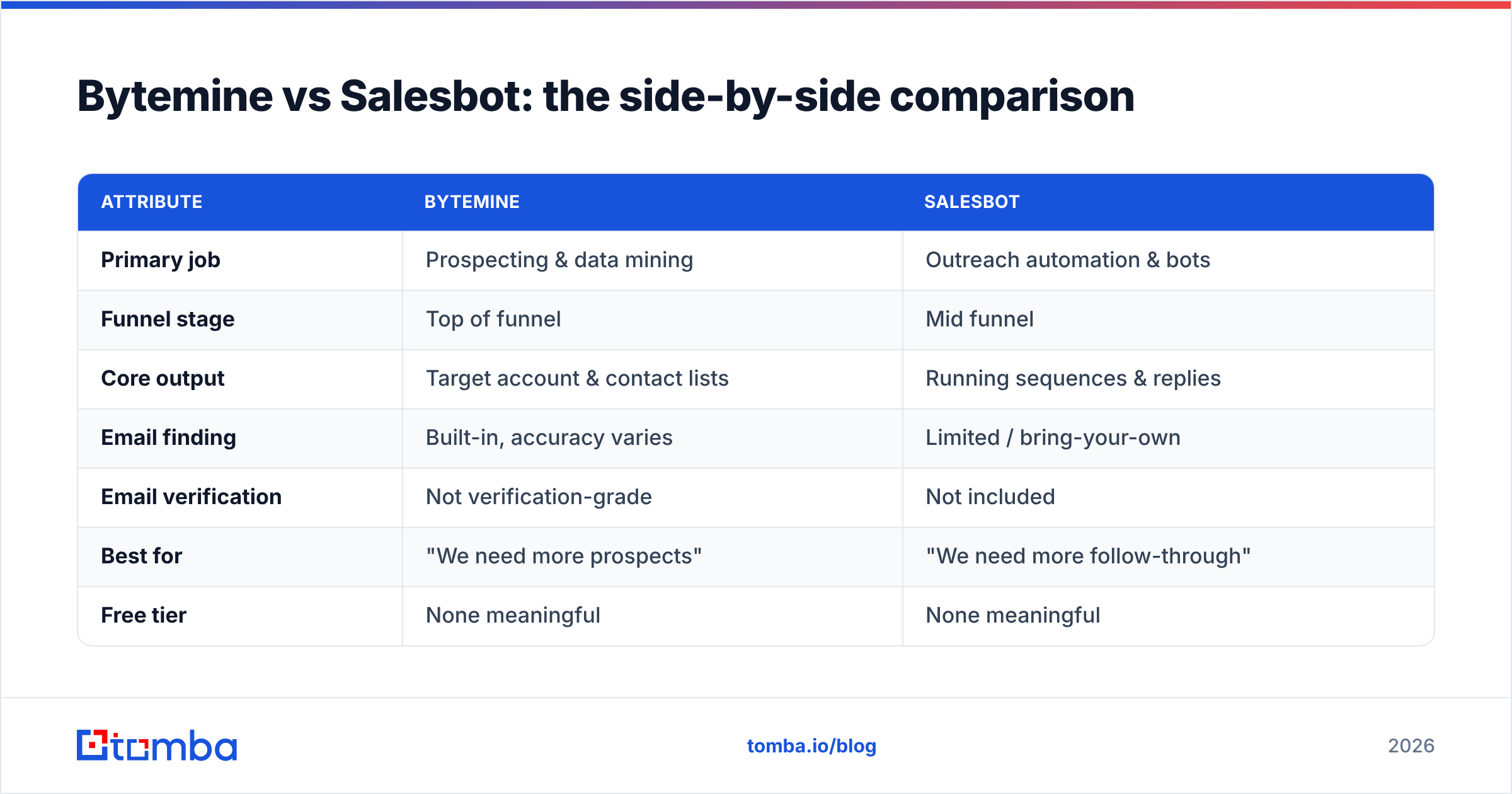
Here's the core comparison across the attributes that actually change your buying decision. Treat pricing as directional — both vendors adjust tiers, so confirm current numbers on their sites or a review platform like G2 before you commit.
| Attribute | Bytemine | Salesbot |
|---|---|---|
| Primary job | Prospecting & data mining | Outreach automation & bots |
| Funnel stage | Top of funnel | Mid funnel |
| Core output | Target account & contact lists | Running sequences & replies |
| Email finding | Built-in, accuracy varies | Limited / bring-your-own |
| Email verification | Not verification-grade | Not included |
| Best for | "We need more prospects" | "We need more follow-through" |
| Free tier | None meaningful | None meaningful |
| Learning curve | Moderate | Moderate to steep |
| Typical buyer | SDR / demand-gen teams | SDR / RevOps teams |
The pattern is clear: these tools are complements more often than substitutes. Bytemine fills the top of the funnel; Salesbot works the middle. If you're forcing a choice, choose based on which gap hurts most right now — list volume or execution discipline.
Is Bytemine better than Salesbot for cold outreach?#
It depends on where your outreach actually breaks. Run this quick diagnostic:
- Your reps run out of people to contact by mid-month → Bytemine solves the bigger pain. You need pipeline volume.
- You have plenty of contacts but follow-up is inconsistent and replies are low → Salesbot solves the bigger pain. You need automation and timing.
- Your bounce rate is above 3–5% and domains are flagging you → neither tool is your fix. You have a data accuracy problem, and you need verification before anything else.
That third scenario is the one teams misdiagnose most. They buy more automation or more lists when the real leak is unverified addresses tanking sender reputation. No sequencing engine and no prospecting database compensates for sending to addresses that don't exist.
Where does data accuracy fit into the Bytemine vs Salesbot decision?#
Accuracy is the variable that quietly decides whether either tool pays off. A prospecting tool that hands you 1,000 contacts with a 70% valid rate has effectively given you 700 — and 300 bounce risks that damage every future send from your domain. Industry guidance from vendors like HubSpot consistently ties list hygiene to deliverability and reply rates; it's not a nice-to-have.
This is where a specialized layer beats a bundled feature. Tomba is built around finding and confirming professional emails rather than running cadences, and that focus shows up in the workflow:
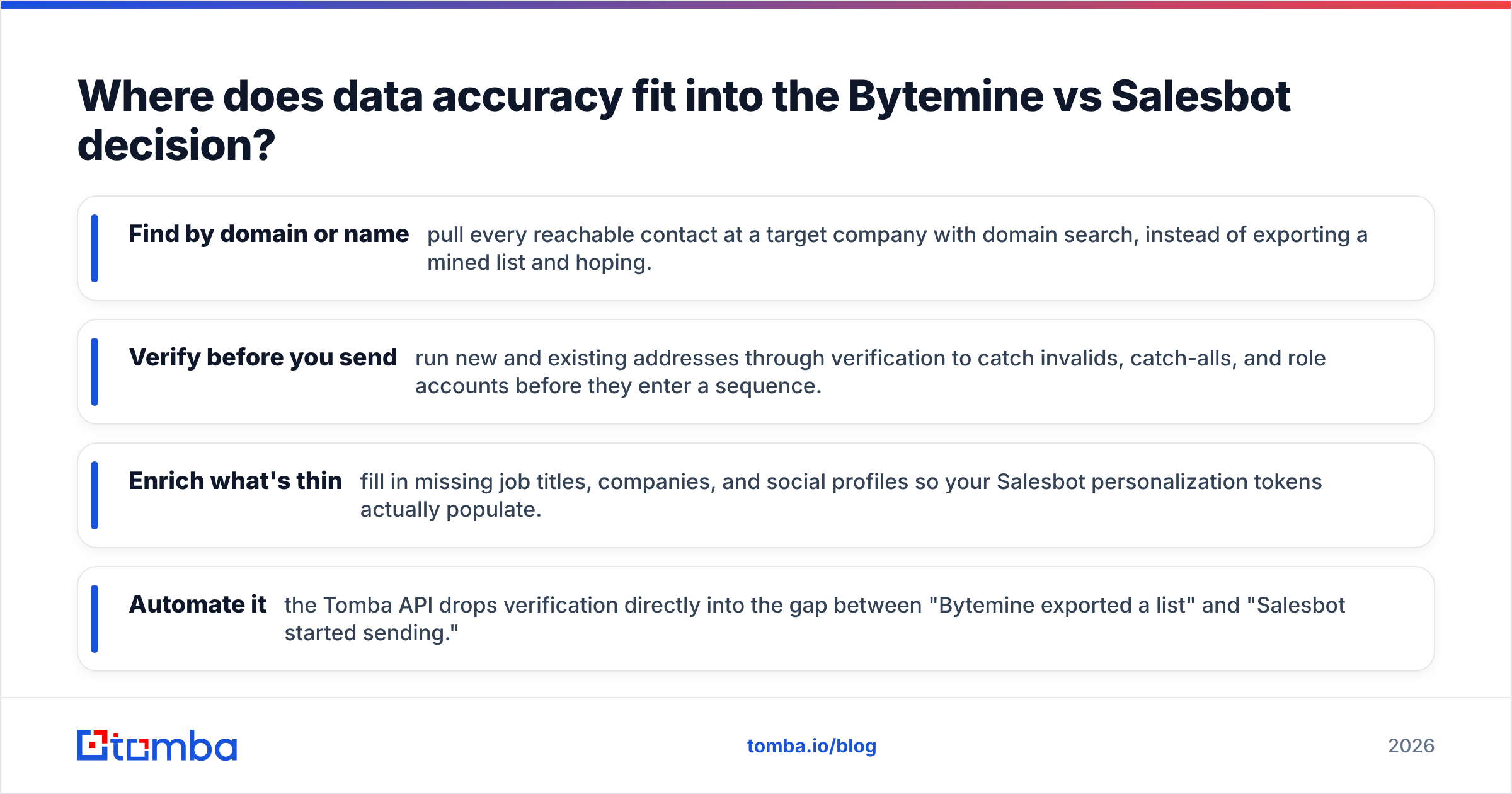
- Find by domain or name — pull every reachable contact at a target company with domain search, instead of exporting a mined list and hoping.
- Verify before you send — run new and existing addresses through verification to catch invalids, catch-alls, and role accounts before they enter a sequence.
- Enrich what's thin — fill in missing job titles, companies, and social profiles so your Salesbot personalization tokens actually populate.
- Automate it — the Tomba API drops verification directly into the gap between "Bytemine exported a list" and "Salesbot started sending."
In other words, Tomba isn't competing with either tool for the same job. It's the accuracy layer that makes both of them perform closer to their marketing claims.
How do the three tools work together?#
The strongest stack rarely picks one winner. Here's a realistic pipeline that uses each tool for what it's genuinely best at:
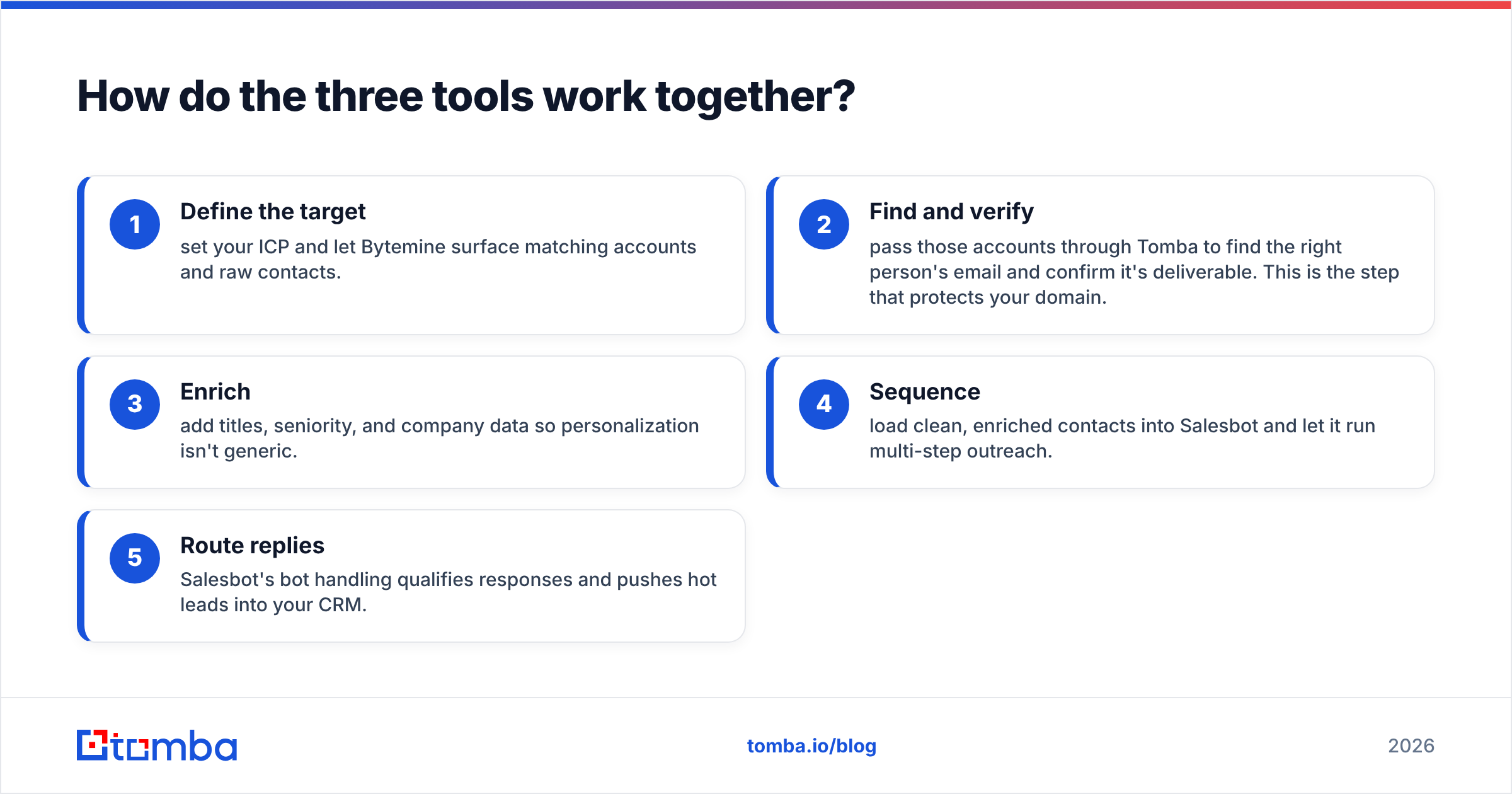
- Define the target — set your ICP and let Bytemine surface matching accounts and raw contacts.
- Find and verify — pass those accounts through Tomba to find the right person's email and confirm it's deliverable. This is the step that protects your domain.
- Enrich — add titles, seniority, and company data so personalization isn't generic.
- Sequence — load clean, enriched contacts into Salesbot and let it run multi-step outreach.
- Route replies — Salesbot's bot handling qualifies responses and pushes hot leads into your CRM.
Skip step two and the whole chain inherits the weakest data. That's the single most common reason "we bought the tools but outbound still doesn't work" — the workflow was sound, the inputs weren't.
Bytemine vs Salesbot: pricing and value#
Both tools price for teams, not solo reps, and neither offers a free tier substantial enough to run a real campaign on. When you compare total cost, factor in the hidden line item: the cost of bad sends. A cheaper prospecting tool that produces a dirtier list can cost more in deliverability damage than it saves in subscription fees.
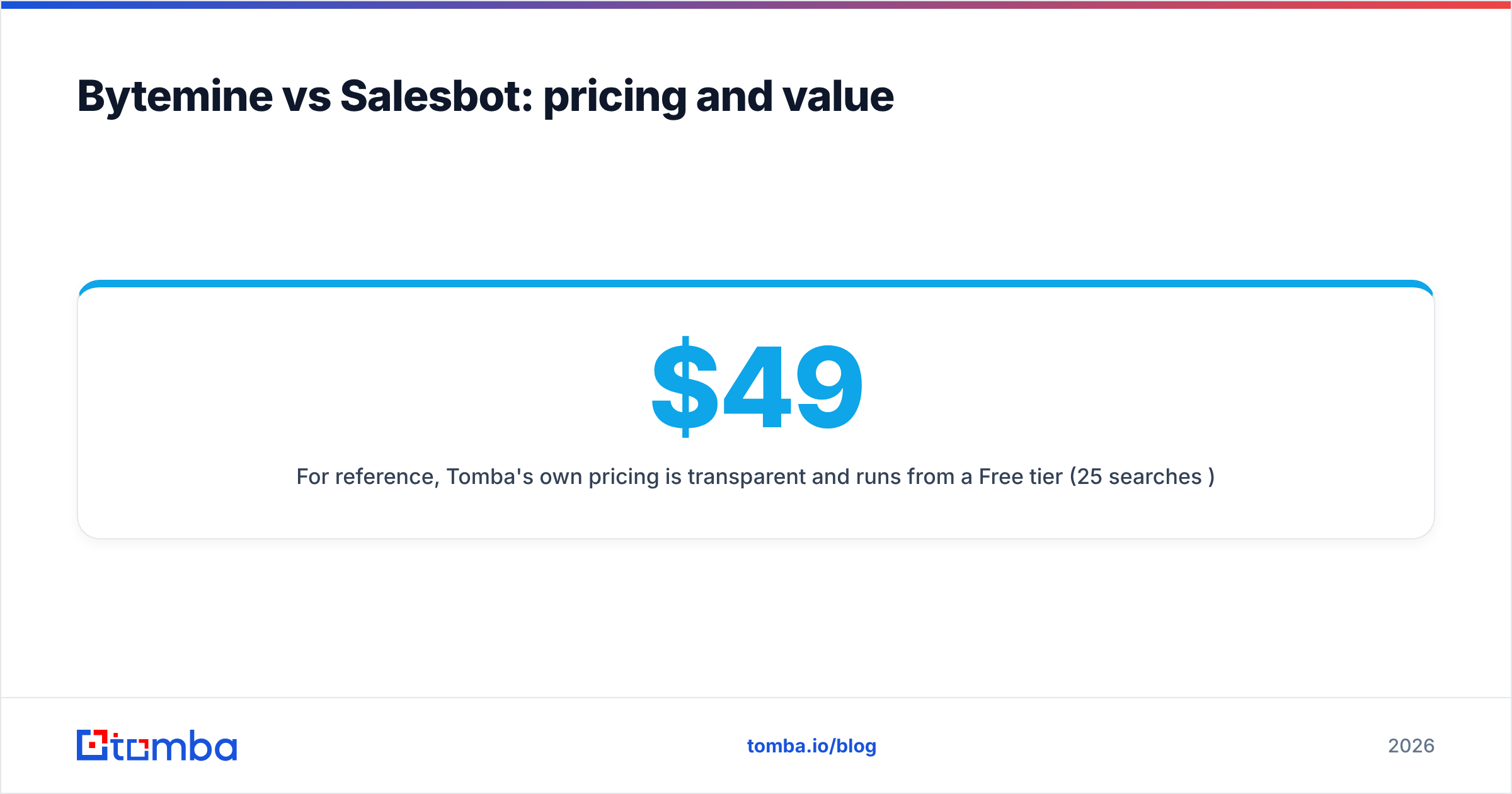
For reference, Tomba's own pricing is transparent and runs from a Free tier (25 searches/month) through Starter at $49/mo, Growth at $99/mo, and Pro at $249/mo, with Enterprise custom — full Tomba pricing is public. The point of mentioning it here isn't to swap categories; it's to show that the accuracy layer is the cheapest insurance in the stack relative to what a prospecting or automation platform costs. Independent reviews on Capterra are a useful sanity check on any vendor's real-world value before you sign.
Which should you choose?#
Conclusion first: choose by your bottleneck, and don't skip verification regardless of which you pick.
- Pick Bytemine if your funnel is starved for prospects and your team burns hours building lists manually.
- Pick Salesbot if you have contacts but your follow-up is leaky and inconsistent.
- Pick both if budget allows — they cover different funnel stages and genuinely complement each other.
- In every case, add an accuracy layer. Find the right contact, verify it's real, and enrich it before a single automated message goes out.
The tools you choose shape your workflow. The data you feed them decides your results. Teams that obsess over the second question outperform teams that only argue about the first.
Make your outreach tools actually work#
Whatever you decide between Bytemine and Salesbot, the fastest reliability upgrade is fixing the data underneath them. Start with the Tomba Email Finder to find verified professional emails by domain, name, or company, then push clean contacts straight into whichever workflow tool you run. You can test it on the free tier, confirm the accuracy yourself, and only scale up once the bounce rate proves it. Better inputs, better pipeline — that's the part no automation can shortcut.
// get started
Find, verify and enrich your first contacts today
Start on the free plan with 25 searches a month, then scale when your team is ready.
Free plan · No credit card required · GDPR & CCPA
// about the author