Bytemine vs Skrapp (2026): Which Email Finder Wins?
Bytemine vs Skrapp compared on accuracy, pricing, LinkedIn coverage, and verification — plus where a stronger third option fits in 2026.
Choosing between Bytemine and Skrapp comes down to one question: which tool puts more valid email addresses in your pipeline for the money you spend? Both promise to turn names and domains into reachable contacts, but they take very different routes to get there — and neither is the obvious default for every team.
This guide breaks down Bytemine vs Skrapp on accuracy, pricing, data coverage, verification, and LinkedIn prospecting, then shows where a stronger third option fits if your bounce rate is keeping you up at night.
TL;DR — Bytemine vs Skrapp at a glance#
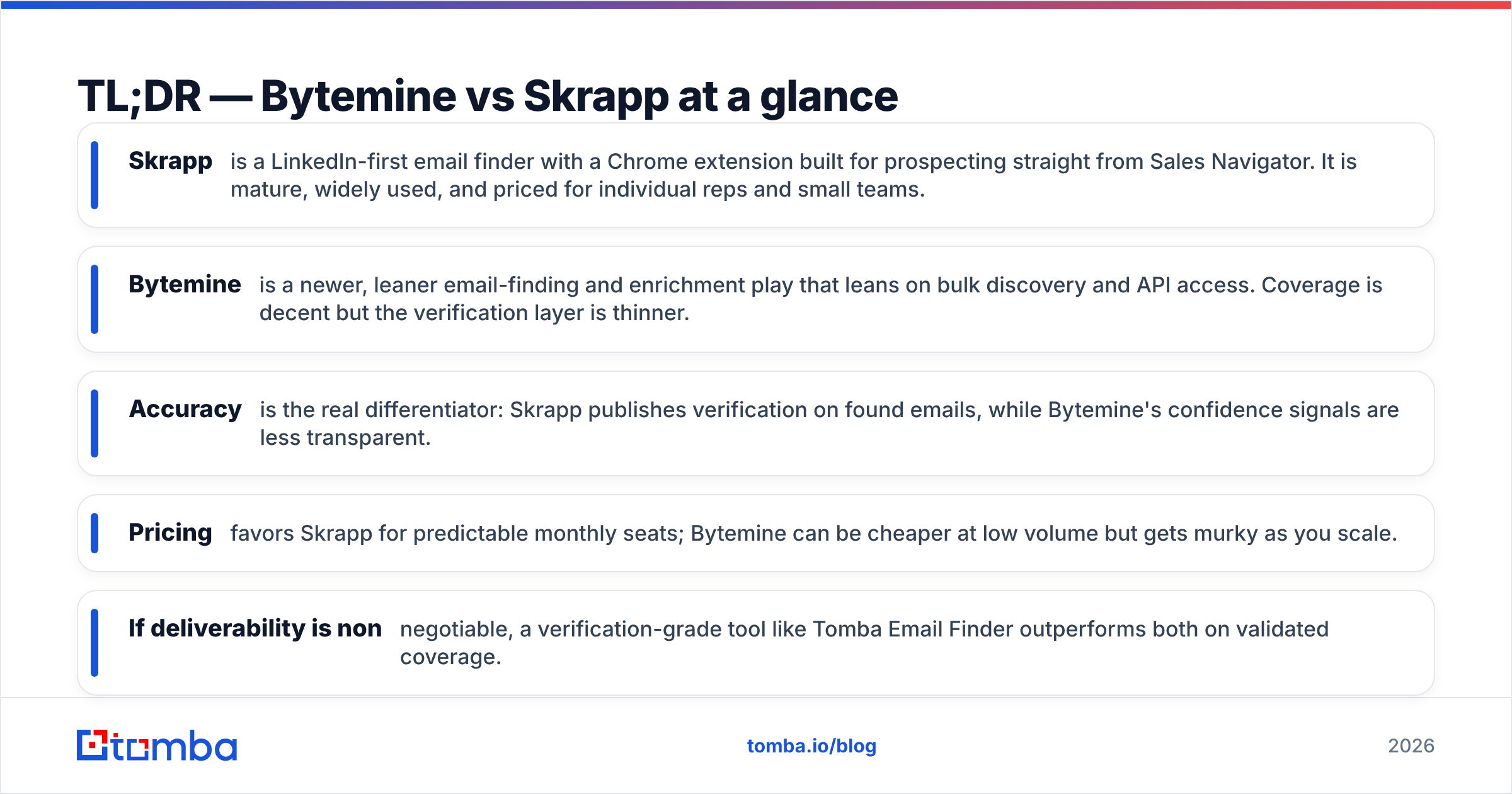
- Skrapp is a LinkedIn-first email finder with a Chrome extension built for prospecting straight from Sales Navigator. It is mature, widely used, and priced for individual reps and small teams.
- Bytemine is a newer, leaner email-finding and enrichment play that leans on bulk discovery and API access. Coverage is decent but the verification layer is thinner.
- Accuracy is the real differentiator: Skrapp publishes verification on found emails, while Bytemine's confidence signals are less transparent.
- Pricing favors Skrapp for predictable monthly seats; Bytemine can be cheaper at low volume but gets murky as you scale.
- If deliverability is non-negotiable, a verification-grade tool like Tomba Email Finder outperforms both on validated coverage.
What is Bytemine?#
Bytemine is an email-finding and lead-enrichment tool aimed at outbound teams that want to generate contact lists quickly. Its core jobs are domain-based discovery (give it a company, get back likely email patterns) and enrichment (attach firmographic or contact data to a record you already have).
The pitch is volume and automation. Bytemine pushes bulk lookups and API access, so it tends to attract developers and growth teams who want to wire email discovery into their own scripts or data enrichment pipelines rather than click through a dashboard all day.
The trade-off is transparency. Bytemine returns emails, but the why — the confidence score, the source, the last-verified date — is less visible than competitors that built their reputation on accuracy. For a high-volume sender, that opacity is a risk, because every guessed-but-unverified address you mail is a coin flip against your sender reputation.
What is Skrapp?#
Skrapp is a LinkedIn email finder with a strong Chrome extension that overlays LinkedIn and Sales Navigator. You browse a profile or a search list, click the extension, and Skrapp surfaces the person's professional email and saves it to a list.
Skrapp's strength is the prospecting motion. If your team lives inside LinkedIn, finding emails without leaving the tab is genuinely faster than copy-pasting names into a separate finder. Skrapp also runs domain search and bulk find-and-verify workflows, and it applies an email-verification step on results so you get a status rather than a raw guess.
)
The catch: Skrapp's accuracy is good on common corporate domains but drops on catch-all domains and smaller companies, and its credit model means heavy LinkedIn scraping burns through allowances faster than you'd expect.
How accurate are Bytemine vs Skrapp?#
Accuracy is where this comparison is won or lost. An email finder that returns 1,000 addresses at 70% validity is worse than one that returns 700 at 97% validity — the second list bounces less, protects your domain, and lands in more inboxes.

Here is how the two stack up on the signals that actually predict deliverability:
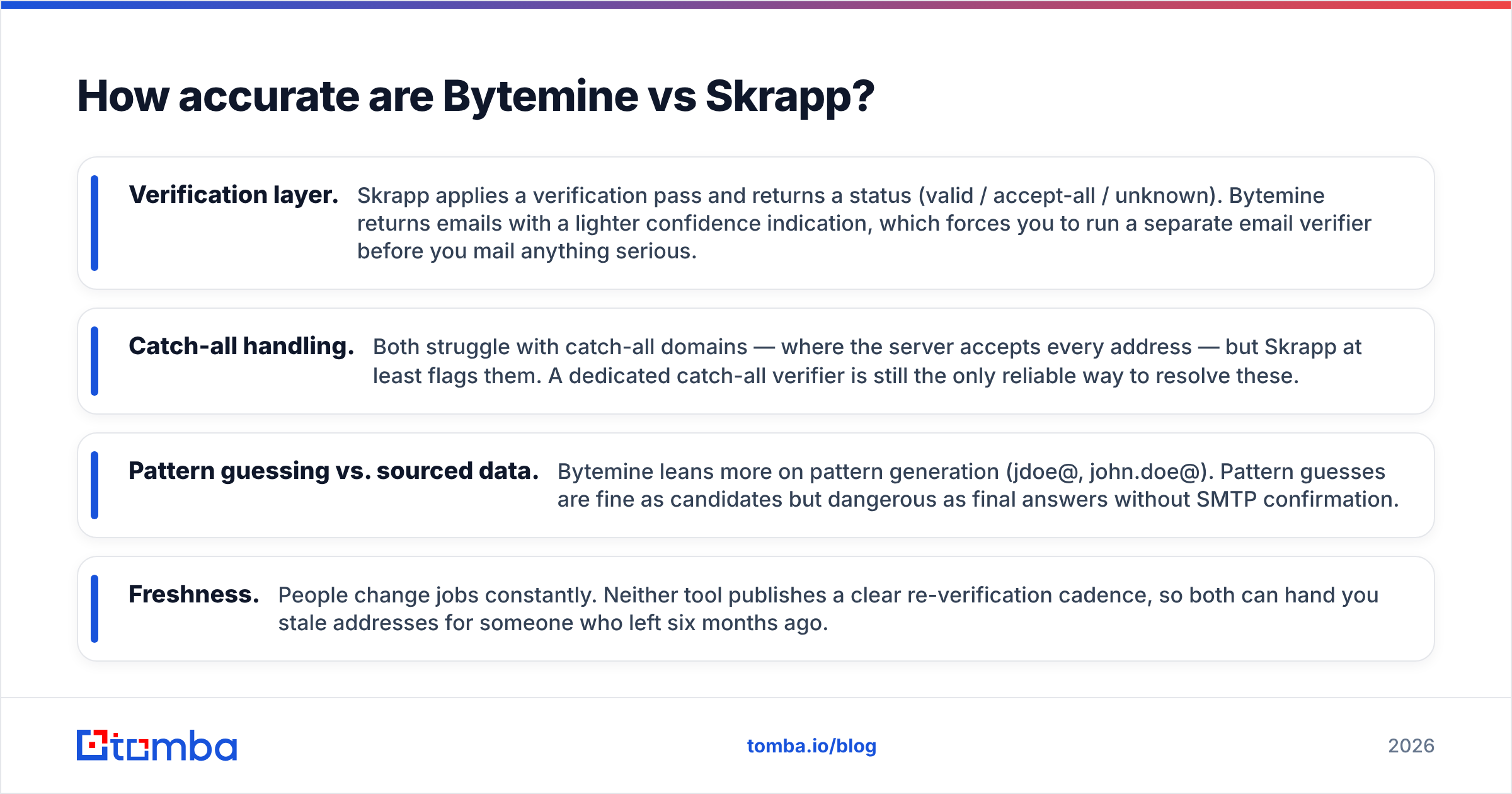
- Verification layer. Skrapp applies a verification pass and returns a status (valid / accept-all / unknown). Bytemine returns emails with a lighter confidence indication, which forces you to run a separate email verifier before you mail anything serious.
- Catch-all handling. Both struggle with catch-all domains — where the server accepts every address — but Skrapp at least flags them. A dedicated catch-all verifier is still the only reliable way to resolve these.
- Pattern guessing vs. sourced data. Bytemine leans more on pattern generation (jdoe@, john.doe@). Pattern guesses are fine as candidates but dangerous as final answers without SMTP confirmation.
- Freshness. People change jobs constantly. Neither tool publishes a clear re-verification cadence, so both can hand you stale addresses for someone who left six months ago.
The practical takeaway: treat either tool's output as candidates, not confirmed contacts, and verify before you send. That single habit will do more for your bounce rate than picking the "winner" between them.
Bytemine vs Skrapp: full comparison table#
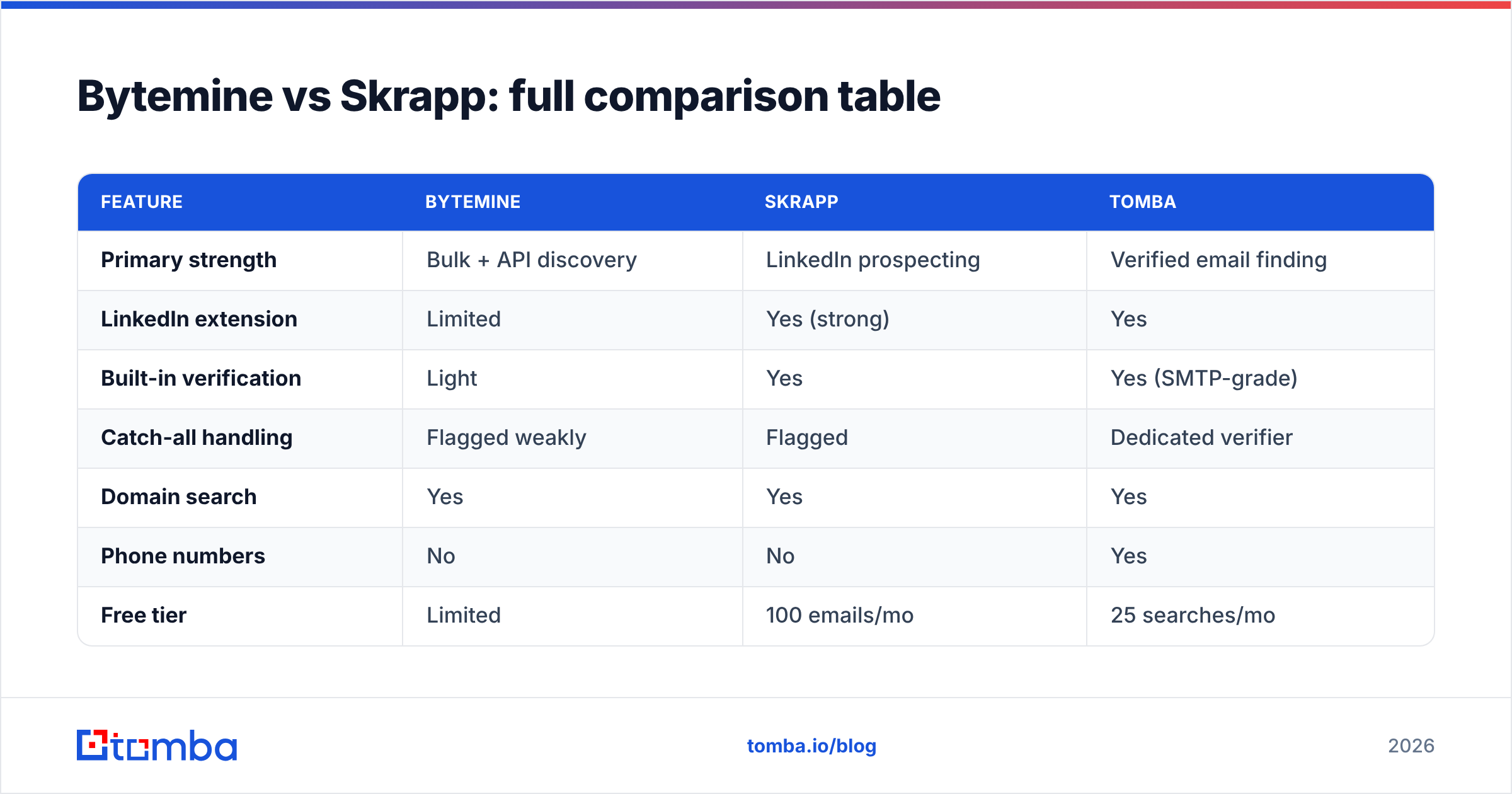
| Feature | Bytemine | Skrapp | Tomba |
|---|---|---|---|
| Primary strength | Bulk + API discovery | LinkedIn prospecting | Verified email finding |
| LinkedIn extension | Limited | Yes (strong) | Yes |
| Built-in verification | Light | Yes | Yes (SMTP-grade) |
| Catch-all handling | Flagged weakly | Flagged | Dedicated verifier |
| Domain search | Yes | Yes | Yes |
| Phone numbers | No | No | Yes |
| Free tier | Limited | 100 emails/mo | 25 searches/mo |
| Entry paid plan | Low, volume-based | ~$49/mo range | $49/mo |
| Best for | Developers, scripts | Individual reps | Teams who mail at scale |
The pattern is clear. Bytemine wins on programmatic flexibility, Skrapp wins on in-browser prospecting speed, and a verification-first tool wins when the cost of a bounce is high.
Which is better for LinkedIn prospecting?#
Skrapp wins this round outright. Its extension is purpose-built for the LinkedIn-to-list motion, and reps who source from Sales Navigator will find it noticeably faster than Bytemine's more dashboard- and API-centric workflow.
That said, "faster to collect" is not the same as "safe to send." LinkedIn-sourced emails skew toward personal or outdated addresses, so the verification step matters even more here. If you're building a LinkedIn outreach sequence, run every Skrapp export through verification before it touches your sending tool.
Bytemine's LinkedIn coverage exists but is secondary to its bulk and enrichment focus. If LinkedIn is your main channel, Skrapp is the better of these two — though tools that combine a strong extension with SMTP-grade verification close that gap.
Which is better for bulk and API use?#
Bytemine is the more natural fit for automation. If you want to pass a list of 10,000 domains through an endpoint and get structured results back, Bytemine's API-first posture is friendlier than Skrapp's prospector-first design.
But "API-friendly" only pays off if the data is clean. Pumping unverified emails into a CRM at scale just industrializes the bounce problem. A bulk email finder that bakes verification into the same job — rather than making you stitch finder + verifier together — saves you the second pipeline and the second bill.
)
For teams that genuinely live in code, check whether the email finder API you choose returns confidence scores and verification status in the same response. That one field decides whether your downstream automation can trust the data or has to re-check it.
How do Bytemine and Skrapp price out?#
Skrapp uses predictable monthly seats with a credit allowance, plus a small free tier (around 100 emails per month). That structure is easy to budget for an individual rep or a small team, and it's the more transparent of the two.
Bytemine's pricing is volume-based and can undercut Skrapp at very low usage, but it gets harder to predict as your needs grow — exactly when budgeting matters most. Always model your real monthly volume against both before committing, and watch how each counts a "credit" (a search? a verified result? a re-check?).
For reference, here's how a verification-first competitor prices, so you can benchmark value rather than just sticker price:
- Free — 25 searches/month, no card required, good for testing accuracy on your own domains.
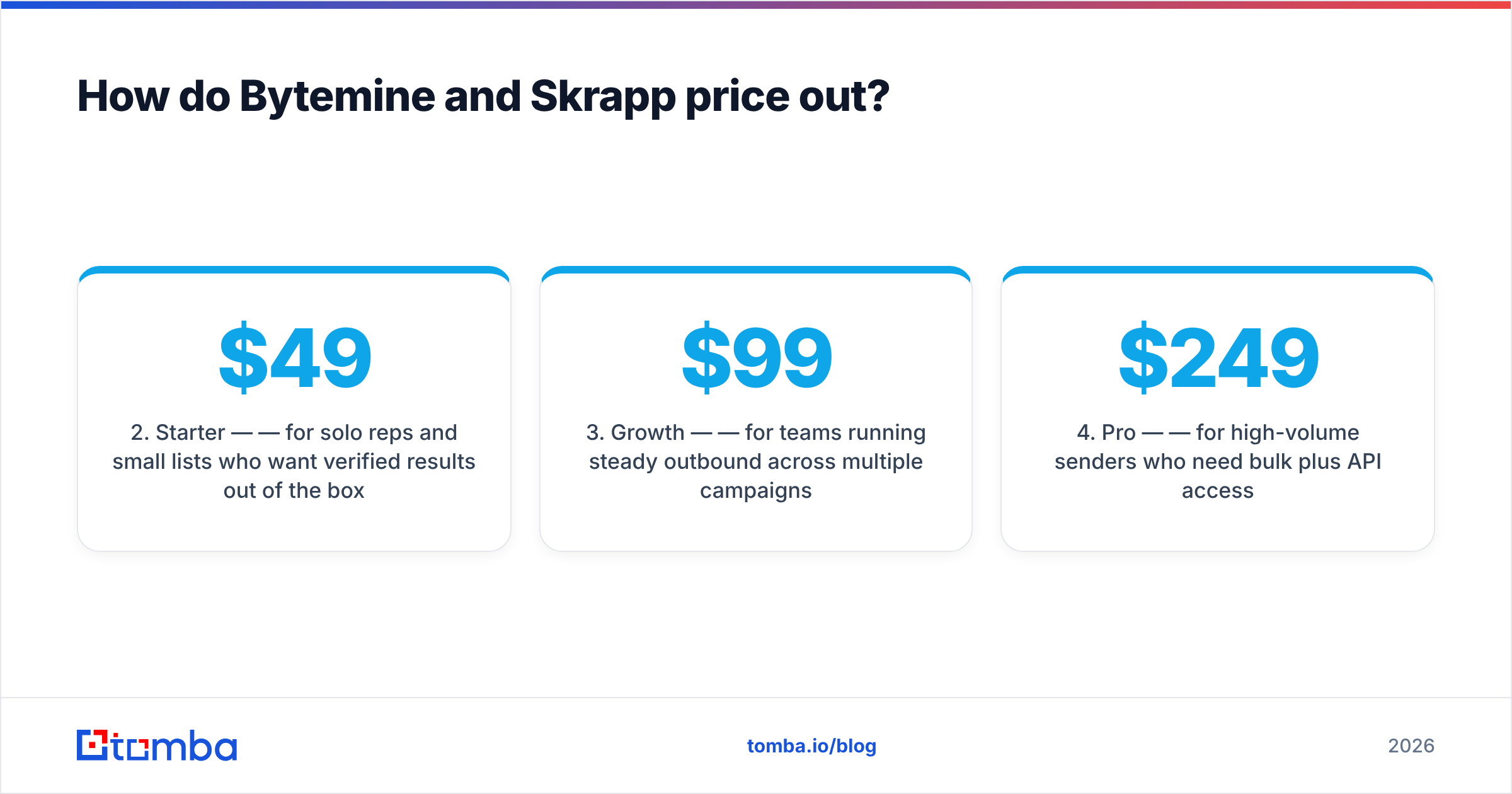
- Starter — $49/mo — for solo reps and small lists who want verified results out of the box.
- Growth — $99/mo — for teams running steady outbound across multiple campaigns.
- Pro — $249/mo — for high-volume senders who need bulk plus API access.
- Enterprise — custom — for security, SLA, and seat requirements at scale.
You can see the full Tomba pricing breakdown for comparison. The lesson isn't "the cheapest tool wins" — it's that a slightly higher price for verified data is cheaper than a low price plus a ruined sender reputation.
What about deliverability and sender reputation?#
This is the cost neither price tag shows. Every invalid address you mail nudges your bounce rate up, and mailbox providers read high bounce rates as a spam signal. Damage your sender reputation and even your verified, valid emails start landing in spam.
Industry guidance from inbox providers like Google Postmaster Tools and deliverability research from Validity is consistent: keep hard bounces under roughly 2%, and verify lists before every major send. Neither Bytemine nor Skrapp removes this responsibility from you. The difference is how much verification they do before the list reaches you.
If your monthly volume is meaningful, prioritize the tool with the strongest built-in verification — or pair whichever finder you like with a dedicated verifier. Protecting email deliverability is not optional once you're sending at scale.
So who should pick Bytemine, and who should pick Skrapp?#
Pick Skrapp if your team prospects mostly from LinkedIn and Sales Navigator, you want a fast in-browser workflow, and you value predictable per-seat pricing. It's the stronger everyday prospecting tool of the two.
Pick Bytemine if you're a developer or growth engineer who wants API-first bulk discovery and enrichment, you're comfortable running your own verification step, and low entry cost matters more than a polished prospecting UI.
Pick neither — and look at a verification-first tool if deliverability is your bottleneck. When the real problem is "too many of my found emails bounce," the answer isn't a faster way to collect guesses; it's a finder that confirms each address before handing it over.
The bottom line#
Bytemine vs Skrapp is a genuine trade-off: Bytemine for programmatic bulk and enrichment, Skrapp for LinkedIn-native prospecting. But both leave verification — the part that actually protects your inbox placement — largely on your plate.
If you'd rather skip the second tool and the second bounce report, try Tomba Email Finder. It combines domain and LinkedIn discovery with SMTP-grade verification, catch-all detection, and bulk plus API access in one place — so the emails you export are ones you can actually send. Start free with 25 searches a month, point it at the same domains you'd test in Bytemine or Skrapp, and compare the bounce rates yourself. That head-to-head, on your own list, is the only benchmark that matters.
Ready to find emails that actually work?
Join 150,000+ professionals who stopped guessing and started sending. Free credits on signup — no credit card required.
Get the Tomba newsletter
Practical outbound tactics and product updates — once every two weeks.
About the author