Bytemine vs Smarte: B2B Data Tools Compared (2026)
Bytemine vs Smarte, compared on data coverage, accuracy, pricing, and workflows — plus where a leaner email finder beats both for cold outbound.
Choosing between Bytemine and Smarte usually comes down to one question your sales ops team keeps avoiding: do you need a heavy data platform, or do you just need accurate contacts you can email today? The two tools sit in the same B2B data intelligence neighborhood, but they solve the problem from different angles — and neither is the obvious winner for every team.
This breakdown compares Bytemine vs Smarte on coverage, accuracy, pricing posture, and real workflows, then shows where a focused email finder undercuts both on cost without sacrificing the part that actually moves pipeline.
TL;DR#
- Bytemine leans toward data mining and account-level intelligence — good when you want to build and segment lists at scale.
- Smarte (SMARTe) positions around GTM enrichment and contact data with a focus on verified, compliant B2B records.
- Pricing for both is quote-driven and opaque, which makes them hard to budget for small and mid-market teams.
- If your real need is "find and verify the right email, fast," a dedicated tool like the Tomba Email Finder does that job for a flat, public price.
- The right pick depends on whether you're buying a platform (Bytemine/Smarte) or a precision tool (email finder). Most teams over-buy.
What are Bytemine and Smarte?#
Both products belong to the broader category of B2B data and intelligence platforms — the tools that feed your CRM with company and contact records so reps aren't googling prospects one at a time.
Bytemine is built around data mining: pulling structured company and contact signals, segmenting them, and exporting lists for outbound. The pitch is breadth — give me an addressable market, slice it, and hand me a list. Teams that think in territories and segments gravitate here.
Smarte (SMARTe) is positioned as a go-to-market data partner, with emphasis on contact accuracy, mobile numbers, and compliance-aware records for North America and beyond. The pitch is trust — the data you push into your sequences should be verified and safe to use. Teams that have been burned by stale lists tend to like this framing.
Here's the honest part: marketing pages for data vendors all sound similar. "Largest database," "highest accuracy," "GDPR-ready" appear on nearly every one. What separates them in practice is coverage in your target geography, how fresh the records are, and what you actually pay. To compare them like an operator, ignore the adjectives and look at the attributes below.
)
How do Bytemine and Smarte compare on features?#
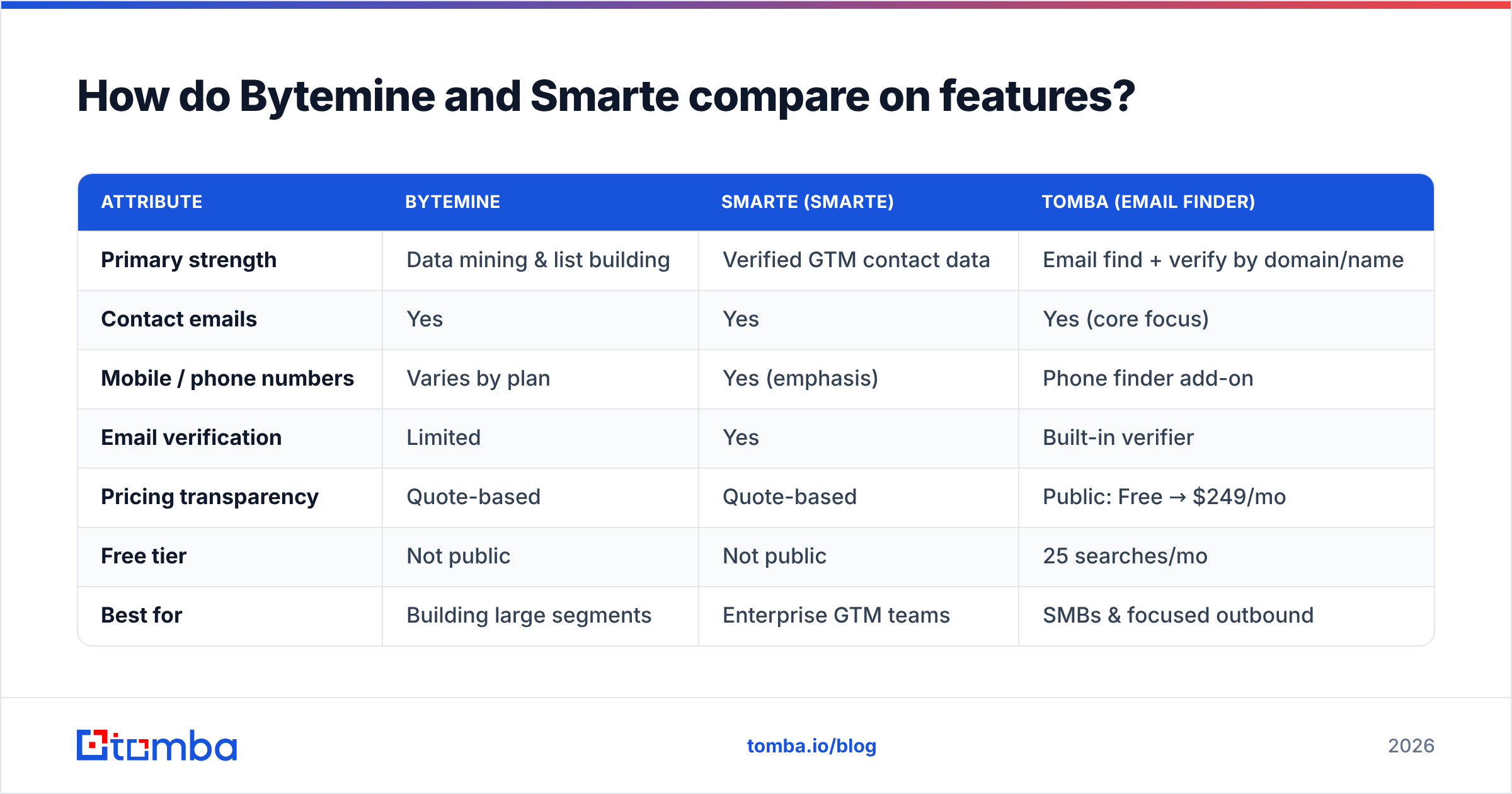
The fastest way to see the difference is attribute by attribute. Treat the table below as a framework — confirm the live specifics against each vendor's current G2 listing before you sign, because data products change their packaging often.
| Attribute | Bytemine | Smarte (SMARTe) | Tomba (email finder) |
|---|---|---|---|
| Primary strength | Data mining & list building | Verified GTM contact data | Email find + verify by domain/name |
| Contact emails | Yes | Yes | Yes (core focus) |
| Mobile / phone numbers | Varies by plan | Yes (emphasis) | Phone finder add-on |
| Email verification | Limited | Yes | Built-in verifier |
| Pricing transparency | Quote-based | Quote-based | Public: Free → $249/mo |
| Free tier | Not public | Not public | 25 searches/mo |
| Best for | Building large segments | Enterprise GTM teams | SMBs & focused outbound |
The pattern is clear. Bytemine and Smarte are platforms — they want to own your top-of-funnel data layer, and they price accordingly. A focused email finder is a tool — it does the contact-acquisition step extremely well and gets out of the way. Knowing which you're buying prevents the most common mistake: paying platform money for tool-level usage.
Which has better data accuracy?#
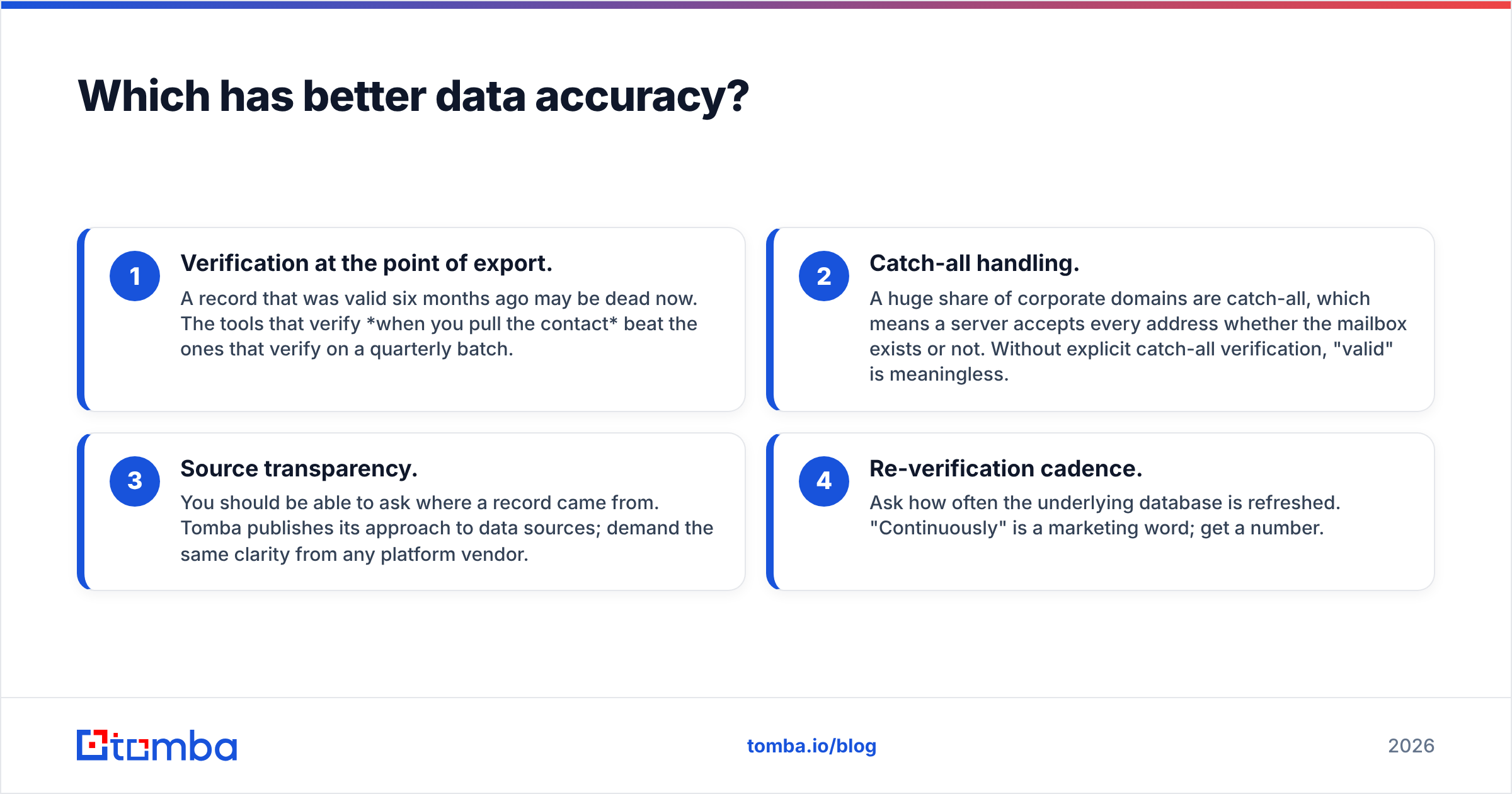
Accuracy is where these decisions are won or lost, because a 90%-accurate list and a 75%-accurate list produce wildly different bounce rates once you start sending.
A few things matter more than the headline "accuracy %" any vendor quotes:
- Verification at the point of export. A record that was valid six months ago may be dead now. The tools that verify when you pull the contact beat the ones that verify on a quarterly batch.
- Catch-all handling. A huge share of corporate domains are catch-all, which means a server accepts every address whether the mailbox exists or not. Without explicit catch-all verification, "valid" is meaningless.
- Source transparency. You should be able to ask where a record came from. Tomba publishes its approach to data sources; demand the same clarity from any platform vendor.
- Re-verification cadence. Ask how often the underlying database is refreshed. "Continuously" is a marketing word; get a number.
Bytemine and Smarte both make accuracy claims, and Smarte in particular leans on verified-contact messaging. But neither publishes a free, repeatable way for you to test accuracy before paying — you're trusting the pitch. With a tool that offers a free tier and a standalone email verifier, you can measure bounce risk on your own list before committing budget. That self-serve testability is worth more than any vendor's accuracy slide.
Rule of thumb: if a vendor won't let you verify a sample of your own target accounts before signing, treat their accuracy number as a hypothesis, not a fact.
Bytemine vs Smarte: pricing and total cost#
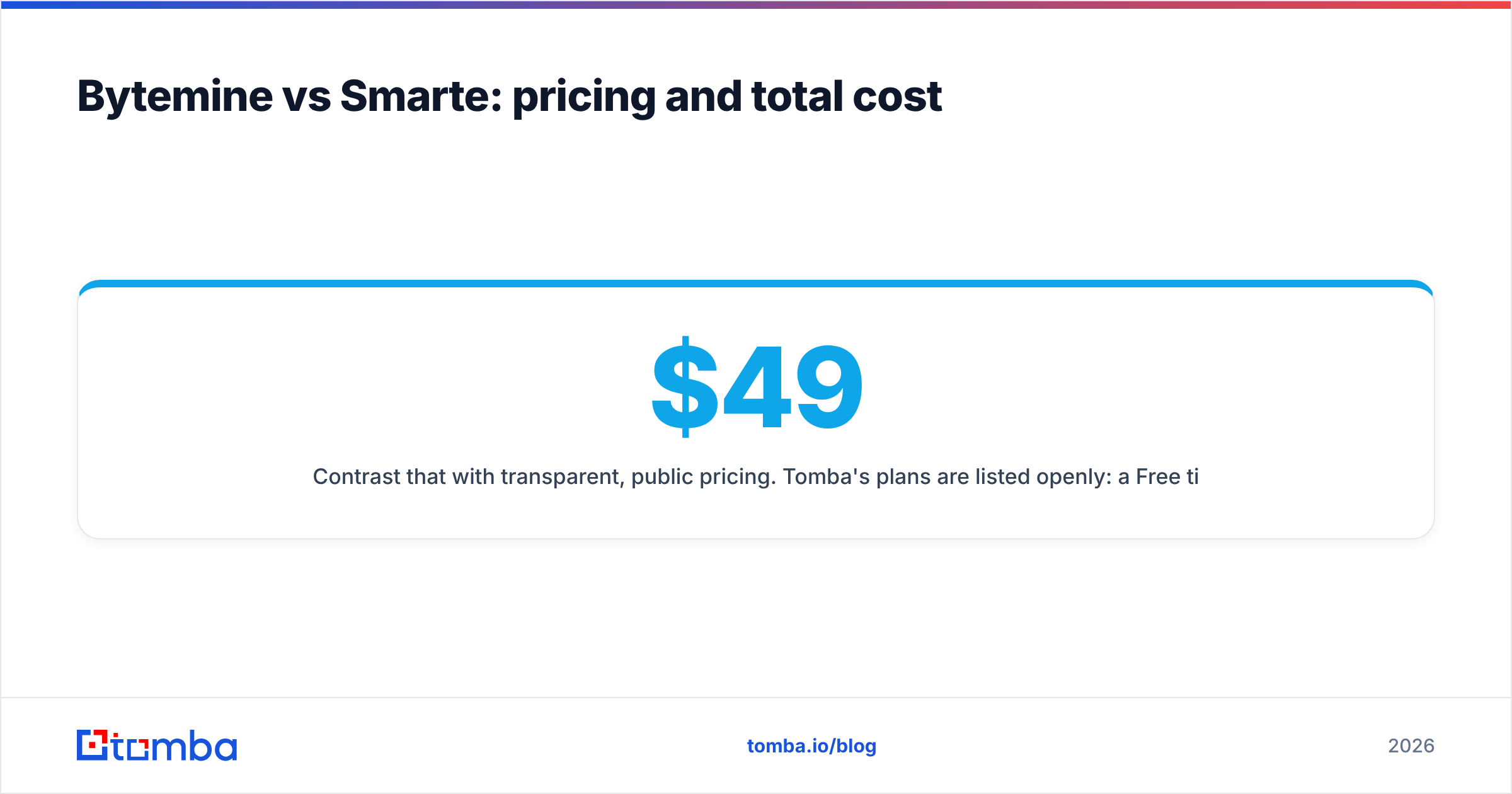
Both Bytemine and Smarte run quote-based pricing, which is normal for enterprise data platforms but frustrating if you're a small team trying to model cost per lead. You'll typically go through a sales call, get scoped on seats and credits, and land on an annual contract.
That model has two consequences:
- You can't budget without a sales conversation. For a 3-person team, that friction alone is a reason to look elsewhere.
- Per-record cost is hidden. Platform pricing bundles data, seats, and features, so it's hard to know what you're actually paying for the one thing you need most — verified contacts.
Contrast that with transparent, public pricing. Tomba's plans are listed openly: a Free tier (25 searches/month), Starter at $49/mo, Growth at $99/mo, Pro at $249/mo, and custom Enterprise. You can see the full Tomba pricing before talking to anyone, model your cost per lead in a spreadsheet, and scale up only when usage demands it.
)
For many teams the math is blunt: if you mainly need accurate emails for outbound, paying enterprise-platform rates for Bytemine or Smarte is overspending for capability you won't fully use.
When should you choose Bytemine or Smarte over an email finder?#
Platforms earn their price in specific situations. Be honest about whether you're in one of them.
Choose a full data platform (Bytemine or Smarte) when:
- You're running account-based motions and need firmographic, technographic, and intent layers — not just contacts.
- You have a dedicated RevOps or data team that will operationalize and govern the data across systems.
- You need broad mobile-number coverage for a heavy outbound-calling motion.
- You're at enterprise scale where a negotiated annual contract genuinely beats per-credit pricing.
Choose a focused email finder when:
- Your core need is finding and verifying business emails for cold email and follow-up.
- You want predictable, public pricing and a free tier to test before you buy.
- You're an SMB, agency, or founder-led sales team that values speed over a sprawling data suite.
- You already have a CRM and just need a reliable contact-acquisition layer feeding it.
This is exactly why "Bytemine vs Smarte" is sometimes the wrong question. If you've defined the problem as "we need better contacts to email," the better comparison is platform-vs-tool, not platform-vs-platform. For a deeper look at the category, see where Tomba gets its data and how a lightweight data enrichment layer can cover the gaps without a six-figure contract.
How do these tools fit your existing workflow?#
A data tool is only as good as how cleanly it drops into the systems your reps already live in. Evaluate three integration points before deciding.
- CRM sync. Does it push enriched records into HubSpot, Salesforce, or Pipedrive without manual CSV gymnastics? Platforms usually support this; confirm field mapping and dedup behavior.
- Outbound stack. Your sequencer needs verified emails, not raw guesses. A built-in verifier reduces the round-trips between "found a contact" and "safe to send."
- Bulk and API access. If you're enriching lists at volume, you want a bulk workflow and a documented email finder API so engineering can wire it into your own tooling.
Bytemine and Smarte both offer integrations typical of enterprise platforms, but the heavier the platform, the heavier the implementation. If you need to be live this week, a self-serve tool with an open API and a Chrome extension is a faster path than an enterprise onboarding cycle.
For independent reviews of any of these tools' integration depth and support quality, check the user feedback on G2 and Capterra rather than relying on vendor case studies. Cross-referencing real reviews against the framing on Gartner gives you a more honest picture than any sales deck.
What's the verdict on Bytemine vs Smarte?#
There's no universal winner — there's a winner for your situation.
- Pick Smarte if verified contact data, mobile coverage, and compliance posture for a GTM team are your top priorities and you have budget for an enterprise contract.
- Pick Bytemine if your motion is segment-and-list-build heavy and you want a data-mining-first platform to define and slice your addressable market.
- Pick a dedicated email finder if the real job is acquiring accurate, verified business emails at a transparent price — which describes most SMB and mid-market outbound teams.
The trap is buying a platform because the demo looked impressive, then using 10% of it to do what a $49/mo tool does better. Define the job first. If the job is contacts-for-outbound, the platform comparison is a distraction.
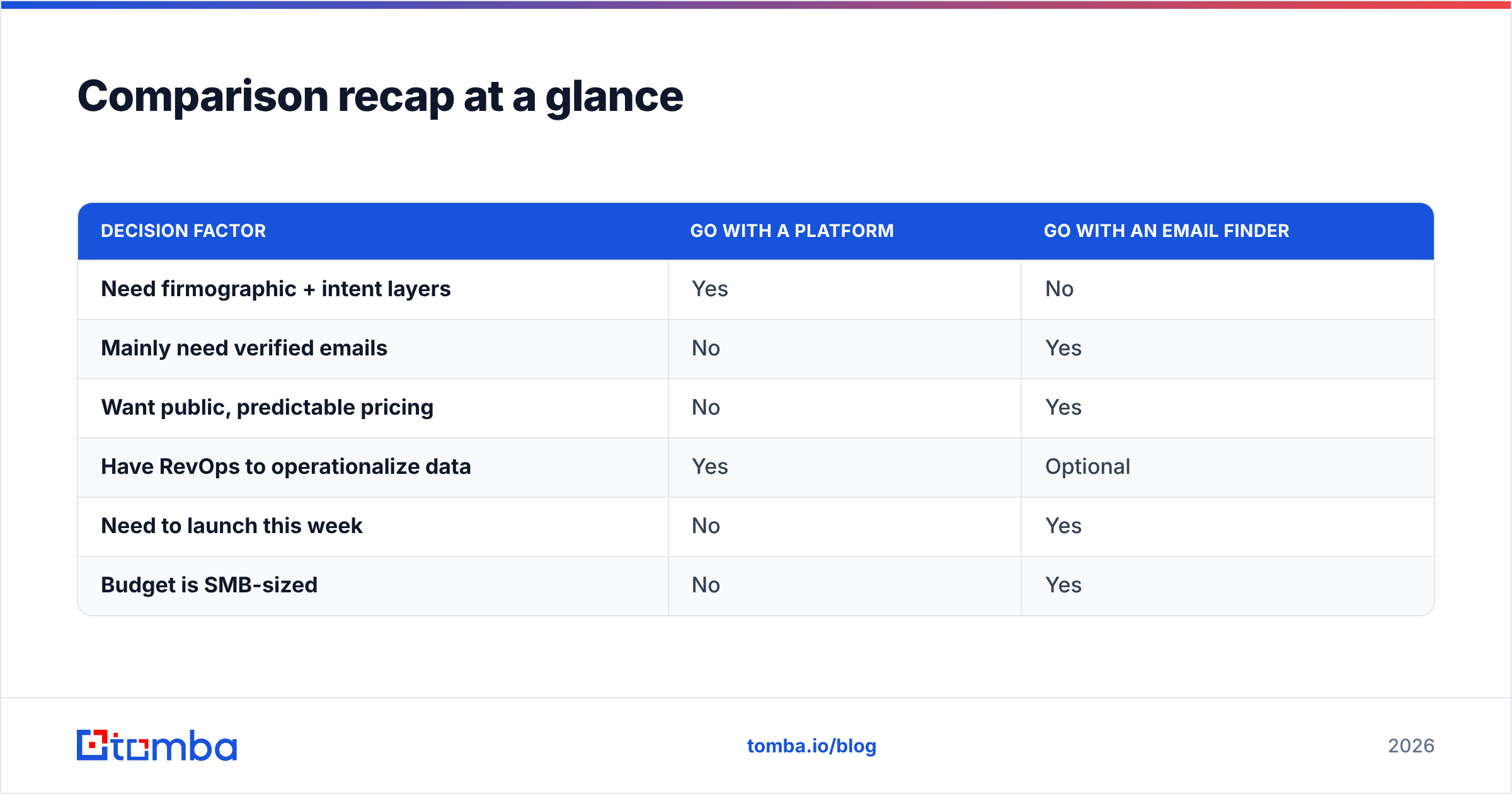
Comparison recap at a glance#
| Decision factor | Go with a platform | Go with an email finder |
|---|---|---|
| Need firmographic + intent layers | Yes | No |
| Mainly need verified emails | No | Yes |
| Want public, predictable pricing | No | Yes |
| Have RevOps to operationalize data | Yes | Optional |
| Need to launch this week | No | Yes |
| Budget is SMB-sized | No | Yes |
Run your own use case down that table. If you land mostly in the right-hand column, you don't need Bytemine or Smarte yet — you need accurate contacts and a clean workflow.
Get accurate B2B emails without the enterprise contract#
If your real bottleneck is finding and verifying the right business emails — not standing up a full data platform — start with the Tomba Email Finder. Search by domain, name, or company; verify before you send with the built-in email verification; and scale from a free 25-search tier up to higher plans only when your volume justifies it. Transparent Tomba pricing, an open API, and catch-all handling mean you can test accuracy on your own accounts today and skip the quote-based sales cycle entirely. Try it free, measure your bounce rate, and decide with evidence instead of a demo.
// get started
Find, verify and enrich your first contacts today
Start on the free plan with 25 searches a month, then scale when your team is ready.
Free plan · No credit card required · GDPR & CCPA
// about the author