Bytemine vs Truemail: Email Finder Showdown for 2026
Bytemine vs Truemail compared on accuracy, pricing, verification depth, and data coverage — plus where a stronger all-in-one finder fits in 2026.
Choosing between Bytemine and Truemail comes down to one question most comparison posts dodge: are you trying to find new email addresses, or just verify a list you already own? These two tools sit on different sides of that line, and picking the wrong one means paying for capability you'll never touch — or worse, shipping a campaign on data you can't trust.
This breakdown puts Bytemine vs Truemail side by side on accuracy, pricing, verification depth, catch-all handling, and data coverage, then shows where each one actually earns its keep in 2026.
TL;DR#
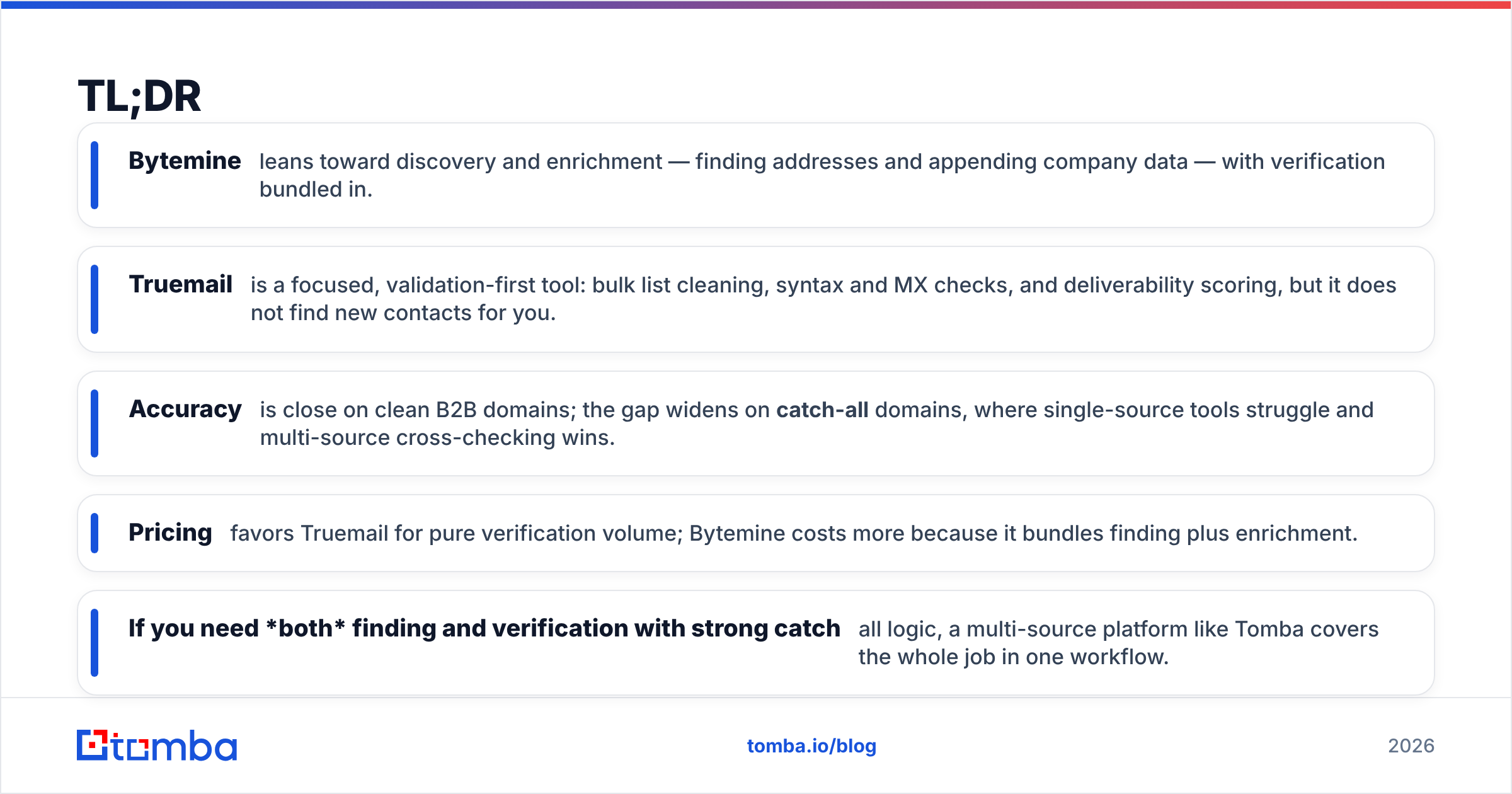
- Bytemine leans toward discovery and enrichment — finding addresses and appending company data — with verification bundled in.
- Truemail is a focused, validation-first tool: bulk list cleaning, syntax and MX checks, and deliverability scoring, but it does not find new contacts for you.
- Accuracy is close on clean B2B domains; the gap widens on catch-all domains, where single-source tools struggle and multi-source cross-checking wins.
- Pricing favors Truemail for pure verification volume; Bytemine costs more because it bundles finding plus enrichment.
- If you need both finding and verification with strong catch-all logic, a multi-source platform like Tomba covers the whole job in one workflow.

What is Bytemine and what does it actually do?#
Bytemine positions itself as a lead-data tool: you give it a domain, a name, or a company, and it returns candidate email addresses along with some firmographic context. Think of it like a metal detector that also tells you a little about the field you're scanning — it surfaces contacts and tags them with company signals.
That makes Bytemine useful at the top of an outbound workflow, when you have a target account list but no contact details yet. Its verification step runs after discovery to filter out the obvious dead addresses before they reach your sequencer.
The trade-off: discovery-first tools live and die by their underlying data. If Bytemine's index is thin for a given region or industry, you get fewer hits, and the addresses it does return need a second look. Discovery without rigorous verification is a recipe for bounce-driven sender reputation damage.
What is Truemail and where does it fit?#
Truemail is a verification engine, not a finder. You bring the list — exported from a CRM, a scraped sheet, a webinar signup form — and Truemail tells you which addresses are safe to send to. It runs the standard validation stack: syntax checks, domain and MX record lookups, SMTP probing, and role-account and disposable-address detection.
Picture Truemail as a water-quality lab. It doesn't dig the well; it tells you whether what's already in the bucket is drinkable. For teams that generate leads through forms, events, or content, that's exactly the job — clean the list, drop the risky addresses, protect deliverability.
The limitation is equally clear: Truemail can't grow your pipeline. If your problem is "I have 500 target companies and no contacts," a verifier alone leaves you stuck. You still need a separate email finder to source the addresses before Truemail can score them.
Bytemine vs Truemail: how do they compare head-to-head?#
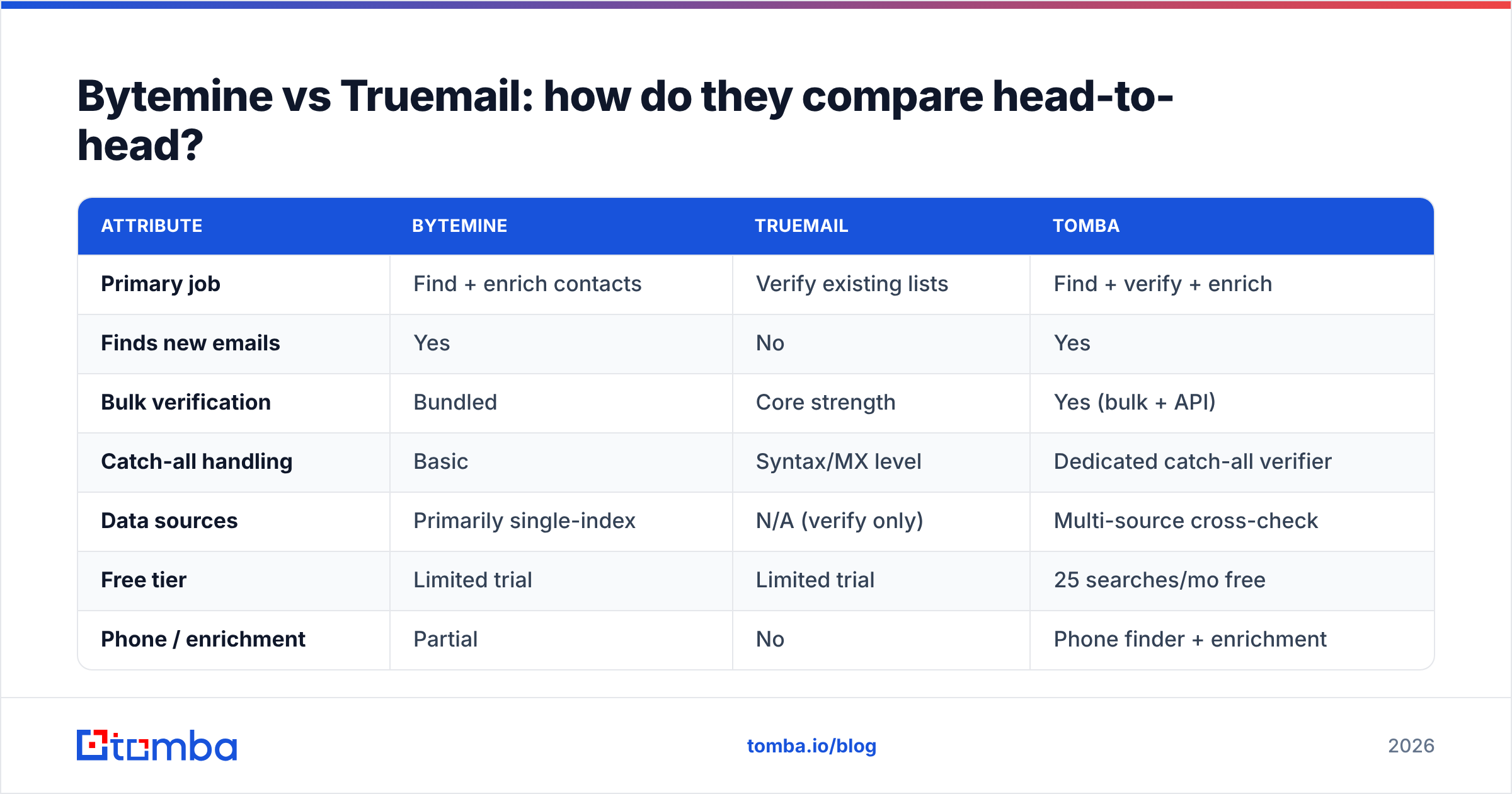
Here's the core comparison across the attributes that actually change your results. Numbers reflect publicly listed positioning at the time of writing — always confirm current tiers on each vendor's site before you buy.
| Attribute | Bytemine | Truemail | Tomba |
|---|---|---|---|
| Primary job | Find + enrich contacts | Verify existing lists | Find + verify + enrich |
| Finds new emails | Yes | No | Yes |
| Bulk verification | Bundled | Core strength | Yes (bulk + API) |
| Catch-all handling | Basic | Syntax/MX level | Dedicated catch-all verifier |
| Data sources | Primarily single-index | N/A (verify only) | Multi-source cross-check |
| Free tier | Limited trial | Limited trial | 25 searches/mo free |
| Phone / enrichment | Partial | No | Phone finder + enrichment |
| API access | Yes | Yes | REST API, CLI, MCP |
The pattern is straightforward. Truemail wins on focused, high-volume verification economics. Bytemine wins when you need discovery and verification in one pass but can accept single-index coverage. Neither fully closes the gap on catch-all domains, which is where most B2B lists quietly leak accuracy.
)
Which one is more accurate?#
On clean, well-known B2B domains, Bytemine and Truemail land in a similar accuracy band — both correctly validate standard first.last@company.com patterns the vast majority of the time. The honest answer is that accuracy diverges in two specific situations:
- Catch-all domains. When a mail server accepts every address at a domain (so SMTP probing returns "OK" for anything), a verify-only tool like Truemail can't distinguish a real mailbox from a fictional one. Bytemine's discovery data helps a little here, but single-source indexes still guess.
- Sparse or regional data. Discovery accuracy depends entirely on coverage. A tool indexing fewer sources returns fewer verified hits and more "unknown" results outside its strongest geographies.
This is why cross-checking across multiple data sources matters. A catch-all verifier that corroborates an address against several independent signals — not just one SMTP handshake — is the difference between a 2% and a 12% bounce rate. You can read more about where reliable email data comes from and why source diversity drives accuracy.
What about pricing — which is cheaper?#
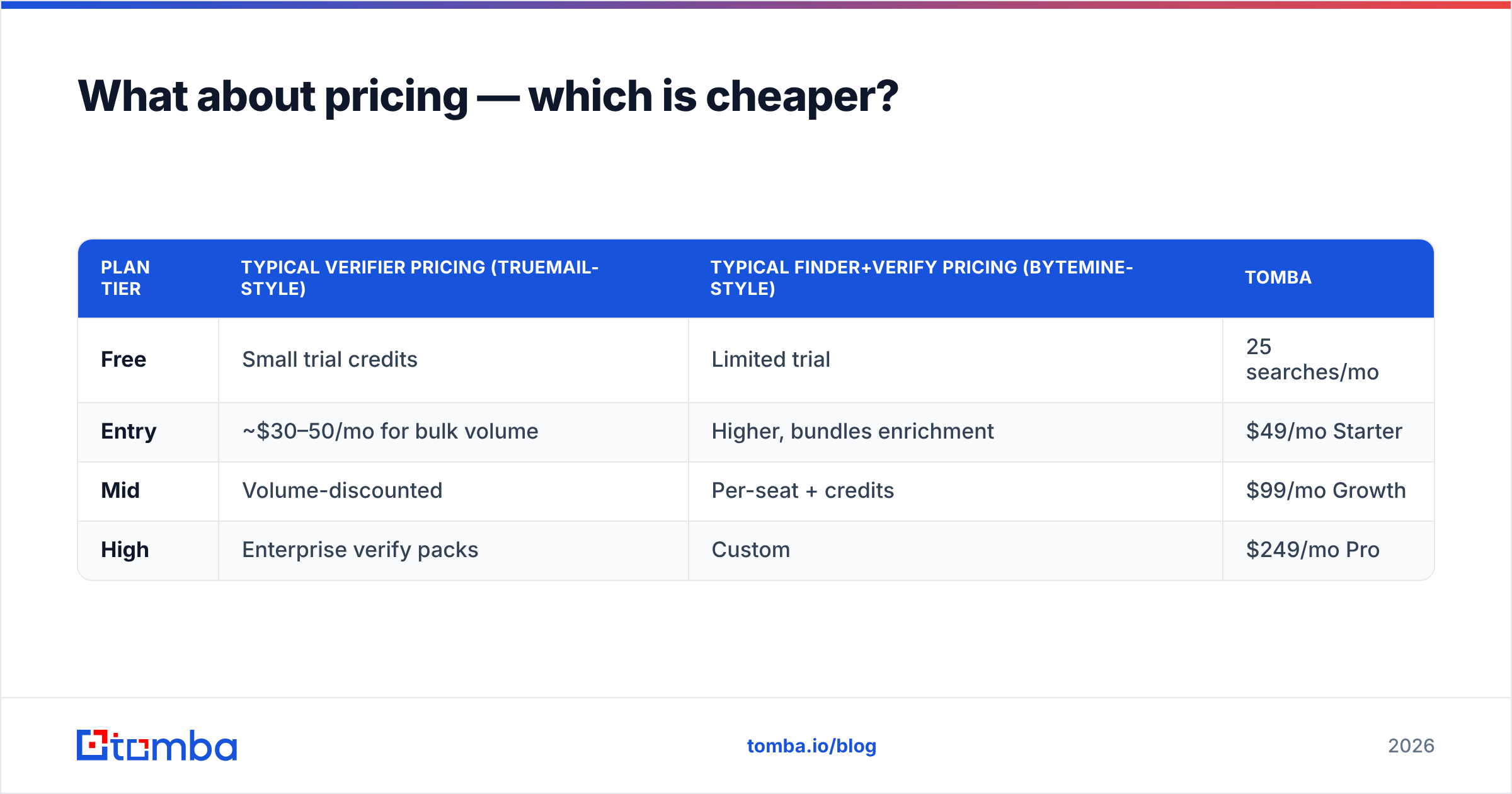
It depends on whether you're paying for finding or verifying, because those are priced very differently across the market.
| Plan tier | Typical verifier pricing (Truemail-style) | Typical finder+verify pricing (Bytemine-style) | Tomba |
|---|---|---|---|
| Free | Small trial credits | Limited trial | 25 searches/mo |
| Entry | ~$30–50/mo for bulk volume | Higher, bundles enrichment | $49/mo Starter |
| Mid | Volume-discounted | Per-seat + credits | $99/mo Growth |
| High | Enterprise verify packs | Custom | $249/mo Pro |
Truemail-style verification tends to be cheaper per address because verifying is computationally lighter than sourcing. Bytemine-style tools cost more because discovery plus enrichment is a heavier lift. If you only ever clean lists, the verifier route is the budget winner. If you need both jobs, paying for two separate tools often costs more than one consolidated platform — compare against the full Tomba pricing before assuming the cheapest line item is the cheapest workflow.
Do you actually need a finder, a verifier, or both?#
Most teams realize halfway through a campaign that they need both — and that running two disconnected tools creates friction.
)
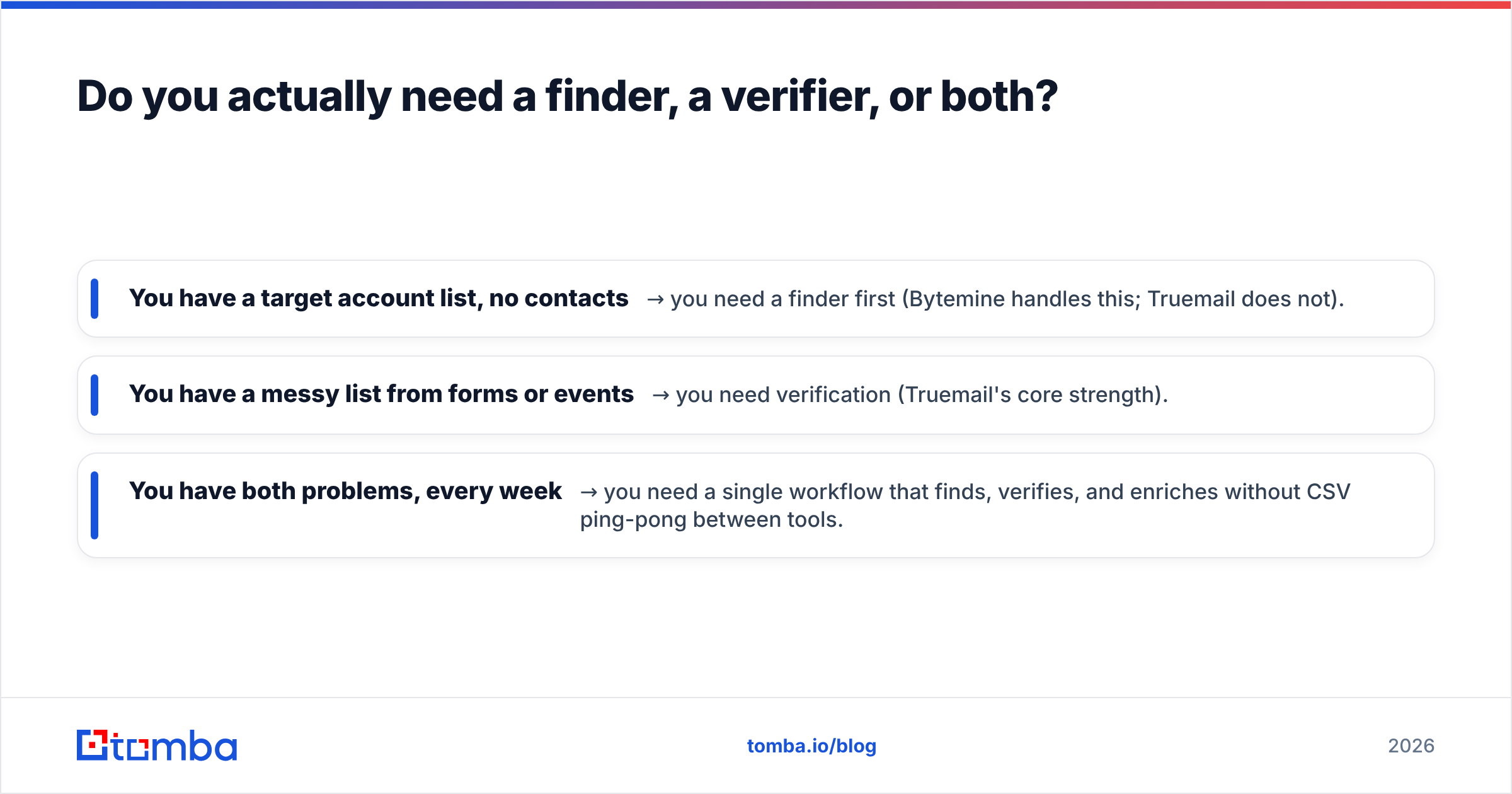
Map your situation to the right setup:
- You have a target account list, no contacts → you need a finder first (Bytemine handles this; Truemail does not).
- You have a messy list from forms or events → you need verification (Truemail's core strength).
- You have both problems, every week → you need a single workflow that finds, verifies, and enriches without CSV ping-pong between tools.
For that third case, a unified platform earns its price by eliminating handoffs. With Tomba you can run a domain search to pull every address pattern at a company, verify each one through the email verifier, and append phone or firmographic data through data enrichment — all in one place, with one email finder API if you're automating.
How do these tools handle bulk work and integrations?#
Bulk processing is where the practical differences show up. Truemail is built for large list uploads and returns clean/risky/invalid segmentation efficiently — that's its home turf. Bytemine handles bulk discovery but is constrained by index depth, so a 10,000-row job may return fewer enriched hits than the row count suggests.
For integration, both offer APIs, which matters if verification needs to happen inside a signup flow or CRM sync rather than as a manual batch. If your stack runs on HubSpot, Salesforce, or a no-code layer, check that whatever you pick connects natively — a bulk email finder plus REST API, CLI, and direct CRM integrations removes the export/import tax that quietly eats hours every week.
According to independent review aggregators like G2 and Capterra, buyers consistently rank workflow consolidation and catch-all accuracy above raw price — a useful reality check when a cheap verifier looks tempting on paper.
Bytemine vs Truemail: which should you choose in 2026?#
Pick based on the single job you do most:
- Choose Truemail if you almost never need new contacts and just want a lean, affordable engine to keep your existing lists clean and your bounce rate low.
- Choose Bytemine if discovery-plus-light-enrichment in one tool matters more than deep multi-source coverage, and your target geographies match its index strengths.
- Choose a consolidated platform if you're tired of stitching a finder to a verifier, want stronger catch-all logic, and would rather pay one bill than two.
There's no universally "best" tool here — only the best fit for your dominant workflow. Be honest about whether your real bottleneck is sourcing contacts or trusting the ones you have, and the choice gets simple.
The bottom line#
Bytemine and Truemail solve adjacent but different problems: Bytemine finds and enriches, Truemail verifies. If your work lives entirely on one side of that line, either can be the right call. But most B2B teams cross the line constantly — and that's where running two tools (or one tool that only does half the job) starts costing more than it saves.
If you want finding, verification, catch-all checking, and enrichment under one roof — with a real free tier to test it on your own domains — start with the Tomba Email Finder. Run 25 searches free this month, verify the results in the same dashboard, and see how multi-source cross-checking changes your bounce rate before you commit a dollar.

// get started
Find, verify and enrich your first contacts today
Start on the free plan with 25 searches a month, then scale when your team is ready.
Free plan · No credit card required · GDPR & CCPA
// about the author