Bytemine vs Unwrapemail: Best Email Finder in 2026?
A hands-on, neutral breakdown of Bytemine vs Unwrapemail — accuracy, pricing, data coverage, and workflow fit — plus where Tomba beats both on cost per verified email.
Bytemine vs Unwrapemail
Choosing between two email finders usually comes down to one number that neither marketing page wants to show you clearly: cost per verified, deliverable email. Bytemine and Unwrapemail both promise to turn a name and a domain into a working inbox, but they get there with different data sources, different pricing math, and very different tolerance for catch-all domains. This guide compares them head to head and shows where a third option fits.
TL;DR — Bytemine vs Unwrapemail at a glance#
- Bytemine leans toward bulk B2B list-building with a database-first model — good raw volume, but accuracy drops on smaller domains and you pay for credits you may not use.
- Unwrapemail is lighter and more workflow-focused, built around inbox and outreach hygiene rather than deep firmographic enrichment — simpler, but thinner coverage outside common domains.
- Neither is the cheapest path to verified emails. Bundled verification, catch-all handling, and per-credit cost decide the real bill, and that is where both tools leave money on the table.
- If you want one platform that finds, verifies, and enriches in the same credit pool, Tomba starts at $49/mo and folds verification into every search.
- Pick by job: bulk prospecting lists lean Bytemine; lightweight outreach hygiene leans Unwrapemail; accuracy-plus-verification-per-dollar leans Tomba.
What do Bytemine and Unwrapemail actually do?#
Both tools live in the same category — turning identity signals (name, company, domain, LinkedIn profile) into contact data — but they emphasize different ends of the funnel.
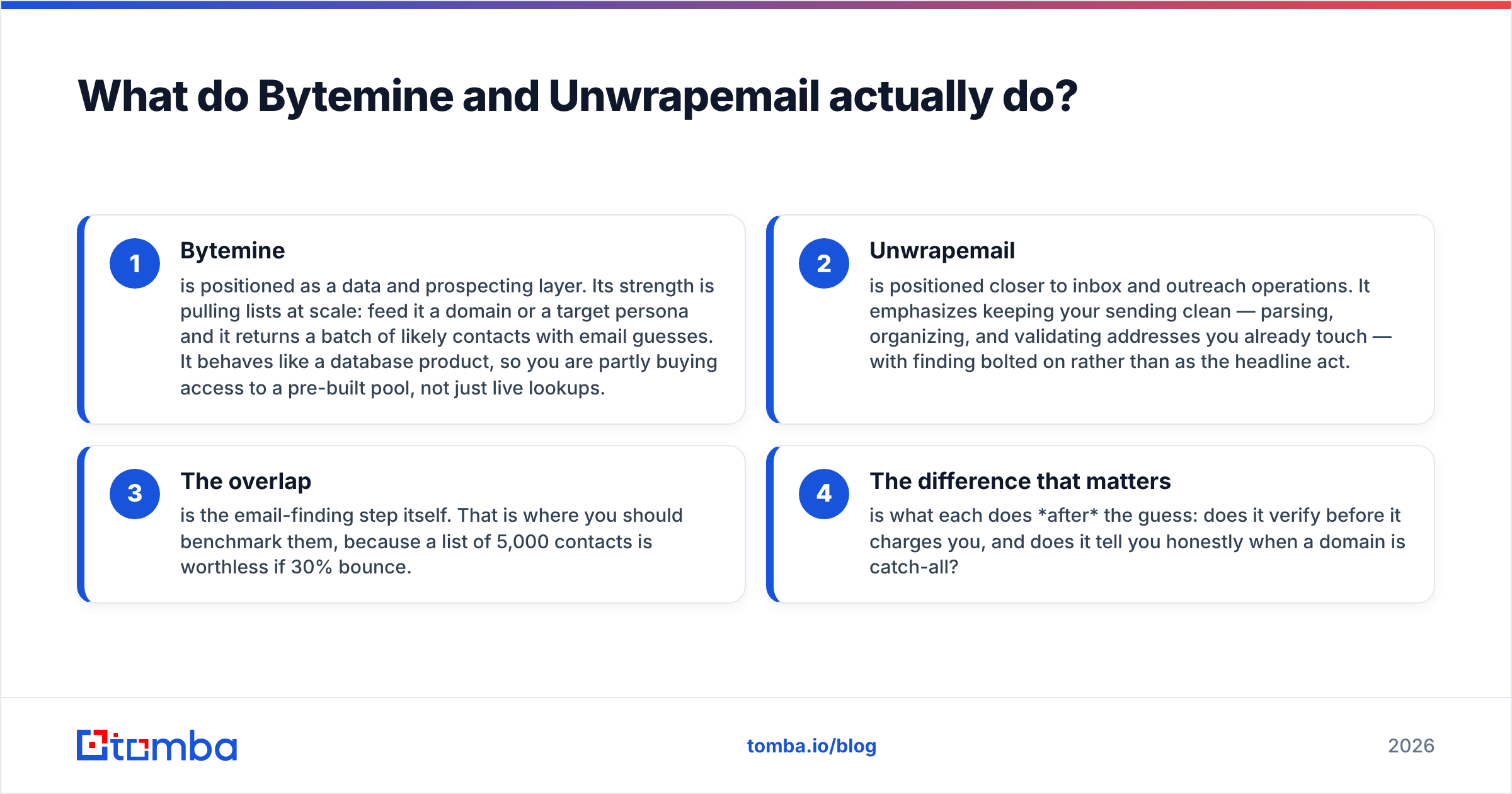
- Bytemine is positioned as a data and prospecting layer. Its strength is pulling lists at scale: feed it a domain or a target persona and it returns a batch of likely contacts with email guesses. It behaves like a database product, so you are partly buying access to a pre-built pool, not just live lookups.
- Unwrapemail is positioned closer to inbox and outreach operations. It emphasizes keeping your sending clean — parsing, organizing, and validating addresses you already touch — with finding bolted on rather than as the headline act.
- The overlap is the email-finding step itself. That is where you should benchmark them, because a list of 5,000 contacts is worthless if 30% bounce.
- The difference that matters is what each does after the guess: does it verify before it charges you, and does it tell you honestly when a domain is catch-all?
If you are new to the mechanics, our explainer on how an email finder resolves patterns is a useful primer before you commit budget to either tool.
How accurate is each one?#
Accuracy is the whole game, and it is where marketing claims and reality diverge most. Vendors quote "95%+ accuracy" on easy domains — big companies with predictable first.last@ patterns — then stay quiet about catch-all domains and SMB inboxes where the real misses happen.

Here is how the two stack up on the dimensions that drive bounce rate:
- Common corporate domains: Both perform well. Bytemine's database depth gives it a slight edge on volume; Unwrapemail matches it on quality for known patterns.
- SMB and long-tail domains: Bytemine's coverage thins out but still returns guesses. Unwrapemail returns fewer results but is less likely to hand you a confident-looking wrong answer.
- Catch-all domains: This is the trap. A catch-all accepts every address, so naive tools mark everything "valid." Tools without a dedicated catch-all verifier inflate their accuracy stats here and quietly feed you bounces.
- Verification timing: If a tool charges you for the find and then asks you to pay again to verify, your effective accuracy-per-dollar is far lower than the headline number.
The honest takeaway: neither Bytemine nor Unwrapemail publishes catch-all-segmented accuracy, so treat their top-line percentages as best-case. Always run a sample batch and measure your own bounce rate before scaling spend.
How does pricing compare?#
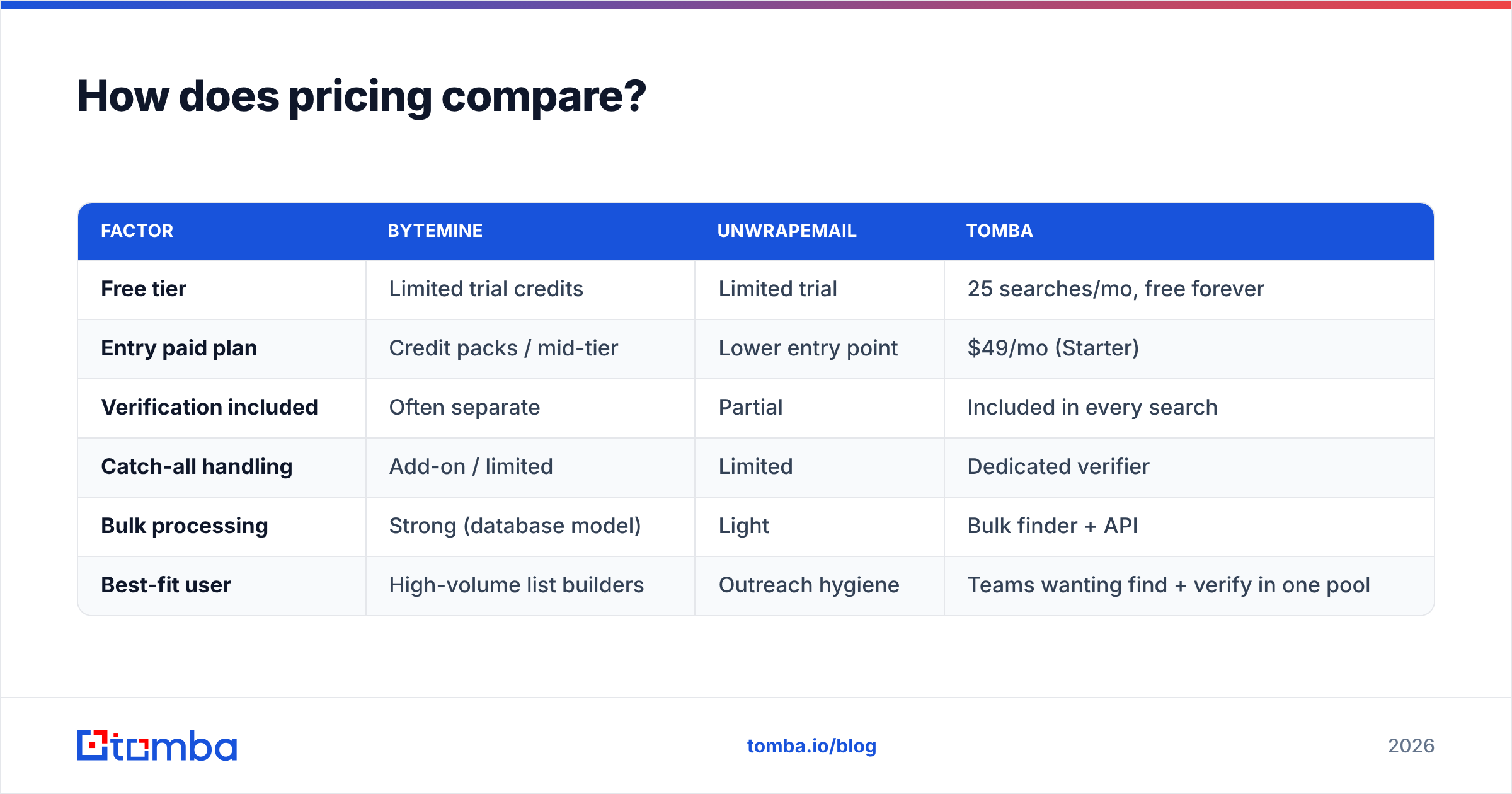
Both tools sell credits, but the unit economics differ. The table below normalizes them so you can compare apples to apples. (Treat competitor figures as representative tiers — always confirm current pricing on each vendor's own page.)
| Factor | Bytemine | Unwrapemail | Tomba |
|---|---|---|---|
| Free tier | Limited trial credits | Limited trial | 25 searches/mo, free forever |
| Entry paid plan | Credit packs / mid-tier | Lower entry point | $49/mo (Starter) |
| Verification included | Often separate | Partial | Included in every search |
| Catch-all handling | Add-on / limited | Limited | Dedicated verifier |
| Bulk processing | Strong (database model) | Light | Bulk finder + API |
| Best-fit user | High-volume list builders | Outreach hygiene | Teams wanting find + verify in one pool |
A few things to read between the lines:
- "Verification not included" is the silent cost. If you have to verify elsewhere (or buy a second credit type), your per-email cost can double versus a tool that verifies inline.
- Credit expiry matters. Database-style products like Bytemine sometimes push larger packs that expire — great if you actually consume them, wasteful if your volume is lumpy.
- Entry price is not the metric. A cheaper plan that returns more bounces costs more once you factor in damaged sender reputation. Protecting email deliverability is part of the price.
For a clean baseline, the Tomba pricing page lists every tier publicly, and verification is baked into the same credit — so the number you see is closer to the number you pay.
Is Bytemine better than Unwrapemail?#
It depends on what you are optimizing for. Neither is strictly "better"; they are tuned for different jobs.
Bytemine wins when:
- You need large prospect lists fast and can tolerate running your own verification pass.
- Your targets skew toward mid-to-large companies with predictable email formats.
- You value database-style browsing (filter by industry, size, role) over one-off lookups.
Unwrapemail wins when:
- Your volume is modest and you care more about keeping a clean sending operation than mass list-building.
- You want a lighter, simpler tool without a heavy enrichment layer.
- You are already managing outreach hygiene and want finding as a convenience, not the core.
Where both fall short:
- Catch-all transparency is weak on both.
- Verification is not consistently bundled, so the true cost per deliverable email is higher than advertised.
- Phone and deeper firmographic enrichment are limited — if you need a phone finder or full data enrichment, you will likely add another vendor.
What about the third option — where Tomba fits#
The reason this comparison rarely ends with a clean winner is that the category itself has a structural gap: most tools either find or verify well, and bundle the other as an afterthought. That gap is the opening Tomba is built around.

Concretely, Tomba consolidates the steps that Bytemine and Unwrapemail split across products or add-ons:
- Find + verify in one credit. Every result from the email finder runs through verification before it counts against you, so your list arrives deliverable, not just plausible.
- Honest catch-all handling. A dedicated catch-all finder flags ambiguous domains instead of marking them "valid" — fewer surprise bounces.
- Domain-first prospecting. Use domain search to pull every known address at a company, with confidence scores and sources.
- Workflow coverage. Bulk processing, a documented Tomba API, a Chrome extension, and Google Sheets and Excel add-ins, so finding fits where your team already works.
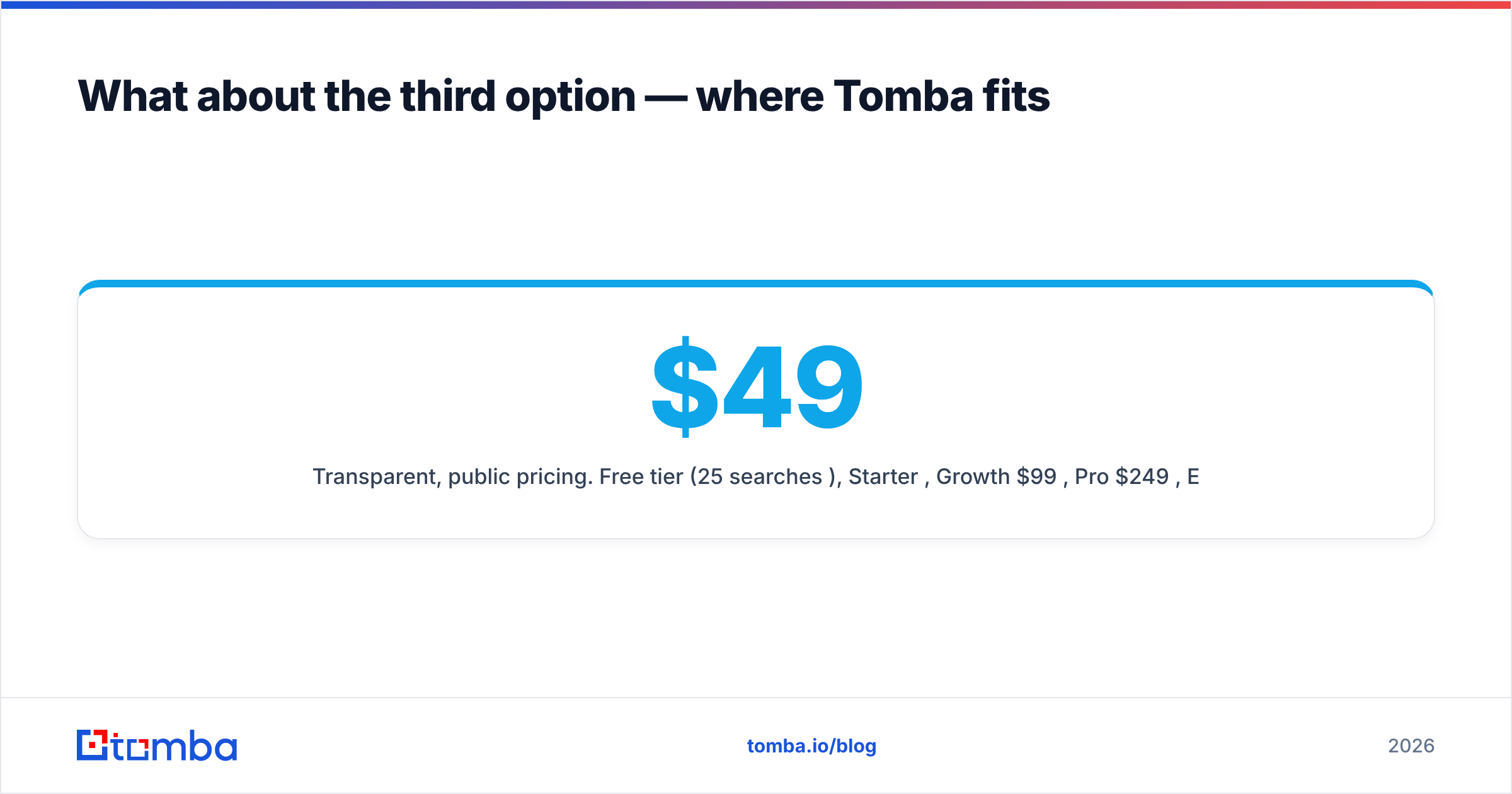
- Transparent, public pricing. Free tier (25 searches/mo), Starter $49/mo, Growth $99/mo, Pro $249/mo, Enterprise custom — with verification included at every level.
This is not to say Tomba is the answer for everyone. If you only want a barebones, low-volume hygiene helper, Unwrapemail's simplicity may suit you. If you live in bulk list-building and already own a verification stack, Bytemine's database model can be efficient. The point is to compare on cost per verified, deliverable email — and on that metric, a bundled find-and-verify platform is hard to beat.
How should you test these tools before buying?#
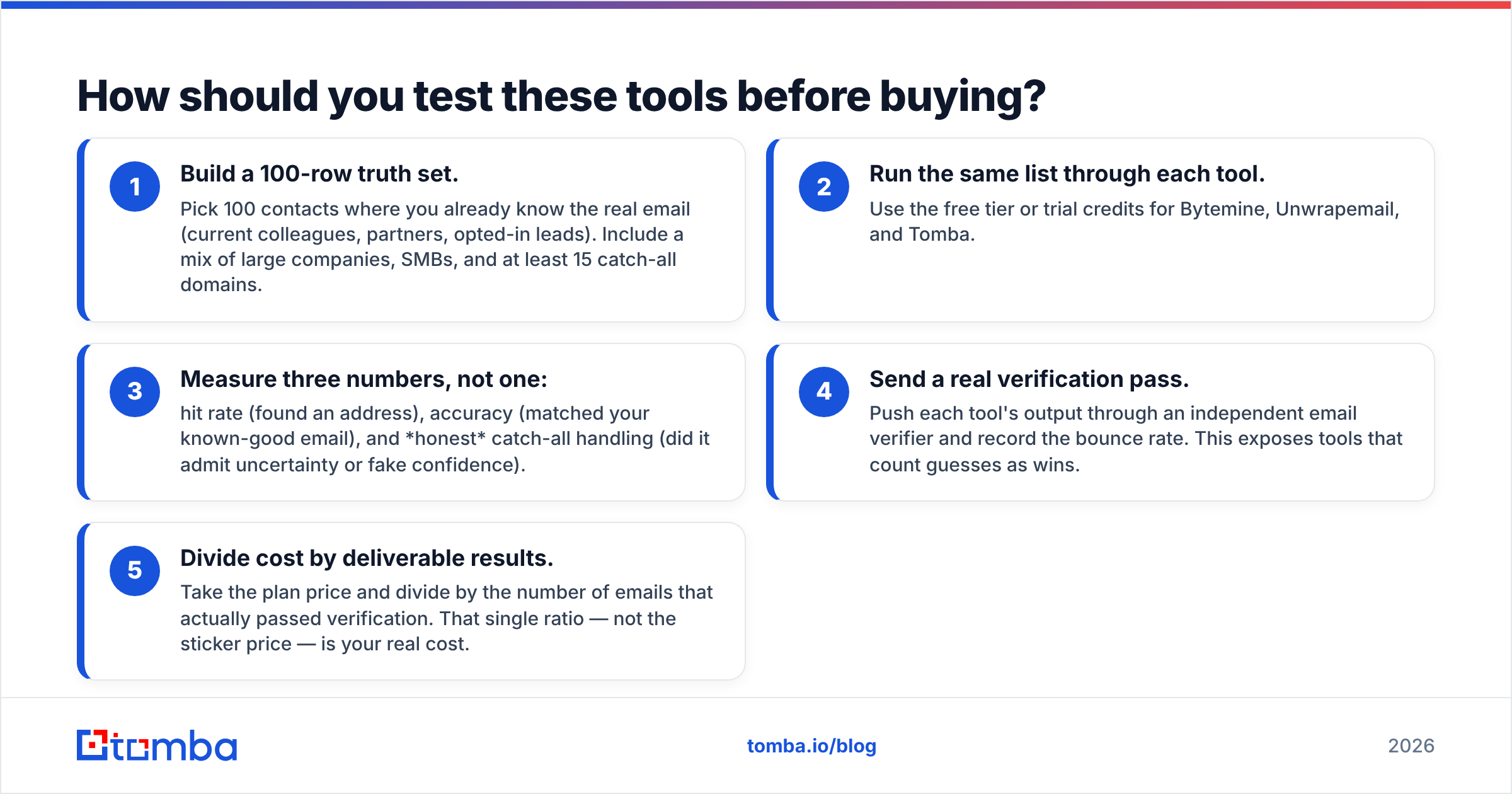
Do not trust any vendor's headline accuracy — including ours. Run a controlled bake-off in under an hour:
- Build a 100-row truth set. Pick 100 contacts where you already know the real email (current colleagues, partners, opted-in leads). Include a mix of large companies, SMBs, and at least 15 catch-all domains.
- Run the same list through each tool. Use the free tier or trial credits for Bytemine, Unwrapemail, and Tomba.
- Measure three numbers, not one: hit rate (found an address), accuracy (matched your known-good email), and honest catch-all handling (did it admit uncertainty or fake confidence).
- Send a real verification pass. Push each tool's output through an independent email verifier and record the bounce rate. This exposes tools that count guesses as wins.
- Divide cost by deliverable results. Take the plan price and divide by the number of emails that actually passed verification. That single ratio — not the sticker price — is your real cost.
This method neutralizes marketing spin. A tool that finds 90 of 100 but only 70 survive verification is worse than one that finds 80 and 78 survive. You can read more on independent review signals at G2 and Capterra before you commit, and cross-check deliverability best practices in the HubSpot blog.
Frequently asked questions#
Is Bytemine or Unwrapemail more accurate? On common corporate domains they are comparable. Bytemine returns more volume on large companies; Unwrapemail is slightly more conservative on long-tail domains. Neither publishes catch-all-segmented accuracy, so run your own sample batch before scaling.
Which is cheaper, Bytemine or Unwrapemail? Unwrapemail typically has a lower entry point, but "cheaper" depends on whether verification is included. Once you add a separate verification step, the gap narrows or reverses. Always compute cost per verified email.
Do either include email verification? Verification is inconsistent on both — often partial or sold separately. If inline verification matters, a platform that bundles it (like Tomba) gives you a more predictable cost.
Can I use these for bulk list-building? Bytemine is the stronger bulk tool of the two due to its database model. For large jobs you will still want a verification pass; Tomba's bulk finder verifies inline, which removes that second step.
What about catch-all domains? This is the weakest spot for both. If a large share of your targets use catch-all domains, prioritize a tool with a dedicated catch-all verifier so you are not billed for addresses that will bounce.
The bottom line#
Bytemine and Unwrapemail solve adjacent problems: Bytemine for volume-first list-building, Unwrapemail for lighter outreach hygiene. The decision should not hinge on sticker price or a headline accuracy claim — it should hinge on how many deliverable emails each one returns per dollar after verification. Run the 100-row bake-off above and the answer for your data will be obvious.
If you would rather not bolt verification onto your finder as a separate step, start with the Tomba Email Finder. It finds, verifies, and enriches in a single credit pool, handles catch-all domains honestly, and publishes its pricing openly from a free 25-search tier up to enterprise — so the cost you compare is the cost you pay. Spin up the free tier, run it against the same truth set you use for Bytemine and Unwrapemail, and let the bounce rate decide.
// get started
Find, verify and enrich your first contacts today
Start on the free plan with 25 searches a month, then scale when your team is ready.
Free plan · No credit card required · GDPR & CCPA
// about the author