Bytemine vs VerifyEmailAddress.com: Which Wins in 2026?
Bytemine and VerifyEmailAddress.com both promise clean email lists, but they solve different problems. Here's an honest 2026 breakdown of accuracy, pricing, and where each one fits.
You have a list of email addresses and a simple question: which ones will actually land? Two tools that keep showing up in that search are Bytemine and VerifyEmailAddress.com. They sound interchangeable, but they are built for different jobs — and picking the wrong one quietly wastes budget and burns your sender reputation.
This is a straight comparison: what each does well, where each falls short, what they cost, and which one you should reach for in 2026.
TL;DR#
- VerifyEmailAddress.com is a lightweight, single-purpose checker — paste an address, get a verdict. Great for one-off lookups, thin for teams running real campaigns.
- Bytemine is a heavier data-and-verification platform aimed at sales teams who want enrichment and bulk processing in one place.
- Neither is a true all-in-one if you also need to find emails, not just check them — that gap is where a suite like Tomba changes the math.
- Accuracy is the deciding factor: a verifier that can't read catch-all domains correctly will pass bounces straight into your sequence.
- Pick by workflow: occasional checks → free single-checker; bulk B2B prospecting → a platform with finder + verifier + enrichment.
What do Bytemine and VerifyEmailAddress.com actually do?#
They sit at different points on the same pipeline.
VerifyEmailAddress.com is exactly what the name says: a free-leaning email verification utility. You drop in an address, it runs syntax, MX, and SMTP checks, and tells you whether the mailbox looks deliverable. It is fast and frictionless for a single address, and it carries no real onboarding cost.
Bytemine positions itself as a B2B data platform. Alongside verification it offers contact data, list building, and enrichment features intended for sales and marketing teams that need volume, not one lookup at a time.
The honest framing: VerifyEmailAddress.com is a tool, Bytemine is a platform, and the right choice depends on whether you're checking one address or operating a pipeline. If you also need to find email addresses in the first place — not just validate ones you already have — both leave a gap that a dedicated finder fills.

How does email verification actually work?#
Before comparing scores, it helps to know what any verifier is doing under the hood. Think of it like a postal worker checking an address before delivery: is the street real, does the house exist, will someone accept the letter?
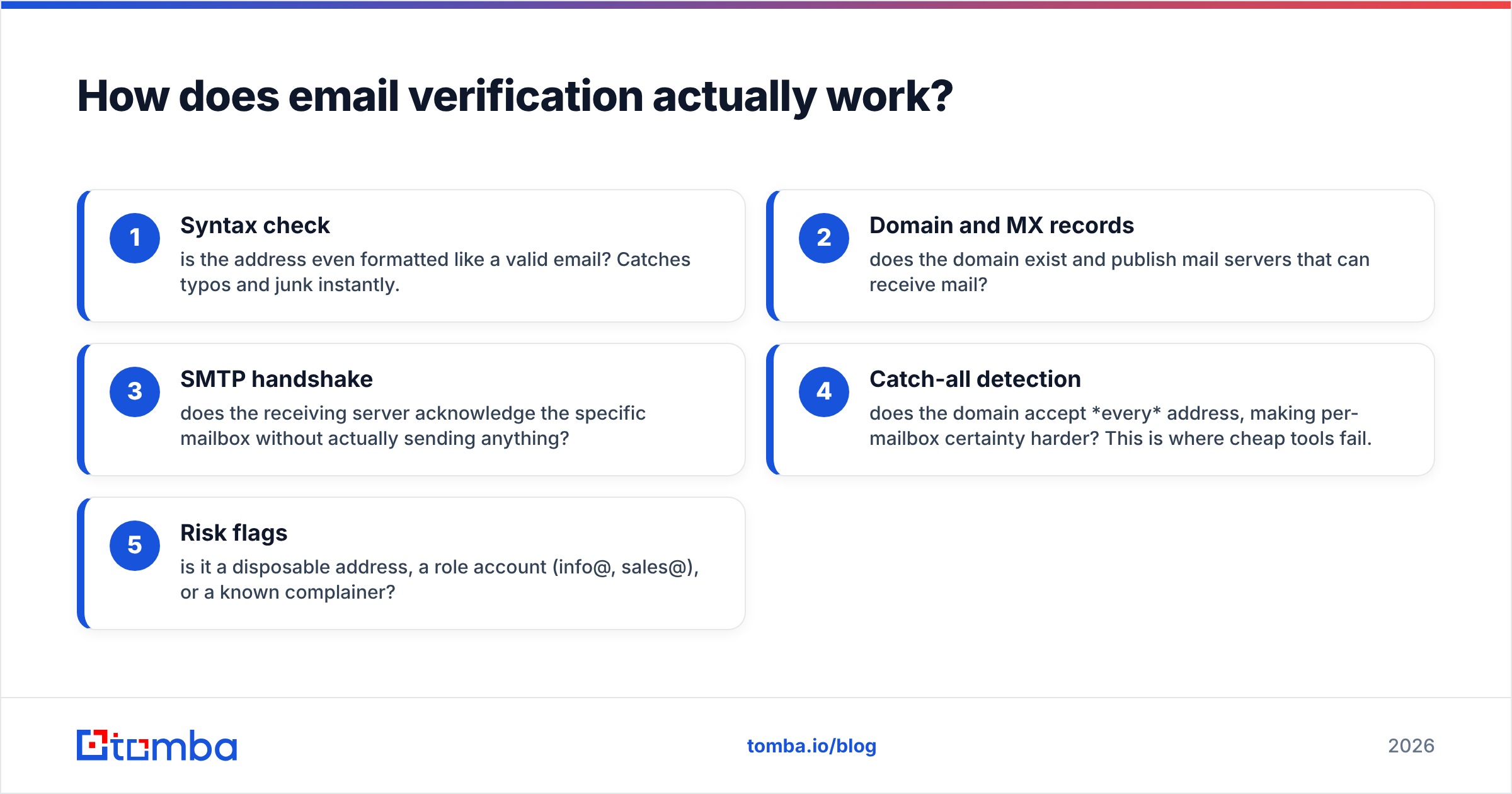
A solid verifier runs these checks in order:
- Syntax check — is the address even formatted like a valid email? Catches typos and junk instantly.
- Domain and MX records — does the domain exist and publish mail servers that can receive mail?
- SMTP handshake — does the receiving server acknowledge the specific mailbox without actually sending anything?
- Catch-all detection — does the domain accept every address, making per-mailbox certainty harder? This is where cheap tools fail.
- Risk flags — is it a disposable address, a role account (info@, sales@), or a known complainer?
The first three are commodity features; almost everyone does them. The real separation happens at steps four and five. A catch-all verifier that guesses "valid" on every catch-all domain is worse than useless — it hands you a clean-looking list full of landmines. Understanding email deliverability is the difference between a tool that protects your domain and one that quietly damages it.
Is Bytemine better than VerifyEmailAddress.com?#
It depends entirely on your volume and what else you need.
Choose VerifyEmailAddress.com when:
- You verify a handful of addresses per week.
- You want zero setup and no subscription.
- You're a solo founder or recruiter doing manual outreach.
Choose Bytemine when:
- You process lists in the thousands.
- You want enrichment (job title, company, social data) bundled with verification.
- You have a sales team that lives in a data platform daily.
But "better" is the wrong question if your real workflow is find leads → verify them → enrich them → push to CRM. In that case both tools are partial. A single platform that does all four removes the export-import-export shuffle that eats hours every week.
Bytemine vs VerifyEmailAddress.com vs Tomba: full comparison#
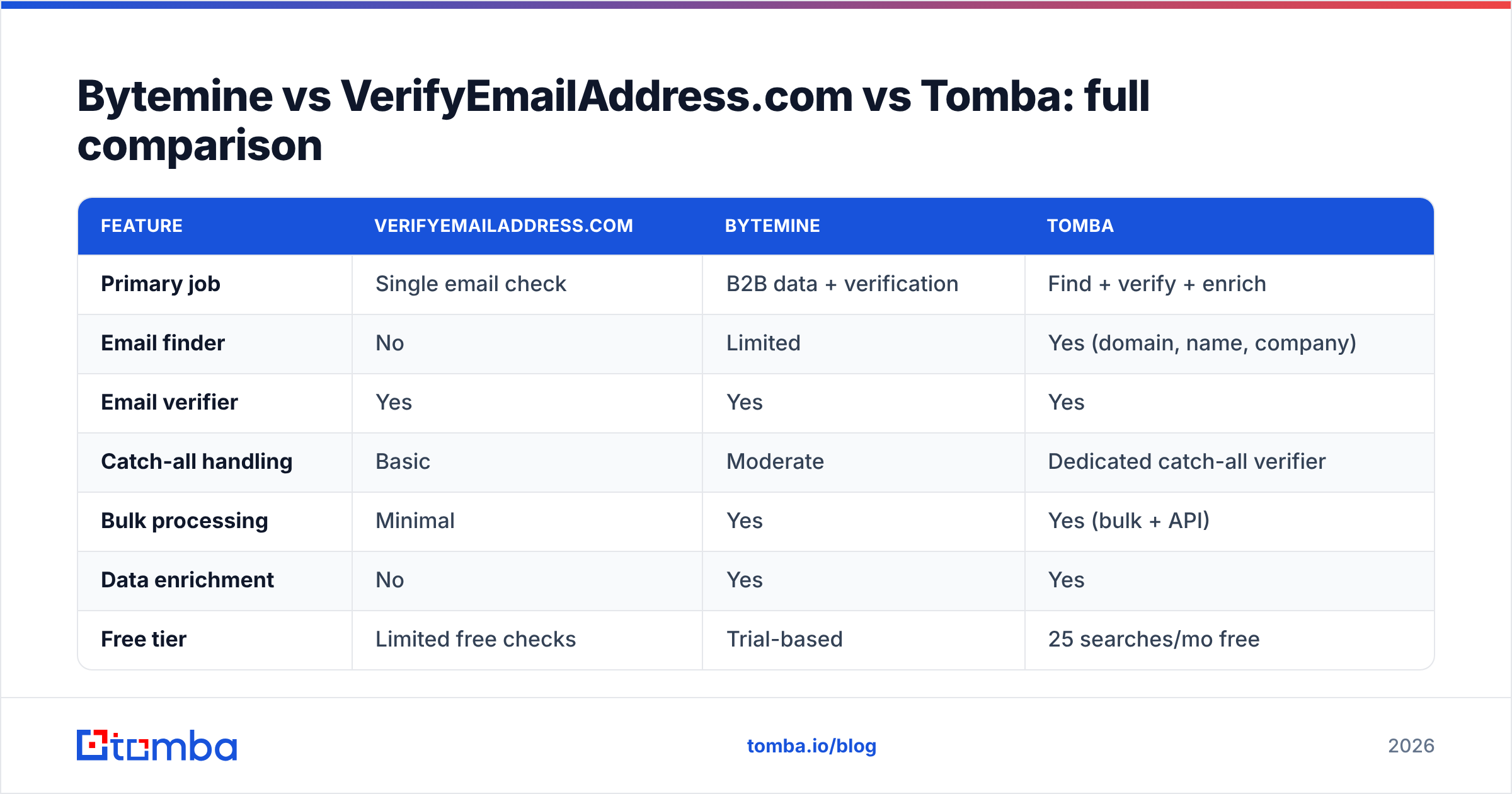
Here's how the two stack up against each other — and against a full suite — across the attributes that matter for B2B teams in 2026.
| Feature | VerifyEmailAddress.com | Bytemine | Tomba |
|---|---|---|---|
| Primary job | Single email check | B2B data + verification | Find + verify + enrich |
| Email finder | No | Limited | Yes (domain, name, company) |
| Email verifier | Yes | Yes | Yes |
| Catch-all handling | Basic | Moderate | Dedicated catch-all verifier |
| Bulk processing | Minimal | Yes | Yes (bulk + API) |
| Data enrichment | No | Yes | Yes |
| Free tier | Limited free checks | Trial-based | 25 searches/mo free |
| Starter price | Free / low | Custom | $49/mo |
| Native integrations | Few | Some | HubSpot, Salesforce, Sheets, Zapier |
| API access | Limited | Yes | Full REST API |
The pattern is clear. VerifyEmailAddress.com wins on simplicity and price for tiny volumes. Bytemine adds enrichment and scale. A suite approach wins when you need the whole pipeline under one login with one billing line and one email finder API.
How accurate are these tools in 2026?#
Accuracy is the only metric that survives contact with a real campaign. A verifier that reports 95% deliverable but actually passes 8% bounces will tank your sender reputation faster than you can recover it.

Two things separate accurate tools from optimistic ones:
- Catch-all intelligence. Roughly a third of B2B domains are catch-all. A naive verifier marks them all "valid" or all "unknown." Better tools use pattern data and historical signals to make a real prediction. If you send to a lot of corporate domains, this single capability decides your bounce rate.
- Fresh data, not stale cache. People change jobs constantly. A verifier checking against a six-month-old snapshot will confidently validate addresses that died two quarters ago. This is why the underlying data sources matter as much as the verification logic.
Use the free email verifier on a sample list before you commit to any paid plan — run the same 100 addresses through each tool and compare bounce rates after a test send. That real-world A/B beats any vendor's marketing number, including ours.
What does each tool cost?#
Pricing tells you who each tool is built for.
VerifyEmailAddress.com leans on a free or very low-cost model for light usage, which is genuinely attractive if you check a few addresses a month. The trade-off is that serious volume, API access, and team features are limited or absent.
Bytemine uses a more enterprise, quote-based structure typical of data platforms. You'll likely talk to sales, and pricing scales with seats and data volume. That's fine for funded teams; it's friction for someone who just wants to start today.
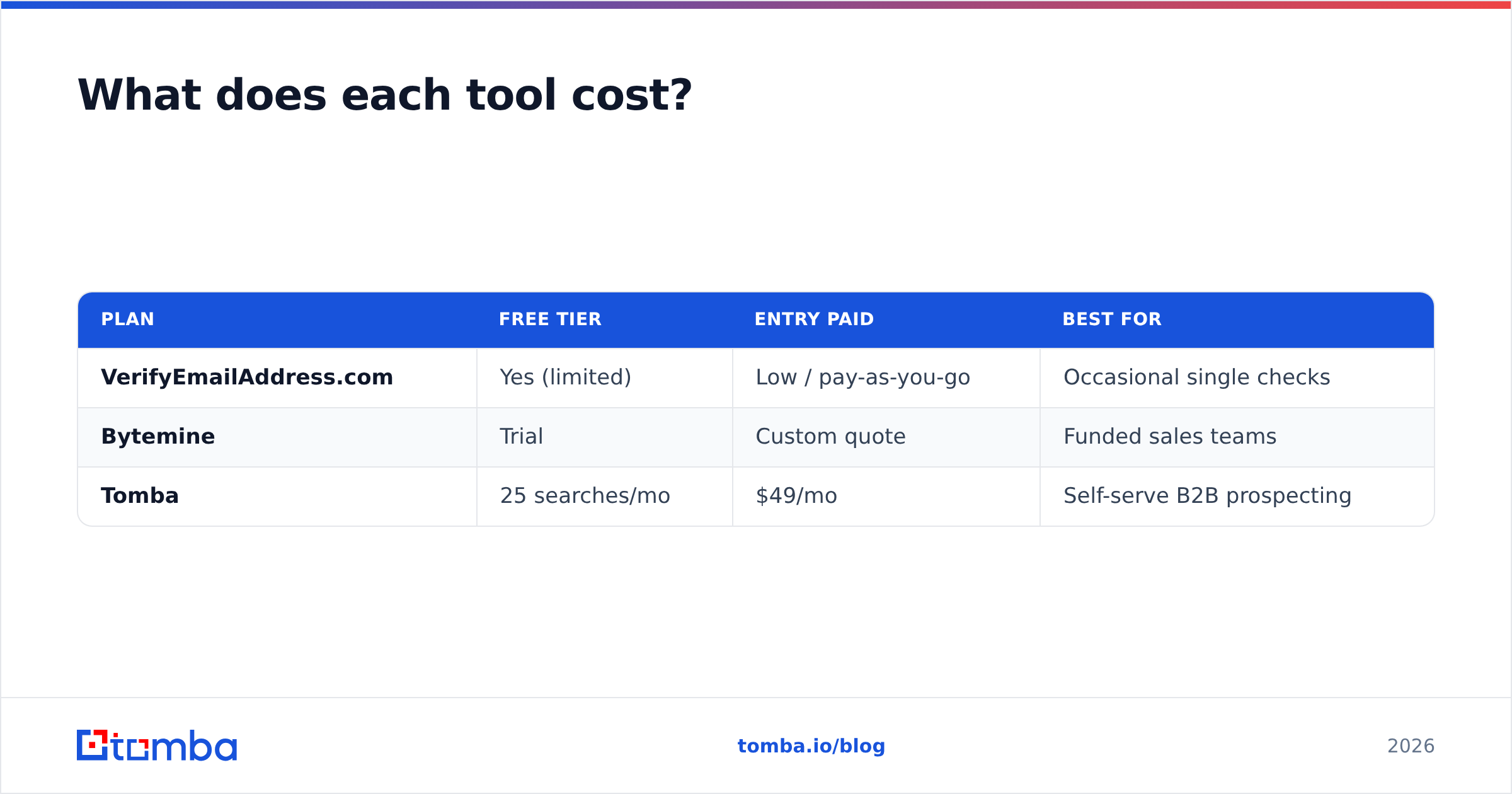
Tomba publishes transparent Tomba pricing: a free tier with 25 searches/mo, Starter at $49/mo, Growth at $99/mo, Pro at $249/mo, and custom Enterprise. The point isn't that cheaper is automatically better — it's that you can self-serve, test, and scale without a sales call, and you're paying for finding and verifying and enriching rather than one slice.
| Plan | Free tier | Entry paid | Best for |
|---|---|---|---|
| VerifyEmailAddress.com | Yes (limited) | Low / pay-as-you-go | Occasional single checks |
| Bytemine | Trial | Custom quote | Funded sales teams |
| Tomba | 25 searches/mo | $49/mo | Self-serve B2B prospecting |
Which tool should you choose?#
Match the tool to the job, not the hype:
- You verify one address occasionally → VerifyEmailAddress.com. It's free, fast, and you don't need anything heavier.
- You're an enterprise team already invested in a data stack → Bytemine is a reasonable fit, especially if enrichment is central.
- You run outbound and need to find, verify, and enrich at scale → a full suite. You'll find emails by domain search, validate them, catch the catch-alls, and sync to your CRM without juggling three subscriptions.
Here's the comparison table one more time as a decision rule of thumb:
| If your priority is… | Reach for |
|---|---|
| Lowest cost, single checks | VerifyEmailAddress.com |
| Enrichment + enterprise data | Bytemine |
| End-to-end prospecting pipeline | Tomba |
| Highest catch-all accuracy | Dedicated catch-all verifier |

How do you migrate or test without risk?#
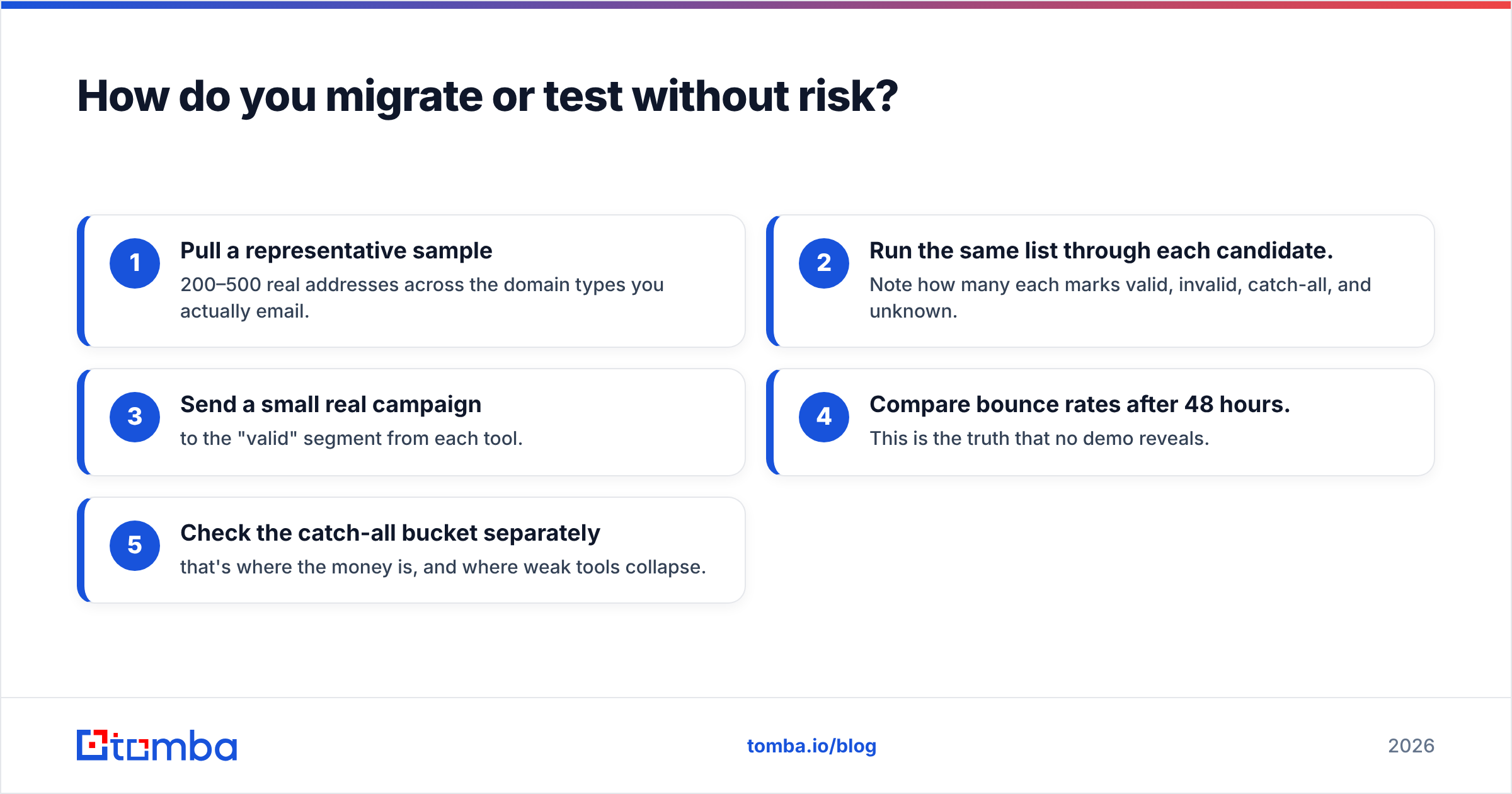
Don't rip out your current tool blind. Run a controlled bake-off:
- Pull a representative sample — 200–500 real addresses across the domain types you actually email.
- Run the same list through each candidate. Note how many each marks valid, invalid, catch-all, and unknown.
- Send a small real campaign to the "valid" segment from each tool.
- Compare bounce rates after 48 hours. This is the truth that no demo reveals.
- Check the catch-all bucket separately — that's where the money is, and where weak tools collapse.
Verification platforms and standalone checkers will diverge most on that catch-all segment. If you want third-party context on how these categories are reviewed, G2 and Capterra both maintain current buyer reviews for email verification software, and HubSpot's deliverability guidance is a solid neutral primer on why bounce rate matters so much.
The bottom line#
VerifyEmailAddress.com and Bytemine aren't really rivals — they're different tools for different scales. VerifyEmailAddress.com is the right call for cheap, occasional single checks. Bytemine makes sense for enterprise teams that want enrichment baked into their data platform. Neither is ideal if your day actually starts with finding the right contacts and ends with them clean in your CRM.
If that full pipeline is your reality, stop stitching point tools together. Tomba's Email Finder finds professional addresses by domain, name, or company, and pairs with a built-in verifier, catch-all checker, and enrichment — all on a free tier you can start on today, scaling to $49/mo when you're ready. Run your toughest 25 contacts through it and compare the results yourself. The accuracy is the pitch.
// get started
Find, verify and enrich your first contacts today
Start on the free plan with 25 searches a month, then scale when your team is ready.
Free plan · No credit card required · GDPR & CCPA
// about the author