Bytemine vs Zintlr: B2B Sales Intelligence Compared (2026)
A hands-on, neutral breakdown of Bytemine vs Zintlr in 2026 — data coverage, email accuracy, pricing, and where a focused email finder like Tomba beats both for cold outreach.
Bytemine vs Zintlr: Which B2B Sales Intelligence Tool Wins in 2026?
Choosing between Bytemine and Zintlr usually comes down to one question: do you want broad firmographic data with prospecting workflows, or contact data layered with personality insights? Both tools promise to fill your pipeline, but they solve slightly different problems — and neither is a pure-play email finder.
TL;DR#
- Bytemine leans into B2B company and contact data with prospecting list-building, best for teams that want volume and territory coverage.
- Zintlr differentiates with "personality intelligence" (DISC-style profiles) on top of a contact database, best for reps who tailor messaging.
- Email accuracy is the weak spot for both — generalist databases trade freshness for breadth, so bounce rates climb on cold lists.
- If your core need is finding and verifying email addresses before a campaign, a dedicated tool like the Tomba Email Finder outperforms either on deliverability per dollar.
- For most outbound teams, the winning stack is a data/intelligence layer plus a focused email verifier — not one tool trying to do everything.
What is Bytemine?#
Bytemine is a B2B sales intelligence and prospecting platform. Its pitch is straightforward: give sales and marketing teams a large database of companies and decision-makers, then let them slice that data into targeted lists by industry, size, role, and geography. You build a segment, export contacts, and push them into your CRM or sequencer.
The platform's strength is list-building at scale. If you run territory-based outbound and need 5,000 contacts in a specific vertical, Bytemine's filters and export flow are built for that motion. It positions itself as a data foundation rather than a full engagement suite, so you'll typically pair it with a separate cold email or dialer tool.
The trade-off is the same one every broad database faces: coverage and accuracy pull in opposite directions. A record that was correct six months ago may now point to someone who changed jobs, and generalist providers rarely re-verify every email at the moment you export it.
What is Zintlr?#
Zintlr is a B2B database and sales intelligence platform best known for "Zintlligence" — personality profiling layered on top of contact records. Alongside standard firmographic and contact data, Zintlr attempts to infer behavioral traits (think DISC-style or Big Five signals) so reps can adjust tone and approach before the first touch.
That makes Zintlr appealing to teams that believe message personalization drives reply rates. Instead of a generic opener, a rep can frame outreach around how a prospect likely prefers to be approached — direct and data-driven versus warm and relationship-first.
The personality layer is a genuine differentiator, but it sits on the same foundational challenge as Bytemine: the underlying contact and email data still has to be accurate, or the cleverest message bounces before it's read. Personalization can't save an email that never lands in the inbox.

How do Bytemine and Zintlr compare on the core attributes?#
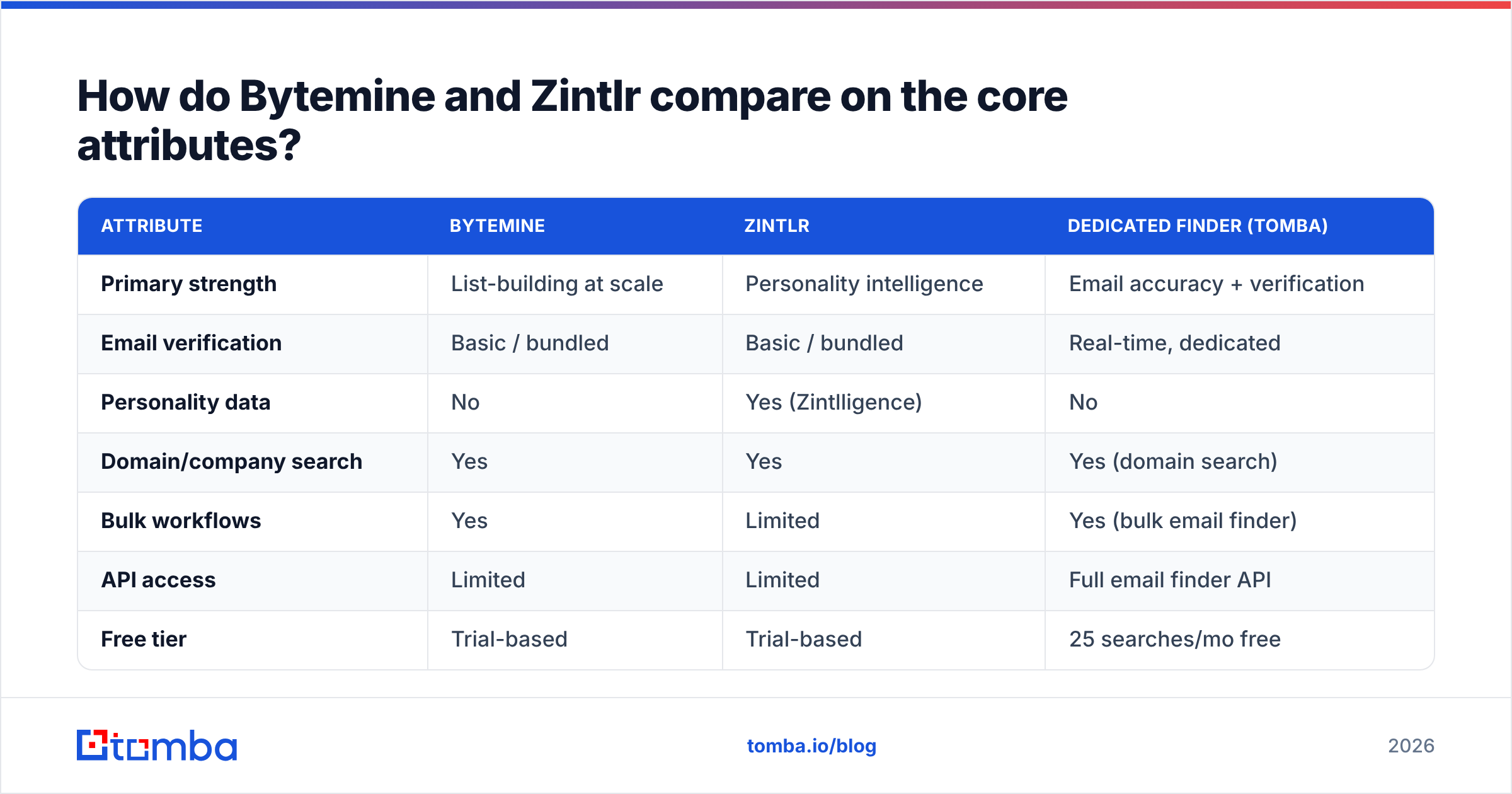
Here is a side-by-side look at the dimensions that actually affect a sales team's day-to-day work.
| Attribute | Bytemine | Zintlr | Dedicated finder (Tomba) |
|---|---|---|---|
| Primary strength | List-building at scale | Personality intelligence | Email accuracy + verification |
| Email verification | Basic / bundled | Basic / bundled | Real-time, dedicated |
| Personality data | No | Yes (Zintlligence) | No |
| Domain/company search | Yes | Yes | Yes (domain search) |
| Bulk workflows | Yes | Limited | Yes (bulk email finder) |
| API access | Limited | Limited | Full email finder API |
| Free tier | Trial-based | Trial-based | 25 searches/mo free |
| Best for | Territory outbound | Personalized outreach | Clean, deliverable lists |
The pattern is clear: Bytemine and Zintlr compete on breadth and intelligence features, while a specialist tool competes on deliverability. Those aren't mutually exclusive — most mature teams run both layers.
Which has better data accuracy?#
Neither generalist platform is built to guarantee inbox delivery — that's the gap a dedicated finder closes. Broad B2B databases optimize for the number of records they can show in a search; a verification-first tool optimizes for whether the email you send actually arrives.
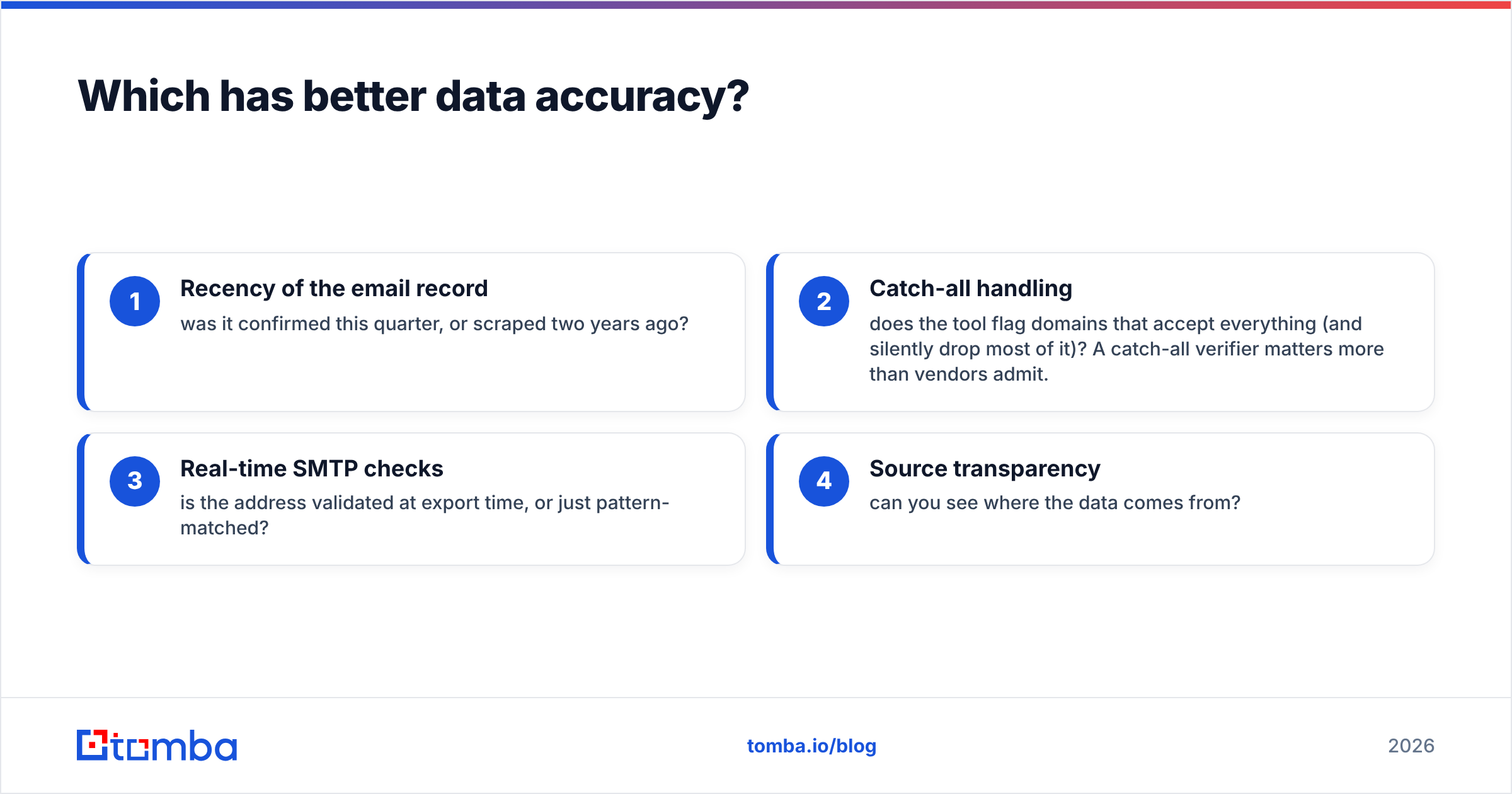
When you evaluate accuracy, look at four things:
- Recency of the email record — was it confirmed this quarter, or scraped two years ago?
- Catch-all handling — does the tool flag domains that accept everything (and silently drop most of it)? A catch-all verifier matters more than vendors admit.
- Real-time SMTP checks — is the address validated at export time, or just pattern-matched?
- Source transparency — can you see where the data comes from?
Bytemine and Zintlr both surface emails as part of a record, but verification tends to be a bundled afterthought rather than the product's center of gravity. That's why teams relying on them for cold email often see bounce rates creep above the 3–5% threshold that protects sender reputation. Once you cross that line, even perfectly personalized Zintlr messaging gets throttled by inbox providers.
For an independent view of how data vendors stack up, third-party review platforms like G2 and Capterra are useful — read the verified reviews that mention bounce rates and data freshness specifically, not just overall star scores.
Bytemine vs Zintlr: pricing and value#
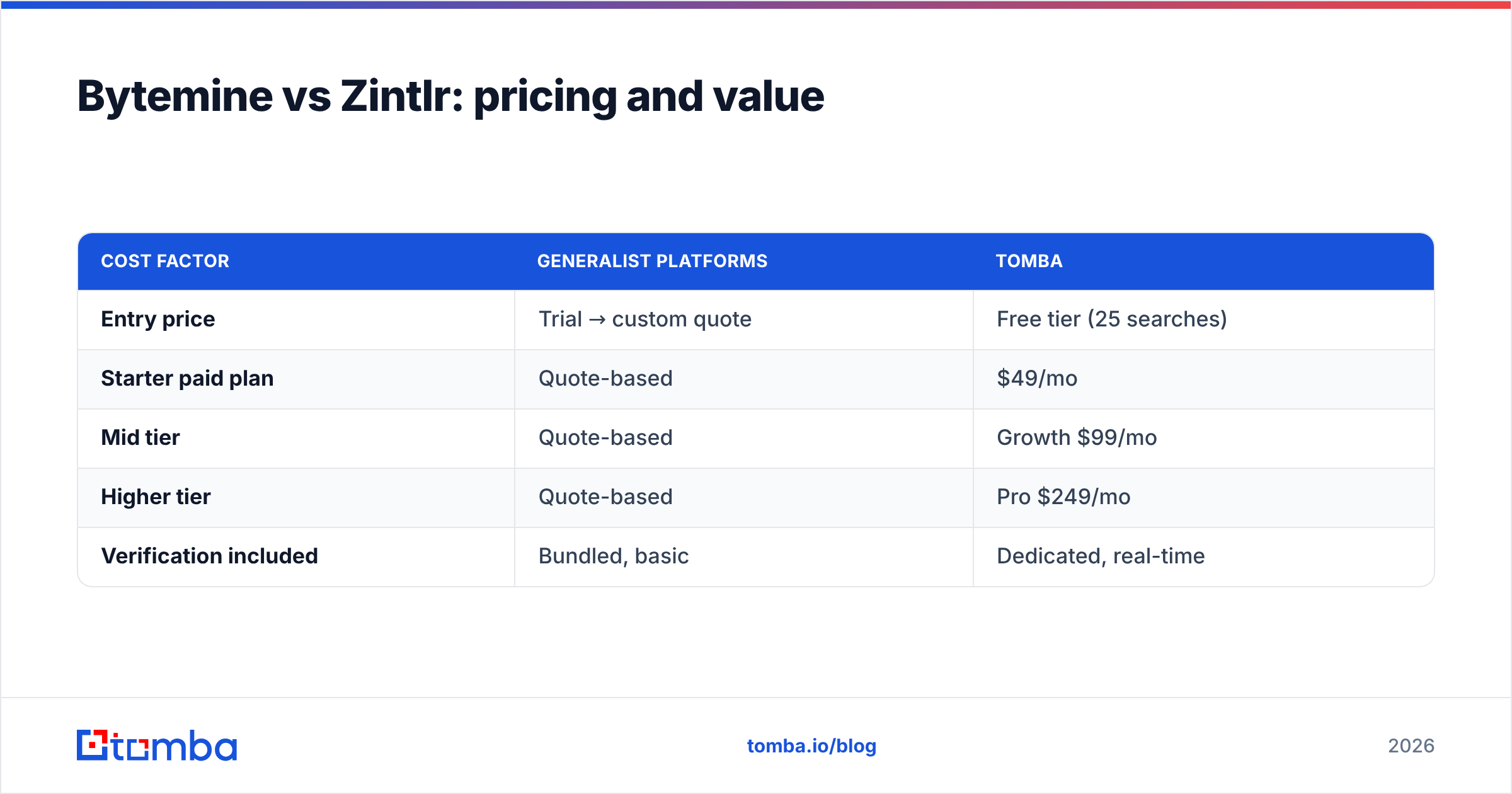
Both tools use quote-or-trial-driven pricing that scales with seats and data volume, which makes apples-to-apples comparison hard until you talk to sales. As a rule of thumb:
- Bytemine charges for database access and export volume — cost rises with the size and frequency of your list pulls.
- Zintlr charges for contact data plus the personality-intelligence layer, so you pay a premium for the differentiator.
The hidden cost in both cases is wasted sends. If 8% of a 10,000-contact list bounces, you've burned budget and damaged your domain at the same time. That's where running a verification pass changes the math.
| Cost factor | Generalist platforms | Tomba |
|---|---|---|
| Entry price | Trial → custom quote | Free tier (25 searches) |
| Starter paid plan | Quote-based | $49/mo |
| Mid tier | Quote-based | Growth $99/mo |
| Higher tier | Quote-based | Pro $249/mo |
| Verification included | Bundled, basic | Dedicated, real-time |
Tomba's transparent pricing — Free, Starter at $49/mo, Growth at $99/mo, and Pro at $249/mo — is easy to model against your list size before you commit. You don't need a sales call to know what 5,000 verified contacts will cost.
Which tool should you choose?#
Match the tool to your dominant motion:
- Choose Bytemine if your team runs high-volume, territory-based outbound and your main bottleneck is building large targeted lists fast. You'll still want a verification step downstream.
- Choose Zintlr if reply rate is your obsession and you have the discipline to act on personality signals in every message. The intelligence layer is wasted if reps don't change behavior.
- Choose a dedicated email finder if your #1 problem is that cold emails bounce or never arrive. Accuracy is upstream of everything else — no amount of segmentation or personalization fixes a bad address.
Most realistic answer for 2026: it's not strictly either/or. A lean stack pairs an intelligence source for who to target with a specialist tool for how to reach them cleanly.
Where does Tomba fit in this comparison?#
Tomba isn't trying to replace a firmographic database or a personality engine. It does the unglamorous job both generalists treat as a feature rather than a product: finding and verifying professional email addresses so your messages actually land.
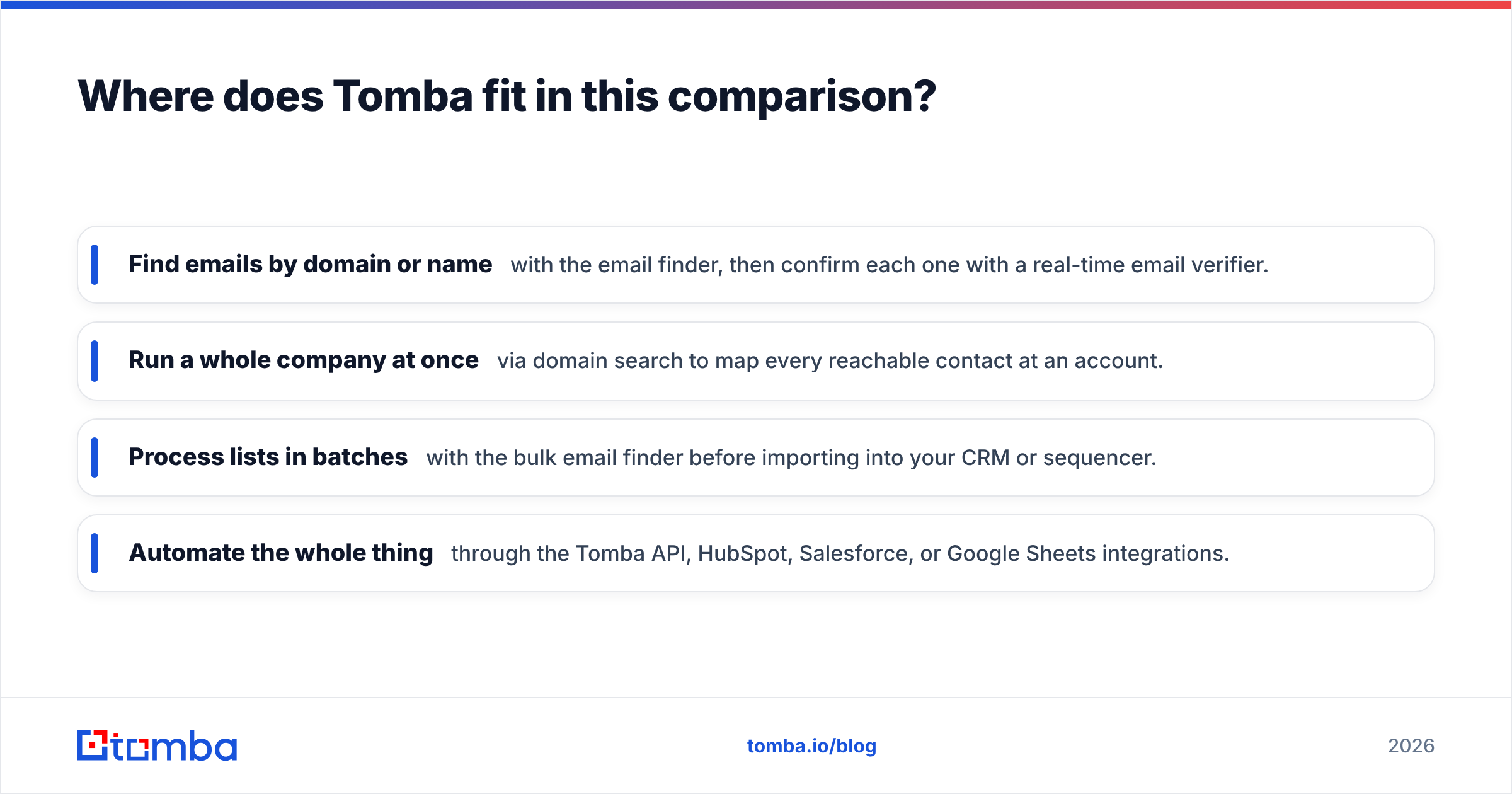
Concretely, that means you can:
- Find emails by domain or name with the email finder, then confirm each one with a real-time email verifier.
- Run a whole company at once via domain search to map every reachable contact at an account.
- Process lists in batches with the bulk email finder before importing into your CRM or sequencer.
- Automate the whole thing through the Tomba API, HubSpot, Salesforce, or Google Sheets integrations.
In practice, the workflow that beats "one tool to rule them all" looks like this: pull your target list from your intelligence source (Bytemine's segments, Zintlr's profiles, LinkedIn, or your CRM), then run every address through verification before the first send. Your bounce rate drops, your domain reputation holds, and your response rate climbs because more messages reach a human.
Frequently asked questions#
Is Bytemine or Zintlr better for cold email?#
Neither is built primarily for deliverability. Bytemine is stronger for building large lists; Zintlr is stronger for personalizing the message. For the actual send, pair either with a dedicated verifier so you don't burn your domain on bad addresses.
Does Zintlr's personality data actually improve reply rates?#
It can — but only if your reps consistently change their approach based on the signal. If messaging stays generic, you're paying a premium for data you don't use. And it only matters once the email reliably reaches the inbox.
Can I use Tomba alongside Bytemine or Zintlr?#
Yes, and that's the recommended setup. Use the intelligence platform to decide who to contact, then use Tomba to find and verify the email so your outreach is deliverable. The two layers complement each other rather than compete.
What's the cheapest way to test these tools?#
Tomba offers a free tier with 25 searches per month, so you can test accuracy on your own target accounts before paying. Bytemine and Zintlr are typically trial-and-quote, which means you'll need a sales conversation to see real numbers.
The bottom line#
Bytemine and Zintlr are both solid sales intelligence platforms that solve real problems — list-building scale and personality-driven personalization, respectively. But both treat email accuracy as a bundled feature, and that's exactly where outbound campaigns quietly fail.
If you're optimizing for deliverable, verified contacts at a transparent price, start with the Tomba Email Finder. Find the addresses, verify them in real time, and feed clean data into whichever intelligence layer fits your motion. Spin up the free tier with 25 searches, test it against your own accounts, and measure the bounce rate yourself — that's the only benchmark that matters.
// get started
Find, verify and enrich your first contacts today
Start on the free plan with 25 searches a month, then scale when your team is ready.
Free plan · No credit card required · GDPR & CCPA
// about the author