Byteplant Alternatives: 7 Best Email Validation Tools (2026)
Byteplant gets the job done, but it is not the only option. Here are seven Byteplant alternatives for email validation, ranked by accuracy, API quality, and price in 2026.

Byteplant is a competent email validation engine, but it is rarely the tool teams settle on once they compare it against the field. If you are evaluating Byteplant alternatives in 2026, you probably want better catch-all handling, a cleaner API, transparent pricing, or a finder and verifier in one place. This guide weighs seven options on the attributes that actually move deliverability and cost.
TL;DR#
- Byteplant does email, phone, and address validation, but its email-only tier is priced per-package and the UX is dated compared to modern verifiers.
- The best all-in-one alternative is Tomba, which pairs a 98%+ accurate email verifier with an email finder, catch-all checks, and a single API.
- For pure list cleaning at volume, ZeroBounce and Bouncer are strong picks; for developer-first workflows, Tomba and Bouncer win on API ergonomics.
- Watch three numbers when you compare: accuracy on catch-all domains, cost per verification at your volume, and API rate limits.
- Skip any tool that cannot tell you why an address was flagged — verdict-only results waste your sender reputation.
Why look for a Byteplant alternative at all?#
Byteplant (marketed as DataValidation.com and the Email-Validator API) is a legitimate, long-running service. The reasons teams move off it are practical, not ideological:
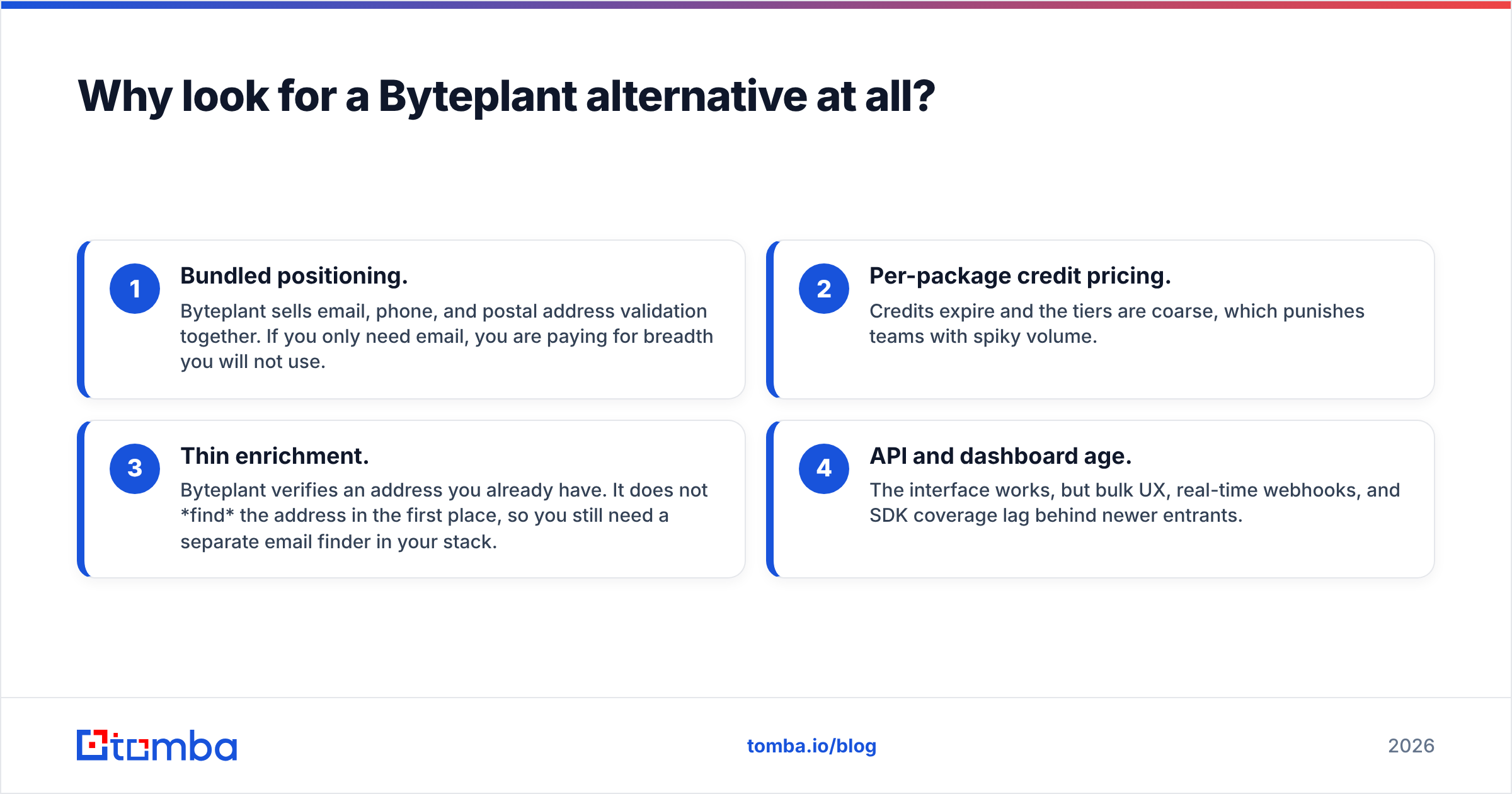
- Bundled positioning. Byteplant sells email, phone, and postal address validation together. If you only need email, you are paying for breadth you will not use.
- Per-package credit pricing. Credits expire and the tiers are coarse, which punishes teams with spiky volume.
- Thin enrichment. Byteplant verifies an address you already have. It does not find the address in the first place, so you still need a separate email finder in your stack.
- API and dashboard age. The interface works, but bulk UX, real-time webhooks, and SDK coverage lag behind newer entrants.
If any of those friction points sound familiar, the alternatives below close the gap.
What should an email validation tool actually do?#
Before comparing brands, anchor on what "good" means. A modern verifier should clear all six of these, not just the first three:
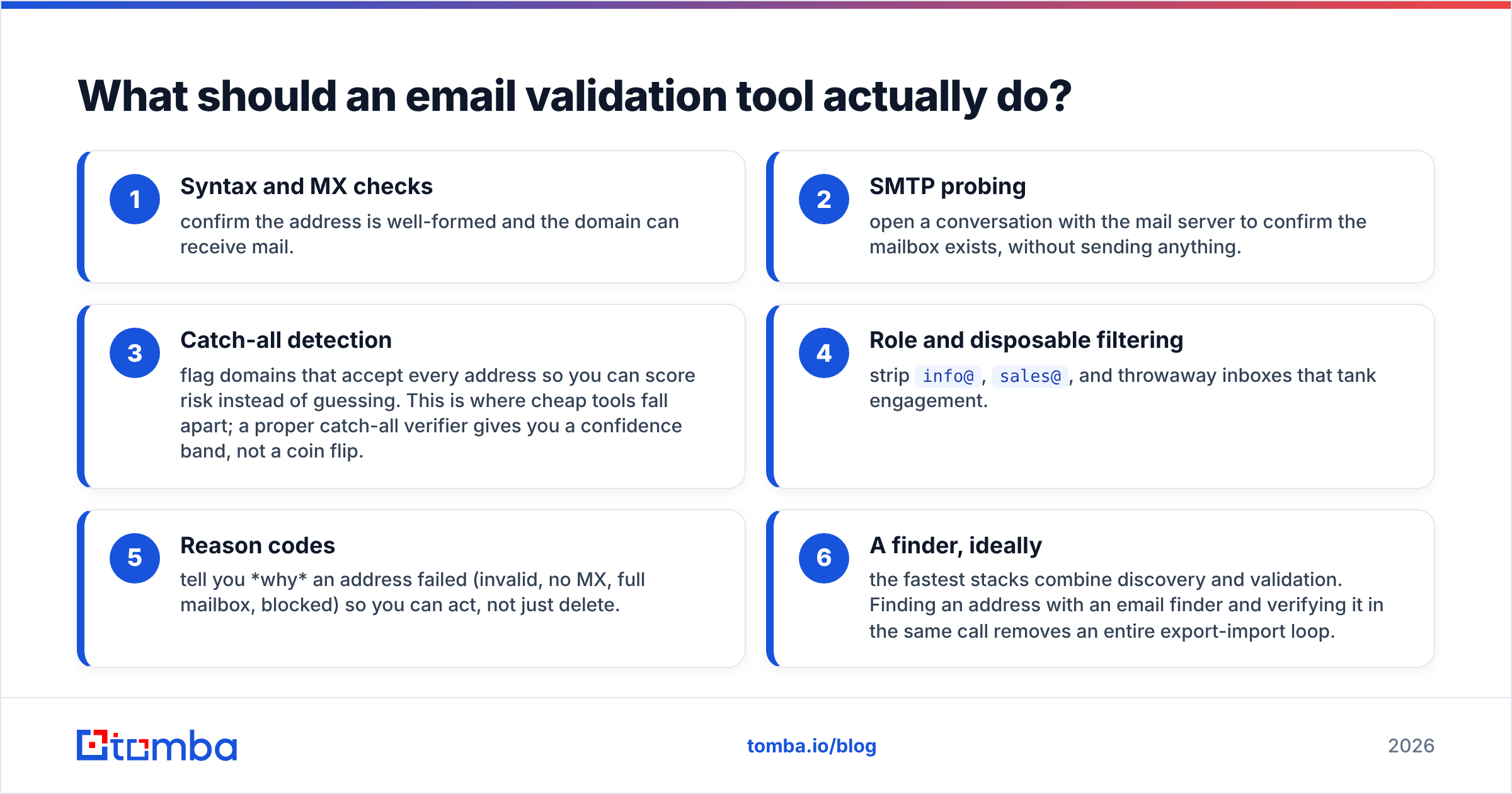
- Syntax and MX checks — confirm the address is well-formed and the domain can receive mail.
- SMTP probing — open a conversation with the mail server to confirm the mailbox exists, without sending anything.
- Catch-all detection — flag domains that accept every address so you can score risk instead of guessing. This is where cheap tools fall apart; a proper catch-all verifier gives you a confidence band, not a coin flip.
- Role and disposable filtering — strip
info@,sales@, and throwaway inboxes that tank engagement. - Reason codes — tell you why an address failed (invalid, no MX, full mailbox, blocked) so you can act, not just delete.
- A finder, ideally — the fastest stacks combine discovery and validation. Finding an address with an email finder and verifying it in the same call removes an entire export-import loop.
Byteplant covers 1–4 well. It is weaker on 5 and absent on 6 — and that absence is the single biggest reason teams consolidate onto a platform that does both.
What are the best Byteplant alternatives in 2026?#
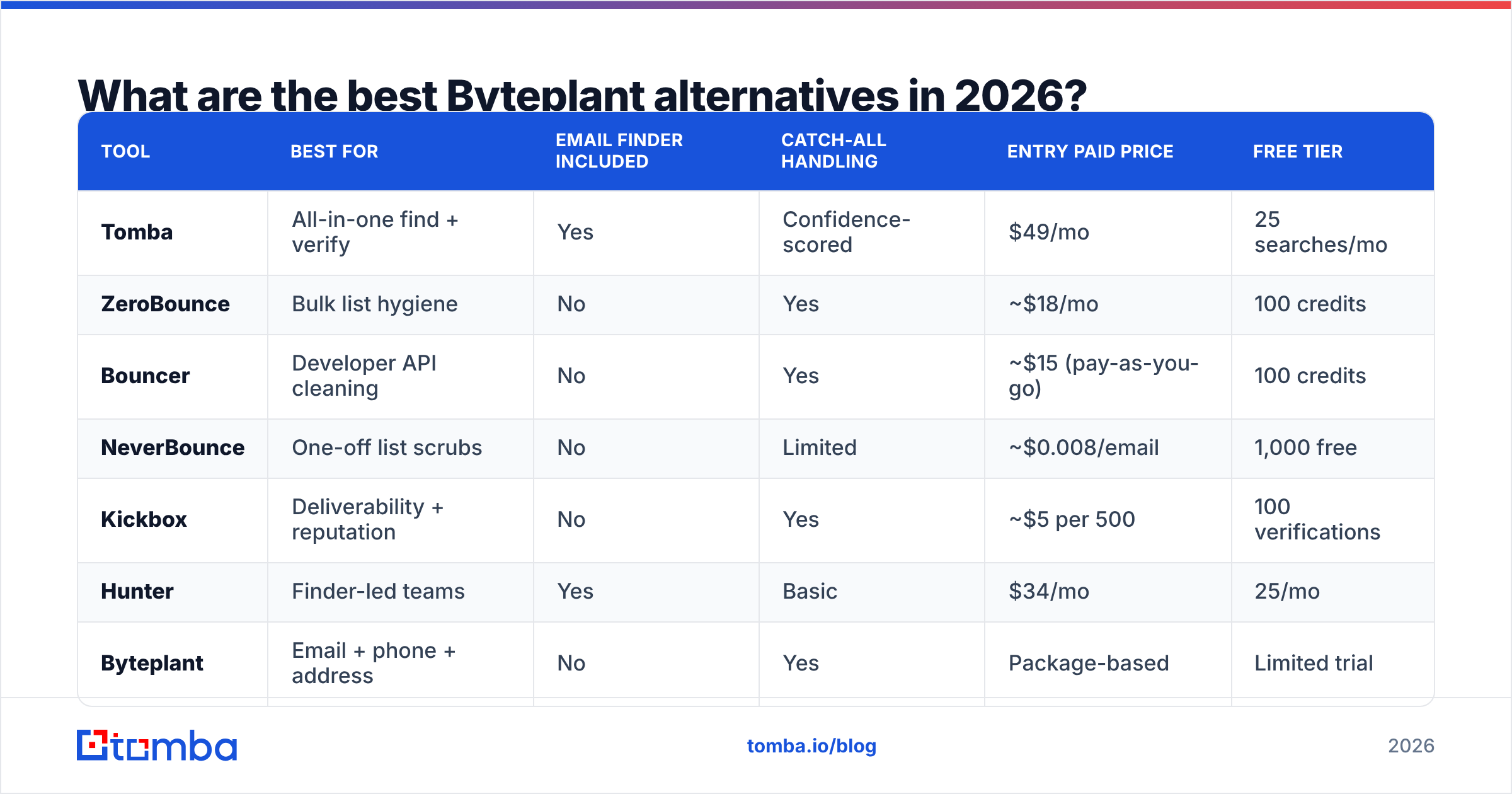
Here is the head-to-head. Prices are entry paid tier (USD) and reflect published 2026 plans; always confirm against current rate cards before buying.
| Tool | Best for | Email finder included | Catch-all handling | Entry paid price | Free tier |
|---|---|---|---|---|---|
| Tomba | All-in-one find + verify | Yes | Confidence-scored | $49/mo | 25 searches/mo |
| ZeroBounce | Bulk list hygiene | No | Yes | ~$18/mo | 100 credits |
| Bouncer | Developer API cleaning | No | Yes | ~$15 (pay-as-you-go) | 100 credits |
| NeverBounce | One-off list scrubs | No | Limited | ~$0.008/email | 1,000 free |
| Kickbox | Deliverability + reputation | No | Yes | ~$5 per 500 | 100 verifications |
| Hunter | Finder-led teams | Yes | Basic | $34/mo | 25/mo |
| Byteplant | Email + phone + address | No | Yes | Package-based | Limited trial |
A few read-throughs from the table:
- Only Tomba and Hunter bundle a finder, and Tomba's verifier scores higher on catch-all domains while undercutting Hunter on credit-equivalent volume.
- ZeroBounce, Bouncer, NeverBounce, and Kickbox are pure verifiers — excellent at cleaning a list you already have, but you will still bolt on a discovery tool.
- Byteplant's package pricing is the outlier; every other tool here offers either a clear monthly plan or true pay-as-you-go.
Tomba — the all-in-one pick#
Tomba is the strongest Byteplant alternative when you want discovery and validation under one roof. Its email verifier runs syntax, MX, SMTP, role, disposable, and catch-all checks and returns a reason code on every verdict. Because the same platform also offers domain search, a finder, and bulk processing, you stop paying two vendors for one workflow.
- Accuracy: 98%+ on standard domains, with confidence scoring on catch-all rather than a binary guess.
- API: A single REST Tomba API covers finding and verifying, with SDKs, a CLI, and an MCP server for AI agents.
- Pricing: Free tier (25 searches/mo), then Starter $49/mo, Growth $99/mo, Pro $249/mo — see the full Tomba pricing breakdown. Predictable monthly limits, no expiring credit packs.
- Bulk: Upload a list to bulk verify and get a scored CSV back without writing code.
ZeroBounce — for large list hygiene#
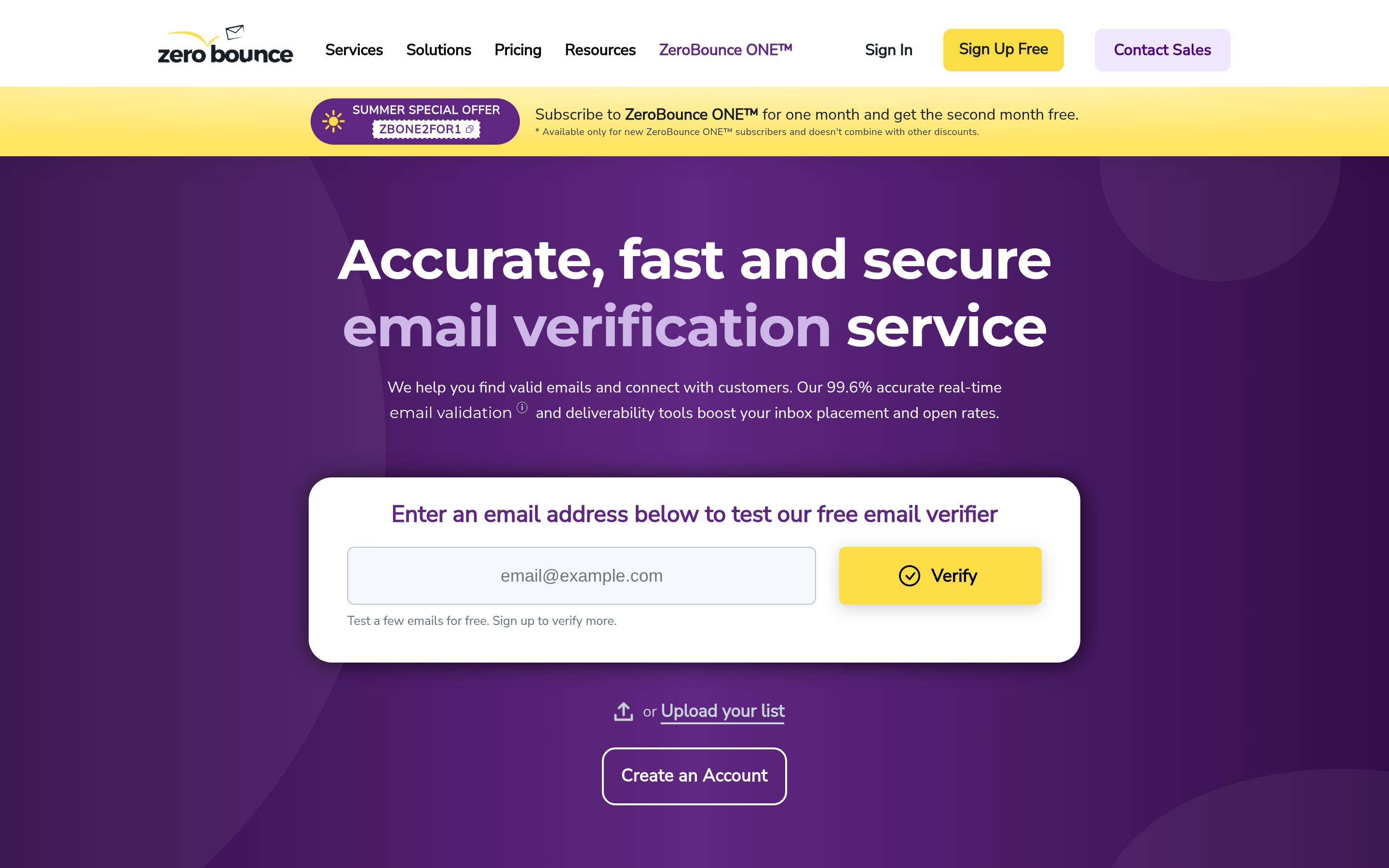
ZeroBounce is a mature, verification-only platform with extras like activity-data scoring and an inbox-placement test. If your job is to clean a 200k-row list once a quarter, it is a safe, accurate choice. It does not find addresses, so pair it with a finder.
Bouncer — developer-friendly cleaning#
Bouncer leans into a clean API and pay-as-you-go pricing, which suits engineering teams that want validation as a service without a subscription. Strong catch-all toxicity scoring; no discovery layer.
NeverBounce, Kickbox, and Hunter#
- NeverBounce is the go-to for cheap, occasional one-off scrubs billed per email.
- Kickbox pairs validation with a "Sendex" reputation score and good deliverability tooling.
- Hunter is finder-first like Tomba, but its verification is more basic and catch-all results are coarser.

How do I choose between them?#
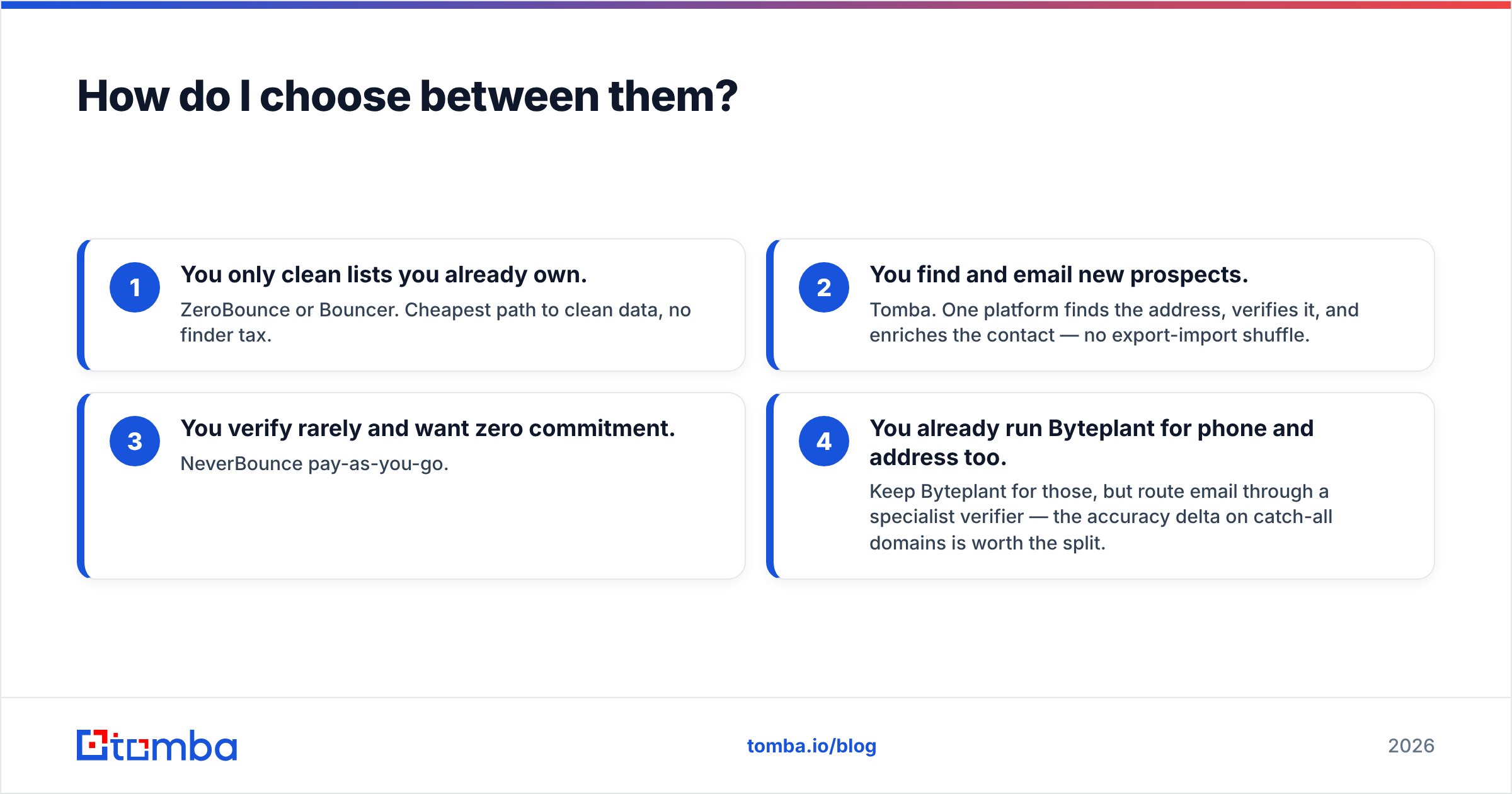
Match the tool to the job, not the brand to the hype. Use this decision shortcut:
- You only clean lists you already own. ZeroBounce or Bouncer. Cheapest path to clean data, no finder tax.
- You find and email new prospects. Tomba. One platform finds the address, verifies it, and enriches the contact — no export-import shuffle.
- You verify rarely and want zero commitment. NeverBounce pay-as-you-go.
- You already run Byteplant for phone and address too. Keep Byteplant for those, but route email through a specialist verifier — the accuracy delta on catch-all domains is worth the split.
The deciding factor for most teams is whether validation lives next to discovery. If your reps or SDRs are sourcing fresh contacts, a combined find-and-verify flow removes a daily bottleneck and keeps your bounce rate low before an address ever enters your sequencer. Protecting email deliverability starts at the point of capture, not at send time.
What does this cost at real volume?#
Sticker price hides the real number, which is cost per verified, usable contact. Three things inflate it:
- Wasted credits on catch-all domains. A tool that returns "unknown" still bills you. Confidence scoring turns those into usable decisions instead of dead spend.
- Expiring credit packs. Byteplant-style packages force you to over-buy. Monthly plans with rollover or generous caps waste less.
- The second vendor. If you pay separately for finding and verifying, add both line items. Consolidating onto one platform like Tomba often costs less than the two tools it replaces.
Run a 1,000-contact pilot on any shortlist. Measure verified-deliverable rate, not just throughput. The tool with the highest usable yield wins, even if its per-check price is a fraction of a cent higher.
Frequently asked questions#
Is Byteplant accurate? Yes, Byteplant's email validation is accurate for standard domains. Its weaknesses are pricing model and the lack of a discovery layer, not core verification quality.
Can I replace Byteplant with a free tool? For light use, yes. Most alternatives — including Tomba's free tier and ZeroBounce's free credits — let you validate small batches at no cost. For ongoing volume you will want a paid plan.
Do I need both a finder and a verifier? If you source new prospects, yes. Buying them separately is the common trap; platforms like Tomba combine them so you find and verify in one call. Compare verification-only tools on Capterra if you only ever clean owned lists.
How is catch-all handled differently? Weak tools mark catch-all domains "unknown" and bill you anyway. Better verifiers score the likelihood the mailbox exists, so you can send to high-confidence catch-alls and suppress the rest.
The bottom line#
Byteplant is fine. It is just not optimized for teams that both find and verify B2B email. If your workflow stops at cleaning an owned list, ZeroBounce or Bouncer are clean, accurate swaps. If your workflow starts with discovering new contacts, consolidating onto one platform is the upgrade that pays for itself.
That is where Tomba fits: find the address with the Tomba Email Finder, verify it on the same platform, enrich it, and push it to your CRM through one API — at a transparent $49/mo entry price instead of expiring credit packs. Start on the free tier, run a 1,000-contact pilot against your current Byteplant results, and let the verified-deliverable rate decide.
Ready to find emails that actually work?
Join 150,000+ professionals who stopped guessing and started sending. Free credits on signup — no credit card required.
Get the Tomba newsletter
Practical outbound tactics and product updates — once every two weeks.
About the author