Byteplant Pricing Reviews Pros and Cons: 2026 Breakdown
A neutral, hands-on look at Byteplant's email and data validation tools — what you actually pay, where it shines, where it frustrates, and the alternatives worth testing in 2026.

Byteplant has quietly validated emails, postal addresses, and phone numbers for B2B teams for over a decade. This is a neutral guide to Byteplant pricing reviews pros and cons for 2026. If you are weighing it for list hygiene or signup checks, your questions are simple. What does it cost? How accurate is it? Where does it fall short? This is a breakdown, not a sales page. Read it, then decide whether Byteplant fits your stack or whether a leaner alternative makes more sense.
TL;DR#
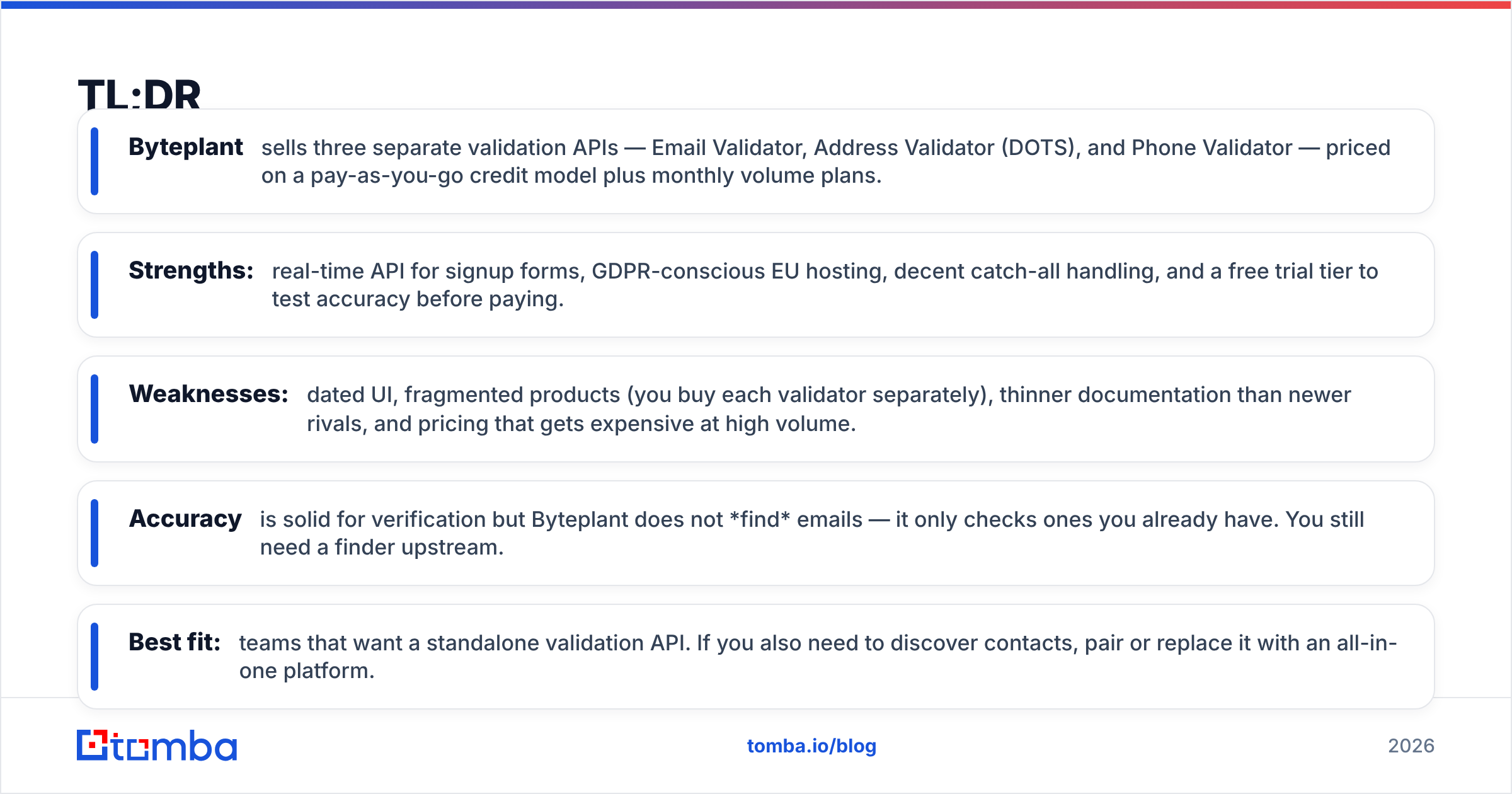
- Byteplant sells three separate validation APIs — Email Validator, Address Validator (DOTS), and Phone Validator — priced on a pay-as-you-go credit model plus monthly volume plans.
- Strengths: real-time API for signup forms, GDPR-conscious EU hosting, decent catch-all handling, and a free trial tier to test accuracy before paying.
- Weaknesses: dated UI, fragmented products (you buy each validator separately), thinner documentation than newer rivals, and pricing that gets expensive at high volume.
- Accuracy is solid for verification but Byteplant does not find emails — it only checks ones you already have. You still need a finder upstream.
- Best fit: teams that want a standalone validation API. If you also need to discover contacts, pair or replace it with an all-in-one platform.
What is Byteplant and what does it actually do?#
Byteplant is a German data-quality vendor. It builds validation tools for three data types: email, postal address, and phone. Each is a distinct product with its own API key, credit balance, and pricing page. The flagship for most marketers is the Email Validator. It runs several checks on each address. Is the syntax valid? Does the domain have working MX records? Does the server accept mail at the SMTP layer? Is the address a known disposable or spam trap? If a check fails, the address gets flagged.
Think of Byteplant like a bouncer at a club door. It does not go out and recruit guests (that is what an email finder does). It stands at the door and decides who gets in. It checks IDs, spots fakes, and turns away anyone who would hurt your sender reputation later.
That distinction matters for your budget. Byteplant assumes you already have a list. If your problem is building the list in the first place, Byteplant alone won't solve it. You'd combine it with a discovery tool or pick a platform that does both.
How does Byteplant pricing work in 2026?#
Byteplant uses a credit-based, pay-as-you-go model layered with monthly subscription tiers for predictable volume. One email validation consumes one credit. Buy more credits up front and the per-check price drops. Commit to a monthly plan and you lock in a lower unit rate. Postal address and phone validation are billed separately under their own credit pools.
A few things to know before you commit:
- Credits are product-specific. Email credits don't pay for phone or address checks — each Byteplant tool has its own wallet.
- Volume discounts are steep but back-loaded. Small lists pay a premium per check; the attractive unit price only appears at tens of thousands of validations.
- A free trial exists. You can validate a capped number of records to gauge accuracy before spending — use it, because catch-all-heavy industries see very different results.
- Real-time vs bulk. The API is metered the same way whether you validate one signup live or upload a CSV, so high-traffic forms can burn credits faster than you expect.
Byteplant adjusts its published rates from time to time. Treat any number you read online as a starting point, and confirm it on their official pricing page. The structural takeaway is what matters: you pay per record, per product, and the economics favor large committed volumes over small ad-hoc cleans.
Byteplant vs Tomba vs ZeroBounce: a side-by-side#
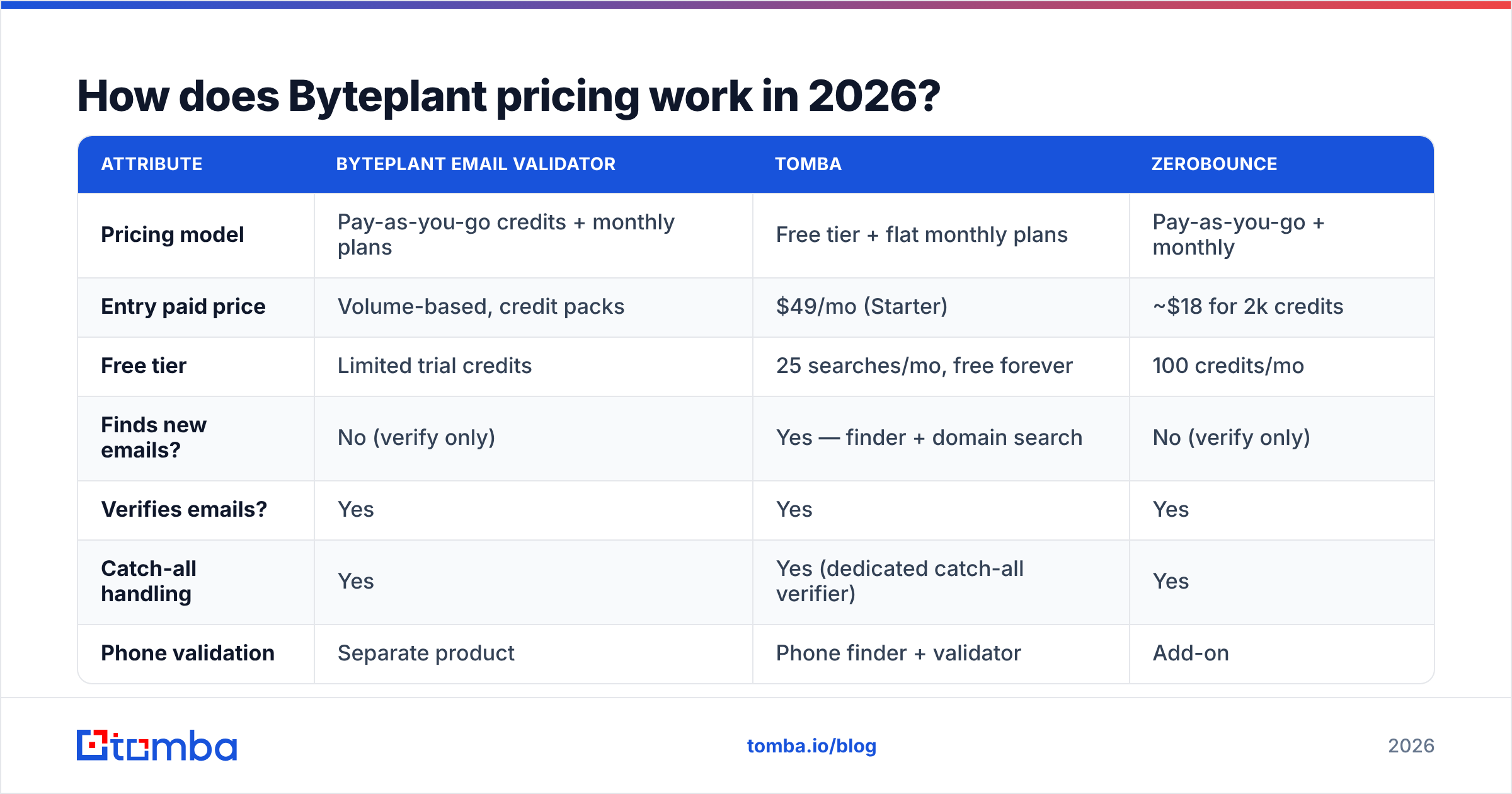
Here is how Byteplant's Email Validator stacks against two common alternatives. Tomba is included because it covers both finding and verifying, which Byteplant does not.
| Attribute | Byteplant Email Validator | Tomba | ZeroBounce |
|---|---|---|---|
| Pricing model | Pay-as-you-go credits + monthly plans | Free tier + flat monthly plans | Pay-as-you-go + monthly |
| Entry paid price | Volume-based, credit packs | $49/mo (Starter) | ~$18 for 2k credits |
| Free tier | Limited trial credits | 25 searches/mo, free forever | 100 credits/mo |
| Finds new emails? | No (verify only) | Yes — finder + domain search | No (verify only) |
| Verifies emails? | Yes | Yes | Yes |
| Catch-all handling | Yes | Yes (dedicated catch-all verifier) | Yes |
| Phone validation | Separate product | Phone finder + validator | Add-on |
| EU/GDPR hosting | Yes (EU-based) | GDPR-compliant | US-based |
| Best for | Standalone validation API | Find + verify in one platform | Bulk list cleaning |
The honest read: Byteplant is a focused validation specialist. If verification is all you need and you value EU hosting, it competes well. If you need to build lists too, a combined platform removes a whole tool from your stack. You can see how a unified approach is priced on the Tomba pricing page.
Is Byteplant accurate enough for cold outreach?#
For straightforward addresses, Byteplant's accuracy is competitive. It reliably catches syntax errors, dead domains, and obvious traps. Every SMTP-based validator struggles with catch-all domains. Here the server accepts mail for any address. It will not confirm whether a specific mailbox exists. Byteplant flags these as "unknown" or "accept-all." That answer is technically correct, but it leaves the risk call to you.
This is the single biggest variable in any validation review. If your target accounts are enterprise domains, expect a lot of catch-alls. A large share of your list will come back inconclusive, no matter which vendor you use. What sets tools apart is how they handle that gray zone. Tomba, for example, ships a dedicated catch-all verifier. It applies extra signals before giving up. It also offers a free email checker for quick one-off tests.
A practical rule: never judge a validator on a clean list of gmail.com addresses. Feed it 200 real prospects from your actual ICP. Mix in corporate domains, a few catch-alls, and some role accounts. Then compare the "valid / invalid / unknown" split against a second tool. That is the only benchmark that predicts your real-world deliverability.
What do Byteplant reviews say — the pros and cons?#
We pulled user sentiment from public review platforms like G2 and Capterra. A consistent picture emerges. Byteplant earns trust for reliability and data privacy. But reviewers note friction around its fragmented product line and aging interface.
Pros (what reviewers like)#
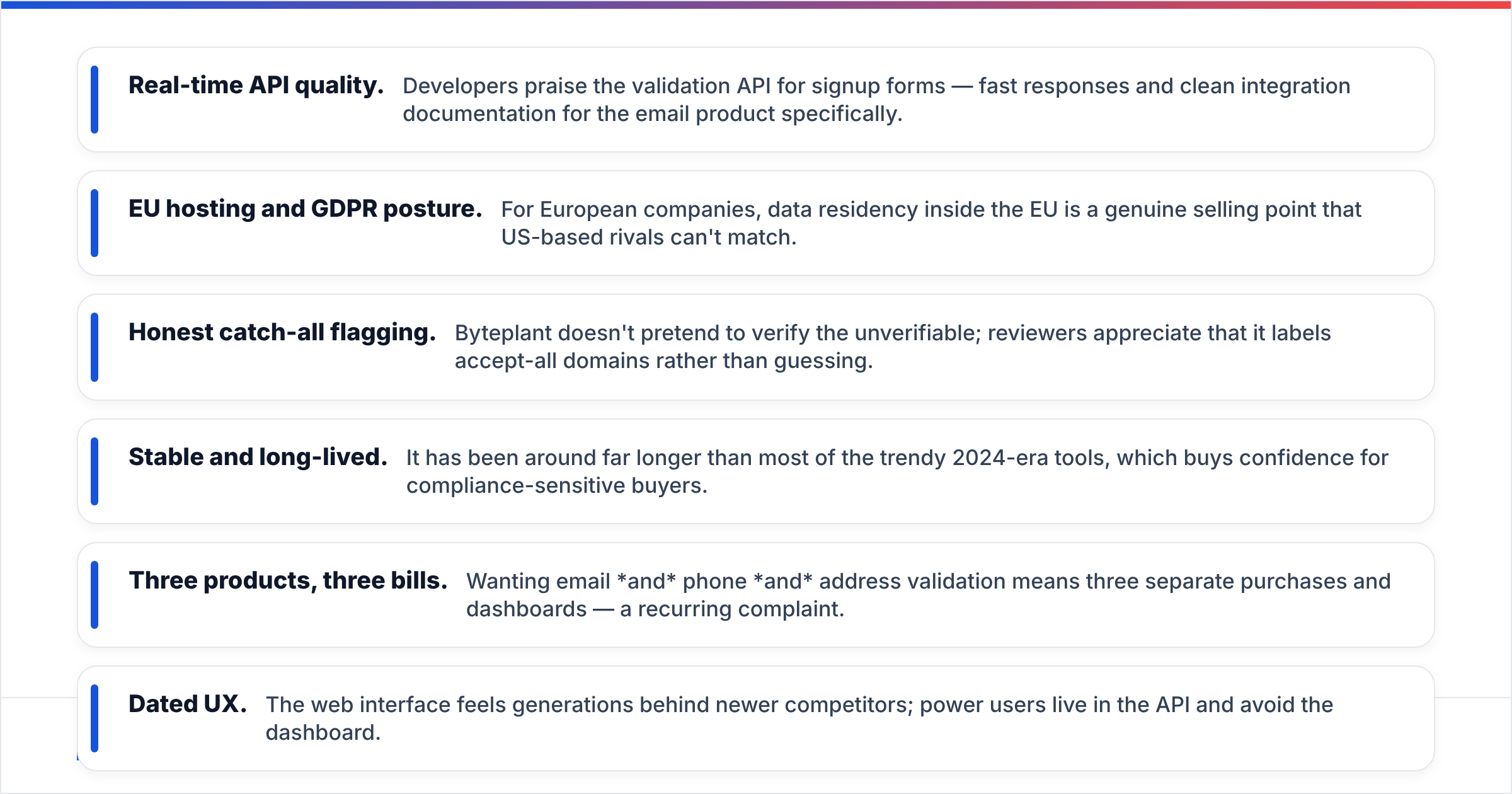
- Real-time API quality. Developers praise the validation API for signup forms — fast responses and clean integration documentation for the email product specifically.
- EU hosting and GDPR posture. For European companies, data residency inside the EU is a genuine selling point that US-based rivals can't match.
- Honest catch-all flagging. Byteplant doesn't pretend to verify the unverifiable; reviewers appreciate that it labels accept-all domains rather than guessing.
- Stable and long-lived. It has been around far longer than most of the trendy 2024-era tools, which buys confidence for compliance-sensitive buyers.
Cons (where reviewers push back)#
- Three products, three bills. Wanting email and phone and address validation means three separate purchases and dashboards — a recurring complaint.
- Dated UX. The web interface feels generations behind newer competitors; power users live in the API and avoid the dashboard.
- No discovery. Several reviewers expected lead-finding features and were surprised Byteplant only validates.
- Cost at scale. Without an annual commitment, high-volume validation gets pricey compared to flat-rate plans.

Who should use Byteplant — and who shouldn't?#
Use Byteplant if you are a developer adding real-time email validation to signup or checkout flows. It also fits if you work under strict EU data rules and already source your contacts elsewhere. As a single-purpose validation API for European compliance, it earns its place.
Look elsewhere if you want one tool to both find and verify contacts, you dislike juggling separate credit pools per data type, or you run smaller, irregular list cleans where pay-as-you-go premiums sting. Many teams find that stitching a finder, a verifier, and an enrichment tool together costs more than one platform that does all three.
This is where consolidating matters. Instead of running Byteplant for verification and a second vendor for discovery, a combined workflow looks like: find contacts by company with domain search, confirm them with an email verifier, then clean the whole list at once using a bulk email finder. One login, one credit system, one invoice.
How does Byteplant compare to all-in-one platforms?#
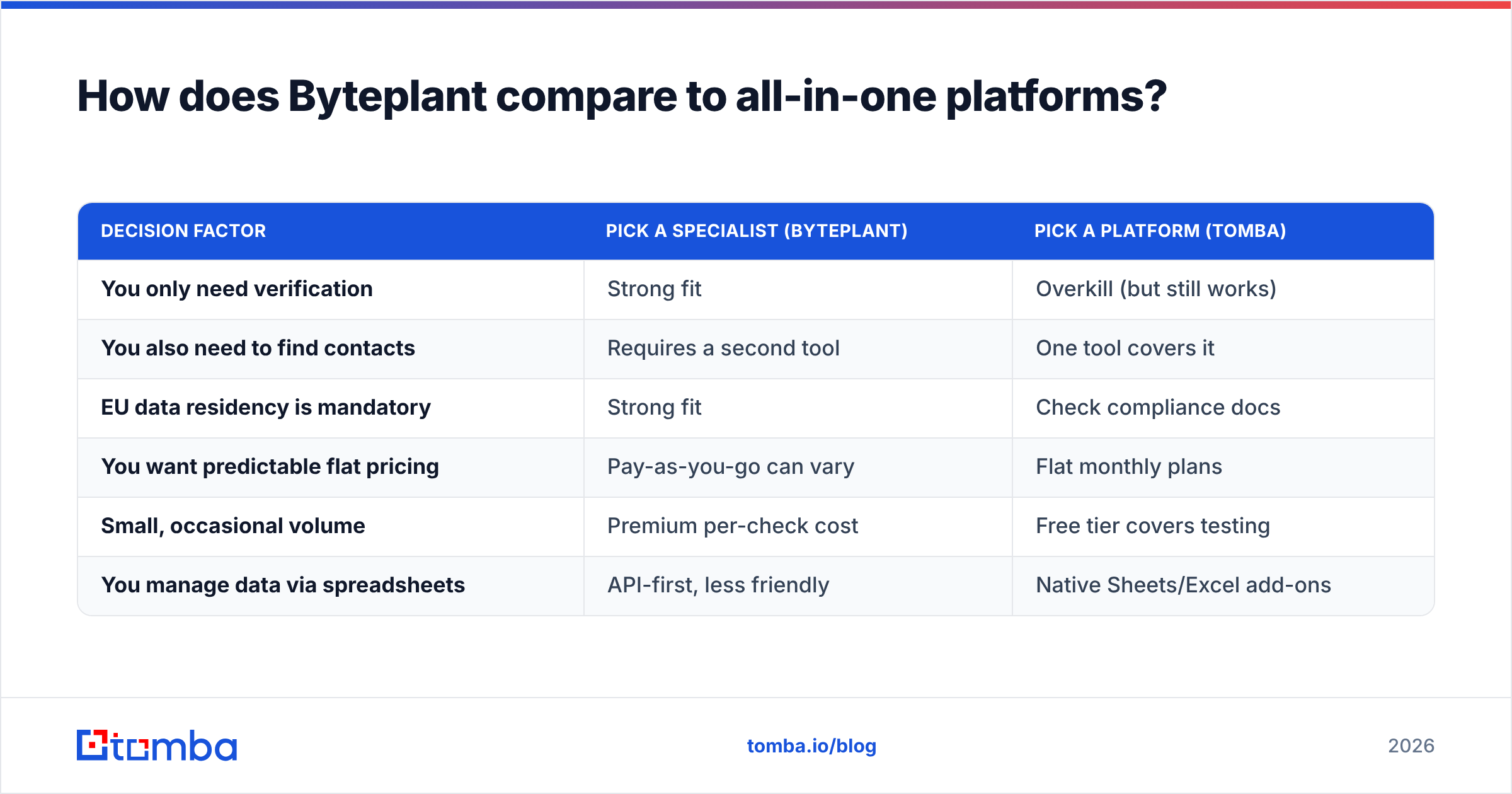
The category has split into two camps. Specialists like Byteplant and ZeroBounce do one job — validation — extremely well and sell it as a standalone API. Platforms like Tomba, Apollo, and Hunter bundle finding, verifying, and enriching so your data pipeline lives in one place.
Neither camp is universally "better." The right choice depends on what already exists in your stack:
| Decision factor | Pick a specialist (Byteplant) | Pick a platform (Tomba) |
|---|---|---|
| You only need verification | Strong fit | Overkill (but still works) |
| You also need to find contacts | Requires a second tool | One tool covers it |
| EU data residency is mandatory | Strong fit | Check compliance docs |
| You want predictable flat pricing | Pay-as-you-go can vary | Flat monthly plans |
| Small, occasional volume | Premium per-check cost | Free tier covers testing |
| You manage data via spreadsheets | API-first, less friendly | Native Sheets/Excel add-ons |
If your team practices good email deliverability hygiene, the validation engine is only one piece. What surrounds it — finding the right contacts, enriching them, and pushing clean data into your CRM — usually decides which tool wins the year.
Frequently asked questions#
Is Byteplant free? Byteplant offers a limited free trial with capped credits so you can test accuracy, but ongoing use is paid. Each product (email, phone, address) has its own trial and billing.
Does Byteplant find email addresses? No. Byteplant only validates emails you already have. To discover new addresses you need a finder tool upstream, then pass results to a validator.
How much does Byteplant cost per email? It depends on volume. Small credit packs carry a premium per check, while large monthly commitments drop the unit price significantly. Confirm current rates on Byteplant's official site, since they adjust periodically.
Is Byteplant GDPR compliant? Byteplant hosts in the EU and markets itself to privacy-sensitive European buyers, which is one of its clearer advantages over US-based competitors.
What's the best Byteplant alternative? For verification-only needs, ZeroBounce is a close comparison. For teams that also need to find contacts, an all-in-one like Tomba removes a separate tool from the stack.
The bottom line on Byteplant pricing reviews pros and cons#
On Byteplant pricing reviews pros and cons, the verdict is simple. Byteplant is a dependable, privacy-first validation specialist. It does exactly what it promises, and nothing more. Its pricing rewards high committed volume. Its accuracy holds up outside the catch-all gray zone. Its EU hosting is a real edge for European teams. The trade-offs are just as clear. You get three fragmented products, an aging interface, and no contact discovery. Most go-to-market teams will run it alongside other tools.
If you'd rather not stitch a finder, a verifier, and an enrichment vendor together, start with one platform that already does all three. Tomba's Email Finder lets you discover professional addresses by name, company, or domain, verify them in the same workflow, and clean entire lists in bulk — with a free tier (25 searches/mo) to test accuracy before you pay a cent. Validate smarter, prospect faster, and keep your whole data pipeline under one roof.
Ready to find emails that actually work?
Join 150,000+ professionals who stopped guessing and started sending. Free credits on signup — no credit card required.
Get the Tomba newsletter
Practical outbound tactics and product updates — once every two weeks.
About the author