Byteplant vs Generect 2026: Data Validation vs Lead Gen
Byteplant validates the data you already have; Generect finds new leads. See where each fits, what they cost, and the single-stack alternative that does both.
Picking between Byteplant and Generect feels like a head-to-head, but it usually isn't. They solve two different problems at two different stages of your pipeline. This guide shows you which one matches the job you actually have — and where a single platform replaces both.
TL;DR#
- Byteplant is a validation company. Its core products clean, verify, and standardize data you already collected — email, phone, and postal addresses — mostly via API.
- Generect is a lead-generation company. It sources fresh B2B contacts and company data (heavily LinkedIn-driven) so you have new people to email in the first place.
- They rarely compete. You validate with one and prospect with the other; comparing them directly is comparing a water filter to a well.
- Pricing models differ sharply: Byteplant sells validation credits per record; Generect sells lead/enrichment volume, often through custom plans.
- If you want one stack that finds and verifies contacts, a combined email-finder-plus-verifier like Tomba covers both jobs without paying two vendors.
What is Byteplant?#
Byteplant is a data-quality vendor. Think of it as the quality-control line at the end of a factory: products (your records) roll in, and Byteplant checks each one is real, correctly formatted, and safe to ship.
Its main services are Email Validator, Phone Validator, and Address Validator. The email product runs syntax checks, MX/DNS lookups, mailbox-level SMTP probing, disposable-domain detection, and role-account flags, then returns a deliverability verdict. The phone and address products do similar standardization and verification against carrier and postal datasets.
The audience is developers and ops teams. Byteplant leans on a clean REST API, bulk file processing, and integrations you wire into signup forms, checkout flows, and CRM imports. You can read the specifics on the official Byteplant site. The recurring theme: Byteplant assumes you already have the data and want it clean.
That's the boundary to keep in mind. Byteplant will tell you whether jane@acme.com is deliverable. It will not tell you that Jane is the VP of Marketing at Acme and hand you her address in the first place.

What is Generect?#
Generect is a B2B lead-generation and data platform. If Byteplant is quality control, Generect is the supplier that fills your warehouse in the first place.
Generect focuses on sourcing contacts and companies that match your ICP. It pulls heavily from LinkedIn-style professional data, returning names, titles, companies, and business emails, and offers enrichment and list-building through an API and app. The positioning is "give us a target profile, get back people to contact." You can see how they frame it on the Generect homepage.
So the two tools sit at opposite ends of the same pipeline:
- Generect (top of funnel): discover and enrich net-new contacts that fit your criteria.
- Your outreach tool (middle): sequence and send.
- Byteplant (guardrail): validate emails and phone numbers before and during sending so bounces stay low.
This is why "Byteplant vs Generect" is the wrong framing for most buyers. The real question is which stage hurts more right now — empty lists, or dirty lists?
Byteplant vs Generect: how do they actually compare?#
Here's the side-by-side on the dimensions that matter when you're scoping a purchase.
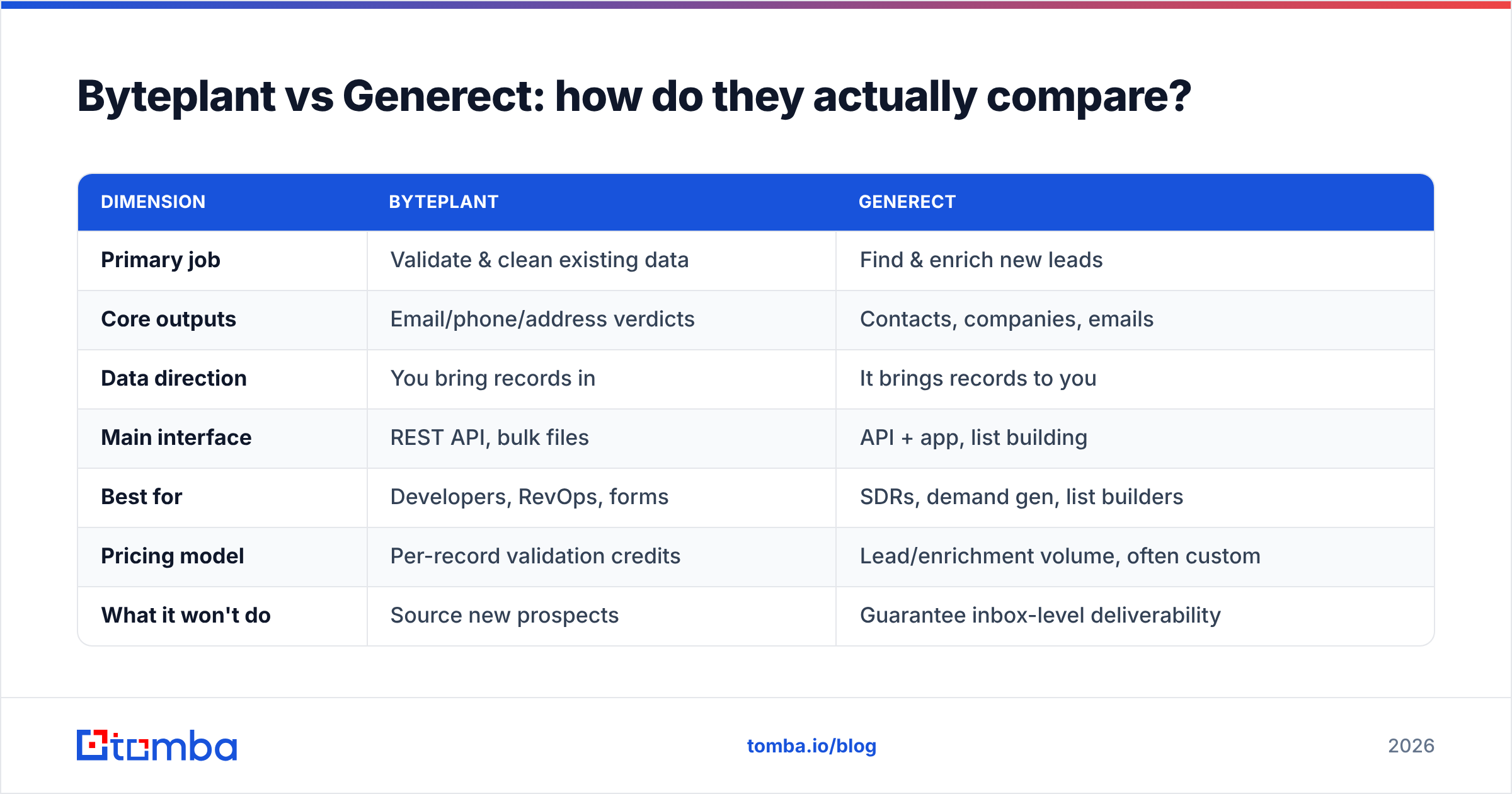
| Dimension | Byteplant | Generect |
|---|---|---|
| Primary job | Validate & clean existing data | Find & enrich new leads |
| Core outputs | Email/phone/address verdicts | Contacts, companies, emails |
| Data direction | You bring records in | It brings records to you |
| Main interface | REST API, bulk files | API + app, list building |
| Best for | Developers, RevOps, forms | SDRs, demand gen, list builders |
| Pricing model | Per-record validation credits | Lead/enrichment volume, often custom |
| What it won't do | Source new prospects | Guarantee inbox-level deliverability |
Read that table as a routing decision, not a scoreboard. The "winner" is whichever column describes the gap in your funnel.
When Byteplant is the right call#
- You already have a large database (signups, CRM, event lists) and bounce rates are climbing.
- You need real-time form validation to stop fake or mistyped emails at the source.
- Postal or phone accuracy matters — shipping, compliance, or SMS.
- You want a narrow, reliable API and don't need prospecting features.
When Generect is the right call#
- Your reps are starving for new accounts and contacts.
- You're building targeted lists by title, industry, or company size.
- You want LinkedIn-style professional data piped into your sequences.
- You'd rather buy discovery than build a scraping stack.

Is accuracy the same thing for both tools?#
No — and conflating the two metrics is the most common buying mistake.
For Byteplant, "accuracy" means verdict accuracy: when it says an email is deliverable, does it actually land? That's measured by false-positive and false-negative rates on validation, plus how well it handles catch-all domains and greylisting.
For Generect, "accuracy" means data accuracy: of the contacts it returns, how many have a correct, current email and title? A lead provider can hand you 1,000 prospects where 200 emails are stale — that's a sourcing-accuracy problem, not a validation one.
Here's the trap: a lead tool's emails are only as fresh as its last crawl, so even "verified" leads from a prospecting vendor benefit from an independent validation pass before you send. That's why mature teams run discovery and verification as separate, sequential steps — or use one platform that does both and reconciles them internally. If you want to understand the underlying signal, our breakdown of email verification walks through what an SMTP-level check actually proves.
A quick rule of thumb for evaluating any data vendor's accuracy claims:
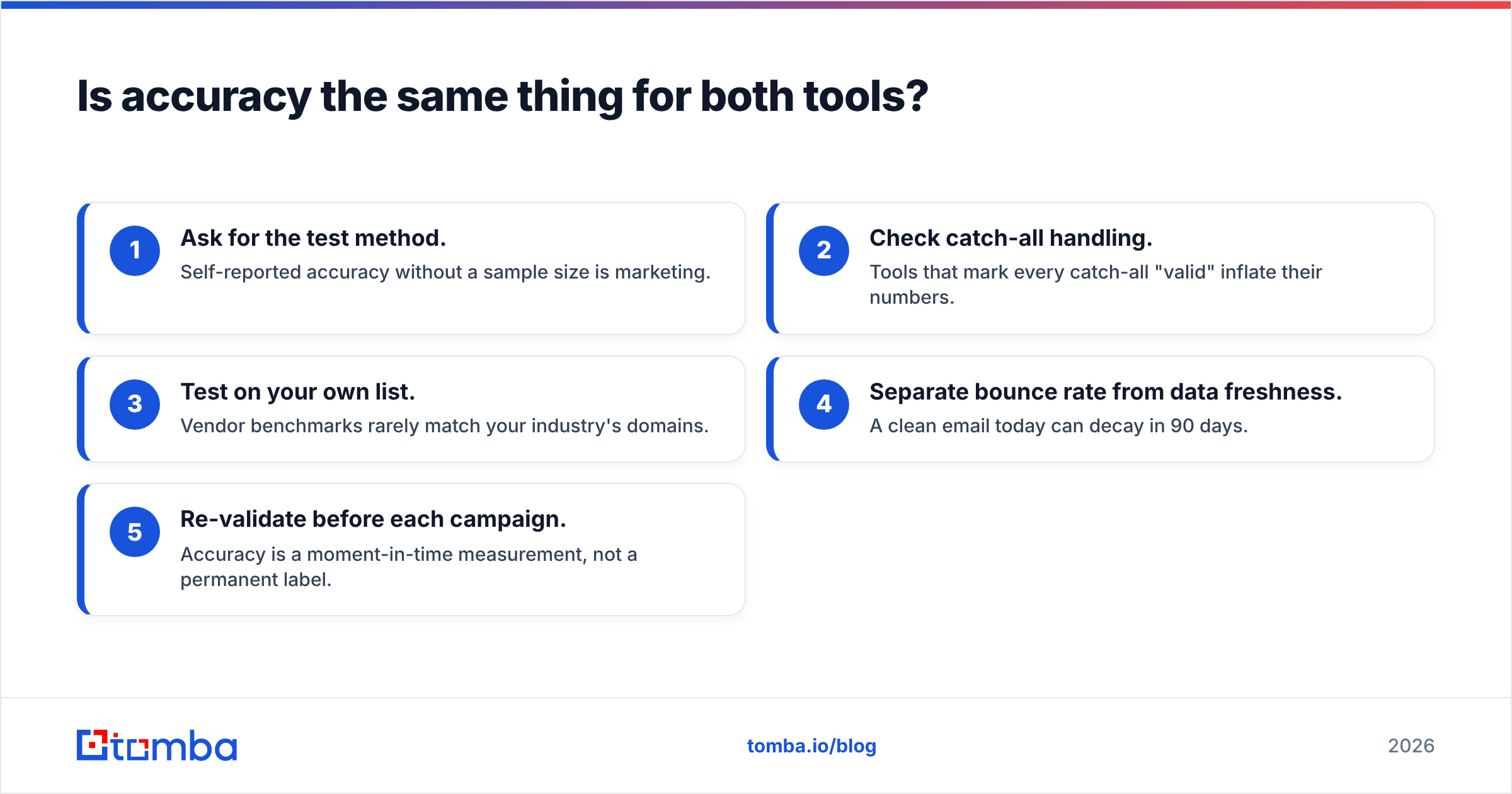
- Ask for the test method. Self-reported accuracy without a sample size is marketing.
- Check catch-all handling. Tools that mark every catch-all "valid" inflate their numbers.
- Test on your own list. Vendor benchmarks rarely match your industry's domains.
- Separate bounce rate from data freshness. A clean email today can decay in 90 days.
- Re-validate before each campaign. Accuracy is a moment-in-time measurement, not a permanent label.
What about pricing — Byteplant vs Generect?#
The pricing logic follows the product logic, so you can't compare a single "per month" number cleanly.
Byteplant prices by records validated. You buy credits (a credit per email, phone, or address checked), and volume discounts kick in at scale. This is predictable: 50,000 emails to verify costs roughly 50,000 credits, full stop. Always confirm current rates on Byteplant's own pricing page, since validation pricing shifts with volume tiers.
Generect prices by lead/enrichment volume, and B2B data providers in this category frequently route serious buyers to custom or sales-assisted plans. The cost scales with how many contacts you pull and enrich, not how many you clean.
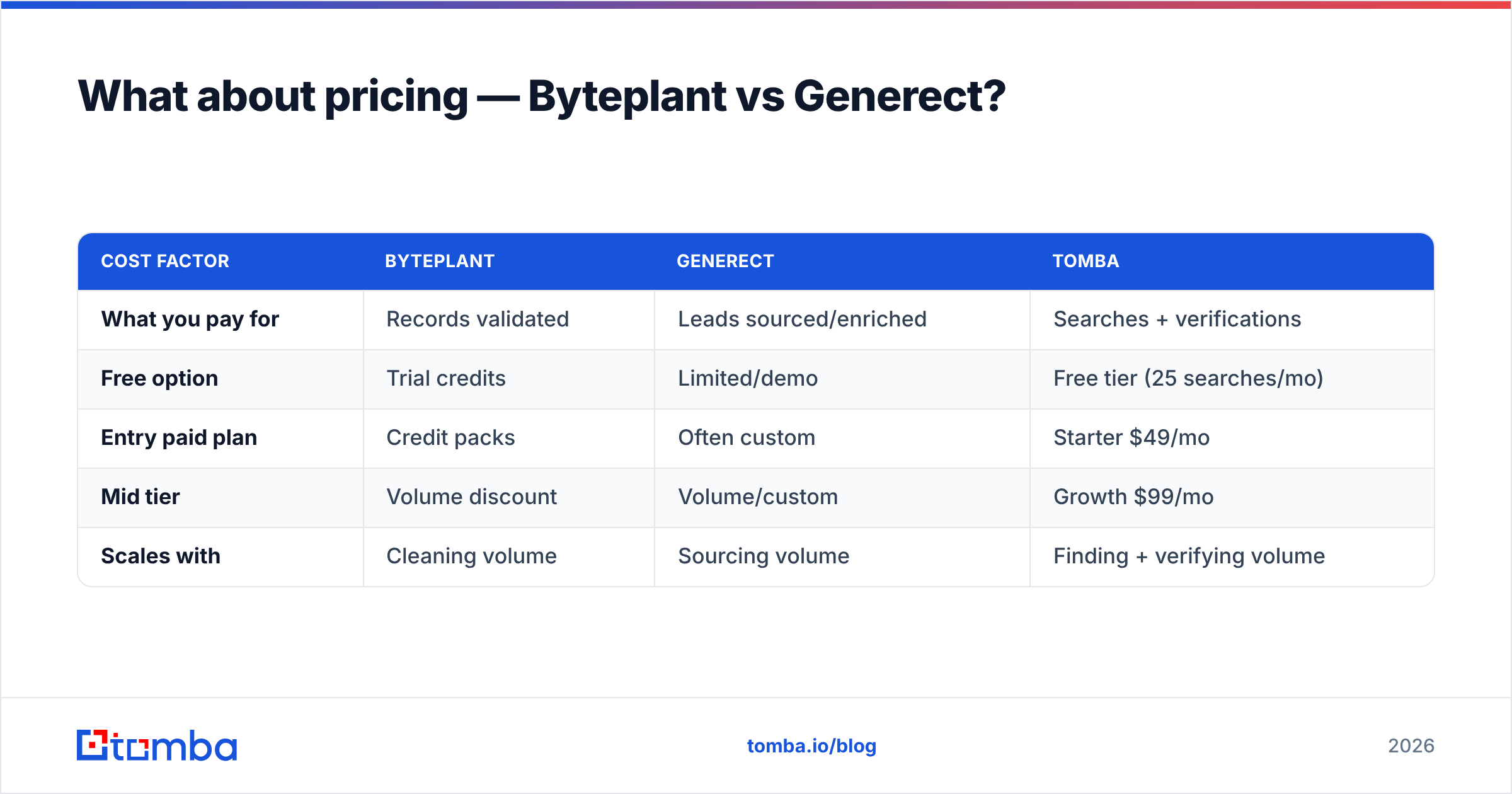
| Cost factor | Byteplant | Generect | Tomba |
|---|---|---|---|
| What you pay for | Records validated | Leads sourced/enriched | Searches + verifications |
| Free option | Trial credits | Limited/demo | Free tier (25 searches/mo) |
| Entry paid plan | Credit packs | Often custom | Starter $49/mo |
| Mid tier | Volume discount | Volume/custom | Growth $99/mo |
| Scales with | Cleaning volume | Sourcing volume | Finding + verifying volume |
The takeaway: budgeting for both tools means funding two cost curves — one that grows with how much you prospect, another that grows with how much you clean. For many teams that's the hidden tax of a two-vendor stack. You can compare a single-curve model on the Tomba pricing page, where finding and verifying share one plan.

Can one tool replace both Byteplant and Generect?#
For a large share of B2B teams, yes — and that's the most important takeaway in this comparison.
The two-vendor setup exists because validation and discovery historically came from different companies. But the jobs are sequential and tightly coupled: you find an email, then you verify it, then you send. Splitting that across Generect and Byteplant means two contracts, two APIs, two billing curves, and a hand-off step where data gets exported, re-imported, and occasionally mangled.
A consolidated email-finder-plus-verifier collapses the workflow:
- Find business emails by name, company, or domain — the Generect-shaped job — with the email finder and domain search.
- Verify each address with SMTP-level checks before it ever enters a sequence — the Byteplant-shaped job — via the built-in email verifier.
- Enrich the surviving contacts with company and role data using data enrichment.
- Automate all of it through one Tomba API instead of stitching two providers together.
This won't fit every edge case. If your only need is postal-address validation at massive scale, Byteplant's specialized address product is purpose-built for that and worth keeping. If you need a very specific regional lead dataset Generect happens to own, that's a reason to use it. But for the mainstream motion — find B2B contacts, clean them, sequence them — one platform removes a vendor, a bill, and an integration.
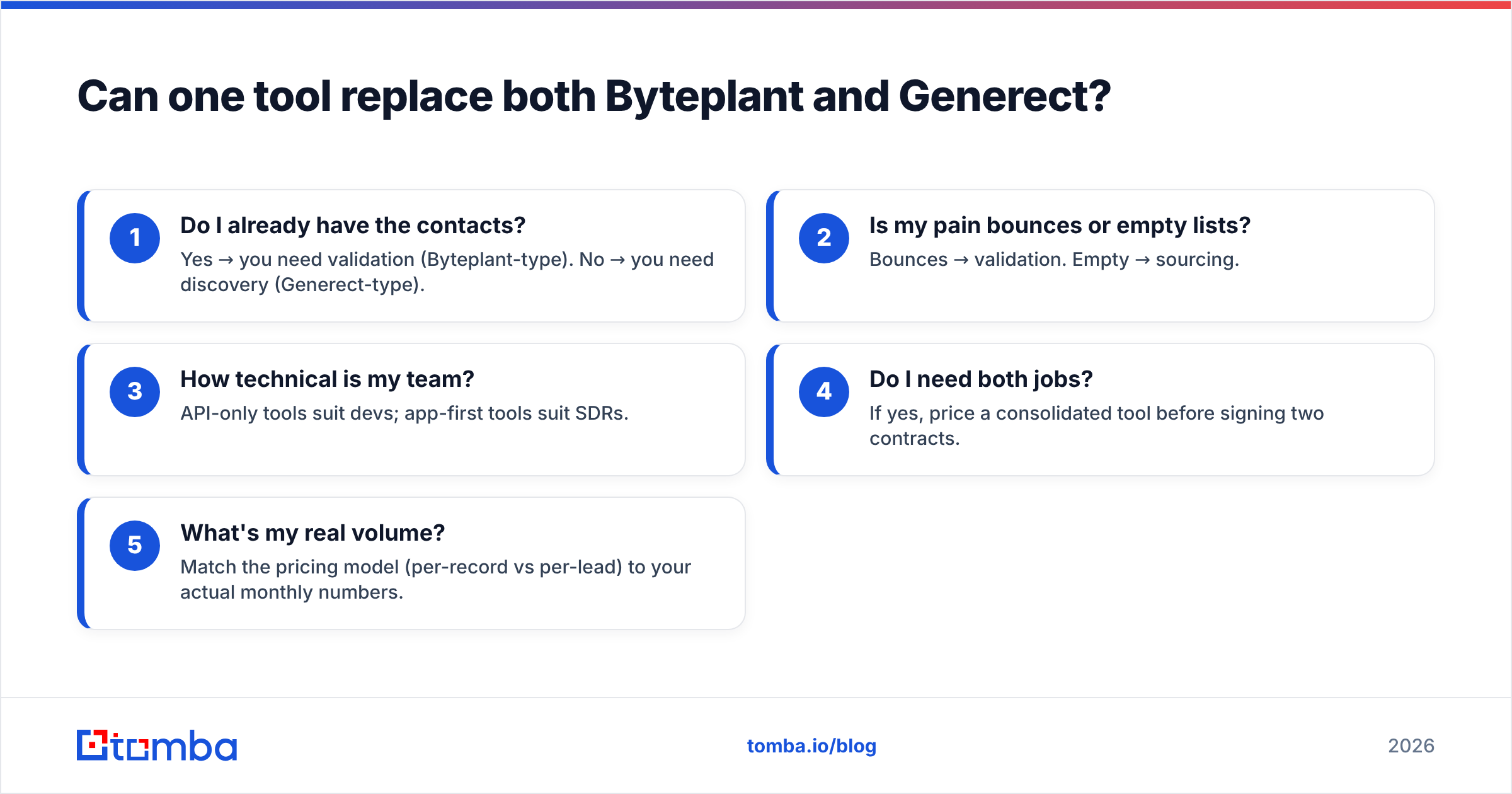
How to decide in five questions#
- Do I already have the contacts? Yes → you need validation (Byteplant-type). No → you need discovery (Generect-type).
- Is my pain bounces or empty lists? Bounces → validation. Empty → sourcing.
- How technical is my team? API-only tools suit devs; app-first tools suit SDRs.
- Do I need both jobs? If yes, price a consolidated tool before signing two contracts.
- What's my real volume? Match the pricing model (per-record vs per-lead) to your actual monthly numbers.
You can sanity-check vendor reputations on neutral marketplaces like G2 before committing, and align the tool choice with your broader revenue operations workflow rather than buying in isolation.
Frequently asked questions#
Is Byteplant a competitor to Generect? Not really. Byteplant validates and cleans existing data; Generect sources new leads. They sit at different stages of the same pipeline and are often used together rather than instead of each other.
Which is better for cold email? Both partially. Generect-style tools give you the prospects; Byteplant-style validation keeps your bounce rate low so your sender reputation survives. For cold email you genuinely need both functions — which is the argument for a combined platform.
Does Generect verify the emails it returns? Lead providers apply some verification, but freshness decays between crawls. Running an independent validation pass before each campaign is best practice regardless of source.
What's the cheapest way to cover both jobs? Usually a single tool with a free tier and one pricing curve. Tomba's free plan includes 25 searches per month, with paid plans from $49/mo that bundle finding and verifying.
The bottom line#
Byteplant and Generect aren't rivals — they're two stages of one pipeline. Byteplant keeps the data you have clean; Generect brings you data you don't. Choose Byteplant when bounces and dirty records are the problem, Generect when empty pipelines are. But if you need both jobs done — find the contact, then prove it's real — running two vendors is usually the expensive answer.
Start with the Tomba Email Finder: find verified B2B emails by domain, name, or company, validate them in the same workflow, and skip the two-contract tax. Spin up the free tier, run your toughest target list through it, and see how much of the Byteplant-plus-Generect stack you actually still need.
// get started
Find, verify and enrich your first contacts today
Start on the free plan with 25 searches a month, then scale when your team is ready.
Free plan · No credit card required · GDPR & CCPA
// about the author