Byteplant vs Reachstream 2026: Email & Data Tools Compared
Byteplant validates email addresses; Reachstream sells B2B contact lists. They solve different problems. Here's which one your pipeline actually needs in 2026 — and where a third option beats both.
TL;DR
- Byteplant and Reachstream are not the same kind of tool. Byteplant is an email validation engine (it tells you if an address is deliverable). Reachstream is a B2B contact database (it hands you lists of people and companies).
- Pick Byteplant when you already have email lists and need to scrub them before sending. Pick Reachstream when you have nothing and need raw contacts to start.
- Neither does the full job alone. A database without verification rots fast; a verifier without a source has nothing to clean.
- Pricing models differ sharply: Byteplant charges per verification credit; Reachstream sells subscription access to its database with monthly credit caps.
- A combined find-and-verify platform like Tomba covers both jobs in one workflow, which is why we compare all three at the end.
What is Byteplant?#
Byteplant is a German data-quality company best known for its Email Validator service. Its core promise is simple: feed it an email list, and it returns a deliverability verdict for each address — valid, invalid, risky (catch-all), or unknown. It runs syntax checks, MX-record lookups, and SMTP handshakes without sending a real message.
Think of Byteplant as a bouncer at the door of your email campaign. It doesn't invite anyone; it just checks IDs and turns away the fakes before they cost you a hard bounce. That matters because mailbox providers punish senders whose bounce rates climb above roughly 2–3%.
Byteplant also sells address validation and phone validation under the same brand, so teams that care about overall data hygiene — not just email — sometimes adopt the whole suite. The API is straightforward, the documentation is solid, and it supports both real-time (one address at a time) and bulk (upload a file) modes.
What Byteplant does not do is find contacts. If your CRM is empty, Byteplant gives you nothing to work with. It is a cleaning tool, full stop.

What is Reachstream?#
Reachstream sits on the opposite side of the problem. It is a B2B contact and company database — a directory you query to pull lists of decision-makers by industry, job title, company size, location, and technology used. You're buying access to data, not a verification engine.
If Byteplant is the bouncer, Reachstream is the guest list. It tells you who to invite in the first place. You search "VP of Marketing at SaaS companies in California with 50–200 employees," and it returns names, business emails, phone numbers, and firmographic details you can export to CSV or push into your CRM.
Reachstream's value lives and dies on two things: how current the data is and how deep the coverage goes. B2B contact data decays at roughly 22–30% per year as people change jobs, companies rebrand, and domains shift. A database that looked great at signup can be a third stale twelve months later — which is exactly why a verification layer still matters even after you buy from a list provider.
Byteplant vs Reachstream: what's the real difference?#
The honest answer is that comparing them head-to-head is a bit like comparing a dishwasher to a grocery store. One sources the goods; the other cleans them. Here's the breakdown that actually matters when you're deciding where your budget goes.
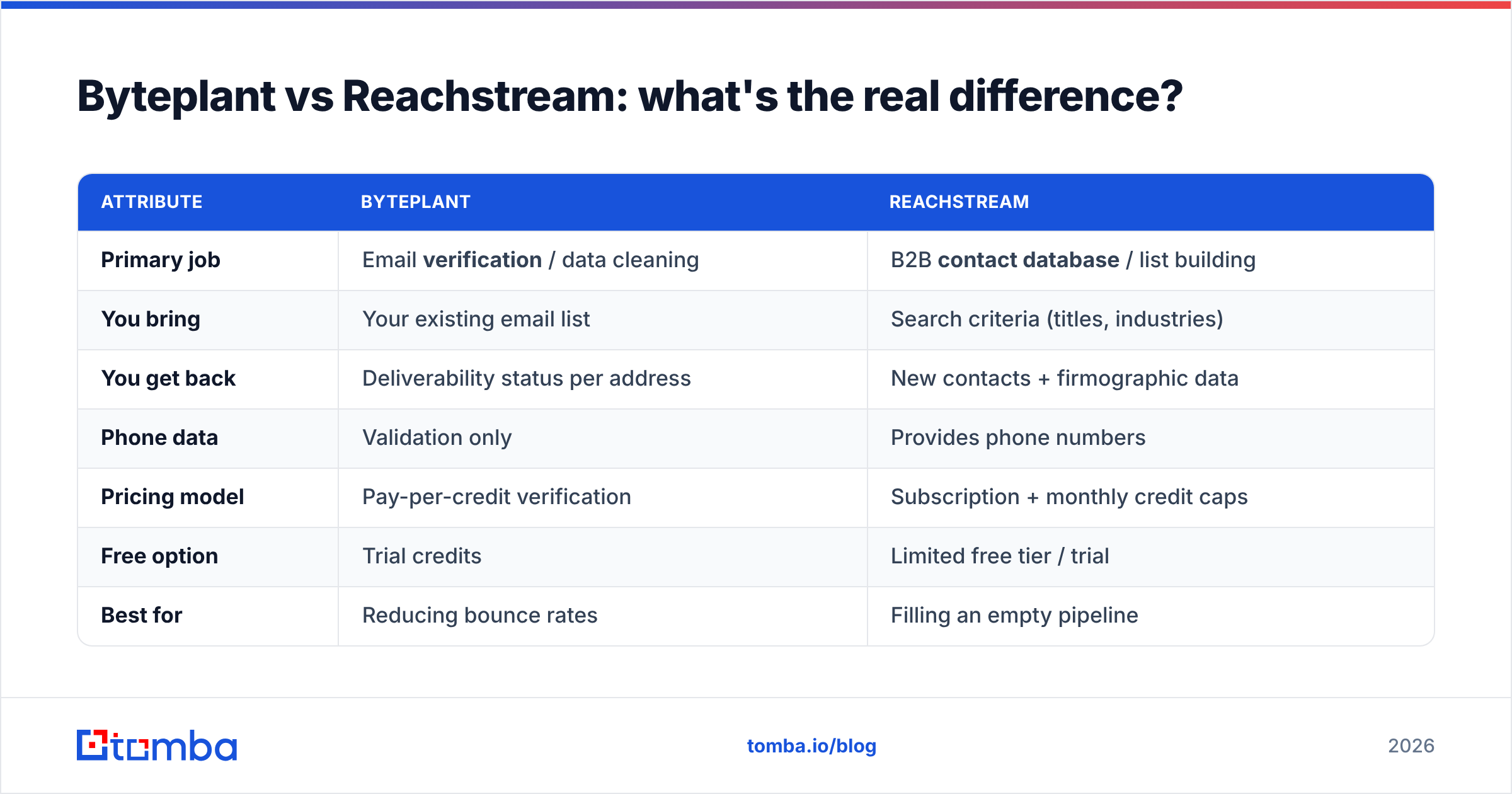
| Attribute | Byteplant | Reachstream |
|---|---|---|
| Primary job | Email verification / data cleaning | B2B contact database / list building |
| You bring | Your existing email list | Search criteria (titles, industries) |
| You get back | Deliverability status per address | New contacts + firmographic data |
| Phone data | Validation only | Provides phone numbers |
| Pricing model | Pay-per-credit verification | Subscription + monthly credit caps |
| Free option | Trial credits | Limited free tier / trial |
| Best for | Reducing bounce rates | Filling an empty pipeline |
| Weak spot | Can't find anyone | Data decays; needs re-verification |
| API access | Yes (REST) | Yes (plan-dependent) |
The takeaway: if you frame this as "which tool wins," you'll buy the wrong one. The right question is "which job am I trying to do right now?"
When should you choose Byteplant?#
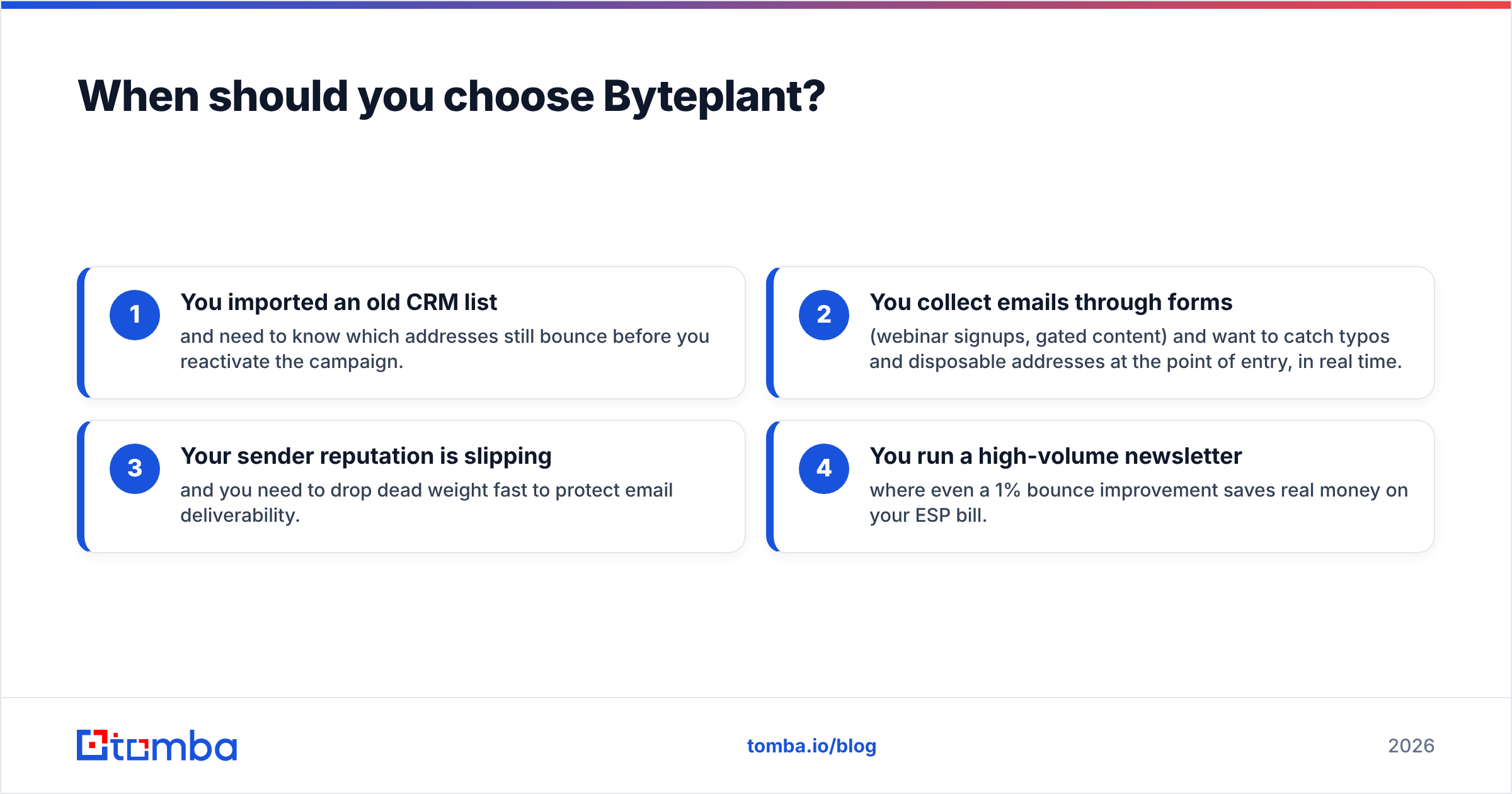
Choose Byteplant when you already have data and your problem is quality, not quantity. Concrete situations:
- You imported an old CRM list and need to know which addresses still bounce before you reactivate the campaign.
- You collect emails through forms (webinar signups, gated content) and want to catch typos and disposable addresses at the point of entry, in real time.
- Your sender reputation is slipping and you need to drop dead weight fast to protect email deliverability.
- You run a high-volume newsletter where even a 1% bounce improvement saves real money on your ESP bill.
Byteplant is a specialist, and specialists are worth it when the specialty is your bottleneck. But pairing it with a dedicated email verifier workflow — or replacing it with one that also finds contacts — is worth pricing out before you commit.
When should you choose Reachstream?#
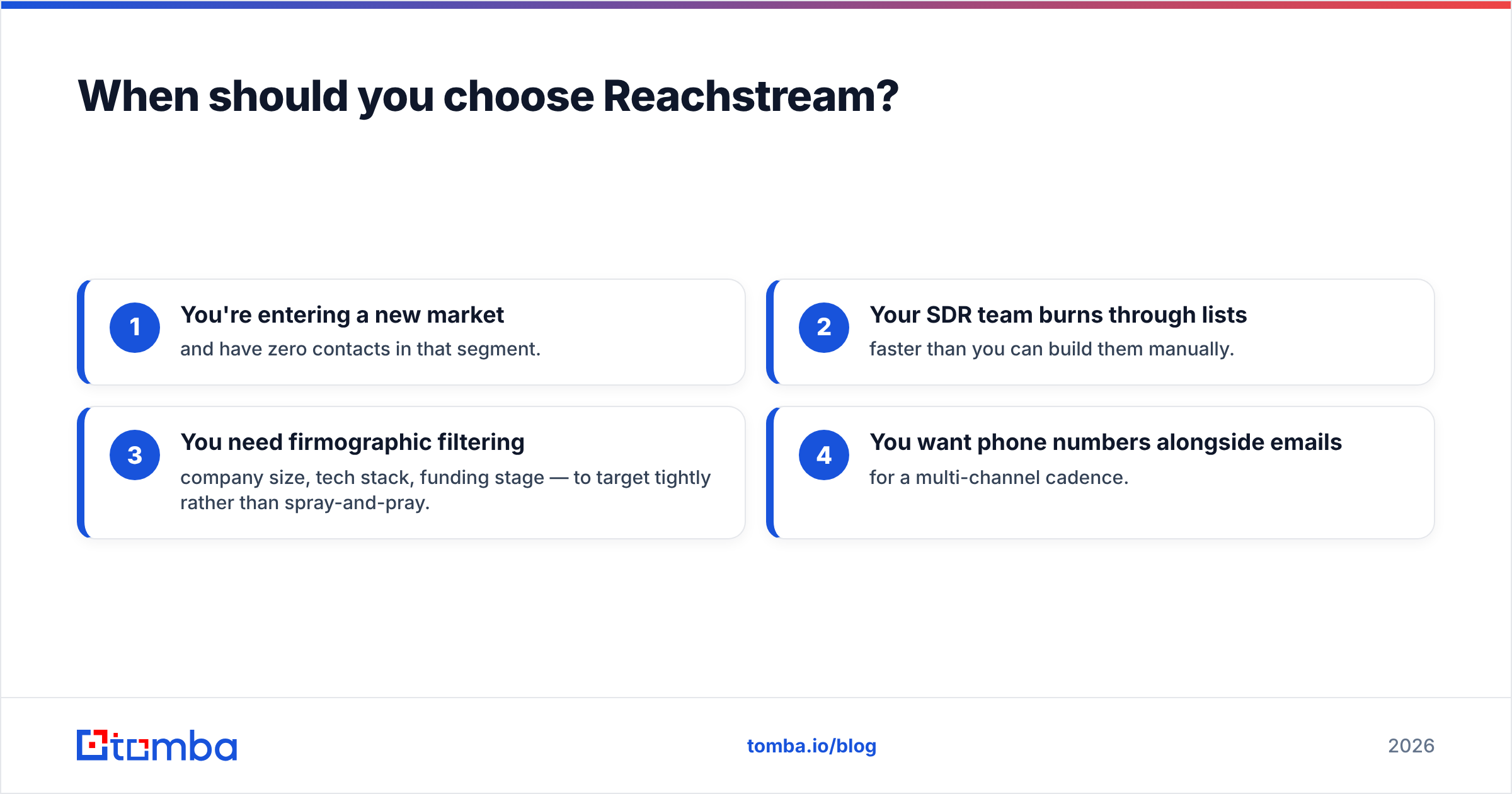
Choose Reachstream when your pipeline is thin and you need net-new contacts to prospect into. Situations where it shines:
- You're entering a new market and have zero contacts in that segment.
- Your SDR team burns through lists faster than you can build them manually.
- You need firmographic filtering — company size, tech stack, funding stage — to target tightly rather than spray-and-pray.
- You want phone numbers alongside emails for a multi-channel cadence.
The catch, again, is freshness. Any list you pull should be re-verified before the first send, because the gap between "exported" and "emailed" is where bounces are born. Buying a list and skipping verification is how good domains get blacklisted.
How accurate is the data from each tool?#
This is where most buyers get burned, so be skeptical of any single accuracy number a vendor quotes.
Byteplant's accuracy is measurable and testable — you can feed it a known list and check its verdicts against reality. Its SMTP-level checks are genuinely strong for standard mailboxes. Where every validator struggles is catch-all domains, which accept all mail at the server and then silently discard invalid addresses. No verifier can be fully certain about a catch-all without sending, so treat "risky/unknown" results as a real category, not noise. A dedicated catch-all verifier helps squeeze more certainty out of those domains.
Reachstream's accuracy is harder to audit because you can't easily test data you don't already have. Independent reviews on G2 for database vendors generally land in the "good but verify it yourself" range — coverage is broad, but a meaningful slice of any large B2B database is stale on any given day. That's not a knock on Reachstream specifically; it's physics. People change jobs, and databases lag reality.
The practical rule: whatever your source, verify before you send. This is true for Byteplant users (who already verify) and doubly true for Reachstream users (who often forget to).
What about pricing — which is cheaper?#
Cheaper depends entirely on what you're buying, so don't compare the sticker prices directly.
Byteplant charges per verification credit, with the per-credit cost dropping as volume rises. If you verify 10,000 addresses once a quarter, you pay for 10,000 credits — clean and predictable. There's no ongoing subscription pressure; you buy what you use.
Reachstream uses a subscription model with monthly credit allotments for record downloads. You commit to a plan, and you get a fixed number of contact reveals per month. Unused credits often don't roll over, so the value depends on whether you actually consume your allotment.
The hidden cost most teams miss: if you buy from Reachstream and verify with Byteplant, you're paying two vendors for one outbound workflow. That stacking is exactly the inefficiency that consolidated platforms exist to remove. Before you sign two contracts, compare them against a single tool's pricing that bundles finding and verifying.
Is there a better alternative to both?#
For most outbound teams, yes — a platform that finds and verifies in one pass beats stitching a database to a separate scrubber. This is where Tomba fits the comparison honestly.
Tomba's core is an email finder: give it a name and a company domain, and it returns the verified professional email with a confidence score. Crucially, verification is built into the find — you're not exporting a stale CSV and cleaning it later; you're getting a freshly confirmed address at the moment you need it. Its data sources are transparent, and for net-new prospecting you can run a domain search to pull every public address at a company, then enrich them with titles and socials through data enrichment.
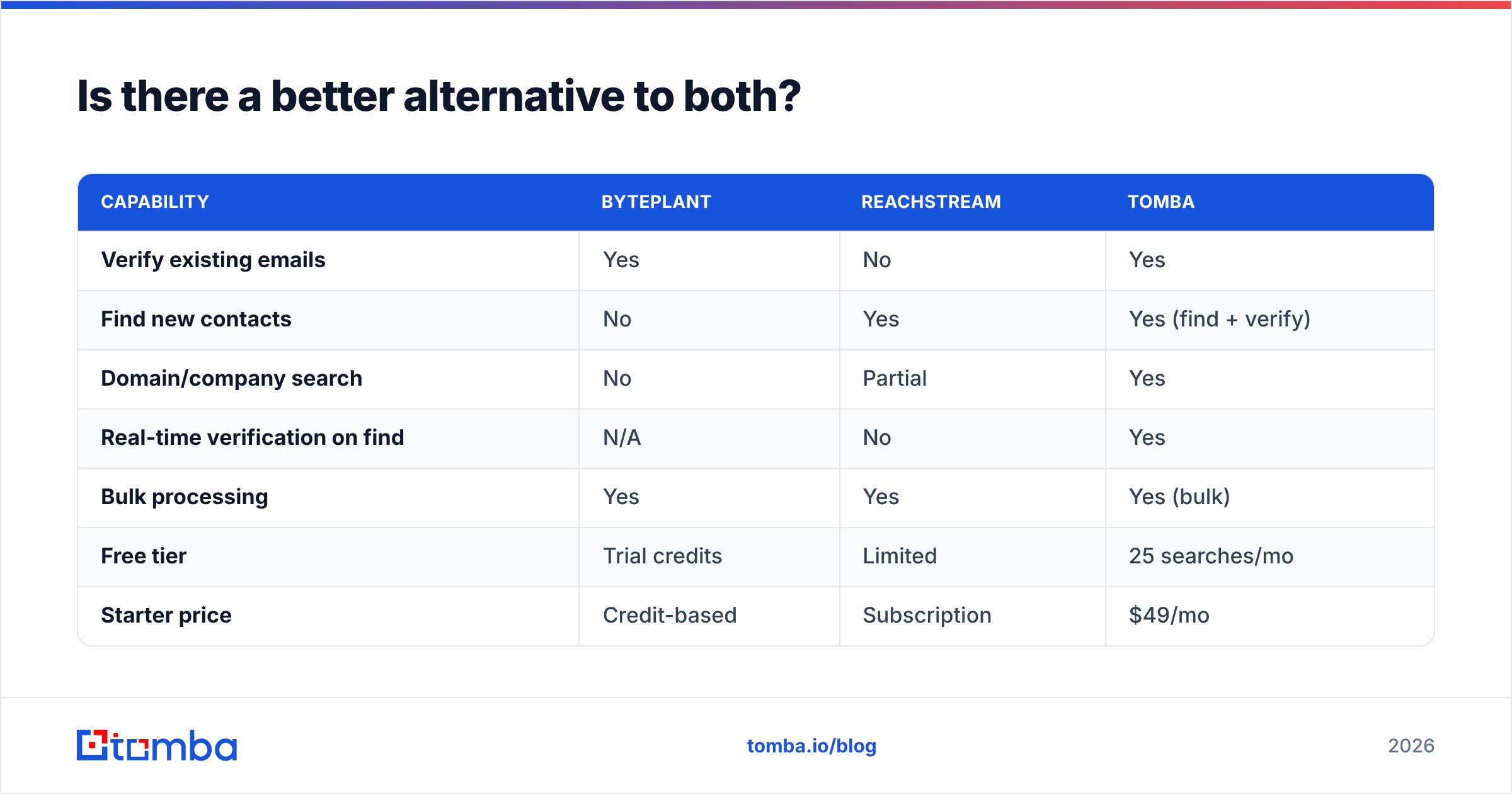
Here's how the three stack up on the jobs that matter:
| Capability | Byteplant | Reachstream | Tomba |
|---|---|---|---|
| Verify existing emails | Yes | No | Yes |
| Find new contacts | No | Yes | Yes (find + verify) |
| Domain/company search | No | Partial | Yes |
| Real-time verification on find | N/A | No | Yes |
| Bulk processing | Yes | Yes | Yes (bulk) |
| Free tier | Trial credits | Limited | 25 searches/mo |
| Starter price | Credit-based | Subscription | $49/mo |
| API + integrations | Yes | Plan-dependent | Yes (full API) |
Tomba isn't always the answer. If your only job is validating a giant existing list and you never need to source contacts, a pure validator like Byteplant is a clean, cheap fit. If you genuinely only need a raw database dump and have your own verification pipeline, Reachstream can work. But the moment your workflow involves both finding and confirming — which describes most outbound motions — paying for two specialists is slower and more expensive than one platform that does both.
For verification at scale, Tomba also ships a standalone bulk verify flow and a developer-friendly email finder API, so you can wire it into your CRM the same way you would Byteplant's endpoint — without giving up the find-side coverage Byteplant lacks.
Byteplant vs Reachstream: the verdict#
Stop thinking of this as a duel. Byteplant and Reachstream answer two different questions:
- "Are my emails real?" → Byteplant.
- "Who should I email?" → Reachstream.
If you've got one of those problems in isolation, buy the specialist. If you have both — and most growing sales teams do — running them in series means two bills, two dashboards, and a stale gap between export and send where bounces sneak in.
That's the case for consolidating. A single find-and-verify platform keeps the data fresh because it confirms each address at the moment you pull it, not weeks later when half your list has already churned jobs. You spend less, you ship cleaner lists, and you stop paying a database vendor and a validation vendor to do what one tool can.
Ready to skip the two-vendor tax? Start with the Tomba Email Finder on the free tier — 25 searches a month, no card — and see verified-on-find addresses land in your workflow before you commit a dollar. If it fits, the $49/mo Starter plan covers most small outbound teams, with Growth at $99/mo when you scale. Find them, verify them, send with confidence — in one pass.
// get started
Find, verify and enrich your first contacts today
Start on the free plan with 25 searches a month, then scale when your team is ready.
Free plan · No credit card required · GDPR & CCPA
// about the author