Byteplant vs Seamless.AI 2026: Email Data Tools Compared
Byteplant verifies data, Seamless.AI finds leads — they solve different problems. Here is how they compare on accuracy, pricing, and where Tomba beats both in 2026.
Byteplant vs Seamless.AI: Which Email Data Tool Wins in 2026?
TL;DR
- Byteplant and Seamless.AI are not really competitors. Byteplant verifies and validates data you already have (email, phone, address). Seamless.AI finds net-new leads and contact data. Choosing between them is usually the wrong question.
- Byteplant wins on validation depth and pay-as-you-go pricing. It is a focused data-quality utility, not a prospecting suite.
- Seamless.AI wins on raw lead volume and CRM-style workflows, but reviewers consistently flag accuracy and aggressive contract renewals.
- If you need both finding and verifying in one place, neither is ideal. A combined email finder plus verifier — like Tomba — covers the full pipeline at a lower blended cost.
- Quick rule: clean a list you own → Byteplant. Build a list from scratch → Seamless.AI or Tomba. Do both without two subscriptions → Tomba.
What is Byteplant and what does it actually do?#
Byteplant is a data-quality vendor. Its flagship products are email validation, phone validation, and address validation, sold both as APIs and as bulk list-cleaning tools. Think of Byteplant as the spell-checker of your contact database: it does not write new content, it tells you which of the words you already have are misspelled.
Byteplant's email validator runs syntax checks, MX-record lookups, SMTP probing, and disposable/role-account detection. It returns a deliverability verdict per address so you can drop hard bounces before they ever reach your sending infrastructure. That matters because mailbox providers punish high bounce rates fast, and a single bad send can drag down your sender reputation for weeks.
What Byteplant does not do is find people. You cannot type "VP of Marketing at Acme" and get a list of names and emails. You bring the data; Byteplant grades it.

What is Seamless.AI and how is it different?#
Seamless.AI sits on the opposite end of the pipeline. It is a sales prospecting platform with a large contact database and a real-time search engine that assembles emails and phone numbers on demand. You search by title, industry, company size, or technology, and it returns contact records you can push to your CRM or sequencer.
In restaurant terms: if Byteplant is the kitchen inspector checking your existing ingredients, Seamless.AI is the supplier delivering new ingredients to your door. The catch is freshness. Real-time-built contact data trades verified accuracy for volume, and that trade-off shows up in reviews.
Seamless.AI also bundles a Chrome extension, intent data add-ons, and a "Writer" AI tool. It is closer to Apollo or ZoomInfo in ambition than to a single-purpose validator. If you are weighing the broader category, our Seamless.AI alternative breakdown covers the prospecting side in more depth.
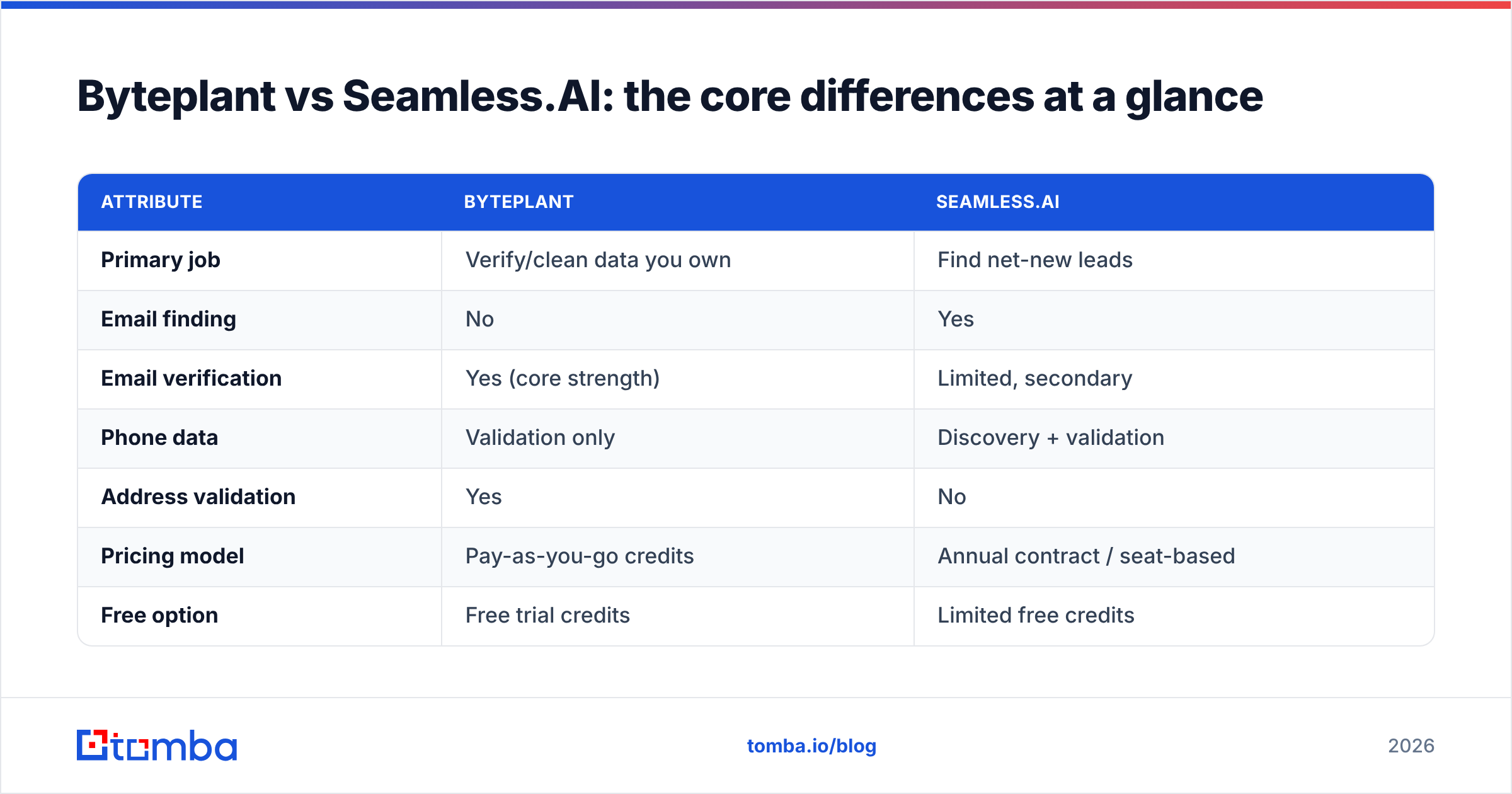
Byteplant vs Seamless.AI: the core differences at a glance#
Here is the honest side-by-side. Read the "Primary job" row first — it explains every other row.
| Attribute | Byteplant | Seamless.AI |
|---|---|---|
| Primary job | Verify/clean data you own | Find net-new leads |
| Email finding | No | Yes |
| Email verification | Yes (core strength) | Limited, secondary |
| Phone data | Validation only | Discovery + validation |
| Address validation | Yes | No |
| Pricing model | Pay-as-you-go credits | Annual contract / seat-based |
| Free option | Free trial credits | Limited free credits |
| Best for | Deliverability teams, ops | SDRs, outbound teams |
| Common complaint | Narrow scope | Accuracy + renewal terms |
The pattern is clear: these tools overlap on the word "email" and almost nowhere else. Picking by feature list alone leads people to buy the wrong one and then complain it "doesn't do X" — when X was never its job.
Which one is more accurate?#
For verifying an existing list, Byteplant is the safer accuracy bet. For sourcing brand-new contacts, neither tool is consistently great, and you should verify whatever you get.
Byteplant's whole value proposition is precision on data you already hold. Because it focuses on SMTP-level checks and catch-all handling, it tends to produce fewer false "valid" verdicts on standard mailboxes. The weak spot for every validator is the catch-all domain, where the server accepts everything and reveals nothing — which is exactly why a dedicated catch-all verifier exists as a separate discipline.
Seamless.AI's accuracy debate is louder because it is generating data, not grading it. On G2, you will find praise for volume alongside repeated notes about outdated emails and wrong direct dials. That is the structural reality of real-time-assembled data: coverage is high, hit-rate is variable. The fix is the same regardless of source — pipe every discovered address through verification before you send.

How do Byteplant and Seamless.AI compare on pricing?#
Byteplant uses pay-as-you-go credits with no seat lock-in. Seamless.AI uses annual, seat-based contracts that reviewers say are hard to exit.
Byteplant's model is friendly to spiky workloads. You buy validation credits, burn them when you clean a list, and stop. There is no monthly seat minimum, which suits ops teams that clean data quarterly rather than daily.
Seamless.AI's pricing is famously opaque — there is no public per-tier price page, and quotes come through sales. Multiple reviewers report auto-renewal clauses and credit caps that reset in ways they did not expect. If predictable cost matters to you, that uncertainty is a real factor.
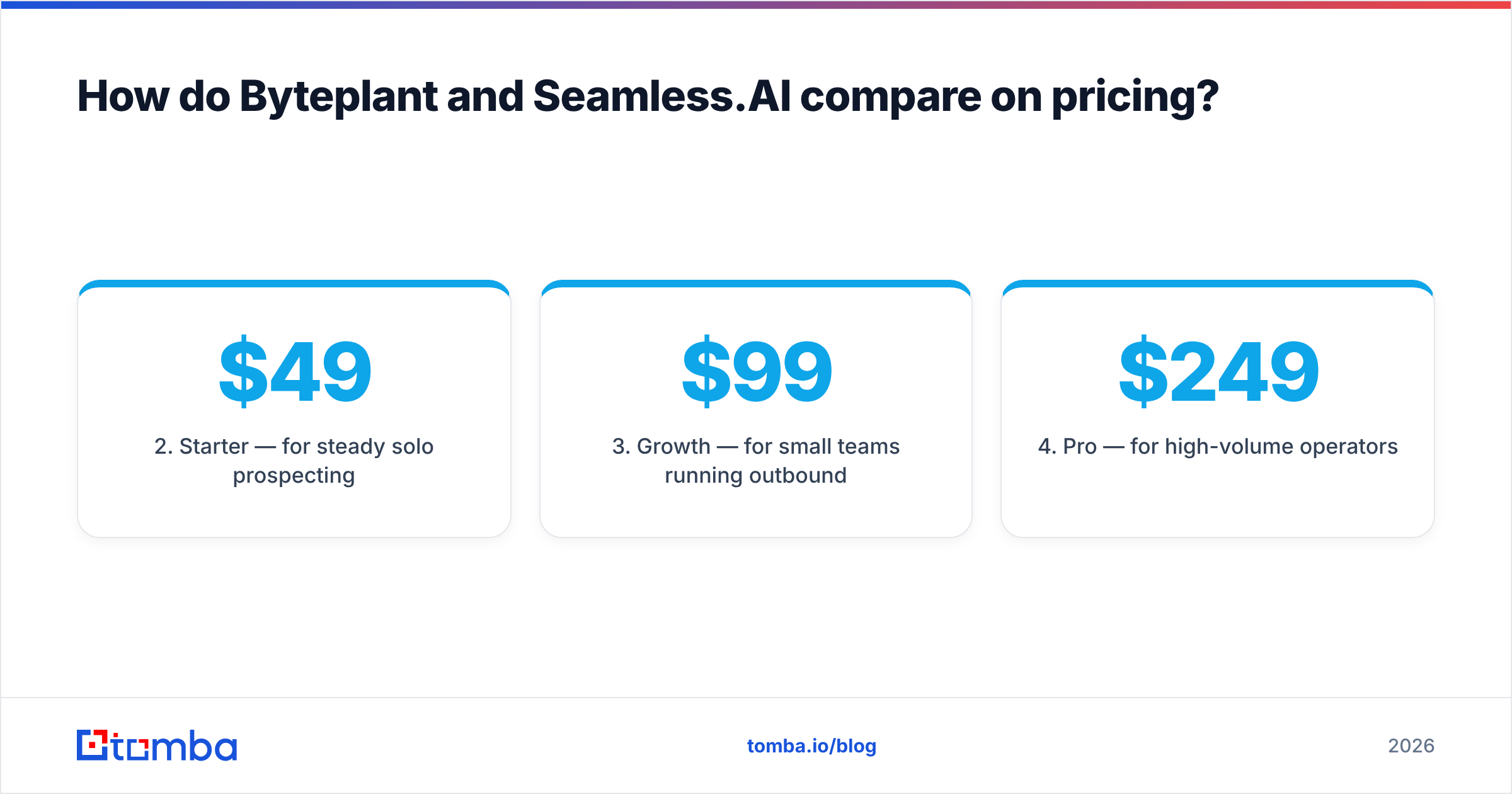
For comparison, here is how transparent, published pricing looks. Tomba lists every tier publicly:
- Free — 25 searches/month, no card required.
- Starter — $49/mo for steady solo prospecting.
- Growth — $99/mo for small teams running outbound.
- Pro — $249/mo for high-volume operators.
- Enterprise — custom, for security and volume needs.
You can see the full breakdown on the Tomba pricing page. The point is not that cheaper always wins — it is that you should be able to read the price before you talk to a rep.
Can one tool do both finding and verifying?#
Yes — and that is the gap Byteplant and Seamless.AI both leave open. Byteplant verifies but cannot find. Seamless.AI finds but verifies weakly. Run an outbound motion and you need both jobs done well, which is why so many teams end up paying for two products.
A combined platform closes that loop. Tomba pairs an email finder with a built-in email verifier, so a discovered address is checked before it lands in your sequence. You search a company, pull the contacts, and the verification verdict travels with each record — no export, re-import, and second invoice.
That single-pipeline design also helps protect email deliverability, because every address is graded at the moment of discovery rather than days later when half your batch has already bounced.
Where does each tool fit best?#
Match the tool to the job, not the brand:
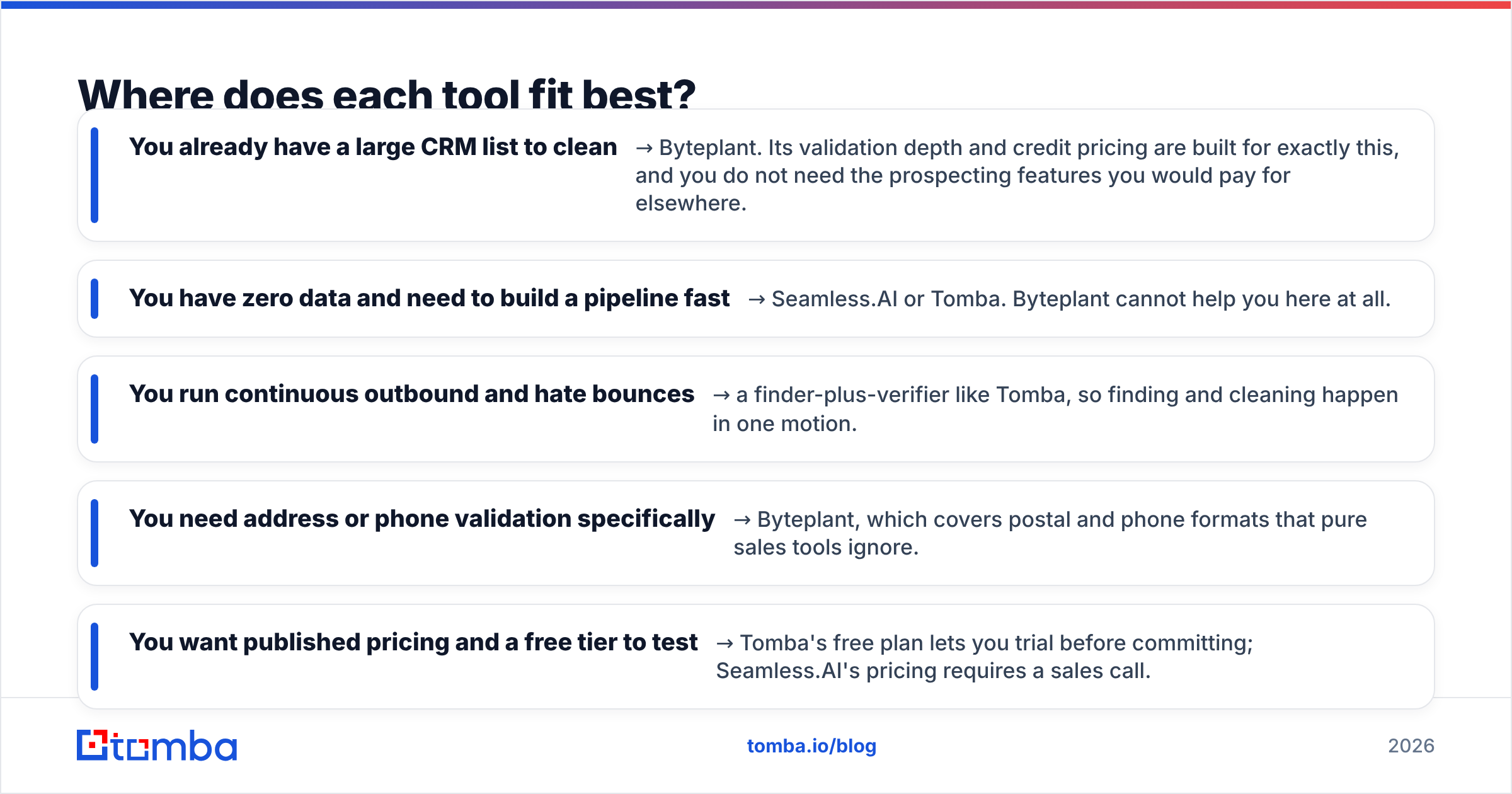
- You already have a large CRM list to clean → Byteplant. Its validation depth and credit pricing are built for exactly this, and you do not need the prospecting features you would pay for elsewhere.
- You have zero data and need to build a pipeline fast → Seamless.AI or Tomba. Byteplant cannot help you here at all.
- You run continuous outbound and hate bounces → a finder-plus-verifier like Tomba, so finding and cleaning happen in one motion.
- You need address or phone validation specifically → Byteplant, which covers postal and phone formats that pure sales tools ignore.
- You want published pricing and a free tier to test → Tomba's free plan lets you trial before committing; Seamless.AI's pricing requires a sales call.
Is Byteplant or Seamless.AI better for cold outbound?#
Seamless.AI is the more natural fit of the two for cold outbound because it actually sources contacts — but on its own it is incomplete. Cold email lives or dies on list quality, and a finder without strong verification feeds your sequencer addresses that bounce.
The healthy outbound stack looks like this: find contacts, verify them, enrich them, then send. Byteplant only owns the verify step. Seamless.AI owns find and (partly) enrich. Neither owns the whole chain. If you go the Seamless.AI route, budget for a separate verification layer — and if you go Byteplant, accept that you still need a sourcing tool in front of it.
This is also where data enrichment matters: knowing an email is valid is step one, but adding role, company size, and LinkedIn context is what makes the message land. A platform that finds, verifies, and enriches in one pass removes two hand-offs from your workflow.
Byteplant vs Seamless.AI vs Tomba: a three-way snapshot#
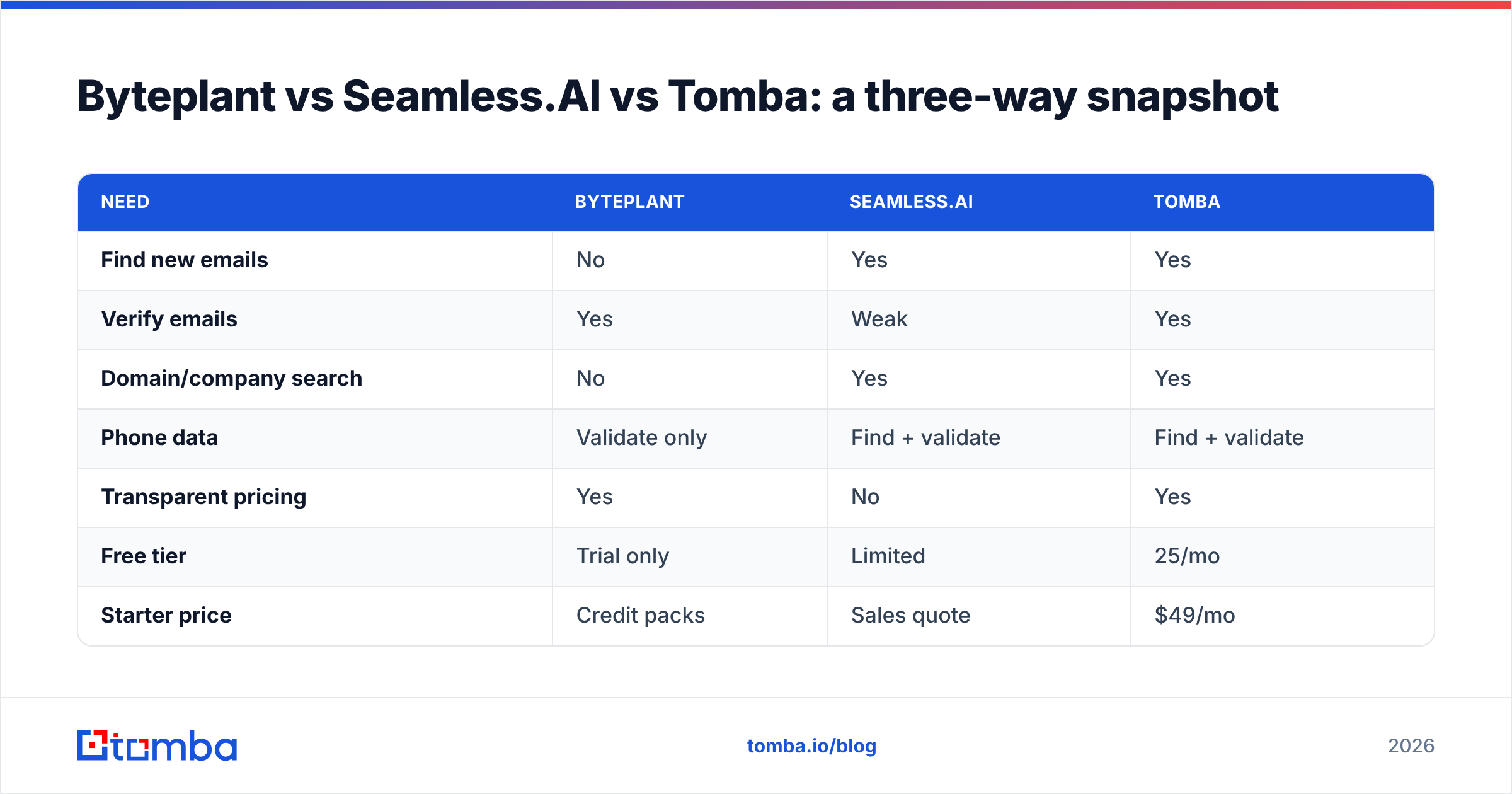
Since most readers comparing these two are really asking "what should I actually buy," here is the practical three-way view.
| Need | Byteplant | Seamless.AI | Tomba |
|---|---|---|---|
| Find new emails | No | Yes | Yes |
| Verify emails | Yes | Weak | Yes |
| Domain/company search | No | Yes | Yes |
| Phone data | Validate only | Find + validate | Find + validate |
| Transparent pricing | Yes | No | Yes |
| Free tier | Trial only | Limited | 25/mo |
| Starter price | Credit packs | Sales quote | $49/mo |
The takeaway is not that one logo beats the others on every line. It is that if your real requirement is "find good contacts and make sure they are deliverable," a single tool that scores green across the finding and verifying rows saves you a second subscription and a brittle integration.
How do I choose in five minutes?#
Ask three questions in order:
- Do I already own the data? Yes → you need verification, look hard at Byteplant. No → keep going.
- Do I need to find people at scale? Yes → you need a finder; Byteplant is out, compare Seamless.AI and Tomba.
- Do I want one tool for both jobs with published pricing? Yes → Tomba is the cleanest fit. No → split your stack and accept the extra cost.
That sequence stops the most common mistake: buying a prospecting suite to clean a list, or buying a validator and wondering why it never surfaces new leads.
The bottom line#
Byteplant and Seamless.AI are good at opposite halves of the same pipeline. Byteplant is a sharp, fairly priced data-quality utility; Seamless.AI is a high-volume prospecting engine with accuracy and contract caveats. Neither does the other's job well, so comparing them head-to-head only makes sense once you know which half of the pipeline you are actually trying to fix.
If your honest answer is "both," stop paying for two tools. Start with the Tomba Email Finder — find verified professional emails by name, domain, or company, with verification baked in and pricing you can read before you commit. Spin up the free tier, run your toughest test domain, and see the full find-and-verify loop in one place before you sign anything.
// get started
Find, verify and enrich your first contacts today
Start on the free plan with 25 searches a month, then scale when your team is ready.
Free plan · No credit card required · GDPR & CCPA
// about the author