Byteplant vs Warpleads: B2B Data Tools Compared (2026)
Byteplant validates emails; Warpleads exports leads in bulk. They solve different halves of the same problem. Here's how they compare in 2026 — and the tool that does both.
You are probably comparing Byteplant and Warpleads because your outbound numbers are leaking somewhere — either bad data is bouncing your campaigns, or you simply do not have enough leads to fill the pipeline. The problem is that these two tools sit on opposite ends of the data lifecycle, and picking one without understanding the other usually leaves a hole in your stack.
This guide breaks down what each tool actually does, where each one is strong, where each one falls short, and how to decide which (if either) belongs in your 2026 workflow.
TL;DR#
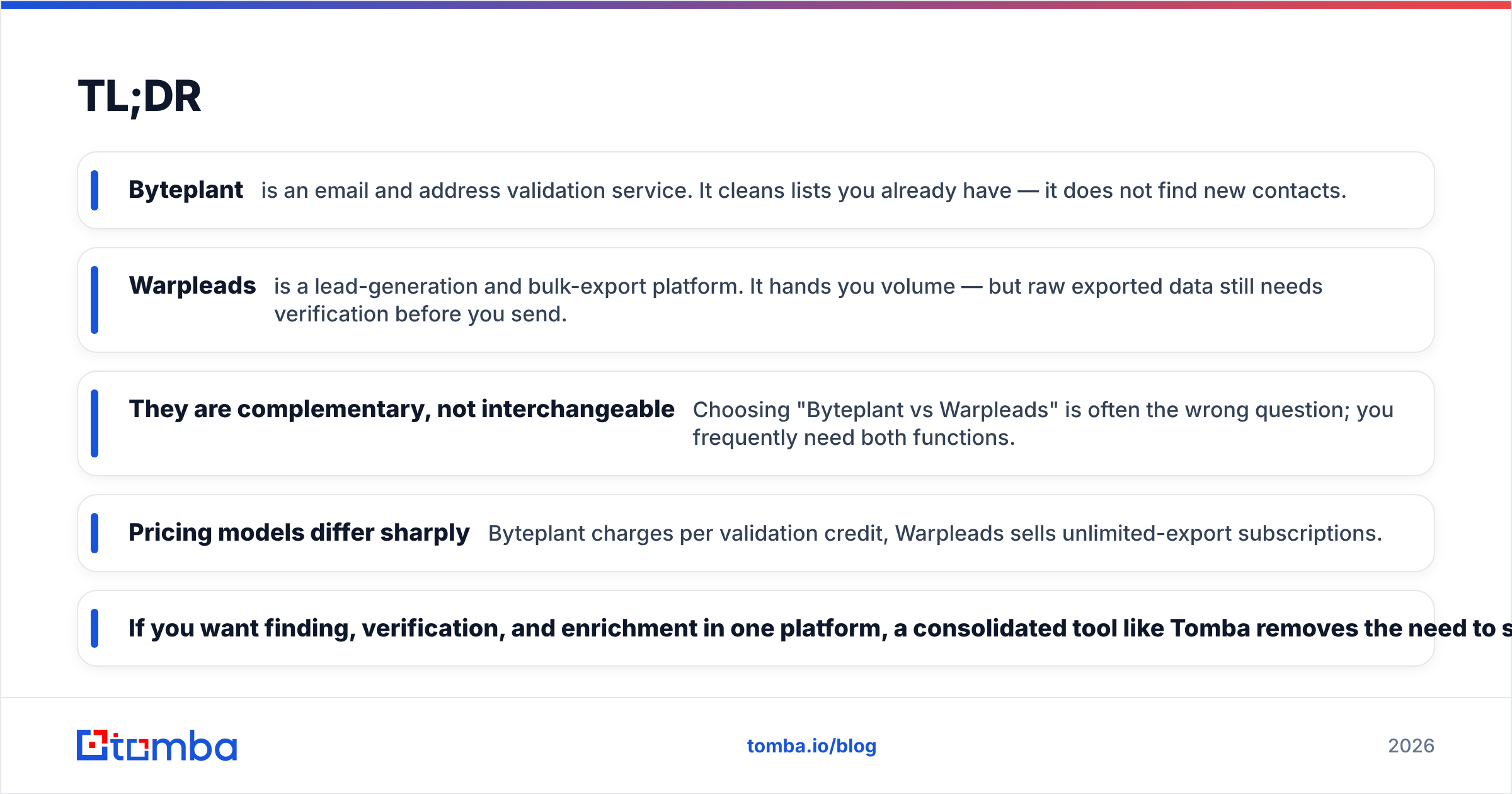
- Byteplant is an email and address validation service. It cleans lists you already have — it does not find new contacts.
- Warpleads is a lead-generation and bulk-export platform. It hands you volume — but raw exported data still needs verification before you send.
- They are complementary, not interchangeable. Choosing "Byteplant vs Warpleads" is often the wrong question; you frequently need both functions.
- Pricing models differ sharply: Byteplant charges per validation credit, Warpleads sells unlimited-export subscriptions.
- If you want finding, verification, and enrichment in one platform, a consolidated tool like Tomba removes the need to stitch two vendors together.

What is Byteplant?#
Byteplant is a data-quality vendor best known for its email validation API (often branded as EmailVerifyAPI) alongside address and phone verification products. Think of it as the quality-control inspector at the end of a factory line: it does not build the product, it checks whether what you already have is defective before it ships.
When you push a list through Byteplant, it runs syntax checks, MX-record lookups, SMTP probes, and known-bounce filtering, then returns a status for each address — valid, invalid, risky, or unknown. Its strength is accuracy on the cleaning side, and it markets heavily to enterprise and developer teams who want a stable email verification API to bolt into their own systems.
What Byteplant does not do is generate leads. If your CRM is empty, Byteplant gives you nothing to validate. It assumes you already have contacts from somewhere else.
What is Warpleads?#
Warpleads is a newer B2B lead-generation platform built around volume. Its pitch is unlimited (or very high-cap) exports of business contacts — names, company data, and emails — so you can fill a sequencing tool fast and cheaply on a flat subscription.
If Byteplant is the inspector, Warpleads is the warehouse: it stocks the shelves with raw inventory. You search by filters, export in bulk, and drop the results into your outreach tool. Warpleads typically bundles some verification, but the depth and freshness of that check is the main thing buyers scrutinize, because exported-at-scale data tends to decay quickly and carry catch-all addresses.
The trade-off with any unlimited-export model is predictable: you optimize for quantity, and data hygiene becomes your responsibility downstream. That is exactly the gap Byteplant-style tools exist to fill — which is why people end up comparing the two.
Byteplant vs Warpleads: how do they actually compare?#
Here is the core distinction laid out attribute by attribute. Read this table as "different jobs," not "winner takes all."
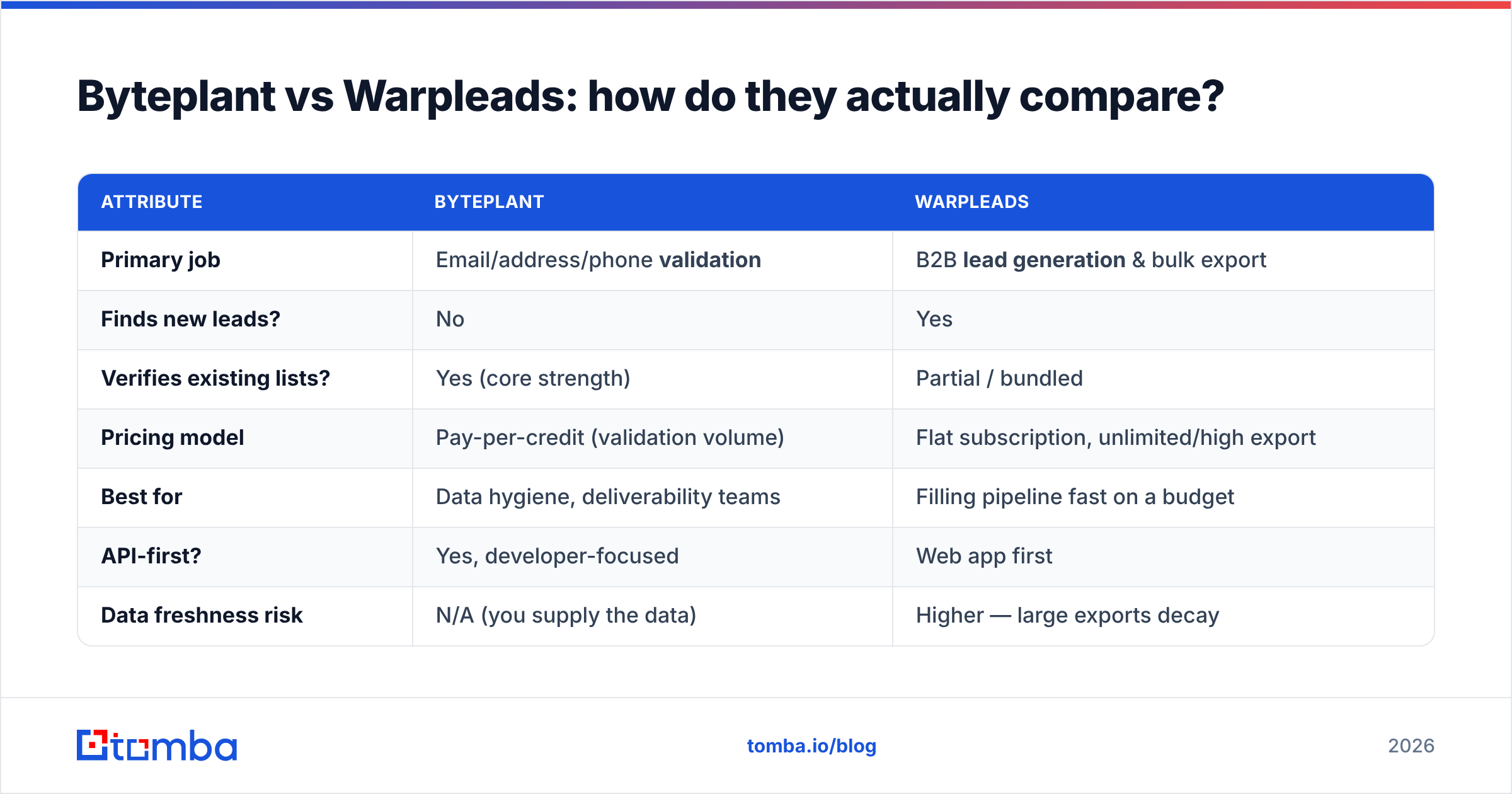
| Attribute | Byteplant | Warpleads |
|---|---|---|
| Primary job | Email/address/phone validation | B2B lead generation & bulk export |
| Finds new leads? | No | Yes |
| Verifies existing lists? | Yes (core strength) | Partial / bundled |
| Pricing model | Pay-per-credit (validation volume) | Flat subscription, unlimited/high export |
| Best for | Data hygiene, deliverability teams | Filling pipeline fast on a budget |
| API-first? | Yes, developer-focused | Web app first |
| Data freshness risk | N/A (you supply the data) | Higher — large exports decay |
| Enrichment (titles, firmographics) | Limited | Some |
The honest read: these tools are two halves of one workflow. Warpleads answers "where do I get contacts?" and Byteplant answers "are these contacts safe to email?" Buying one and skipping the other is how teams end up either with empty pipelines or with high bounce rates that wreck their sender reputation.
Which problem are you actually trying to solve?#
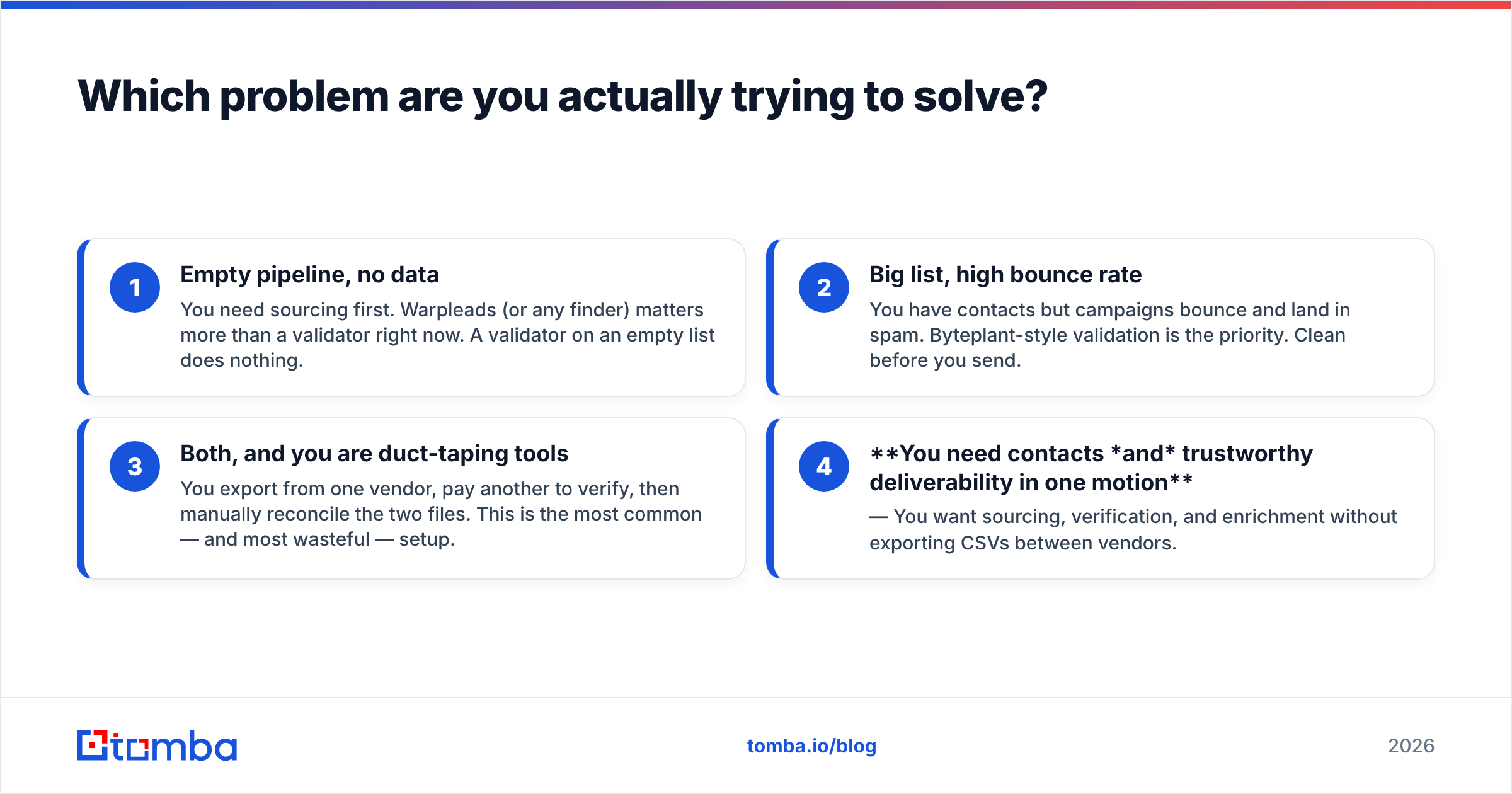
Before you pick, name the bottleneck. Most teams fall into one of these four buckets:
- Empty pipeline, no data — You need sourcing first. Warpleads (or any finder) matters more than a validator right now. A validator on an empty list does nothing.
- Big list, high bounce rate — You have contacts but campaigns bounce and land in spam. Byteplant-style validation is the priority. Clean before you send.
- Both, and you are duct-taping tools — You export from one vendor, pay another to verify, then manually reconcile the two files. This is the most common — and most wasteful — setup.
- You need contacts and trustworthy deliverability in one motion — You want sourcing, verification, and enrichment without exporting CSVs between vendors.
Buckets 3 and 4 are where a single consolidated platform usually beats a two-vendor stack, because every CSV handoff between tools introduces format drift, duplicate rows, and stale records.

How much do Byteplant and Warpleads cost?#
Pricing is where the two diverge most, and it explains who each tool is built for.
Byteplant uses a credit model: you buy a block of validations (for example, tens of thousands of email checks) and burn them down. This is predictable for a one-time list clean but can get expensive if you validate continuously at scale, because every check costs a credit.
Warpleads uses a subscription model centered on unlimited or very high export caps. You pay a flat monthly fee and pull as many leads as your plan allows. That is attractive when you send a lot, but the cost shifts elsewhere: you still pay (in money or deliverability) to verify what you exported.
Neither model is wrong — they are priced for different jobs. The hidden cost is the second tool. If you run Warpleads for sourcing and Byteplant for cleaning, your real monthly spend is both subscriptions plus the labor of moving data between them. When you compare against an all-in-one's pricing, factor in that integration tax.
Rule of thumb: a pay-per-credit validator is cheapest when you clean infrequently; an unlimited exporter is cheapest when you source constantly. Running both means you are paying twice for what one platform can do.
Where does a consolidated tool like Tomba fit?#
Tomba collapses the two jobs into one workflow: find the contact, verify it, and enrich it before it ever reaches your sequencer. Instead of exporting from a lead tool and re-importing into a validator, the verification happens inline.
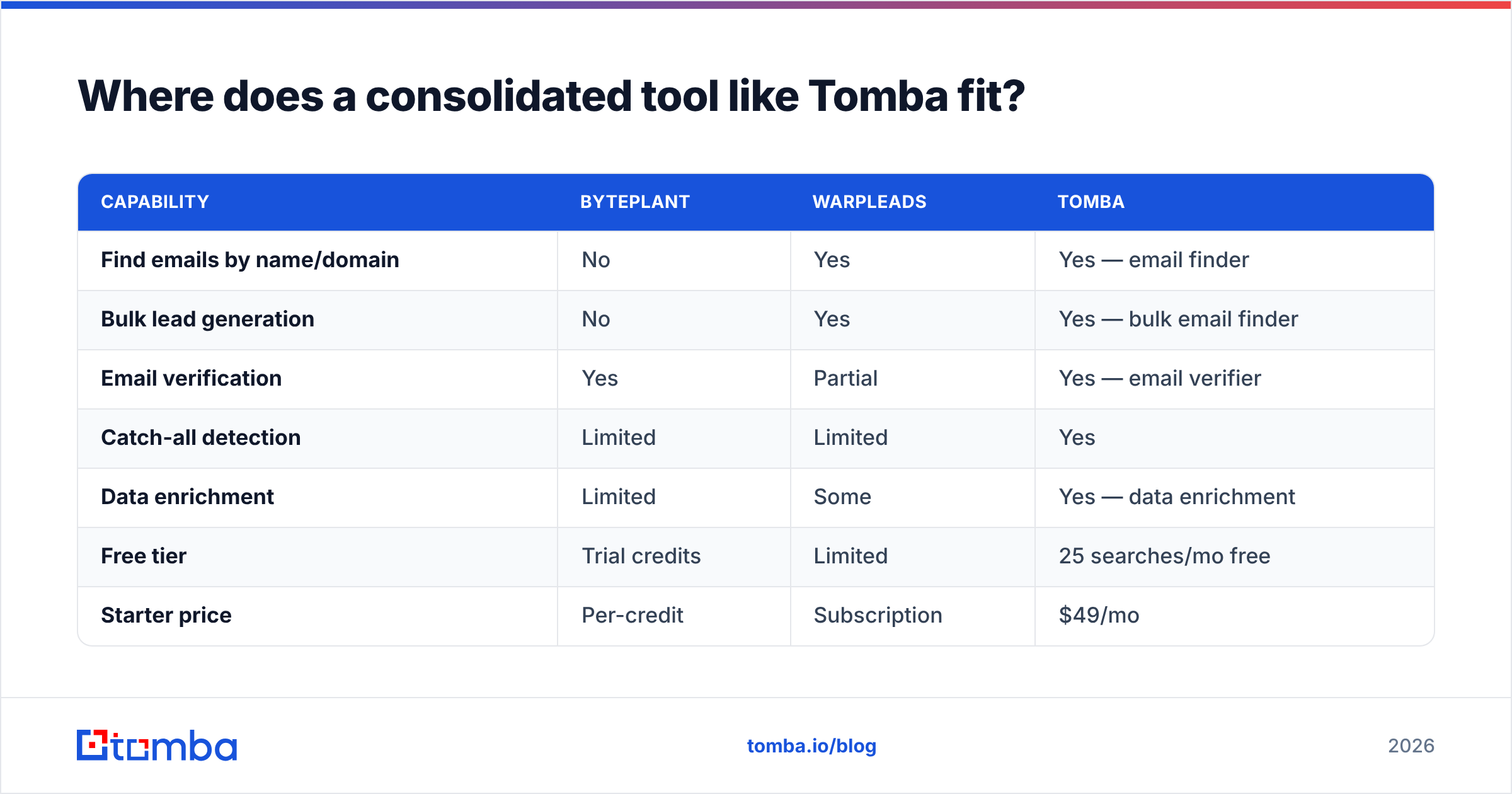
Here is how the functional coverage compares:
| Capability | Byteplant | Warpleads | Tomba |
|---|---|---|---|
| Find emails by name/domain | No | Yes | Yes — email finder |
| Bulk lead generation | No | Yes | Yes — bulk email finder |
| Email verification | Yes | Partial | Yes — email verifier |
| Catch-all detection | Limited | Limited | Yes |
| Data enrichment | Limited | Some | Yes — data enrichment |
| Free tier | Trial credits | Limited | 25 searches/mo free |
| Starter price | Per-credit | Subscription | $49/mo |
Tomba's plans run from a free tier (25 searches/month) through Starter at $49/mo, Growth at $99/mo, Pro at $249/mo, and custom Enterprise. The point is not that Tomba "beats" Byteplant at pure validation depth or out-volumes every unlimited-export tool — it is that for most outbound teams, having finding and verification in one place removes the two-vendor tax entirely.
If you want to see the methodology behind that verification, Tomba documents its data sources openly, which matters when you are trusting a tool with deliverability.
Is Byteplant better than Warpleads?#
Wrong question — but here is the useful answer. Byteplant is better if your only problem is dirty data. It is a mature, API-first validator and it does that job well. If you have a large purchased list and you just need to scrub it before a send, Byteplant is a defensible choice, and you can read real-user takes on G2 before committing.
Warpleads is better if your only problem is volume. When the pipeline is empty and budget is tight, a flat-rate unlimited exporter fills sequences faster than a credit-based validator ever could. Just go in knowing the exported data needs a verification pass.
Neither is "better" overall because they are not really competitors — they are sequential steps. The teams that struggle are the ones who buy one expecting it to do the other's job.
What should you actually buy in 2026?#
Decide with this short checklist:
- You only clean lists, rarely source → Byteplant (or any strong validator).
- You only source, verify elsewhere → Warpleads (or any bulk exporter), plus a separate validator.
- You do outbound end to end → a consolidated platform so finding, verifying, and enriching live in one place.
For most sales and growth teams running continuous outbound, the third path wins on both cost and data integrity. Every tool boundary you remove is one fewer place for duplicates, stale rows, and format mismatches to creep in. You can confirm Warpleads' current export limits and Byteplant's credit packs on their respective sites — Byteplant and Warpleads — before you decide.
The bottom line#
Byteplant and Warpleads are not rivals; they are two stages of one pipeline. Byteplant keeps your existing data clean. Warpleads keeps your pipeline full. If you only have one of those two problems, buy the matching tool and move on.
But if you are doing real outbound — sourcing contacts and protecting deliverability week after week — running two vendors and shuttling CSVs between them is slow and error-prone. That is exactly where a single platform earns its place.
Ready to stop juggling two tools? Start with the Tomba Email Finder to find verified, enriched B2B contacts in one motion — with a free tier of 25 searches a month and built-in verification so the addresses you export are ready to send. Find it, verify it, enrich it, and skip the second subscription entirely.
// get started
Find, verify and enrich your first contacts today
Start on the free plan with 25 searches a month, then scale when your team is ready.
Free plan · No credit card required · GDPR & CCPA
// about the author