Byteplant vs ZoomInfo (2026): Which B2B Data Tool Wins?
Byteplant validates emails; ZoomInfo sells a massive contact database. They solve different problems at wildly different prices. Here's how to choose in 2026.
Byteplant vs ZoomInfo: Which B2B Data Tool Actually Fits Your Stack in 2026?
People type "Byteplant vs ZoomInfo" into Google as if they're two versions of the same product. They aren't. One scrubs your existing list; the other sells you a list in the first place. Picking between them without understanding that gap is how teams end up paying enterprise prices for a problem a $49/mo tool already solves.
TL;DR#
- Byteplant is an email validation engine. It checks whether addresses you already have are deliverable. It does not find new contacts.
- ZoomInfo is a sales intelligence database. It sells access to millions of company and contact records, intent data, and workflow tooling — at a starting cost that routinely clears five figures per year.
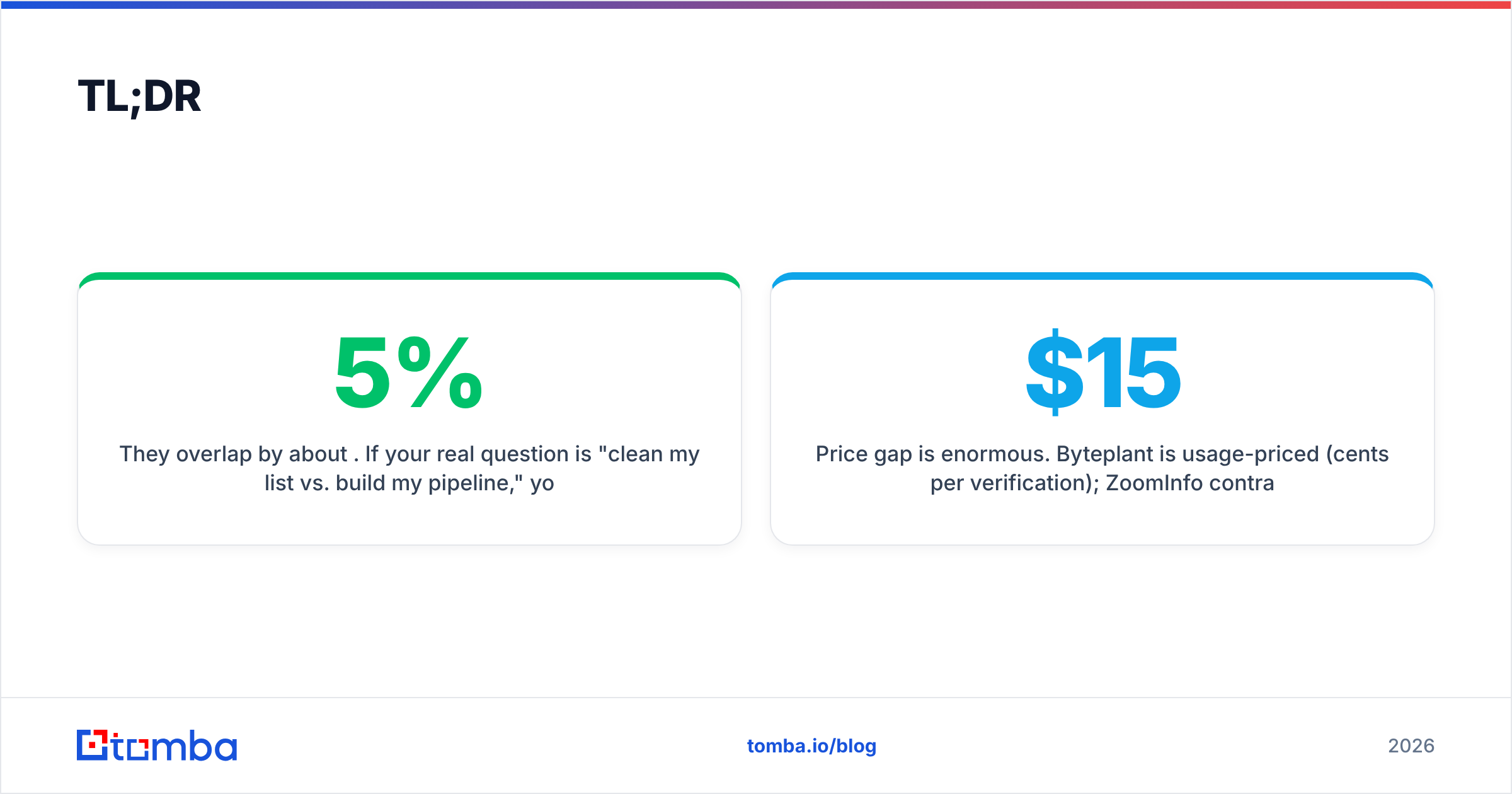
- They overlap by about 5%. If your real question is "clean my list vs. build my pipeline," you're comparing a wrench to a hardware store.
- Price gap is enormous. Byteplant is usage-priced (cents per verification); ZoomInfo contracts commonly land between $15,000 and $40,000+ annually.
- A third path exists. A combined email finder plus email verifier like Tomba covers most of the "find and validate" job for a fraction of ZoomInfo's spend — which is why we'll bring it in as a benchmark.
What is Byteplant?#
Byteplant is a German data-quality vendor best known for its EmailVerifier product (also marketed as DataValidation tools for addresses and phone numbers). Its core job is narrow and well-executed: take a list of email addresses and tell you which ones are real, deliverable, risky, or junk.
Think of Byteplant like a bouncer at the door of your email campaigns. It doesn't recruit the guests — it just checks IDs and keeps the fakes out so your sender reputation survives the night.
Under the hood it runs syntax checks, MX-record lookups, SMTP handshakes, role-account detection, disposable-domain flagging, and catch-all identification. You can use it through a web dashboard, a real-time API, or batch uploads. Pricing is consumption-based: you buy verification credits and burn them per check, which makes it cheap to start and predictable to scale.
What Byteplant is not: a prospecting tool. It has no contact database. It will never hand you a CMO's email address — it only tells you whether the one you already typed in is going to bounce. For that single job, it's solid and you can read independent reviews on G2 to confirm.
What is ZoomInfo?#
ZoomInfo is the opposite end of the spectrum: a full go-to-market intelligence platform. Its value isn't validation — it's discovery. ZoomInfo maintains one of the largest commercial B2B databases in the world, covering hundreds of millions of professional profiles, firmographics, technographics, org charts, and buying-intent signals.
If Byteplant is the bouncer, ZoomInfo is the entire guest list, their job titles, who they report to, and a tip that three of them are shopping for exactly what you sell this quarter.
ZoomInfo bundles in workflow features too: list building, CRM enrichment, intent scoring, conversation intelligence (via Chorus), and sales engagement. You can see the full scope on the official ZoomInfo site. All of that power comes with a price tag and a contract — typically annual, seat-based, with add-on modules that stack quickly.

The catch is that ZoomInfo's data, while broad, still needs verification before you send. A database that large drifts — people change jobs constantly — so even ZoomInfo users run a verification pass before hitting send. That's the irony: buying ZoomInfo doesn't eliminate the Byteplant-shaped problem.
Byteplant vs ZoomInfo: the core difference#
Here's the cleanest way to hold it in your head:
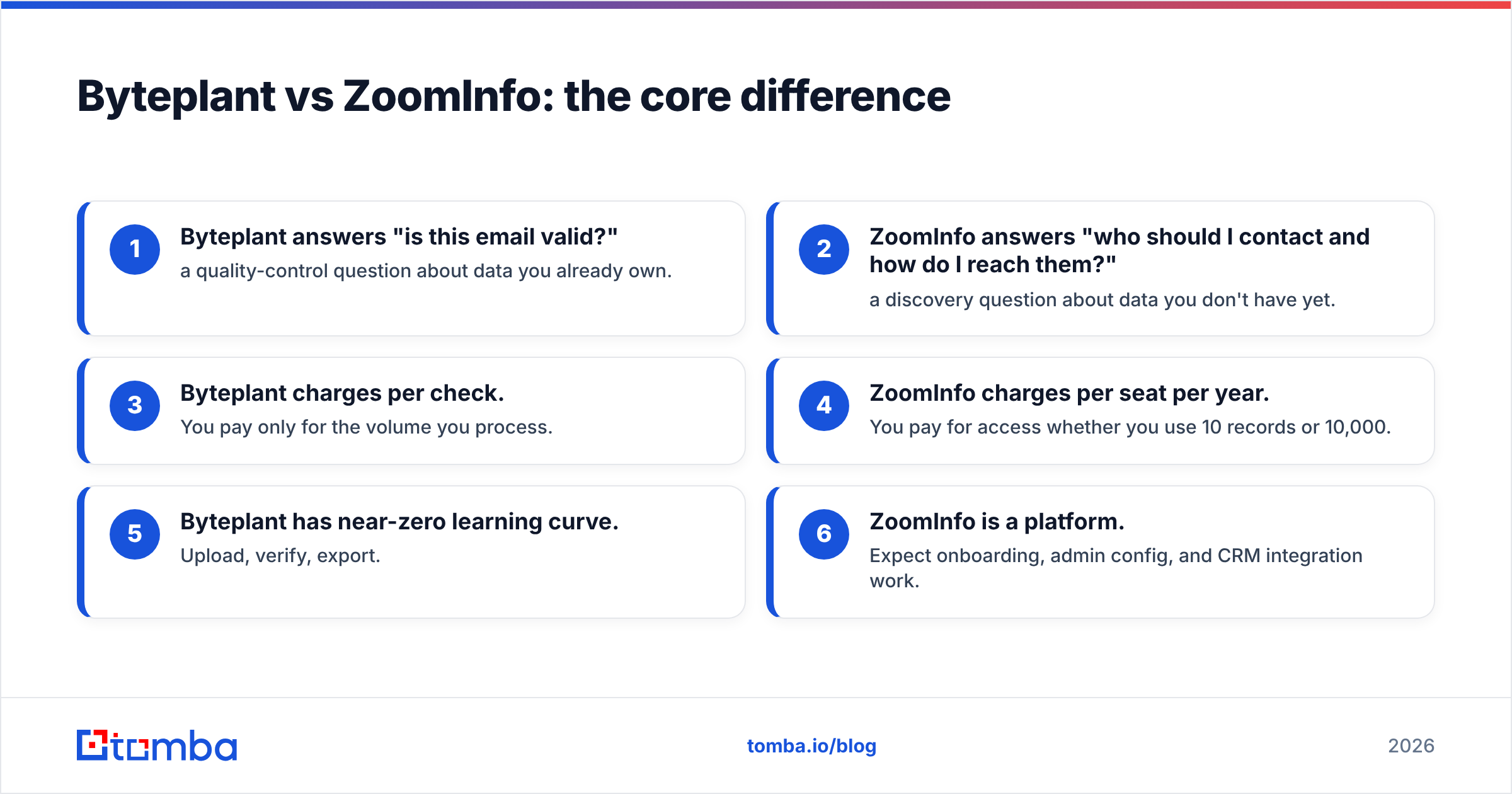
- Byteplant answers "is this email valid?" — a quality-control question about data you already own.
- ZoomInfo answers "who should I contact and how do I reach them?" — a discovery question about data you don't have yet.
- Byteplant charges per check. You pay only for the volume you process.
- ZoomInfo charges per seat per year. You pay for access whether you use 10 records or 10,000.
- Byteplant has near-zero learning curve. Upload, verify, export.
- ZoomInfo is a platform. Expect onboarding, admin config, and CRM integration work.
These are different line items in a sane go-to-market budget. The mistake is treating them as either/or when, for many teams, the honest answer is "I need a finder, and verification baked in" — not a $30k database.
How do they compare side by side?#
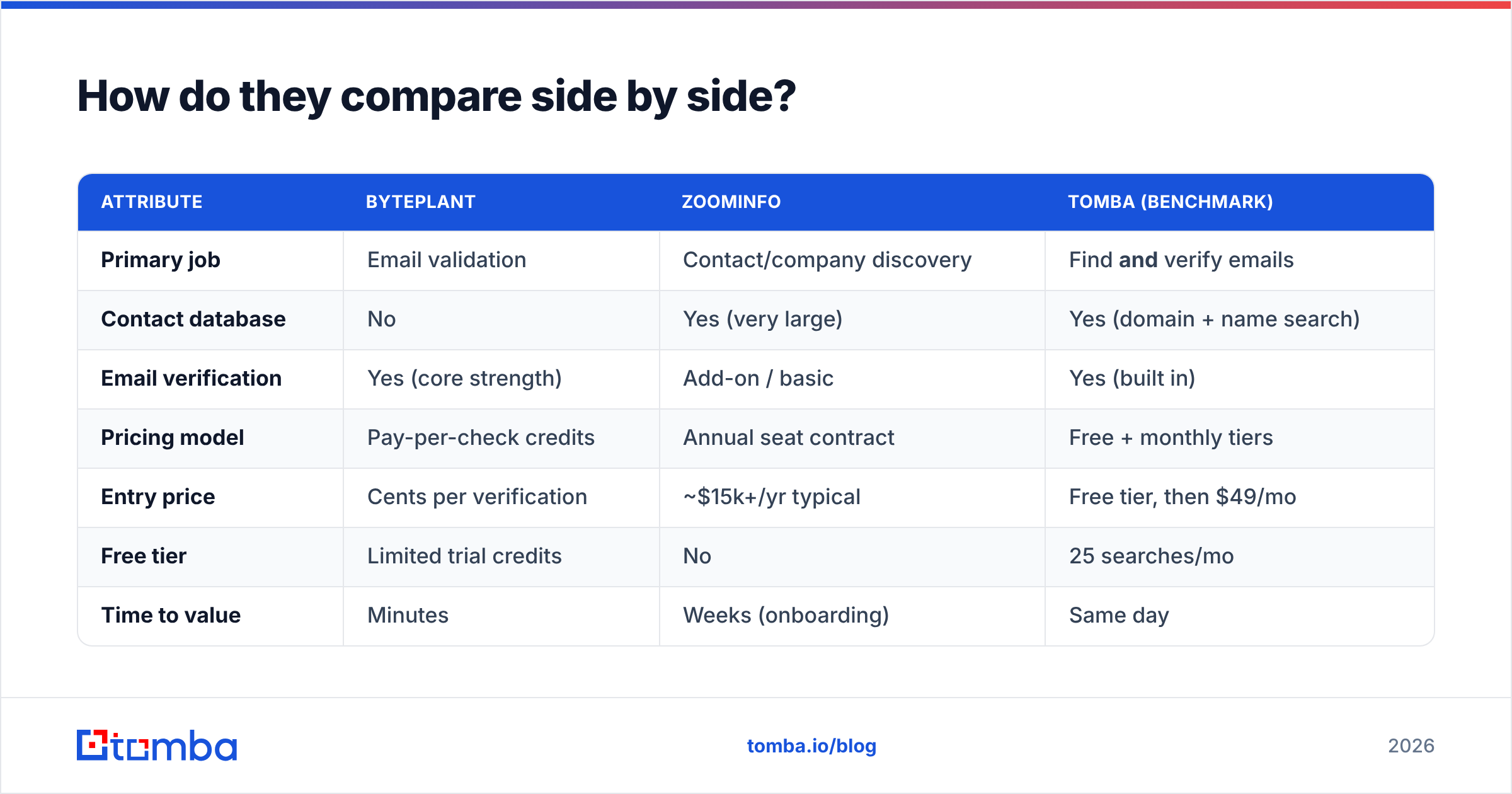
| Attribute | Byteplant | ZoomInfo | Tomba (benchmark) |
|---|---|---|---|
| Primary job | Email validation | Contact/company discovery | Find and verify emails |
| Contact database | No | Yes (very large) | Yes (domain + name search) |
| Email verification | Yes (core strength) | Add-on / basic | Yes (built in) |
| Pricing model | Pay-per-check credits | Annual seat contract | Free + monthly tiers |
| Entry price | Cents per verification | ~$15k+/yr typical | Free tier, then $49/mo |
| Free tier | Limited trial credits | No | 25 searches/mo |
| Time to value | Minutes | Weeks (onboarding) | Same day |
| Best for | Cleaning existing lists | Enterprise GTM teams | SMBs & lean sales teams |
| API access | Yes | Yes (higher tiers) | Yes (Tomba API) |
| Contract lock-in | None | Annual | Month-to-month |
The table makes the strategic point obvious: Byteplant and ZoomInfo barely compete. Byteplant competes with other verifiers (ZeroBounce, NeverBounce, Bouncer). ZoomInfo competes with Apollo, Cognism, and Lusha. The only reason they show up in the same search is that buyers conflate "good email data" with "lots of email data."
Is ZoomInfo worth the price over Byteplant?#
Wrong question — but it's the one everyone asks, so let's answer it honestly.
ZoomInfo is worth its price only if you actually consume what you're paying for: large prospecting volumes, multiple seats, intent-driven outbound, and tight CRM workflows that justify a platform. For a 30-person SDR org running account-based plays across thousands of target accounts, ZoomInfo's data depth and intent signals can pay for themselves.
For a five-person team that mostly needs to reach known target companies, ZoomInfo is overkill — you'd be financing a database the size of a phone book to make a dozen calls a week. And Byteplant alone won't fill the gap either, because it can't find anyone.
That's the trap in the middle: Byteplant is too narrow (no discovery), ZoomInfo is too heavy (enterprise cost). Most small and mid-market teams live precisely in that gap.

Where does a tool like Tomba fit?#
Tomba sits in that exact gap, and that's why it belongs in this comparison even though it's neither a pure verifier nor a ZoomInfo-scale database.
Tomba combines discovery and validation in one workflow:
- Find emails by domain, name, or company with the email finder, so you get the discovery layer ZoomInfo provides — without the contract.
- Verify before you send so you get the deliverability protection Byteplant provides — without bolting on a second vendor.
- Search by company using domain search to pull every public address pattern at a target account.
- Run it at scale with the bulk email finder when you're working a full list instead of one prospect.
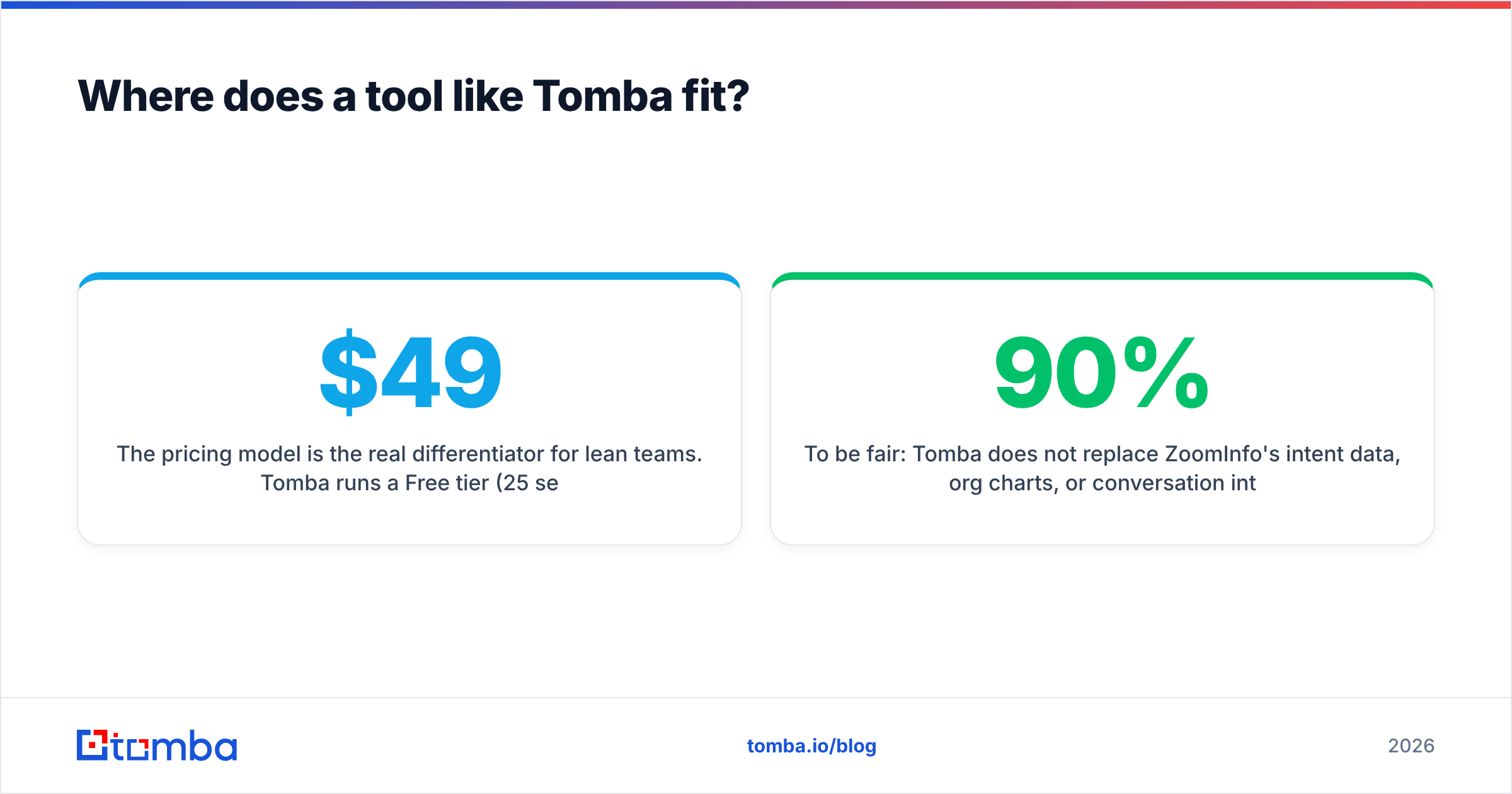
The pricing model is the real differentiator for lean teams. Tomba runs a Free tier (25 searches/mo), then Starter at $49/mo, Growth at $99/mo, and Pro at $249/mo — month to month, no annual lock-in. You can see the full breakdown on the Tomba pricing page. That's a different universe from a ZoomInfo contract, and it includes verification that Byteplant would charge you separately for.
To be fair: Tomba does not replace ZoomInfo's intent data, org charts, or conversation intelligence. If those signals drive your revenue motion, ZoomInfo earns its keep. But if "find the right person's email and don't bounce" is 90% of your need, paying enterprise rates is leaving money on the table.
Which should you choose? A decision guide#
Match the tool to the actual job rather than the search query:
- You already have a list and just need it clean → Byteplant (or a built-in verifier). Cheap, fast, no commitment.
- You're an enterprise GTM team running intent-based ABM at scale → ZoomInfo. The depth justifies the spend at that volume.
- You need to find contacts AND keep bounce rates low, on an SMB budget → a finder-plus-verifier like Tomba. One tool, two jobs, no five-figure invoice.
- You're verification-only but hate per-vendor sprawl → consider a platform that includes verification so you're not paying twice.
A quick gut check: if you can't name three platform features beyond "the database" that you'll use weekly, you probably don't need ZoomInfo yet. And if you find yourself buying Byteplant credits because the contacts you sourced bounce a lot, the smarter fix is sourcing cleaner contacts in the first place — which means a finder with verification built in.
What about data accuracy?#
Accuracy is where the "vs" finally becomes a fair fight, because both touch deliverability.
Byteplant's whole reputation rests on verification accuracy, and for pure validation it performs well — its SMTP-level checks and catch-all detection are genuinely useful. ZoomInfo's accuracy is a different metric: breadth and freshness of contact records. A huge database means more matches, but also more stale rows, because the more people you track, the more job changes you miss between refreshes.
The practical takeaway: no database is accurate enough to skip verification. Whether you source from ZoomInfo, scrape LinkedIn, or buy a list, you verify before you send. That's why a workflow that pairs sourcing with email verification in one pass tends to beat stitching a discovery vendor to a separate validation vendor — fewer handoffs, fewer stale rows slipping through, one bill.
The bottom line#
Byteplant and ZoomInfo aren't really rivals — they're two stages of the same pipeline. Byteplant cleans; ZoomInfo discovers. Comparing them head-to-head only makes sense once you admit what you're actually trying to do.
If you're an enterprise drowning in target accounts and intent signals, ZoomInfo is built for you. If you just need a cleaner list, Byteplant does that job cheaply. But if you're like most growing sales teams — you need to find the right contacts and reach them without bouncing, without signing an annual enterprise contract — neither one alone is the answer.
Start with the Tomba Email Finder. Use the free 25 searches to pull real, verified contacts at your target companies, see the deliverability hold up in your own outbound, and decide from evidence instead of a sales demo. It's the rare option that covers the discovery ZoomInfo charges five figures for and the verification Byteplant bills separately — at a price a lean team can actually approve. Find emails, verify them, and send with confidence.
// get started
Find, verify and enrich your first contacts today
Start on the free plan with 25 searches a month, then scale when your team is ready.
Free plan · No credit card required · GDPR & CCPA
// about the author