Calilio Pricing, Reviews, Pros and Cons: 2026 Honest Guide
A no-fluff 2026 breakdown of Calilio pricing, real user reviews, and the pros and cons that matter before you buy a cloud phone system for sales.
Calilio is a cloud-based business phone system built for teams that live on the phone — sales reps, support desks, and distributed startups that need numbers in multiple countries without buying hardware. If you are evaluating it for an outbound sales motion, the real questions are simple: what does it cost, what do users actually say, and where does it fall short. This guide answers all three without the marketing gloss.
TL;DR#
- Calilio is a VoIP/virtual phone platform, not a CRM or a data tool — it gives you numbers, a dialer, call recording, and analytics.
- Pricing is per-user, per-month, with an entry tier in the low teens and a business tier around $20/user — plus usage costs for numbers and minutes. Always confirm live rates on Calilio's site before you commit.
- Reviewers praise the clean interface, fast number provisioning, and call analytics; common complaints center on occasional call quality dips, support response times, and integration gaps.
- A phone system only performs as well as the list you load into it — bad numbers and missing contacts kill connect rates faster than any feature.
- Pair Calilio (or any dialer) with accurate contact data from a tool like Tomba so your reps dial real people, not dead lines.
What is Calilio and who is it for?#
Calilio is a cloud phone system you run entirely from a browser or app — no PBX box in a closet. You buy virtual numbers (local, toll-free, or international), assign them to team members, and route calls through Calilio's infrastructure. The platform bundles the features a modern sales or support team expects: shared inboxes for calls and texts, call recording, IVR menus, analytics dashboards, and team collaboration tools like call notes and tags.
The sweet spot is small-to-mid sales and support teams that want predictable per-seat pricing and global number coverage without an enterprise telecom contract. If you run cold-calling campaigns, Calilio sits in the same conversation as Aircall, OpenPhone, JustCall, and CloudTalk. It is less of a fit for large contact centers that need deep workforce management, or for solo users who just want one cheap line.
One thing to set straight early: Calilio handles the call, not the contact. It does not find phone numbers or enrich leads. That gap is where most outbound teams quietly lose money, and we will come back to it.
How much does Calilio cost in 2026?#
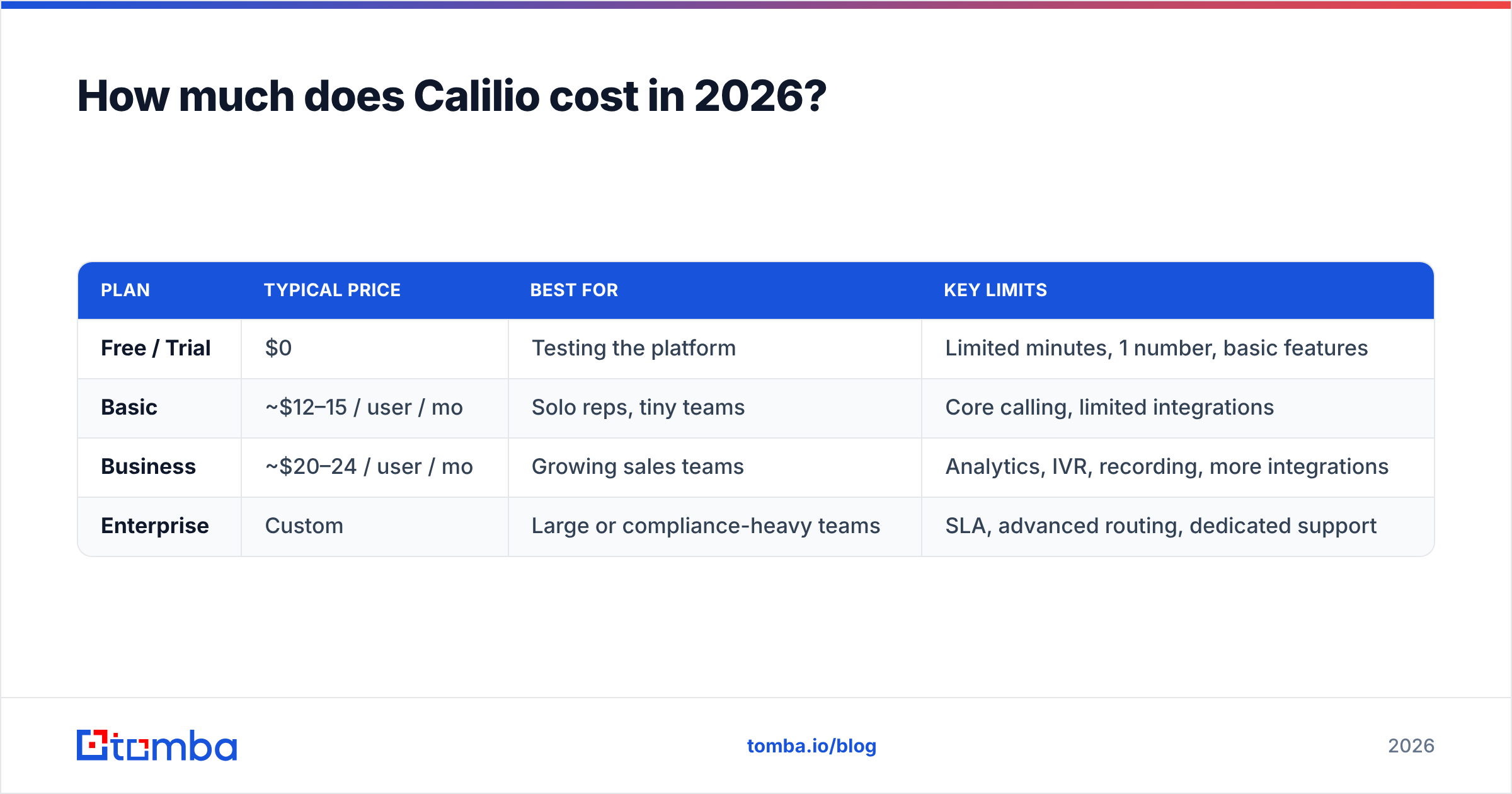
Calilio uses per-user, per-month pricing with separate charges for the numbers and minutes you consume. The plan structure below reflects the typical shape of its tiers — treat the figures as a planning baseline and verify current numbers on the official Calilio site, since VoIP vendors adjust pricing and bundled minutes often.
| Plan | Typical price | Best for | Key limits |
|---|---|---|---|
| Free / Trial | $0 | Testing the platform | Limited minutes, 1 number, basic features |
| Basic | ~$12–15 / user / mo | Solo reps, tiny teams | Core calling, limited integrations |
| Business | ~$20–24 / user / mo | Growing sales teams | Analytics, IVR, recording, more integrations |
| Enterprise | Custom | Large or compliance-heavy teams | SLA, advanced routing, dedicated support |
Beyond the seat price, budget for three things that catch buyers off guard:
- Number rental — each local or toll-free number carries a small monthly fee on top of the seat.
- Per-minute usage — international and high-volume calling can add up quickly outside bundled minutes.
- Add-ons — some advanced analytics, compliance, or integration features live in higher tiers or as paid extras.
When you compare Calilio's per-seat cost to your CRM, dialer add-ons, and data spend, the phone bill is rarely the expensive part. The expensive part is reps burning paid minutes dialing wrong or dead numbers — which is a data problem, not a telecom one. If you want a sense of how data tooling is priced alongside a stack like this, the transparent Tomba pricing page is a useful reference point.
What do Calilio reviews say — the pros?#
Across G2 and Capterra, Calilio's strongest, most repeated positives cluster around four themes.
- Clean, modern interface. Reviewers consistently call out how fast the UI is to learn. New reps are taking calls the same day, which lowers onboarding friction for growing teams.
- Quick number provisioning. Spinning up local numbers in new markets is fast — a real advantage if you sell internationally and need a local presence to lift answer rates.
- Useful call analytics. Dashboards for call volume, duration, missed calls, and team activity give managers visibility without exporting to spreadsheets.
- Collaboration features. Shared call inboxes, notes, and tags help small teams stay aligned on accounts without a heavy CRM workflow.
- Reasonable entry price. For teams priced out of premium incumbents, Calilio's lower tiers deliver most of the day-to-day calling features at a friendlier seat cost.
The throughline: Calilio earns its keep as an easy-to-adopt, fairly priced calling layer. For a team that mostly needs reliable numbers and visibility, that is often enough.
What do Calilio reviews say — the cons?#
No tool wins every review, and the honest picture includes friction. The recurring criticisms:
- Occasional call-quality dips. Some users report jitter or dropped calls during peak hours or on weaker networks. VoIP quality is partly your bandwidth, but it shows up in reviews often enough to flag.
- Support response times. A subset of reviewers describe slower-than-hoped support on lower tiers. If uptime and fast help are mission-critical, scrutinize the SLA on your plan.
- Integration gaps. Calilio integrates with common tools, but power users sometimes want deeper, native CRM sync or more automation hooks than the current connector list offers.
- Feature gating. Advanced analytics, routing, and compliance features can sit behind higher tiers, nudging serious teams toward the Business or Enterprise price.
- No built-in data layer. This is the big structural one: Calilio gives you a great way to dial, but zero help finding who to dial or confirming a number is live. You bring the list; it makes the call.
That last point is the hinge of this whole evaluation, so let's deal with it directly.
Is a cloud phone system enough on its own?#
No — a dialer without clean contact data is a fast car with no fuel. You can buy the slickest phone system on the market and still watch connect rates crater because half your numbers are wrong, disconnected, or belong to the wrong person.
Think of it like a restaurant. Calilio is the kitchen — efficient, well-equipped, ready to cook. But if the delivery truck drops off spoiled ingredients (stale, unverified contact data), no kitchen can serve a good meal. The quality of your outbound results is capped by the quality of the data going in, every single time.
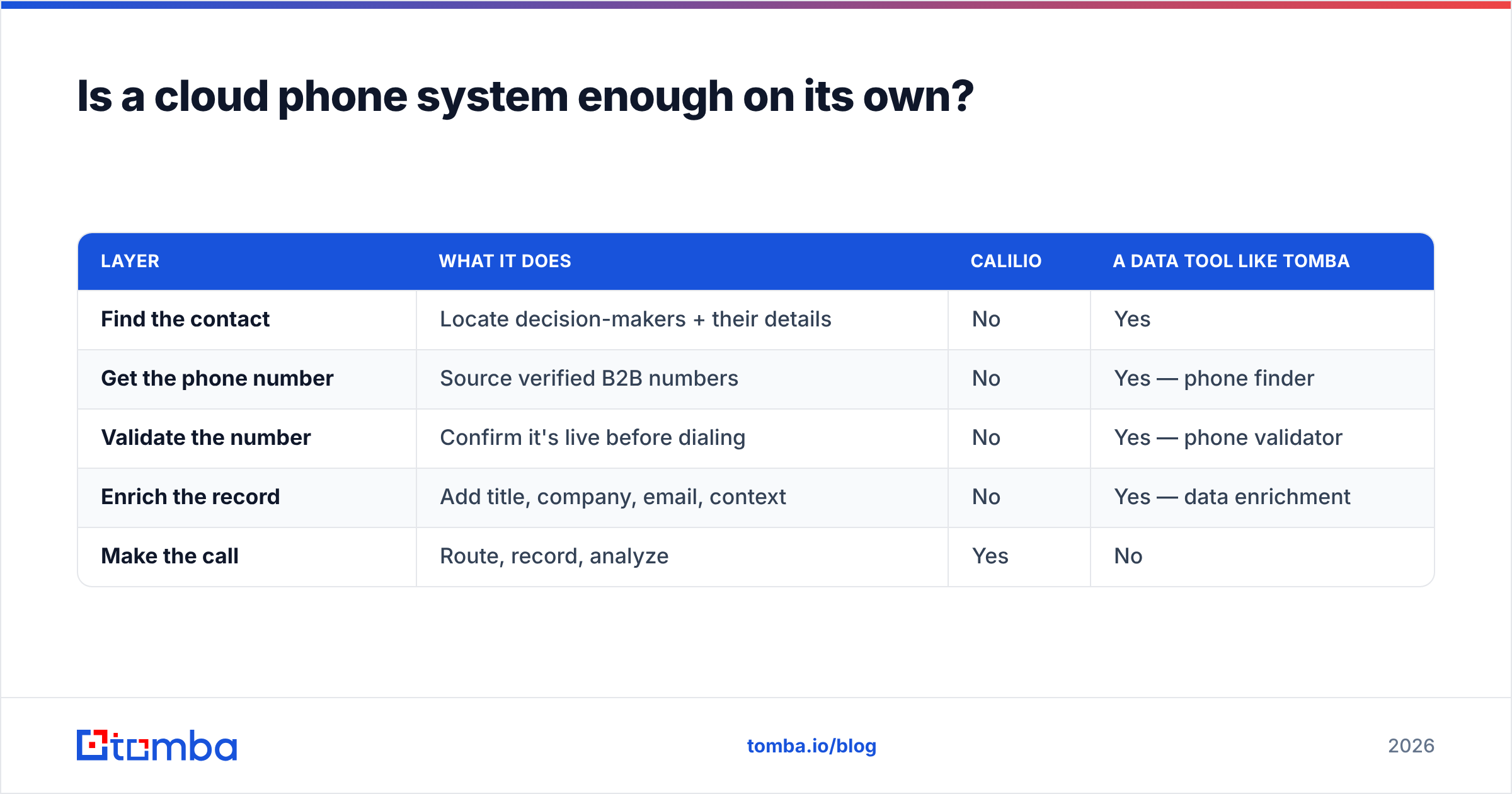
Here is how the two layers split:
| Layer | What it does | Calilio | A data tool like Tomba |
|---|---|---|---|
| Find the contact | Locate decision-makers + their details | No | Yes |
| Get the phone number | Source verified B2B numbers | No | Yes — phone finder |
| Validate the number | Confirm it's live before dialing | No | Yes — phone validator |
| Enrich the record | Add title, company, email, context | No | Yes — data enrichment |
| Make the call | Route, record, analyze | Yes | No |
The two are complementary, not competing. Calilio owns the call. A contact-data platform owns everything that has to be true before the call connects. Teams that treat data as an afterthought end up paying for premium minutes to leave voicemails for disconnected lines.

How does Calilio compare to other phone systems?#
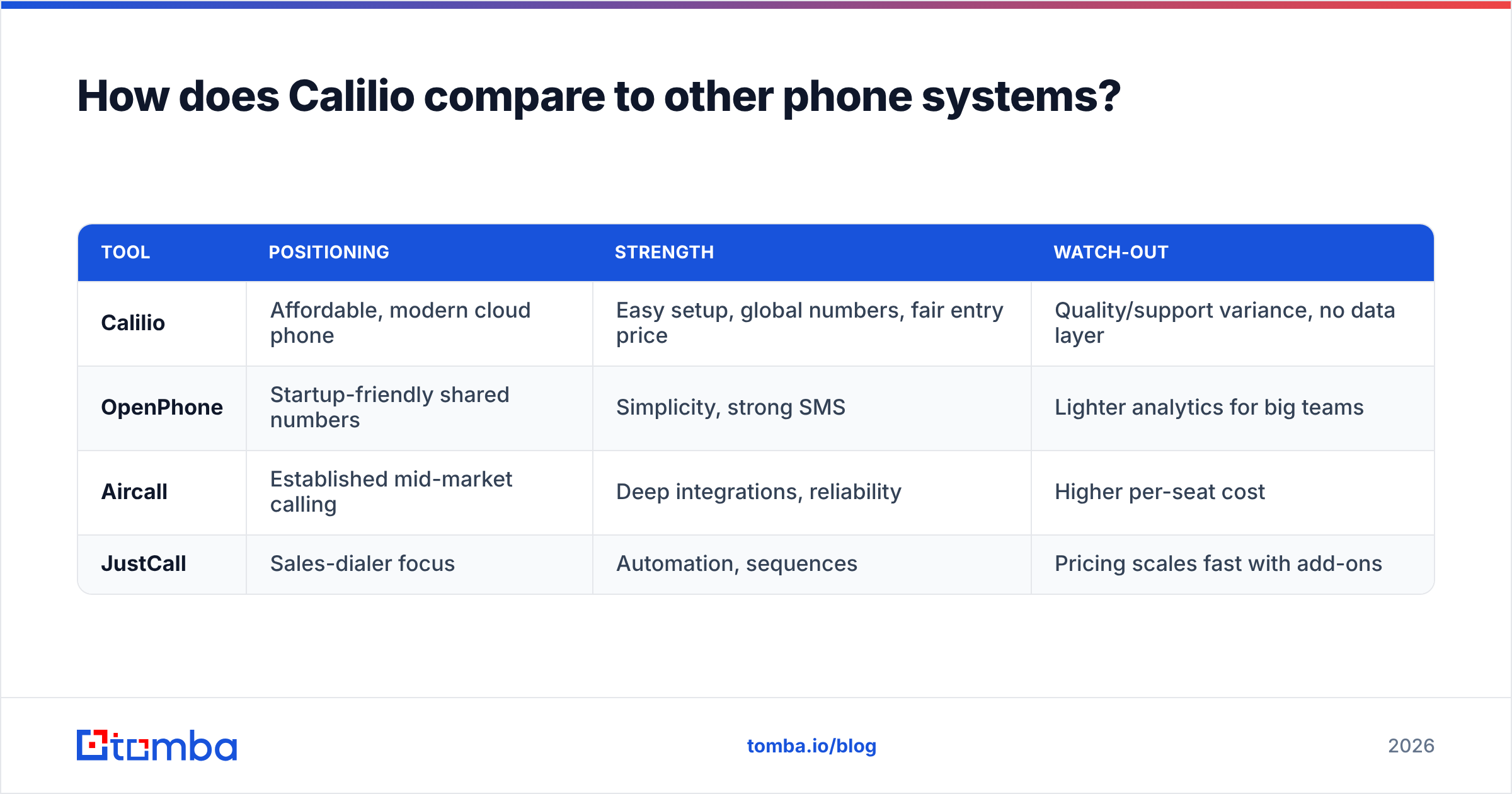
If Calilio makes your shortlist, it is usually next to OpenPhone, Aircall, and JustCall. A rough positioning:
| Tool | Positioning | Strength | Watch-out |
|---|---|---|---|
| Calilio | Affordable, modern cloud phone | Easy setup, global numbers, fair entry price | Quality/support variance, no data layer |
| OpenPhone | Startup-friendly shared numbers | Simplicity, strong SMS | Lighter analytics for big teams |
| Aircall | Established mid-market calling | Deep integrations, reliability | Higher per-seat cost |
| JustCall | Sales-dialer focus | Automation, sequences | Pricing scales fast with add-ons |
The right pick depends on what you weight: raw price and ease (Calilio, OpenPhone), integration depth (Aircall), or sales automation (JustCall). But note what is not on this axis — none of these is a data provider. Whichever dialer wins, you still need to solve the "good numbers and good contacts" problem separately.
How do you get more from Calilio (or any dialer)?#
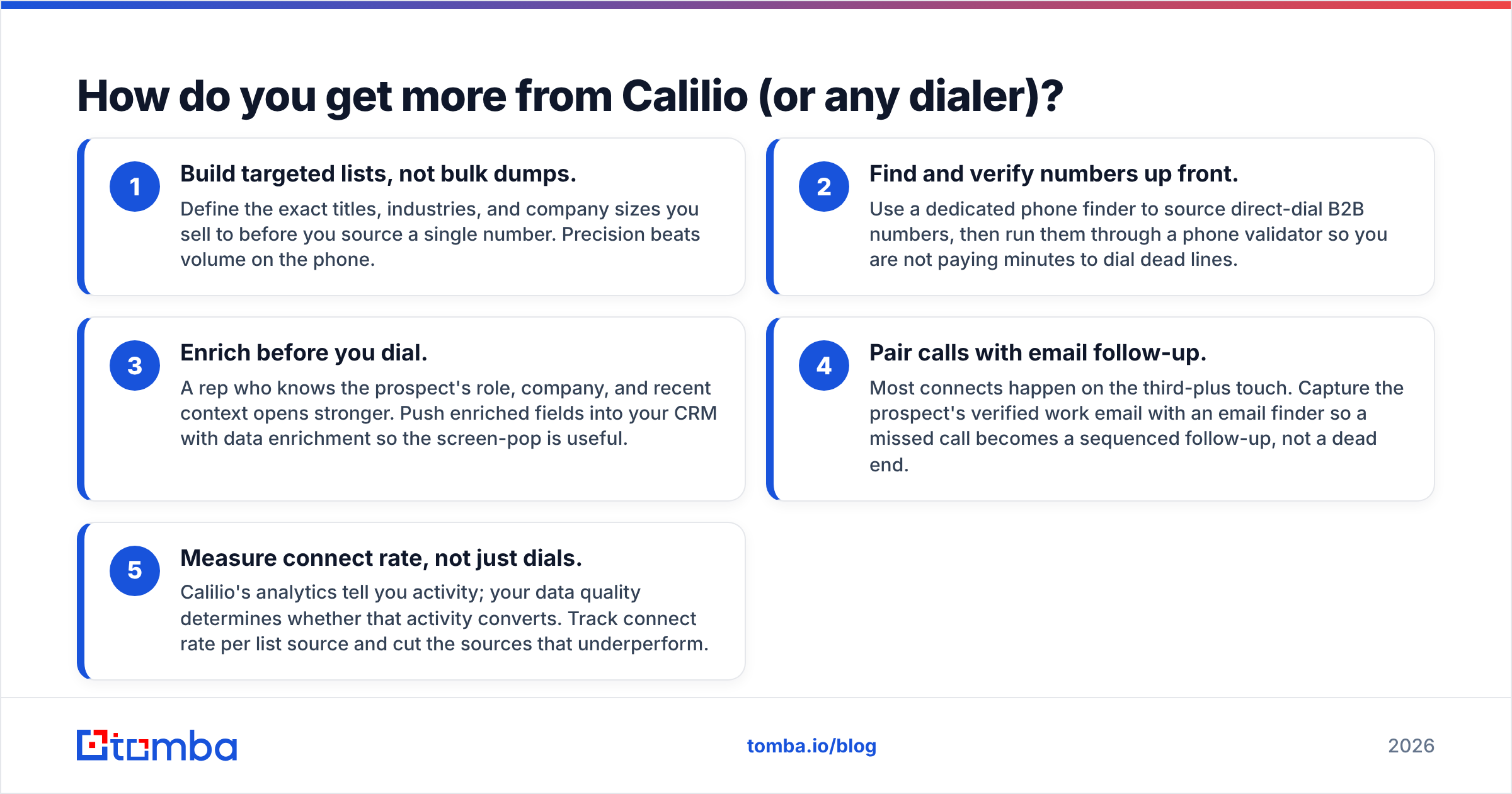
Buy the phone system for the calling experience, then fix the input side so reps spend their day talking to real prospects. A practical checklist:
- Build targeted lists, not bulk dumps. Define the exact titles, industries, and company sizes you sell to before you source a single number. Precision beats volume on the phone.
- Find and verify numbers up front. Use a dedicated phone finder to source direct-dial B2B numbers, then run them through a phone validator so you are not paying minutes to dial dead lines.
- Enrich before you dial. A rep who knows the prospect's role, company, and recent context opens stronger. Push enriched fields into your CRM with data enrichment so the screen-pop is useful.
- Pair calls with email follow-up. Most connects happen on the third-plus touch. Capture the prospect's verified work email with an email finder so a missed call becomes a sequenced follow-up, not a dead end.
- Measure connect rate, not just dials. Calilio's analytics tell you activity; your data quality determines whether that activity converts. Track connect rate per list source and cut the sources that underperform.
Do these five things and a mid-tier phone system will outperform a premium one running on garbage data. The leverage is in the inputs.
Calilio pricing, reviews, pros and cons — the verdict#
Calilio is a credible, affordable cloud phone system that does the core job well: fast number provisioning, a clean interface, and analytics that small-to-mid sales and support teams genuinely use. Its weak spots — occasional call-quality variance, support timing on lower tiers, and integration gaps — are worth probing during a trial, but none are dealbreakers for most teams. At roughly $12–24 per user per month plus usage, it is priced to compete.
The honest caveat is structural, not a knock on Calilio specifically: a phone system is half the equation. It cannot find your prospects, source their numbers, or tell you whether a line is even live. Skip that half and you will blame the dialer for results that bad data caused.
So treat the decision as two purchases. Pick the calling layer that fits your budget and integration needs — Calilio is a strong candidate. Then fund the data layer that keeps it busy with real, reachable people. Start with Tomba's email finder and phone finder to build verified, enriched contact lists, validate every number before it hits the dialer, and watch your connect rate climb regardless of which phone system you chose. Your reps' time is the most expensive line item you have — point it at people who actually pick up.
// get started
Find, verify and enrich your first contacts today
Start on the free plan with 25 searches a month, then scale when your team is ready.
Free plan · No credit card required · GDPR & CCPA
// about the author