Sales Call Planning in 2026: A Pre-Call Prep Framework
Most reps lose the call before they dial. Here's a repeatable call planning framework that turns cold conversations into booked meetings in 2026.
You can hear an unplanned call within ten seconds. The rep fumbles the name, mispronounces the company, asks a question they could have answered with a 30-second LinkedIn check, and the prospect mentally hangs up while still holding the phone. Call planning is the difference between a conversation that earns the next 20 minutes and one that gets "we're all set, thanks."
This guide gives you a concrete, repeatable pre-call framework you can run in five minutes per prospect — not a vague "do your research" platitude.
TL;DR#
- Call planning is pre-call preparation: research, a single primary objective, a tailored opener, anticipated objections, and a clear next step — written down before you dial.
- Accurate contact data is step zero. A perfect script aimed at the wrong number or a stale title wastes the whole effort. Verify the human before you plan the call.
- One call, one objective. Trying to qualify, demo, and close in a single cold call is why most calls collapse. Pick the next commitment.
- Anticipate the three objections you'll actually hear and script the first sentence of each response — improvising under pressure is where reps lose deals.
- A 5-minute planning template scales across a list; pair it with a B2B database and verified direct dials so the plan rests on real data.
What is call planning in sales?#
Call planning is the structured preparation a rep does before a sales call so the conversation has a destination instead of wandering. Think of it like a pilot's pre-flight checklist: the flight is mostly automatic once you're in the air, but skipping the checklist on the ground is how avoidable disasters happen. The plan is the checklist — research, objective, opener, objection handling, and the close.
It applies to every call type, but the depth changes:
- Cold calls — light research, a pattern-interrupt opener, and heavy objection prep, because you have seconds to earn attention.
- Discovery calls — a question map tied to your qualification framework (MEDDIC, BANT, or your own), because the goal is information, not persuasion.
- Demo calls — a tailored agenda built from what discovery surfaced, so the demo speaks to their pain, not your feature list.
- Renewal or expansion calls — account history, usage data, and a specific expansion thesis, because "just checking in" is not a reason to call.
- Closing calls — a mutual action plan and a pre-handled list of last-minute blockers (legal, security, budget timing).
The common thread: every effective call plan answers four questions — Who am I calling? Why am I calling? What's the one outcome I want? What will they push back on?
Why does call planning matter more in 2026?#
Buyers are harder to reach and faster to disqualify you. Direct dials are scarcer, gatekeepers are smarter, and a prospect who senses a generic pitch is gone before your second sentence. According to HubSpot's sales research, personalization and relevance now drive connect-to-meeting conversion more than raw dial volume. Conversation-intelligence platforms like Gong consistently show that the calls that convert open with a relevant, specific reason — not a script.
There's a second reason: data decay. Roughly a quarter to a third of B2B contact data goes stale every year — people change roles, companies, and numbers. A flawless call plan built on a contact who left the company eight months ago is a flawless plan for a wrong number. That's why the first move in any serious call planning workflow is verifying the person and pulling a current direct line, not writing the opener.
What are the core steps of a pre-call plan?#
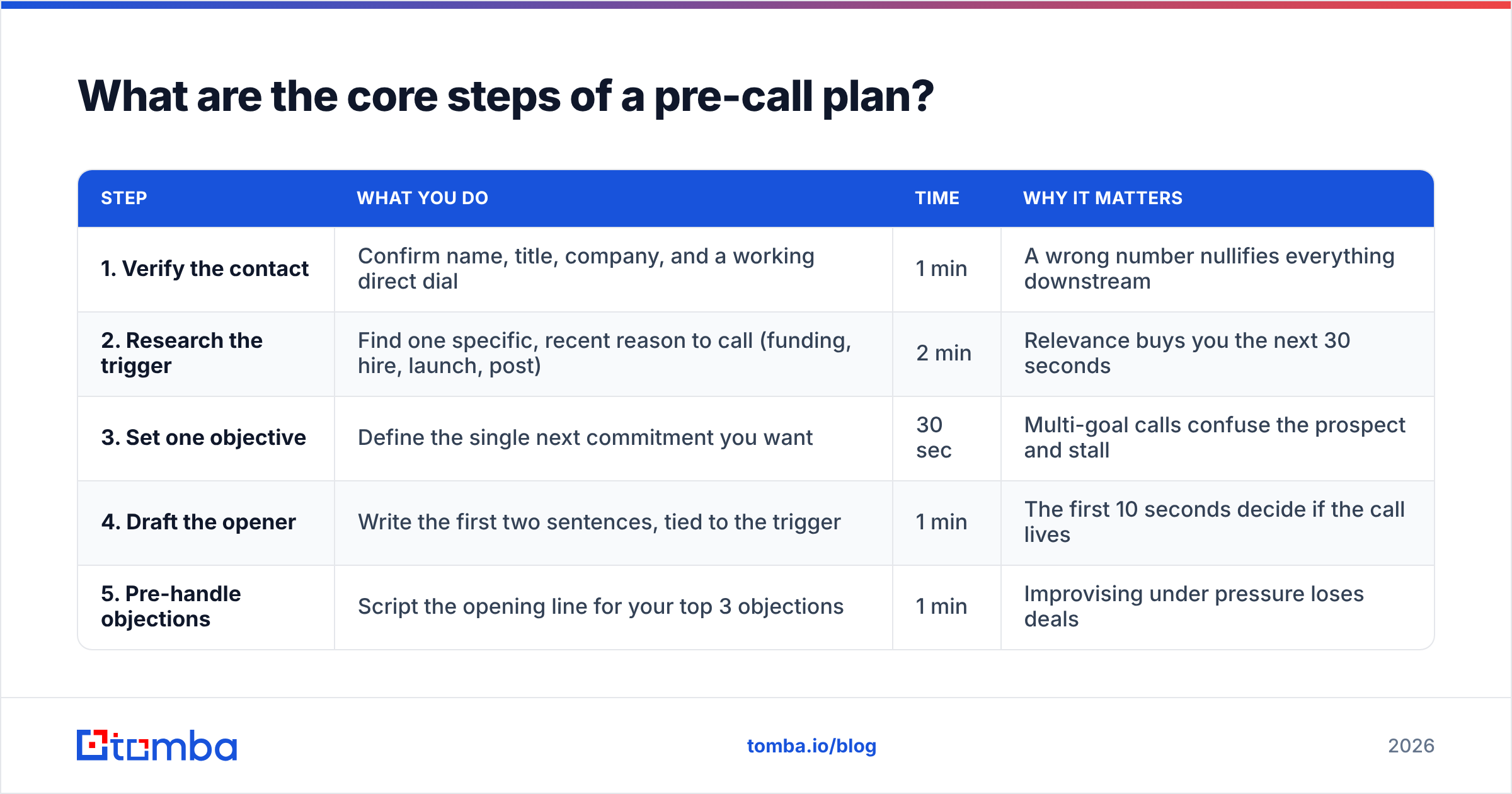
Run these five steps in order. The first two are about data; the last three are about the conversation.
| Step | What you do | Time | Why it matters |
|---|---|---|---|
| 1. Verify the contact | Confirm name, title, company, and a working direct dial | 1 min | A wrong number nullifies everything downstream |
| 2. Research the trigger | Find one specific, recent reason to call (funding, hire, launch, post) | 2 min | Relevance buys you the next 30 seconds |
| 3. Set one objective | Define the single next commitment you want | 30 sec | Multi-goal calls confuse the prospect and stall |
| 4. Draft the opener | Write the first two sentences, tied to the trigger | 1 min | The first 10 seconds decide if the call lives |
| 5. Pre-handle objections | Script the opening line for your top 3 objections | 1 min | Improvising under pressure loses deals |
Notice the whole thing fits in about five minutes. Call planning fails when reps treat it as an hour-long research project — it becomes something they skip. Make it fast and repeatable, and they'll actually do it.
Step 1 in practice: data before script#
You cannot plan a call to someone you can't reach. Before anything else, confirm you have the right person and a number that rings. A phone finder pulls direct dials so you're not stuck navigating a switchboard, and a phone validator confirms the line is live before you waste a dial. If you're working from an email list, run it through an email verifier so your follow-up doesn't bounce. This isn't busywork — it's the foundation the other four steps stand on.
How do you write a call objective that actually works?#
Pick the next commitment, not the final outcome. A cold call's objective is almost never "close the deal" — it's "earn a 20-minute discovery meeting." A discovery call's objective is "secure a scoped demo with the right stakeholders in the room." Each call advances the deal one verifiable step.
A good objective is specific, single, and within the prospect's power to grant on this call. Compare:
- Weak: "Build a relationship and see if there's a fit."
- Strong: "Get a 25-minute discovery call on the calendar for next week with the VP of Ops."
The strong version tells you exactly what success looks like and what to ask for. When the conversation drifts, the objective is your anchor — you know what you're steering back toward. This discipline is also what keeps your sales pipeline honest: every call has a defined exit, so deals don't sit in limbo labeled "had a nice chat."
What should go in your call planning template?#
Keep one template, fill it in per prospect, and store it where your CRM logs it against the contact. Here's the minimum viable structure:
- Contact: Name, title, company, verified direct dial, time zone.
- Trigger: The one recent, specific reason you're calling today.
- Objective: The single next commitment you want.
- Opener: Your first two sentences, written verbatim.
- Discovery questions: Three open questions tied to likely pain.
- Objections: Top three, each with a scripted first response.
- Next step: The exact ask and two proposed times.
The reason to write the opener verbatim — not bullet points — is that the first ten seconds are where nerves hit hardest. A written first line you can read if you blank out is a safety net. After the opener, you can go off-script; you just need to survive the cold open.
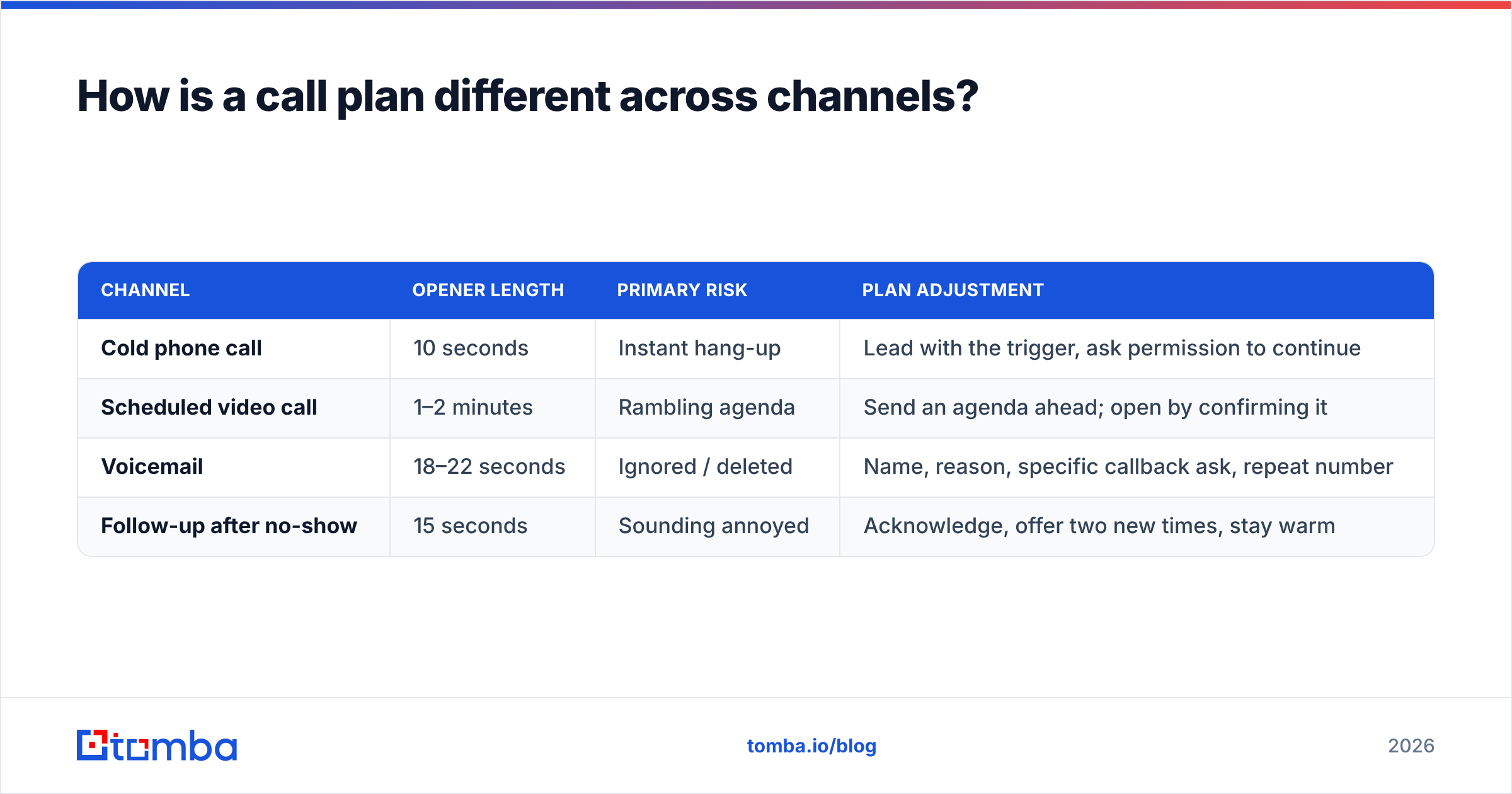
How is a call plan different across channels?#
Phone, video, and voicemail each need a different plan even for the same prospect. A few practical differences:
| Channel | Opener length | Primary risk | Plan adjustment |
|---|---|---|---|
| Cold phone call | 10 seconds | Instant hang-up | Lead with the trigger, ask permission to continue |
| Scheduled video call | 1–2 minutes | Rambling agenda | Send an agenda ahead; open by confirming it |
| Voicemail | 18–22 seconds | Ignored / deleted | Name, reason, specific callback ask, repeat number |
| Follow-up after no-show | 15 seconds | Sounding annoyed | Acknowledge, offer two new times, stay warm |
The deeper point: your call planning should adapt to the medium, but the four questions (who, why, what outcome, what objection) never change. You're just re-tuning the answers for the format.
How does data quality change your call planning?#
Garbage in, garbage call. The most disciplined plan in the world can't recover from a contact list full of wrong titles and dead numbers. This is the quiet failure mode behind most "our reps just need to make more calls" conversations — the calls aren't the problem, the list is.
Two habits fix it:
- Enrich before you plan. Pull current title, company, and direct dial so your trigger and opener are accurate. Tomba's data enrichment fills the gaps on a thin lead before the rep ever opens the template.
- Verify in bulk for outbound pushes. If you're planning a day of 40 calls, validate the whole list first instead of discovering dead numbers one painful dial at a time. A bulk email finder and bulk validation step turn a list of names into a list of reachable humans.
Tomba's pricing scales with this workflow: the Free tier gives 25 searches a month to test the data quality, Starter runs $49/mo, Growth $99/mo, and Pro $249/mo for teams running high-volume outbound.
How does Tomba compare to other prospecting data sources?#
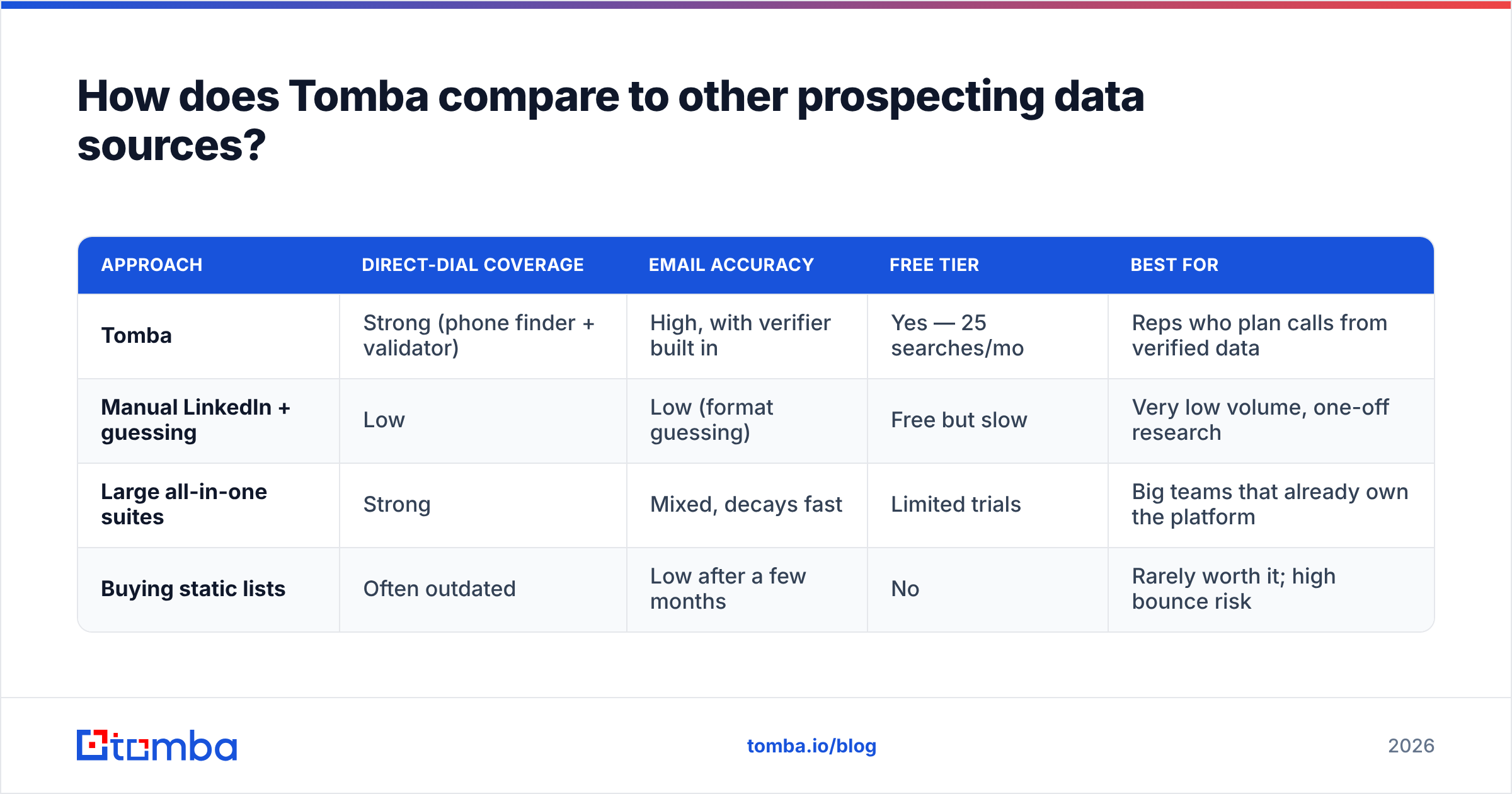
You have options for sourcing the contact data that feeds your call plans. Here's an honest comparison of the common approaches:
| Approach | Direct-dial coverage | Email accuracy | Free tier | Best for |
|---|---|---|---|---|
| Tomba | Strong (phone finder + validator) | High, with verifier built in | Yes — 25 searches/mo | Reps who plan calls from verified data |
| Manual LinkedIn + guessing | Low | Low (format guessing) | Free but slow | Very low volume, one-off research |
| Large all-in-one suites | Strong | Mixed, decays fast | Limited trials | Big teams that already own the platform |
| Buying static lists | Often outdated | Low after a few months | No | Rarely worth it; high bounce risk |
No tool is magic — coverage varies by region and industry, and you should test against your own ICP. The point is to plan calls from data you've verified, not data you've assumed. A focused tool like the Tomba Email Finder plus phone enrichment gives most outbound teams the verified contact layer they need without paying for a bloated suite. For peer reviews across tools, G2's sales intelligence category is a reasonable neutral starting point.
What are the most common call planning mistakes?#
- Planning the script before verifying the person. You'll write a beautiful opener for someone who changed jobs in Q3.
- Stacking objectives. "I'll qualify them, demo, and try to close" is three calls crammed into one, and prospects feel the pressure.
- Generic openers. "I wanted to introduce our solution" is the sentence prospects have been trained to hang up on.
- No objection prep. The same three objections come up every day; not having a first line ready is a choice.
- Skipping the next-step ask. Reps who don't pre-write the exact ask end a great call with a vague "I'll send some info" — and the deal dies in the inbox.
- Treating the plan as one-and-done. Update the plan after the call with what you learned; the next conversation should build on it.
How do you scale call planning across a team?#
Standardize the template, automate the data layer, and review the calls. The template gives everyone the same structure so a manager can coach against a consistent format. Automating enrichment — through Tomba's API or a CRM integration — means reps spend their five minutes on strategy, not on hunting for a phone number. And reviewing recorded calls against the plan closes the loop: you can see exactly where reps deviate and whether the deviation helped or hurt.
The teams that win here treat call planning as a system, not a personal habit. The data feeds the plan, the plan feeds the call, and the call result feeds the next plan. When that loop is tight, connect rates and meeting-booking rates climb without anyone dialing more.
Plan better calls on a foundation of verified data#
A call plan is only as good as the contact it targets. Before you write a single opener, make sure the person is real, the title is current, and the number actually rings. The Tomba Email Finder — paired with phone finding, validation, and enrichment — gives you that verified foundation so your five minutes of planning go toward the conversation instead of chasing dead data. Start free with 25 searches a month, build your call planning template on top of it, and watch how much shorter the path from dial to booked meeting becomes.
// get started
Find, verify and enrich your first contacts today
Start on the free plan with 25 searches a month, then scale when your team is ready.
Free plan · No credit card required · GDPR & CCPA
// about the author