Sales Call Prep in 2026: The Pre-Call Research Checklist
Most reps lose the deal before they dial. Here's a repeatable call prep system that turns 10 minutes of research into higher connect and close rates in 2026.
Most sales calls are won or lost before the phone rings. Not in the pitch, not in the objection handling — in the ten minutes of preparation that most reps skip because their calendar is packed. This guide gives you a repeatable call prep system: what to research, where to pull accurate contact data, and a tight pre-call routine you can run in under ten minutes per account.
TL;DR#
- Call prep is a process, not a vibe. A repeatable 10-minute checklist beats an hour of unstructured "research" every time.
- Bad data kills prep before it starts. If the direct dial or email is wrong, your perfect script never gets heard. Verify contact data first.
- Three layers of prep — account, contact, and trigger — give you a relevant opener and two genuine reasons to talk.
- Tools compound the effort. Pairing a CRM with an accurate email and phone-finder turns prep from manual digging into a one-click pull.
- Track prep-to-outcome. Reps who log what they researched can see which signals actually move connect and close rates.
What is call prep, really?#
Call prep is the structured research you do before a sales call so the conversation starts relevant and stays on the prospect's agenda. Think of it like a pilot's pre-flight checklist: the plane could probably take off without it, but the checklist is what catches the one missing thing that turns a routine flight into an incident. In sales, that "one missing thing" is usually a wrong number, an irrelevant opener, or a question you could have answered yourself with thirty seconds of reading.
Good call prep answers three questions before you dial:
- Who am I actually calling, and is my contact data correct? Name, role, direct dial, email, and timezone.
- What does this company care about right now? Funding, hiring, product launches, leadership changes, public pain points.
- Why would this person take my call today? A specific, recent reason to talk that isn't "I wanted to introduce myself."
If you can't answer all three in writing before the call, you're not prepared — you're improvising.

Why does call prep matter more in 2026?#
Buyers are harder to reach and less patient than they were even two years ago. Spam filtering, call screening, and a flood of automated outreach mean prospects give you a few seconds to prove relevance before they disengage. Generic openers now actively hurt you — they signal "mass outreach" and trigger the mental spam folder.
The payoff for preparation has grown at the same time. According to widely cited research on B2B buying behavior from firms like Gartner, buyers spend only a small fraction of their journey talking to any single vendor's sales team, so the minutes you do get have to count. A prepared call that opens with a relevant, specific reason to talk earns more of those minutes than ten unprepared dials combined.
There's also a data-quality reality. The average B2B contact database decays quickly as people change jobs, companies rebrand, and phone systems migrate. Prep built on stale data is worse than no prep, because you walk in confident and wrong. That's why the first step of any modern call prep routine is verifying the contact, not researching the company.
What does a repeatable call prep checklist look like?#
Here's the core routine. It's deliberately layered so you can stop early on low-value calls and go deep on high-value ones.
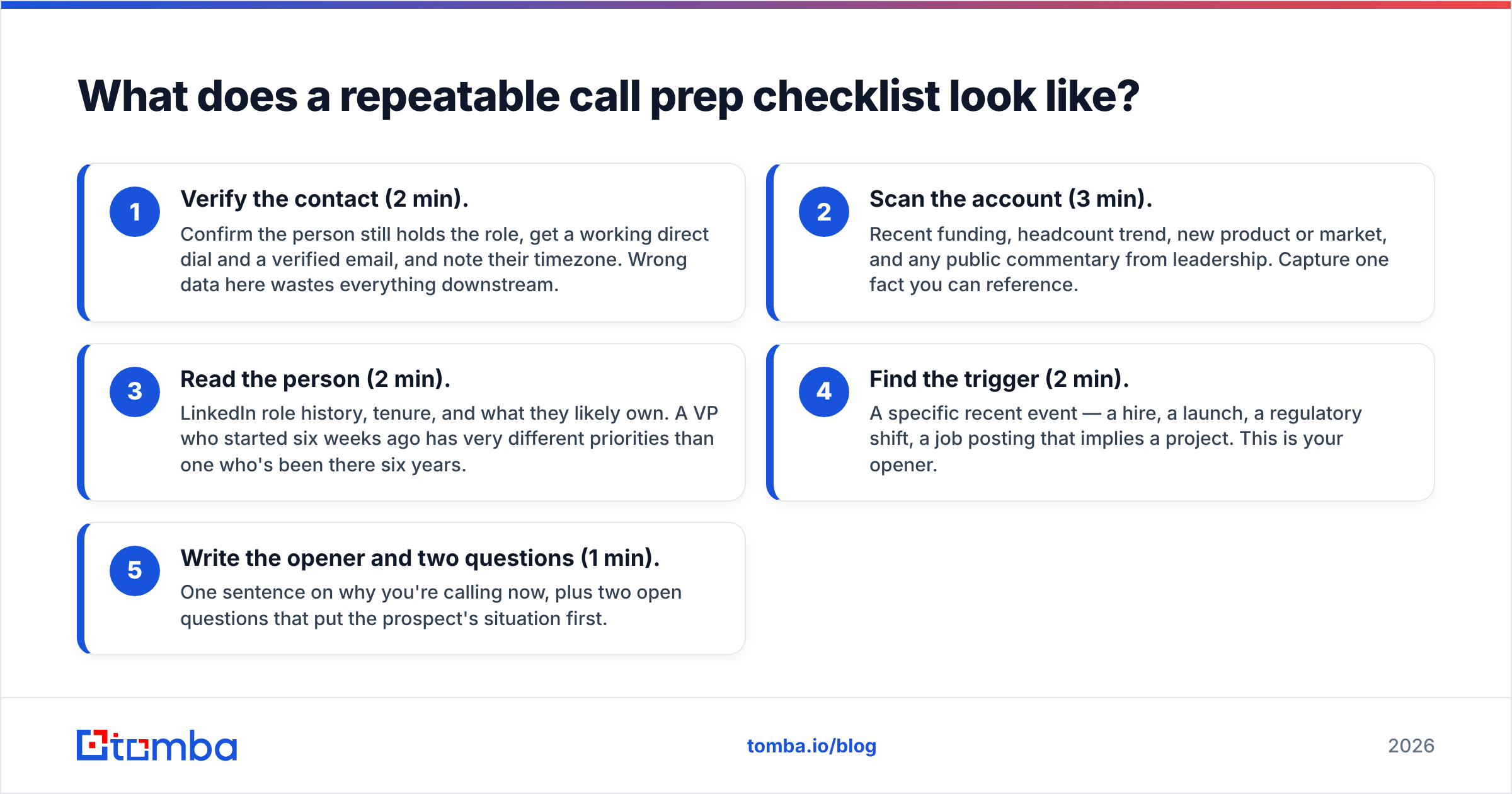
- Verify the contact (2 min). Confirm the person still holds the role, get a working direct dial and a verified email, and note their timezone. Wrong data here wastes everything downstream.
- Scan the account (3 min). Recent funding, headcount trend, new product or market, and any public commentary from leadership. Capture one fact you can reference.
- Read the person (2 min). LinkedIn role history, tenure, and what they likely own. A VP who started six weeks ago has very different priorities than one who's been there six years.
- Find the trigger (2 min). A specific recent event — a hire, a launch, a regulatory shift, a job posting that implies a project. This is your opener.
- Write the opener and two questions (1 min). One sentence on why you're calling now, plus two open questions that put the prospect's situation first.
The whole thing fits in ten minutes once the data sourcing is fast. The bottleneck is almost always step one — which is exactly where the right tooling pays off.
Where should you pull the data for call prep?#
You need three categories of information, and they come from different places. The mistake is treating all of it as "research" and burning twenty minutes hopping between tabs. Split it by source type and automate the parts that repeat.
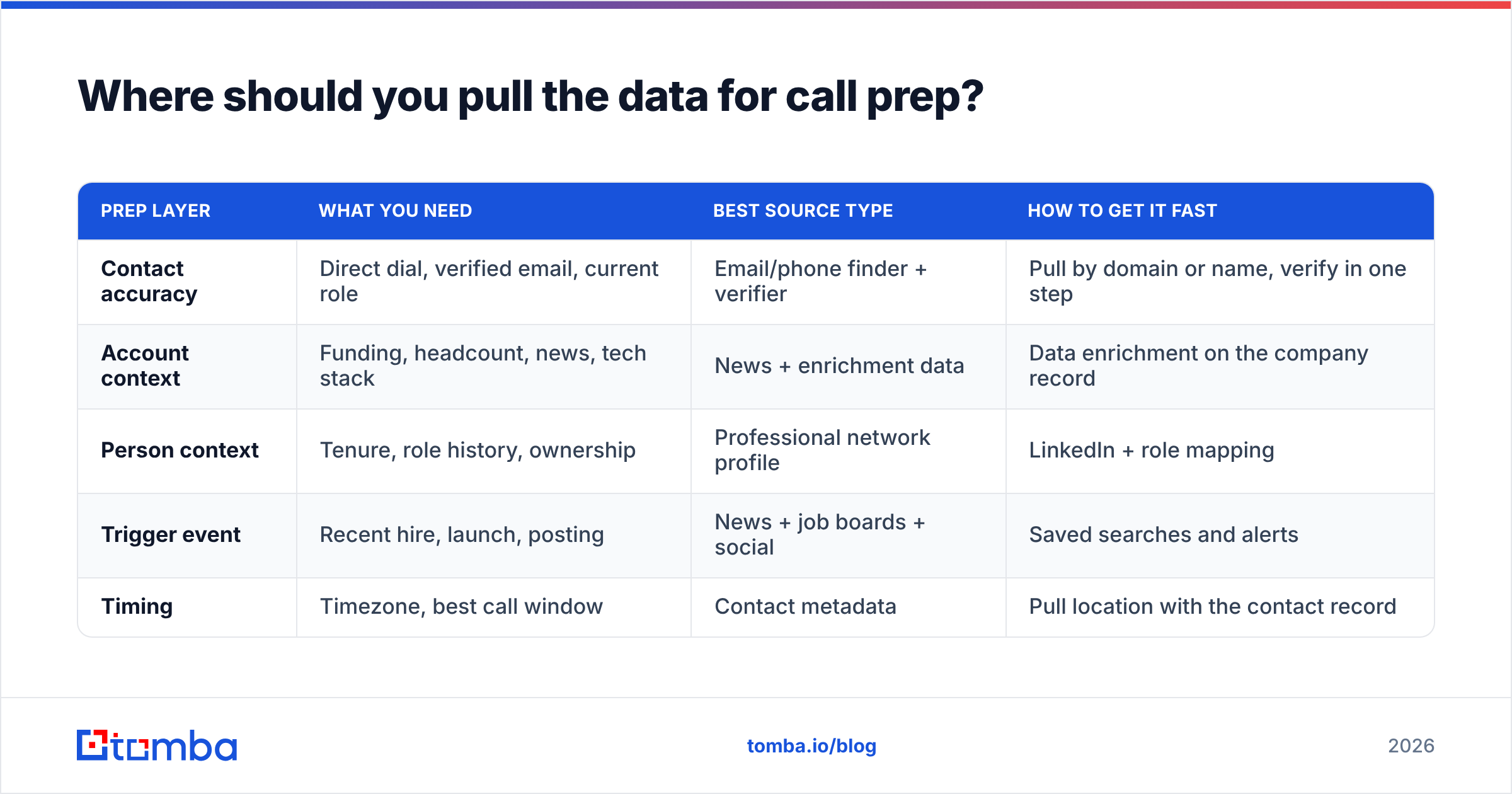
| Prep layer | What you need | Best source type | How to get it fast |
|---|---|---|---|
| Contact accuracy | Direct dial, verified email, current role | Email/phone finder + verifier | Pull by domain or name, verify in one step |
| Account context | Funding, headcount, news, tech stack | News + enrichment data | Data enrichment on the company record |
| Person context | Tenure, role history, ownership | Professional network profile | LinkedIn + role mapping |
| Trigger event | Recent hire, launch, posting | News + job boards + social | Saved searches and alerts |
| Timing | Timezone, best call window | Contact metadata | Pull location with the contact record |
The single highest-leverage move is fixing the contact layer. If you're still guessing email formats or dialing a switchboard, every other minute of prep is at risk. A tool like the Tomba Email Finder returns the professional email by name and domain, a phone finder surfaces direct dials, and bulk workflows let you prep an entire call list at once instead of one account at a time. For more on how source quality affects accuracy, Tomba documents where its data comes from.

How much call prep is enough? (Tiering your effort)#
Not every call deserves ten minutes. The skill is matching prep depth to deal value, so you don't spend an hour preparing for a $200/month account or wing it on a six-figure opportunity. Tier your list before you start dialing.
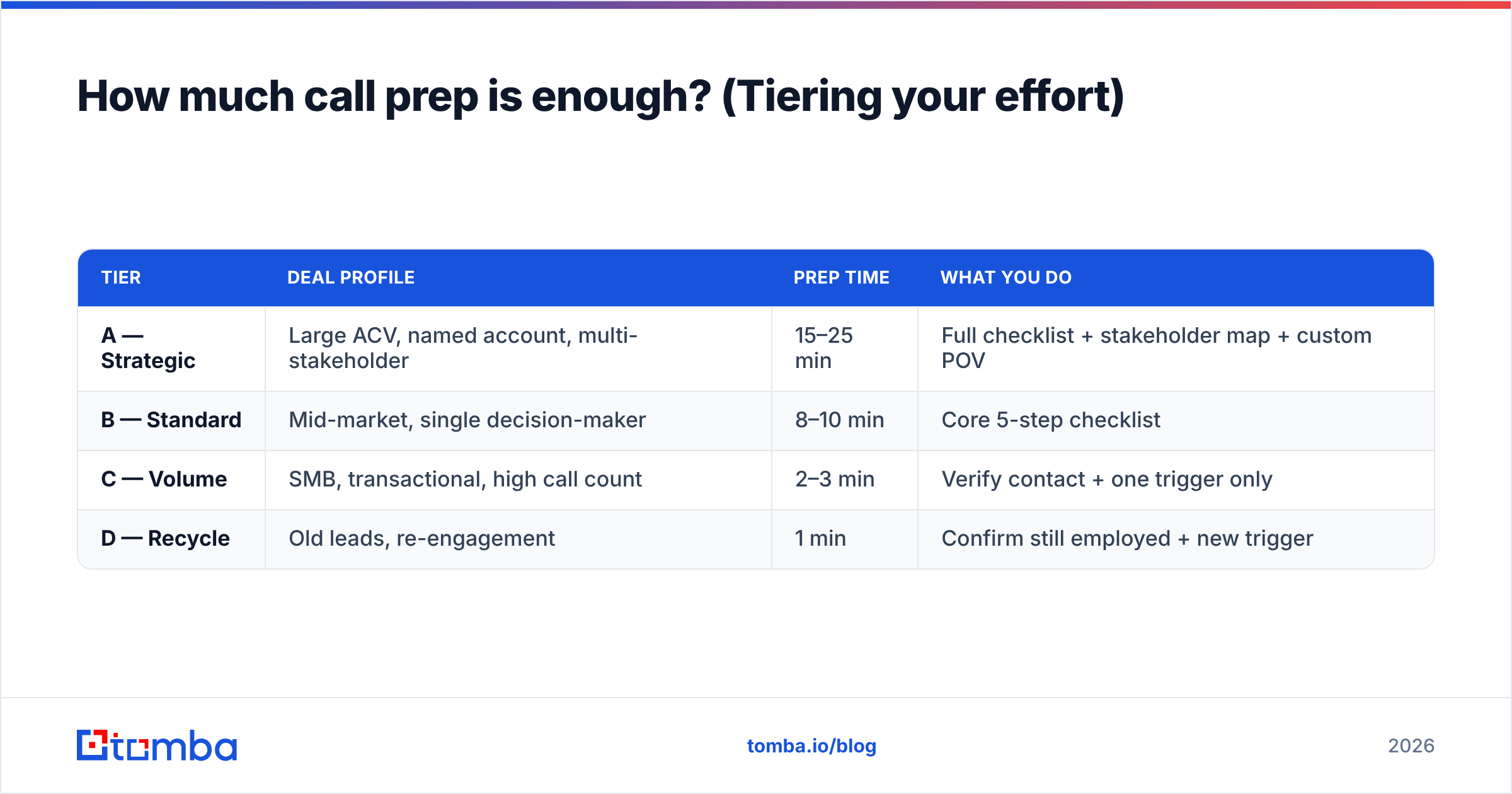
| Tier | Deal profile | Prep time | What you do |
|---|---|---|---|
| A — Strategic | Large ACV, named account, multi-stakeholder | 15–25 min | Full checklist + stakeholder map + custom POV |
| B — Standard | Mid-market, single decision-maker | 8–10 min | Core 5-step checklist |
| C — Volume | SMB, transactional, high call count | 2–3 min | Verify contact + one trigger only |
| D — Recycle | Old leads, re-engagement | 1 min | Confirm still employed + new trigger |
The point isn't to prepare less — it's to spend your prep budget where it changes outcomes. Volume callers especially benefit from automation: if you're making forty dials a day, you cannot manually research each one, so you front-load the data work with a bulk email and phone finder and reserve human judgment for the opener.
What should you never skip, even on a rushed call?#
Three things, in order:
- Contact verification. A perfect pitch to a disconnected number is zero. If you only have sixty seconds, spend them confirming the dial and the email is valid.
- One relevant reason to call now. Not your reason — theirs. A hire, a launch, a problem their job posting implies. One specific trigger beats five generic talking points.
- A question, not a pitch. Open with something that makes the prospect talk about their situation. You learn more in their first answer than in your whole script.
Everything else is optional polish. These three are the floor.
Manual prep vs. tool-assisted prep: which wins?#
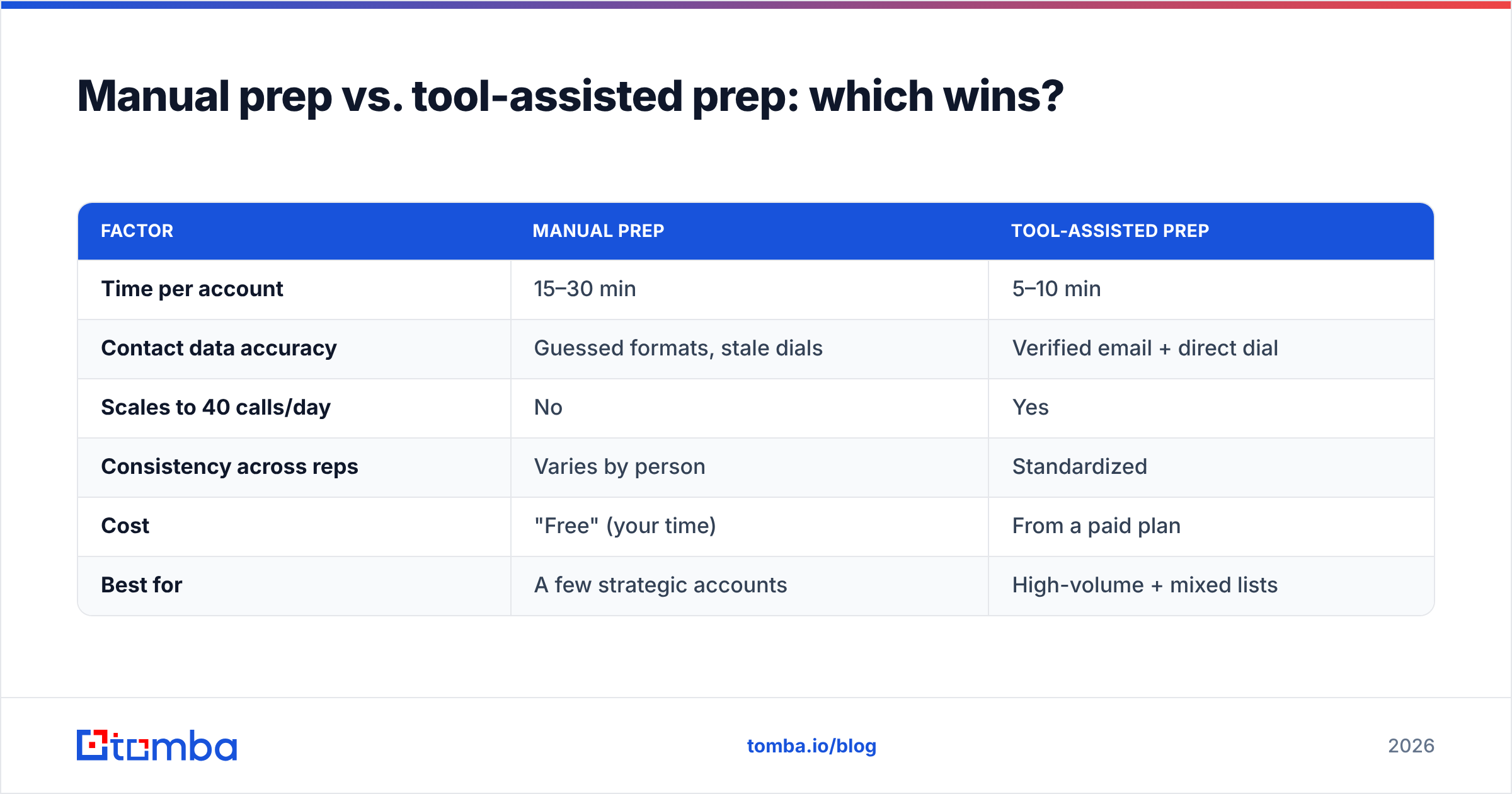
Both work, but they scale very differently. Manual prep is fine when you're making five high-value calls a week. The moment volume climbs, manual research becomes the thing you skip when you're behind — and skipped prep is where pipelines quietly die.
| Factor | Manual prep | Tool-assisted prep |
|---|---|---|
| Time per account | 15–30 min | 5–10 min |
| Contact data accuracy | Guessed formats, stale dials | Verified email + direct dial |
| Scales to 40 calls/day | No | Yes |
| Consistency across reps | Varies by person | Standardized |
| Cost | "Free" (your time) | From a paid plan |
| Best for | A few strategic accounts | High-volume + mixed lists |
The honest answer: tool-assisted prep wins for any rep doing meaningful call volume, because it removes the slowest, most error-prone step — sourcing and verifying contact data — and lets you spend your human attention on the parts a tool can't do, like reading the trigger and crafting the opener. For deep strategic accounts, you still layer manual research on top. The tooling doesn't replace judgment; it buys you time to apply it.
How do you build call prep into a repeatable team habit?#
Individual reps improvise. Teams systematize. If you want prep to actually happen under deadline pressure, make it part of the workflow rather than a thing people are supposed to remember.
- Standardize the checklist. One shared template — the five steps above — so every rep preps the same way and managers can coach to it.
- Automate the data pull. Connect your finder and verifier to the CRM so contact data populates on the record. Tomba's HubSpot and Salesforce integrations push verified emails and dials straight into the account, so prep starts with clean data instead of a blank field.
- Pre-build call blocks. Prep the night before or in a morning block, not call-by-call. Batching research is dramatically faster than context-switching between prep and dialing.
- Log what you researched. A one-line note on the trigger you used lets you correlate prep signals with connect and close rates over time. You can't improve what you don't record.
- Review the misses. When a call goes nowhere, ask whether the prep was wrong or missing. Most "bad calls" trace back to a data error or a missing trigger, both fixable.
Industry resources like the HubSpot Sales Blog are full of opener and discovery frameworks, but frameworks only work on top of accurate data and a consistent habit. Get those two right first.
What are the most common call prep mistakes?#
- Researching the company but not verifying the contact. You arrive knowing their funding round and dial a dead number.
- Confusing volume of notes with quality of prep. Three relevant facts beat a page of trivia. Prospects can tell the difference.
- Generic openers dressed up as personalization. "I saw you're in the SaaS space" is not a trigger. A specific, recent event is.
- Over-preparing low-value calls. Spending twenty minutes on a transactional SMB lead while strategic accounts get five.
- No system, so prep evaporates under pressure. The week you're busiest is the week prep matters most and gets dropped first.
Most of these collapse into one root cause: starting prep with the company instead of the contact. Fix the data layer, standardize the routine, and the rest gets much easier.
Put your call prep on a faster foundation#
Call prep only pays off when it's built on contact data you can trust — the right person, a working direct dial, and a verified email. That's the layer most reps skip and the one that quietly sinks otherwise-good calls. Start your pre-call routine with the Tomba Email Finder: pull professional emails by name or domain, verify them before you reach out, and feed clean contacts straight into your CRM so every dial begins prepared instead of guessing. Spin up the free tier (25 searches a month), and when your call volume grows, the paid plans scale prep across your whole list. Prepared reps don't make more calls — they make the calls that connect.
// get started
Find, verify and enrich your first contacts today
Start on the free plan with 25 searches a month, then scale when your team is ready.
Free plan · No credit card required · GDPR & CCPA
// about the author