Call Reluctance in Sales: Causes and Fixes (2026 Guide)
Call reluctance quietly kills more quota than any objection. Here's what causes it, the 12 types reps fall into, and a proven system to dial without dread.
You know the number you should hit today. You also know you keep finding "one more thing" to do before you dial it. That gap — between intent and the physical act of pressing call — has a name. It is call reluctance, and it costs more pipeline than any pricing objection or competitor ever will.
TL;DR#
- Call reluctance is the emotional hesitation that stops reps from initiating contact — not a skills gap, a feelings gap. Skilled reps suffer from it too.
- There are at least 12 recognized types, from "yielder" (fear of intruding) to "over-preparer" (research as procrastination). Most reps have two or three.
- It is measurable and fixable. The fix is behavioral, not motivational — pep talks fail, structured exposure works.
- A clean, accurate call list removes the biggest hidden trigger: dialing numbers you do not trust. Bad data multiplies hesitation.
- Reps who fix call reluctance routinely double their daily dials without working longer hours.
What is call reluctance?#
Call reluctance is the tendency to hesitate, delay, or avoid initiating contact with prospects — even when you have the skill, the script, and the list right in front of you. Think of it like stage fright for someone who already knows their lines. The talent is not the problem; stepping onto the stage is.
The term was popularized by psychologists George Dudley and Shannon Goodson, whose research found that a large share of failed sales careers had nothing to do with ability and everything to do with chronic call avoidance. The reps could sell. They just could not consistently start the conversation.
This matters because call reluctance hides in plain sight. It disguises itself as "research," "admin," "waiting for a better time," or "warming up the email first." Every one of those feels productive. None of them is a dial.

Wait — ignore that mental image of a chart. The real tell is simpler: you finish a task and feel relief instead of momentum. Relief after avoiding a call is the clearest diagnostic you have.
Why does call reluctance happen?#
Call reluctance is your brain protecting you from a perceived social threat. A cold call carries the risk of rejection, intrusion, and judgment — three things humans are wired to avoid. The discomfort is real even when the stakes are tiny.
Several forces stack on top of that baseline:
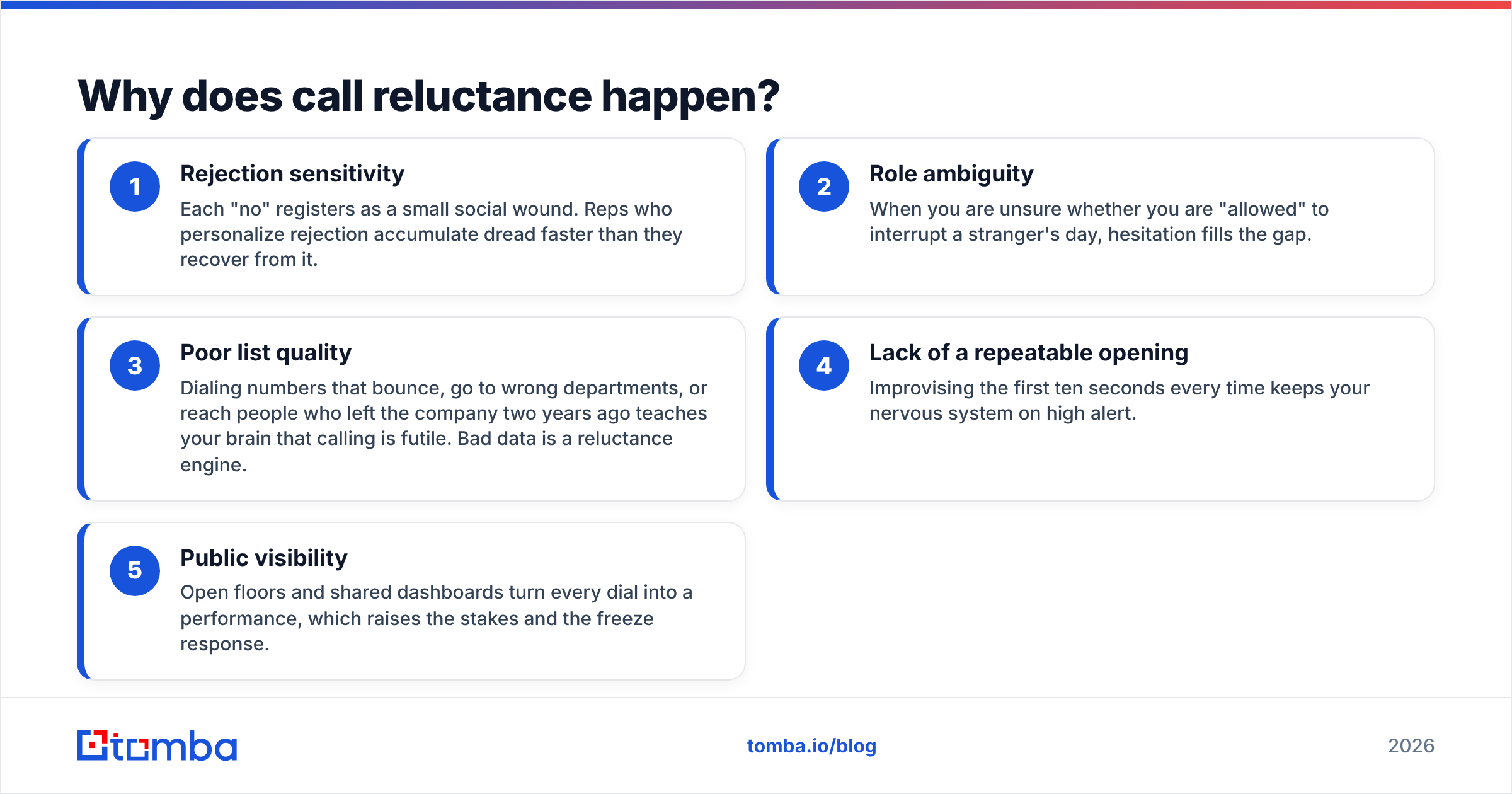
- Rejection sensitivity — Each "no" registers as a small social wound. Reps who personalize rejection accumulate dread faster than they recover from it.
- Role ambiguity — When you are unsure whether you are "allowed" to interrupt a stranger's day, hesitation fills the gap.
- Poor list quality — Dialing numbers that bounce, go to wrong departments, or reach people who left the company two years ago teaches your brain that calling is futile. Bad data is a reluctance engine.
- Lack of a repeatable opening — Improvising the first ten seconds every time keeps your nervous system on high alert.
- Public visibility — Open floors and shared dashboards turn every dial into a performance, which raises the stakes and the freeze response.
Notice that only one of these is about "confidence." The rest are structural. That is good news: structure is something you can change this week.

What are the main types of call reluctance?#
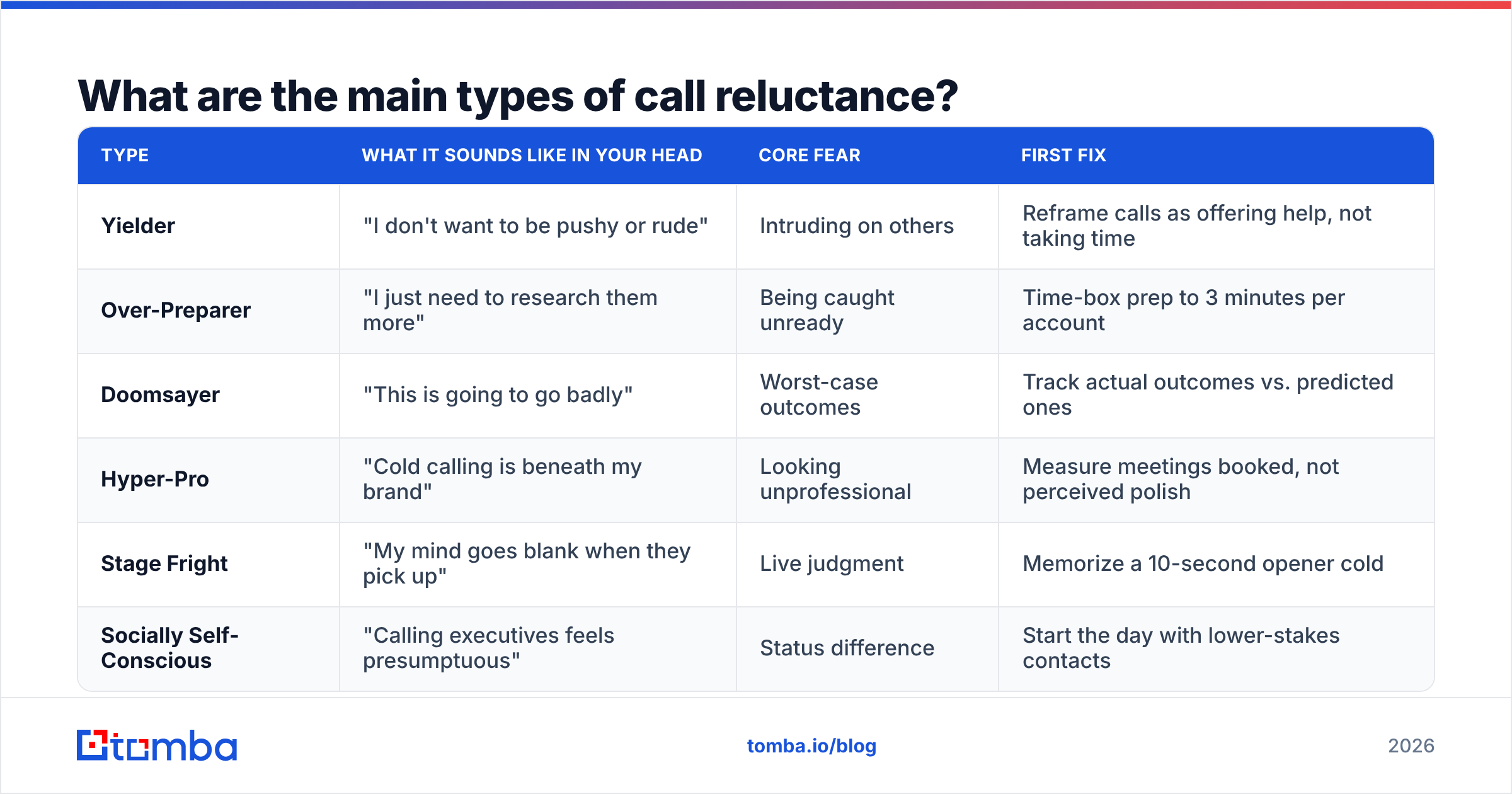
Not all hesitation looks the same. Dudley and Goodson catalogued more than a dozen distinct patterns, and most reps recognize themselves in two or three. Naming yours is the first step, because each type has a different antidote.
| Type | What it sounds like in your head | Core fear | First fix |
|---|---|---|---|
| Yielder | "I don't want to be pushy or rude" | Intruding on others | Reframe calls as offering help, not taking time |
| Over-Preparer | "I just need to research them more" | Being caught unready | Time-box prep to 3 minutes per account |
| Doomsayer | "This is going to go badly" | Worst-case outcomes | Track actual outcomes vs. predicted ones |
| Hyper-Pro | "Cold calling is beneath my brand" | Looking unprofessional | Measure meetings booked, not perceived polish |
| Stage Fright | "My mind goes blank when they pick up" | Live judgment | Memorize a 10-second opener cold |
| Socially Self-Conscious | "Calling executives feels presumptuous" | Status difference | Start the day with lower-stakes contacts |
Most teams discover that their lowest-activity reps are not lazy. They are quietly stuck in one of these patterns, working hard at everything except the dial. A rep can spend three hours building a perfect list, polishing a cold email template, and updating the CRM — and make four calls. The activity is real. The avoidance is also real.
Is call reluctance the same as being lazy or unmotivated?#
No — and treating it as a motivation problem is the most common mistake managers make. A lazy rep avoids work. A call-reluctant rep often over-works on safe tasks to avoid the one task that scares them. The output looks similar (low dials) but the cause is opposite, so the cure is opposite too.
Motivation-based fixes — pep talks, leaderboards, "just push through it" — usually backfire. They add pressure to an already-threatened nervous system, which deepens avoidance. The rep now feels reluctant and guilty.
The evidence-based approach is graded exposure: small, repeated, low-stakes contact that teaches your brain the threat is survivable. Sales researchers and behavioral psychologists agree on this point. You can read more on the underlying mechanism in the Wikipedia overview of exposure therapy, which sales coaching borrows from directly.
How do you overcome call reluctance? A step-by-step system#
You beat call reluctance by shrinking the call until it stops feeling threatening, then rebuilding volume on top of those reps. Here is the sequence that works.
1. Diagnose your type. Spend ten minutes with the table above. Write down which two patterns you fall into. You cannot fix a fear you have not named.
2. Fix your list before your mindset. This is the step reps skip and managers underrate. Half of dialing dread comes from not trusting the number on the screen. When every contact is verified and current, you remove a genuine reason to hesitate — your brain is no longer right to be wary. A verified, deduplicated list of direct numbers does more for daily dials than any motivational poster. Tools like the Tomba phone finder and a phone validator pass help here, because a clean list converts "is this even real?" hesitation into "let's go."
3. Lock your first ten seconds. Memorize one opener until you can say it half-asleep. Stage fright lives in improvisation. A fixed opening removes the blank-mind freeze.
4. Warm up with low-stakes dials. Start the session with the least intimidating contacts — existing relationships, inbound leads, or accounts where you have nothing to lose. Get three easy connects before you touch the scary list.
5. Use call blocks, not call goals. "Make 50 calls" is a finish line that invites avoidance until 4 p.m. "Dial continuously for 25 minutes" is a behavior you control. Block, dial, break, repeat.
6. Track predicted vs. actual. Before a block, jot down how badly you expect it to go. After, record what actually happened. Doomsayers especially need this — the gap between feared and real outcomes is the data that rewires the fear.
7. Separate dialing from judging. During a block, your only job is to dial and talk. Analysis, CRM notes, and strategy happen after. Mixing them mid-block reintroduces the over-preparer trap.

What role does data quality play in call reluctance?#
Bigger than almost anyone admits. Call reluctance is partly rational: if 40% of your numbers are wrong, your hesitation is your brain correctly noticing that most dials are wasted. You cannot pep-talk your way out of a data problem.
Clean, enriched contact data attacks reluctance from a direction pep talks never reach. When the name, title, company, and direct line are all verified, three things happen: connect rates climb, "wrong person" embarrassment drops, and each dial starts feeling worth the discomfort. Confidence follows competence, and competence follows good inputs.
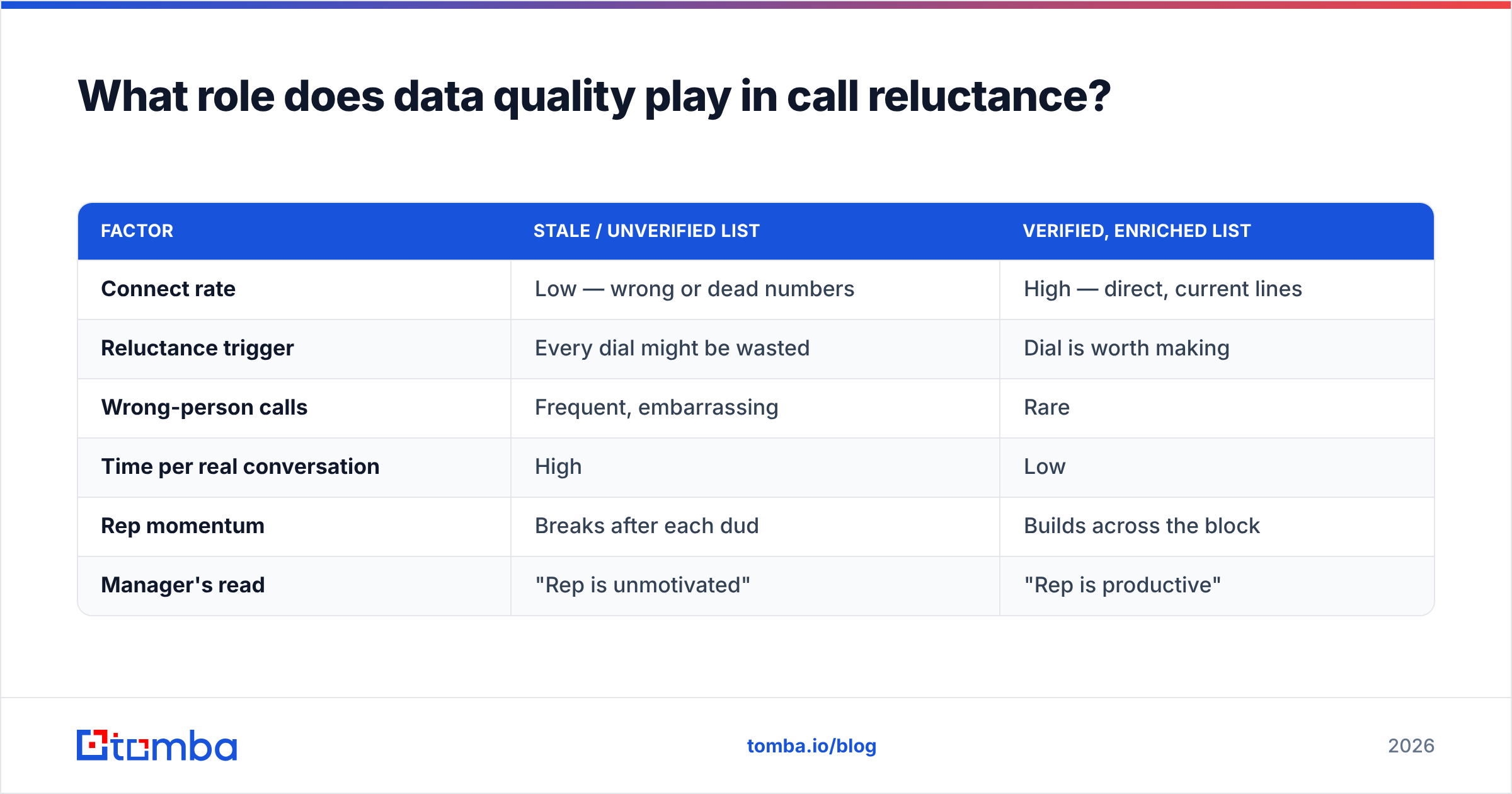
Here is how poor data and clean data compare in their effect on a rep's day:
| Factor | Stale / unverified list | Verified, enriched list |
|---|---|---|
| Connect rate | Low — wrong or dead numbers | High — direct, current lines |
| Reluctance trigger | Every dial might be wasted | Dial is worth making |
| Wrong-person calls | Frequent, embarrassing | Rare |
| Time per real conversation | High | Low |
| Rep momentum | Breaks after each dud | Builds across the block |
| Manager's read | "Rep is unmotivated" | "Rep is productive" |
This is why fixing data is step two of the system, not an afterthought. You can layer enrichment onto your existing CRM with Tomba's data enrichment so that by the time a rep opens their dialing block, every record is one they can trust. The goal of better response rate starts before the call — it starts with who you are calling.
For teams running outbound at scale, pairing verified phone data with a tight process is the difference between a floor full of reluctant reps and one that hums. The best sales-engagement platforms — see the Gong and HubSpot sales ecosystems — all assume your underlying contact data is clean. They optimize the call; they do not fix the list. That part is on you.
How do managers reduce call reluctance across a team?#
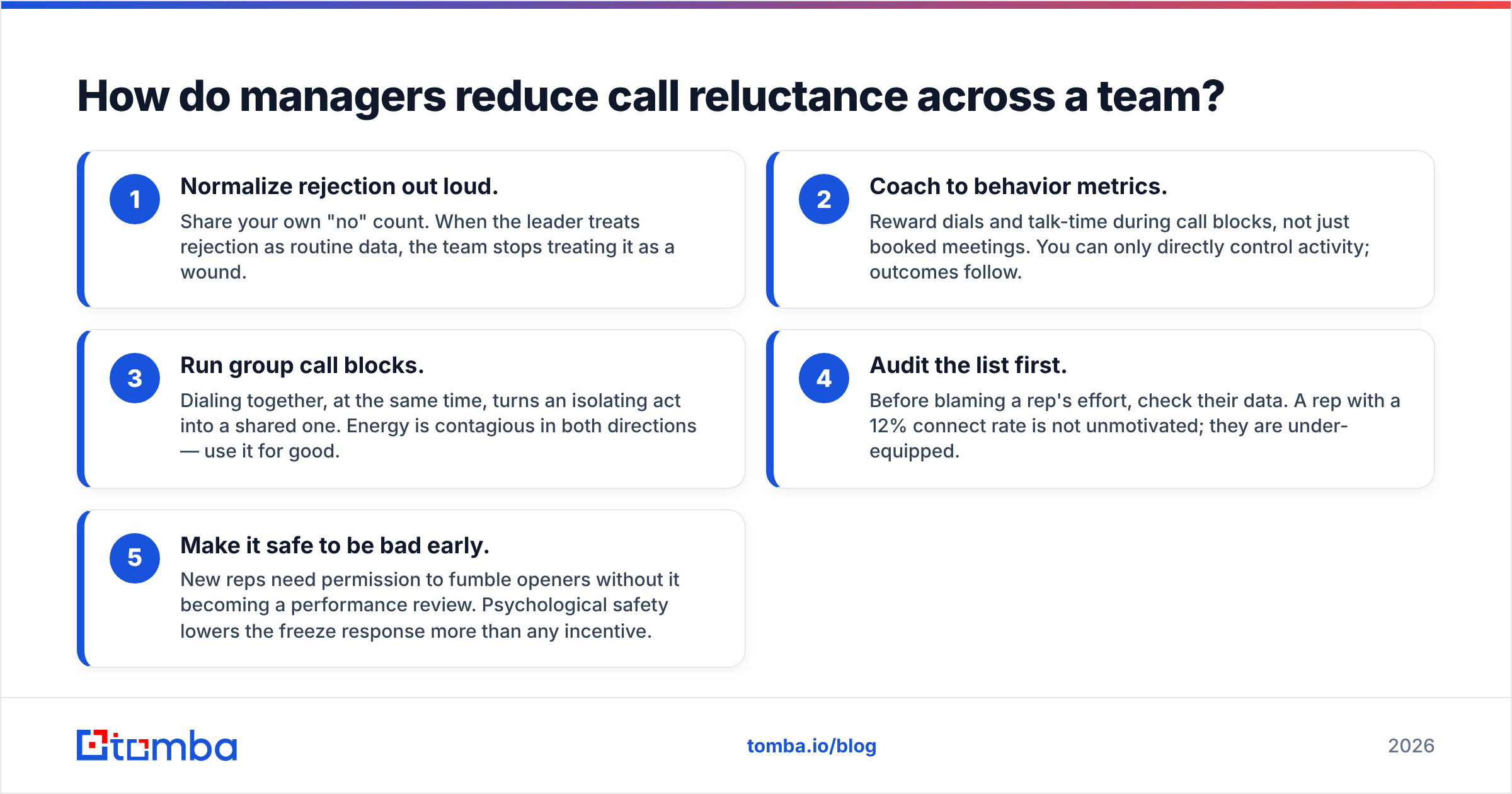
Managers cut team-wide call reluctance by changing the environment, not by exhorting individuals. Five moves do most of the work:
- Normalize rejection out loud. Share your own "no" count. When the leader treats rejection as routine data, the team stops treating it as a wound.
- Coach to behavior metrics. Reward dials and talk-time during call blocks, not just booked meetings. You can only directly control activity; outcomes follow.
- Run group call blocks. Dialing together, at the same time, turns an isolating act into a shared one. Energy is contagious in both directions — use it for good.
- Audit the list first. Before blaming a rep's effort, check their data. A rep with a 12% connect rate is not unmotivated; they are under-equipped.
- Make it safe to be bad early. New reps need permission to fumble openers without it becoming a performance review. Psychological safety lowers the freeze response more than any incentive.
A manager who does these five things will watch dial volume rise without ever saying the words "you need to make more calls." The pressure that creates reluctance gets replaced by the structure that dissolves it.
How long does it take to overcome call reluctance?#
Most reps see a meaningful shift within two to three weeks of consistent, structured practice — not because the fear vanishes, but because the brain accumulates enough evidence that the threat is survivable. Graded exposure works on a timeline you can feel.
The reps who never recover are usually the ones who attacked it with willpower instead of system. They white-knuckled a few brutal days, burned out, and concluded they "aren't phone people." They were never the problem. The approach was. Swap willpower for structure — fixed openers, call blocks, clean data, predicted-vs-actual tracking — and the timeline becomes reliable.
One honest caveat: call reluctance is rarely cured once and forever. It recedes and occasionally returns after a rough stretch or a long gap. That is normal. The system is something you run continuously at low cost, like brushing your teeth, not a one-time surgery.
The bottom line#
Call reluctance is not a character flaw and it is not laziness. It is a predictable, nameable, fixable pattern that lives at the intersection of human psychology and bad inputs. Name your type, lock your opener, dial in blocks, track what actually happens — and above all, dial a list you can trust.
That last point is where most of the avoidable dread comes from. If half your hesitation is your brain correctly flagging junk data, then better data is half the cure. Build verified, current, enriched call lists with the Tomba Email Finder and its companion phone and enrichment tools, then point your newly confident reps at numbers worth dialing. Check the Tomba pricing — the free tier gives you 25 searches a month to test the difference clean data makes before you commit a dollar. Fix the list, and the calls get a lot less scary.
// get started
Find, verify and enrich your first contacts today
Start on the free plan with 25 searches a month, then scale when your team is ready.
Free plan · No credit card required · GDPR & CCPA
// about the author