Callback Message Script: 7 Templates That Get Callbacks (2026)
A great callback message script turns ignored voicemails into return calls. Steal 7 proven templates, a structure that works, and the metrics to track in 2026.
Callback Message Script: 7 Templates That Get Prospects to Call Back
Most voicemails die the second they start. The prospect hears "Hi, my name is..." and deletes before you reach your pitch. A real callback message script flips that: it earns the return call in 20 seconds or less, every time, because it's built on structure instead of luck.
TL;DR
- A callback message script is a pre-written, repeatable voicemail framework designed to trigger a return call — not to deliver your whole pitch.
- The best scripts follow a 5-part structure: hook, name + reason, value tease, specific ask, and a slow callback number.
- Keep it under 25 seconds. Callbacks drop sharply past the 30-second mark.
- Dial a verified, accurate number first — a perfect script on a wrong number gets zero callbacks.
- Track callback rate, connect rate, and time-to-callback so you can iterate on the actual words that work.
What is a callback message script?#
A callback message script is the exact wording you leave on a prospect's voicemail to make them want to call you back. Think of it like a movie trailer: the trailer's only job is to get you to buy a ticket, not to show you the whole film. Your voicemail's only job is to earn the return call — the conversation happens later, live.
The mistake reps make is treating voicemail like a one-way pitch. They cram features, pricing, and three calls-to-action into 45 seconds. The prospect tunes out at second five. A disciplined script does the opposite: it creates a small, specific curiosity gap and then gets out of the way.
This matters more in 2026 than ever. Buyers screen unknown numbers aggressively, and a generic ramble confirms their instinct to ignore you. A tight, personalized message signals you're a professional worth ten minutes.
)
Why do most callback voicemails get ignored?#
Three reasons, and all of them are fixable.
- They're too long. Anything past 30 seconds feels like a chore to return. Gong's analysis of sales calls repeatedly shows that brevity correlates with engagement — the same logic applies to voicemail.
- They lead with the rep, not the prospect. "I'm calling from [Company] and we do X" is about you. The prospect cares about their problem, their quarter, their number.
- The callback number is rushed. Reps fire off a 10-digit number in two seconds at the end. If the prospect has to replay the message three times to catch it, they won't.
There's a fourth, quieter killer: you dialed the wrong person or a dead number. Even a flawless script can't recover from bad data. Before any of the templates below matter, you need an accurate, current phone number — which is why teams pair their scripts with a phone finder and a phone validator to confirm the line is live before they ever pick up the receiver.
What is the structure of a high-converting callback message script?#
Every script that consistently earns callbacks shares the same five-part skeleton. Memorize the structure, then swap the words to fit your prospect.
- The hook (0–3 sec): Open with their name or a specific trigger — a funding round, a job change, a competitor they just lost to. Never open with your name.
- Name and reason (3–8 sec): Now say who you are and the single reason you called. One reason, not three.
- The value tease (8–15 sec): Hint at a specific outcome or insight. Don't explain it. The unanswered question is what drives the callback.
- The specific ask (15–20 sec): Ask for the return call and give a reason to make it ("I have two ideas for your Q3 pipeline").
- The slow number (20–25 sec): Say your number slowly, twice, at the very end. Pause between the area code and the rest.
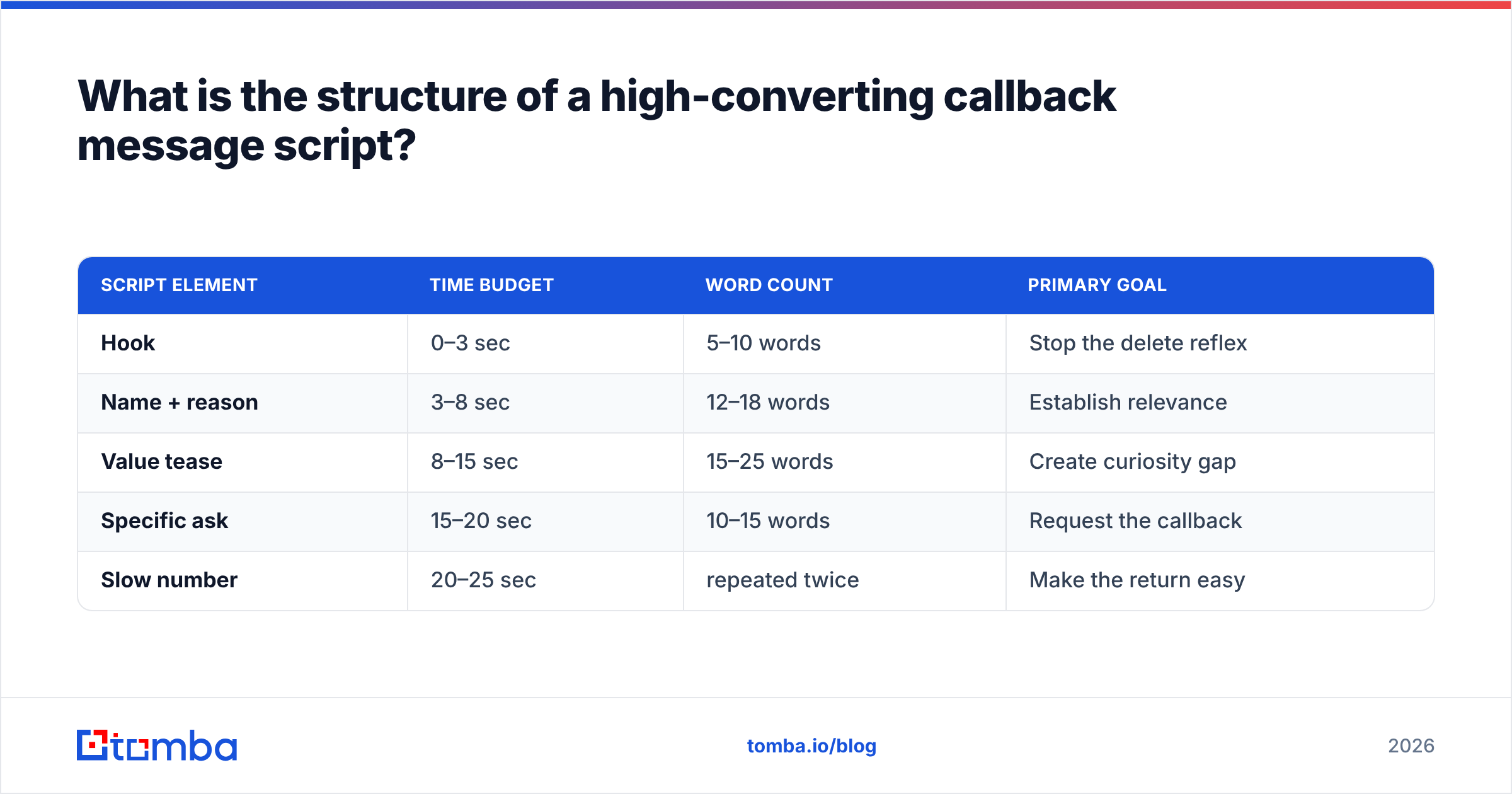
Here's how the structure maps to time, length, and goal:
| Script element | Time budget | Word count | Primary goal |
|---|---|---|---|
| Hook | 0–3 sec | 5–10 words | Stop the delete reflex |
| Name + reason | 3–8 sec | 12–18 words | Establish relevance |
| Value tease | 8–15 sec | 15–25 words | Create curiosity gap |
| Specific ask | 15–20 sec | 10–15 words | Request the callback |
| Slow number | 20–25 sec | repeated twice | Make the return easy |
Notice the whole thing fits inside 25 seconds. That constraint is the point. If your draft runs long, cut the value tease — never the number.
What are 7 callback message script templates you can steal?#
Below are seven ready-to-use scripts for the most common B2B scenarios. Replace the brackets, read them aloud, and time yourself. If you cross 30 seconds, trim.
1. The cold first-touch
"Hi [First Name] — saw [Company] just opened a [City] office, congrats. This is [Your Name] at [Your Company]. I work with [similar company] on [specific outcome] and had one idea that fits your expansion. Worth a two-minute call. I'm at [number, slowly, twice]."
2. The referral mention
"[First Name], [Referrer Name] suggested I reach out. I'm [Your Name] — [Referrer] thought what we did on [outcome] would map to what you're building. Call me back when you have five minutes: [number, twice]."
3. The trigger event
"Hi [First Name], saw the news about [funding / acquisition / launch]. [Your Name] here from [Company]. Teams hitting that stage usually run into [specific problem] — I've got a quick fix worth sharing. [Number, twice]."
4. The breakup voicemail
"[First Name], it's [Your Name] — I've left a couple messages, so I'll assume the timing's off and close your file. If [problem] is still on your plate later this year, I'm at [number]. No hard feelings either way."
5. The post-email follow-up
"Hi [First Name], [Your Name] here — I sent a note about [topic] earlier this week and wanted to put a voice to it. The short version: [one-line value]. Two minutes by phone beats ten emails. [Number, twice]."
6. The re-engagement (gone quiet)
"[First Name], [Your Name] from [Company]. We talked back in [month] about [topic] and then life got busy on both ends. Something changed on our side that's directly relevant to what you wanted. Call me: [number, twice]."
7. The decision-maker bump
"Hi [First Name], [Your Name] here. [Champion Name] on your team has been looking at [outcome], and I wanted you to hear the 30-second version directly since it touches [budget / strategy]. [Number, twice]."
)
How long should a callback message script be?#
Twenty to twenty-five seconds. That's the sweet spot.
Under 15 seconds and you sound rushed and vague. Over 30 and the prospect mentally files you under "deal with later," which means never. The 20–25 second window gives you enough room to be specific without testing their patience.
A practical test: read your script aloud at a normal pace and time it. If you're editing on the page, count words — most people speak about 130–150 words per minute, so a 25-second message is roughly 55–60 words including your repeated number. If you blow past that, the value tease is almost always the bloated section. Trim it to a single, concrete hook.
How does data accuracy affect callback rates?#
Enormously — and it's the part most reps ignore. The slickest callback message script in the world earns zero returns if it lands on a disconnected line or the wrong contact's voicemail.
Two things decide whether your message even reaches the right ear:
- Correct number: You need the prospect's current, direct line — not a switchboard or a number they ported away from two jobs ago.
- Live line: A number that rings to a dead mailbox wastes the dial and skews your metrics.
This is where sourcing and verification earn their keep. Pulling direct-dial B2B phone numbers tied to the right person, then running them through validation to confirm the line is active, means every script you leave actually has a shot. Pair that with data enrichment so your hook references the right company, role, and trigger event — personalization only works when the underlying data is right.
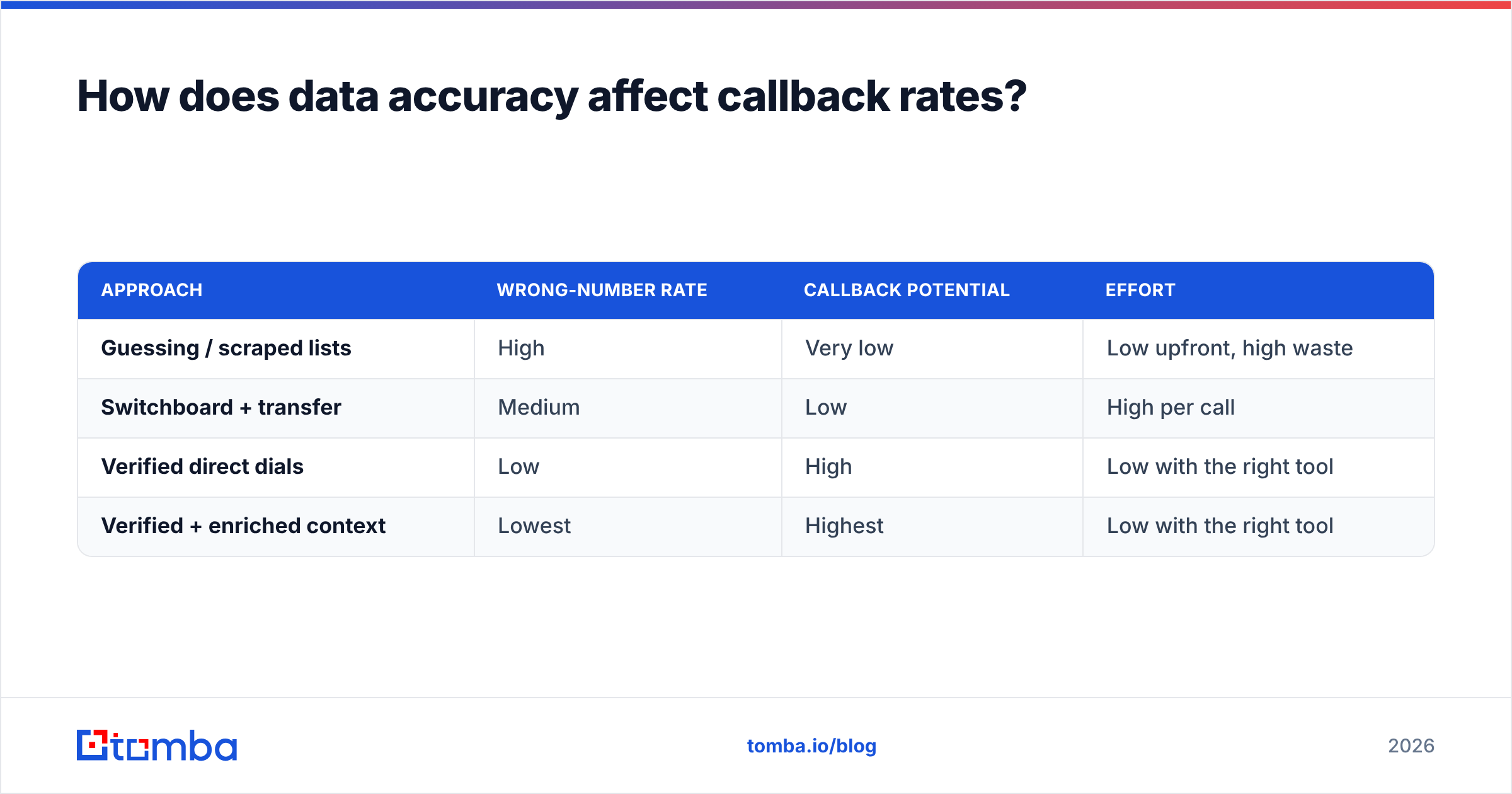
| Approach | Wrong-number rate | Callback potential | Effort |
|---|---|---|---|
| Guessing / scraped lists | High | Very low | Low upfront, high waste |
| Switchboard + transfer | Medium | Low | High per call |
| Verified direct dials | Low | High | Low with the right tool |
| Verified + enriched context | Lowest | Highest | Low with the right tool |
The pattern is clear: the better your data, the more your script gets to do its job. Garbage numbers make even great copy look like a failure.
How do you measure if your callback message script works?#
Track three numbers and you'll know exactly what to fix.
- Callback rate: Returned calls divided by voicemails left. This is your headline metric. A solid B2B cold callback rate sits in the low single digits; warm or referral scripts run much higher.
- Connect rate: Of the callbacks, how many turn into real conversations versus phone tag. If callbacks are high but connects are low, your callback number timing or availability is the issue.
- Time-to-callback: How fast prospects return the call. Faster returns usually mean a stronger hook and a more urgent value tease.
Log these in your CRM alongside the script variant you used. When you A/B test two hooks, you'll see in two weeks which words actually move the needle — and which ones you only assumed worked. Your overall response rate across channels gives you the bigger picture, but voicemail-specific metrics keep you honest about the phone.
For benchmarking against the broader market, resources like G2 and HubSpot's sales blog publish ongoing cold-outreach data worth checking against your own numbers.
What mistakes should you avoid in a callback message script?#
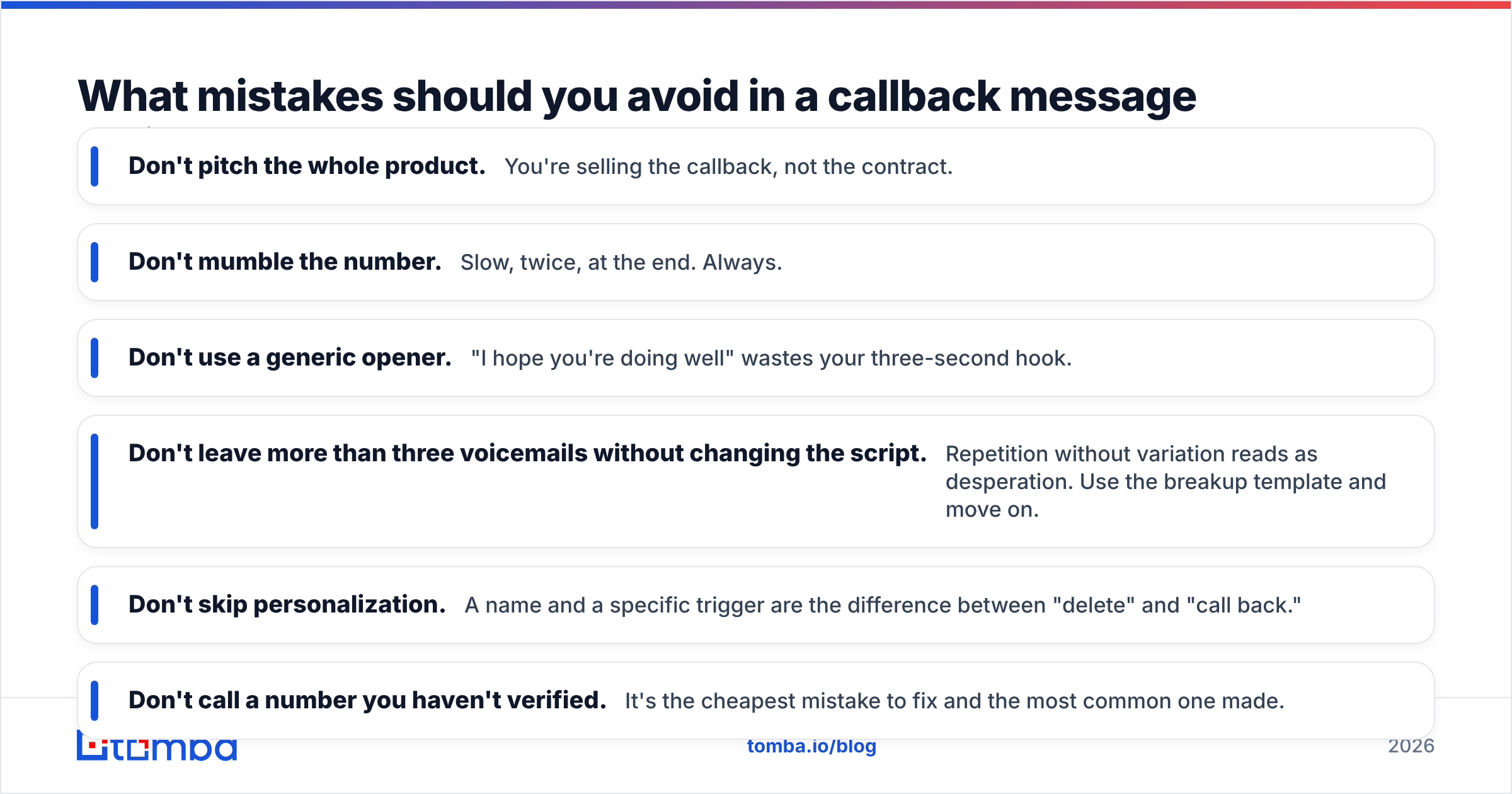
A quick checklist before you hit dial:
- Don't pitch the whole product. You're selling the callback, not the contract.
- Don't mumble the number. Slow, twice, at the end. Always.
- Don't use a generic opener. "I hope you're doing well" wastes your three-second hook.
- Don't leave more than three voicemails without changing the script. Repetition without variation reads as desperation. Use the breakup template and move on.
- Don't skip personalization. A name and a specific trigger are the difference between "delete" and "call back."
- Don't call a number you haven't verified. It's the cheapest mistake to fix and the most common one made.
Combine voicemail with other touches, too. A voicemail plus a matching email plus a LinkedIn outreach note in the same week compounds. The prospect sees a coordinated, professional sequence rather than one random call — and that consistency is what earns trust before you've even spoken.
Put your callback message script to work#
A script is only as good as the number you dial it to. Write a tight, 25-second message using the five-part structure, personalize the hook, and slow down on your callback number — then make sure that prospect's line is real and current before you ever pick up the phone.
That's where the right data tool pays for itself. Use Tomba's Email Finder to source the right contacts across email, then layer in direct-dial numbers and enrichment so every voicemail you leave reaches the decision-maker you actually meant to call. Start on the free tier (25 searches a month) and scale up through the Starter plan at $49/mo as your callback rate climbs. Better contacts in, more callbacks out — the script does the rest.
// get started
Find, verify and enrich your first contacts today
Start on the free plan with 25 searches a month, then scale when your team is ready.
Free plan · No credit card required · GDPR & CCPA
// about the author