Callcloud Pricing, Reviews, Pros and Cons (2026 Guide)
A neutral 2026 breakdown of Callcloud pricing, real-world reviews, and the honest pros and cons — plus what to check before you sign a contract.
Callcloud markets itself as an AI-driven calling platform that promises to turn cold lists into booked meetings without an army of SDRs. Whether it actually earns a line in your 2026 stack depends on three things: what it costs, what real users say, and where it quietly falls short. This guide walks all three, then shows the one input that decides whether any dialer — Callcloud included — wins or loses.
TL;DR#
- Callcloud uses quote-based pricing, not a public price list. Expect a platform fee plus usage (minutes, AI credits, or seats), so two teams rarely pay the same.
- Reviews skew positive on automation and speed, mixed on onboarding complexity, call quality on cheaper routes, and the learning curve for AI scripting.
- The biggest pro is volume: AI calling compresses weeks of manual dialing into days.
- The biggest con is garbage-in: an AI dialer amplifies a bad list instead of fixing it.
- Your real lever isn't the dialer — it's the data. Verified numbers and enriched contacts move connect rates more than any voice feature.
What is Callcloud and who is it for?#
Callcloud is an AI calling and outbound voice platform aimed at sales teams that run high-volume phone outreach. Think of it less as a phone and more as a factory line: you feed in contacts, it dials, routes, and in some configurations lets AI voice agents handle first-touch conversations or qualification before passing a live human a warm call.
The typical buyer is a B2B sales org, agency, or lead-gen shop that already lives on the phone and wants to remove the manual grind — dialing, leaving voicemails, logging dispositions. If your motion is purely email or LinkedIn, a calling platform is overkill. If you book revenue on calls, it's squarely in your lane, sitting next to your CRM and your B2B phone numbers source.
How much does Callcloud cost in 2026?#
Short answer: Callcloud does not publish a flat, take-it-or-leave-it price — pricing is quote-based and usage-driven, which is standard for AI-voice tooling. That means the honest move is to model your own costs rather than trust a sticker.
Most platforms in this category bill on some mix of:
- Platform/seat fee — a base monthly cost per user or per workspace.
- Usage — outbound minutes, AI voice credits, or per-conversation charges that scale with volume.
- Numbers & routing — local presence numbers, caller-ID registration, and carrier fees.
- Add-ons — CRM integrations, transcription, analytics tiers, or premium support.
- Contract term — annual commitments usually unlock the real discount; month-to-month costs more.
Because the usage layer is where bills balloon, ask for a written estimate at your expected dial volume, not the demo's. A platform that looks cheap at 500 dials a month can get expensive at 50,000.
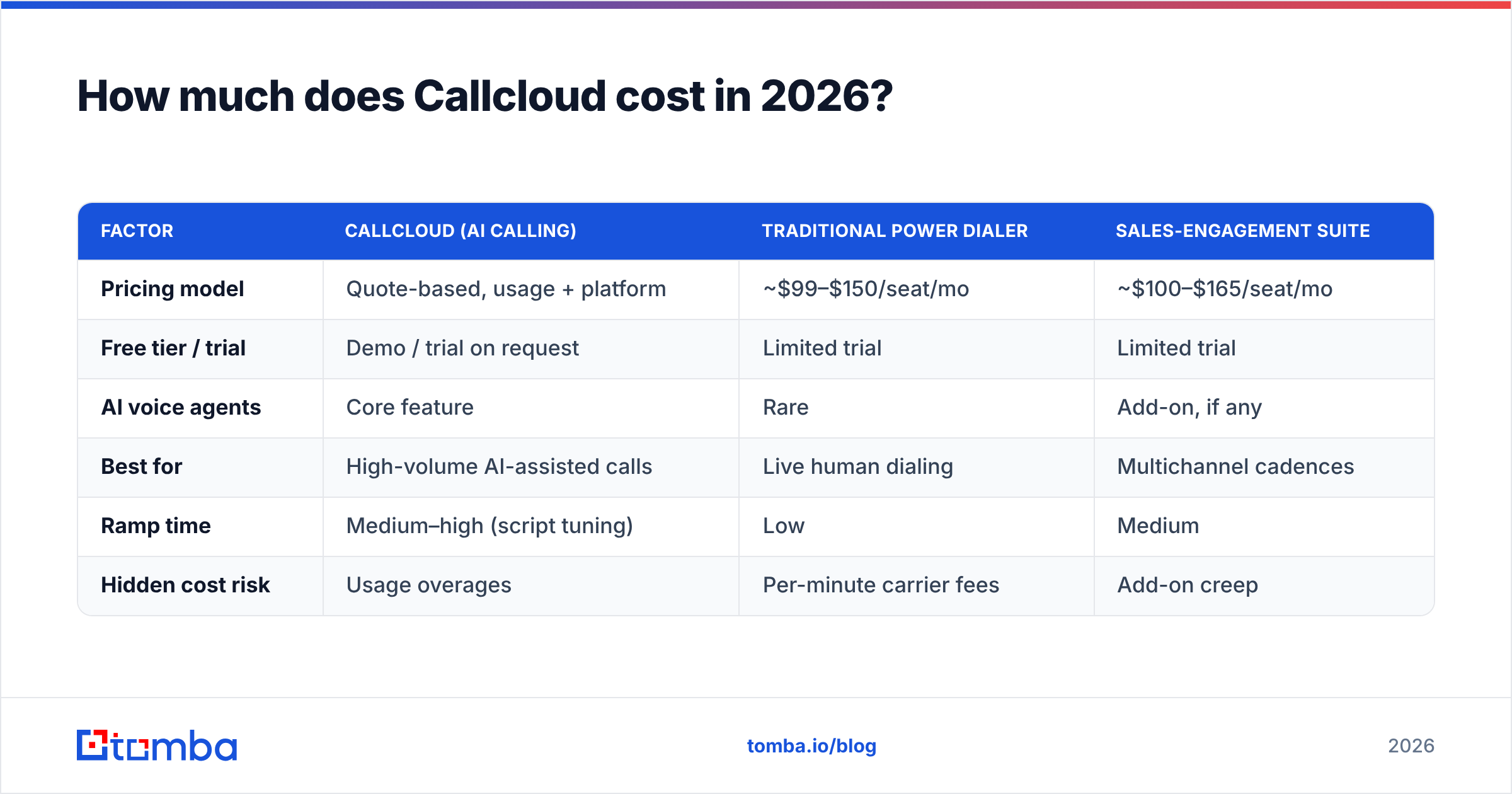
Here's a framework for comparing Callcloud against the two obvious alternatives — a traditional power dialer and a generalist sales-engagement suite. Numbers below are representative market ranges for planning, not quotes:
| Factor | Callcloud (AI calling) | Traditional power dialer | Sales-engagement suite |
|---|---|---|---|
| Pricing model | Quote-based, usage + platform | ~$99–$150/seat/mo | ~$100–$165/seat/mo |
| Free tier / trial | Demo / trial on request | Limited trial | Limited trial |
| AI voice agents | Core feature | Rare | Add-on, if any |
| Best for | High-volume AI-assisted calls | Live human dialing | Multichannel cadences |
| Ramp time | Medium–high (script tuning) | Low | Medium |
| Hidden cost risk | Usage overages | Per-minute carrier fees | Add-on creep |
The takeaway: AI calling can lower cost-per-conversation at scale, but only if your contact data is good enough to keep connect rates high. Otherwise you're paying AI credits to dial dead numbers. If you want to sanity-check a vendor's billing against peers, browse current category pricing on G2 and Capterra before your sales call.
What do Callcloud reviews actually say?#
Aggregate sentiment across review sites for AI-calling platforms like Callcloud lands in a predictable pattern. Here's the honest split.
What reviewers praise:
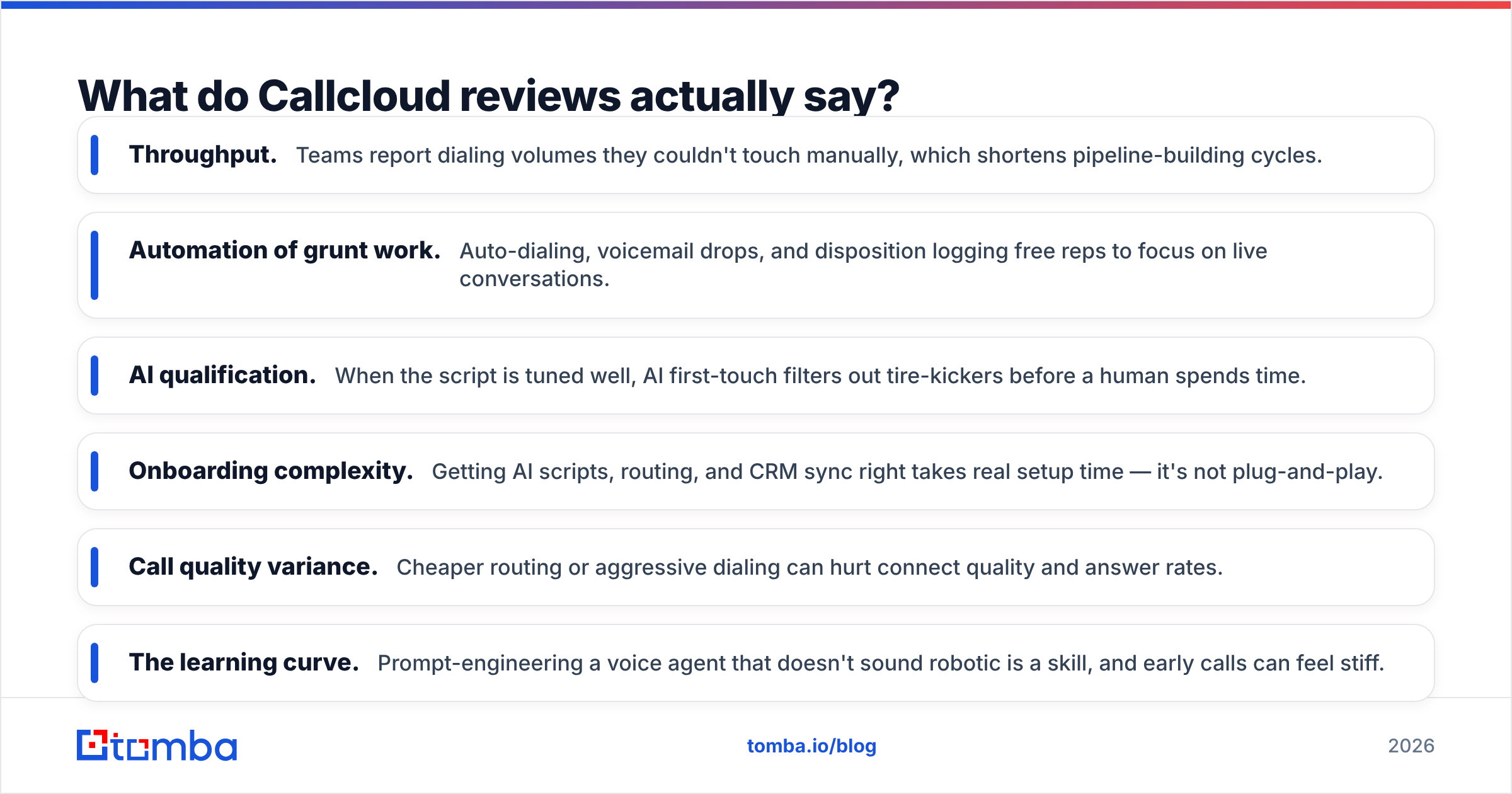
- Throughput. Teams report dialing volumes they couldn't touch manually, which shortens pipeline-building cycles.
- Automation of grunt work. Auto-dialing, voicemail drops, and disposition logging free reps to focus on live conversations.
- AI qualification. When the script is tuned well, AI first-touch filters out tire-kickers before a human spends time.
What reviewers criticize:
- Onboarding complexity. Getting AI scripts, routing, and CRM sync right takes real setup time — it's not plug-and-play.
- Call quality variance. Cheaper routing or aggressive dialing can hurt connect quality and answer rates.
- The learning curve. Prompt-engineering a voice agent that doesn't sound robotic is a skill, and early calls can feel stiff.
- Compliance overhead. Auto-dialing and AI voice trigger real regulatory obligations (consent, disclosure, do-not-call), which is on you, not the tool.
One theme runs under almost every negative review and it has nothing to do with the software: bad lists. Reps blame the dialer for low connect rates when the actual culprit is stale, unverified, or wrong-number data. No voice feature fixes a number that was never correct.
What are the pros and cons of Callcloud?#
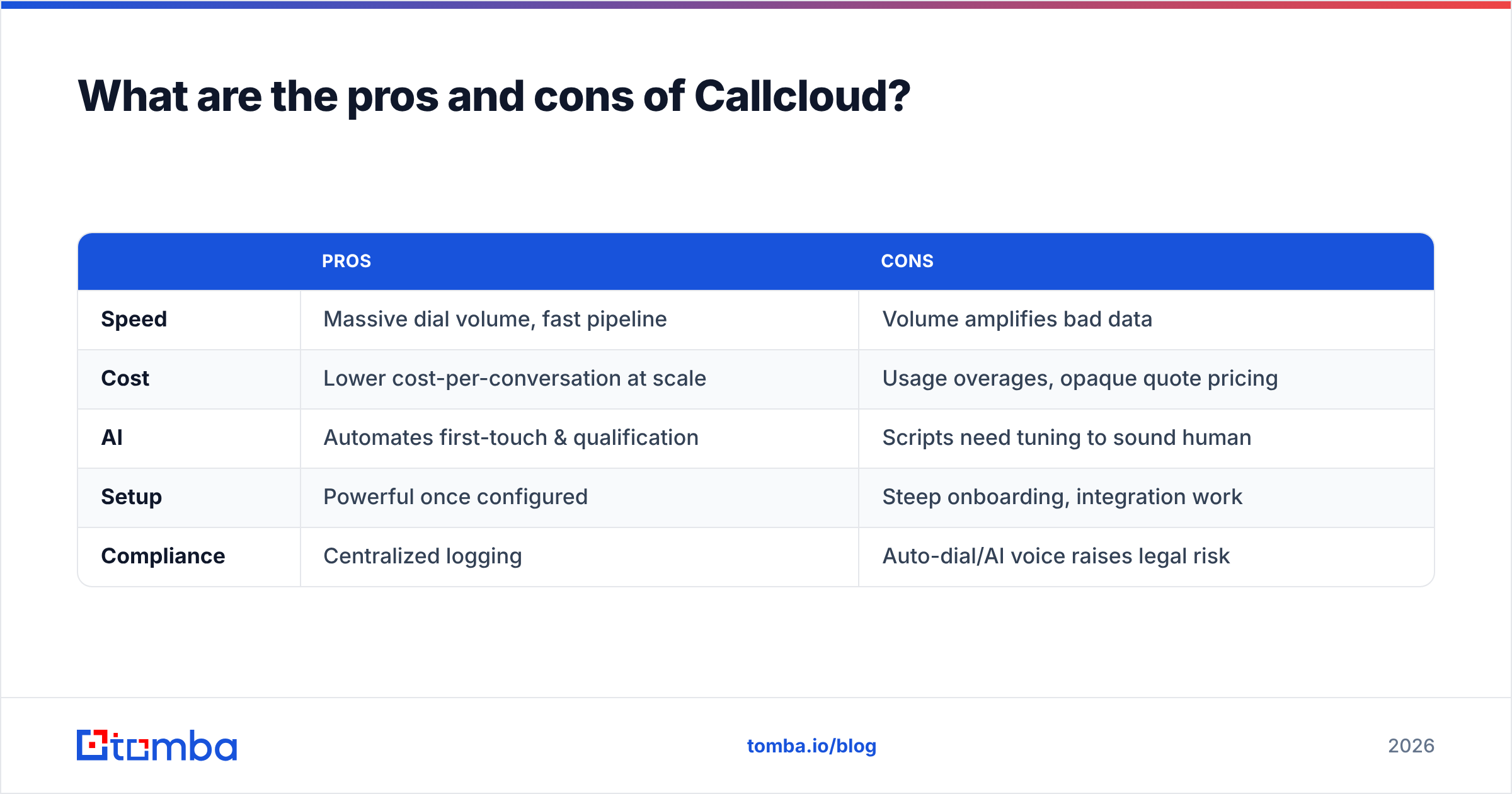
Here's the balanced ledger.
| Pros | Cons | |
|---|---|---|
| Speed | Massive dial volume, fast pipeline | Volume amplifies bad data |
| Cost | Lower cost-per-conversation at scale | Usage overages, opaque quote pricing |
| AI | Automates first-touch & qualification | Scripts need tuning to sound human |
| Setup | Powerful once configured | Steep onboarding, integration work |
| Compliance | Centralized logging | Auto-dial/AI voice raises legal risk |
Pros in plain terms: if you have a large, accurate list and a repeatable pitch, Callcloud-style automation multiplies your team's reach without proportional headcount.
Cons in plain terms: the platform is a force multiplier, and it multiplies whatever you feed it. Feed it bad numbers and you get more wrong-number calls, lower answer rates, and a worse caller reputation — faster.

Is Callcloud worth it, or is the problem your data?#
Conclusion first: Callcloud can absolutely be worth it — but only after you fix the input. An AI dialer is a megaphone. If the message and the audience are right, it's powerful. If the phone numbers are wrong, you've just bought a faster way to fail.
Think of it like a high-end espresso machine. It won't rescue stale beans; it'll just brew bad coffee with precision. The "beans" in outbound calling are your contact records — names, direct-dial numbers, and the firmographic context that lets a rep open with relevance.
That's why the smartest buyers pair any calling platform with three data disciplines:
- Verify before you dial. Run numbers through a phone validator so AI credits and rep minutes go to reachable lines, not dead ends.
- Enrich the record. Data enrichment adds title, company, and context so the opener isn't generic.
- Source direct dials, not switchboards. A dedicated find phone numbers workflow gets you to the human instead of a front desk.
Do this and a mediocre dialer outperforms a great one running on garbage. Skip it and no amount of AI voice tuning saves the campaign.
How does Callcloud fit a modern outbound stack?#
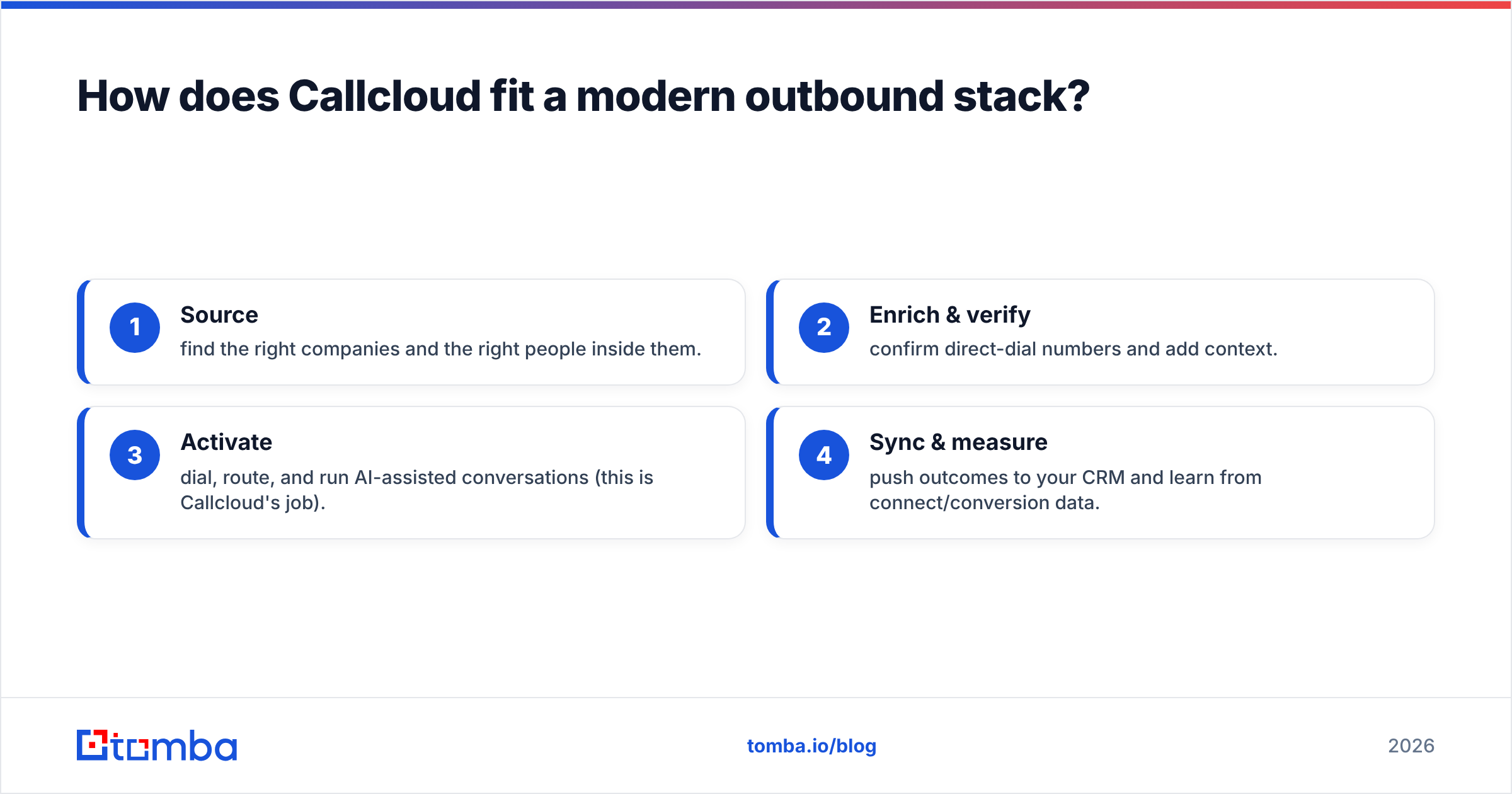
Callcloud is one layer — the activation layer. A complete 2026 phone motion has four:
- Source — find the right companies and the right people inside them.
- Enrich & verify — confirm direct-dial numbers and add context.
- Activate — dial, route, and run AI-assisted conversations (this is Callcloud's job).
- Sync & measure — push outcomes to your CRM and learn from connect/conversion data.
Callcloud is strong at layer three. It does little for layers one and two, which is exactly where most teams' connect rates are won or lost. Treating the dialer as the whole stack is the most common — and most expensive — mistake.
For broader context on how phone outreach sits inside a multichannel motion, the discipline of cold calling and phone sales hasn't changed: relevance and reachability beat raw volume. AI just lets you execute the fundamentals faster. Industry analysts like Gartner consistently flag data quality, not tooling, as the top driver of outbound performance.
What should you check before signing with Callcloud?#
Run this short due-diligence list before you commit to a contract:
- Get usage pricing in writing at your real monthly dial volume, including overage rates.
- Ask about caller-ID and number reputation management — spam-flagged numbers tank answer rates regardless of features.
- Test AI voice quality live, not in a curated demo. Hear it cold-call you.
- Confirm CRM sync depth — does it write dispositions, recordings, and outcomes back automatically?
- Clarify compliance support for consent, disclosure, and do-not-call handling in your regions.
- Pressure-test the contract term — negotiate month-to-month for the first quarter while you validate ROI.
If a vendor won't give you concrete numbers or a live cold test, treat that as a finding.
The verdict#
Callcloud is a credible AI-calling platform with the strengths and weaknesses common to its category: real speed and automation upside, offset by usage-based pricing opacity, a real onboarding curve, and compliance responsibility you can't outsource. Reviews are mostly positive when teams come in with clean data and realistic expectations, and frustrated when they expect the software to fix a broken list.
The honest bottom line: the dialer is rarely the deciding factor. Your contact data is. Get that right first.
Power your dialer with data that actually connects#
Before you pay for another AI minute, fix what you're feeding the machine. Tomba's Email Finder and contact tools help you build accurate, enriched, multichannel contact records — verified emails, direct-dial numbers, and company context — so your calls reach real people instead of dead lines. Start free with 25 searches a month, then scale on the Starter plan at $49/mo when you're ready. Whatever dialer you choose, give it data worth dialing.
// get started
Find, verify and enrich your first contacts today
Start on the free plan with 25 searches a month, then scale when your team is ready.
Free plan · No credit card required · GDPR & CCPA
// about the author