CallHippo Pricing, Reviews, Pros and Cons (2026 Breakdown)
A no-fluff look at CallHippo pricing, real user reviews, and the honest pros and cons—plus what to pair it with so your dialer actually reaches live prospects.
TL;DR
- CallHippo is a cloud-based virtual phone system and power dialer aimed at sales and support teams, with plans that start cheap but scale per user, per month.
- Real pricing runs roughly $0–$40+ per user/month across Starter, Professional, and Ultimate-style tiers, and the cheapest plan hides the features most cold callers actually need.
- Reviews praise fast setup, global numbers, and the power dialer; they criticize call quality variability, support response times, and surprise add-on charges.
- The biggest miss most teams make: buying a great dialer and feeding it stale, unverified contact data. A dialer is only as good as the numbers you load into it.
- Pair any phone system with a clean B2B data source. Tools like the phone finder and data enrichment close the gap CallHippo leaves open.
What is CallHippo?#
CallHippo is a virtual phone system you buy by the seat. Think of it like renting phone lines from the cloud instead of installing hardware: you log in, claim numbers in 50+ countries, and your reps start dialing from a browser, desktop app, or mobile app within minutes.
The core use case is outbound and inbound calling for sales development reps, support agents, and small distributed teams that don't want an on-premise PBX. Its headline feature is the power dialer, which queues a contact list and auto-dials the next number the moment a rep hangs up. That single capability is why most cold-calling teams shortlist it in the first place.
But "phone system" undersells what you're really evaluating. You're buying three things at once: the calling infrastructure, the software around it (CRM sync, call recording, analytics), and the per-minute or bundled-minute economics. Each of those has its own price tag, and that's where the published "starts at" number stops telling the whole story. For context on how dialing fits into a broader motion, our guide to cold calling and phone sales tactics pairs well with any tool you pick.

How much does CallHippo cost in 2026?#
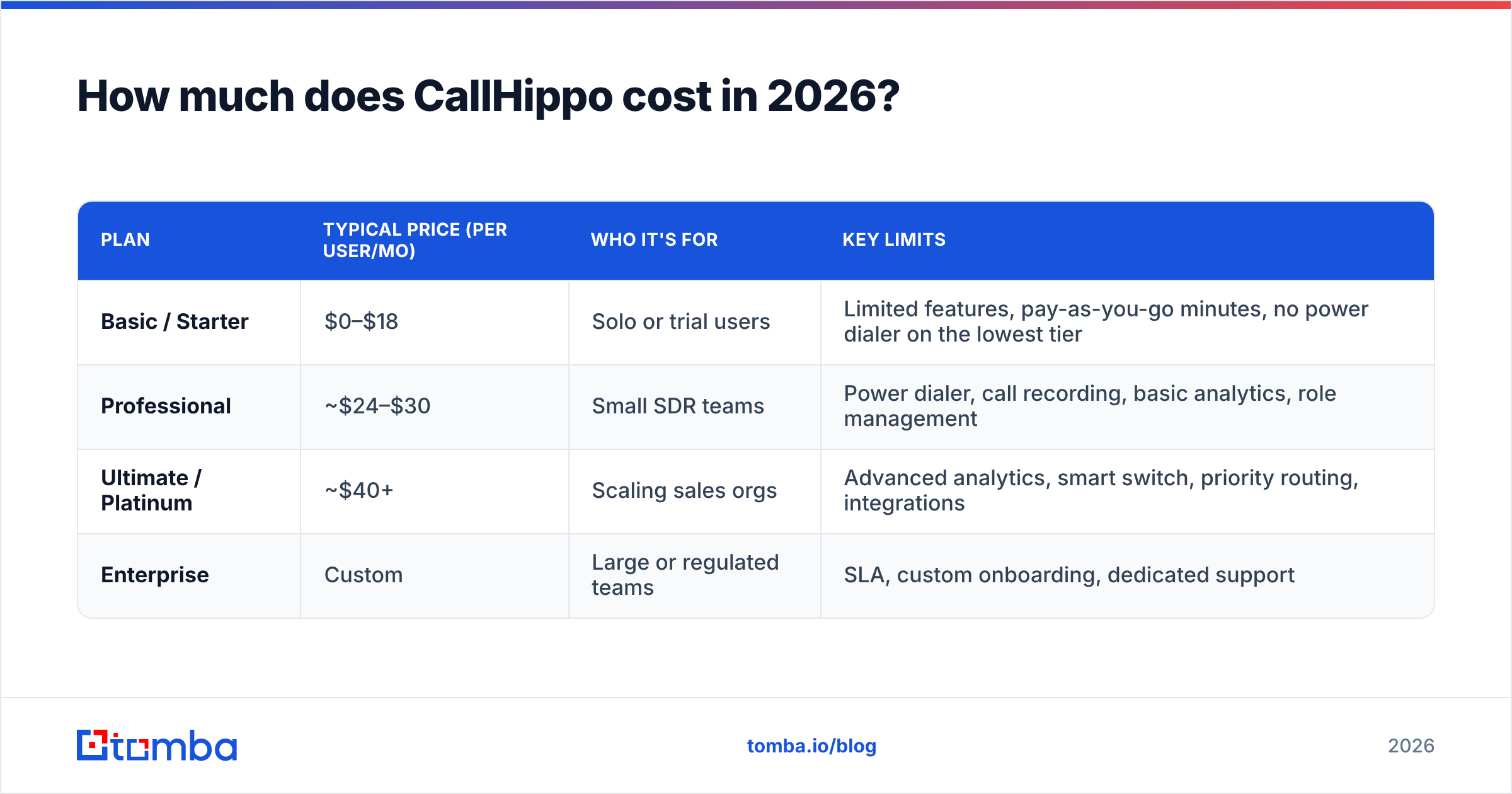
CallHippo prices per user, per month, and bills cheaper annually than monthly. The structure is a classic good-better-best ladder, with a near-free entry tier that exists mostly to get you in the door.
Here's how the tiers shake out in practice. Always confirm live numbers on the official CallHippo pricing page before you buy, since SaaS vendors adjust tiers often.
| Plan | Typical price (per user/mo) | Who it's for | Key limits |
|---|---|---|---|
| Basic / Starter | $0–$18 | Solo or trial users | Limited features, pay-as-you-go minutes, no power dialer on the lowest tier |
| Professional | ~$24–$30 | Small SDR teams | Power dialer, call recording, basic analytics, role management |
| Ultimate / Platinum | ~$40+ | Scaling sales orgs | Advanced analytics, smart switch, priority routing, integrations |
| Enterprise | Custom | Large or regulated teams | SLA, custom onboarding, dedicated support |
A few things to flag before the sticker price fools you:
- Numbers cost extra. Each phone number you claim typically carries its own monthly rental on top of the seat price. Multi-country coverage multiplies fast.
- Minutes are not unlimited. Many tiers bundle a credit allowance, then charge per-minute overage. Heavy dialers blow through allowances and see the "real" cost climb.
- Premium features gate upward. Power dialer, call transcription, and advanced analytics tend to live on the middle and top tiers, so the $0 plan is rarely the plan you actually run.
- Annual lock saves money but reduces flexibility. The advertised low end usually assumes annual prepay.
The honest read: budget for the Professional tier as your floor if you cold call seriously, then add number rentals and overage on top. The entry plan is a demo, not a deployment.
What do CallHippo reviews say?#
Aggregate review sentiment on platforms like G2 and Capterra lands CallHippo in the "solid but not flawless" band, generally in the low-to-mid 4-star range. The pattern in the written feedback matters more than the average.
What reviewers consistently like:
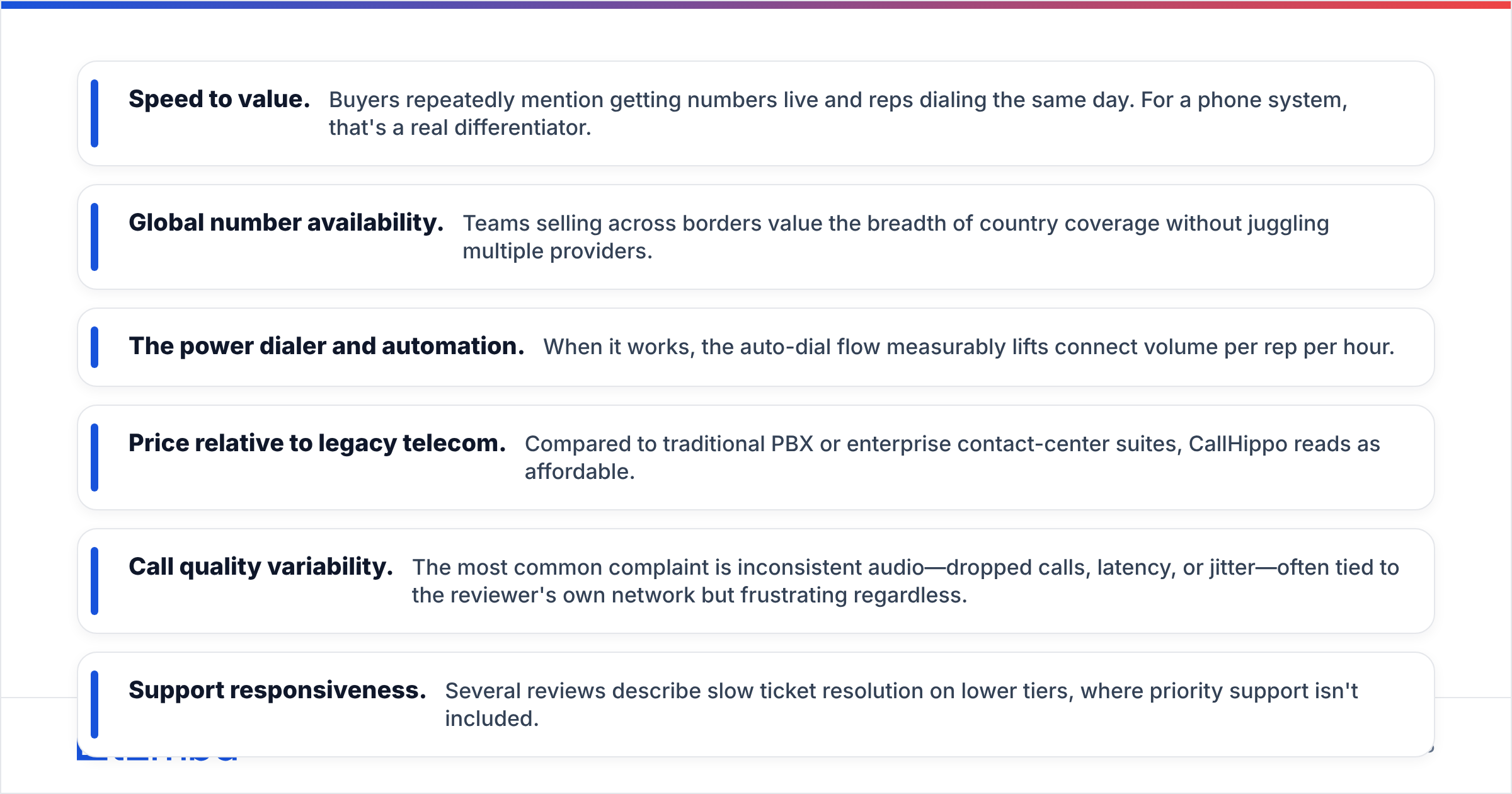
- Speed to value. Buyers repeatedly mention getting numbers live and reps dialing the same day. For a phone system, that's a real differentiator.
- Global number availability. Teams selling across borders value the breadth of country coverage without juggling multiple providers.
- The power dialer and automation. When it works, the auto-dial flow measurably lifts connect volume per rep per hour.
- Price relative to legacy telecom. Compared to traditional PBX or enterprise contact-center suites, CallHippo reads as affordable.
What reviewers consistently criticize:
- Call quality variability. The most common complaint is inconsistent audio—dropped calls, latency, or jitter—often tied to the reviewer's own network but frustrating regardless.
- Support responsiveness. Several reviews describe slow ticket resolution on lower tiers, where priority support isn't included.
- Billing surprises. Add-on charges for numbers, minutes, and features catch buyers who anchored on the headline price.
- Occasional app instability. Desktop and mobile app glitches show up periodically across review cycles.
None of these are dealbreakers on their own, but they explain why "it depends on your setup" is the most honest one-line review you'll find.
What are the pros and cons of CallHippo?#
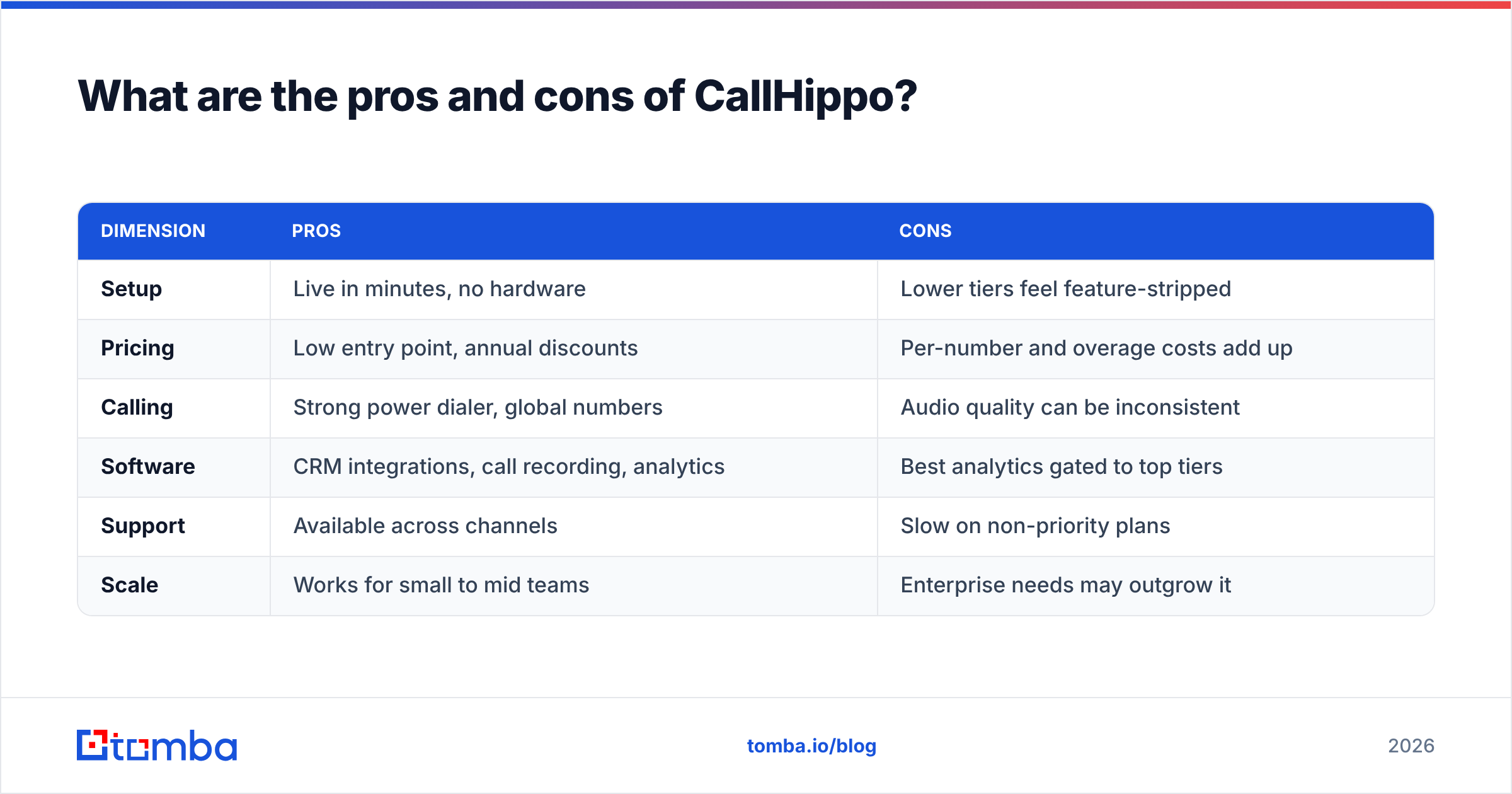
Here's the balanced scorecard a buyer actually needs, not a marketing list.
| Dimension | Pros | Cons |
|---|---|---|
| Setup | Live in minutes, no hardware | Lower tiers feel feature-stripped |
| Pricing | Low entry point, annual discounts | Per-number and overage costs add up |
| Calling | Strong power dialer, global numbers | Audio quality can be inconsistent |
| Software | CRM integrations, call recording, analytics | Best analytics gated to top tiers |
| Support | Available across channels | Slow on non-priority plans |
| Scale | Works for small to mid teams | Enterprise needs may outgrow it |
When CallHippo is a good fit: you're a small-to-mid B2B sales or support team that needs international numbers and a power dialer fast, you're comfortable on the Professional tier, and your call volume is predictable enough to budget minutes.
When to look elsewhere: you need rock-solid enterprise-grade audio SLAs, heavy native conversation intelligence, or you're cost-sensitive about per-number sprawl across many regions.
How does CallHippo compare to other dialers?#
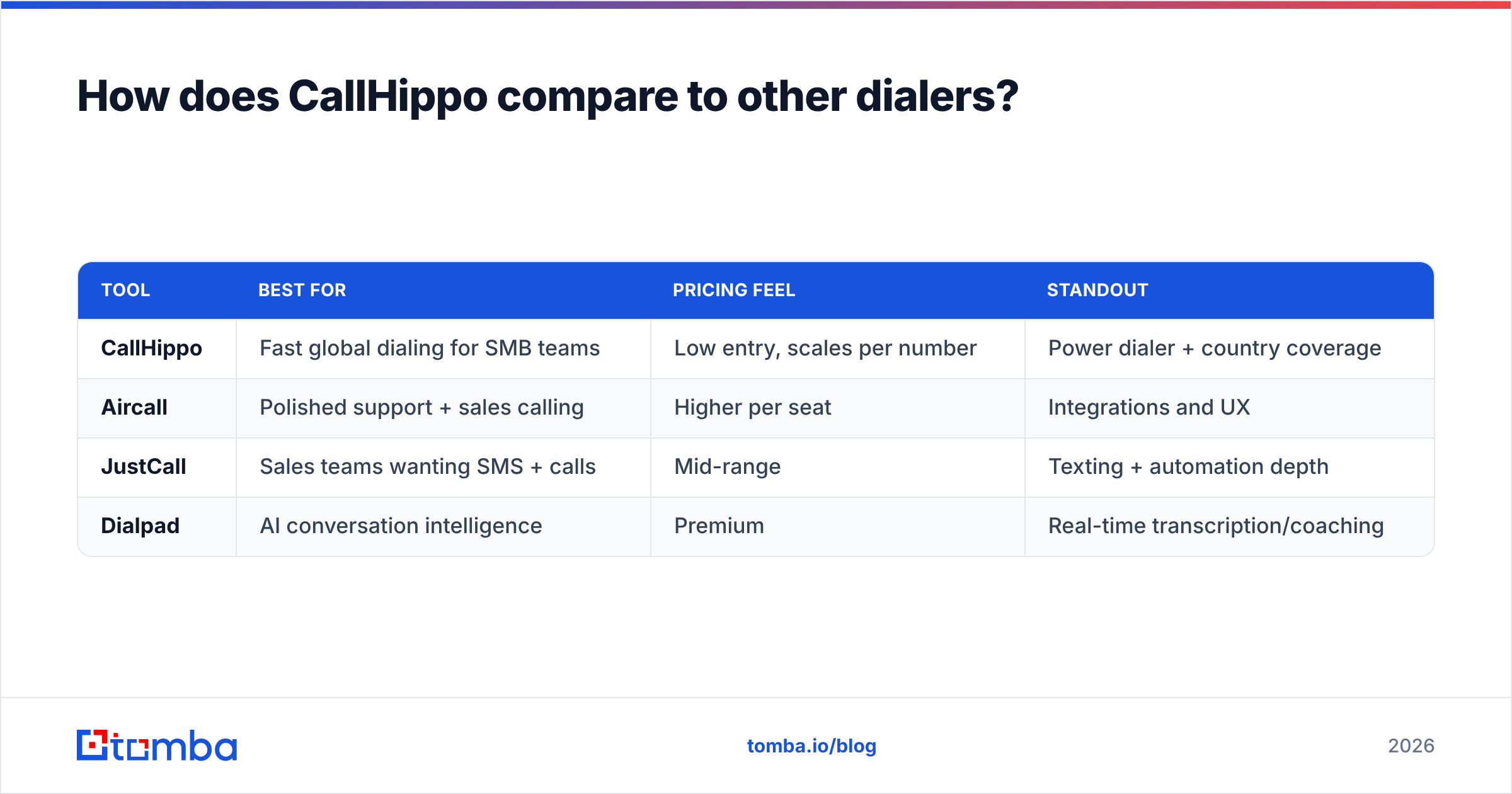
CallHippo competes with a crowded field of cloud phone systems and sales dialers. The right comparison depends on whether you're optimizing for raw calling, conversation intelligence, or all-in-one sales engagement.
| Tool | Best for | Pricing feel | Standout |
|---|---|---|---|
| CallHippo | Fast global dialing for SMB teams | Low entry, scales per number | Power dialer + country coverage |
| Aircall | Polished support + sales calling | Higher per seat | Integrations and UX |
| JustCall | Sales teams wanting SMS + calls | Mid-range | Texting + automation depth |
| Dialpad | AI conversation intelligence | Premium | Real-time transcription/coaching |
The takeaway: CallHippo wins on price-to-coverage for smaller teams. If conversation intelligence or premium reliability is the priority, the more expensive options earn their cost. Most teams pick based on budget ceiling and how international their dialing needs to be.
What does CallHippo not solve?#
CallHippo moves the call. It does not find or clean the number you dial. This is the gap that quietly wrecks ROI on every dialer purchase, and it's worth saying plainly: a power dialer that auto-dials 200 bad numbers an hour just reaches 200 dead ends faster.
Three data problems sit upstream of any phone system:
- Wrong or disconnected numbers. Direct dials go stale as people change roles. Dialing them burns minutes and tanks connect rates.
- Missing decision-maker contacts. You have the company but not the right person's direct line, so reps gatekeeper-hop instead of selling.
- No enrichment. A bare phone number with no title, company, or email context means weaker personalization and lower pickup-to-conversation rates.
This is where your data layer matters more than your dialer. Before a number ever hits CallHippo's queue, it should be sourced and validated. Tomba's phone finder surfaces B2B phone numbers tied to real people at target companies, and the phone validator checks that a number is live before your rep wastes a dial on it. For full-record context—email, title, company—data enrichment fills in what a phone tool alone can't.
In other words: CallHippo is the engine, but clean data is the fuel. Buy both, or the engine idles.
Is CallHippo worth it?#
Yes—for the right team, with eyes open on the real cost. CallHippo is a legitimately good value virtual phone system for small and mid-sized B2B teams that need international numbers and a working power dialer without a telecom project. The Professional tier, not the free plan, is the honest baseline, and you should budget number rentals and minute overage into your forecast from day one.
It stops being the obvious choice when you need enterprise audio guarantees, deep native conversation AI, or you're scaling across so many regions that per-number costs balloon. In those cases, price out Aircall or Dialpad against your actual call volume.
But here's the strategic point that survives whichever dialer you choose: your connect rate is decided before the call is ever placed. Spend weeks tuning a dialer while feeding it scraped, unverified lists and you've optimized the wrong half of the funnel. Get the data right first, then let the power dialer do what it's good at.
Frequently asked questions#
Does CallHippo have a free plan? There's a near-free entry tier, but it's feature-limited and meant for trial or very light use. Serious cold callers need at least the Professional tier for the power dialer and recording.
Why is my CallHippo bill higher than the advertised price? Almost always because of per-number monthly rentals and per-minute overage beyond your bundled allowance. The seat price is only one line item.
Is call quality reliable? It's generally good but network-dependent. Reviews show variability, so test on your actual office and remote connections during a trial.
What should I pair with CallHippo? A clean B2B data source. Use a phone finder to source direct dials, a phone validator to drop dead numbers before dialing, and contact enrichment to give reps context on every call.
Get the data right before you dial#
A dialer multiplies whatever you feed it—good numbers or bad. Before you commit budget to CallHippo or any phone system, fix the input. Start with Tomba's Email Finder to build verified, enriched B2B contact records, then layer in phone numbers and validation so every dial reaches a real person at the right company. Check Tomba pricing—a free tier with 25 searches/month lets you test the data quality before you pay a cent. Buy the dialer for the call; buy clean data for the connect.
// get started
Find, verify and enrich your first contacts today
Start on the free plan with 25 searches a month, then scale when your team is ready.
Free plan · No credit card required · GDPR & CCPA
// about the author