9 Best CallHub Alternatives for Sales Calling in 2026
CallHub is solid for broadcasts and SMS, but it isn't the only option. Here are 9 CallHub alternatives ranked on dialer power, pricing, and the data behind every call.
CallHub does one thing well: it moves a lot of calls and texts cheaply, which is why nonprofits and political campaigns love it. But if you run a B2B sales team, "cheap broadcast minutes" is not the same as "a dialer that helps reps book meetings." The two jobs are different, and the tool that wins for one usually loses for the other.
This guide ranks nine CallHub alternatives on the things sales teams actually care about — dialer speed, CRM sync, call quality, pricing transparency, and the phone data that feeds the whole machine.
TL;DR#
- CallHub is built for volume outreach (voice broadcasting, P2P texting, campaign calling) — great for nonprofits, mediocre for B2B sales pipelines.
- For power dialing + CRM sync, look at PhoneBurner, Kixie, or JustCall. For voice-as-infrastructure, Aircall and CloudTalk lead.
- No dialer fixes bad numbers. Connect rates collapse when 30–40% of your phone list is wrong, regardless of how fast you dial.
- Pair any dialer with verified B2B phone data. Tomba's phone finder and phone validator cut wasted dials before they happen.
- Budget pick: JustCall or CloudTalk. Connect-rate pick: Kixie + clean data. Enterprise: Five9 or Dialpad.
What is CallHub and who is it actually for?#
CallHub is a cloud calling and texting platform aimed at high-volume outreach: voice broadcasting, robocalls, peer-to-peer SMS, and call center campaigns. Its sweet spot is organizations that need to contact thousands of people fast and cheaply — advocacy groups, political campaigns, fundraising teams, and community organizers.
That design shapes everything. CallHub charges per-minute and per-text on top of seat fees, agents work from contact lists you upload, and the reporting is built around campaign turnout rather than sales pipeline stages. For a phone-bank pushing get-out-the-vote messages, that is exactly right.
For a B2B SDR team, it starts to creak. You want tight CRM two-way sync, local presence dialing, call coaching, and conversation analytics — and you want the cost model to be predictable instead of a per-minute meter that spikes on a busy day. That mismatch is the single biggest reason teams shop for CallHub alternatives.

Why look for a CallHub alternative?#
A few recurring pain points push sales teams to switch:
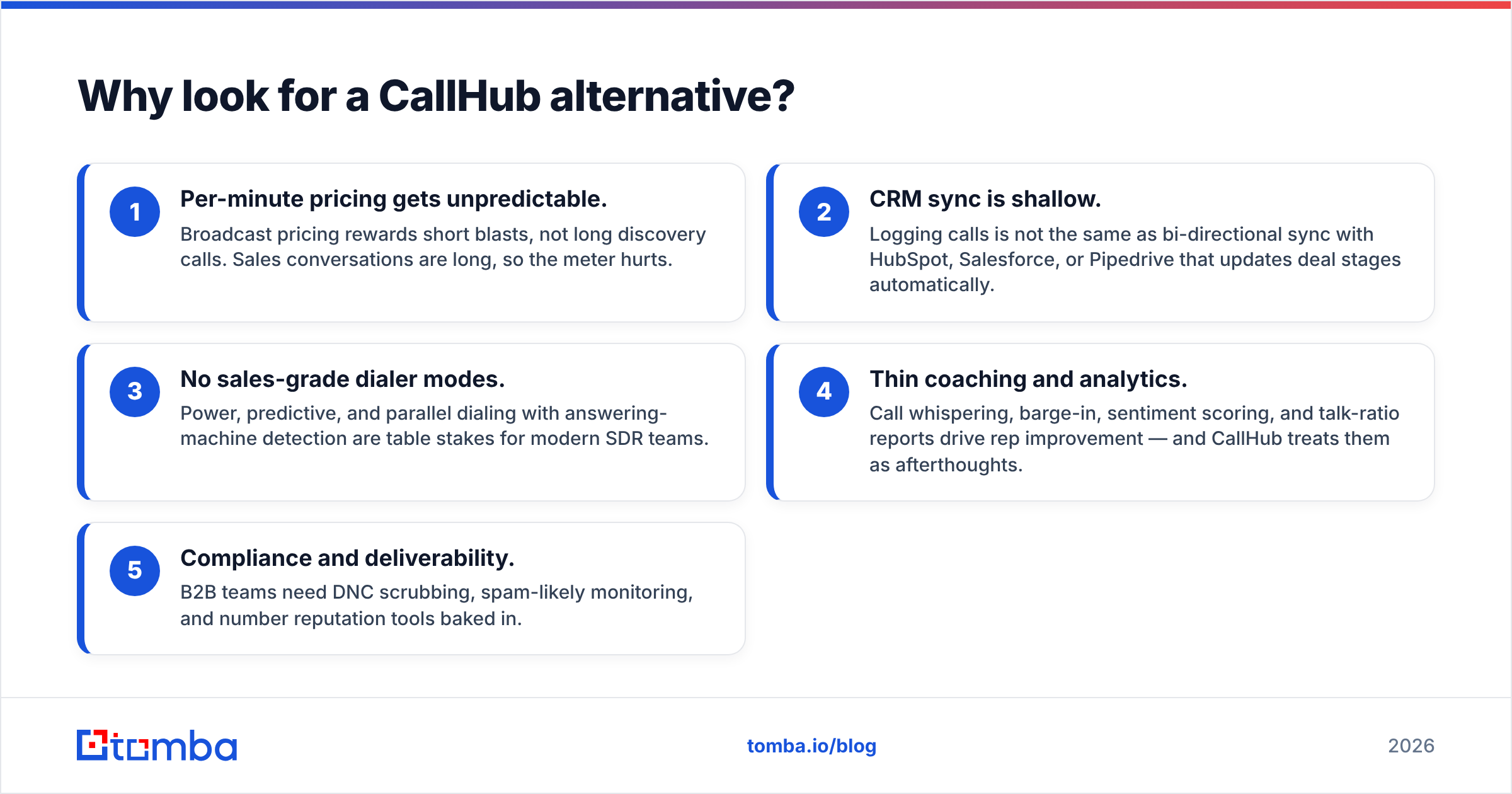
- Per-minute pricing gets unpredictable. Broadcast pricing rewards short blasts, not long discovery calls. Sales conversations are long, so the meter hurts.
- CRM sync is shallow. Logging calls is not the same as bi-directional sync with HubSpot, Salesforce, or Pipedrive that updates deal stages automatically.
- No sales-grade dialer modes. Power, predictive, and parallel dialing with answering-machine detection are table stakes for modern SDR teams.
- Thin coaching and analytics. Call whispering, barge-in, sentiment scoring, and talk-ratio reports drive rep improvement — and CallHub treats them as afterthoughts.
- Compliance and deliverability. B2B teams need DNC scrubbing, spam-likely monitoring, and number reputation tools baked in.
If two or more of those hit home, it is worth comparing the field.
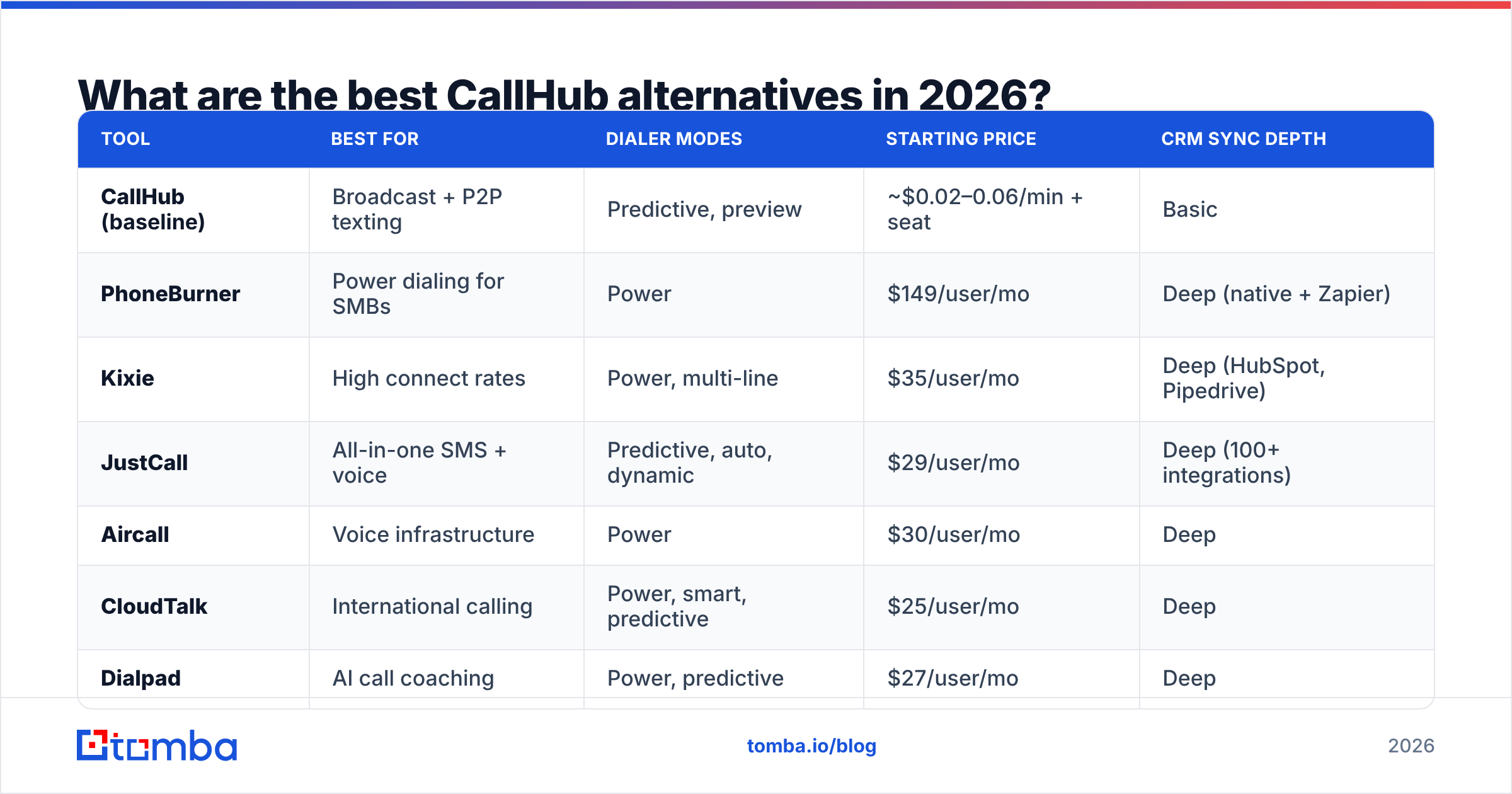
What are the best CallHub alternatives in 2026?#
Here is the short list, grouped by what each tool is genuinely best at.
| Tool | Best for | Dialer modes | Starting price | CRM sync depth |
|---|---|---|---|---|
| CallHub (baseline) | Broadcast + P2P texting | Predictive, preview | ~$0.02–0.06/min + seat | Basic |
| PhoneBurner | Power dialing for SMBs | Power | $149/user/mo | Deep (native + Zapier) |
| Kixie | High connect rates | Power, multi-line | $35/user/mo | Deep (HubSpot, Pipedrive) |
| JustCall | All-in-one SMS + voice | Predictive, auto, dynamic | $29/user/mo | Deep (100+ integrations) |
| Aircall | Voice infrastructure | Power | $30/user/mo | Deep |
| CloudTalk | International calling | Power, smart, predictive | $25/user/mo | Deep |
| Dialpad | AI call coaching | Power, predictive | $27/user/mo | Deep |
| Five9 | Enterprise contact center | Predictive, progressive | Custom (~$175+) | Deep |
| Twilio | Build-your-own | API-driven | Pay-as-you-go | DIY |
Prices are list rates as of early 2026 and shift with seats and contract length — always confirm on the vendor's own page before you commit.
PhoneBurner#
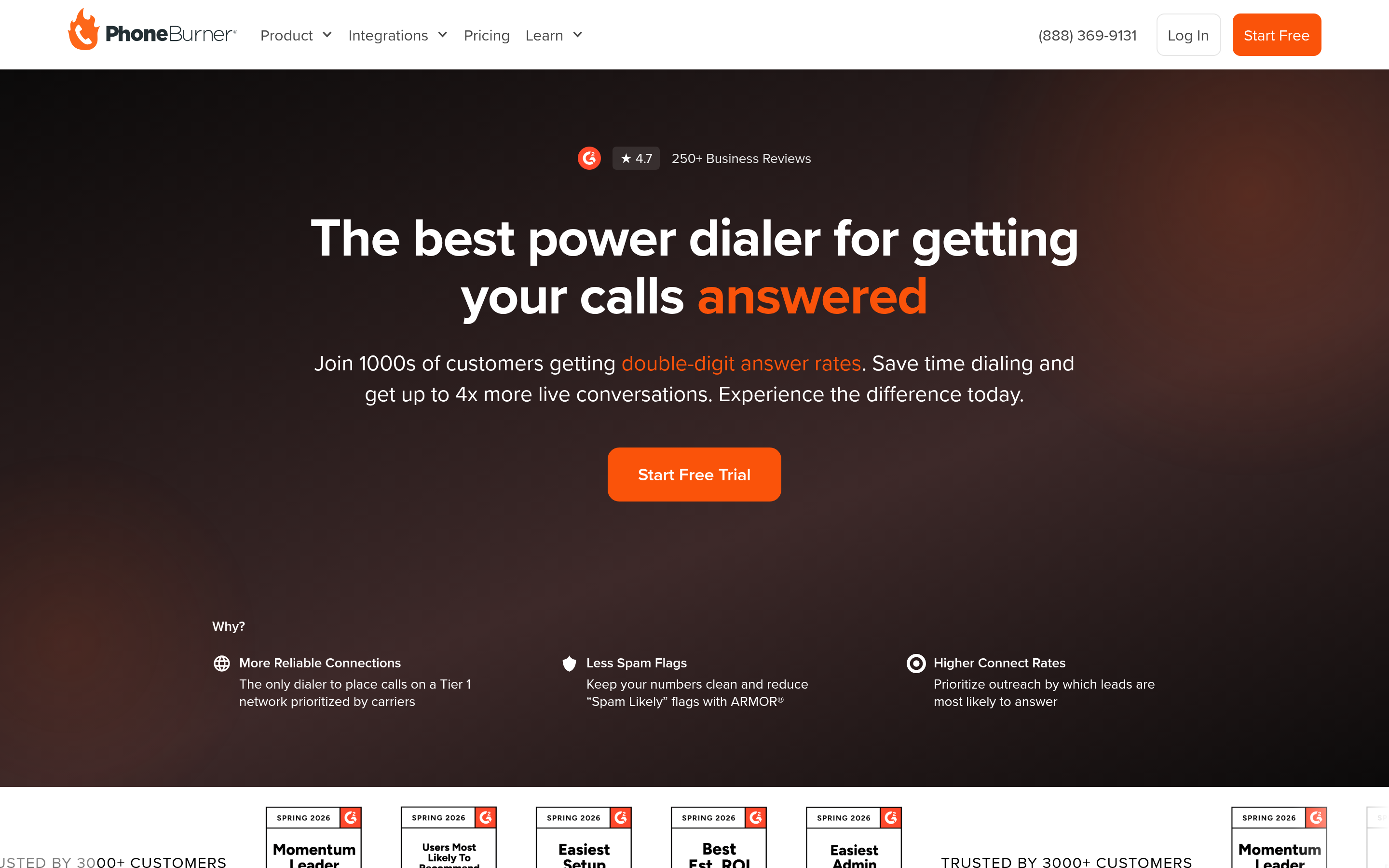
PhoneBurner is the classic power dialer for small and mid-size sales teams. It dials one number at a time with zero connection delay, drops voicemails in a click, and logs everything. There is no predictive over-dial, so you avoid the awkward "dead air" that gets you flagged as spam. The trade-off is price — it sits at the premium end per seat — but connect quality is excellent.
Kixie#
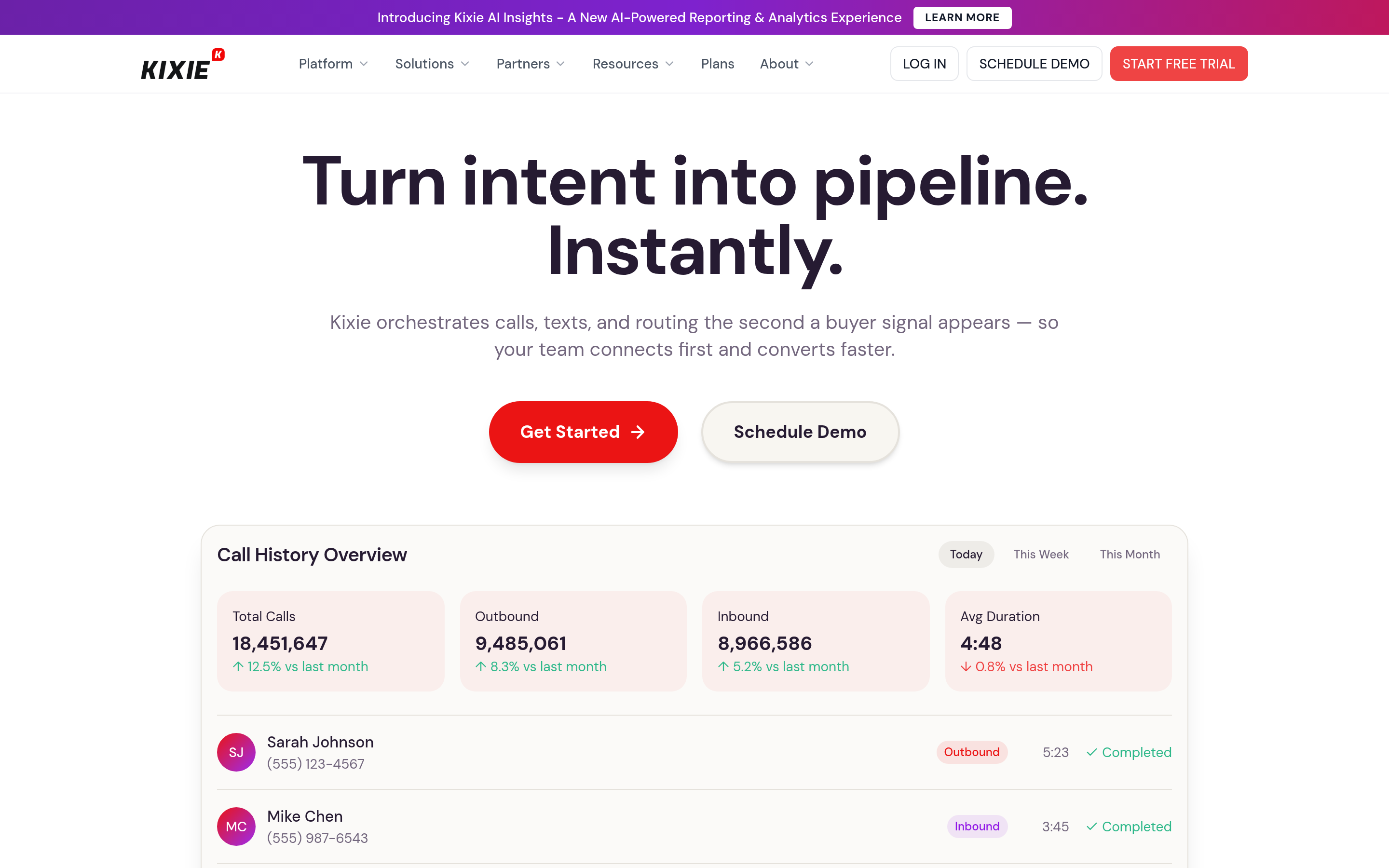
Kixie pairs a fast multi-line power dialer with local presence and automatic spam-number monitoring, which is why teams chasing connect rates like it. It plugs natively into HubSpot and Pipedrive, triggers SMS automations, and starts cheaper than most rivals. If your single metric is "more conversations per hour," Kixie is a strong default.
JustCall#

JustCall is the most well-rounded all-in-one: voice, SMS, WhatsApp, and an AI agent layer in one subscription with 100+ integrations. It offers predictive, auto, and dynamic dialer modes, so it scales from a two-rep startup to a 50-seat floor. For teams that want texting and calling under one roof — closest in spirit to CallHub but built for sales — JustCall is the natural swap. See JustCall on G2 for current user sentiment.
Aircall and CloudTalk#
Both treat voice as infrastructure: clean apps, strong call quality, deep CRM connectors, and solid international number coverage. CloudTalk edges ahead for cross-border teams thanks to broader local-number availability and smart routing. Aircall wins on ecosystem polish and app marketplace. Either is a safe "grown-up phone system" choice.
Dialpad, Five9, and Twilio#
Dialpad leans hard into real-time AI — live transcription, sentiment, and coaching cues mid-call. Five9 is the enterprise contact-center heavyweight with predictive dialing and workforce management; it is overkill (and over-budget) for small teams. Twilio is not a product but a set of APIs — pick it only if you have engineers to build your own dialer and want total control.
How do CallHub alternatives compare on pricing?#
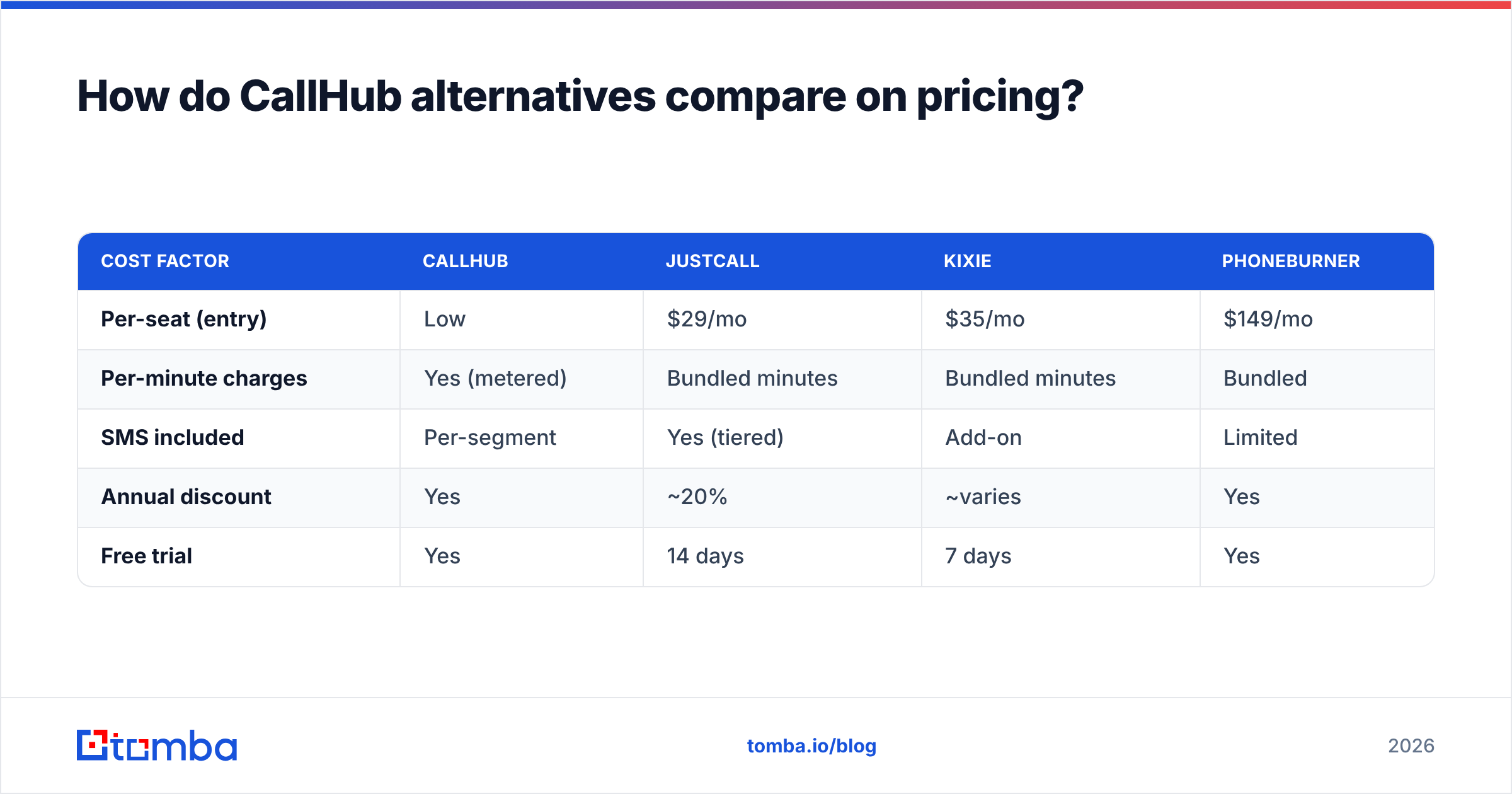
The headline trap is comparing seat prices while ignoring usage. CallHub's seat fee looks low, but the per-minute and per-segment charges add up fast on long sales calls. Seat-inclusive tools like JustCall or CloudTalk are often cheaper once you model real call volume.
| Cost factor | CallHub | JustCall | Kixie | PhoneBurner |
|---|---|---|---|---|
| Per-seat (entry) | Low | $29/mo | $35/mo | $149/mo |
| Per-minute charges | Yes (metered) | Bundled minutes | Bundled minutes | Bundled |
| SMS included | Per-segment | Yes (tiered) | Add-on | Limited |
| Annual discount | Yes | ~20% | ~varies | Yes |
| Free trial | Yes | 14 days | 7 days | Yes |
Rule of thumb: if your reps spend most of the day in live conversations, pick a bundled-minute plan and ignore the cheap-looking metered options. If you blast short voice messages to big lists, CallHub's model may still be cheapest — which is precisely why it dominates the nonprofit space.
Does the dialer actually matter more than the data?#
No — and this is the part most "best dialer" roundups skip. A predictive dialer running at 40% wrong numbers is just a faster way to reach dead ends. Connect rate is the product of two things: dialer efficiency and list accuracy. You can buy the first; you have to earn the second.

B2B phone numbers decay fast — people change roles, companies switch carriers, direct lines get reassigned. If your list is six months old, assume a chunk of it is wrong. Two habits fix this:
- Source direct-dial numbers from a current B2B dataset instead of scraping stale CSVs. Tomba's phone finder returns mobile and direct-dial numbers tied to a verified contact, and you can enrich leads with title, company, and email in the same pass.
- Validate before you dial. A quick phone validator pass flags disconnected and invalid lines so reps never burn a call slot on them. For large lists, run it through bulk lead generation so the whole file is scrubbed at once.
Do this and a mid-tier dialer outperforms a premium one fed garbage. The math is not subtle: clean data is the cheapest connect-rate upgrade you can buy.
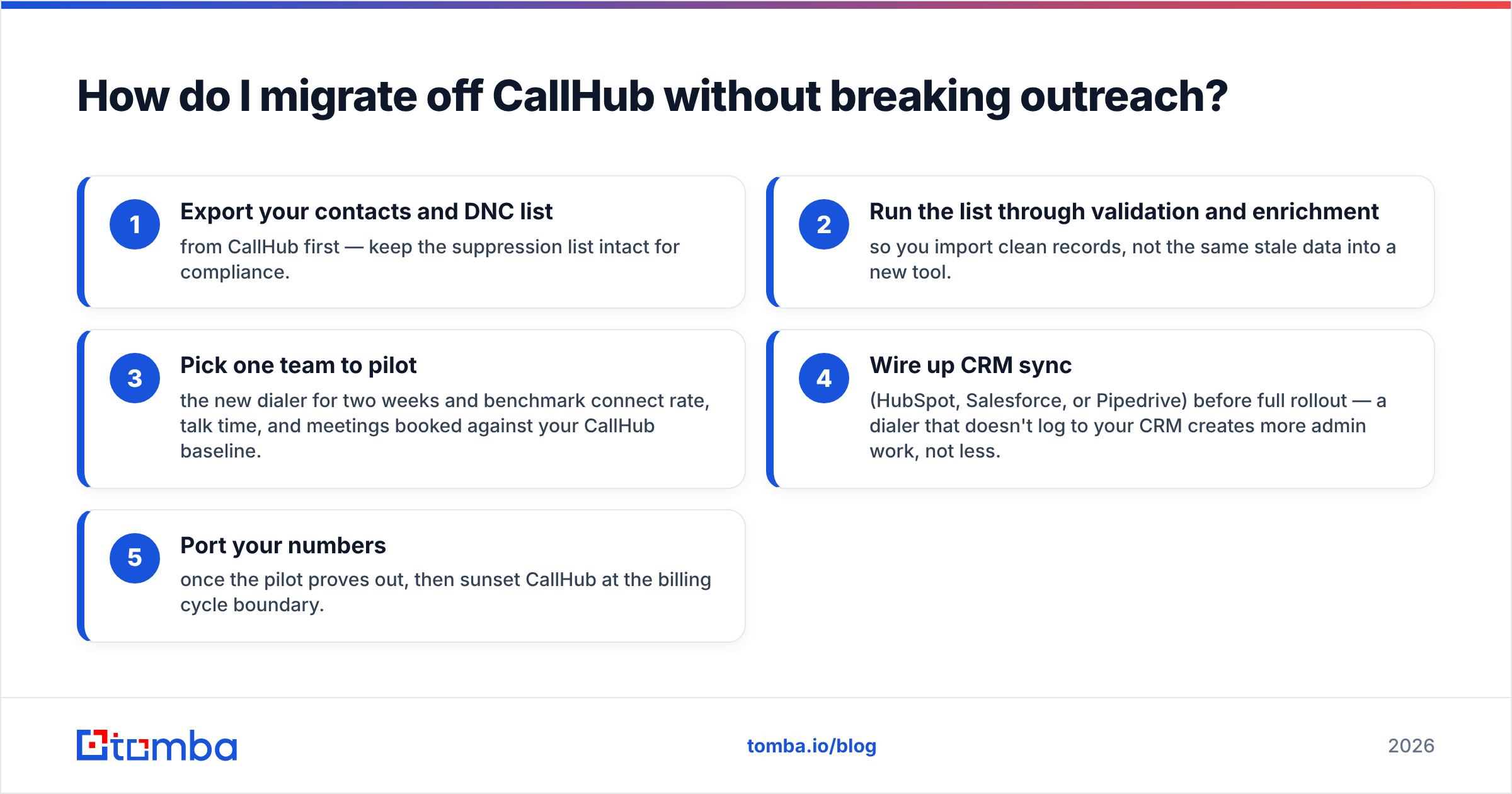
How do I migrate off CallHub without breaking outreach?#
Switch in stages so you never go dark:
- Export your contacts and DNC list from CallHub first — keep the suppression list intact for compliance.
- Run the list through validation and enrichment so you import clean records, not the same stale data into a new tool.
- Pick one team to pilot the new dialer for two weeks and benchmark connect rate, talk time, and meetings booked against your CallHub baseline.
- Wire up CRM sync (HubSpot, Salesforce, or Pipedrive) before full rollout — a dialer that doesn't log to your CRM creates more admin work, not less.
- Port your numbers once the pilot proves out, then sunset CallHub at the billing cycle boundary.
The enrichment step in #2 is where most teams cut the biggest waste. Importing a dirty list into a shiny new dialer just relocates the problem.
Which CallHub alternative should you choose?#
- You want the closest sales-grade replacement for CallHub's voice + SMS combo: JustCall.
- Your only goal is more live conversations per hour: Kixie with local presence.
- You run a small, high-touch team and connect quality beats volume: PhoneBurner.
- You need a clean, reliable phone system with great CRM sync: Aircall or CloudTalk.
- You want AI coaching on every call: Dialpad.
- You're an enterprise contact center: Five9.
- You have engineers and want to build it yourself: Twilio.
But notice the common thread: every recommendation assumes the numbers you dial are real. The dialer is the engine; the data is the fuel.
The bottom line#
CallHub is a fine broadcast and texting tool that was never designed to be a B2B sales dialer — so if you're a sales team, you've outgrown it, not picked it wrong. JustCall, Kixie, and PhoneBurner are the strongest sales-focused replacements, and Aircall, CloudTalk, and Dialpad win on infrastructure and AI. Compare them on real usage cost, not sticker seat price, and pilot before you port.
Whatever dialer you land on, fix the data first. Start with the Tomba Email Finder and phone finder to build verified, enriched contact lists, then validate them before your reps ever pick up the phone — Tomba's free tier gives you 25 searches to test it, with paid plans from $49/mo on the pricing page. The fastest connect-rate gain isn't a faster dialer. It's dialing numbers that actually ring.
// get started
Find, verify and enrich your first contacts today
Start on the free plan with 25 searches a month, then scale when your team is ready.
Free plan · No credit card required · GDPR & CCPA
// about the author