Calling Campaigns: The 2026 B2B Phone Outreach Playbook
Calling campaigns still close deals in 2026 — if the data is clean and the cadence is tight. Here's how to build phone outreach that books meetings instead of voicemails.
TL;DR
- A calling campaign is a structured, time-boxed phone outreach effort aimed at a defined contact list with one goal — usually booked meetings, not closed deals on the first dial.
- The single biggest predictor of campaign success isn't the script. It's list quality: wrong numbers and stale records kill connect rates before a rep says a word.
- A tight cadence (call + email + voicemail across 8–12 touches) beats a "blitz day" of random dials almost every time.
- Track connect rate, conversation rate, and meetings booked per 100 dials — vanity metrics like "total dials" hide whether the campaign actually works.
- Clean phone data up front with a phone validator and enrich thin records before you load them into the dialer.
What is a calling campaign?#
A calling campaign is a coordinated push where a sales team works a specific list of prospects by phone over a fixed window — a week, a month, a quarter — toward one measurable goal. Think of it like a fishing trip with a plan: you pick the lake (your segment), check your gear (data and dialer), and fish at the hours the fish actually bite (when buyers answer). You don't just cast randomly and hope.
That structure is what separates a campaign from "reps dialing whoever's in the CRM." A real campaign has a target list, a defined offer, a cadence, a script framework, and a scoreboard. Everything else is just busywork that feels productive.
In 2026, phone still works in B2B — but the bar is higher. Buyers screen unknown numbers, mobile carriers flag spam aggressively, and a single bad list can torch your connect rate and your caller ID reputation. So modern calling campaigns lean hard on two things old-school boiler rooms ignored: clean, verified data and a multi-channel cadence that earns the right to call.
Why do most calling campaigns fail before the first dial?#
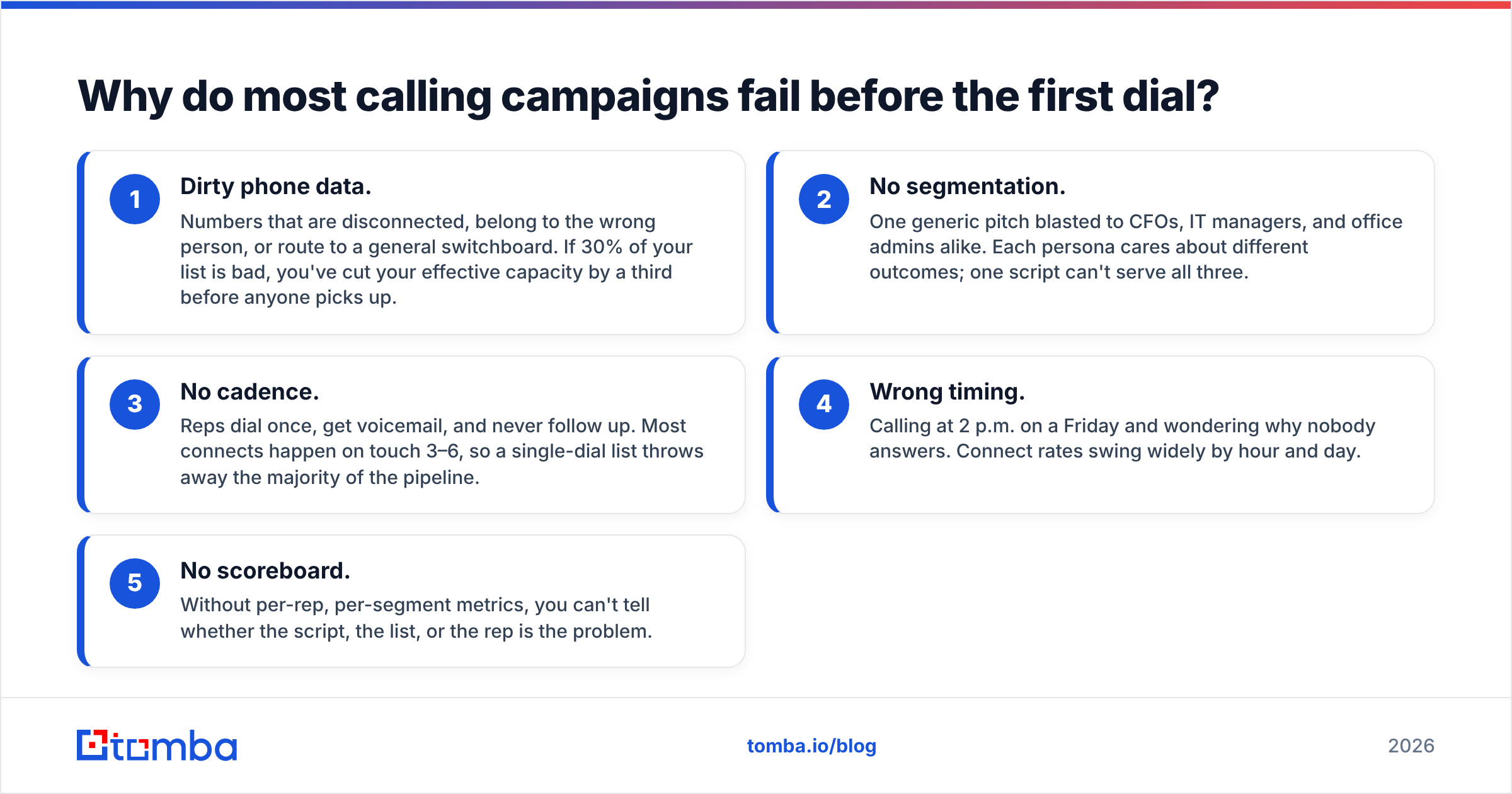
Most campaigns die in the spreadsheet, not on the phone. Here are the failure modes that show up over and over:
- Dirty phone data. Numbers that are disconnected, belong to the wrong person, or route to a general switchboard. If 30% of your list is bad, you've cut your effective capacity by a third before anyone picks up.
- No segmentation. One generic pitch blasted to CFOs, IT managers, and office admins alike. Each persona cares about different outcomes; one script can't serve all three.
- No cadence. Reps dial once, get voicemail, and never follow up. Most connects happen on touch 3–6, so a single-dial list throws away the majority of the pipeline.
- Wrong timing. Calling at 2 p.m. on a Friday and wondering why nobody answers. Connect rates swing widely by hour and day.
- No scoreboard. Without per-rep, per-segment metrics, you can't tell whether the script, the list, or the rep is the problem.
Notice that three of those five are data and planning problems, not talent problems. You can hire great closers and still run a dead campaign if the list underneath them is junk. That's why list hygiene — validating numbers, deduping, and filling gaps with data enrichment — is the highest-leverage hour you'll spend.
How do you build a calling campaign step by step?#
Here's the sequence that consistently produces booked meetings rather than burned hours.
1. Define the goal and the offer. Pick one primary outcome — almost always a booked discovery call. Write the one-sentence reason a prospect would say yes to 20 minutes.
2. Build and clean the list. Pull contacts that match your ICP, then verify every phone number and fill missing direct dials. Skip this and everything downstream degrades.
3. Segment by persona. Split the list into 2–4 buckets so each gets a relevant opener and pain hypothesis.
4. Design the cadence. Combine calls, voicemails, and emails across 8–12 touches over 2–3 weeks. The phone is the spearhead; email and LinkedIn are the supporting fire.
5. Write a script framework, not a script. Give reps an opener, a permission ask, two or three discovery questions, and an objection map — not a word-for-word monologue.
6. Set the scoreboard. Decide which metrics you'll review daily and weekly before the first dial goes out.
7. Run, listen, and tune. Review call recordings, watch the metrics, and adjust the worst-performing segment or talk track every few days.
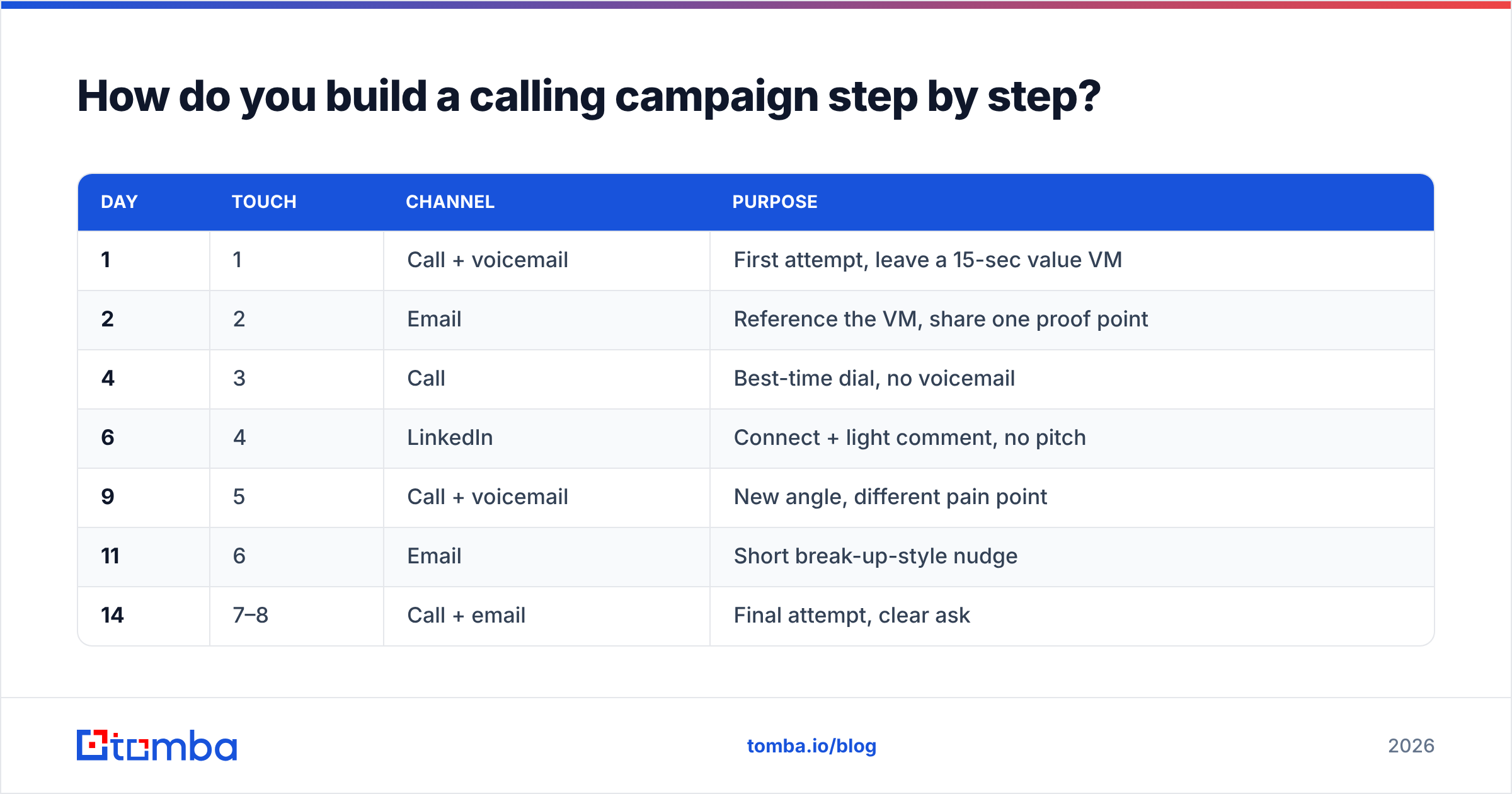
A sample multi-touch cadence#
| Day | Touch | Channel | Purpose |
|---|---|---|---|
| 1 | 1 | Call + voicemail | First attempt, leave a 15-sec value VM |
| 2 | 2 | Reference the VM, share one proof point | |
| 4 | 3 | Call | Best-time dial, no voicemail |
| 6 | 4 | Connect + light comment, no pitch | |
| 9 | 5 | Call + voicemail | New angle, different pain point |
| 11 | 6 | Short break-up-style nudge | |
| 14 | 7–8 | Call + email | Final attempt, clear ask |
This is a starting template, not gospel. The point is rhythm: predictable, multi-channel, and persistent without being a nuisance.
What metrics actually measure a calling campaign?#
Conclusion first: track conversation-to-meeting efficiency, not raw activity. A rep who makes 40 great dials and books 4 meetings beats one who makes 120 dials and books 1.
The core metrics worth a daily glance:
- Connect rate — % of dials that reach a live human. Below ~8–12% on cold B2B usually means a data or timing problem.
- Conversation rate — % of connects that turn into a real conversation (past the 10-second brush-off).
- Meetings booked per 100 dials — the north-star efficiency number.
- Cadence completion — % of prospects who got the full touch sequence. Low completion means reps are giving up early.
- Dials per booked meeting — the cost-per-outcome figure that tells you when to scale or stop.
Pair these with call recordings. Numbers tell you what's wrong; recordings tell you why. For broader context on how these phone metrics feed your funnel, it helps to think in terms of overall response rate across every channel, not phone in isolation.
How does data quality make or break calling campaigns?#
Data quality is the campaign. Everything else is amplification — and you can't amplify zero.
Run the math. Say you have 1,000 prospects and two reps who can each make 60 dials a day.
- With a 70%-accurate list, ~300 numbers are wrong. At a 10% connect rate on the good numbers, you get ~70 conversations from the whole list.
- With a 95%-accurate list, ~950 numbers are good. Same 10% connect rate gives you ~95 conversations — a 35% lift in pipeline from the exact same dialing effort.
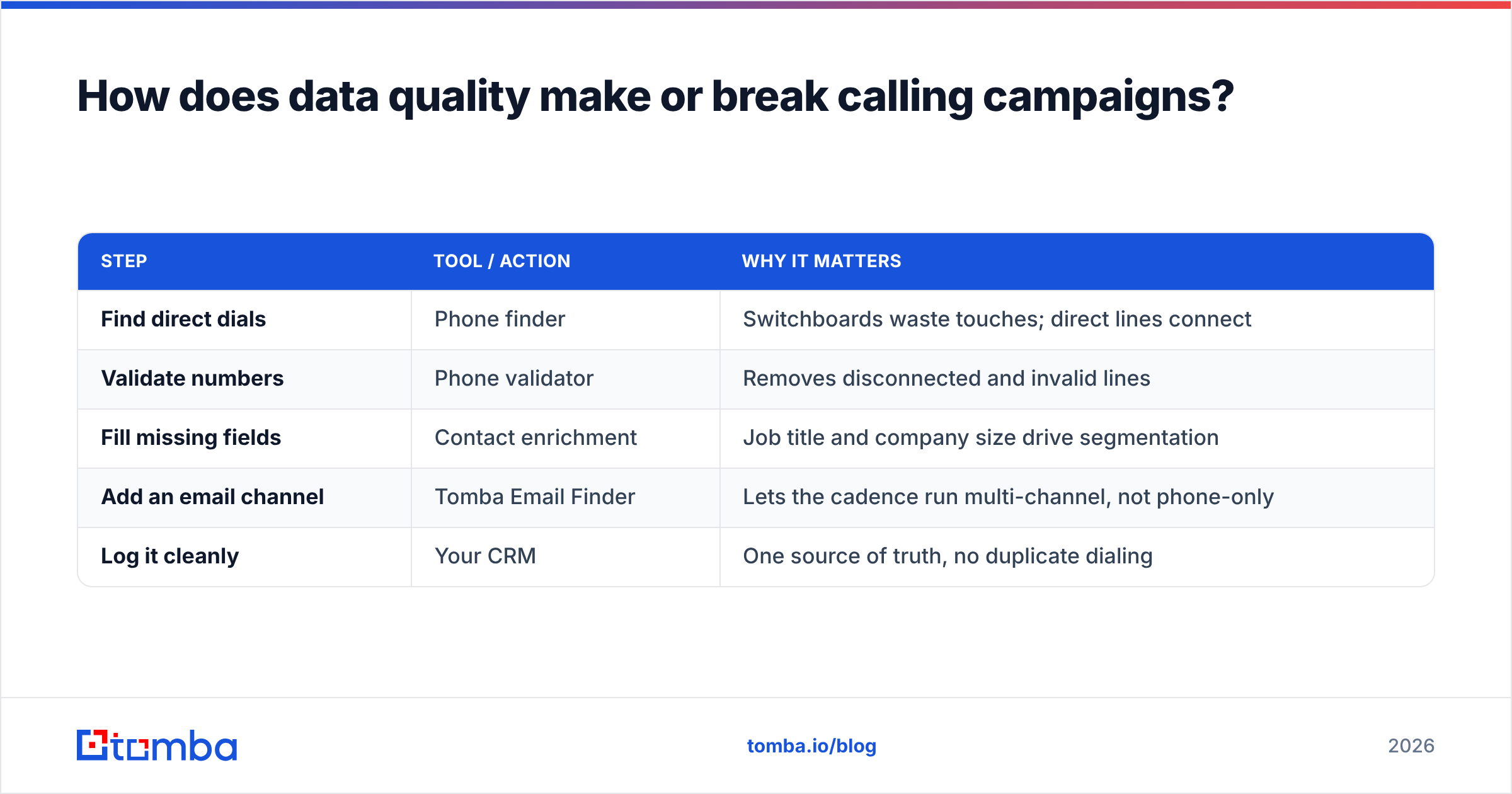
That gap compounds across every campaign you'll ever run. It's why the data layer deserves real investment before the dialing layer. A practical pre-flight checklist:
| Step | Tool / action | Why it matters |
|---|---|---|
| Find direct dials | Phone finder | Switchboards waste touches; direct lines connect |
| Validate numbers | Phone validator | Removes disconnected and invalid lines |
| Fill missing fields | Contact enrichment | Job title and company size drive segmentation |
| Add an email channel | Tomba Email Finder | Lets the cadence run multi-channel, not phone-only |
| Log it cleanly | Your CRM | One source of truth, no duplicate dialing |
The teams that win calling campaigns in 2026 treat the contact record as an asset to be maintained, not a static export. Numbers go stale, people change jobs, and direct dials get reassigned. A quarterly re-validation pass keeps your lists from quietly rotting.
Calling campaigns vs. email-only sequences: which wins?#
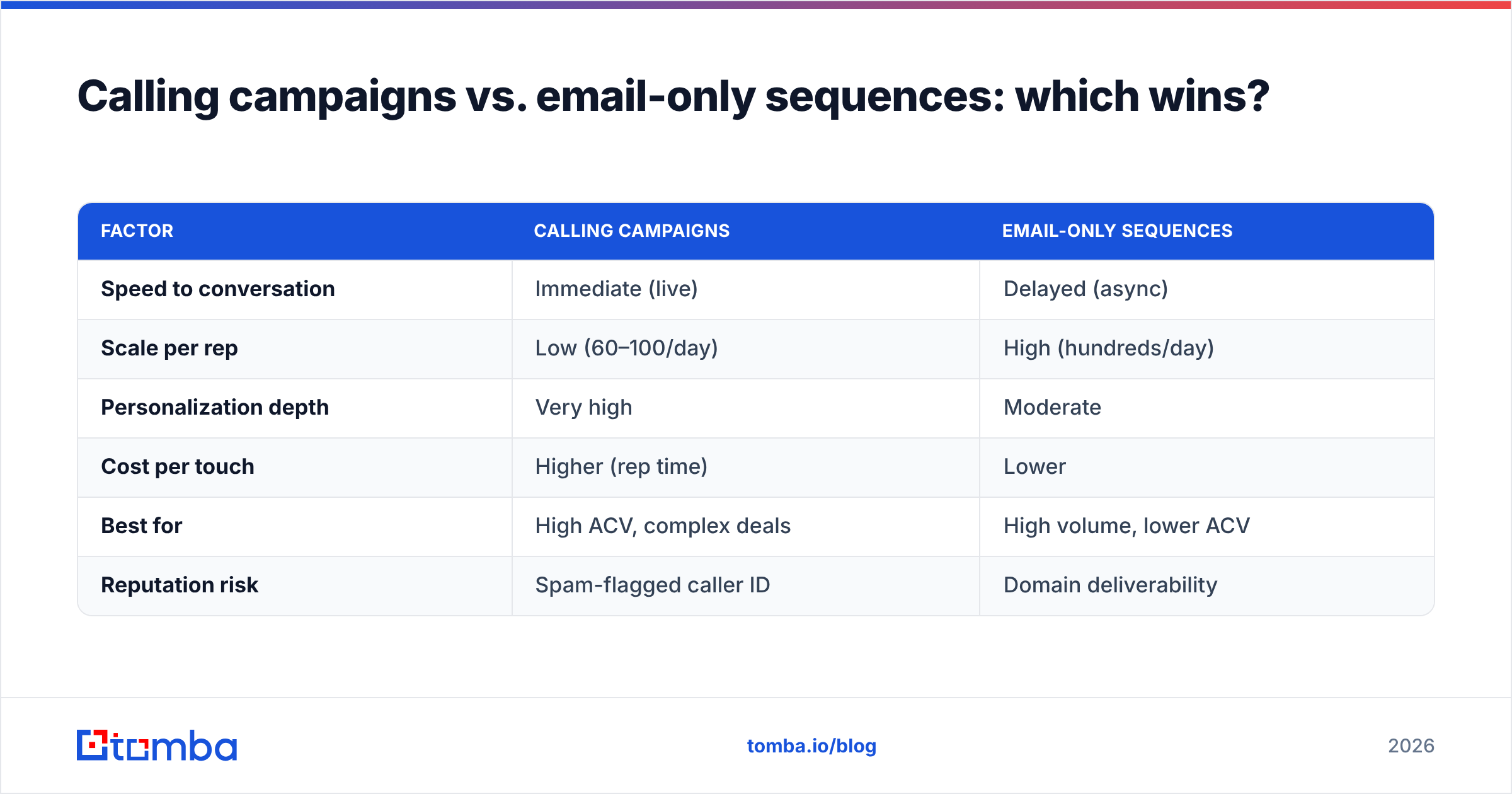
Neither wins alone — but here's the honest trade-off so you can weight them for your motion.
| Factor | Calling campaigns | Email-only sequences |
|---|---|---|
| Speed to conversation | Immediate (live) | Delayed (async) |
| Scale per rep | Low (60–100/day) | High (hundreds/day) |
| Personalization depth | Very high | Moderate |
| Cost per touch | Higher (rep time) | Lower |
| Best for | High ACV, complex deals | High volume, lower ACV |
| Reputation risk | Spam-flagged caller ID | Domain deliverability |
The strongest GTM motions blend both: email and LinkedIn warm the prospect and earn name recognition, and the call converts interest into a booked meeting. Phone is your highest-intent-signal channel — when someone agrees to talk, they're closer to buying than any open or click implies. Use it where the deal size justifies the rep minutes, and let automated channels carry the long tail.
If you're staffing a dedicated calling team, weigh the per-seat cost of your tooling against the meetings it generates. Transparent, usage-based plans like Tomba pricing make it easier to model cost-per-meeting than opaque enterprise contracts where you're paying for shelfware.
What does a good 2026 calling-campaign tech stack look like?#
You need four layers, and most teams over-invest in the dialer while neglecting the data:
- Data layer — find, verify, and enrich contacts (phone + email). This is where connect rate is won or lost.
- Dialer layer — a power or parallel dialer to remove manual dialing dead time. Vendors like Salesforce and HubSpot bundle this with the CRM; specialist dialers go deeper.
- CRM layer — single source of truth for activity, outcomes, and cadence state.
- Coaching layer — call recording and conversation intelligence so managers can review and improve talk tracks.
Resist the urge to buy the flashiest dialer first. A great dialer pointed at a bad list just makes you fail faster. Get the data layer right, plug in a competent dialer, and wire both into your CRM so nothing falls through the cracks. When you're comparing vendors across these layers, neutral review sites like G2 are useful for separating marketing claims from verified-buyer reality.
How do you keep caller ID reputation clean during a campaign?#
Caller ID reputation is the new deliverability. If carriers flag your numbers as "Spam Likely," your connect rate collapses no matter how good your list is. To protect it:
- Spread dials across multiple registered numbers instead of hammering everyone from one line.
- Register your numbers with the carrier branded-calling and STIR/SHAKEN frameworks so your business name displays.
- Keep your bad-number rate low — repeatedly dialing disconnected lines is itself a spam signal, which is another reason validation matters.
- Respect frequency caps. Three calls to the same person in one day reads as harassment to both the buyer and the carrier.
- Monitor flag status and rotate or rehabilitate numbers that get marked.
Treat your phone numbers like sending domains: warm them, monitor them, and don't burn them on dirty lists.
Closing: build the list before you build the script#
The reps, the script, and the dialer get all the attention, but calling campaigns are won in the data. Verified direct dials, accurate titles for segmentation, and a parallel email channel are what turn a wall of voicemails into a calendar full of meetings.
Start there. Use Tomba's Phone Finder to pull direct-dial numbers for your ICP, validate them so reps aren't dialing dead lines, and enrich the thin records before they ever hit your dialer. Spin up a free Tomba account, clean your next calling list, and measure the lift in connect rate yourself — it's the cheapest pipeline upgrade you'll make this quarter.
// get started
Find, verify and enrich your first contacts today
Start on the free plan with 25 searches a month, then scale when your team is ready.
Free plan · No credit card required · GDPR & CCPA
// about the author