How to Build B2B Calling Lists That Convert in 2026
Most calling lists fail before the first dial. Here's how to build, clean, and prioritize a B2B calling list that actually books meetings in 2026.
You can have the best pitch in your team and still lose the quarter if your calling list is garbage. The list decides who picks up, whether the number even rings, and whether the person on the other end is someone who can actually buy. Everything downstream — talk tracks, objection handling, cadence — is multiplied by the quality of the rows you start with.
This guide breaks down how to build a B2B calling list in 2026 that connects, qualifies, and converts: where to source numbers, how to clean them, how to prioritize, and how to keep the list alive instead of letting it rot.
TL;DR#
- A calling list is only as good as its phone data. Validate every number before reps dial — bad numbers burn time and crush connect rates.
- Source from multiple channels, then enrich. A name and company is a lead; a name, direct dial, role, and trigger is a callable record.
- Segment and prioritize by ICP fit and intent, not alphabetical order. Reps should never guess who to call next.
- Refresh continuously. B2B contact data decays ~30% a year, so a static list is a depreciating asset.
- Tools matter: pairing a phone finder with a phone validator turns a raw spreadsheet into a dial-ready list.
What is a calling list in B2B sales?#
A calling list is a structured set of prospect records your sales team works through by phone — each row holding everything a rep needs to make a relevant, well-timed call. At minimum that means a name, company, role, and a valid phone number. A good one carries far more: ICP fit, recent triggers, prior touchpoints, and a priority score.
Think of it like a flight manifest versus a phone book. A phone book is every number in the city, unsorted and mostly useless to you. A manifest tells you exactly who is on the plane, where they sit, and why they're traveling. Your reps need the manifest. Most teams hand them a phone book and wonder why connect rates are 4%.
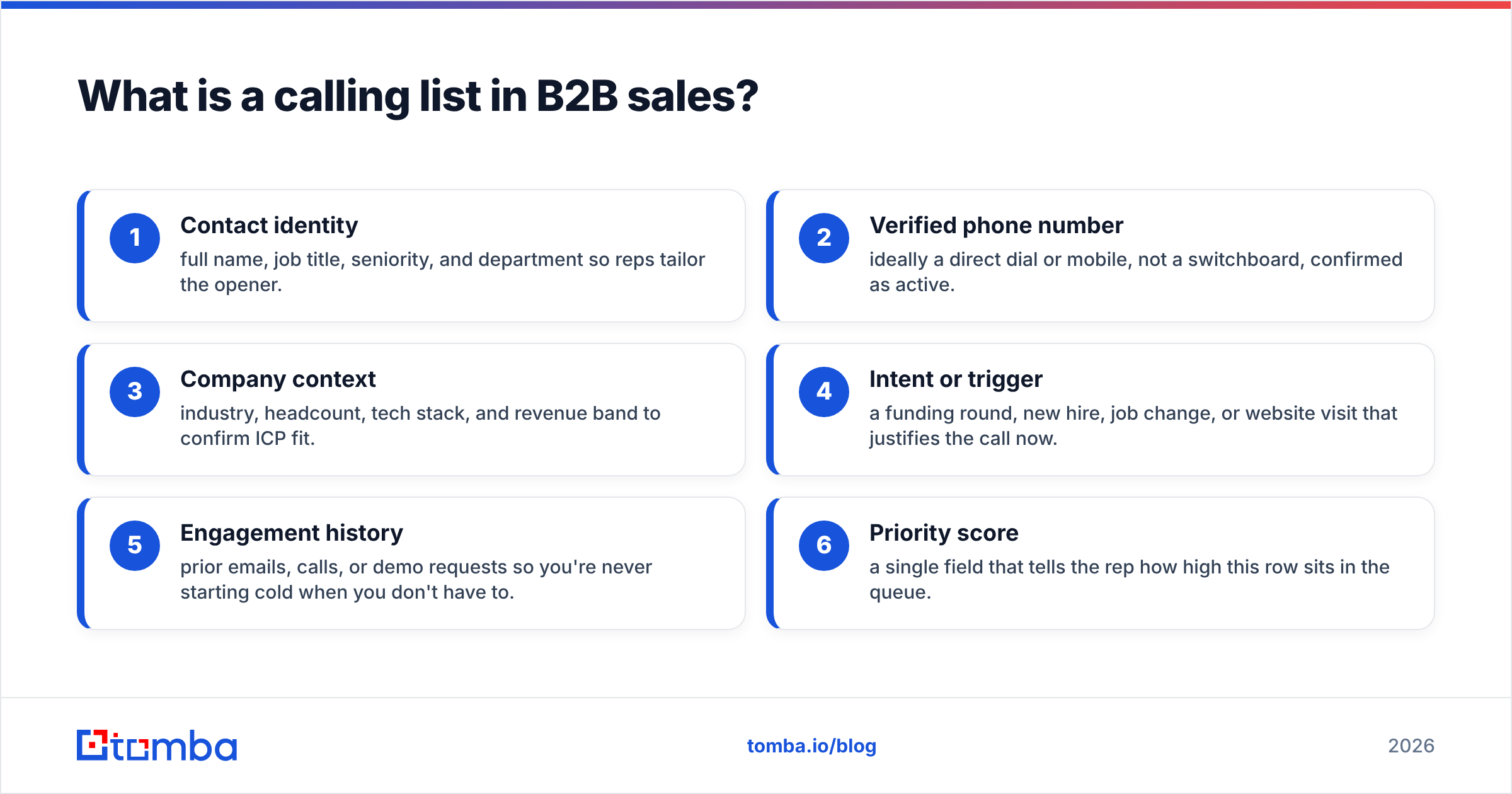
A complete calling record usually includes:
- Contact identity — full name, job title, seniority, and department so reps tailor the opener.
- Verified phone number — ideally a direct dial or mobile, not a switchboard, confirmed as active.
- Company context — industry, headcount, tech stack, and revenue band to confirm ICP fit.
- Intent or trigger — a funding round, new hire, job change, or website visit that justifies the call now.
- Engagement history — prior emails, calls, or demo requests so you're never starting cold when you don't have to.
- Priority score — a single field that tells the rep how high this row sits in the queue.
That structured-record shape is what separates a calling list that books meetings from a CSV that wastes a morning.
)
Why do most calling lists fail?#
Most calling lists fail because they're built once and never validated. The number that was a direct dial last year is now a dead extension. The "VP of Marketing" left eight months ago. The company got acquired and the area code changed. None of that shows up until a rep wastes a dial finding out.
Here are the failure modes that quietly kill connect rates:
- Dead or wrong numbers. Disconnected lines, wrong extensions, and reassigned mobiles. According to industry benchmarks reported across vendors like HubSpot, B2B data decays roughly 22–30% per year — phone data degrades fastest.
- Switchboards instead of direct dials. A main line means a gatekeeper, a phone tree, and a 30-second detour before a human.
- No prioritization. Reps dial top-to-bottom, spending equal effort on a perfect-fit enterprise account and a free-tier hobbyist.
- Missing context. Without a trigger or role detail, every call is a generic cold pitch, and prospects can hear the lack of homework.
- Compliance blind spots. Calling numbers on a Do-Not-Call list or in a region with strict consent rules creates legal and reputational risk.
Fix the data and the prioritization, and the same reps with the same script see connect and conversion rates climb — no new headcount required.
How do you build a calling list that converts?#
Build it in five stages: define the ICP, source contacts, enrich and find direct dials, validate every number, then segment and score. Skipping any stage shows up later as wasted dials.
1. Define your ICP before you pull a single number#
Decide who belongs on the list before you source anyone. Lock the firmographics (industry, company size, revenue, geography) and the persona (titles, seniority, department). A tight ICP of 500 perfect-fit accounts beats a loose list of 5,000 maybes every time, because your reps' hours are the scarce resource — not the size of the spreadsheet.
2. Source contacts from multiple channels#
No single source is complete. Combine:
- A B2B database for breadth across companies and roles.
- Your CRM and past closed-lost opportunities — warm context, often overlooked.
- LinkedIn and event lists for fresh, intent-rich names.
- Inbound and website visitors you can reverse-resolve to companies.
Pull names and companies first; you'll attach the phone numbers in the next step.
3. Enrich and find direct dials#
A name and company isn't callable yet. Use a phone finder to attach direct dials and mobiles, and layer in data enrichment to fill role, seniority, headcount, and tech-stack fields. The goal is to turn each thin row into a complete record a rep can act on without a research detour.
4. Validate every number#
This is the step teams skip and the one that matters most. A phone validator checks whether numbers are active, correctly formatted, and line-typed (mobile vs. landline vs. VoIP) before reps ever dial. Validating up front protects connect rates and keeps your reps' time on conversations, not voicemail beeps.
5. Segment and score#
Finally, rank the list. Tier by ICP fit, then break ties with intent signals. The output is a queue, not a dump — reps always know the next best call.
What does a clean vs. dirty calling list look like?#
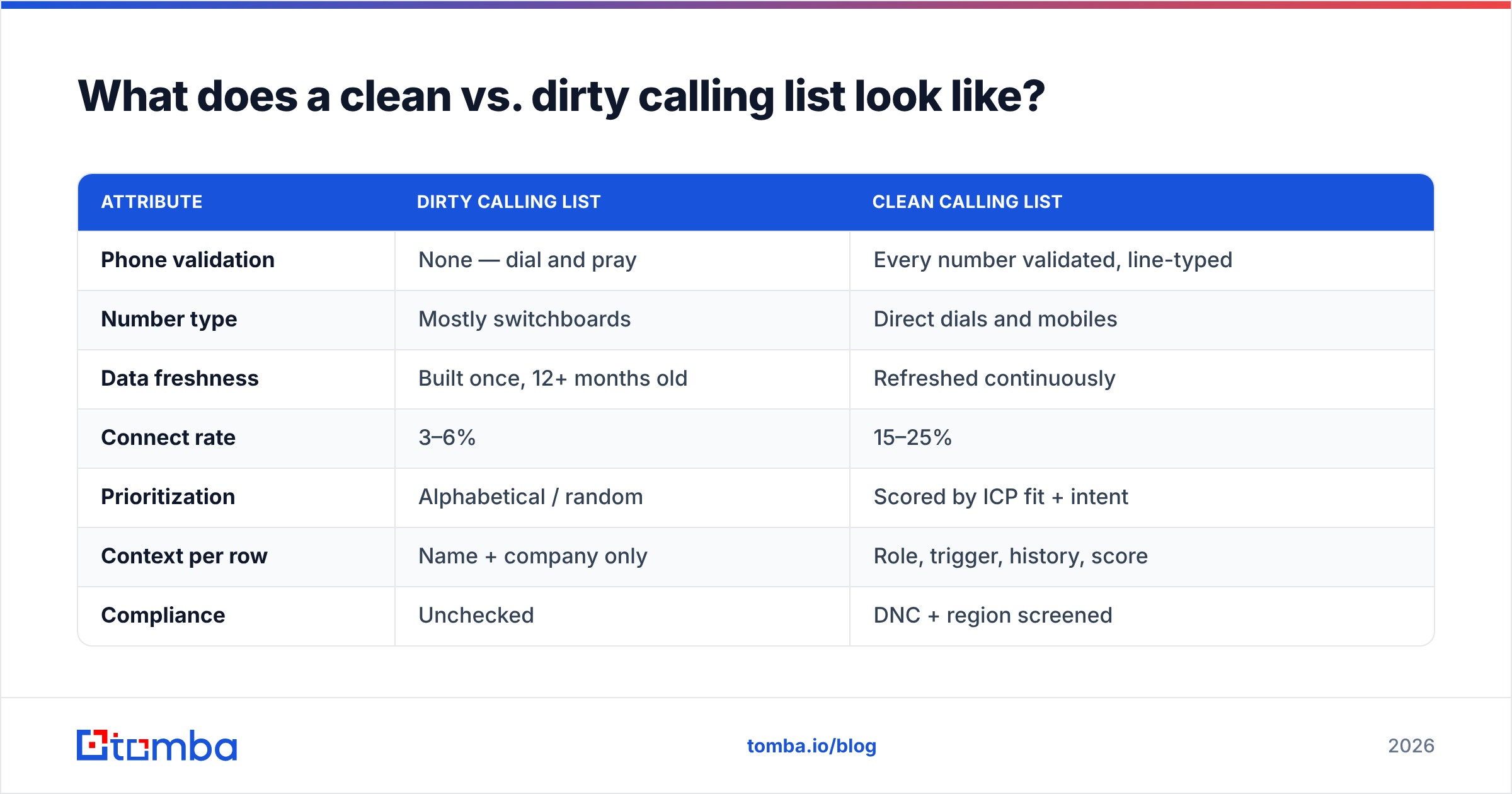
The difference between a dirty and clean list isn't subtle once you see the numbers side by side. Same reps, same script, same hours — wildly different output.
| Attribute | Dirty calling list | Clean calling list |
|---|---|---|
| Phone validation | None — dial and pray | Every number validated, line-typed |
| Number type | Mostly switchboards | Direct dials and mobiles |
| Data freshness | Built once, 12+ months old | Refreshed continuously |
| Connect rate | 3–6% | 15–25% |
| Prioritization | Alphabetical / random | Scored by ICP fit + intent |
| Context per row | Name + company only | Role, trigger, history, score |
| Compliance | Unchecked | DNC + region screened |
| Rep morale | Burnout from dead dials | Momentum from live conversations |
The clean column isn't aspirational — it's the baseline you get from running the five build stages above. The gap between the two columns is usually the gap between a team that hits quota and one that doesn't.
)
Which tools should power your calling list?#
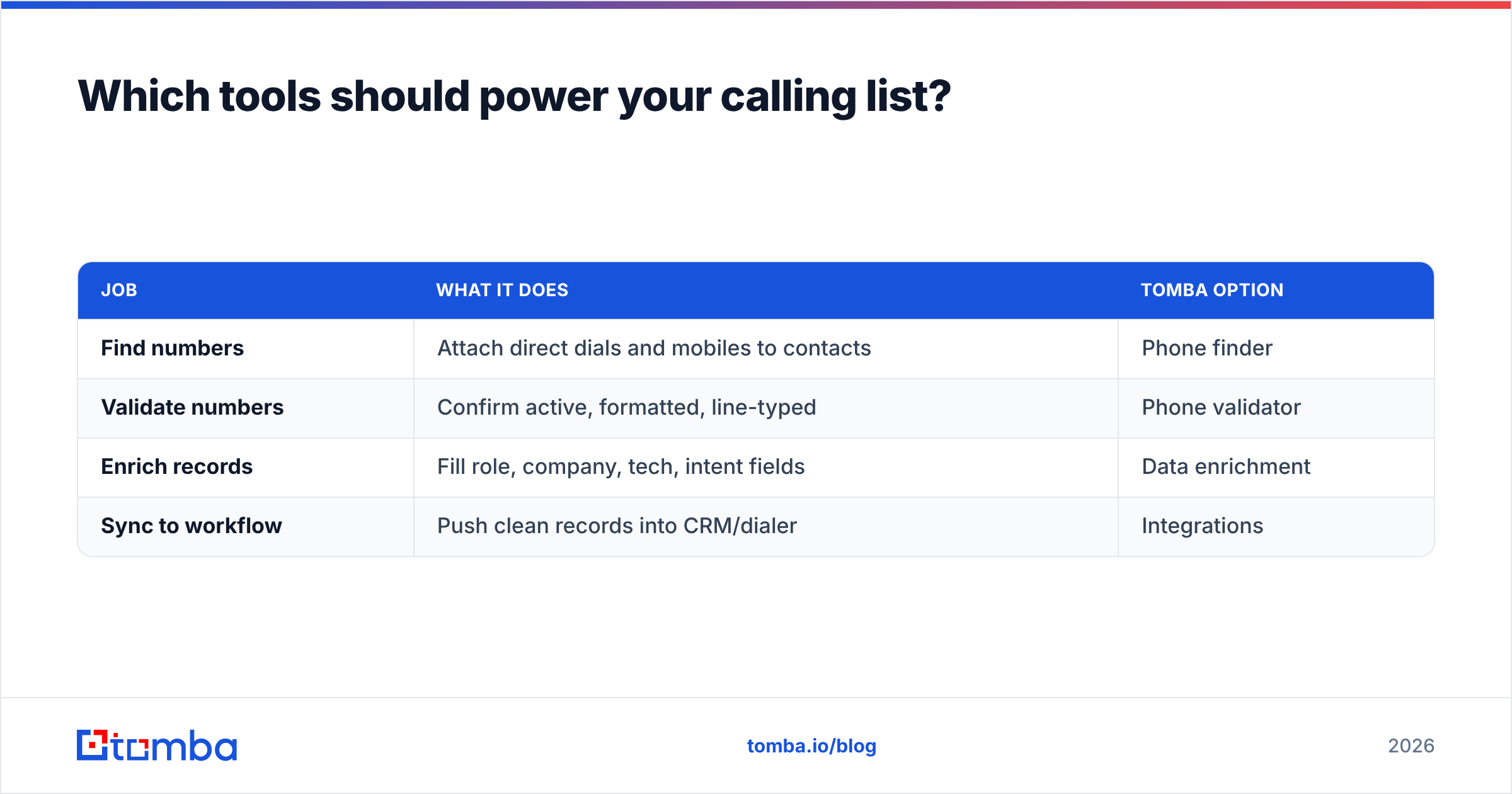
The right stack covers four jobs: source, enrich, validate, and dial. You can stitch these together or use a platform that handles the first three so your CRM and dialer handle the rest.
| Job | What it does | Tomba option |
|---|---|---|
| Find numbers | Attach direct dials and mobiles to contacts | Phone finder |
| Validate numbers | Confirm active, formatted, line-typed | Phone validator |
| Enrich records | Fill role, company, tech, intent fields | Data enrichment |
| Sync to workflow | Push clean records into CRM/dialer | Integrations |
For dialing and call logging, pair the list with a CRM-native dialer or a platform like Salesforce Sales Engagement. The key is that the list arrives clean — no tool fixes bad data at dial time. You can compare phone-data vendors on review sites like G2 before committing, but prioritize accuracy and validation over raw record counts.
On cost: Tomba runs a free tier with 25 searches a month, then Tomba pricing scales from Starter at $49/mo to Growth at $99/mo and Pro at $249/mo, with enterprise custom. That covers list-building for most outbound teams without a per-seat dialer markup.
How do you prioritize who to call first?#
Prioritize by combining ICP fit with intent, then let reps work strictly top-down. Two prospects can both fit your ICP, but the one who just raised a Series B or posted a relevant job opening is a far hotter call today. Bake that into a score so reps never deliberate.
A simple, durable scoring model:
- Fit (0–50): firmographic and persona match against your ICP.
- Intent (0–30): recent triggers — funding, hiring, tech change, site visit.
- Engagement (0–20): prior touches, opened emails, past demos.
Sum to a 0–100 score, sort descending, and your reps dial the highest numbers first. This is the same logic behind lead scoring — you're just applying it to a phone queue. Revisit the weights quarterly as you learn which signals actually predict booked meetings.
How often should you refresh a calling list?#
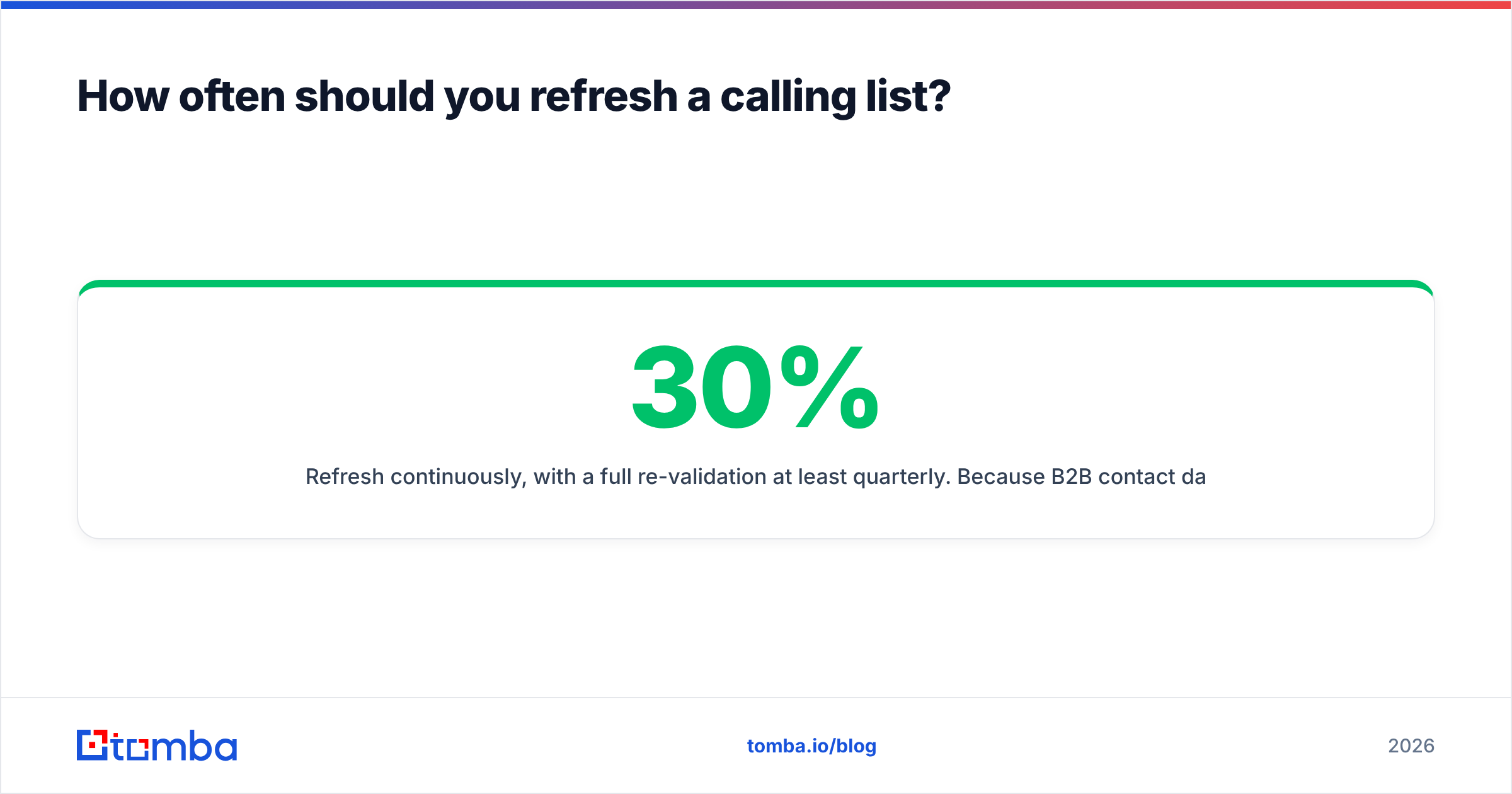
Refresh continuously, with a full re-validation at least quarterly. Because B2B contact data decays around 30% a year, a list that was 90% accurate in January is closer to 70% by summer and worse by year-end. Treat the list as a living asset, not a one-time deliverable.
Practical cadence:
- Real-time: validate numbers the moment a record enters the list.
- Weekly: re-enrich rows touched by reps, flag job changes.
- Quarterly: re-run the full list through a phone validator and purge dead numbers.
- On-trigger: when an account fires a buying signal, re-verify and re-prioritize immediately.
Automating this with integrations means your CRM stays clean without a quarterly fire drill — validation runs in the background and reps only ever see callable rows.
What about compliance?#
Screen for compliance before reps dial, every time. Calling numbers on a national Do-Not-Call registry, or contacting prospects in regions with strict consent rules, exposes you to fines and brand damage. Build a screening step into your list pipeline: scrub against DNC lists, respect region-specific consent requirements, and log consent where required. Clean compliance isn't just legal hygiene — it keeps your numbers and domain reputation intact for the long run.
Frequently asked questions#
How many contacts should a calling list have? Fewer than you think. A focused list of 300–800 well-scored, validated records gives a rep weeks of high-quality dialing. Volume without fit just inflates the spreadsheet and lowers your hit rate.
What's the difference between a calling list and a lead list? A lead list is any set of prospects across channels. A calling list is the phone-specific subset: validated numbers, direct dials, and call-ready context. Every calling list is a lead list, but not every lead list is dial-ready.
Can I build a calling list from just company names? Yes — start with companies, then use a phone finder and enrichment to attach contacts and direct dials, and validate before dialing.
Do direct dials really matter that much? Enormously. Direct dials and mobiles skip the gatekeeper and the phone tree, which is where most cold calls die. They're the single highest-leverage upgrade to a calling list.
Build a calling list your reps will actually want to dial#
Your reps' time is the most expensive thing in your sales org. Stop spending it on dead numbers and switchboards. Build the list once the right way — sourced from real data, enriched with context, validated end to end, and scored so the best call is always next.
Start with Tomba's phone finder to attach direct dials to your prospects, run every number through the phone validator, and push clean records straight into your CRM. The free tier lets you build your first dial-ready list in minutes — no contract, no per-seat dialer markup. Give your team a manifest instead of a phone book, and watch the connect rate take care of itself.
// get started
Find, verify and enrich your first contacts today
Start on the free plan with 25 searches a month, then scale when your team is ready.
Free plan · No credit card required · GDPR & CCPA
// about the author