Canada Business Database: Best Sources & Tools for 2026
Where to find an accurate Canada business database in 2026 — free government registries, paid B2B data providers, and how to enrich and verify Canadian company records before you outreach.
Building outbound, market research, or a sales pipeline in Canada starts with one thing: a reliable Canada business database. The problem is that "Canadian company data" is scattered across federal registries, provincial corporate offices, scraped directories, and paid B2B platforms — and most of it goes stale fast. This guide shows you exactly where to get Canadian business records, what each source is good for, and how to turn raw company names into verified, outreach-ready contacts.
TL;DR#
- A Canada business database can come from free government registries (Statistics Canada, the federal Business Registry) or paid B2B data providers — each trades off coverage, freshness, and contact-level detail.
- Free registries are authoritative for legal entity data (name, status, jurisdiction) but rarely give you decision-maker emails or phone numbers.
- Paid providers and email-finder tools fill the contact gap, but accuracy varies wildly — always verify before you send.
- The best workflow is layered: start with a registry or list, enrich it with firmographics, then verify every email and phone number.
- Tomba's domain search and data enrichment turn a list of Canadian company domains into verified contacts without buying a bloated all-in-one platform.
What is a Canada business database?#
A Canada business database is any structured collection of records about Canadian companies — legal name, operating status, jurisdiction, industry code (NAICS), address, size, and ideally the people who work there with their contact details. Think of it like a phone book that got a graduate degree: the basic listing tells you a company exists, but a good database also tells you who to call, where they sit in the org, and whether the number still works.
There are three broad types, and confusing them is where most teams waste money:
- Legal/registry data — Official incorporation records. Authoritative, but limited to entity-level facts.
- Firmographic data — Company attributes like revenue, headcount, industry, and tech stack, usually aggregated by commercial vendors.
- Contact data — The actual emails, phone numbers, and roles of individual employees. This is what outbound teams actually need, and it's the hardest to keep accurate.
Most "Canada business database" products bundle these unevenly. Knowing which layer you're paying for keeps you from buying a registry export when you actually needed verified emails.
Where can you get Canadian business data for free?#
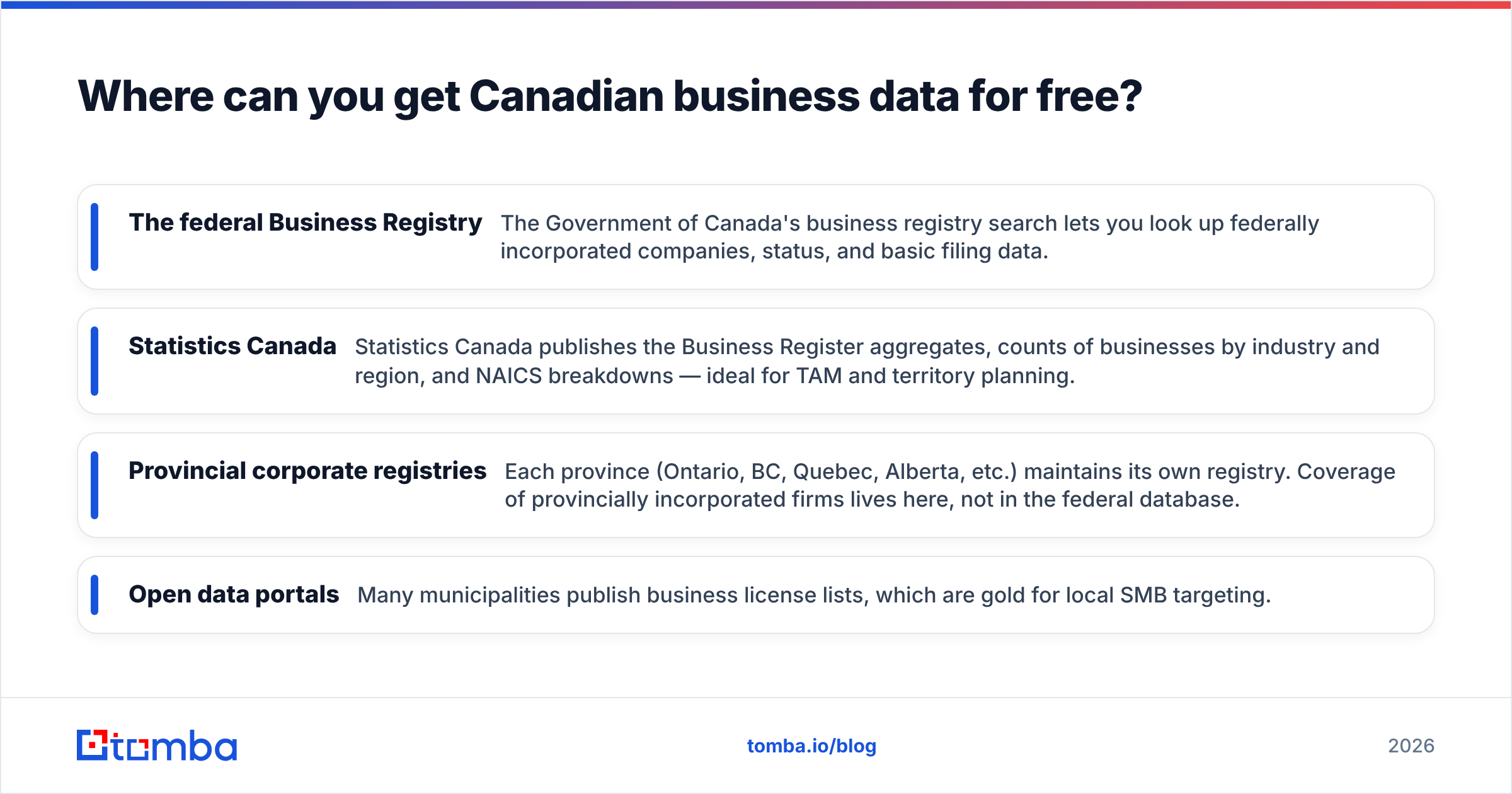
Canada has unusually good public infrastructure for company data. If you only need legal-entity facts or are doing market sizing, you can get a long way without spending a dollar.
- The federal Business Registry — The Government of Canada's business registry search lets you look up federally incorporated companies, status, and basic filing data.
- Statistics Canada — Statistics Canada publishes the Business Register aggregates, counts of businesses by industry and region, and NAICS breakdowns — ideal for TAM and territory planning.
- Provincial corporate registries — Each province (Ontario, BC, Quebec, Alberta, etc.) maintains its own registry. Coverage of provincially incorporated firms lives here, not in the federal database.
- Open data portals — Many municipalities publish business license lists, which are gold for local SMB targeting.
The catch: none of these reliably hand you a decision-maker's email or direct dial. They confirm a company exists and is in good standing. To go from "this company exists" to "here is the VP of Marketing's verified email," you need an enrichment and contact-finding layer on top.
)
)
Free vs paid: which Canada business database source fits your use case?#
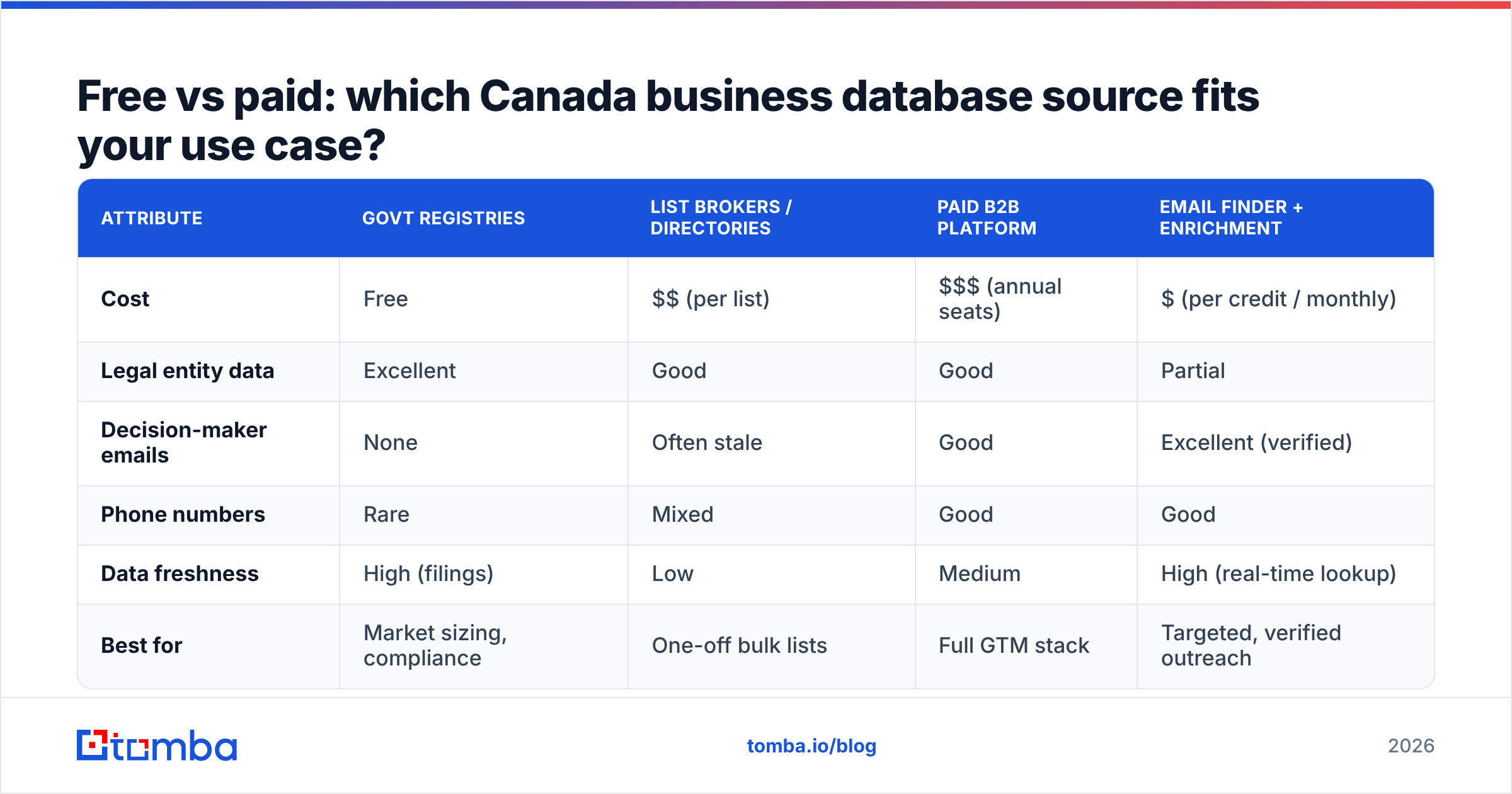
Here's how the main source types stack up on the attributes that actually decide projects. Use this to match the source to the job before you commit budget.
| Attribute | Govt registries | List brokers / directories | Paid B2B platform | Email finder + enrichment |
|---|---|---|---|---|
| Cost | Free | $$ (per list) | $$$ (annual seats) | $ (per credit / monthly) |
| Legal entity data | Excellent | Good | Good | Partial |
| Decision-maker emails | None | Often stale | Good | Excellent (verified) |
| Phone numbers | Rare | Mixed | Good | Good |
| Data freshness | High (filings) | Low | Medium | High (real-time lookup) |
| Best for | Market sizing, compliance | One-off bulk lists | Full GTM stack | Targeted, verified outreach |
The pattern is clear: registries win on authority and freshness for entity data, static lists are cheap but decay fast, big platforms are comprehensive but expensive, and a focused email-finder-plus-enrichment workflow gives you verified contact data at the lowest cost per usable lead. Most growing teams end up combining a registry or platform for discovery with a verification tool for accuracy.
Why does Canadian B2B data go stale so fast?#
Conclusion first: roughly 25–30% of B2B contact data decays every year, and Canadian data is no exception. People change jobs, companies rebrand, domains migrate, and catch-all servers hide invalid addresses. A list you bought 12 months ago is now a quarter wrong — and you won't know which quarter until your bounce rate spikes.
Three Canada-specific wrinkles make it worse:
- Bilingual naming. A company may operate as "Société ABC" in Quebec and "ABC Inc." federally, creating duplicate or mismatched records across sources.
- Provincial vs federal incorporation. The same business can appear differently depending on which registry you pull from, inflating duplicates.
- Catch-all domains. Many Canadian SMBs run mail servers that accept every address, so a naive verifier marks junk addresses as valid.
This is why the "buy a big CSV once" approach fails. A static export is a snapshot of a moving target. The fix is to verify at the point of use, not at the point of purchase. Run every address through an email verifier before it enters a sequence, and use a catch-all verifier to safely handle those accept-all Canadian domains instead of guessing.
How do you build an accurate Canada business database workflow?#
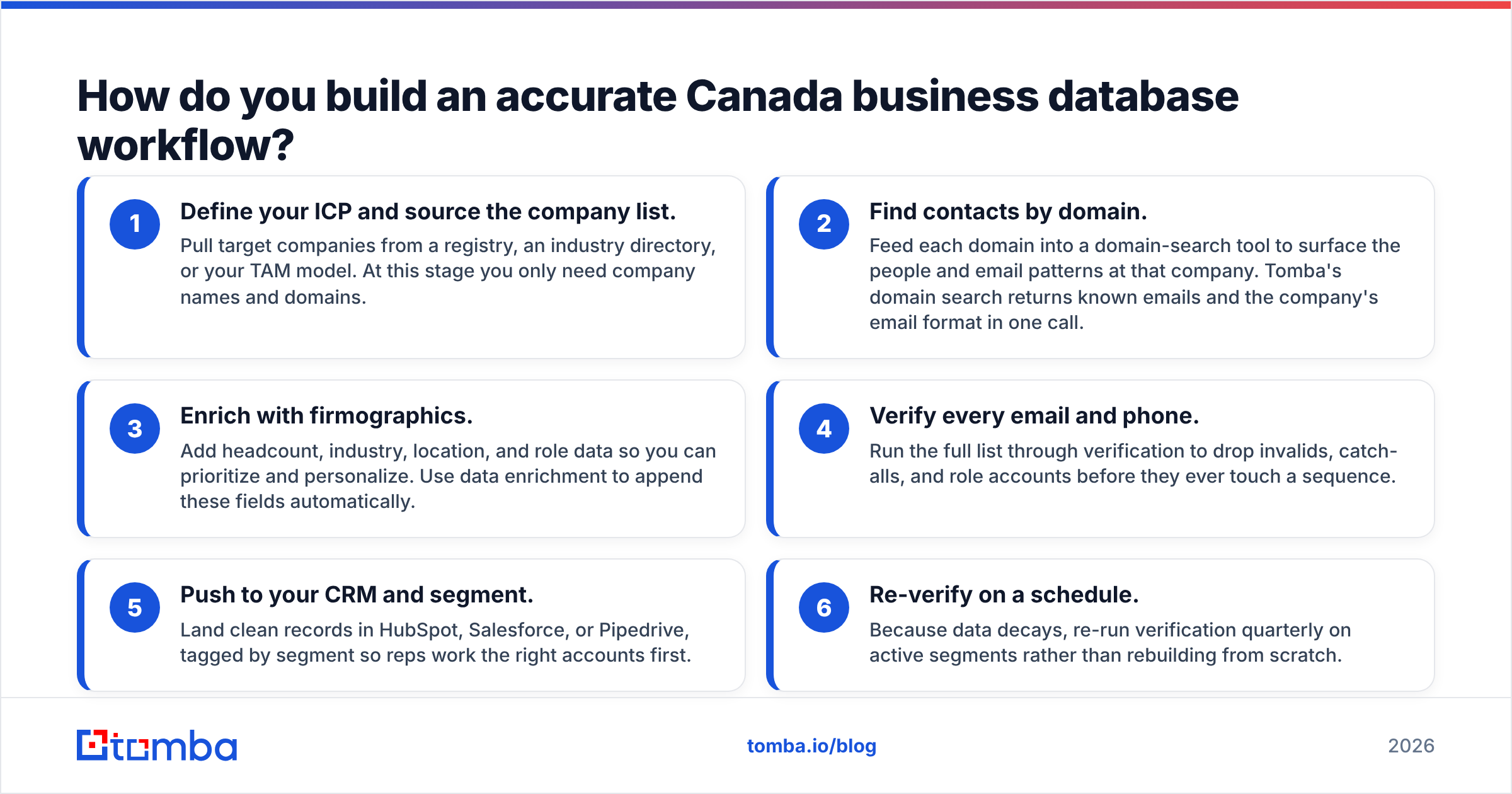
The most reliable approach is layered, not monolithic. You don't need one perfect source — you need a pipeline that compounds accuracy at each step. Here's the workflow that consistently produces clean, outreach-ready Canadian contacts:
- Define your ICP and source the company list. Pull target companies from a registry, an industry directory, or your TAM model. At this stage you only need company names and domains.
- Find contacts by domain. Feed each domain into a domain-search tool to surface the people and email patterns at that company. Tomba's domain search returns known emails and the company's email format in one call.
- Enrich with firmographics. Add headcount, industry, location, and role data so you can prioritize and personalize. Use data enrichment to append these fields automatically.
- Verify every email and phone. Run the full list through verification to drop invalids, catch-alls, and role accounts before they ever touch a sequence.
- Push to your CRM and segment. Land clean records in HubSpot, Salesforce, or Pipedrive, tagged by segment so reps work the right accounts first.
- Re-verify on a schedule. Because data decays, re-run verification quarterly on active segments rather than rebuilding from scratch.
This pipeline beats any single "magic database" because each step corrects the weaknesses of the one before it. Registries give you authoritative companies; domain search gives you people; enrichment gives you context; verification gives you deliverability.
How accurate is the contact data, really?#
Accuracy is the whole game, and it's where cheap lists quietly burn your sender reputation. An email that bounces doesn't just waste a send — it signals to mailbox providers that you're working a dirty list, which drags down inbox placement for your good contacts too. Protecting email deliverability is a direct function of how well you verify Canadian contact data before sending.
A few honest benchmarks to set expectations:
- Treat any provider claiming "99% accuracy" on cold data with skepticism — real-world verified accuracy on Canadian B2B contacts typically lands in the high 80s to mid 90s when verification is applied at lookup time.
- Catch-all domains are the silent killer. A list can look 95% valid and still bounce hard if catch-alls weren't separated out.
- Role-based addresses (info@, sales@, contact@) inflate "valid" counts but rarely reach a human decision-maker.
The practical takeaway: don't trust a vendor's headline accuracy number. Verify the data yourself, segment out catch-alls and role accounts, and measure your own bounce rate as the real scoreboard. For an independent read on how providers compare, G2's data quality category is a useful sanity check against vendor marketing.
What about phone numbers and multi-channel data?#
Email is the backbone of Canadian B2B outreach, but pairing it with verified phone numbers lifts connect rates, especially for AE-led motions. The same decay and verification rules apply: a phone list is only as good as its last validation pass.
If your motion includes calling, layer a phone finder into the same workflow you use for emails, and validate numbers before dialing so reps aren't burning hours on disconnected lines. Treat multi-channel data as one enriched record per contact — email, phone, role, company — rather than separate lists you have to reconcile later. One clean record per person is far easier to keep current than three siloed exports.
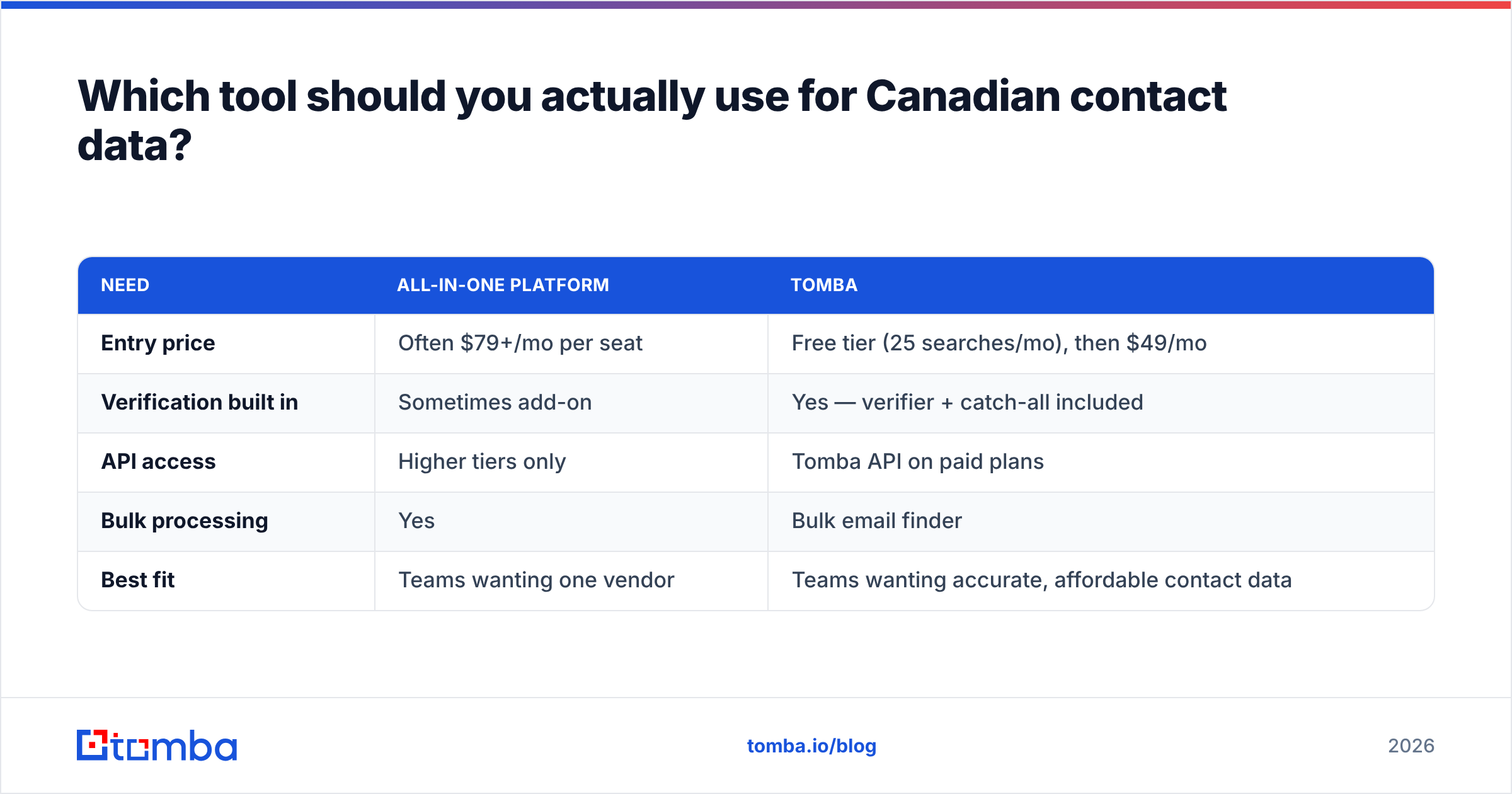
Which tool should you actually use for Canadian contact data?#
It depends on your scale and budget, but the decision usually comes down to whether you want a sprawling all-in-one platform or a focused, verify-first toolkit you can plug into your existing stack.
| Need | All-in-one platform | Tomba |
|---|---|---|
| Entry price | Often $79+/mo per seat | Free tier (25 searches/mo), then $49/mo |
| Verification built in | Sometimes add-on | Yes — verifier + catch-all included |
| API access | Higher tiers only | Tomba API on paid plans |
| Bulk processing | Yes | Bulk email finder |
| Best fit | Teams wanting one vendor | Teams wanting accurate, affordable contact data |
For most teams sourcing a Canada business database, you don't need to pay for a heavyweight platform's CRM, dialer, and sequencer when you only wanted accurate contacts. A focused finder-plus-verifier is cheaper per usable lead and integrates with the CRM and sequencer you already run. See full Tomba pricing to map plans to your volume.
Common mistakes to avoid#
- Buying one giant static list. It's stale the day it lands. Source companies, then find and verify contacts on demand.
- Skipping catch-all handling. Accept-all Canadian domains will quietly inflate your "valid" rate and then bounce.
- Ignoring bilingual duplicates. Dedupe across federal/provincial and English/French naming before you import.
- Verifying once, never again. Re-verify active segments quarterly; data decays whether you watch it or not.
- Over-trusting accuracy claims. Measure your own bounce rate — it's the only number that matters.
Final take: source smart, verify always#
The best Canada business database isn't a single file you buy — it's a workflow you run. Start with authoritative companies from government registries or your TAM model, find the right people with domain search, enrich for context, and verify every email and phone before it touches a sequence. That layered approach beats any "all-in-one" export on both accuracy and cost.
Ready to turn a list of Canadian company domains into verified, outreach-ready contacts? Start with the Tomba Email Finder — find professional emails by domain, name, or company, with verification built in, on a free tier that lets you test accuracy before you ever pay. Source smart, verify always, and let your bounce rate stay where it belongs: near zero.
Ready to find emails that actually work?
Join 150,000+ professionals who stopped guessing and started sending. Free credits on signup — no credit card required.
Get the Tomba newsletter
Practical outbound tactics and product updates — once every two weeks.
About the author