Candidate Sourcing Email Template: 9 Examples for 2026
Steal 9 candidate sourcing email templates that actually get replies in 2026 — plus the subject lines, personalization, and verified-address workflow behind them.
Most candidate sourcing emails fail before anyone reads the pitch. The address bounces, the subject line screams "mass blast," or the first line is about you instead of the candidate. A good candidate sourcing email template fixes all three at once — it gives you a repeatable structure that still reads as one human writing to another.
This guide gives you nine templates you can paste and send today, the subject lines that lift reply rates, and the deliverability workflow that keeps your messages out of spam. Every example is built for passive candidates in 2026, where inboxes are crowded and generic recruiter spam gets archived in seconds.
TL;DR#
- A candidate sourcing email template is a reusable outreach skeleton — subject, hook, value, and call to action — that you personalize per candidate instead of rewriting from scratch.
- Reply rate beats open rate. Lead with why this person, keep it under 120 words, and ask for a low-commitment yes.
- Verify the address first. Even a perfect template dies if it bounces; clean your list with an email verifier before you send.
- Nine templates below cover cold sourcing, referrals, re-engagement, follow-ups, and the "we've met before" angle.
- Personalization tokens plus one custom line is the formula that scales without sounding robotic.
What is a candidate sourcing email template?#
A candidate sourcing email template is a pre-written outreach message with fixed structure and swappable variables — name, company, role, and one personal detail — that recruiters reuse across many candidates. Think of it like a chef's mise en place: the components are prepped and ready, so each plate goes out fast but still looks made to order.
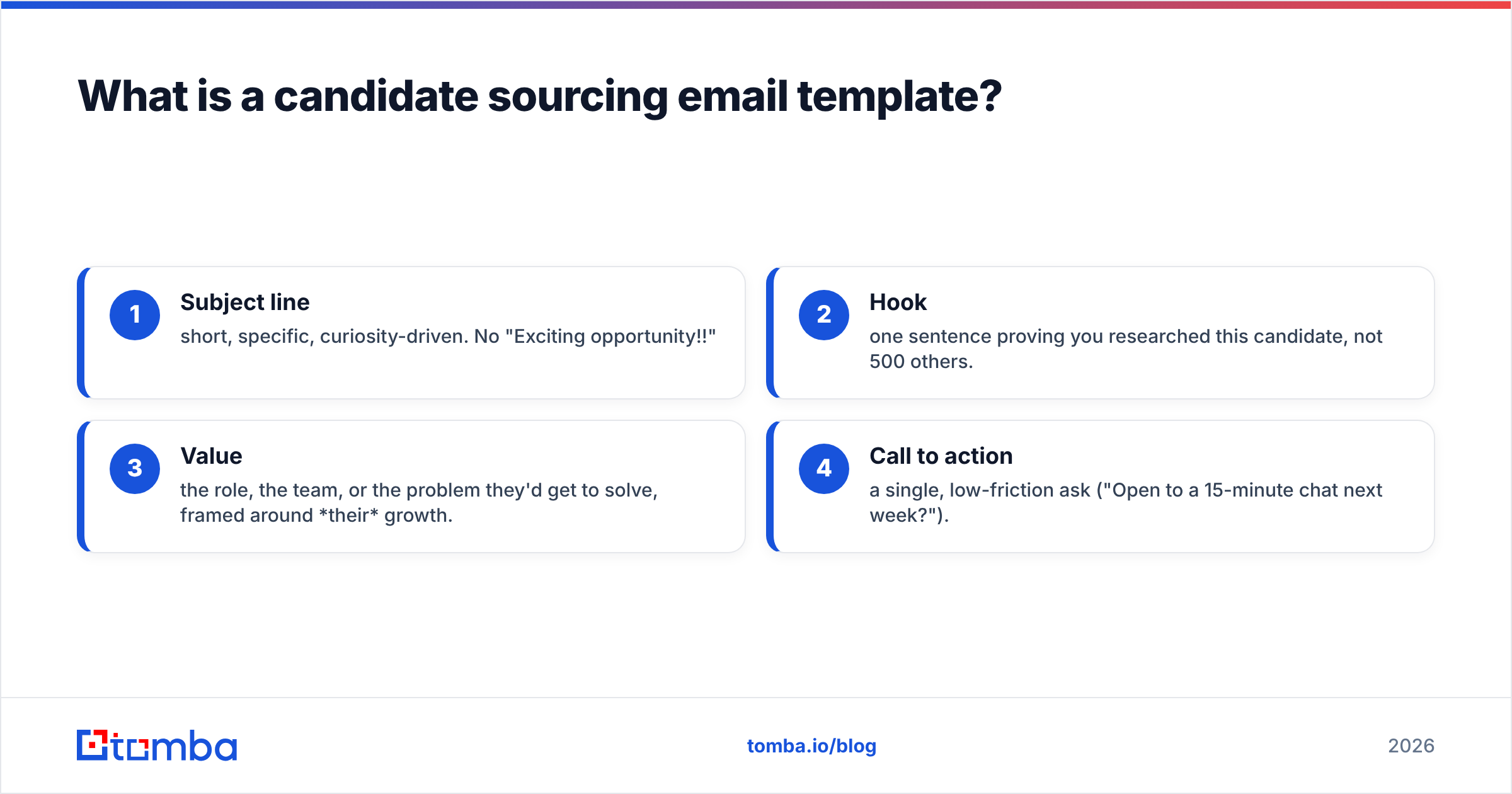
The structure almost always has four parts:
- Subject line — short, specific, curiosity-driven. No "Exciting opportunity!!"
- Hook — one sentence proving you researched this candidate, not 500 others.
- Value — the role, the team, or the problem they'd get to solve, framed around their growth.
- Call to action — a single, low-friction ask ("Open to a 15-minute chat next week?").
A template is not a script you send word-for-word. The whole point is that the skeleton stays constant while the personal details change. That's what lets you send 50 emails in an afternoon that each feel individual.

Why do most candidate sourcing emails get ignored?#
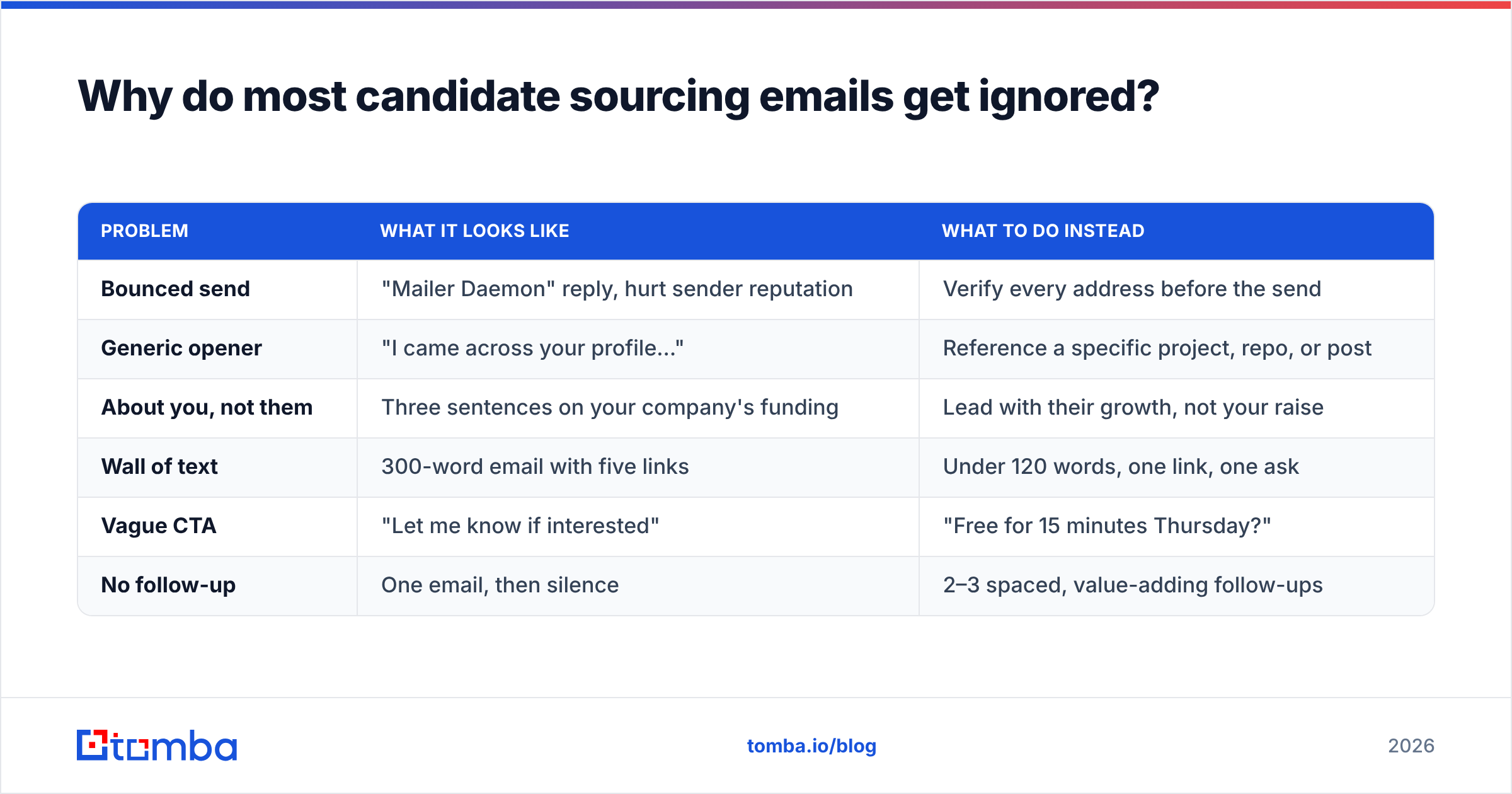
Because they break one of three rules: they bounce, they bore, or they beg. Here's how the failure modes stack up against what actually works.
| Problem | What it looks like | What to do instead |
|---|---|---|
| Bounced send | "Mailer Daemon" reply, hurt sender reputation | Verify every address before the send |
| Generic opener | "I came across your profile…" | Reference a specific project, repo, or post |
| About you, not them | Three sentences on your company's funding | Lead with their growth, not your raise |
| Wall of text | 300-word email with five links | Under 120 words, one link, one ask |
| Vague CTA | "Let me know if interested" | "Free for 15 minutes Thursday?" |
| No follow-up | One email, then silence | 2–3 spaced, value-adding follow-ups |
The single biggest lever is the first row. A study of recruiting outreach consistently shows that bounce rates above 5% drag down inbox placement for every email you send afterward, candidate-related or not. Protecting email deliverability is non-negotiable before you obsess over copy.
How do you write a candidate sourcing email that gets replies?#
Lead with the candidate, keep it short, and make the yes easy. Below is the anatomy applied to a real opener.
Subject: Your work on the Stripe migration at Acme
Hi Priya — I read your write-up on cutting Acme's checkout latency by 40%. The payments team I'm hiring for at Nimbus is wrestling with the exact same scaling wall right now.
I'm not going to pretend I know if you're looking. But if you're curious how a Series B team is solving it differently, I'd love to trade notes for 15 minutes.
Open to a quick call Thursday or Friday?
Notice what it does: a specific hook (the migration write-up), a problem framed around their expertise, an honest acknowledgment they may be happy where they are, and one calendar-friendly ask. No funding bragging, no nine bullet points.
Use the subject line generator if you're stuck — specific beats clever almost every time.
9 candidate sourcing email templates for 2026#
Copy these, swap the {{tokens}}, and add one custom line per candidate.
1. The cold sourcing opener#
Subject: {{specific_project}} caught my eye
Hi {{first_name}}, your work on {{specific_project}} is exactly the kind of thing my team at {{company}} is building toward. I'd love to share how the {{role}} role here could be a next step. Worth a 15-minute call this week?
2. The "we've met before" re-engagement#
Subject: Picking up where we left off
Hi {{first_name}}, we spoke about {{old_role}} back in {{timeframe}} — the timing wasn't right. Things have changed on our side ({{whats_new}}), and I immediately thought of you. Open to reconnecting?
3. The referral request#
Subject: Who's the best {{role}} you know?
Hi {{first_name}}, I'm hiring a {{role}} at {{company}} and you always seem to know the strongest people in {{field}}. No pressure at all — is there anyone you'd vouch for? Happy to return the favor anytime.
4. The passive-candidate value drop#
Subject: A resource for the {{specific_problem}} problem
Hi {{first_name}}, saw your post about {{specific_problem}}. We solved something similar — here's the short version: {{one_line_insight}}. I also happen to be hiring for a role that lives in this space. Curious to hear more?
5. The mutual-connection intro#
Subject: {{mutual_name}} suggested I reach out
Hi {{first_name}}, {{mutual_name}} mentioned you're one of the sharpest {{role}}s they've worked with. I'm building a team at {{company}} and would value 15 minutes of your perspective — even if a move isn't on your radar.
6. The data-point hook#
Subject: {{metric}} — how'd you pull that off?
Hi {{first_name}}, {{metric}} on {{project}} is genuinely impressive. I'm hiring a {{role}} who'd own problems at that scale. Would you be open to comparing notes on how you'd approach ours?
7. The honest "you're probably not looking"#
Subject: A long shot
Hi {{first_name}}, you're clearly thriving at {{current_company}}, so this is a long shot. But the {{role}} opening at {{company}} is unusual enough that I'd kick myself for not asking. 15 minutes?
8. The first follow-up (3 days later)#
Subject: Re: {{original_subject}}
Hi {{first_name}}, floating this back up in case it slipped past. Even a "not now" helps me — totally fine if the timing's off.
9. The breakup follow-up (final touch)#
Subject: Closing the loop
Hi {{first_name}}, I'll stop crowding your inbox after this. If {{role}} work at {{company}} ever feels timely, my door's open. Wishing you the best either way.
Want more copy patterns beyond sourcing? Browse the cold email templates library for outreach structures you can adapt.
Which subject lines lift recruiting reply rates?#
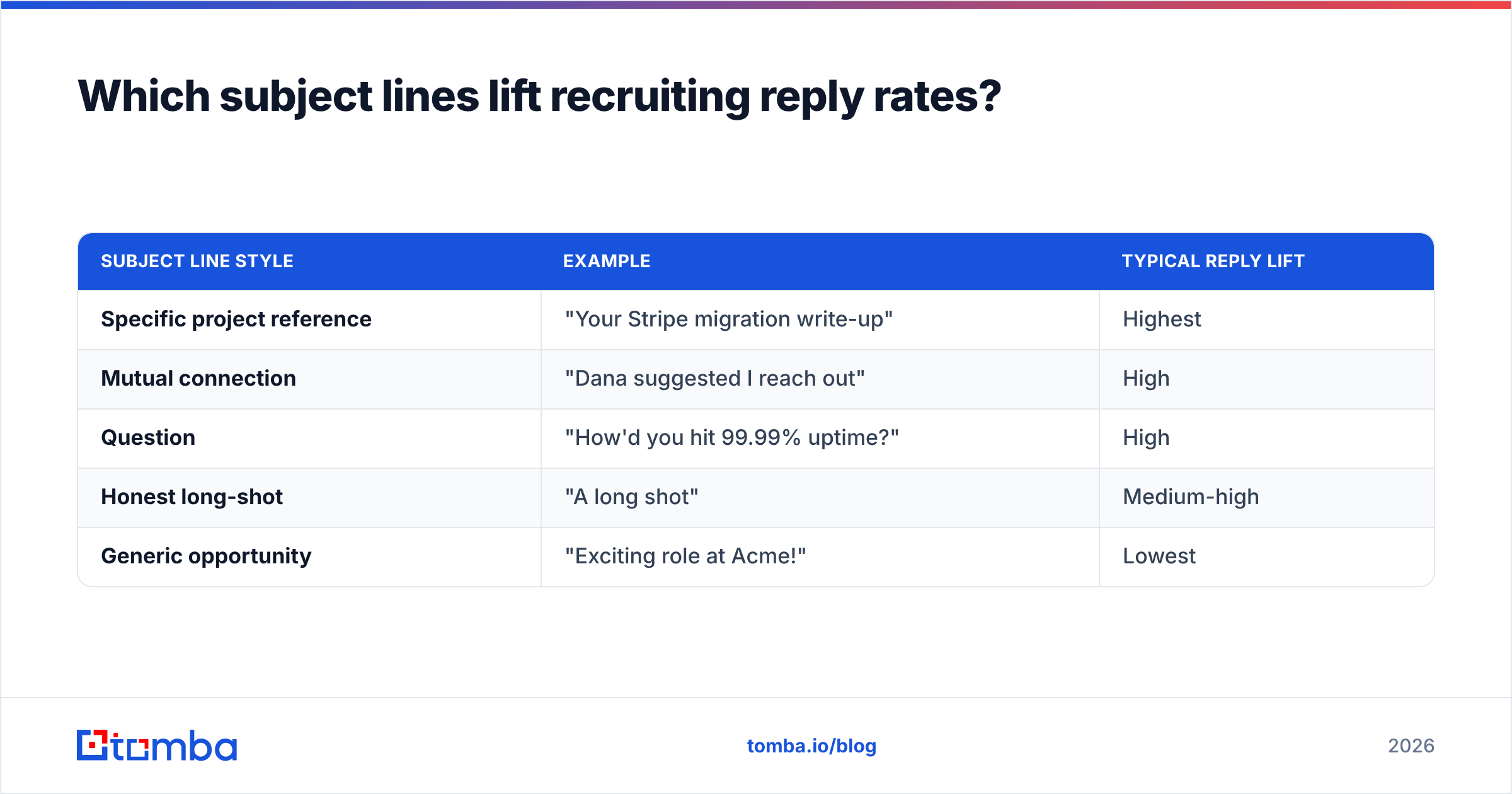
Specific, curiosity-driven subject lines under 50 characters win. Here's how common approaches compare.
| Subject line style | Example | Typical reply lift |
|---|---|---|
| Specific project reference | "Your Stripe migration write-up" | Highest |
| Mutual connection | "Dana suggested I reach out" | High |
| Question | "How'd you hit 99.99% uptime?" | High |
| Honest long-shot | "A long shot" | Medium-high |
| Generic opportunity | "Exciting role at Acme!" | Lowest |
The pattern is obvious once you see it: anything that proves you did homework outperforms anything that sounds templated. Ironically, a good template makes that homework faster, because you only have to write the one custom line.
How do you keep sourcing emails out of spam?#
Verify addresses, warm your domain, and avoid spam-trigger formatting. The best copy in the world won't matter if the email never lands.
- Verify before you send. A single high-bounce campaign can tank your sender reputation for weeks. Run your list through a bulk email finder and verifier first.
- Find the right address, not a guess. Use a real email finder instead of guessing
first.last@company.com— guessed addresses are the number-one bounce source in recruiting. - Source emails from LinkedIn profiles. When you're working off profiles, the LinkedIn finder pulls verified professional addresses so you skip the InMail bottleneck.
- Keep formatting clean. One link max, no giant images, no all-caps subject. Run a quick spam checker on your template before it goes live.
- Space your follow-ups. Three to four days between touches reads as persistent; same-day double-sends read as a bot.

For the underlying mechanics — SPF, DKIM, and warmup — LinkedIn's own Talent Solutions guidance and Greenhouse's recruiting resources both stress that deliverability hygiene is now table stakes, not an advanced tactic.
How much personalization is enough?#
One genuinely custom sentence per candidate is the sweet spot. More than that and you can't scale; less and you sound like a mail merge gone wrong.
The math is simple. A token-only email (Hi {{first_name}}, I saw your profile) takes 10 seconds and converts poorly. A fully bespoke email takes 15 minutes and converts well but caps you at a handful per day. The template-plus-one-line approach takes about 90 seconds per candidate and captures most of the lift — that's the model nearly every high-volume sourcing team uses, and it's echoed in HubSpot's outreach research on personalization at scale.
To make that one line fast, you need data at your fingertips: the candidate's recent work, their company, their role history. Pulling that with data enrichment means the human touch costs you a sentence, not a research project.
What metrics tell you a template is working?#
Track reply rate first, positive-reply rate second, and bounce rate as a health check. Open rate is increasingly unreliable in 2026 thanks to privacy proxies, so don't optimize for it.
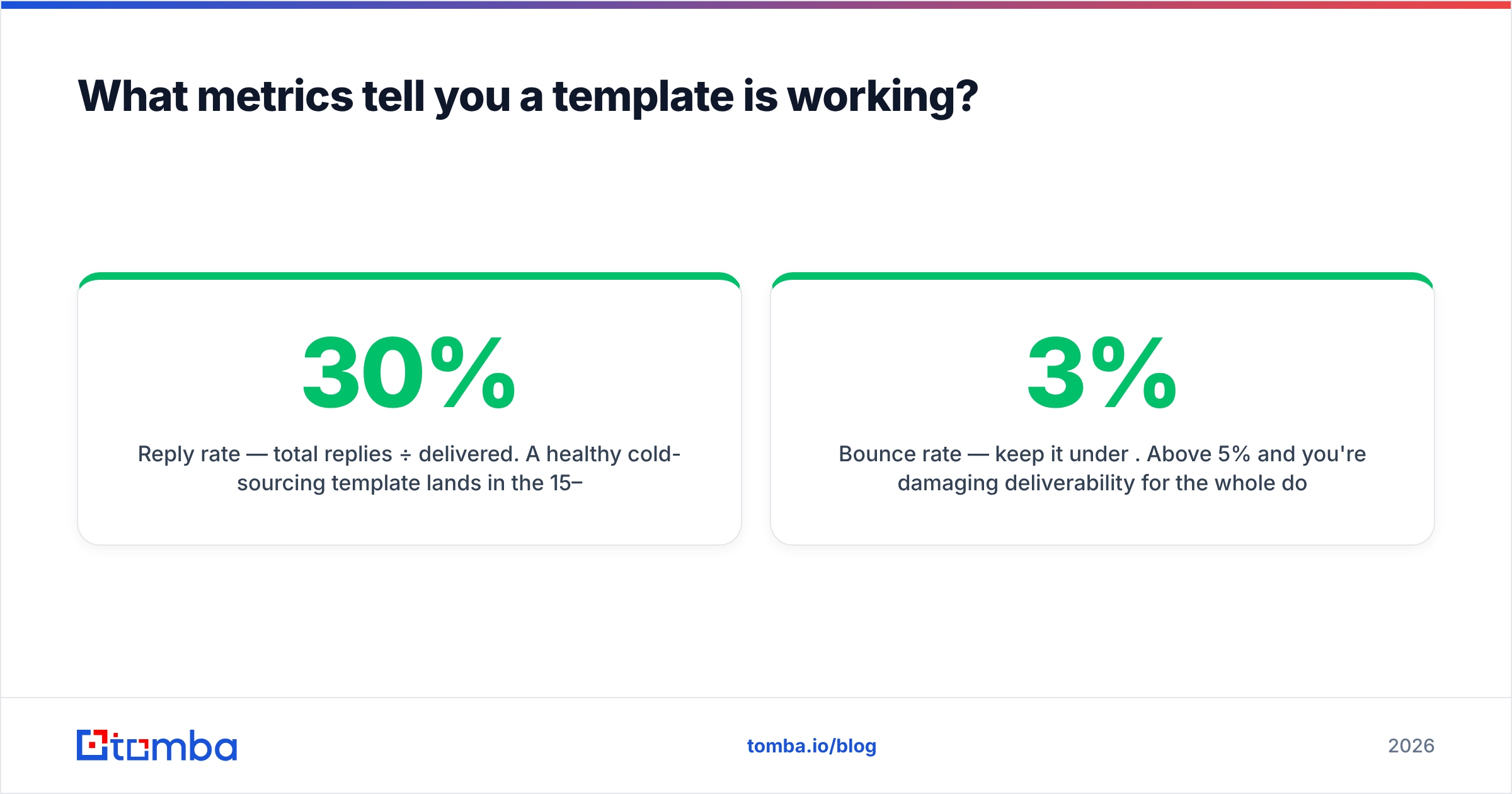
- Reply rate — total replies ÷ delivered. A healthy cold-sourcing template lands in the 15–30% range once verified and personalized.
- Positive reply rate — interested replies ÷ delivered. This is the number that actually fills your pipeline.
- Bounce rate — keep it under 3%. Above 5% and you're damaging deliverability for the whole domain.
- Time-to-first-reply — tells you whether your follow-up cadence is too slow or too aggressive.
If reply rate is low but bounce is clean, fix the copy. If bounce is high, fix the list before touching a single word — no subject line survives a dead inbox.
Put your candidate sourcing email template to work#
A great template is only half the equation. The other half is sending it to addresses that actually exist and actually reach a human. That's where most sourcing campaigns quietly leak.
Start with the Tomba Email Finder to turn a name and company into a verified, deliverable address — then drop it into the templates above and personalize the one line that matters. Free accounts include 25 searches a month to test it, with paid Tomba plans starting at $49/mo when you're ready to scale your outreach. Get the address right, and your best template finally gets the replies it deserves.
// get started
Find, verify and enrich your first contacts today
Start on the free plan with 25 searches a month, then scale when your team is ready.
Free plan · No credit card required · GDPR & CCPA
Get the Tomba newsletter
Product and data updates
// about the author