CapitalConnectorAI Pricing, Reviews, Pros and Cons (2026)
An honest 2026 breakdown of CapitalConnectorAI pricing, real-world reviews, and the pros and cons every revenue team should weigh before buying.
TL;DR
- CapitalConnectorAI is positioned as an AI-driven capital and B2B connection platform that promises automated prospecting, intent signals, and outreach — sold mostly on annual or quote-based contracts rather than transparent monthly tiers.
- Pricing is the biggest friction point in reviews: most plans are quote-gated, onboarding fees show up, and credits expire, so the "per-lead" cost is hard to pin down before a sales call.
- The strongest pros are workflow automation and a polished dashboard; the loudest cons are data accuracy on smaller markets, opaque pricing, and lock-in.
- If your real bottleneck is finding and verifying accurate contact data, a focused tool like Tomba Email Finder often covers 80% of the need at a fraction of the cost.
- This post is a neutral buyer's guide: how the platform is priced, what reviewers say, and where it fits versus leaner alternatives.
What is CapitalConnectorAI?#
CapitalConnectorAI markets itself as an AI layer on top of B2B prospecting — the kind of platform that promises to surface "ready-to-engage" accounts, enrich them with contact data, score intent, and push outreach into your sequencing tool. Think of it like a financial advisor's Rolodex bolted to an autopilot: it claims to both find the right counterparties and nudge you toward the ones most likely to convert.
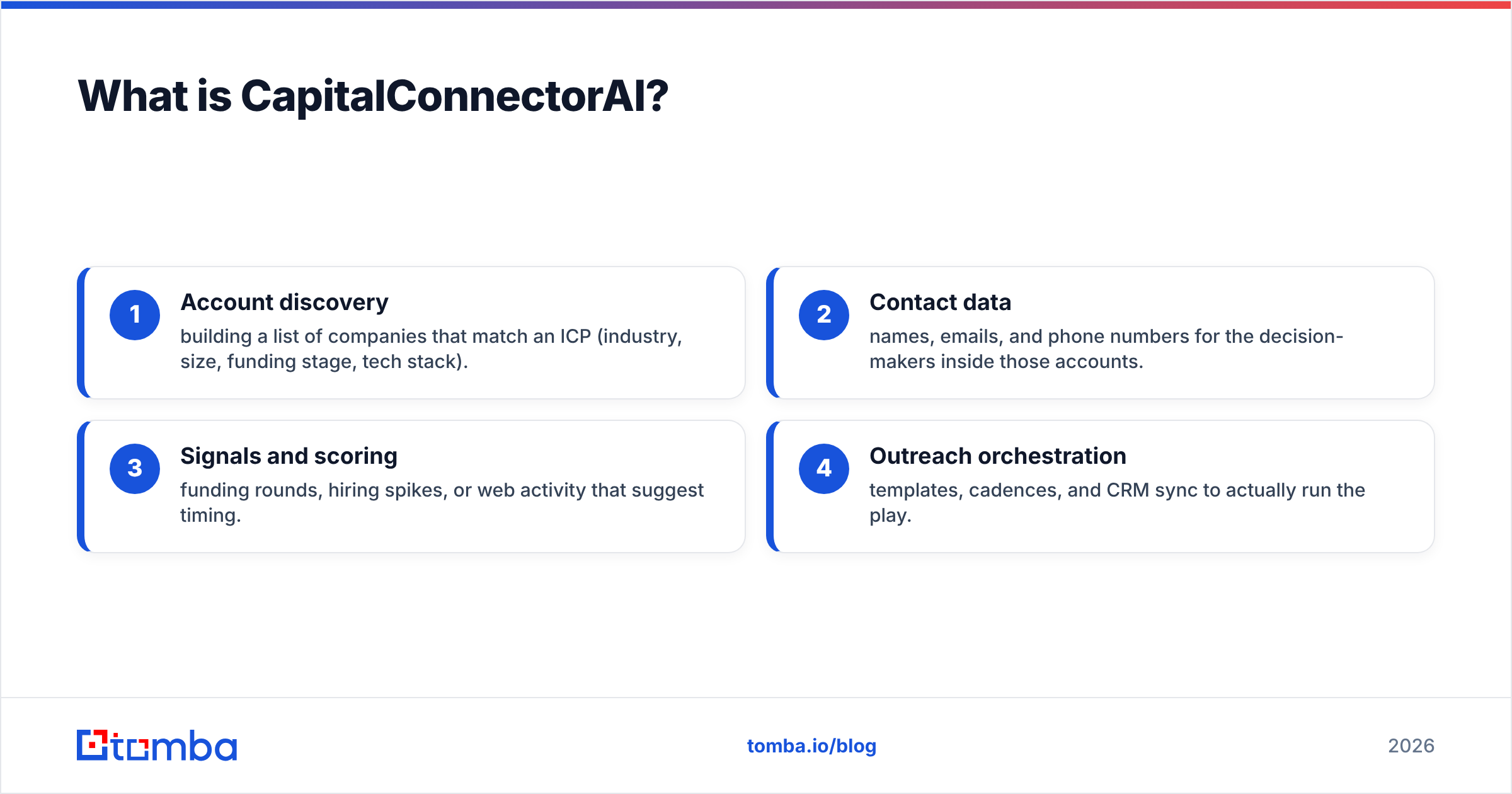
In practice, tools in this category bundle four jobs that used to be four separate purchases:
- Account discovery — building a list of companies that match an ICP (industry, size, funding stage, tech stack).
- Contact data — names, emails, and phone numbers for the decision-makers inside those accounts.
- Signals and scoring — funding rounds, hiring spikes, or web activity that suggest timing.
- Outreach orchestration — templates, cadences, and CRM sync to actually run the play.
The pitch is compelling. The catch, and the reason you searched for reviews, is that bundling all four makes pricing murky and quality uneven across the stack. A tool can be excellent at orchestration and mediocre at the underlying data accuracy — and the second problem quietly poisons everything downstream.
)
Honesty note: CapitalConnectorAI publishes limited public pricing, so figures below reflect the typical structure reviewers report for platforms in this class. Always confirm current numbers directly with the vendor before signing.
How much does CapitalConnectorAI cost in 2026?#
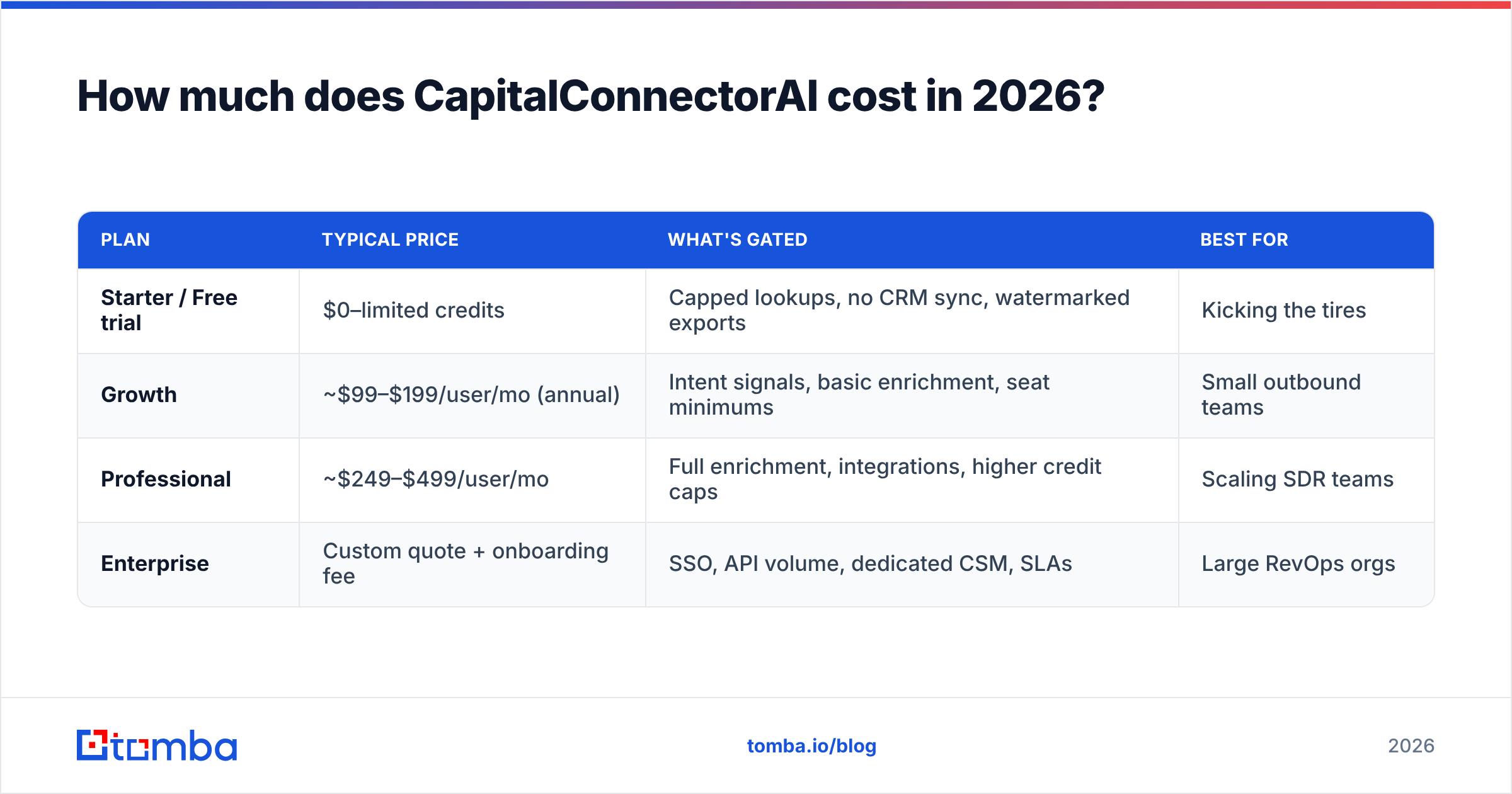
The headline answer: most of CapitalConnectorAI's real pricing sits behind a "Talk to sales" button, which is the single most common complaint in reviews. Platforms in this segment usually follow a three-tier shape — a constrained entry plan, a team plan, and an enterprise quote — with credits that reset monthly and expire if unused.
Here is the structure buyers most often describe, alongside what each tier typically gates:
| Plan | Typical price | What's gated | Best for |
|---|---|---|---|
| Starter / Free trial | $0–limited credits | Capped lookups, no CRM sync, watermarked exports | Kicking the tires |
| Growth | ~$99–$199/user/mo (annual) | Intent signals, basic enrichment, seat minimums | Small outbound teams |
| Professional | ~$249–$499/user/mo | Full enrichment, integrations, higher credit caps | Scaling SDR teams |
| Enterprise | Custom quote + onboarding fee | SSO, API volume, dedicated CSM, SLAs | Large RevOps orgs |
Three pricing realities reviewers flag repeatedly:
- Seat minimums. Team plans often require 3–5 seats, so the "per-user" price understates the real invoice.
- Credit expiry. Unused lookup credits reset monthly. If your prospecting is seasonal, you pay for capacity you never touch.
- Onboarding fees. Enterprise quotes frequently add a one-time implementation charge that doesn't appear in any public table.
Compare that to transparent, published Tomba pricing: a Free tier with 25 searches/month, Starter at $49/mo, Growth at $99/mo, Pro at $249/mo, and Enterprise as custom. You can model your cost before anyone calls you — which is exactly what most reviewers wish CapitalConnectorAI offered.
What do CapitalConnectorAI reviews actually say?#
Reviews for AI-bundled connection platforms cluster into a predictable shape on sites like G2 and Capterra. Strip away the marketing and the signal looks like this:
What reviewers praise
- The dashboard is clean and the AI scoring "feels" intelligent during demos.
- Automation genuinely saves time once configured — sequences, enrichment, and CRM push happen in one place.
- Support during onboarding is responsive (you have a CSM motivated to get you live).
What reviewers criticize
- Data accuracy degrades outside core markets. Large US enterprises are well covered; SMBs, non-US contacts, and niche industries return stale or missing emails.
- Pricing is opaque and "creeps." Quotes rise at renewal; credits and seats are upsold.
- Lock-in. Annual contracts plus deep CRM integration make it painful to leave even when results disappoint.
- Bounce rates on cold campaigns. When the underlying email data is unverified, deliverability suffers and sender reputation takes the hit.
That last point matters more than the marketing admits. An AI that hands your reps a confident-looking but wrong email address doesn't just waste a send — it can damage your sender reputation and inbox placement for the good addresses too. This is why many teams run a dedicated email verifier regardless of which prospecting suite they buy.
)
What are the pros and cons of CapitalConnectorAI?#
Here's the balanced view, organized so you can map it to your own priorities rather than a vendor scorecard.
Pros
- All-in-one workflow. Discovery, data, signals, and outreach in one login reduces tool-switching and context loss.
- AI scoring and prioritization. When the underlying data is good, intent ranking helps reps spend time on the warmest accounts.
- Polished UX and onboarding. Lower learning curve than stitching five point tools together.
- CRM and sequencer integrations. Native sync to HubSpot, Salesforce, and popular cadence tools.
Cons
- Opaque, quote-gated pricing. Hard to budget; renewal increases are common.
- Uneven data quality. Strong on large US accounts, weak on SMB, international, and niche verticals.
- Vendor lock-in. Annual terms plus deep integration raise switching costs.
- You pay for the whole bundle even if you only need one part. If contact data is your gap, you're subsidizing modules you won't use.
- Deliverability risk from unverified emails feeding cold outreach.
The decisive question is altitude: do you need an entire prospecting operating system, or do you need accurate contacts to feed the operating system you already run? Many teams discover, after a year of bundle spend, that their actual constraint was data — not orchestration.
How does CapitalConnectorAI compare to focused alternatives?#
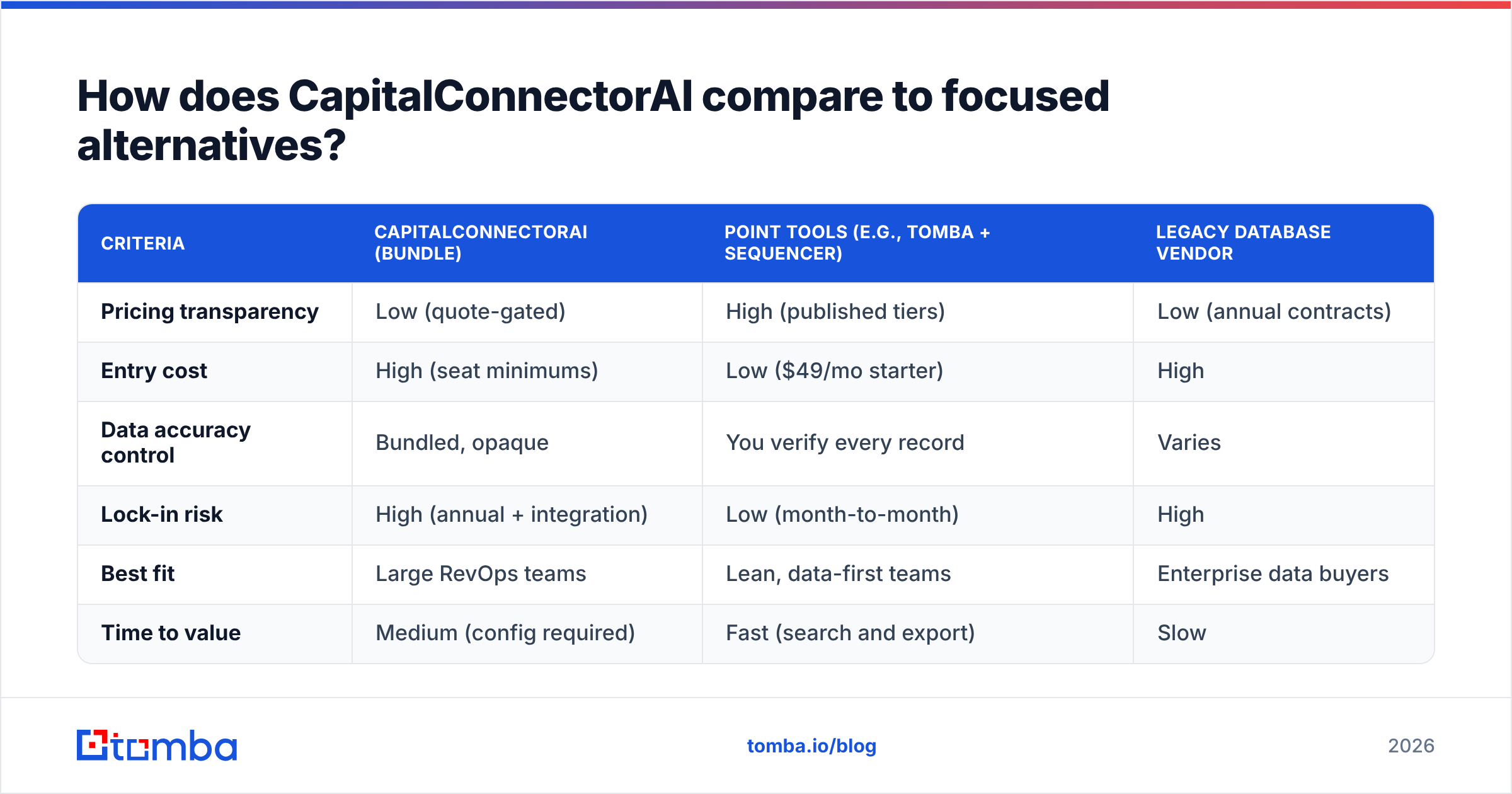
If your gap is contact data and verification, a specialized stack frequently outperforms an all-in-one on both accuracy and cost. Here's how the buying decision breaks down across three common setups.
| Criteria | CapitalConnectorAI (bundle) | Point tools (e.g., Tomba + sequencer) | Legacy database vendor |
|---|---|---|---|
| Pricing transparency | Low (quote-gated) | High (published tiers) | Low (annual contracts) |
| Entry cost | High (seat minimums) | Low ($49/mo starter) | High |
| Data accuracy control | Bundled, opaque | You verify every record | Varies |
| Lock-in risk | High (annual + integration) | Low (month-to-month) | High |
| Best fit | Large RevOps teams | Lean, data-first teams | Enterprise data buyers |
| Time to value | Medium (config required) | Fast (search and export) | Slow |
A practical hybrid that many 2026 teams land on:
- Find and verify contacts with a focused tool. Tomba's domain search builds a list of verified emails for any company, and its data enrichment fills in the firmographic gaps.
- Sequence and track in whatever sender or CRM you already trust.
- Keep the AI optional. Add intent signals only when you can prove they lift conversion — not because they came bundled.
This keeps your spend tied to outcomes you can measure. You're not paying $249–$499 per seat for an AI score when a $49–$99 plan delivers the verified data that actually moves pipeline. For independent category context, Gartner and peer-review sites are useful sanity checks before any annual commitment.
Who should (and shouldn't) buy CapitalConnectorAI?#
Consider it if:
- You're a large RevOps team that genuinely wants one platform and has budget for enterprise quotes.
- Your ICP is concentrated in large US enterprises where bundled data is strongest.
- You value a single vendor relationship over best-of-breed flexibility.
Skip it if:
- Your core problem is accurate emails and phone numbers, not workflow.
- You sell to SMBs, international markets, or niche verticals where bundled data thins out.
- You want transparent, month-to-month pricing you can scale up and down.
- You already own a sequencer and CRM you like, and just need a reliable data feed.
The fastest way to know which camp you're in: run a small accuracy test. Pull 100 target contacts through your candidate tool, then verify the same 100 with an independent email verifier. If a meaningful share bounce or fail verification, the bundle's AI gloss is masking a data problem — and no amount of scoring fixes a wrong address.
How do you test data accuracy before committing?#
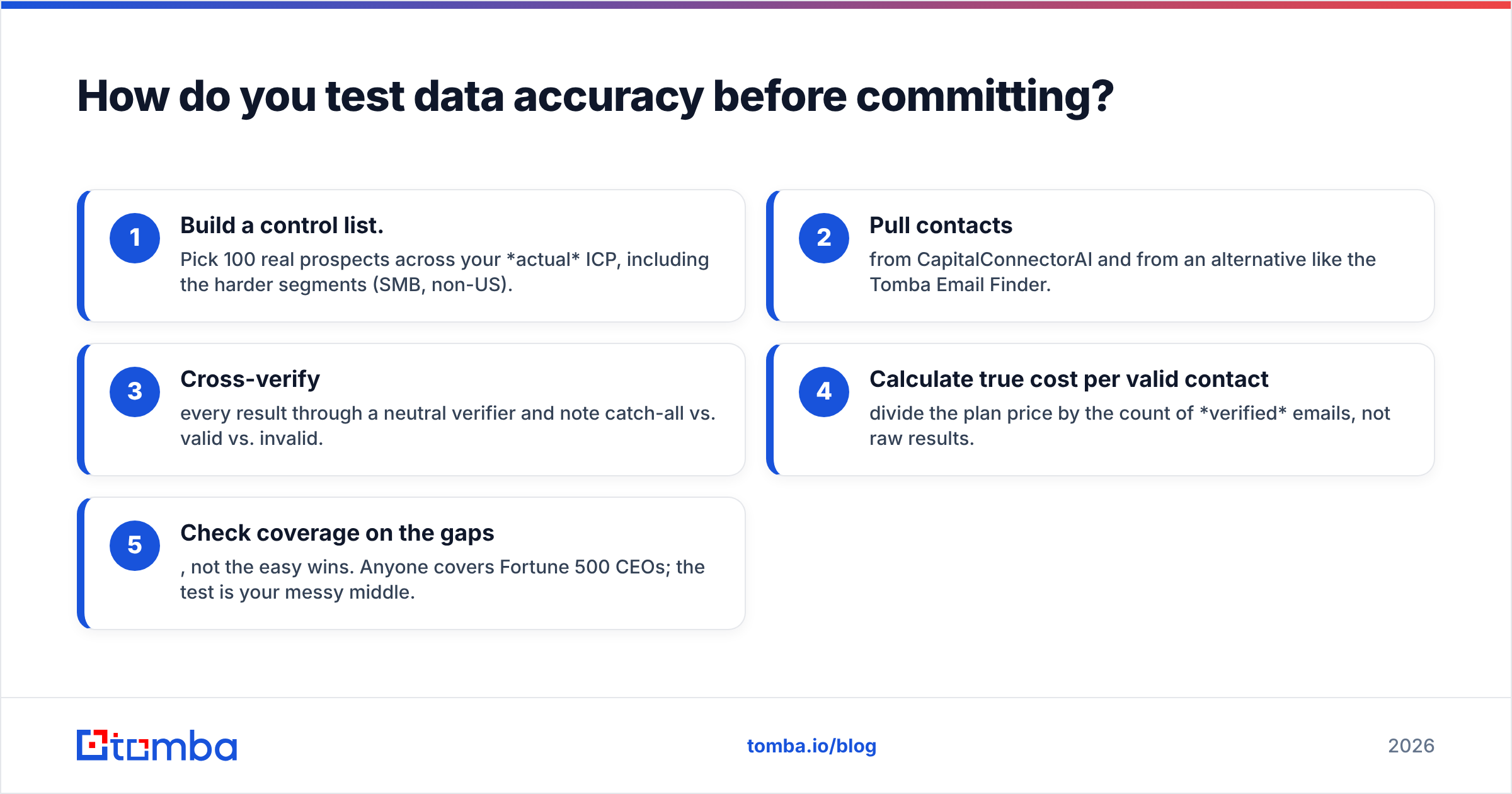
Don't take any vendor's accuracy claim on faith — including ours. Run this 30-minute check before signing anything:
- Build a control list. Pick 100 real prospects across your actual ICP, including the harder segments (SMB, non-US).
- Pull contacts from CapitalConnectorAI and from an alternative like the Tomba Email Finder.
- Cross-verify every result through a neutral verifier and note catch-all vs. valid vs. invalid.
- Calculate true cost per valid contact — divide the plan price by the count of verified emails, not raw results.
- Check coverage on the gaps, not the easy wins. Anyone covers Fortune 500 CEOs; the test is your messy middle.
Whatever wins that test is the right tool — bundle or not. Accuracy and transparent pricing beat a slick dashboard every time, because your reps live and die on whether the next email actually lands.
The bottom line#
CapitalConnectorAI is a credible all-in-one for large teams that want a single platform and can absorb quote-based, annual pricing. Its pros — automation, AI scoring, polished UX — are real. But the cons that show up in reviews — opaque pricing, uneven data outside core markets, and lock-in — are exactly the things that quietly cap ROI. For most teams, the actual bottleneck isn't orchestration; it's getting accurate, verified contact data into the system they already run.
If that's you, start lean. Tomba's email finder gives you verified professional emails by name, domain, or company — with published pricing from a Free 25-search tier up to plans that scale with your team, no sales call required. Test it against your hardest 100 prospects, measure cost per valid contact, and let the numbers — not a demo — decide. You can always layer AI and automation on top once your data foundation is solid.
// get started
Find, verify and enrich your first contacts today
Start on the free plan with 25 searches a month, then scale when your team is ready.
Free plan · No credit card required · GDPR & CCPA
// about the author