CapitalConnectorAI vs Datanyze: B2B Data Tools Compared 2026
CapitalConnectorAI vs Datanyze: which B2B data and intelligence platform actually fits your pipeline in 2026? A neutral, feature-by-feature breakdown of accuracy, pricing, and fit.
TL;DR
- CapitalConnectorAI is a newer, AI-first platform built around investor-and-capital matching and intent signals, while Datanyze is a long-running technographics and contact-data tool best known for its Chrome extension.
- They overlap less than the "vs" framing suggests: CapitalConnectorAI leans toward funding-driven prospecting, Datanyze leans toward "what tech does this company run."
- Datanyze is cheaper to start and simpler; CapitalConnectorAI charges more but bundles enrichment and scoring most teams would otherwise buy separately.
- Neither is a dedicated email-finding engine. If contact accuracy is your bottleneck, pair either tool with a focused email finder.
- Pick CapitalConnectorAI for funding/intent-led outbound, Datanyze for technographic targeting, and budget for verification regardless.
What are CapitalConnectorAI and Datanyze?#
Short version: they solve different halves of the same prospecting problem.
CapitalConnectorAI is an AI-driven B2B intelligence platform that frames prospecting around capital events — funding rounds, investor relationships, growth signals — and layers contact enrichment and lead scoring on top. Think of it as a research analyst who only flags companies when money is moving, then hands you the people to call.
Datanyze is a technographics pioneer. Its core value is telling you which technologies a company uses (CRM, analytics, hosting, ad tech) so you can target accounts that already run — or lack — a specific stack. If you sell a Shopify app, Datanyze helps you find Shopify stores. Its Chrome extension surfaces contact details while you browse LinkedIn or a company site. Datanyze is owned by ZoomInfo and positioned as a lightweight, self-serve entry point.
The analogy: Datanyze tells you what tools are in the house; CapitalConnectorAI tells you which houses just got a renovation loan. Both are useful, but they answer different questions, and that difference should drive your choice more than any feature checklist.

How do CapitalConnectorAI and Datanyze compare on features?#
Here is the honest, side-by-side view. Capabilities shift between releases, so treat this as a directional snapshot for 2026 and verify current limits on each vendor's site before you buy.
| Feature | CapitalConnectorAI | Datanyze |
|---|---|---|
| Primary signal | Funding, investor, intent | Technographics (tech stack) |
| Contact data | Built-in enrichment + scoring | Email/phone via extension |
| Chrome extension | Yes | Yes (its signature feature) |
| Lead scoring | AI-native, included | Limited / none |
| Data freshness model | Continuous AI refresh | Periodic crawl + community |
| Ease of onboarding | Moderate (more to configure) | Fast, self-serve |
| Best-fit team | Funding-led outbound, RevOps | SMB sales targeting by stack |
| Starting price | Higher, quote-driven | Lower, transparent tiers |
A few things this table hides. CapitalConnectorAI's scoring is its real differentiator — it tries to rank accounts by likelihood to buy, not just list them. That is valuable when your team is drowning in accounts and starved for prioritization. Datanyze's differentiator is the opposite: it is narrow, fast, and cheap, and it does one job (technographic + contact lookup) without asking you to adopt a whole workflow.
If you want to understand the category language here, the B2B data and intelligence space splits roughly into firmographics, technographics, and intent — Datanyze owns technographics, CapitalConnectorAI blends intent with firmographics.
Is CapitalConnectorAI better than Datanyze for accuracy?#
It depends on which accuracy you mean — and on both vendors, the contact-data layer is the weakest link.
Technographic accuracy and contact accuracy are not the same metric. Datanyze is generally strong at detecting common, web-visible technologies (anything that drops a script or DNS record). It gets weaker on internal tooling that leaves no public footprint, and its email/phone data — like most extension-based tools — varies by region and seniority. CapitalConnectorAI's funding and firmographic signals tend to be fresh because they are pulled from filings and news, but its appended contact data inherits the same industry-wide problem: emails decay 2-3% per month as people change jobs.
This is the trap in every "Tool A vs Tool B" data comparison: you compare the headline databases and forget that a stale email tanks your campaign regardless of which platform produced it. Independent reviews on G2 consistently note that contact accuracy is the most common complaint across this entire tool category, not a flaw unique to one vendor.
The practical fix is verification. Before you load any list into your sequencer, run it through an email verifier to strip catch-alls, traps, and dead addresses. Teams that skip this step routinely see 15-30% of an "enriched" list bounce — enough to damage sender reputation and push good mail into spam.
If your primary job is finding and confirming business emails by company, a purpose-built domain search will usually beat the contact layer bolted onto a technographics or intent tool — because that is the only thing it is optimized to do.
How much do CapitalConnectorAI and Datanyze cost in 2026?#
Datanyze wins on transparency and entry price; CapitalConnectorAI wins on what's bundled.
Datanyze publishes simple, low-cost self-serve tiers (including a free trial allotment of credits), which makes it easy to test without a sales call. CapitalConnectorAI is more quote-driven and sits at a higher price point because it bundles scoring and enrichment that you'd otherwise license separately. Neither is "expensive" or "cheap" in a vacuum — the real question is cost per usable contact after verification.
Here's a simplified way to reason about total cost:
- List price — what the tier says. Datanyze is lower; CapitalConnectorAI is higher.
- Credits vs seats — Datanyze meters by credits, which punishes high-volume teams; AI platforms often bundle more generous limits into a seat.
- Verification overhead — budget for a verifier regardless. This is real money most comparisons ignore.
- Workflow replacement — if CapitalConnectorAI lets you drop a separate scoring tool, its higher price may net out cheaper.
- Ramp cost — Datanyze is faster to onboard, so time-to-value is shorter for small teams.
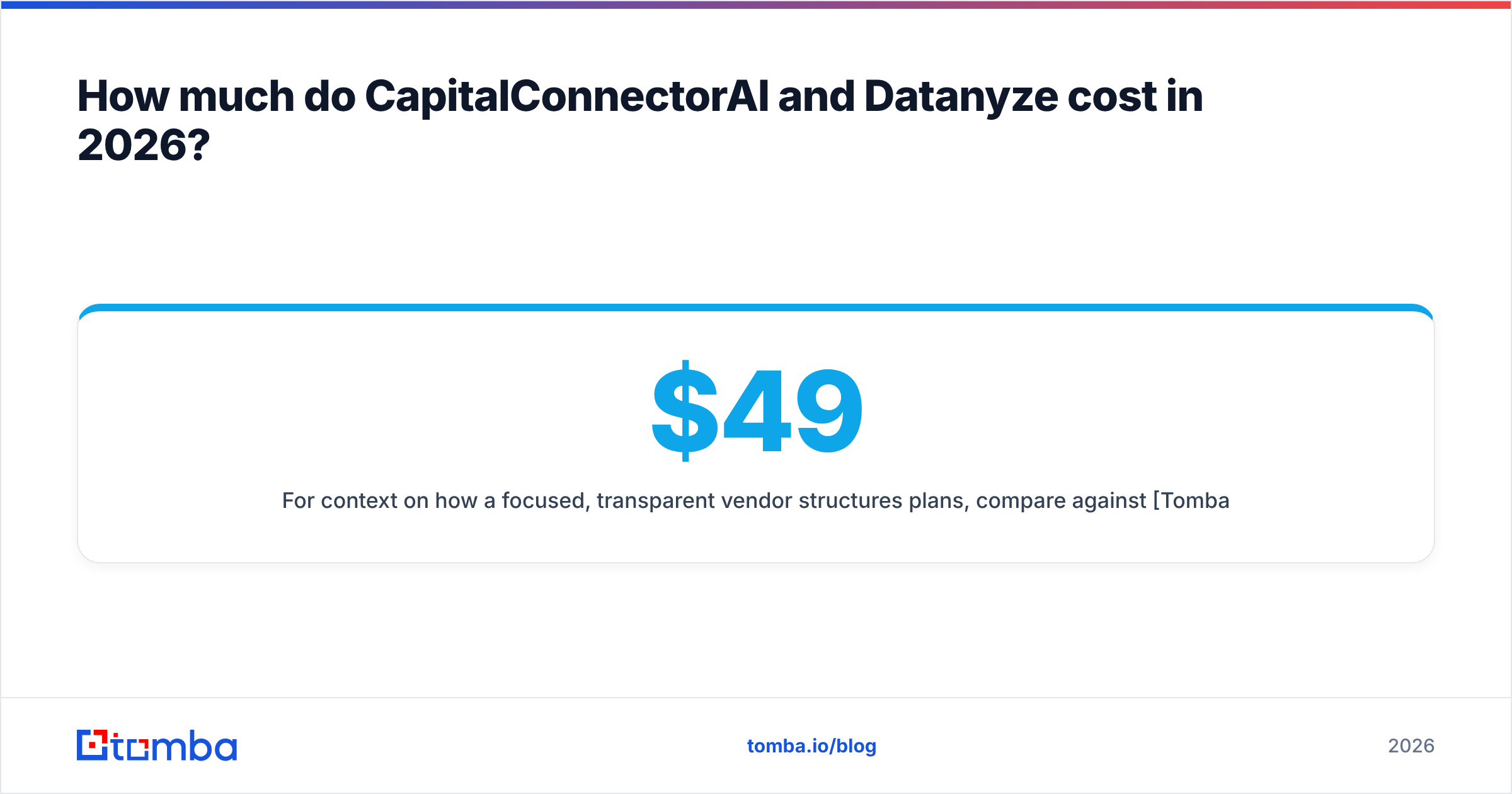
For context on how a focused, transparent vendor structures plans, compare against Tomba pricing: a free tier (25 searches/mo), Starter at $49/mo, Growth at $99/mo, and Pro at $249/mo. The point isn't that one model is universally right — it's that you should map every quote to cost per verified, reachable contact, not the sticker on the landing page.
Which tool fits your use case?#
Match the tool to your motion, not to its marketing.
Choose CapitalConnectorAI if:
- Your outbound is event-driven — you reach out when a company raises, hires, or shows intent.
- You have too many accounts and need AI scoring to prioritize.
- You want enrichment and scoring in one platform and will pay a premium to avoid stitching tools together.
- You run a RevOps function that can configure and maintain a richer system.
Choose Datanyze if:
- You sell by technology ("companies using Salesforce," "sites on Shopify").
- You're an SMB or solo seller who needs fast, cheap, self-serve lookups.
- You live in the browser and want a lightweight Chrome extension for on-the-fly contact grabs.
- You want predictable, transparent pricing without a sales call.
Choose a dedicated finder/verifier (alongside either) if:
- Your real bottleneck is reaching people, not finding companies.
- Bounce rates and email deliverability are hurting your campaigns.
- You need bulk, API, or spreadsheet workflows for contact discovery and verification.
Most mature teams end up with a two-layer stack: one tool for account selection (technographics or funding/intent) and one tool for contact discovery and verification. CapitalConnectorAI and Datanyze compete in the first layer. They do not fully replace the second.
What are the main pros and cons?#
No tool is all upside. Here's the balanced view.
| Pros | Cons | |
|---|---|---|
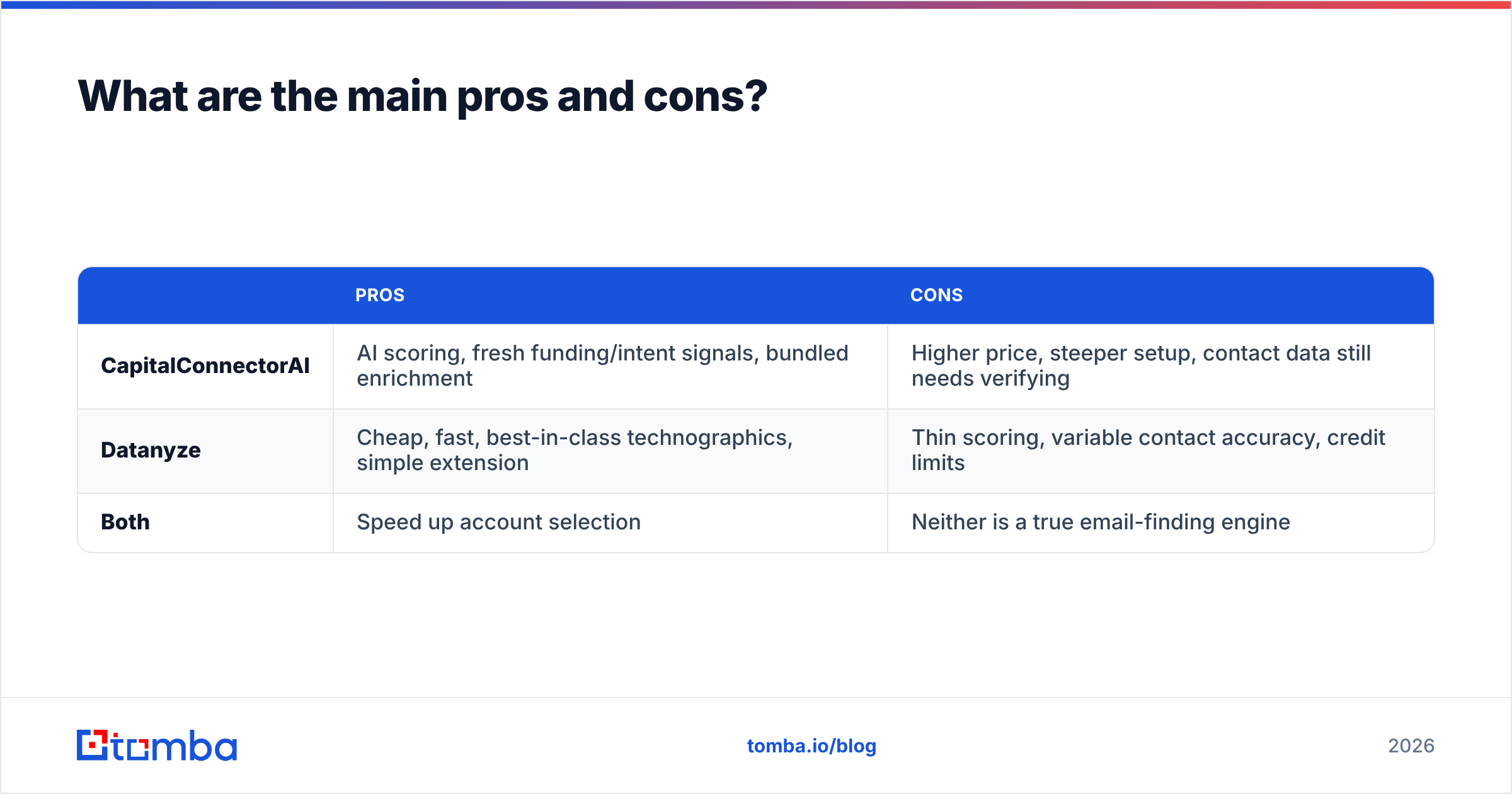
| CapitalConnectorAI | AI scoring, fresh funding/intent signals, bundled enrichment | Higher price, steeper setup, contact data still needs verifying |
| Datanyze | Cheap, fast, best-in-class technographics, simple extension | Thin scoring, variable contact accuracy, credit limits |
| Both | Speed up account selection | Neither is a true email-finding engine |
The recurring theme: account selection is where these tools shine, and contact deliverability is where every tool in this category leaks. Plan for the leak.
How do CapitalConnectorAI and Datanyze handle data sourcing?#
This is the question that quietly determines accuracy, so ask it during every demo.
CapitalConnectorAI leans on continuously refreshed public sources — filings, news, web signals — processed by models that infer intent and growth. The upside is freshness; the risk is inference error, where a model "predicts" a signal that isn't there. Datanyze leans on web crawling plus a community/contributory model, which is excellent for visible tech detection but lags on anything that doesn't leave a public trace, and contact records can age between crawls.
When you evaluate either vendor, ask three things:
- How often is contact data re-verified? "Sourced" is not the same as "currently valid."
- What's the catch-all policy? Catch-all domains accept everything, so a "valid" result can still bounce — handle them with a catch-all verifier.
- Can I get raw exports and an API? Locked-in data is worth less than portable data.
For a transparent example of how a vendor can document provenance, see how Tomba publishes its data sources. You want that level of clarity from whichever platform you choose — vague "proprietary AI data" answers are a yellow flag.
Frequently asked questions#
Is CapitalConnectorAI a replacement for Datanyze? Not really. CapitalConnectorAI focuses on funding and intent with AI scoring; Datanyze focuses on technographics. If your targeting depends on tech stack, CapitalConnectorAI won't fully replace Datanyze, and vice versa.
Do either of them find verified emails? Both append contact data, but neither is built primarily for email discovery and verification. Expect to verify results before sending. Pair them with a dedicated email finder and verifier for reliable outreach.
Which is cheaper? Datanyze has a lower, more transparent entry price. CapitalConnectorAI costs more but bundles scoring and enrichment, which can be cheaper than buying those separately — run the math on cost per verified contact.
Is Datanyze still independent? Datanyze is part of ZoomInfo and positioned as a lightweight, self-serve product. You can read more on the official Datanyze site.
The bottom line#
CapitalConnectorAI vs Datanyze is less a head-to-head and more a fork in the road: funding-and-intent prospecting on one side, technographic targeting on the other. Pick by motion. If you sell into companies based on the tech they run, Datanyze's speed and price are hard to beat. If your edge is reacting to capital events with AI-prioritized accounts, CapitalConnectorAI earns its premium. Either way, the deciding factor for revenue isn't the account list — it's whether your emails actually land.
That's the layer most teams under-invest in. Once you've chosen your account-selection tool, close the loop on contacts: use the Tomba Email Finder to find professional email addresses by domain, name, or company, verify them before they hit your sequencer, and enrich the rest with data enrichment. Selection gets you the target; verified contact data gets you the meeting. Start free with 25 searches and only scale up when the pipeline proves itself.
// get started
Find, verify and enrich your first contacts today
Start on the free plan with 25 searches a month, then scale when your team is ready.
Free plan · No credit card required · GDPR & CCPA
// about the author