Capitalconnectorai vs Finderio: Best Email Finder in 2026?
A neutral, data-driven breakdown of Capitalconnectorai vs Finderio — accuracy, pricing, coverage, and where each email finder actually wins in 2026.
Choosing between Capitalconnectorai and Finderio comes down to one question most review posts dodge: which one actually returns verified, deliverable emails when you run your real prospect list through it? Below is a neutral, attribute-by-attribute comparison — plus an honest note on where a third option fits.
TL;DR#
- Capitalconnectorai leans toward AI-scored intent data and enrichment, so it suits teams that want signals bundled with contact data — but its raw email accuracy is mid-pack and pricing climbs fast.
- Finderio is the leaner, cheaper email-lookup play; good single-search UX, weaker on bulk verification and catch-all handling.
- Neither publishes an independently audited accuracy rate, so treat their headline numbers with skepticism.
- If deliverability is your real KPI, a verification-first tool with transparent data sources usually beats either on bounce rate.
- For most B2B teams in 2026, the deciding factors are catch-all accuracy, bulk throughput, and price-per-verified-email — not the marketing copy.
What are Capitalconnectorai and Finderio?#
Both tools live in the same broad category: B2B contact-data platforms that turn a name and a company domain into a usable work email. They differ in emphasis.
Capitalconnectorai positions itself as an AI-first prospecting layer. The pitch is that it doesn't just find an email — it scores the account, guesses buying intent, and enriches the record with firmographics. That bundling is attractive if you're building an outbound motion from scratch and want fewer tools.
Finderio is the opposite philosophy: a focused email finder that does name-plus-domain lookups quickly and cheaply. There's less ceremony, fewer dashboards, and a lower entry price. The tradeoff is that you're buying a single capability, so verification and bulk work feel bolted on rather than native.
Here's the thing to internalize before you compare feature lists: an email finder is only as good as the email that lands. A tool can "find" a syntactically valid address and still hand you a hard bounce. So the rest of this comparison weights accuracy and verification heavily.

How do Capitalconnectorai and Finderio compare on accuracy?#
Accuracy is where the marketing gets slippery. Both vendors quote a "95%+" figure, but neither defines it the same way, and neither submits to a third-party audit. When you dig in, "accuracy" can mean any of three very different things:
- Pattern-match rate — the tool guessed an address that fits the company's known format. Cheap to claim, weak as a guarantee.
- SMTP-verified rate — the mail server acknowledged the mailbox exists. Much stronger.
- Deliverability rate — the message actually reaches an inbox, not spam. The only number that pays your bills.
Capitalconnectorai's accuracy claim leans on pattern matching plus its enrichment graph, which inflates the headline but produces a meaningful tail of risky sends — especially at companies using catch-all domains. Finderio relies more on real-time SMTP checks for single lookups, which is good, but its bulk pipeline samples rather than verifies every row, so large jobs degrade.
In practice, the honest takeaway is that you should never trust a vendor-reported accuracy number without running your own sample. Pull 200 known-good contacts you can independently confirm, run them through each tool, and measure the real bounce rate with a separate email verifier. That 30-minute test tells you more than any review, including this one.
)
A quick note on catch-all domains, because this is where most finders quietly fail. A catch-all server accepts mail for any address, so a naive SMTP check returns "valid" for garbage. Capitalconnectorai flags catch-alls but still counts them in its accuracy math. Finderio detects them inconsistently. If a large share of your TAM sits on catch-all infrastructure (common in enterprise and EU markets), you need a dedicated catch-all verifier regardless of which finder you pick.
Capitalconnectorai vs Finderio: side-by-side comparison#
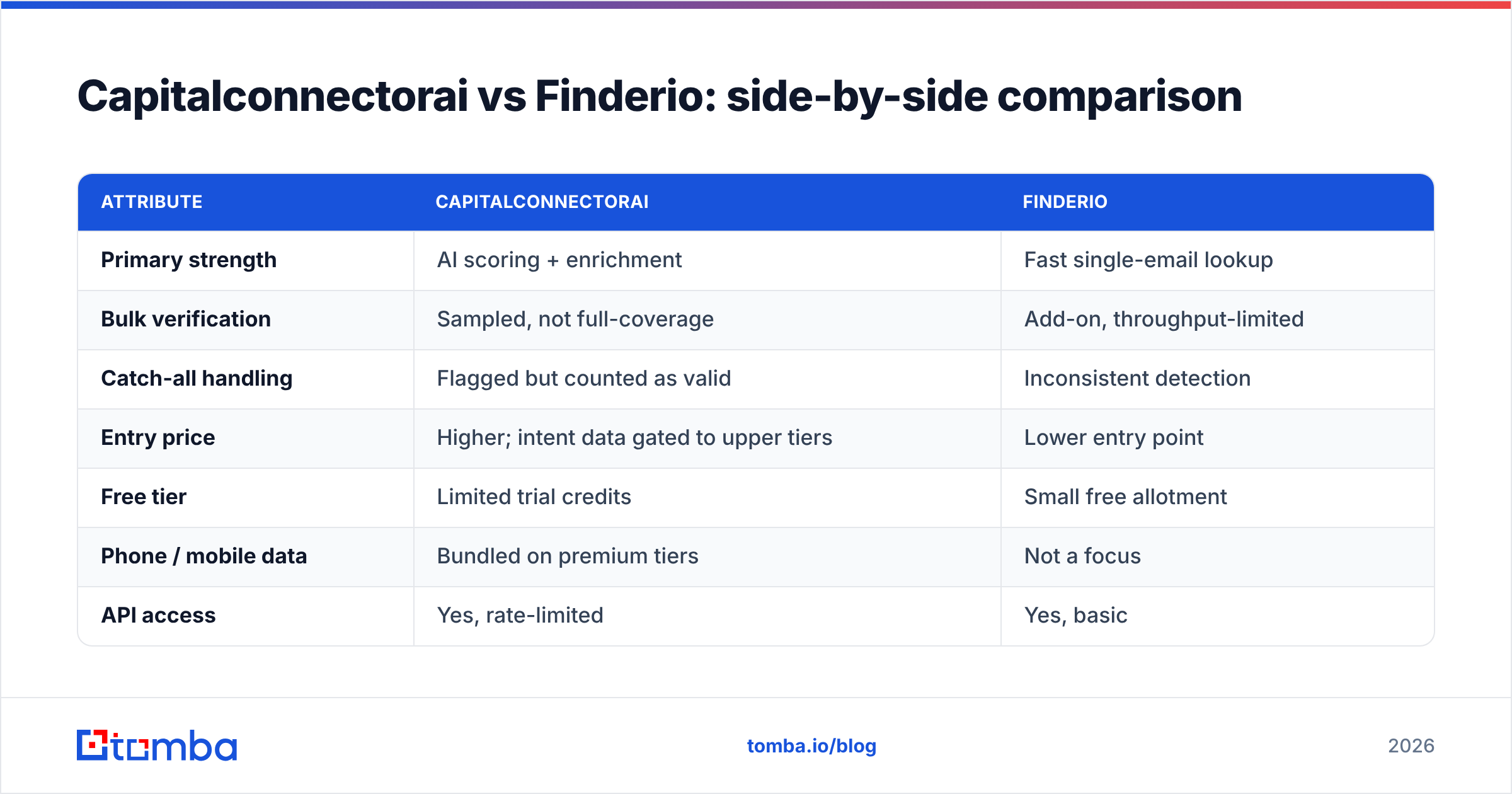
The table below summarizes the practical differences. Where a vendor doesn't publish a number transparently, that's noted — and it should factor into your decision as much as the features themselves.
| Attribute | Capitalconnectorai | Finderio |
|---|---|---|
| Primary strength | AI scoring + enrichment | Fast single-email lookup |
| Bulk verification | Sampled, not full-coverage | Add-on, throughput-limited |
| Catch-all handling | Flagged but counted as valid | Inconsistent detection |
| Entry price | Higher; intent data gated to upper tiers | Lower entry point |
| Free tier | Limited trial credits | Small free allotment |
| Phone / mobile data | Bundled on premium tiers | Not a focus |
| API access | Yes, rate-limited | Yes, basic |
| Transparency of data sources | Vague | Vague |
| Best for | All-in-one outbound starters | Budget single-seat users |

Read that table as a map of tradeoffs, not a scoreboard. Capitalconnectorai wins if you genuinely need intent scoring inside the same tool and have budget for the upper tiers where it lives. Finderio wins if you're a solo SDR or founder doing low-volume, high-touch outreach and you care mostly about cost-per-search.
Which one is better for cold outreach deliverability?#
Neither tool is a deliverability platform, and that matters more than people expect. Finding the email is step one; protecting your sender reputation is step two, and a finder that hands you a 6% bounce rate will torch your sender reputation faster than any subject line can save it.
Mailbox providers like Google and Microsoft treat repeated hard bounces as a spam signal. Google Postmaster Tools and the broader deliverability community are consistent on this: keep bounce rates under ~2-3% or your inbox placement craters. You can read the mechanics straight from the source in Google's bulk sender guidelines, which spell out the reputation cost of dirty lists.
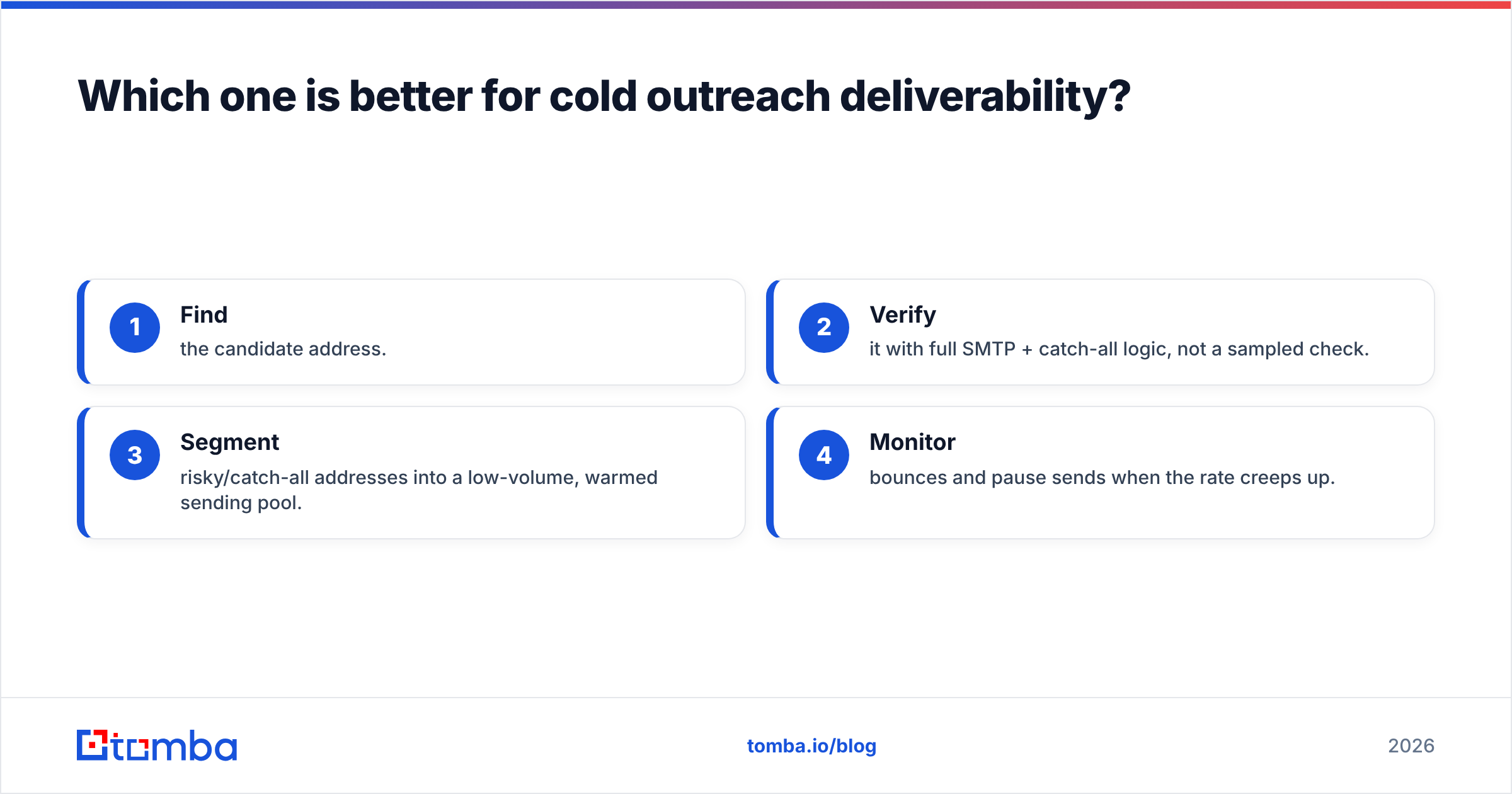
So the real comparison for outreach teams isn't "which tool finds more emails" — it's "which workflow lands more emails in the inbox without damaging my domain." That favors a verification-heavy process:
- Find the candidate address.
- Verify it with full SMTP + catch-all logic, not a sampled check.
- Segment risky/catch-all addresses into a low-volume, warmed sending pool.
- Monitor bounces and pause sends when the rate creeps up.
Capitalconnectorai's bundled approach can shortcut step one but leaves steps two through four to you. Finderio is honest about being a finder, which at least sets expectations. Either way, budget for a real verifier in your stack.
)
What about pricing and value?#
Pricing is where "cheaper" and "better value" diverge. Finderio has the lower sticker price, but if its bulk jobs return unverified rows, you pay again in bounces, re-sends, and reputation cleanup. Capitalconnectorai costs more up front and gates its best data (intent, mobile numbers) behind premium tiers, so the entry plan can feel thin.
The metric that actually matters is cost per verified, deliverable email, not cost per search or per credit. A tool that charges more but delivers a clean 98% list often beats a "cheaper" tool whose effective yield is 80% once you strip out bounces and catch-all noise.
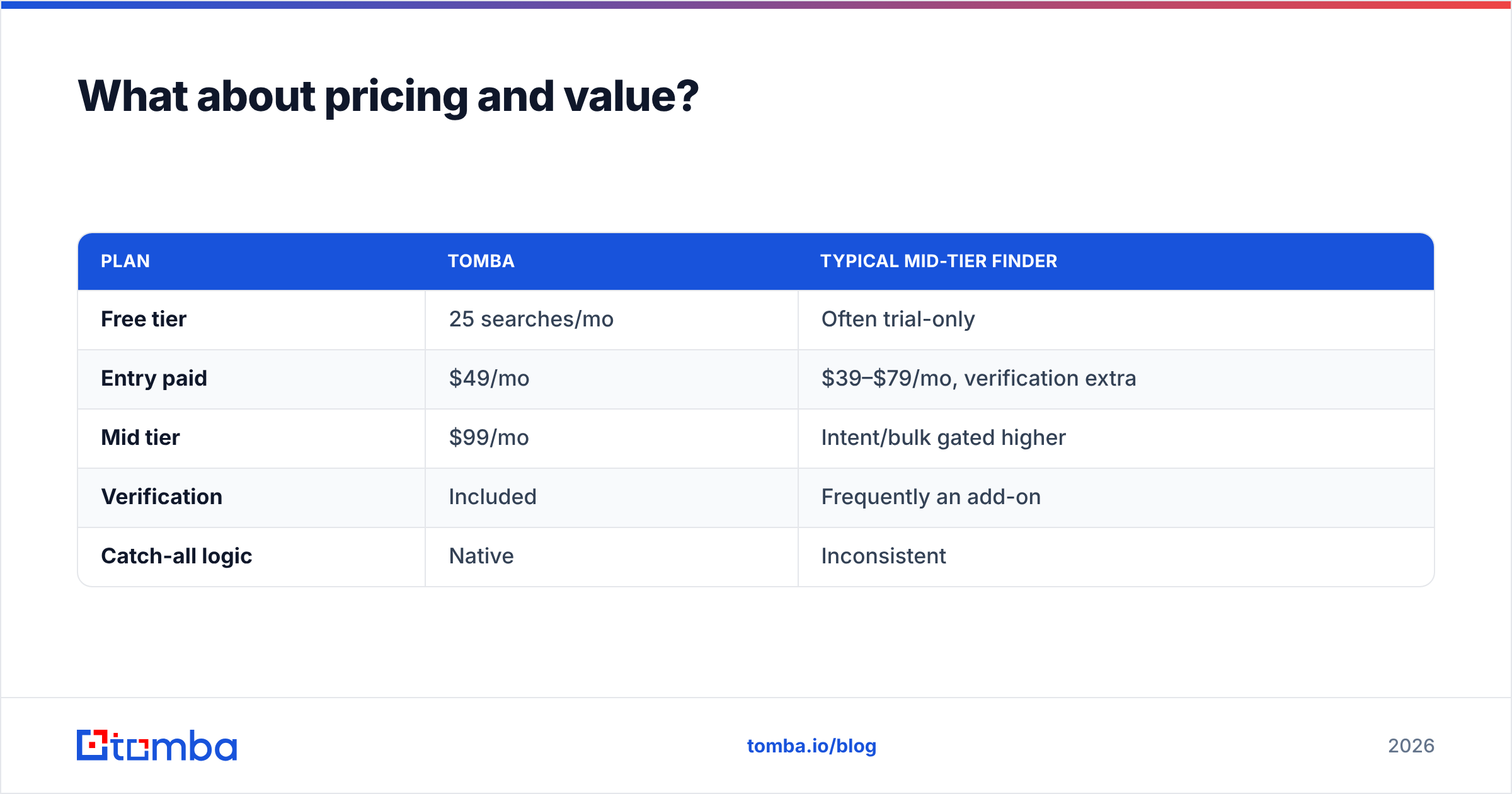
For reference, here's how a transparent, verification-first alternative structures pricing — useful as a yardstick when you read either vendor's quote. Tomba's pricing runs a Free tier (25 searches/mo), Starter at $49/mo, Growth at $99/mo, and Pro at $249/mo, with verification and catch-all handling built into the core product rather than sold as an upsell.
| Plan | Tomba | Typical mid-tier finder |
|---|---|---|
| Free tier | 25 searches/mo | Often trial-only |
| Entry paid | $49/mo | $39–$79/mo, verification extra |
| Mid tier | $99/mo | Intent/bulk gated higher |
| Verification | Included | Frequently an add-on |
| Catch-all logic | Native | Inconsistent |
The point isn't that one price is objectively right — it's that you should normalize every quote to verified output before comparing. A $39 plan that needs a separate verification subscription is not actually cheaper than a $49 plan that includes it.
Is there a better alternative to both?#
For most B2B teams, the honest answer is that the find-then-verify split is the wrong way to buy. You're better served by a platform where verification, domain search, catch-all detection, and enrichment are the same pipeline — because that's what keeps bounce rates low without you stitching tools together.
That's the niche Tomba occupies. It's an email finder first, but the email verification and catch-all logic that determine your real deliverability are native, not add-ons. A few practical differences worth weighing against Capitalconnectorai and Finderio:
- Verification is in the loop, not a separate purchase — every found address can be SMTP-checked in the same flow, so your exported list is already clean.
- Catch-all is handled explicitly — instead of silently counting catch-alls as "valid," they're flagged so you can route them carefully.
- Bulk is full-coverage — the bulk email finder verifies rows rather than sampling, which is exactly where Finderio's bulk pipeline gets soft.
- Transparent data sourcing — you can read where the data comes from on the data sources page, which is more than either competitor publishes clearly.
None of this means Tomba wins every scenario. If your single most important requirement is bundled intent scoring inside one dashboard, Capitalconnectorai's all-in-one pitch may genuinely fit better, and you should test it. If you're a solo user doing a handful of lookups a month and price is the only axis, Finderio's free allotment might be all you need. Match the tool to the job.
How should you decide?#
Run the test, don't read the reviews — including this one. Here's a decision checklist that cuts through vendor copy:
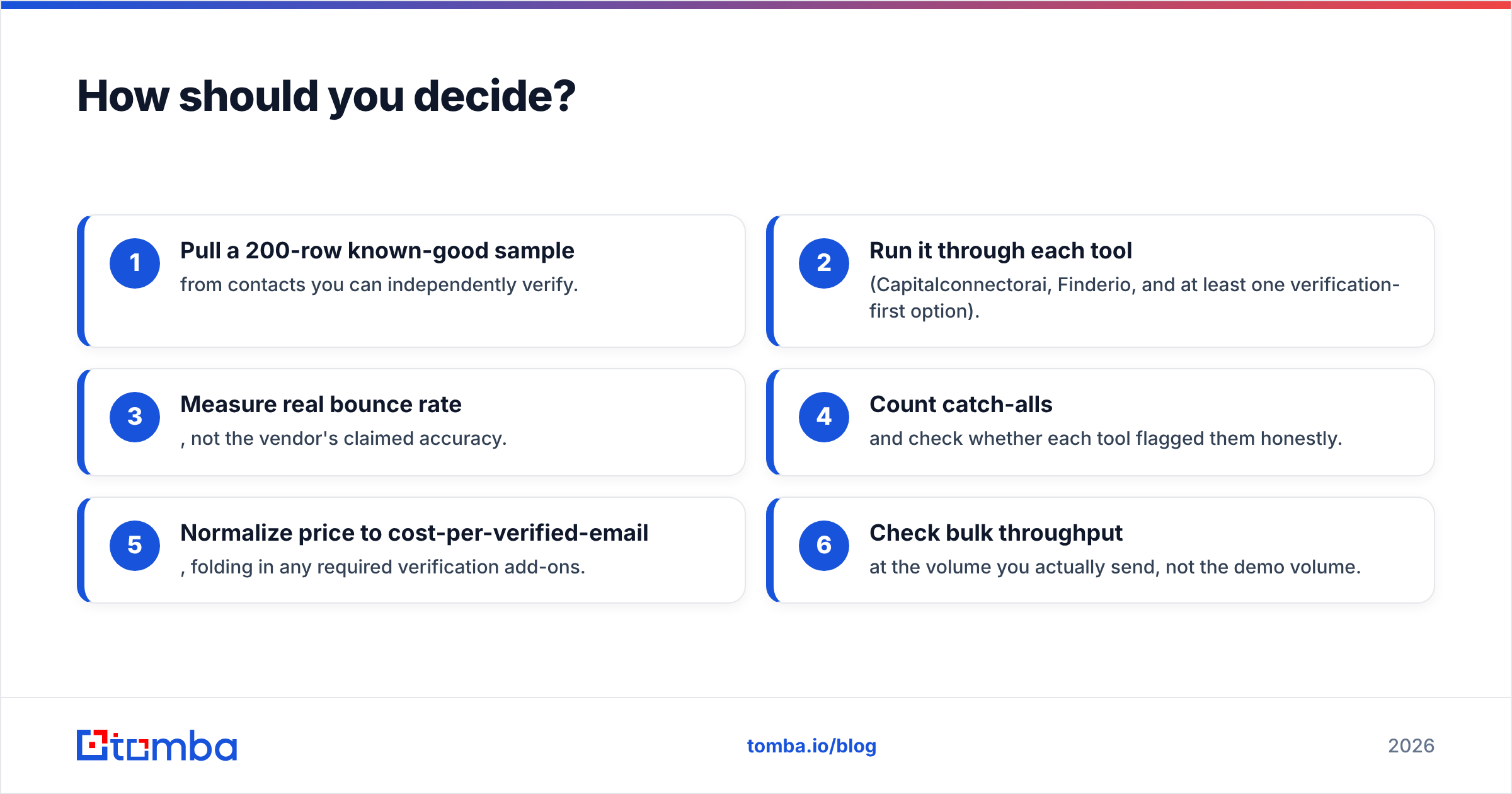
- Pull a 200-row known-good sample from contacts you can independently verify.
- Run it through each tool (Capitalconnectorai, Finderio, and at least one verification-first option).
- Measure real bounce rate, not the vendor's claimed accuracy.
- Count catch-alls and check whether each tool flagged them honestly.
- Normalize price to cost-per-verified-email, folding in any required verification add-ons.
- Check bulk throughput at the volume you actually send, not the demo volume.
Whichever tool wins your sample test is the right answer for your data, your market, and your sending infrastructure — which no generic comparison can predict for you.
The bottom line#
Capitalconnectorai is the broader, pricier, AI-bundled option; Finderio is the lean, cheaper, single-purpose finder. Both leave verification and deliverability partly on your shoulders, and both quote accuracy numbers you should independently test before trusting.
If your real goal is a clean list that protects your domain and lands in the inbox, start with a finder that treats verification as core. Spin up the free tier of the Tomba Email Finder, run your own 200-contact sample against it alongside Capitalconnectorai and Finderio, and let the bounce rate — not the marketing — decide. It takes thirty minutes and saves you a quarter of cleanup.
// get started
Find, verify and enrich your first contacts today
Start on the free plan with 25 searches a month, then scale when your team is ready.
Free plan · No credit card required · GDPR & CCPA
// about the author