CapitalConnectorAI vs Kipplo: 2026 Lead Data Showdown
CapitalConnectorAI vs Kipplo, compared head-to-head on data accuracy, pricing, workflow fit, and where a dedicated email finder beats both for outbound teams in 2026.
Choosing between CapitalConnectorAI and Kipplo usually comes down to one question your sales ops team is too polite to ask out loud: which one actually puts a working contact in front of a rep, and which one just looks busy on a dashboard? Both market themselves as AI-powered B2B data platforms. Both promise warmer leads, faster pipeline, and less manual research. The differences only show up when you push real volume through them.
This is a neutral breakdown — not a sales page. Where one tool is genuinely stronger, you'll see it. And where a focused, single-purpose tool beats both for the part that matters most (getting a verified email that lands in the inbox), you'll see that too.
TL;DR — CapitalConnectorAI vs Kipplo#
- CapitalConnectorAI leans toward investor and capital-network matching, surfacing relationship paths and intent signals. Strong for fundraising-adjacent and account-based plays; thinner on raw contact volume.
- Kipplo is a broader prospecting and enrichment tool with a workflow-builder feel — good for mid-market outbound teams that want sequencing plus data in one place.
- Neither is a deliverability tool. Both hand you contacts; neither guarantees the email is real, current, or safe to send to.
- Accuracy is the deciding factor. A bigger database means nothing if 30% of the emails bounce and torch your sender reputation.
- For the email layer specifically, a dedicated email finder with built-in verification (like Tomba) outperforms the bundled data inside generalist platforms — and costs less to run at volume.
What is CapitalConnectorAI?#
CapitalConnectorAI positions itself around connection intelligence: mapping who knows whom, scoring warm-intro paths, and layering intent data on top of a contact graph. Think of it less as a phone book and more as a relationship GPS — it's trying to tell you the shortest route to a decision-maker, not just the address.
That framing makes it appealing for fundraising, partnerships, and high-ACV account-based selling, where a warm path is worth more than a thousand cold contacts. The tradeoff is coverage. Relationship-graph tools are only as good as the network they can see, so coverage gets thin outside well-connected hubs (venture, tech, finance). If your ICP is a regional manufacturer or a mid-market ops leader with a quiet LinkedIn, the graph often goes dark.
What is Kipplo?#
Kipplo is the more conventional of the two: a prospecting database plus enrichment plus light sequencing, wrapped in a workflow builder. It wants to be the single tab a rep lives in — build a list, enrich it, push it into a cadence, track replies. For teams tired of stitching five tools together, that consolidation is the pitch.
The risk with all-in-one platforms is the "jack of all trades" problem. The database is fine, the sequencer is fine, the enrichment is fine — but "fine" across the board often means no single layer is best-in-class. Most notably, the email data bundled into broad platforms tends to be refreshed less aggressively than what a specialist provider maintains, which shows up as higher bounce rates the moment you scale past a few hundred sends a week.
)
CapitalConnectorAI vs Kipplo: the head-to-head table#
Here's the honest side-by-side. Treat database "size" numbers from any vendor with skepticism — what matches your specific ICP matters far more than the global total.
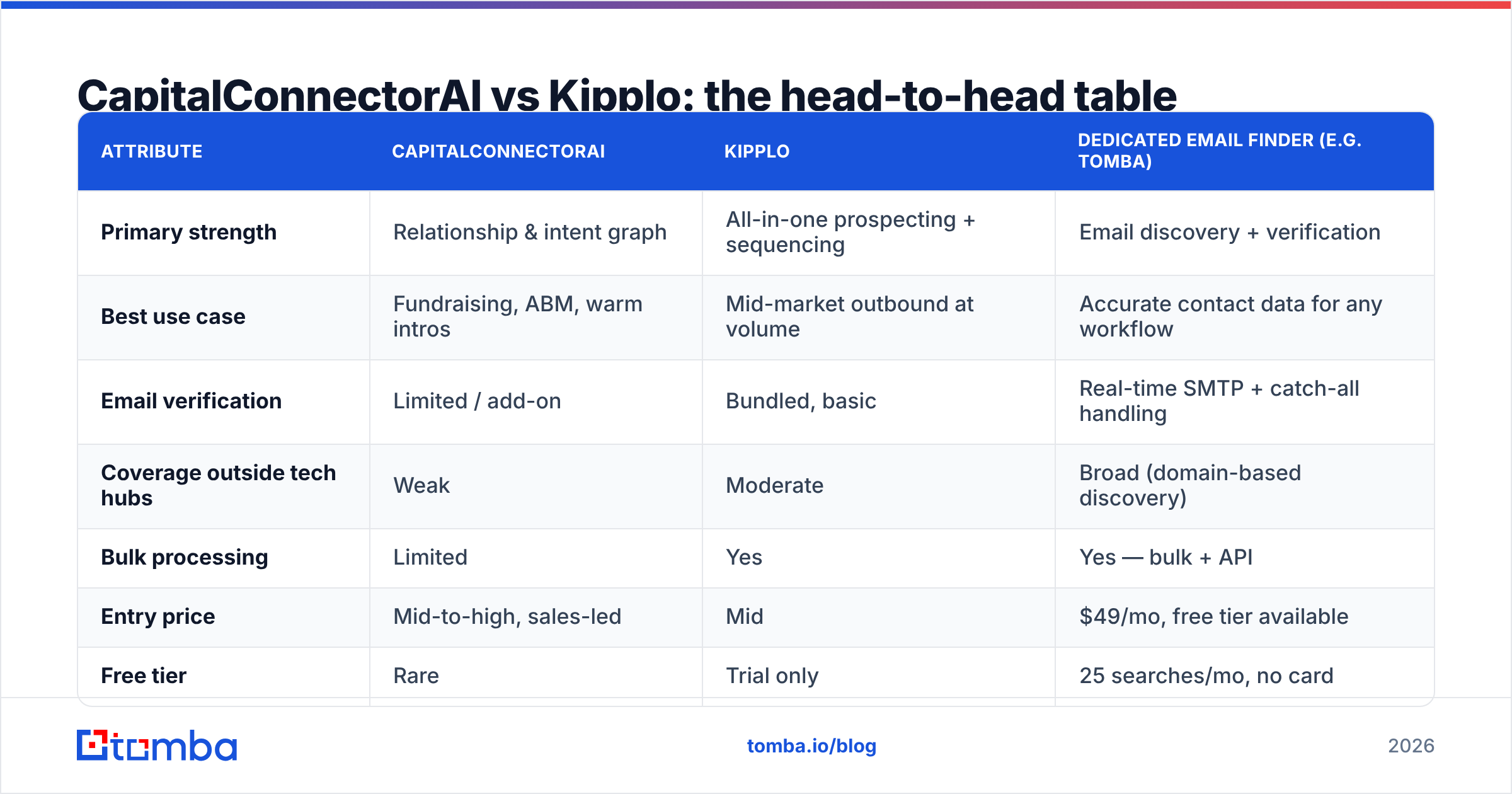
| Attribute | CapitalConnectorAI | Kipplo | Dedicated email finder (e.g. Tomba) |
|---|---|---|---|
| Primary strength | Relationship & intent graph | All-in-one prospecting + sequencing | Email discovery + verification |
| Best use case | Fundraising, ABM, warm intros | Mid-market outbound at volume | Accurate contact data for any workflow |
| Email verification | Limited / add-on | Bundled, basic | Real-time SMTP + catch-all handling |
| Coverage outside tech hubs | Weak | Moderate | Broad (domain-based discovery) |
| Bulk processing | Limited | Yes | Yes — bulk + API |
| Entry price | Mid-to-high, sales-led | Mid | $49/mo, free tier available |
| Free tier | Rare | Trial only | 25 searches/mo, no card |
| API access | Partial | Yes | Full REST API |
The pattern is consistent: the two platforms compete on breadth of workflow, while the email layer — the thing that decides whether your message is even seen — is treated as a secondary feature in both.
Is CapitalConnectorAI better than Kipplo?#
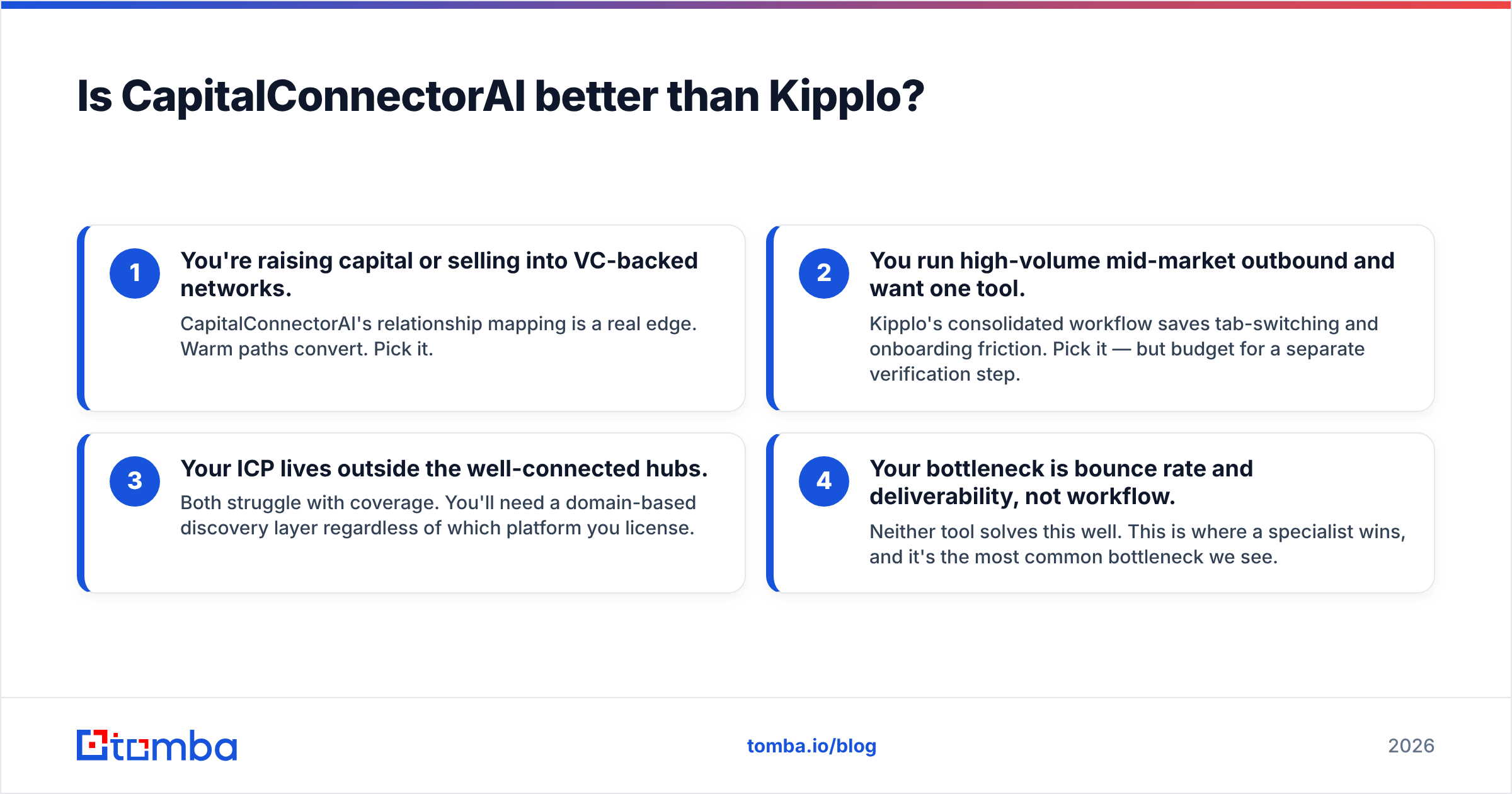
It depends entirely on what you're optimizing for. Here's the decision in four concrete scenarios:
- You're raising capital or selling into VC-backed networks. CapitalConnectorAI's relationship mapping is a real edge. Warm paths convert. Pick it.
- You run high-volume mid-market outbound and want one tool. Kipplo's consolidated workflow saves tab-switching and onboarding friction. Pick it — but budget for a separate verification step.
- Your ICP lives outside the well-connected hubs. Both struggle with coverage. You'll need a domain-based discovery layer regardless of which platform you license.
- Your bottleneck is bounce rate and deliverability, not workflow. Neither tool solves this well. This is where a specialist wins, and it's the most common bottleneck we see.
Notice that two of the four scenarios end with "you'll need something else for the data." That's not an accident — it's the structural weakness of generalist platforms.
What both tools get wrong about email data#
Both CapitalConnectorAI and Kipplo treat the email address as a static field — find it once, store it, move on. In reality, B2B email data decays at roughly 22–30% per year as people change jobs, companies get acquired, and catch-all domains mask whether an address even exists. A contact you "found" in January may be a hard bounce by June.
A bounce isn't just a missed message. Mailbox providers read your bounce rate as a quality signal. Cross 2–3% and your sender reputation starts to slide, which means even your good emails land in spam. So the cheap data bundled into an all-in-one platform isn't actually cheap — you pay for it later in deliverability.
This is why serious outbound teams decouple the layers: use a platform for workflow and intent, but route every address through a dedicated email verifier before it ever enters a sequence. The verification step is non-negotiable at volume.
)
How a dedicated email finder fits alongside either tool#
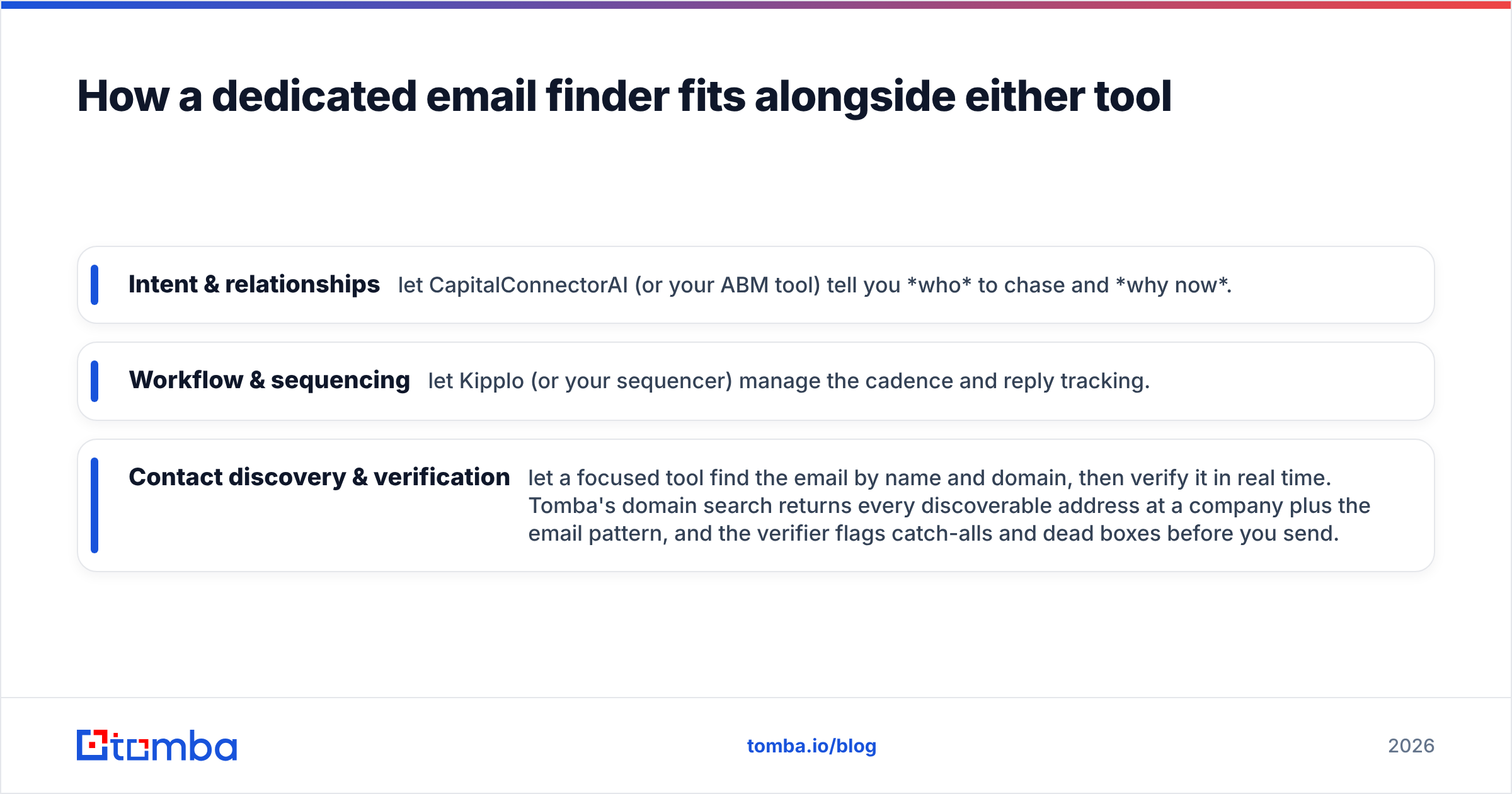
You don't have to choose CapitalConnectorAI or Kipplo or a contact-data specialist. The smartest stacks layer them. Here's the clean division of labor:
- Intent & relationships — let CapitalConnectorAI (or your ABM tool) tell you who to chase and why now.
- Workflow & sequencing — let Kipplo (or your sequencer) manage the cadence and reply tracking.
- Contact discovery & verification — let a focused tool find the email by name and domain, then verify it in real time. Tomba's domain search returns every discoverable address at a company plus the email pattern, and the verifier flags catch-alls and dead boxes before you send.
In practice, the API matters here. If your data layer exposes a clean email finder API, you can enrich a Kipplo list or a CapitalConnectorAI account list on the fly without exporting CSVs and re-importing — the verification happens inside your existing workflow.
How accurate is the contact data, really?#
Vendor-published accuracy numbers are marketing until you test them on your list. The only number that counts is your bounce rate on a real send. Independent reviews on G2 and Capterra are a better starting point than any vendor's own claims — sort by recent reviews and read the 3-star ones, where the real limitations surface.
When you run your own bake-off, do it properly:
- Pull the same 200 contacts through each tool.
- Send to a seed list and measure actual bounces, not the tool's predicted confidence score.
- Check catch-all handling specifically — this is where most tools quietly fail, returning "valid" for addresses they can't actually confirm. A proper catch-all verifier will tell you the truth instead of guessing.
- Compare coverage on your ICP, not the global database size.
Most teams that run this test discover their bottleneck was never the workflow tool — it was the 25% of addresses that should have been filtered out before the first send.
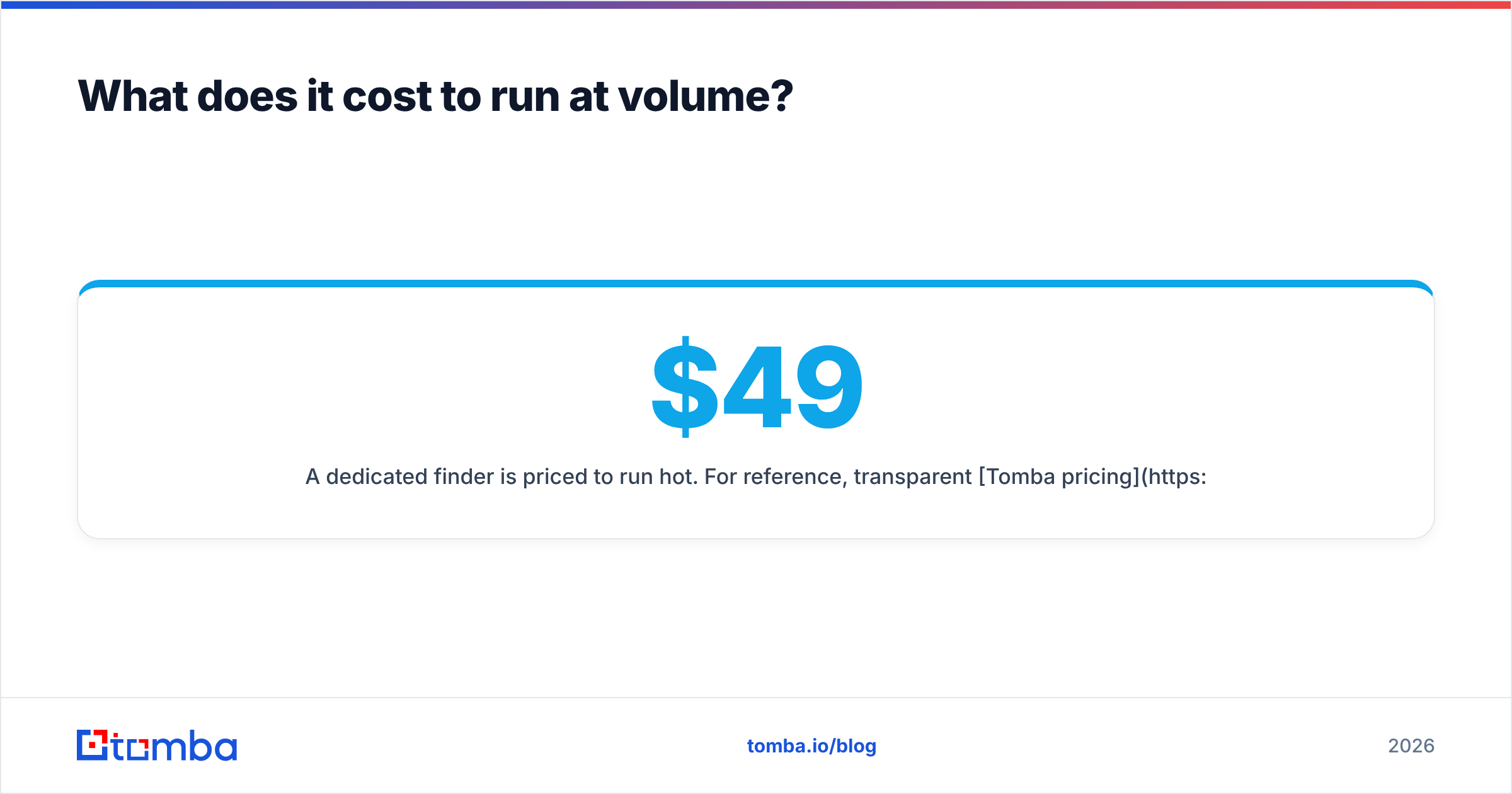
What does it cost to run at volume?#
Sticker price and running cost are different animals. CapitalConnectorAI and Kipplo both tend toward mid-to-high, often sales-led pricing where you negotiate seats and credits. The hidden cost is the bounce tax: every bad address you send to is wasted sequence capacity plus reputation damage.
A dedicated finder is priced to run hot. For reference, transparent Tomba pricing starts with a Free tier (25 searches/mo), then Starter at $49/mo, Growth at $99/mo, and Pro at $249/mo — with a full API on every paid plan and bulk processing for list work. The point isn't that it's cheaper in isolation; it's that fixing the data layer cheaply protects the expensive platform you're already paying for.
Which should you choose in 2026?#
Conclusion first: match the tool to your actual bottleneck, and don't expect any single platform to be best at everything.
- Choose CapitalConnectorAI if warm-path and intent intelligence is your edge and your ICP sits in well-networked markets.
- Choose Kipplo if you want one consolidated outbound workspace and you're willing to bolt on real verification.
- In both cases, treat contact discovery and verification as a separate, specialist layer — because that's the part that decides whether your carefully chosen prospect ever reads your message.
The teams that win outbound in 2026 aren't the ones with the biggest database. They're the ones whose emails actually arrive. Workflow tools get you organized; verified data gets you delivered.
Get the data layer right first#
Before you sign a CapitalConnectorAI or Kipplo contract, fix the part that quietly breaks every campaign: the email itself. Start free with the Tomba Email Finder — find professional addresses by name, company, or domain, verify them in real time, and feed clean, confirmed contacts into whichever platform you pick. Run 25 searches on your own ICP this week, send to a seed list, and compare the bounce rate against your current stack. The data will make the decision for you.
// get started
Find, verify and enrich your first contacts today
Start on the free plan with 25 searches a month, then scale when your team is ready.
Free plan · No credit card required · GDPR & CCPA
// about the author