CapitalConnectorAI vs LeadGenius: 2026 Lead Gen Showdown
CapitalConnectorAI vs LeadGenius compared on data quality, pricing model, automation, and fit. See which lead engine matches your 2026 go-to-market, plus a leaner alternative.
Choosing a lead engine in 2026 is less about who has "more data" and more about which model fits how your team actually sells. CapitalConnectorAI and LeadGenius sit at opposite ends of that spectrum: one leans on AI-driven matching for capital and growth introductions, the other on managed, human-verified B2B data delivered as a service. This guide breaks down where each wins, where each frustrates, and what to do if neither shape fits your budget.
TL;DR#
- CapitalConnectorAI is an AI-first platform built around automated matching and connection workflows. It suits founders and small teams who want speed and a low-touch setup over deep customization.
- LeadGenius is a managed data service — human researchers plus AI build custom lead lists and enrichment to spec. It suits enterprise GTM teams with budget and complex targeting.
- Pricing models differ sharply: CapitalConnectorAI trends toward self-serve subscriptions; LeadGenius is custom-quoted and enterprise-priced, so expect a sales call before a number.
- Neither is a cheap, on-demand email finder. If you mostly need verified contact data per domain, a tool like Tomba Email Finder starts at $49/mo and skips the managed-service overhead.
- Verdict: pick CapitalConnectorAI for automated matching at speed, LeadGenius for done-for-you enterprise lists, and a self-serve email finder when you just need accurate contacts without a contract.
What is CapitalConnectorAI?#
CapitalConnectorAI is an AI-driven platform focused on connecting people and companies — typically founders, fundraisers, and growth teams — with relevant contacts through automated matching. Instead of handing you a raw spreadsheet, it leans on algorithmic scoring to surface who you should reach and routes introductions or outreach with minimal manual setup.
The appeal is speed and low operational drag. You configure a target profile, and the system does the heavy lifting of matching and prioritization. For a lean team without a dedicated research analyst, that automation removes a real bottleneck. The trade-off, as with most AI-first matching tools, is transparency: you get a curated output, but you have less granular control over exactly how a list was built or how each record was verified.
If your motion is high-velocity and you value "good enough, right now" over bespoke precision, this model is attractive. Treat any accuracy or coverage claims as something to validate against your own niche before committing budget — algorithmic matching shines in dense markets and gets thin in narrow verticals.

What is LeadGenius?#
LeadGenius is a managed B2B data and lead generation service. Rather than a pure software tool you operate yourself, it combines human researchers with machine learning to build custom contact and account lists, enrich existing records, and capture hard-to-find data points to your exact specification. You can read more on their approach at leadgenius.com.
This human-in-the-loop model is its biggest differentiator. Need niche firmographic signals, specific job-function targeting, or data points that scrapers routinely miss? A managed team can chase those down in ways automated tools cannot. That's why LeadGenius is frequently positioned for enterprise revenue and revenue operations teams running complex, account-based plays.
The catch is the same as any managed service: cost and turnaround. You're buying analyst hours, so pricing is custom and lands in enterprise territory, and a list takes time to produce versus an instant API lookup. For large deals with high contract values, that economics works. For a startup doing rapid, low-cost prospecting, it usually doesn't.
How do CapitalConnectorAI and LeadGenius compare?#
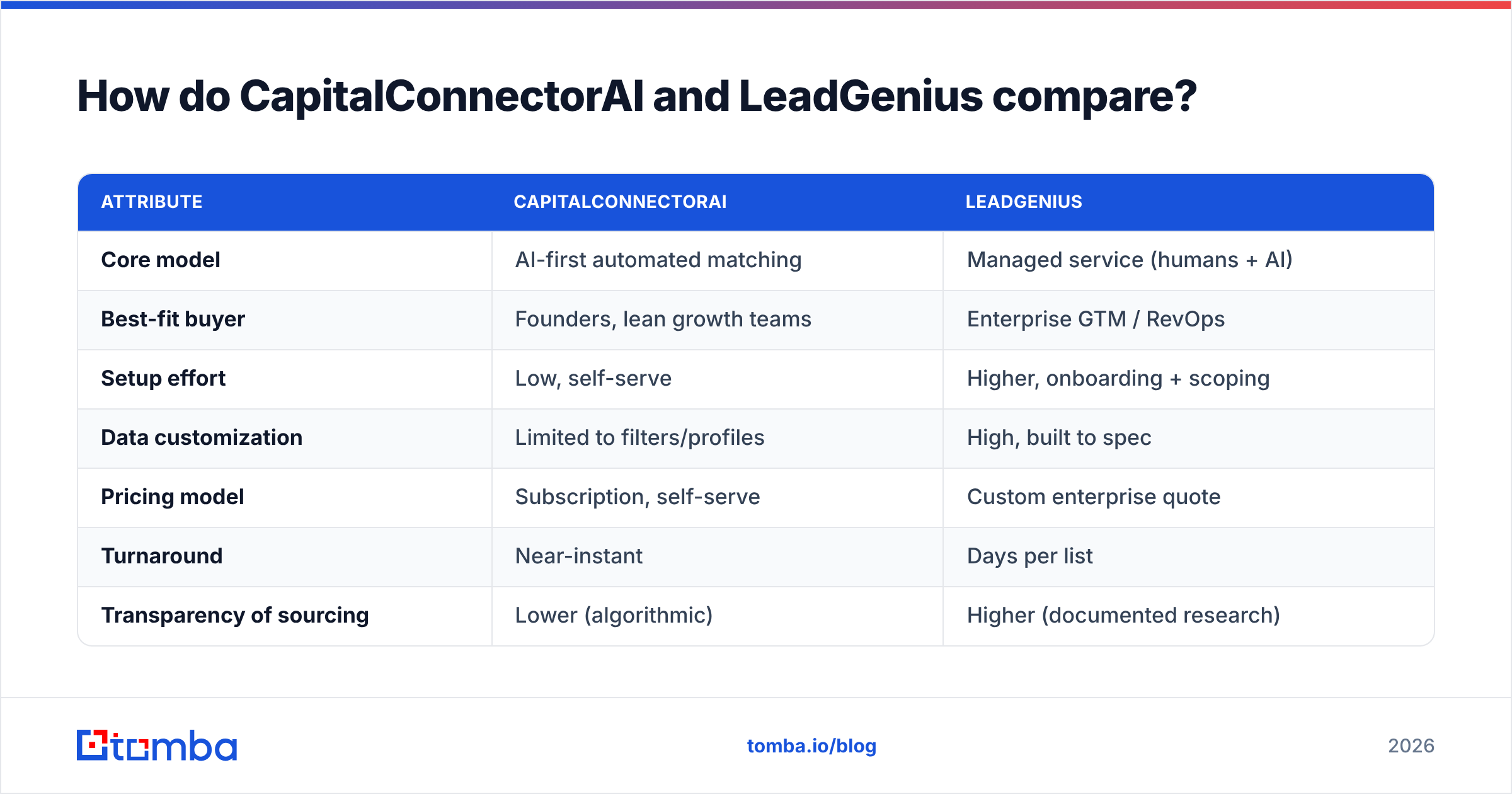
Here's the core comparison across the attributes that actually drive a buying decision.
| Attribute | CapitalConnectorAI | LeadGenius |
|---|---|---|
| Core model | AI-first automated matching | Managed service (humans + AI) |
| Best-fit buyer | Founders, lean growth teams | Enterprise GTM / RevOps |
| Setup effort | Low, self-serve | Higher, onboarding + scoping |
| Data customization | Limited to filters/profiles | High, built to spec |
| Pricing model | Subscription, self-serve | Custom enterprise quote |
| Turnaround | Near-instant | Days per list |
| Transparency of sourcing | Lower (algorithmic) | Higher (documented research) |
| Typical commitment | Monthly plan | Annual / contract |
The pattern is clear: CapitalConnectorAI optimizes for speed and low friction, LeadGenius for precision and depth. Your choice hinges on whether your constraint is time and budget or data complexity and scale.

Which one has better data accuracy?#
Accuracy depends less on marketing claims and more on how data is sourced and verified. LeadGenius generally holds an edge on hard-to-find and niche data points precisely because humans verify the records — a researcher can confirm a title or a direct line that an automated crawl gets wrong. For complex, low-volume, high-value targeting, that verification is worth paying for.
CapitalConnectorAI's accuracy is a function of its matching algorithms and underlying data feeds. In dense, well-documented markets it can be strong; in narrow verticals or for senior, hard-to-reach roles, algorithmic matching tends to degrade. The honest move with any vendor is to run a paid pilot against a slice of your real target list and measure bounce rate and title accuracy yourself.
One universal truth holds regardless of which platform you pick: verify before you send. Even excellent source data decays — people change jobs, domains migrate, mailboxes get deactivated. Running any list through an email verifier before a campaign protects your sender reputation and keeps your bounce rate in safe territory. No data provider, managed or automated, removes that step.

What about pricing?#
Pricing is where these two diverge most, and where a third option often makes more sense.
- CapitalConnectorAI follows a self-serve subscription logic — you can typically sign up, pick a plan, and start without a sales process. That predictability is friendly to startups and individual operators.
- LeadGenius is custom-quoted. Because you're buying managed research and bespoke lists, expect an enterprise budget and a scoping call before you see a number. It rewards scale; it punishes small, ad-hoc needs.
The hidden cost in both is misfit. Pay for a managed service when you only need a few hundred verified contacts a month, and you've overspent. Lean on automated matching for a niche where it's thin, and you'll burn deliverability cleaning up bounces. Map your actual monthly contact volume and targeting complexity before you compare price tags.
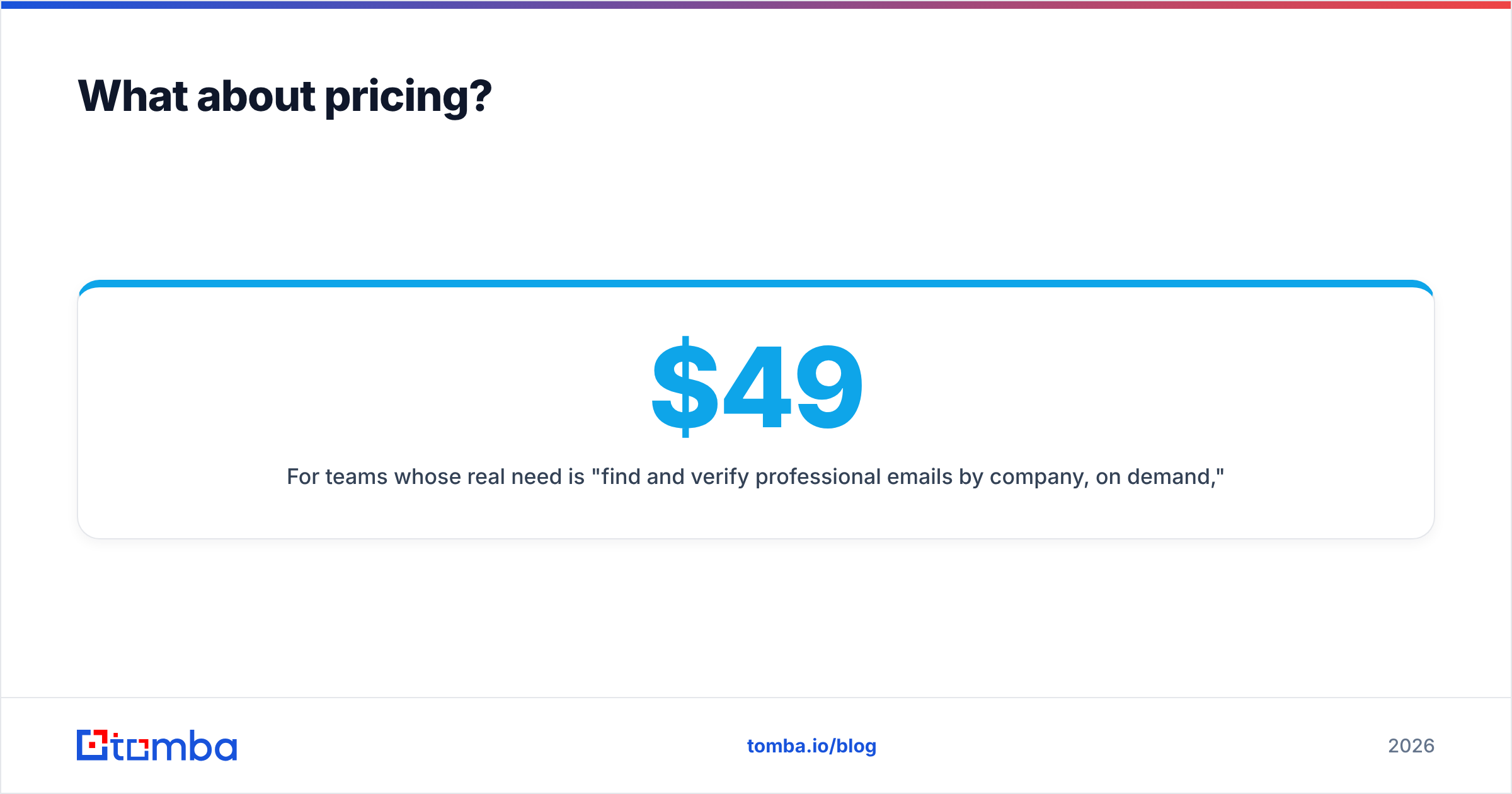
For teams whose real need is "find and verify professional emails by company, on demand," transparent self-serve pricing is usually the cheapest path. Tomba, for example, publishes flat tiers — Free (25 searches/mo), Starter $49/mo, Growth $99/mo, and Pro $249/mo — with no quote required. You can see full Tomba pricing without talking to sales.
When should you pick a self-serve email finder instead?#
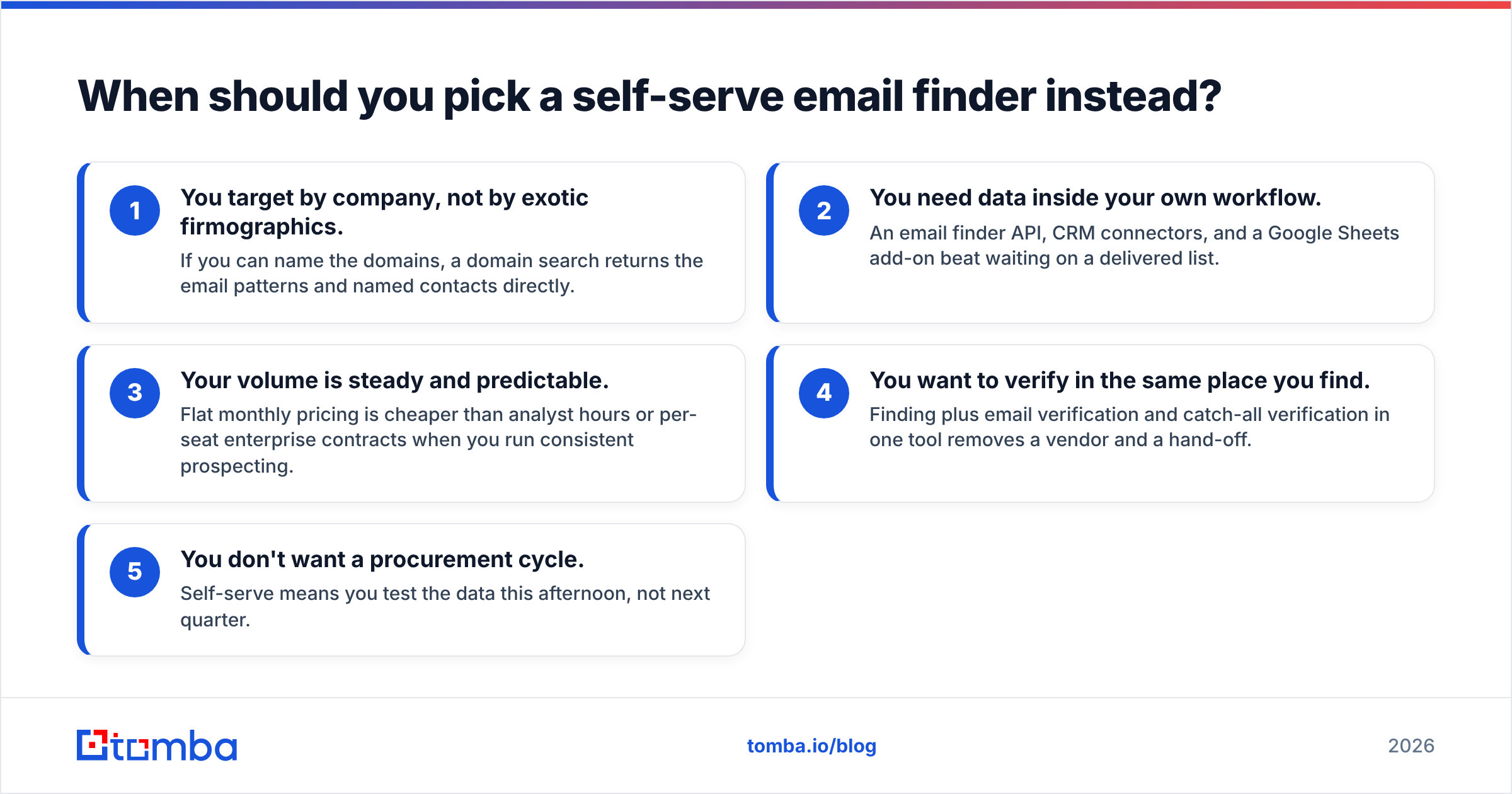
Plenty of teams reach for a heavyweight platform when they actually have a contact-data problem, not a managed-service problem. The signals that you should skip both options above:
- You target by company, not by exotic firmographics. If you can name the domains, a domain search returns the email patterns and named contacts directly.
- You need data inside your own workflow. An email finder API, CRM connectors, and a Google Sheets add-on beat waiting on a delivered list.
- Your volume is steady and predictable. Flat monthly pricing is cheaper than analyst hours or per-seat enterprise contracts when you run consistent prospecting.
- You want to verify in the same place you find. Finding plus email verification and catch-all verification in one tool removes a vendor and a hand-off.
- You don't want a procurement cycle. Self-serve means you test the data this afternoon, not next quarter.
This is the lane where a focused email-finding tool quietly outperforms broader platforms: it does one job — accurate contact discovery and verification — without the overhead of a service contract or the opacity of a black-box matcher.

How do you choose between CapitalConnectorAI, LeadGenius, and a focused finder?#
Work backward from your constraint, not from the feature list:
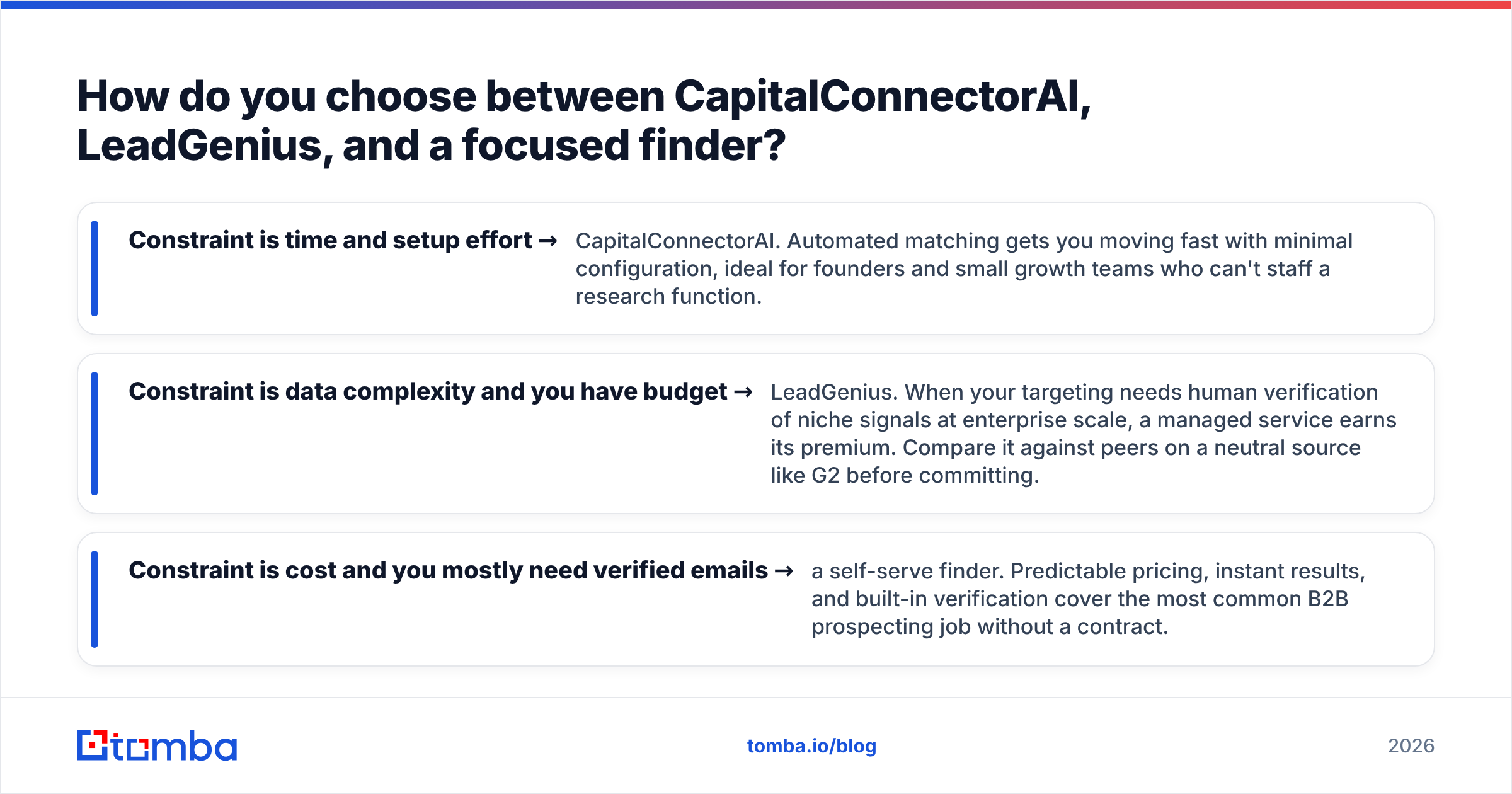
- Constraint is time and setup effort → CapitalConnectorAI. Automated matching gets you moving fast with minimal configuration, ideal for founders and small growth teams who can't staff a research function.
- Constraint is data complexity and you have budget → LeadGenius. When your targeting needs human verification of niche signals at enterprise scale, a managed service earns its premium. Compare it against peers on a neutral source like G2 before committing.
- Constraint is cost and you mostly need verified emails → a self-serve finder. Predictable pricing, instant results, and built-in verification cover the most common B2B prospecting job without a contract.
A practical hybrid many teams land on: use a managed service or matching tool for the rare, complex account research, and a self-serve finder for the daily, high-volume contact discovery that makes up most of the pipeline. You stop overpaying premium rates for routine lookups while keeping the heavy machinery for when it's genuinely needed.
It also pays to keep your stack honest about email deliverability. Whichever provider supplies the contacts, your results depend on clean lists, warmed domains, and verified addresses. The most expensive data in the world still bounces if the mailbox closed last month.
Frequently asked questions#
Is CapitalConnectorAI better than LeadGenius? Neither is universally better. CapitalConnectorAI wins on speed, self-serve access, and low setup; LeadGenius wins on customization, niche data accuracy, and enterprise scale. The right answer depends on whether your bottleneck is time and budget or data complexity.
Are CapitalConnectorAI and LeadGenius email finders? Not in the narrow sense. They are broader lead generation and data platforms. If your core need is finding and verifying professional emails by domain or name, a dedicated email finder is typically a better and cheaper fit.
How much does LeadGenius cost? LeadGenius uses custom enterprise pricing rather than public self-serve tiers, so you'll need a scoping call. Budget for an enterprise-level spend, which is most justifiable at scale and high deal values.
Can I use a cheaper tool and still get accurate data? Yes — provided you verify. A self-serve finder with built-in verification, run against a real sample of your target list first, often matches the practical accuracy you need for outbound at a fraction of managed-service cost.
The bottom line#
CapitalConnectorAI and LeadGenius solve real but different problems: fast automated matching versus deep managed research. Most teams comparing them, though, are really trying to fill a pipeline with accurate, reachable contacts — and for that job, a focused, self-serve tool is leaner and cheaper than either.
If that's you, start with the Tomba Email Finder. Find professional emails by domain, name, or company, verify them in the same workflow, and scale from a free 25-search tier to flat monthly plans — no sales call, no contract, no black box. Test it against your real target list today and let the bounce rate decide.
// get started
Find, verify and enrich your first contacts today
Start on the free plan with 25 searches a month, then scale when your team is ready.
Free plan · No credit card required · GDPR & CCPA
// about the author